Congenital anomalies of the coronary arteries are present in 0.2–1.4% of the population.Reference Davis, Cecchin, Jones and Portman1 Although many variations in coronary arterial anatomy are recognised in association with the structural forms of congenital cardiac disease, anomalies of the coronary arteries in otherwise structurally normal hearts are recognised as an important cause of sudden death in active young individuals. The terms anomalous or abnormal are generally used to define any variant form of coronary arterial anatomy, and these variant forms are observed in less than 1% of the general population. The clinical implications of the many variants range from none, in other words an incidental finding without associated risk, to substantial risk of cardiac-related morbidity or premature death. It is therefore important that we have a system for the naming and classification of these anomalies, to stratify them according to associated risk and to develop rational approaches to their evaluation and management.
Historical systems of classification
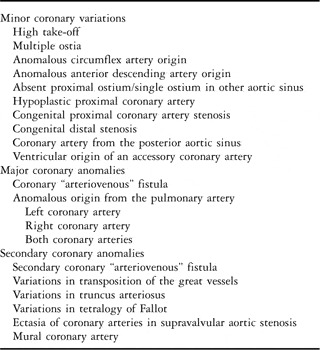
In 1969, OgdenReference Ogden2 proposed a classification of congenital anomalies of the coronary arteries. He placed known coronary anomalies into three categories, primarily based upon anatomical considerations, that is, “how different does it appear from normal?” Thus, his classification included minor coronary variations, major anomalies, and secondary coronary anomalies (Table 1).
Classification of congenital anomalies of the coronary arteries according to Ogden.Reference Ogden2

Although the system of classification of congenital anomalies of the coronary arteries according to Ogden came many years after the recognition of the clinical course and consequences associated with some of the coronary anomalies that he listed,Reference Brooks3–Reference Smith5 his “major–minor–secondary” system does not emphasise the clinical importance of certain anomalies, and is therefore of somewhat limited utility.
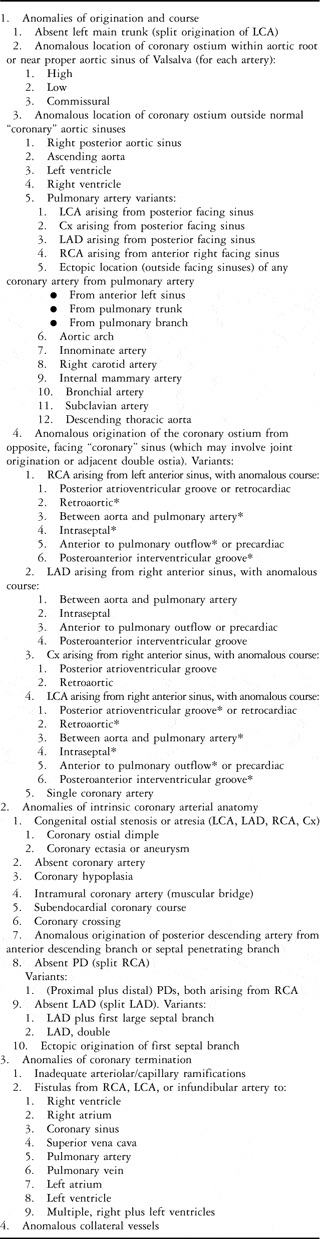
In 1989, Dr Paolo AngeliniReference Angelini6 of the Texas Heart Institute proposed a system of nomenclature and definitions of both normal variations in coronary arteries and anomalous coronary arteries. He took into consideration the available data regarding the embryogenesis of the coronary arteries and proposed a definition of normality that referred to essential anatomical features. The concepts of normal variant versus anomaly were introduced, based on a statistical definition of the normal range: 99% of the presentations observed in a normal, unselected population. Coronary arterial anomalies were defined as those patterns found in less than 1% of the cases. The wide spectrum of coronary arterial abnormalities was then organised according to a comprehensive classification scheme. For clinical purposes the conceptual difference between anatomical and pathophysiological anomalies was stressed. Angelini recognised a gap in knowledge with respect to basic studies regarding the embryology and pathogenesis of coronary arterial anomalies. In 1999, Angelini updated his comprehensive schema of classification (Table 2).Reference Angelini and Fairchild7
Classification of anomalies of the coronary arteries according to Angelini

Please note that Table 2 is replicated from documentation from Angelini et al. The following abbreviations used by Angelini et al: Cx = circumflex coronary artery, LAD = left anterior descending coronary artery = anterior interventricular coronary artery, LCA = left coronary artery, RCA = right coronary artery, and PD = posterior descending coronary artery
*If a single, common ostium is present, the pattern is considered to represent “single” coronary artery
The International Paediatric and Congenital Cardiac Code
Although the system of classification of Angelini is very detailed and comprehensive, it is not as “user friendly” as the hierarchical system of nomenclature and classification that was proposed by Dodge-Khatami et alReference Dodge-Khatami, Mavroudis and Backer8 in 2000, as part of the International Congenital Heart Surgery Nomenclature and Database Project of the European Association for Cardio-Thoracic Surgery and the Society of Thoracic Surgeons. Their system has been adopted by both the Society of Thoracic Surgeons and the European Association of Cardio-Thoracic Surgeons for classification of both diagnoses and procedures in their respective congenital cardiac surgery databases, and is also the basis for the diagnostic and procedural nomenclature in the version of the International Paediatric and Congenital Cardiac Code derived from the nomenclature of the International Congenital Heart Surgery Nomenclature and Database Project of the European Association for Cardio-Thoracic Surgery and the Society of Thoracic Surgeons.9
In the Diagnostic Long List of this version of the International Paediatric and Congenital Cardiac Code, the term Coronary Anomaly serves to define the first level of the hierarchy. The second hierarchical level is formed by the following diagnoses:
• Coronary anomaly
• Coronary anomaly, AAOC (Anomalous aortic origin of coronary)
• Coronary anomaly, APOC (Anomalous pulmonary origin of coronary)
• Coronary anomaly, CAF (Coronary artery fistula)
• Coronary anomaly, Congenital atresia of the left main (CALM) (ostial atresia of left main)
• Coronary anomaly, Coronary aneurysm (CAn)
• Coronary anomaly, Coronary bridging (intramyocardial coronary artery course)
• Coronary anomaly, Coronary compression
• Coronary anomaly, Coronary stenosis.
For each of these categories, a series of additional hierarchical terms provides additional granularity and specificity. For example, the third level of the hierarchical classification of “anomalous pulmonary origin of coronary” includes the following diagnostic terms:
• Coronary anomaly, APOC (Anomalous pulmonary origin of coronary), ACxPA
• Coronary anomaly, APOC (Anomalous pulmonary origin of coronary), ALCAPA (Anomalous left main coronary artery from PA)
• Coronary anomaly, APOC (Anomalous pulmonary origin of coronary), anomalous LAD from PA
• Coronary anomaly, APOC (Anomalous pulmonary origin of coronary), ARCAPA
• Coronary anomaly, APOC (Anomalous pulmonary origin of coronary), Both ALCAPA and ARCAPA.
In the third level of the hierarchical classification shown above, the abbreviation ARCAPA is for anomalous right coronary artery from the pulmonary artery, and the abbreviation PA is for pulmonary artery.
The third level of the hierarchical classification of “anomalous aortic origin of coronary” includes the following diagnostic terms:
• Coronary anomaly, AAOC (Anomalous aortic origin of coronary), Cx from RASV (“right coronary” aortic sinus of Valsalva)
• Coronary anomaly, AAOC (Anomalous aortic origin of coronary), Cx from RCA
• Coronary anomaly, AAOC (Anomalous aortic origin of coronary), inverted coronary arteries
• Coronary anomaly, AAOC (Anomalous aortic origin of coronary), LAD from RASV (“right coronary” aortic sinus of Valsalva)
• Coronary anomaly, AAOC (Anomalous aortic origin of coronary), LAD from RCA
• Coronary anomaly, AAOC (Anomalous aortic origin of coronary), LMCA from RASV (“right coronary” aortic sinus of Valsalva)
• Coronary anomaly, AAOC (Anomalous aortic origin of coronary), LMCA from RCA
• Coronary anomaly, AAOC (Anomalous aortic origin of coronary), RCA from Cx
• Coronary anomaly, AAOC (Anomalous aortic origin of coronary), RCA from LAD
• Coronary anomaly, AAOC (Anomalous aortic origin of coronary), RCA from LASV (“left coronary” aortic sinus of Valsalva)
• Coronary anomaly, AAOC (Anomalous aortic origin of coronary), RCA from left main coronary artery
• Coronary anomaly, AAOC (Anomalous aortic origin of coronary), single coronary artery.
The above examples of the third level of the hierarchical nomenclature are followed by additional levels of hierarchical nomenclature that provide additional anatomical and diagnostic detail. Please note that the complete lists of nomenclature of the International Paediatric and Congenital Cardiac Code, as described in this article, are all available for free download at http://www.IPCCC.NET.
These degrees of diagnostic specificity take on considerable importance as more is learned about the abnormal natural history of these rare anomalies. It is becoming evident that stratification of risk and determination of decisions about management must be based on a detailed assessment of the anatomy.Reference Brothers, Gaynor, Paridon, Lorber and Jacobs10–Reference Brothers, Jacobs, Caldarone, Jegatheeswaran and Jacobs12 In some instances, even greater degrees of specificity or granularity are required to guide therapeutic counselling or intervention. Patients with anomalous aortic origin of a coronary artery from the wrong sinus of Valsalva exemplify this need for greater anatomical granularity to elucidate the implications of the details of ostial origin:
• orthogonal or slit-like,
• with or without proximal intramural segment;
and of proximal coronary arterial course:
• interarterial,
• intramural,
• intraconal.
Therefore, a new, specific system of nomenclature has been developed, in collaboration with the Anomalous Coronary Artery Working Group of the Congenital Heart Surgeons’ Society, to further describe and classify patients with anomalous aortic origin of a coronary artery from the wrong sinus of Valsalva. This new terminology has been added to the International Paediatric and Congenital Cardiac Code, and is described in detail in the article by Brothers and colleaguesReference Brothers, Jacobs, Caldarone, Jegatheeswaran and Jacobs12 in this Supplement.
To apply these systems of nomenclature reliably and responsibly, it is essential that each term be associated with a definition that is known and accepted by users of terminology. Such definitions are included in the specifications of both the Society of Thoracic Surgeons Congenital Heart Surgery Database and the European Association for Cardio-Thoracic Surgery Congenital Heart Surgery Database. These databases use the Diagnostic Short List of the version of the International Paediatric and Congenital Cardiac Code derived from the nomenclature of the International Congenital Heart Surgery Nomenclature and Database Project of the European Association for Cardio-Thoracic Surgery and the Society of Thoracic Surgeons . The section of diagnostic nomenclature for anomalies of the coronary arteries in this short list includes the following five diagnostic terms:
• Coronary artery anomaly, Anomalous aortic origin
• Coronary artery anomaly, Anomalous pulmonary origin (includes ALCAPA)
• Coronary artery anomaly, Fistula
• Coronary artery anomaly, Aneurysm
• Coronary artery anomaly, Other.
The following definitions and guidelines13 have been adopted for use by the Society of Thoracic Surgeons Congenital Heart Surgery Database and the European Association for Cardio-Thoracic Surgery Congenital Heart Surgery Database.
Coronary artery anomaly, Anomalous aortic origin
Anomalous aortic origins of the coronary arteries include a spectrum of anatomic variations of the normal coronary artery origins. Coronary artery anomalies of aortic origin to be coded under this diagnostic field include anomalies of take-off (high take-off), origin (sinus), branching, and number. An anomalous course of the coronary artery vessels is also significant, particularly those coronary arteries that arise or course between the great vessels.
Coronary artery anomaly, Anomalous pulmonary origin (includes ALCAPA)
In patients with anomalous pulmonary origin of the coronary artery, the coronary artery (most commonly the left coronary artery) arises from the pulmonary artery rather than from the aorta. Rarely, the right coronary artery, the circumflex, or both coronary arteries may arise from the pulmonary artery.
Coronary artery anomaly, Fistula
The most common of coronary artery anomalies, a coronary arteriovenous fistula, is a communication between a coronary artery and either a chamber of the heart (coronary-cameral fistula) or any segment of the systemic or pulmonary circulation (coronary arteriovenous fistula). They may be congenital or acquired (traumatic, infectious, iatrogenic) in origin, and are mostly commonly observed singly, but occasionally multiple fistulas are present. Nomenclature schemes have been developed that further categorise the fistulas by vessel of origin and chamber of termination, and one angiographic classification scheme by Sakakibara has surgical implications. Coronary artery fistulas can be associated with other congenital cardiac anomalies such as tetralogy of Fallot, atrial septal defect, ventricular septal defect, and pulmonary atresia with intact ventricular septum, among others. The major cardiac defect should be listed as the primary diagnosis and the coronary artery fistula should be as an additional secondary diagnosis.
Coronary artery anomaly, Aneurysm
Coronary artery aneurysms are defined as dilations of a coronary vessel 1.5 times the adjacent normal coronaries. There are two forms, saccular and fusiform (most common), and both may be single or multiple. These aneurysms may be congenital or acquired (atherosclerotic, Kawasaki, systemic diseases other than Kawasaki, iatrogenic, infectious, or traumatic) in origin.
Coronary artery anomaly, Other
Coronary artery anomalies that may fall within this category include coronary artery bridging and coronary artery stenosis, as well as secondary coronary artery variations seen in congenital cardiac defects such as tetralogy of Fallot, transposition of the great arteries, and truncus arteriosus, with the exception of variations that can be addressed by a more specific coronary artery anomaly code.
Summary
Abnormalities of the coronary arterial circulation represent a broad spectrum of anomalies. Some of these coronary arterial anomalies are of little clinical significance and generally are discovered either as incidental findings at autopsy or at the time of diagnostic coronary angiography in patients with atherosclerotic ischaemic cardiac disease. Some of these coronary arterial anomalies, however, are associated with a markedly abnormal natural history that may include significant cardiac morbidity very early in infancy, or increased risk of cardiac sudden death in childhood or adolescence. Importantly, a much higher incidence of coronary anomalies is observed in young victims of sudden death than in adults, 4–15% in young victims of sudden death versus 1% in adults with sudden death. Ultimately, evidence-based decisions regarding the investigation and management of patients with coronary anomalies will depend upon the consistent use of a descriptive and inclusive system of classification and nomenclature.