Introduction
Gender disparity within Emergency Medicine in the United States (US) has been repeatedly demonstrated. Female Emergency Medicine physicians with equivalent training to their male counterparts are less likely to be published authors, Reference Bennett, Raja and Kapoor1,Reference Cydulka, D’Onofrio, Schneider, Emerman and Sullivan2 speak at national conferences, Reference Carley, Carden and Riley3,Reference Joshi4 serve as reviewers Reference Kaji, Meurer and Napper5 or editors of peer-reviewed journals, Reference Kaji, Meurer and Napper5,Reference Gottlieb, Krzyzaniak and Mannix6 receive national awards, Reference Krzyzaniak, Gottlieb, Parsons, Rocca and Chan7 and be promoted or retained in academic settings. Reference Bennett, Raja and Kapoor1,Reference Cydulka, D’Onofrio, Schneider, Emerman and Sullivan2,Reference Madsen, Linden and Rounds8 However, little is formally known as to whether similar professional gender disparities impact their out-of-hospital colleagues in the field of Emergency Medical Services (EMS).
Thus far, literature has confirmed the long-standing under-representation of females entering the US EMS workforce compared to the percentage of females in the US population. Reference Crowe, Krebs, Cash, Rivard, Lincoln and Panchal9 Of the individuals who obtained an initial national EMS certification in 2017, only 35% of those achieving emergency medical technician (EMT) certifications and 23% of those achieving paramedic certifications were female. Reference Crowe, Krebs, Cash, Rivard, Lincoln and Panchal9 Although the proportion of females entering the EMS workforce has improved over the last decade, gender representation has improved at a slower rate for paramedics as compared to EMTs. Reference Crowe, Krebs, Cash, Rivard, Lincoln and Panchal9
The “leaky pipeline effect” is used to describe the reduction in females at each advancing level of training, academic promotion, or leadership within a particular field of medicine or science. Reference Clark Blickenstaff10–Reference Paulus, Switkowski and Allison12 It encompasses inequalities in the ratio of females entering into a specialty, as well as the subsequent disproportionate attrition of females leaving a specialty. Reference Sardelis and Drew11 While the “leaky pipeline effect” is multifactorial, a lack of visibility for females succeeding in prestigious, respected roles is likely a major contributor. Reference Sardelis and Drew11,Reference Jones, Fanson, Lanfear, Symonds and Higgie13,Reference Casadevall and Handelsman14 For example, the absence of prominent, publicly visible female role models likely contributes to the lower number of females entering a specialty. Reference Clark Blickenstaff10,Reference Sardelis and Drew11,Reference Casadevall and Handelsman14,Reference Ruzycki, Fletcher, Earp, Bharwani and Lithgow15 In addition, it makes it more challenging for females already in the specialty to literally and figuratively “see” themselves as not only being qualified for these advancing roles, but also being successful in them. Reference Casadevall and Handelsman14,Reference Boiko, Anderson and Gordon16,Reference Klein, Voskuhl and Segal17
One of the most high-impact, highly visible roles is as an invited speaker at national professional conferences. Reference Casadevall and Handelsman14,Reference Ruzycki, Fletcher, Earp, Bharwani and Lithgow15,Reference Klein, Voskuhl and Segal17 Since conference speakers are generally selected due to their expertise on a specific topic, Reference Larson, Sharkey and Poorman18 being featured in these highly prestigious roles affords them wide-spread public recognition for their achievements. Reference Sardelis and Drew11 Individuals selected for the most highly coveted of the conference speaker spots, the keynote speaker, must therefore represent the most influential leaders of the specialty. Reference Larson, Sharkey and Poorman18,Reference Shishkova, Kwiecien, Hebert, Westphall, Prenni and Coon19 As such, gender disparity for these conference speaker roles may contribute to the low proportions of females entering into and advancing within the EMS profession. While anecdotally there seems to be few female speakers at national EMS conferences, their true gender representation has yet to be described objectively.
The primary objective of this study was to determine if disparity exists in gender representation of speakers at well-known national EMS conferences and trade shows in the US from 2016-2020. The secondary objective was to determine if males were more likely than females to return to a conference as a speaker in subsequent years.
Materials and Methods
Study Design and Population
A cross-sectional analysis was performed to examine the gender of speakers listed in conference programs of well-known national conferences and trade shows specifically for EMS providers in the US from 2016 through 2020 (American Ambulance Association Annual Conference & Trade Show; Air Medical Transport Conference; Critical Care Transport Medicine Conference; EMS Today; EMS World Expo; and National Association of EMS Educator’s Symposium). Conference programs were pursued by internet search and by contacting conference organizers.
Measurements
One author (LMM) abstracted the conference programs using a pre-defined data abstraction tool: conference name, conference year, type of conference session (pre-conference session, keynote address, main conference session), and speakers’ names were recorded, including panelists and moderators. Sessions were excluded if speakers’ names were not listed, or if the session was only open to physicians (eg, National Association of EMS Physicians National EMS Medical Direction Overview Course). If both a schedule graphic and a detailed list of sessions were included in the conference program, only the detailed list of sessions was abstracted.
Speaker gender (male, female) was determined by conducting a Google (Google Inc.; Mountain View, California USA) search for speaker interviews and profiles on conference, agency, institution, or professional networking websites.
In addition, it was important to evaluate if many individuals were listed as conference speakers, or rather if it was a small group of individuals who gave many conference presentations. For example, an individual may have been listed as a speaker for three different conference sessions. As such, “listed speaker name” refers to every name that is listed as a conference session speaker. These names were then distilled down into a list of unique, individual speakers which is referred to as “individual speakers.” This was performed for each conference (eg, EMS World 2020), series of conferences (eg, EMS World 2016 – 2020), and for all included conferences.
Statistical Analysis
Categorical data were evaluated using descriptive statistics on Microsoft Excel 2020 (Microsoft Corp.; Redmond, Washington USA). Mann-Whitney U testing on SPSS Statistics Faculty Pack 26 (IBM Corporation; Armonk, New York USA) was performed to determine if male speakers were more likely to return to present at conferences in subsequent years than female speakers, with statistical significance at P <.05.
Results
Seventeen conference programs were obtained, with a total of 1,709 conference sessions identified for inclusion in the analysis (Figure 1).
Conference Session Search Strategy.
Abbreviation: EMS, Emergency Medical Services.

Of note, one conference was cancelled due to the COVID-19 pandemic (2020 American Ambulance Association Annual Conference & Trade Show) and three conferences were virtual instead of in-person (2020 Air Medical Transport Conference; 2020 EMS World Expo; and 2020 National Association of EMS Educator’s Symposium).
The 1,709 included conference sessions had a total of 2,731 listed speaker names, of whom 537 (20%) were female. The listed speaker names were determined to represent 1,112 individual speakers of whom 289 (26%) were female.
There was a total of 30 keynote addresses with 39 listed speaker names of whom six (15%) were female. The 39 listed keynote speaker names were determined to represent 34 individual speakers of whom six (18%) were female.
Table 1 details the speaker representation for each conference session type (pre-conference session, keynote address, main conference session) for each of the 17 conferences.
Subset Analysis of the Speaker Composition for the Different Types of Conference Sessions for Each of the Included Conferences

Abbreviations: AAA, American Ambulance Association Annual Conference & Trade Show; AMTC, Air Medical Transport Conference; NAEMSE, National Association of EMS Educator’s Symposium; N/A, appears if a type of conference session was not offered; EMS, Emergency Medical Services.
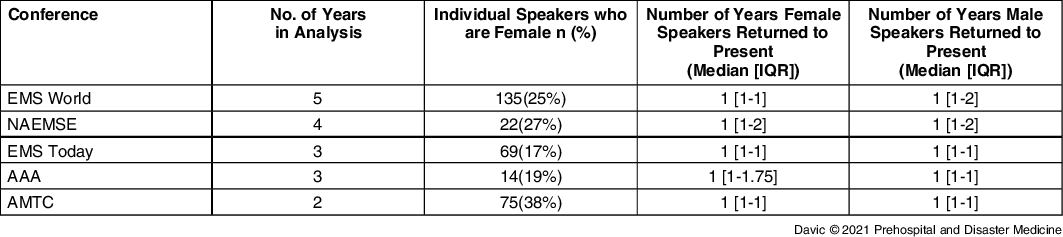
Finally, there was no statistically significant difference in the number of years males returned to a conference in subsequent years as a speaker compared to females (Table 2).
Mann-Whitney U Testing Revealed No Statistically Significant Difference in the Number of Years Male Speakers Returned to a Conference to Present in Subsequent Years than Female Speakers

Abbreviations: NAEMSE, National Association of EMS Educator’s Symposium; AAA, American Ambulance Association Annual Conference & Trade Show; AMTC, Air Medical Transport Conference; EMS, Emergency Medical Services.
Discussion
This cross-sectional analysis suggests that disparity exists in gender representation of speakers at well-known national EMS conferences and trade shows in the US from 2016-2020. Furthermore, the gender representation of national EMS conference speakers is not reflective of the current best estimate of the gender representation of the EMS workforce. This under-representation exists not only in the overall percent of female names listed as speakers (20%), but also in the percentage of individual female speakers (26%). This gender disparity is most notable for keynote presentations, with only 15% of keynote speakers being female.
Although some conferences met or exceeded ratios reflective of the EMS workforce for a particular type of conference session in a given year, cumulatively, all stakeholders at play - conference attendees, program committee members, conference speakers, industry sponsors, departmental or agency leadership, and clinical and educational medical directors - need to strive for better gender representation. Eventual gender equity in national EMS conference speakers, by being proactive in promoting and then expecting to see female conference speakers, could ideally help to improve gender disparities in the specialty as a whole.
Speculations about the causes of persistent gender disparities in conference speakers across medical and scientific specialties have been proposed. Intrinsic self-selection, possibly coupled with self-doubt or professional under-estimation, may result in fewer females submitting speaker applications to conferences. Reference Jones, Fanson, Lanfear, Symonds and Higgie13,Reference Bismark, Morris, Thomas, Loh, Phelps and Dickinson20 These issues are likely perpetuated by the persistent under-representation of female peers and mentors as conference speakers such that fewer females are likely to see themselves being successful in such a role. Reference Ruzycki, Fletcher, Earp, Bharwani and Lithgow15,Reference Boiko, Anderson and Gordon16,Reference Cejka and Eagly21 Finally, habitual speaker invitations coupled with a desire to publicize well-known, prestigious speakers likely compounds the selection process. Reference Carley, Carden and Riley3,Reference Mehta, Rose, Cook, Herridge, Owais and Metaxa22,Reference Amrein, Stoisser and Hoffmann23 This analysis, however, suggests there is no significant difference in the tendency for males versus females to return as a speaker to a particular conference in subsequent years.
Initiatives have been undertaken by conference program committees to successfully reduce speaker gender disparity. For example, improved balance in conference speakers has been achieved by intentionally including females on the program committee, Reference Sardelis and Drew11,Reference Casadevall and Handelsman14,Reference Lithgow, Earp, Bharwani, Fletcher and Ruzycki24,Reference Casadevall25 as well as by giving the program committee direct instruction to “do better” with regards to gender balance in speaker selection. Reference Casadevall25 Finally, public disclosure of speaker demographics by conferences has been repeatedly recommended. Reference Mehta, Rose, Cook, Herridge, Owais and Metaxa22,Reference Casadevall25,Reference Martin26
Just as important to these program committee-level initiatives is to identify and recruit female EMS providers into the prospective speaker pipeline and thereby grow the applicant pool. This could be done by surveying peers for recommendations or nominations of females in EMS with a personal interest or experience with a given topic. It may also be useful to assemble a list of female authors on recent EMS-related publications. Reference Klein, Voskuhl and Segal17 These methods could yield providers who otherwise under-estimate their specialized knowledge, or who hadn’t previously considered becoming a conference speaker. Finally, a speakers’ bureau could be created, much like that of FemInEM.org, Reference Mehta, Rose, Cook, Herridge, Owais and Metaxa22 in which EMS providers could list their interests, background, and even post sample recordings of lectures they have given.
Once new prospective female speakers have been identified, intentional mentorship on how to submit for and then deliver a conference session could be initiated. That strategy could be similar to the creation of a Speakers Development Program, as described by Sunga, et al. Reference Sunga and Kass27 This program engages prospective speakers into a three-phase-program, where each phases lasts one year: Year 1, self-directed learning about delivering presentations using free open-access medical education online resources; Year 2, developing and delivering a grand rounds presentation for their department followed by a critique of the recording with a mentor; and Year 3, submitting and delivering a presentation at a national conference. The program seemed to be effective at improving participants’ skills and confidence. Reference Sunga and Kass27 Key elements of the program’s success were mentor engagement, support from leadership, and accountability from peers. Reference Sunga and Kass27 The abrupt change to the delivery of medical education from in-person to online due to the COVID-19 pandemic makes this approach to speaker development even more realistic and generalizable.
While the skills involved in delivering conference presentations vary from those of webcast sessions, both experiences are likely meaningful for professional development, building self-confidence, and increasing visibility of female experts of the field. Year 1 could be completed entirely asynchronously, with input from a local or remote mentor. Given travel restrictions, many institutions may be utilizing more local faculty for grand rounds presentations, thus creating the opportunity for participants to hone their skills locally during Year 2. Since the travel previously required to attend or speak at national conferences can be expensive, time consuming, and limited by professional and personal obligations, the new virtual landscape of national conferences could make presentation opportunities during Year 3 more easily obtainable. This shift to online educational platforms reduces, if not obliterates, many of the previous barriers which prevented new speakers, both male and female, from joining the lecture circuit. Moreover, this silver-lining to the COVID-19 pandemic offers an opportunity to harness this innovation to improve conference speaker gender representation and speaker diversity.
Limitations
The most significant limitation to this study is the possible bias in determination of gender. Ideally, each speaker would be contacted to ask how they describe their gender, which may not be limited to male or female. This was not feasible given the number of speakers and lack of contact information in conference programs. It is possible there were changes in speakers between the time that the conference program was published and the actual conference. Omission of a session title or speaker name was possible due to human error. Finally, because the study was limited to well-known national conferences, an analysis of gender representation of speakers at regional or smaller EMS conferences may lead to a different conclusion.
Conclusion
Gender representation of speakers at national EMS conferences in the US is not reflective of the current best estimate of the US EMS workforce. This disparity exists not only in the overall percent of female names listed as speakers, but also in the percent of individual female speakers, and is most pronounced within keynote speakers. Online lecture platforms as an unintentional consequent of the COVID-19 pandemic, coupled with intentional speaker development and mentorship initiatives, may reduce barriers to facilitating a new pipeline for more females to be featured as speakers at national EMS conferences.
Conflicts of interest/funding
No funding was used to support the development of this manuscript. The authors have no financial conflicts of interest.
Author Contributions
All authors meet ICMJE requirements for authorship: study concept and design (AD, LM); acquisition of the data (all authors); analysis and interpretation of the data (AD, LM); drafting of the manuscript (AD, LM); critical revision of the manuscript for important intellectual content (all authors); and statistical expertise (LM).