Introduction
Nasal obstruction in the paediatric population has classically been attributed to adenoid hypertrophy. Recently, however, with the increase in the incidence of allergies, turbinate hypertrophy has become a more frequent entity in paediatric patients presenting with nasal obstruction.Reference Chen, Liu and Huang1 Considering turbinate hypertrophy in the differential diagnosis of a child with nasal obstruction is essential in order to properly manage these patients and improve their quality of life.
Traditionally, surgeons have been very conservative and cautious about operating on the inferior turbinates in children, for fear of affecting the facial skeleton and growth. Nevertheless, various surgical methods have been proposed for the treatment of hypertrophic inferior turbinates in children, including: partial turbinectomyReference Thompson2–Reference Weider and Sulzner4 and total turbinectomy;Reference Thompson2, Reference Ducroz, Girschig, Roger, Grimfeld and Garabedian5, Reference Segal, Eviatar, Berenholz, Kessler and Shlamkovitch6 the use of a carbon dioxide laser,Reference Pang and Willatt7, Reference Araki, Suzuki, Sato, Yamaguchi, Fujita and Umezawa8 a diode laser,Reference Araki, Suzuki, Sato, Yamaguchi, Fujita and Umezawa8 or a holmium: yttrium aluminium garnet (‘YAG’) laser and surface diathermy;Reference Rejali, Upile, McLellan and Bingham9 the use of a microdebrider and submucosal resection;Reference Chen, Liu and Huang1 and radiofrequency ablation.Reference O'Connor-Reina, Garcia-Iriarte, Angel, Morente and Rodríguez-Diaz10, Reference Sullivan, Li and Guilleminault11
Advances in surgical technology and the introduction of the turbinate coblator have allowed surgeons to reduce the size of hypertrophied inferior turbinates, while still maintaining the physiological function of the mucosal lining and nasal passages.Reference Farmer, Quine and Eccles12 Siméon et al.Reference Siméon, Soufflet and Souchal Delacour13 recently demonstrated improvement in nasal obstruction in nine children with allergic rhinitis treated using coblation.
We hereby present an observational cohort study of the use of coblation to effect bilateral inferior turbinate reduction in children, focusing on the safety and efficacy of the procedure; we also suggest some useful hints pertinent to the technique.
Materials and methods
The approval of the Institutional Review Board of the American University of Beirut was obtained prior to study commencement.
An observational cohort study was conducted, comprising all paediatric and adolescent patients who underwent bilateral inferior turbinate reduction by coblation between January 2002 and December 2009.
Inclusion criteria included an age of 6–18 years, and nasal obstruction for at least 3 months which was unresponsive to medical therapy (which consisted mainly of a minimum 6-week course of intranasal topical steroids; antihistamines were prescribed if other allergic rhinitis symptoms (e.g. itching, sneezing or rhinorrhoea) were present).
Exclusion criteria included a previous history of turbinate surgery, septal deviation, intranasal adhesions or any other cause of nasal obstruction other than inferior turbinate hypertrophy, and the presence of acute upper respiratory tract infections at the time of initial evaluation.
Patients' demographic data and characteristics were recorded, including age and sex.
Symptoms of allergic rhinitis (including sneezing, itching, rhinorrhoea, nasal congestion, and eye symptoms such as excessive tearing or redness) were assessed pre- and post-operatively when present. The subjective severity of allergic rhinitis symptoms was graded as zero (i.e. none: no symptoms evident) one (mild: symptoms present but easily tolerated, with the patient only minimally aware of them), two (moderate: definite awareness of symptoms, which were bothersome but tolerable) or three (severe: symptoms were hard to tolerate and interfered with activities of daily living and/or sleeping). The results of available skin tests and/or radioallergosorbent tests were reviewed at the time of initial evaluation.
The subjective severity of nasal obstruction was graded from zero to three using a scale similar to that used for allergic rhinitis symptom severity (see above). The severity of nasal obstruction symptoms was also assessed clinically based on the presence of mouth-breathing, snoring, restless sleep, frequent night-time awakening and/or obstructive breathing during sleep.Reference Bitar, Rahi, Khalife and Madanat14 In addition, a 10-cm visual analogue scale (VAS) was used as further quantification of patients' subjective assessment of the degree of nasal obstruction. Use of the VAS has been validated against rhinomanometry in adult patients undergoing turbinate surgery.Reference Mora, Cassano, Mora, Gallina and Ciprandi15 Patients were asked to draw a cross on a 10-cm line, corresponding to their perception of the severity of the nasal obstruction, on a scale ranging from 0 (no obstruction) to 10 (complete obstruction).
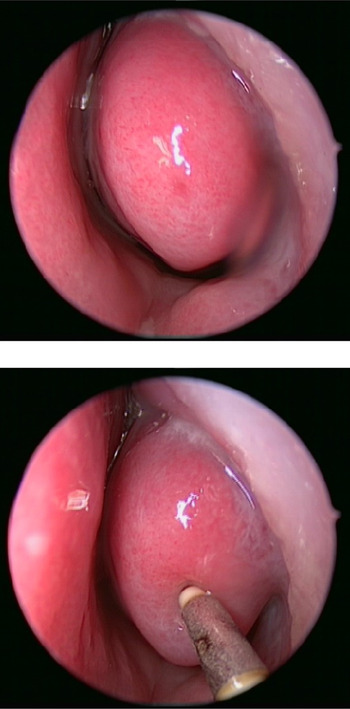
The degree of nasal obstruction was assessed objectively by nasal endoscopy. Assessments were made pre- and post-operatively, using a graded scale from one to three (Figure 1). At the end of the pre-operative endoscopic assessment, topical decongestant was applied (xylometazoline sprayed into the nasal cavities) to facilitate further examination of the nasal airway and estimation of the degree of the mucosal component of the turbinate enlargement (by observing the degree of decongestion achieved). Decongestion also allowed the endoscopist to assess the patency of the posterior choanae.
Diagram indicating endoscopic grading of the degree of obstruction caused by the inferior turbinates.

During analysis, we reviewed the medical treatment received, post-operative care, duration of follow up, development of complications and surgical outcome. These parameters were compared pre- and post-operatively. The pre-operative values were considered as a control for each patient.
The statistical significance of changes in parameter values was assessed using the Wilcoxon signed-rank test.
Procedure
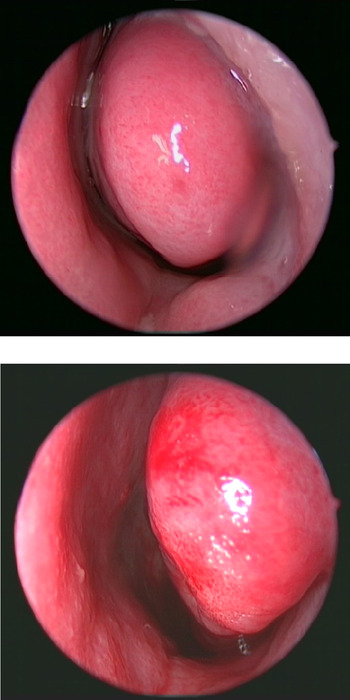
All patients were operated upon by the same surgeon (MAB). The procedure was performed under general anaesthesia, using a 0° Hopkins telescope for endoscopic guidance. No decongestant was used before the initiation of coblation, in order to avoid abolishing the submucosal space within which coblation was to be conducted. The tip of the coblator (Reflex Ultra 45 Plasma Wand; ArthroCare, Austin, Texas, USA) was introduced anteriorly and inferiorly through the turbinate mucosa (Figure 2), and then passed submucosally along the length of the turbinate. Once inside the turbinate, several passes were made, coblating the submucosal tissue using a power setting of six.
Nasendoscopic view showing initiation of the coblation procedure by targeting the tip of the inferior turbinate.

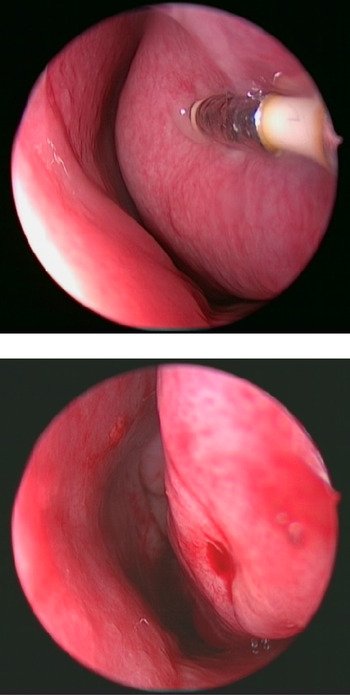
The turbinate volume could be seen to shrink during the procedure (Figure 3). The coblator was then re-introduced in the middle of the turbinate (Figure 4) in order to reach the posterior part, mainly the tail. If bleeding was encountered, patties soaked with xylometazoline were used as a temporary pack.
Nasendoscopic view of inferior turbinate coblation, showing immediate reduction in turbinate volume after the first set of anterior passes. No topical decongestion was applied before the procedure in order to facilitate accurate coblation.

Nasendoscopic view of inferior turbinate coblation, showing the crucial stage of coblation of the posterior half of the turbinate. Coblation of the tail is especially important; if needed, the tail can be entered directly to achieve further reduction in volume.

At the end of the procedure, a 20-cm Merocel pack (Medtronic, Watford, UK), cut in half along its length and shortened as needed, was inserted bilaterally and removed after 2 hours.
Results
Thirty-two patients, aged between 6 and 17 years (mean age, 11.28 years; standard deviation, 3.33 years), and comprising 14 females and 18 males, underwent bilateral inferior turbinate reduction by coblation.
Of these 32 patients, 62.5 per cent had severe subjective nasal obstruction symptoms (i.e. a grade of 3), while 68.8 per cent had grade 3 obstruction on nasendoscopic examination.
Eighteen (56.25 per cent) patients had symptoms of allergic rhinitis, with positive results for skin testing and/or radioallergosorbent testing.
Compared with pre-operative levels, the subjective severity of most allergic symptoms improved significantly after coblation (p < 0.05), with the exception of eye symptoms (Table I).
Patients' post-operative change in allergic rhinitis symptoms

*Improved vs worsened, Wilcoxon signed-rank test.
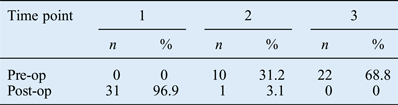
There was also a significant improvement in nasal obstruction, indicated by improvements in both the subjective nasal obstruction severity grade (p < 0.001) (Table II) and the clinical nasal obstruction symptom severity assessment (p < 0.05) (Table III). The median VAS score for subjective nasal obstruction dropped significantly, from 9 (range, 7–10) pre-operatively to 0 (range, 0–2) within 1 month post-operatively (p < 0.001) (Table IV). The degree of nasal obstruction objectively assessed by nasal endoscopy also decreased significantly (p < 0.001) (Table V).
Patients' subjective nasal obstruction severity grade

All patients showed a pre- vs post-operative improvement (p < 0.001; Wilcoxon signed-rank test).
Patients' post-operative change in clinical nasal obstruction symptoms

*Improved vs no change, Wilcoxon signed-rank test.
Patients' visual analogue scale scores

Data represent patient numbers.
Patients' nasendoscopic inferior turbinate obstruction grade
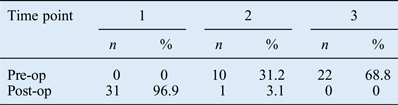
Pre-op = pre-operative; post-op = post-operative
The observed improvements were maintained after a mean follow-up period of 10.5 months (range, 1 month to 4 years).
None of the patients developed mucosal ulceration, adhesions or other complications, as indicated by post-operative nasal endoscopy. At 1-week follow up, minimal crusting was noted in 8.57 per cent of the patients; no crusting was seen in any patient thereafter. All patients had the same post-operative care for one month, which included nasal cavity cleaning using saline washes.
Discussion
The main goal of turbinate surgery is to improve nasal breathing by reducing the size of the inferior turbinates.Reference Hol and Huizing16 The ideal inferior turbinate surgical procedure would be one that achieves this goal by removing just enough volume while maintaining healthy turbinate mucosa. When this is accomplished, the patient can regain normal nasal breathing without excessive crusting or the risk of empty nose syndrome.
Various methods have been used to reduce turbinate size. Passàli et al.Reference Passàli, Passàli, Damiani, Passàli and Bellussi17 analysed the efficacy of six surgical techniques (turbinectomy, laser cautery, electrocautery, cryotherapy, submucosal resection and submucosal resection with lateral displacement) over a six-year follow-up period. They randomly allocated 382 patients to 6 therapeutic groups. They noticed that the mucosa-damaging surgical techniques resulted in rapid benefit but interfered with nasal physiology. In contrast, turbinectomy and submucosal resection resulted in restoration of normal nasal patency on long-term follow up. However, turbinectomy decreased the efficiency of mucociliary transport and the production of secretory immunoglobulin (Ig) A. Only the submucosal resection group achieved normalisation of mucociliary transport time and secretory IgA production. Using a saccharin test after turbinate surgery, Chen et al.Reference Chen, Liu and Huang1 demonstrated that microdebrider-assisted inferior turbinoplasty was capable of preserving nasal mucosa mucociliary transport in children.
Coblation (a contraction of ‘cold ablation’) targets the submucosa during turbinate reduction. Coblation technology is based on a controlled, non-heat-driven process that uses radiofrequency energy to excite the electrolytes in a conductive medium such as saline solution, in order to create precisely focused plasma. Energised particles or ions in the plasma have sufficient energy to break, or dissociate, molecular bonds within soft tissue at relatively low temperatures (typically 40–70°C). This enables coblation devices to remove target tissue volume with minimal damage to surrounding tissue. They are also used to achieve soft tissue shrinkage and haemostasis.18 Pre-operatively, we elected not to use topical decongestion or turbinate tissue infiltration with xylocaine plus adrenaline, in order to maintain adequate submucosal tissue volume at the coblation sites. We believe this allowed better assessment of the degree of tissue ablation, as it enabled the surgeon to directly observe turbinate tissue shrinkage during the procedure. Pre-operative decongestion of the turbinate may result in under-treatment and/or damage to the mucosa.
Inferior turbinates coblation has been previously performed in adults, with significant improvement in nasal obstruction. Bhattacharyya and KepnesReference Bhattacharyya and Kepnes19 studied the clinical effectiveness of inferior turbinate reduction by coblation in 24 adult patients treated in a clinic setting. Subjective symptoms were assessed pre-operatively, and at three and six months' follow up (using the Rhinosinusitis Symptom Inventory and a short nasal symptom questionnaire). Diagnosis was based on clinical symptoms and endoscopic findings. In contrast to our technique, no endoscope was used during the procedure, and only the anterior third of the inferior turbinate was addressed. Post-operative epistaxis occurred in 8.3 per cent of patients, and crusting was noted in 16.7 per cent of patients at 2 weeks' follow up; these figures are higher than those encountered in our study group. Bhattacharyya and Kepnes reported a significant decrease in nasal symptoms at three months, which was maintained at the six-month follow-up visit. However, there was no significant improvement in mucus production or post-nasal discharge at six months. We prefer using the endoscope to address the tail of the turbinate, which we believe is the main site of failure of turbinate surgery on long-term follow up.
Farmer et al.Reference Farmer, Quine and Eccles12 investigated nasal function in 20 adult patients before and after inferior turbinate coblation for nasal obstruction. Patients' subjective nasal obstruction symptoms (measured using VAS scores) decreased significantly at both the 2-week and 3-month follow-up visits. Again, there was no change in the severity of rhinorrhoea, nasal itching or sneezing in this group of patients. In contrast, our patients showed sustained improvement in both nasal obstruction and allergic rhinitis symptoms, over a mean follow-up period of 10.5 months, with the longest follow-up period being 4 years.
We could identify only one previously published study of children treated by inferior turbinate reduction via coblation. Siméon et al.Reference Siméon, Soufflet and Souchal Delacour13 showed reduced nasal obstruction and improved rhinological function signs (confirmed by favourable Paediatric and Adolescent Rhinoconjunctivitis Quality of Life Questionnaire scores) in nine children with allergic rhinitis. These findings were confirmed by our study, in which sustained improvements (and no complications) were observed in a larger group of children.
• The prevalence of allergies is increasing, and paediatric turbinate hypertrophy is becoming more common
• Various surgical treatments have been proposed
• Inferior turbinate coblation reduces turbinate size while maintaining mucosal function
• This study found a resultant improvement in both nasal obstruction and allergic rhinitis symptoms
• Inferior turbinate coblation appears safe and durably effective in children
Our findings compare favourably with those of O'Connor-Reina et al.,Reference O'Connor-Reina, Garcia-Iriarte, Angel, Morente and Rodríguez-Diaz10 who showed a positive and sustained effect using radiofrequency ablation in children. However, in this latter study, 57 out of 93 patients underwent tonsillectomy with or without grommet insertion at the same time as radiofrequency ablation. This presents a confounding variable, especially in those patients who had obstructive tonsils and/or adenoids. In contrast, our patients were selected based on turbinate hypertrophy as the only cause of upper airway obstruction.
Surgical ablation of the turbinate submucosa has a positive effect not only on nasal obstruction but also on other symptoms of allergic rhinitis. Mori et al.Reference Mori, Fujieda, Igarashi, Fan and Saito20 studied 60 patients with severe perennial allergic rhinitis who underwent submucous turbinectomy. Those patients were followed up for 1 year, using a standard symptom score, rhinometry and nasal provocation tests in vivo. In 16 cases, biopsies from the nose were available for immunohistochemical analysis. The mean total nasal symptom score was significantly reduced after surgery and the effect was maintained for at least 12 months. Submucous turbinectomy not only reduced nasal congestion, but also nasal discharge and sneezing. Histopathological examination of biopsies revealed infiltration of fibrous tissue into the lamina propria, together with a reduced number of vessels, nasal glands, eosinophils and infiltrating IgE+ cells in the turbinates. We too found a clear improvement in allergic rhinitis symptoms in our patients following inferior turbinate reduction.
Although VAS assessment of nasal obstruction has been validated against rhinomanometry only in adults, we elected to extrapolate such VAS assessment to children, as the VAS is a simple, readily available tool. Recently, Haavisto et al.Reference Haavisto, Vahlberg and Sipilä21 reported that the VAS has potential as a tool to investigate subjective nasal obstruction in children (i.e. seven years and older), following their assessment of the correlation between VAS and acoustic rhinometry results.
Although ours was an observational study, all data were carefully collected in a prospective and well-defined fashion. We used various methods of assessing nasal obstruction, including VAS scoring and endoscopy, in order to ensure adequate documentation of changes in the degree of nasal obstruction following treatment.
Conclusion
Inferior turbinates coblation was found to be a safe and effective technique for the treatment of children with nasal obstruction with or without allergic rhinitis. In patients with allergic rhinitis, the reduction of turbinate volume in this manner not only improved nasal obstruction, but also improved sneezing, itching and rhinorrhoea symptoms.