1. Introduction
The UK government has stated that it aims to create a society in which each individual, regardless of background, has an equal chance of realising their potential (Cabinet Office, 2011). Yet educational achievement still varies significantly by socio-economic background and, partly because of this, the UK has relatively low levels of intergenerational income mobility (Ermisch et al., Reference Ermisch, Jantti and Smeeding2012). One specific aspect of this problem has been investigated by Alan Milburn in his reports on fair access to higher paying professions.Footnote 1 Milburn found that individuals from more advantaged backgrounds continue to be more likely to secure a higher-paid professional role, with many employers recruiting from a very limited range of universities and degree subjects. For example, he reported that even in 2012, of the top 200 civil servants only one in five was educated at a state comprehensive. Just over 40 per cent of barristers had gone to a private secondary school and one third had attended Oxbridge. In this paper, we contribute new evidence to this debate, exploring the relative importance of educational achievement and social networks in explaining the socio-economic gap in graduates’ access to high-status ‘top’ occupations.
We define what we mean by high-status occupation below, but broadly these are occupations that have high earnings, more job security and better longer-term income prospects (Goldthorpe and McKnight, Reference Goldthorpe, McKnight, Morgan, Grusky and Fields2006; Bukodi and Goldthorpe, Reference Bukodi and Goldthorpe2011a). We contribute to the literature by focusing on the extent to which family background is correlated with being employed in one of these specific occupations for a recent cohort of graduates, even after allowing for educational achievement. We also assess whether social networks play a significant role in perpetuating unequal access to these jobs. We use data from the Higher Education Statistics AgencyFootnote 2 on first degree graduates leaving higher education in 2006/07 and who have been surveyed at six months and at around 3.5 years after graduation.
We need to better understand access to these high-status occupations as this will influence the later occupational status, job quality and crucially the earnings and resources available to the individual over their lifetime. Indeed, in the UK we have lacked good data on the lifetime earnings of graduates, instead having to rely on early measures of graduates’ earnings which may not be a good guide to their longer-term economic prospects, as many graduates earn less in their early career due to shorter tenure and a focus on training. Assessing graduates’ transitions into occupations that have good long-run economic prospects is one way to get partially around this data problem and to illicit some insight into the influence of socio-economic background on the long-term labour market success of graduates.
2. Related literature
This paper contributes to the extensive research that has identified low levels of intergenerational income mobility in the UK (Blanden et al., Reference Blanden, Gregg and Macmillan2013; Corak, Reference Corak2013; Crawford et al., Reference Crawford, Johnson, Machin and Vignoles2011). Educational attainment in the UK also varies by socio-economic background (Devine and Li, Reference Devine and Li2013; Gregg and Macmillan, Reference Gregg and Macmillan2010; Goodman et al., Reference Goodman, Gregg and Washbrook2011; Chowdry et al., Reference Chowdry, Crawford, Dearden, Goodman and Vignoles2012; Crawford et al., Reference Crawford, Goodman and Joyce2010; Jerrim, Reference Jerrim2012; Green et al., Reference Green, Machin, Murphy and Zhu2012) and is a key driver of persistence in incomes across generations (Blanden et al., Reference Blanden, Gregg and Macmillan2007).
Our research focuses on access to elite occupations by family background. Access to managerial and professional careers are of particular interest as they are expected to account for approximately two million additional jobs in the next decade, increasing their share of total employment in the UK from 42 per cent to 46 per cent (Wilson and Homenidou, Reference Wilson and Homenidou2011; Brewer et al., Reference Brewer, Dickerson, Gambin, Green, Joyce and Wilson2012). While there have been a number of official reports published on this topic (Cabinet Office, 2009, 2012), academic research on potential barriers to professional careers is limited (Langlands, Reference Langlands2005; Sutton Trust, 2005, 2006). Macmillan (Reference Macmillan2009) found an increase in the proportion of professionals originating from wealthier families between 1958 and 1970 in nine of the 12 professions examined, and Bukodi and Goldthorpe (Reference Bukodi and Goldthorpe2011b) highlight the influence of education, particularly higher tertiary qualifications, and class origin on access to the salariat (defined as NS-SEC classes 1 and 2).
We build on this work, focusing on elite occupations (NS-SEC 1 only), incorporating analysis of female graduates and attempting to isolate the relationship between background and occupation by taking fuller account of individuals’ school and university experiences, including subject of degree and institution attended. Our work is also closely related to the international research on the extent to which children are employed in the same organisations as their parents (Corak and Piraino, Reference Corak and Piraino2010; Bingley et al., Reference Bingley, Corak and Westergård-Nielsen2011), although we take a wider approach, considering a number of measures of background and measuring the extent to which children with parents working in elite occupations are more likely to work in these high-status occupations themselves.
We also assess whether the use of networks explains a significant proportion of the socio-economic gap in access to high-status occupations. Networks represent informal channels of job search, including employee referrals and social connections (Rees, Reference Rees1966) and are one important element of social capital (Loury, Reference Loury, Wallace and Le Mund1977; Coleman, Reference Coleman1990). Numerous theoretical contributions have modelled the influence of networks on labour market outcomes (Montgomery, Reference Montgomery1991; Calvo-Armengol, Reference Calvó-Armengol2004, Reference Calvó-Armengol2007; Casella and Hanaki, Reference Casella and Hanaki2005; Granovetter Reference Granovetter1973, Reference Granovetter1974(Reference Granovetter1995)). Networks are considered to be productive and low-cost methods of generating job offers (Holzer, Reference Holzer1988), usually with benefits for income and job tenure (Loury, Reference Loury2006). However, reliance on networks may also cause a mismatch between occupational choice and productive advantage, thus lowering wages (Bentolila et al., Reference Bentolila, Michelacci and Suarez2010). Ioannides and Loury (Reference Ioannides and Loury2004) outline the widespread use of networks and find significant variation in the usage and productivity of networks between job seekers.
This variation and complexity provides mixed evidence on the role of networks in accessing top jobs. Marsden and Gorman (Reference Marsden, Gorman, Berg and Kalleberg2001) present evidence that network contacts are more likely to be used by firms where high-quality information about workers’ likely performance is important, such as in managerial and professional positions. However, evidence to the contrary indicates that informal recruitment processes may be used less frequently than expected for ‘top jobs’ (Pellizzarri, Reference Pellizzari2004; Rivera, Reference Rivera2012). Pellizzari (Reference Pellizzari2004) further finds that use of personal contacts leads more frequently to jobs in small- and medium-sized firms, perhaps indicating that networks may be more valuable for securing top jobs in smaller firms rather than larger firms that are more likely to have formalised recruitment processes.
Networks also provide privileged access to valuable work experience opportunities, which are crucial stepping stones to securing a top job (Kramarz and Skans, Reference Kramarz and Skans2006; Francis and Sommerlad, Reference Francis and Sommerlad2009; Rolfe and Anderson, Reference Rolfe and Anderson2003). Several US studies have conducted evaluations of ‘school to work’ initiatives, which often include work experience opportunities but also mentoring and employer engagement (Neumark and Rothstein, Reference Neumark and Rothstein2006; Kemple and Willner, Reference Kemple and Willner2008). The findings from these studies are mixed. An AIR UK (2008) report for the UK government indicates that only a few similar robust evaluations have been undertaken in the UK, but, for those available, school links with employers have positive effects on student attainment, employability and initial wages. Mann (Reference Mann2012) also found that young people in the UK who have had regular contact with employers while in education are five times less likely to be NEET (‘not in education, employment or training’) and earn, on average, 16 per cent more than their peers who did not have the advantage of this regular contact. More broadly, the importance of finding work experience, internships and placement opportunities is also regularly highlighted by national reviews and graduate recruitment research (Wolf, Reference Wolf2011; Association of Graduate Recruiters, 2012; CBI, 2011), thus again highlighting the disadvantage faced by students without access to relevant networks.
3. Data
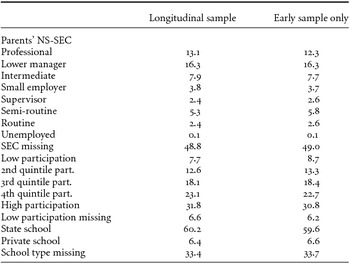
We use data from the Destinations of Leavers from Higher Education (DLHE) ‘early’ and ‘longitudinal’ surveys carried out by the UK Higher Education Statistics Agency (HESA). The ‘early survey’ is conducted approximately six months after graduation,Footnote 3 with a total 453,880 eligible leavers in 2006/2007, of which 332,110 (73.2 per cent) responded: the response rate is in line with previous years (HEFCE, 2011). A longitudinal survey was conducted up to 3.5 years after graduationFootnote 4 for a sub-sample of students,Footnote 5 with 49,065 valid responses from the 332,110 students who responded to the census survey.Footnote 6 Of these, we limit our final sample to 24,980 graduates who finished higher education in 2006/2007 during the reference period, completed the survey at 3.5 years after graduation, studied for an undergraduate degree, were aged 18–25 on 31 July 2007 and provided occupational data (Standard Occupation Classification (SOC) 2000Footnote 7). Appendix Table A1 suggests that this restricted sample looks very similar to the ‘early survey’ sample in terms of student characteristics. We focus our analysis on graduates some 3.5 years after graduation because the period immediately after graduation is transitional. Some graduates may take temporary jobs or no job at all. We are more confident that their occupation 3.5 years after graduation is a better guide to their future occupational status.
The occupational status of graduates at 3.5 years after graduation is measured using 5-digit SOC 2000 codes. We aggregate this into a form that enables us to rank the socio-economic status of occupations. We assign each individual an analytical National Statistics Socio-economic ClassificationFootnote 8 (NS-SEC) codes 1 to 7.Footnote 9 Individuals’ positions within this scale have been shown to be a major influence on their economic life chances (Chan and Goldthorpe, 2007).Footnote 10 We define high-statusFootnote 11 occupations as those in the top NS-SEC grouping (29.8 per cent of the total sample of graduates).
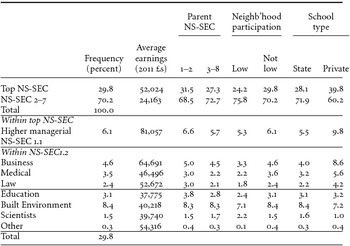
We also consider three separate groups of occupations within the top NS-SEC in our analysis: (a) higher managerial (NS-SEC 1.1 occupations), (b) business, medical and law professionals and (c) other professionals (including educational, built environment, scientist and other NS-SEC 1.2 occupations). Occupations within these groupings are listed in the Appendix. These high-profile occupations within the top NS-SEC are the focus of government policies for promoting fair access, and there are clear differences in the labour market reward by groups of occupations: on average, individuals working in higher managerial occupations earned £81,000 in 2011 compared to £51,000 for business, medical and law professions and £39,000 for other professions compared to £24,000 for all other occupations (NS-SEC 2–7).Footnote 12Table 1 shows the proportion of graduates in our sample employed in these high-status occupations at 3.5 years after graduation (column 1) and the average annual earnings in 2011 by occupation grouping.
Family background of those entering into high-status professions

Notes: Data in column 2 from the Annual Survey of Hours and Earnings (ASHE) average annual earnings for 2011 for all workers by 4-digit SOC code. Occupations within professional groupings: business – accountants, economists, statisticians, brokers, underwriters, tax specialist; legal – judges, barristers, solicitors; life science – doctors, dentists, pharmacists, psychologists, veterinarians; education – higher education teachers and researchers, secondary and primary head teachers, senior administrators; built environment – engineers, IT consultants, architects and surveyors; scientists – chemists, biologists, physicists, astronomers, mathematicians; other – clergy, probation officers, aircraft pilots.
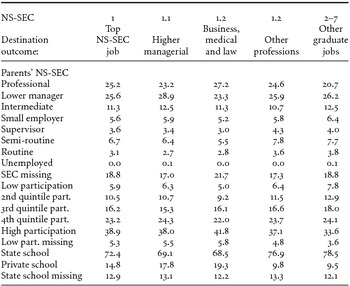
We have three measures of family background available: parental NS-SEC, the neighbourhood participation rate in higher education and type of secondary school attended. Undergraduate students entering higher education through UCAS are asked to provide information on their parents’ occupations, though some choose not to do this, particularly mature students, which may explain the relatively high rate of missing data. Missing parental NS-SEC data (18.8 per cent of our sample) includes graduates for whom the occupation of their parents is either unclassified (14.4 per cent) or unknown (4.4 per cent). Appendix Table A2 illustrates the proportion of our sample with missing information. The extent of missing data is identical for those in top NS-SEC occupations as it is for NS-SEC 2–7 occupations.
Our measure of neighbourhood higher education participation is based on the POLAR3 classification, which contains rankings of higher education participation by area (Census Area Statistic wards). From this, quintiles of areas are constructed, ordered from 1 (those with lowest participation) to 5 (those with highest participation). School type is binary: private (independent) schools and state schools.Footnote 13
Columns 3 to 8 of Table 1 illustrate the socio-economic background of graduates employed in our various definitions of high-status occupations 3.5 years after graduation. Of those with professional or managerial parents, 31.5 per cent work in high-status occupations compared to 27.3 per cent with parents working in a lower NS-SEC occupation. Of those from low higher education (HE) participation areas, 24.2 per cent enter top jobs compared to 29.8 per cent from higher HE participation areas, and 40 per cent of private school pupils enter an NS-SEC 1 occupation compared to 28.1 per cent of state school pupils.
Within the top NS-SEC, there are notable differences in the family background of those entering different careers. Graduates from higher parental NS-SEC backgrounds, higher HE participation areas and who attended a private school are more likely to enter into higher managerial or business, medical and law professions. The picture for other professions is more mixed. State school pupils are more likely to enter into built environment and scientist occupations than private school pupils. Scientists are more likely to be from lower parental NS-SEC families, from low participation areas and state educated on average.
When considering the role of networks, we use information on the channels that the graduates used to find out about the job that they are employed in 3.5 years after graduation. Three types of network are identified: professional (professional, work or educational contacts or networks), personal (personal contacts, including family, friends and social networks) and already/previously having worked for the organisation. Our baseline category includes students who found out about their job in other ways, using non-network channels (recruitment agency, career service, employer website, media advertisement, speculative application or other).
In reality, graduates are likely to have used numerous job search channels. However, the DLHE survey only permits one channel to be reported. Graduates may also systematically under-report their use of networks due to the perception of not gaining employment on the basis of merit alone. These measurement issues indicate that the true propensity of graduates to use networks may be higher than observed in our analysis, although it is unclear whether this would vary by final occupation grouping.
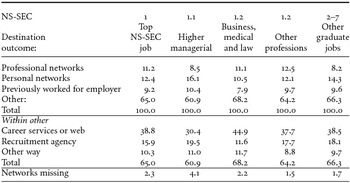
The descriptive statistics presented in Table 2 show the use of different types of networks by occupation grouping. Professional networks are used by 11.2 per cent of those working in the top NS-SEC compared to 8.2 per cent in NS-SEC 2–7 occupations. Personal networks are actually used less in top NS-SEC jobs than in lower NS-SEC 2–7 jobs but within top NS-SEC jobs they are used by 16.1 per cent of graduates entering higher managerial occupations compared to 10.5 per cent of graduates entering business, medical and law professions.
How those entering high-status occupations found out about their jobs (per cent)

Notes: Other professions include: education, environment, scientists and other occupation groups from NS-SEC 1.2.
4. Methodology
We hypothesise that more socio-economically advantaged students will acquire more human capital and in turn will access top jobs to a greater extent than more disadvantaged students. To the extent that we can control for individual human capital, however, we might expect socio-economic background to have an additional independent impact on the likelihood of accessing a top job. This might occur if more advantaged students can afford to invest greater resources in their job search, taking more time to secure the top job they want. Sociological theories also suggest that more advantaged students will be more likely to secure a top job because they have greater levels of social capital. We cannot measure all aspects of students’ human and social capital but we are able to assess whether the use of networks plays a role in helping to secure a high-status occupation. We use this as a proxy for their social capital.
Family background and accessing top jobs
We consider the raw association between family background and being in a top job 3.5 years after graduation. This association captures the overall relationship between family background and securing a top job, regardless of the mechanisms driving this relationship. Given that entry into a top job is a binary variable, we estimate equation (1) using a probit model, where F(.) is the cumulative normal distribution and X a vector of family background characteristics, including parental NS-SEC, quintiles of neighbourhood-level participation in higher education and a state school indicator.
 \begin{equation}
F(Top\_job_i^{child} ) = {\it \Phi} (\alpha + \beta X_i^{family} )\end{equation}
The estimated parameters are presented as marginal effects, indicating the percentage point change in the probability of entering a top job for a unit change in X, evaluated at the sample mean.
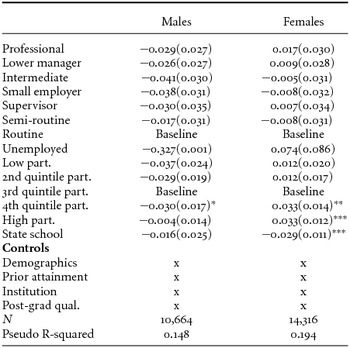
We pool male and female graduates to maximise our sample size. Males and females make different occupational choices and have different lifetime earnings. However, our data are from the early years of graduates’ careers, when the gender wage gap is approximately zero (Manning and Swaffield, Reference Manning and Swaffield2008), and by implication occupational choices are more similar.Footnote 14 We also estimate the model separately by gender: the coefficients on the variables of interest are not statistically significantly different from one anotherFootnote 15 though the smaller sample size does cause some coefficients to become statistically insignificantly different from zero (Appendix Table A3).
Ideally, we would like to measure the association between socio-economic background and securing a top job allowing for the individual's human capital. There are other factors associated with family background and the chances of entering into a top job that may be driving the observed association. First, we add potential confounders to our model to control for observable differences across graduates (equation (2)). Second, we add these in four blocks, first demographic controls (D = ethnicity, age and gender), then controls for human capital as measured by prior attainment, A, including UCAS tariff score, subject of degree and degree class. We do this to remove differences in access to top jobs driven by the academic achievement of the candidate and the subject specialism. Third, we control for institution effects (I) to condition on the choice of institution and region. This is to reflect the fact that studying at a prestigious institution can provide an additional advantage to students in terms of future employment. Finally, we condition on the type of postgraduate study undertaken up to 3.5 years after graduating (PG) to assess whether this is an important route into the top jobs and if this accounts for differences in entry by family background.
 \begin{equation}
F(Top\_job_i^{grad} ) = {\it \Phi} (\alpha + \beta X_i^{family} + \gamma D_i^{grad} + \delta A_i^{grad} + \rho I_i^{grad} + \tau PG_i^{grad} )\end{equation}
The inclusion of these controls allows a ‘like-for-like’ comparison of graduates, at least in terms of observed characteristics. For example, professional firms often claim they recruit graduates based on academic attainment. Controlling for degree class, subject choice, prior attainment and where the graduate went to university ensures that we are comparing the chances of similar graduates entering top professions. The results show whether or not socio-economic background has an effect on occupational status over and above these controls. Despite our attempts to eliminate the impact of other factors on occupational status, graduates are still likely to differ in ways we do not observe, in particular in their aspirations, preferences and other aspects of non-cognitive ability, which may be influential in securing a professional career. We cannot control for these unobserved sources of selection bias in our model and we return to this issue in our conclusions.
When we analyse entry to higher managerial occupations, business, medical and legal professions and other professions compared to other graduate jobs (NS-SEC 2–7), we use a multinomial logit model, presenting the marginal effects of the probability of entering each occupation group relative to entering an NS-SEC 2–7 job evaluated at the sample mean. The multinomial logit model requires the assumption of the independence of irrelevant alternatives (IIA). This implies that the relative likelihood of preferring one occupational group to another must not depend on the availability of other irrelevant alternatives, which we argue is not an overly strong assumption in this case. It requires, for example, that a graduate's relative likelihood of choosing a higher managerial occupation compared to a business occupation would be unaffected by other career options available to them. We argue that choice of occupation is dependent on a number of factors, including human and social capital and, as such, the existence of alternative occupation groupings is sufficiently independent to the individuals’ relative preferences, given their capital.
The role of networks
We add a measure of social capital to our models, namely the students’ use of networks (N) to get their job (equation (3)). We consider whether networks can account for any of the remaining socio-economic gradient in accessing top occupations after controlling for a range of characteristics, or whether they have an independent effect over and above family background.
 \begin{eqnarray}
F(Top\_job_i^{grad} ) &=& \Phi (\alpha + \beta X_i^{family} + \sigma N_i^{grad} + \gamma D_i^{grad} + \delta A_i^{grad} \nonumber\\
&& +\, \rho I_i^{grad} + \tau PG_i^{grad} )
\end{eqnarray}
If higher socio-economic status graduates disproportionately use networks to secure top jobs, then the inclusion of networks in the model should diminish the direct effect of family background. If networks significantly predict entry to top jobs but the remaining socio-economic gap remains intact, then this indicates that networks are being used but cannot explain the remaining socio-economic gradient in access.
5. Results
Family background and accessing the top jobs
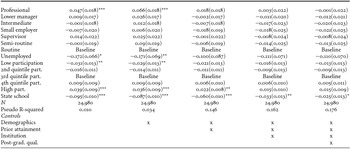
Column 1 of Table 3 presents the marginal effects from our baseline probit model in equation (1) to show the raw socio-economic gradient in access to top jobs before conditioning on any further characteristics.Footnote 16 Graduates with parents in a top NS-SEC occupation are 4.7 percentage points more likely to be working in a top NS-SEC occupation (baseline 30 per cent) compared to graduates whose parents work in a routine occupation. There are no other significant effects by parental NS-SEC, although graduates whose parents are long-term unemployed are 17.2 percentage points less likely to work in a top NS-SEC occupation compared to graduates with routine occupation parents (note the unemployed parent group is very small).
Marginal effects from a probit model of family background on having a high-status occupation(top NS-SEC) 3.5 years after graduation compared to other occupations(NS-SEC 2–7)

Demographics: Gender, age, ethnicity. Prior attainment: UCAS tariff, subject, attainment. Institution: institution fixed effects, region of institution. Post-graduate: higher research, taught, post-graduate certificate/diploma or other at three years. Robust standard errors in parenthesis. In models including institution FE standard errors are clustered at institution level. * 90% confidence, ** 95% confidence, *** 99% confidence.
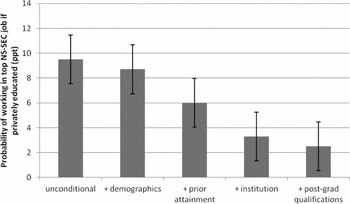
A socio-economic gradient also exists in terms of the neighbourhood measure of HE participation. A graduate from a low participation area is 3.1 percentage points less likely to enter a top job, while a graduate from a high participation area is 3.9 percentage points more likely to enter a top job than a graduate from an average participation area. The strongest gradient is observed for those who attended state schools compared to privately educated graduates. Figure 1 plots the private school advantage for each of the five specifications we consider. As seen in the first bar, before conditioning on any other characteristics, graduates who attended a private school are 9.5 percentage points more likely to enter a top job 3.5 years after graduation than a state educated graduate.
Marginal effects of private school attendance on having a high-status occupation(top NS-SEC) 3.5 years after graduation compared to other occupations(NS-SEC 2–7)
Demographics: Gender, age, ethnicity. Prior attainment: UCAS tariff, subject, attainment. Institution: Institution fixed effects, region of institution. Post-grad: Higher research, taught, post-grad certificate/diploma or other at three years.

Columns 2 to 5 add controls as discussed in the previous section. Adding in demographic controls does little to the estimated socio-economic gradients across the measures and in some cases accentuates the findings from the baseline specification. However, when conditioning on prior attainment, degree subject, degree classification and UCAS tariff point score, the socio-economic gradient is reduced substantially.Footnote 17 This implies that a main mechanism by which socio-economic background impacts on access to a high-status profession is via enhancing educational achievement (human capital). There is little difference now in the probability of accessing a top job by parental occupation. Living in a high participation neighbourhood is associated with an additional 2.2 percentage point advantage in accessing a top job. However, even when conditioning on prior attainment, state school educated graduates are still 6 percentage points less likely to enter into a top job than a comparable privately educated graduate, who took the same subject and achieved the same grade in their degree (and A-levels).
Conditioning on the higher education institution attended further reduces this negative state school gradient by 45 per cent: one mechanism through which attending a private school increases a graduate's chances of entering a high-status occupation is therefore by increasing the chances that the student attends a high-status university. It is less clear whether this is because private schools are better able to help their students secure places in high-status universities or whether their students just have a stronger preference for attending such institutions. However, even when accounting for these different choices and conditioning on post-graduate qualifications, the final column of Figure 1 shows that private school graduates are still 2.5 percentage points (baseline 30 per cent) more likely to access a top NS-SEC occupation than a comparable state school graduate who has parents from a similar NS-SEC group, is from the same type of neighbourhood, got similar A-levels and has the same degree classification in the same subject from the same institution and has obtained similar post-graduate qualifications.
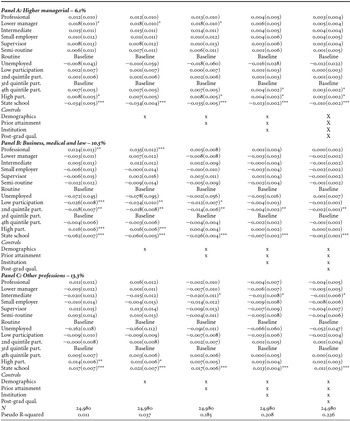
Interesting differences in access to high-status occupations also exist within the top NS-SEC occupations. Table 4 presents the marginal effects from a multinomial logit model comparing access to (a) higher managerial (b) business, medical and law professions and (c) other professions as compared to NS-SEC 2–7 jobs.
Marginal effects from a multinomial logit model of family background on having alternative high-status occupations 3.5 years after graduation compared to other occupations(NS-SEC 2–7)

Demographics: Gender, age, ethnicity. Prior attainment: UCAS tariff, subject, attainment. Institution: institution fixed effects, region of institution. Post-grad: higher research, taught, post-grad certificate/diploma or other at three years. Robust standard errors in parenthesis. In models including institution fixed effects, standard errors are clustered at institution level. *90% confidence, **95% confidence, ***99% confidence.
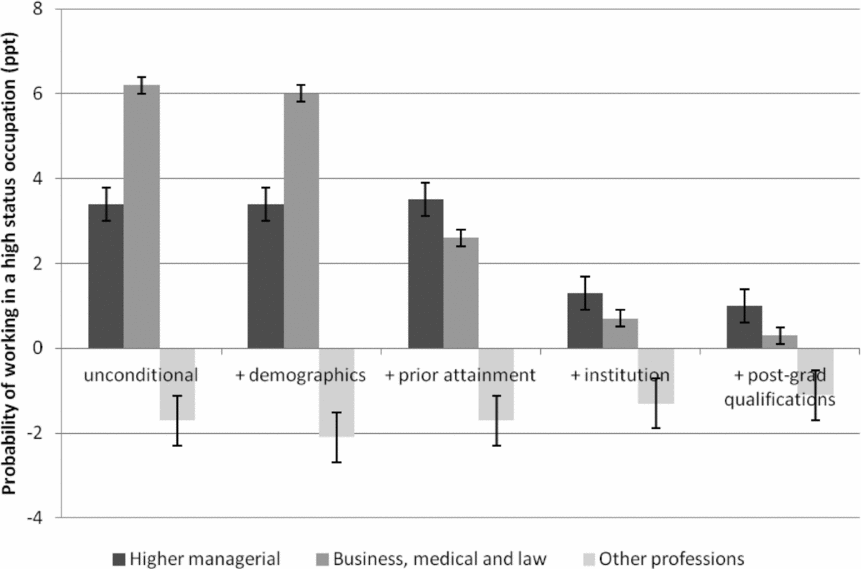
Graduates with lower managerial parents are 1.8 percentage points more likely to work in a higher managerial occupation at 3.5 years after graduation than graduates with a parent working in a routine occupation (baseline 6.1 per cent compared to NS-SEC 2–7 occupations). Those living in high participation neighbourhoods are 0.8 percentage points more likely to work in these top occupations as compared to graduates from an average participation neighbourhood. Figure 2 illustrates that the private school advantage is large, with privately educated graduates 3.4 percentage points more likely to work in a higher managerial position than state educated graduates from a baseline of 6.1 per cent. When we condition on demographics and prior attainment, the SES gradients remain intact suggesting that access to these particular occupations is not related to gender, ethnicity, age or indeed prior attainment.
Marginal effects of private school attendance on having alternative high-status occupations 3.5 years after graduation compared to other occupations(NS-SEC 2–7)
Demographics: Gender, age, ethnicity. Prior attainment: UCAS tariff, subject, attainment. Institution: Institution fixed effects, region of institution. Post-grad: Higher research, taught, post-grad certificate/diploma or other at three years.

Controlling for the HE institution removes any differences by parental NS-SEC, although an effect remains for neighbourhood participation and type of school attended. Controlling for postgraduate qualifications further reduces the socio-economic gradient. Comparing a privately educated and state educated graduate from the same type of family and neighbourhood, with the same prior attainment, from the same institution, with the same post-graduate qualifications, the privately educated graduate has a small (1 percentage point from a baseline 6.1 per cent) but statistically significant advantage over the state school graduate. The neighbourhood HE participation rate and parental SES measures are statistically insignificant.
A similar picture emerges when considering access to business, medical and law professions, although for this grouping the raw private school association is slightly larger (6.2 percentage point advantage on a baseline of 10.5 per cent), and more of the background effect can be accounted for by prior attainment (Figure 2). The significant association between having parents in the top NS-SEC and entering a business, medical or law profession disappears once we control for prior attainment. Even when conditioning on all of these variables, including prior attainment, degree subject and institution and postgraduate qualifications, there is still a small but significant advantage from a private school education: privately educated graduates are 0.3 percentage points more likely to work in these occupations than a comparable state educated graduate.
If we focus on other professions, the private school advantage is reversed, as seen in Figure 2. Privately educated graduates are 1.7 percentage points less likely than state educated graduates to work in these occupations in the baseline specification and 1.1 percentage points less likely in the full model (baseline 13.3 per cent). This finding is perhaps surprising, although it could indicate different preferences between state and privately educated students. Top state school graduates may choose to select into alternative types of careers compared to privately educated graduates or, given the increased likelihood of private school graduates accessing top managerial and business, medical and law professions, state school graduates may be sorted into these other professions.
The role of networks in accessing top jobs
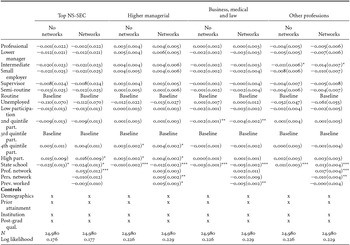
We explore one potential channel through which graduates from higher status families may gain preferential access to these occupations, namely the use of networks. Column 1 of Table 5 presents the relationship between socio-economic status and entering a top NS-SEC job before controlling for the use of networks (reproducing the last column of Table 3), whilst column 2 conditions on the use of networks (equation (3)), both conditioning on the full range of controls. It is clear that the residual socio-economic gap in accessing top jobs remains unchanged whether or not the use of networks is controlled for. Columns 3–8 repeat this analysis from multinomial logit models of the more detailed occupation groupings from Table 4. The inclusion of the network variable has very little impact on the residual relationship between family background and entering a top occupation. This suggests that, when conditioning on the full range of controls, the use of networks is orthogonal to socio-economic status and not the main driver of these large residual socio-economic gaps in accessing top jobs.Footnote 18
Marginal effects of family background on having a high-status occupation 3.5 years after graduation conditioning on the use of networks

Demographics: Gender, age, ethnicity. Prior attainment: UCAS tariff, subject, attainment. Institution: Institution fixed effects, region of institution. Post-grad: Higher research, taught, post-grad certificate/diploma or other at three years. Standard errors are clustered at institution level. *90% confidence, **95% confidence, ***99% confidence. First two columns from probit models. Other six columns from multinomial probit models.
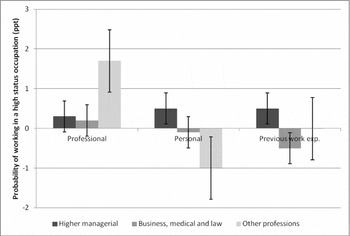
The use of networks has a significant independent effect on the likelihood of accessing top jobs. However, these effects are likely to be understated due to network usage being under-reported as it may be regarded as non-meritocratic. Using a professional network to find a job, rather than some other method, increases the probability of working in a top NS-SEC job by 5.3 percentage points. Figure 3 plots the association between using networks and access to higher managerial, business, medical and law professions and other professions. Use of professional networks is more strongly associated with accessing other professions. Access to higher managerial occupations is improved marginally by the use of personal networks and previous work experience.
Marginal effects of the use of networks to find out about a job on having a high-status occupation 3.5 years after graduation
Demographics: Gender, age, ethnicity. Prior attainment: UCAS tariff, subject, attainment. Institution: Institution fixed effects, region of institution. Post-grad: Higher research, taught, post-grad certificate/diploma or other at three years.

6. Conclusions
Our findings are stark. There is a large socio-economic gradient in the likelihood of a recent graduate accessing a top job, and differences across socio-economic groups are statistically significant. Our baseline model predicts that 40 per cent of graduates who attended a private school secured a higher status occupation, compared to just 28 per cent of students from state school backgrounds. In addition, 32 per cent of graduates who come from higher SES family backgrounds (NS-SEC Group 1 or 2) enter top jobs compared to 27 per cent from lower SES backgrounds (NS-SEC groups 3–7). Much of this socio-economic gradient is because socio-economically advantaged graduates have higher levels of human capital. They have higher achievement at Key Stage 5, are more likely to attend an elite university and take subjects that have greater economic value in the labour market. Even controlling for these differences in human capital, we still find a modest socio-economic gradient in access to top jobs. When we include a measure of social capital, namely use of networks, the socio-economic gradient remains. Higher SES students are more likely to say they have used a network to secure their job, but this does not explain the strong link between socio-economic background and getting a top job.
It is worth noting that our models compare the likelihood of equally qualified graduates from more and less advantaged backgrounds securing access to a top job. This may understate the true socio-economic gap in access to the professions. This is because we are comparing disadvantaged state school pupils who have achieved very highly in the system, despite their background, against those from more privileged backgrounds. The former group of students may not be fully representative of disadvantaged students as a whole. They are likely to be more motivated in ways we may not fully observe, and indeed they may achieve more highly precisely because they intend to go on to a professional job. We would therefore view our estimates as downward biased in this respect.
We have shown that it is not simply the case that socio-economically advantaged students are better qualified or use their networks in order to access top jobs. Our work discounts the notion that higher education completely levels the playing field between students of differing socio-economic backgrounds. Beyond academic achievement, our analysis suggests there are other reasons why more advantaged students, and particularly those who attended a private school, are somewhat more likely to secure a top job.
More socio-economically advantaged graduates may have other forms of capital that are important for accessing top jobs. These could include non-cognitive skills, including confidence and self-esteem, that help individuals in interviews. Alternatively, these graduates could have greater cultural capital that enables them to exhibit desirable behaviours and conversations in the interview setting. They may have access to greater financial capital that enables them to increase the period of their job search or take unpaid internships and hence increase their likelihood of accessing a top job.Footnote 19 Lastly, it may be the case that more advantaged graduates have different preferences and motivations, opting into higher status occupations. Our results comparing different occupation groupings within the top NS-SEC indicate some degree of sorting of individuals from different backgrounds into different career choices, which could represent different motivations. Note that even if this is the case, this is likely to be linked to differences in graduates’ social and cultural capital. To the extent that we cannot measure all these factors, our identification strategy does not entirely eliminate the possibility that graduates are sorted into top jobs on the basis of characteristics unobserved by the researcher.
This research contributes to the literature by eliminating differences in education achievement and use of social networks as the sole reasons for the differences we observe in graduates’ access to top professions, though the former is clearly very important. Further research is needed to establish which alternative explanations are most important.
The policy implications are important. The research tells us that among recent UK graduates, socio-economic background remains a significant factor in explaining why some students secure top jobs. After many decades of policies to improve social mobility and to widen participation in higher education, it remains the case that a student's family background has a major influence on their job and their life chances. The fact that this relationship is largely but not entirely explained by more advantaged students having demonstrably higher levels of human capital would imply that we must strive to achieve greater transparency in hiring practices so we fully understand why socio-economically disadvantaged students are somewhat less likely to get a top job even when they have the necessary human capital. Only when we understand this can we develop policies to address it.
Acknowledgements
This work was part-funded by the Social Mobility and Child Poverty Commission. We are grateful for comments from John Micklewright, Paul Gregg and contributors to the Intergenerational Mobility and Social Gradients in Children's Life Chances conference hosted by the Social Mobility and Child Poverty Commission and the Centre for Market and Public Organisation, University of Bristol.
Appendix
Occupations within professional groupings:
Business: Accountants, economists, statisticians, brokers, underwriters, tax specialists.
Medical: Doctors, dentists, pharmacists, psychologists, veterinarians.
Law: Judges, barristers, solicitors.
Education: Higher education teachers and researchers, secondary and primary head teachers, senior administrators.
Built environment: Engineers, IT consultants, architects, surveyors.
Scientists: Chemists, biologists, physicists, astronomers, mathematicians.
Other: Clergy, probation officers, aircraft pilots
Differences in the social origins of those in the early HESA sample and those in the later longitudinal sample

Social origins of those entering the top professions

Marginal effects of family background on having a high-status(top NS-SEC) occupation 3.5 years after graduation by gender