Introduction
In Europe, organic farming practice is guided by rules and aims as formulated in the EU Regulations (EC, 1999; 2007). This can be summarised as the use of farm-own feed, no preventive allopathic veterinary medication, access to pasture, low stocking density, slow growing genotypes and longer duration of production.
Access to pasture provides fresh grass, insects, and worms (Glatz et al., Reference GLATZ, RU, MIAO, WYATT and RODDA2005), which may lead to enhanced quality of the products. Pasture management is essential in order to keep high health and welfare status in the flock. The ground has to be kept in good condition in order to provide forage for the birds, to prevent the area from becoming muddy, to avoid poaching/predators and prevent the build-up of parasitic populations. Mud can increase fly breeding areas, transmit diseases, create unsafe footing and increase pollution, and the area directly outside the poultry house tends to suffer the greatest amount of damage, due to the intensive foraging and scratching of hens (Sossidou et al., Reference SOSSIDOU, ROSE, HALL and TSERVENI-GOUSSI2010). The range area can stimulate increased activity for organic broilers, thereby improving leg health (Rodenburg and Koene, 2007).
Consumer preferences for organic poultry products is related to a perceived greater quality and safety of meat derived from such systems coupled with high standards of animal welfare, although there is little evidence supporting these perceptions (Napolitano et al., Reference NAPOLITANO, CASTELLINI, NASPETTI, PIASENTIER, GIROLAMI and BRAGHIERI2013).
Although outdoor access is intrinsic to the organic system, there are large variations concerning the amount and type of outdoor access provided in Europe. Therefore, although outside access is associated with pasture and invertebrate intake, the nutritional relevance of such feed products is unknown (Walker and Gordon, Reference WALKER and GORDON2003).
This review, after a description of the main pasture management practices in the production process, discusses the various effects of these practices on poultry health and welfare, including physical comfort, absence of hunger and disease, possibilities to perform motivated behaviours, as well as meat quality, including both consumer and nutritional quality and sensory attributes as related to pasture composition and intake.
Pasture management practices
In commercial organic broiler systems, fast-growing birds never leave the houses, making them organic in name only and suggesting that the environment provided is not adequate (Dawkins et al., Reference DAWKINS, COOK, WHITTINGHAM, MANSELL and HARPER2003). It is essential to choose a genetic strain of bird which is selected for extensive pasture systems, and farmers are encouraged to choose birds selected for their ability to cope with natural environment, with a well developed immune system, low occurrence of injurious behaviours, suitable body conformation, skeletal development and growth rate. Birds at pasture consume herbs, roots, stems and invertebrates; providing poultry with green matter can reduce the supplementation of dietary vitamins and minerals, support gut fill and can be used as an enrichment device. Poultry are able to consume 10-20% of their dietary requirements from fresh, dried, or ensiled grass depending on age, type of plant material and genotype. Lorenz et al. (Reference LORENZ, KANY and GRASHORN2013) analysed the crop and gizzard contents of three broiler genotypes with access to pasture found that slow-growing broilers have higher pasture intake than fast-growing genotypes. On-farm trials in the UK showed that a pasture mix of ryegrass (70%), meadow grass (10%), white clover (10%), timothy (5%) and brown top bent (5%) proved to be robust enough for use by poultry (ECOA, 2009). Some key pasture management practices in the production process are given below (Sossidou and Elson, Reference SOSSIDOU and ELSON2009).
maximising foraging behaviour
If ‘adapted’ birds have permanent access to pasture, they will learn to forage on plant and protein sources, such as insects, worms, and grubs. In any case, producers should use pasture rotation to maximise foraging behaviour and reduce the risk of soil erosion and weakening of the grass cover. Access to the outdoors should be guaranteed as early as possible to improve the use of the pasture (DEFRA, 2002; Burbaugh et al., Reference BURBAUGH, TORO and GERNAT2010) and to reduce injurious feather pecking (Merritt et al., Reference MERRITT, KELLY, MOAKES and LITTLE2010). Birds are generally provided with outdoor access when their feather cover and/or outdoor conditions enable them to thermo regulate. To encourage range use, farmers should provide shade and shelter, by either natural or artificial means throughout the outdoor area including close proximity to the exit points. Dal Bosco et al. (Reference DAL BOSCO, MUGNAI, ROSATI, PAOLETTI, CAPORALI and CASTELLINI2014) reported that chickens reared under olive trees used the run better and had higher herbage ingestion compared to birds reared without range enrichment. Chisholm et al. (Reference CHISHOLM, TROTT, ZIVNUSKA, COX and SEIPEL2003) revealed that foraging behaviour is concentrated during the early morning (45% of birds) and late afternoon (29%), compared to 24% in the middle of the day.
feeding management
Pasture intake depend on several factors, like strain, age, and forage characteristics rendering difficult to know which nutrients will be supplied and in which quantity. It should be remembered that pasture, a part the intake in bioactive compounds, may limit other nutrient utilisation, growth rates and feed efficiency due to the high fibre content. Thus, birds raised on pasture still require a grain-based ration formulated for their growth stage.
pasture rotation
Rotation allows pasture to recover from grazing, to reduce the feeding costs and infestation by pathogens (RSPCA, 2011). Pasture should be rotated at least every two to three months, although once a month would be better. Pasture management helps to prevent health problems and to reduce the environmental impact. Site selection is another important aspect that should not be overlooked. Pastures used for poultry production should be well drained, as birds can drown easily or suffer from hypothermia when puddles of water form (Gordon and Charles, Reference GORDON and CHARLES2002).
Moreover the forage should be maintained in a vegetative state because older plants are less digestible than young leafy plants (ATTRA, 1998). Chickens ignore vegetation over 10-15 cm high - all they will do is trample on it. In tall grass, they tend to make tunnels to feeders and not use the rest of the range. Tall grass, especially when mowed, may become caught in the crop and cause digestive problems. Poultry yards should be constructed so it is easy to use a tractor to mow, plough and plant. Ruminant grazing can help manage forage for poultry and avoid the need to mow or make hay.
outdoor stocking densities
Outdoor stocking densities and group size should be balanced with soil type, grass growth, environmental impact (Moyle et al., Reference MOYLE, ARSI, WOO-MING, ARAMBEL, FANATICO, BLORE, CLARK and DONOGHUE2014), and health and welfare of the birds. The outdoor area must be 4 m2/bird (EC, 1999) but, as already affirmed, the use of pasture largely depends on genetic strain (Castellini et al., Reference CASTELLINI, BERRI, LE BIHAN-DUVAL and MARTINO2008), environmental enrichment (Dal Bosco et al., Reference DAL BOSCO, MUGNAI, ROSATI, PAOLETTI, CAPORALI and CASTELLINI2014), season and management. Thus, the actual stocking density outdoors should be very different from the theoretic one due to the different kinetic activity of genetic strains, e.g. fast-growing birds, which remain close to the house, easily could exceed the nitrogen level allowed by organic rule (170 kg/ha) due to high faecal concentration (Dal Bosco et al., Reference DAL BOSCO, MUGNAI, SIRRI, ZAMPARINI and CASTELLINI2010).
mitigate climate variations and control of disease
The management of free range birds is complex due to uncontrollable environmental conditions. The spread of disease is higher for outdoor raised birds during warm and/or wet conditions. Standing water as well as runoff water from heavy rains can be health hazards for chickens on pasture, especially in movable houses (Laing, Reference LAING1988). Sanitation and isolation are preventative measures to control disease problems. The ‘all-in, all-out’ approach is useful in organic systems to maintain flock health. Rotational schedules can be determined by taking into consideration the lifecycle of the parasites, along with soil type, plant growth, and any other relevant farm information.
feather pecking and aggressiveness
This behaviour can cause serious economic and welfare problems like feather damage, and severe body injuries (Hughes and Duncan, Reference HUGHES and DUNCAN1972). Feather pecking occurs not only in caged birds but also in alternative housing systems (Appleby and Hughes Reference APPLEBY and HUGHES1991), but in this case a foraging substrate (Nørgaard-Nielsen et al., Reference NØRGAARD-NIELSEN, VESTERGAARD and SIMONSEN1993; Huber-Eicher and Wechsler, Reference HUBER-EICHER and WECHSLER1997; Nicol et al., Reference NICOL, LINDBERG, PHILLIPS, POPE, WILKINS and GREEN2001) or grass (Huber-Eicher and Wechsler, Reference HUBER-EICHER and WECHSLER1997; Bozakova et al., Reference BOZAKOVA, GERZILOV, POPOVA-RALCHEVA and SREDKOVA2011) may reduce aggression and the tendencies to engage in feather pecking.
preventing predation
Free-range birds are attractive to predators (Van de Weerd et al., Reference VAN DE WEERD, KEATINGE and RODERICK2009). Permanent or electrified fencing will generally provide satisfactory levels of protection against most predators. Foxes are the most frequent cause of problems, but mink, dogs and badgers can cause damage and often kill or maim large numbers of birds. Beside the direct attacks on the birds, these predators cause panic and hysteria that can cause losses through smothering and trigger outbreaks of aggressive behaviour (Zeltner and Maurer, Reference ZELTNER and MAURER2009). Chickens are also predated by raptors and the presence of trees or bush cover help them to feel more secure and more sheltered from sun and the elements, so they can venture further away from the huts and eat more forage (Dal Bosco et al., Reference DAL BOSCO, MUGNAI, ROSATI, PAOLETTI, CAPORALI and CASTELLINI2014).
housing
Housing systems can be movable or stationary. Units should be moved frequently to decrease the risk of disease transmission (Moyle et al., Reference MOYLE, ARSI, WOO-MING, ARAMBEL, FANATICO, BLORE, CLARK and DONOGHUE2014), and to ensure the land does not become sour or infected with parasites. Producers with stationary systems are encouraged to create a buffer system between the stationary barn and the outdoor paddock. These areas help reduce nutrient loading in the area directly around the house as well as help to keep excess dirt from external soil. Typically, the area within 20 meters from the feeder is most frequently used by the birds (Dal Bosco et al., Reference DAL BOSCO, MUGNAI, ROSATI, PAOLETTI, CAPORALI and CASTELLINI2014).
Poultry health and welfare
In a free range system, birds may show beneficial behavioural elements which are not available when confined to the poultry house (Olsson and Keeling, Reference OLSSON and KEELING2005). Therefore, access to free range can improve welfare (Ruis et al., Reference RUIS, COENEN, VAN HARN, LENSKENS and RODENBURG2004) and should therefore comply with the Five Freedoms, as laid down by the RSPCA. Freedom from thermal and physical discomfort is challenging to meet, as pasture-based systems face more climatic extremes. However, they also offer a choice when seeking warmth or a cool place to lie (Spoolder, Reference SPOOLDER2007). The freedom from pain, injury and disease is the most complicated to manage because beak trimming is generally banned and birds are more exposed to wildlife and at risk of contracting infectious diseases. The freedom to express normal behaviour is met through environmental enrichment where birds are able to behave naturally. Under range conditions, birds show typical signs of calmness and comfort, such as dust and solar bathing (Huber, Reference HUBER1987), stretching wings and beak cleaning and preening. Freedom from fear and distress is supported by extra space, as stress is reduced by having access to range, small flocks and low stocking density (ATTRA, 1998). Predators are a cause of broiler losses in free-range systems and thus adequate protection should be adopted.
Organic egg and meat production are mainly based on the same genetics as conventional stock because the use of traditional breeds is currently not profitable for the vast majority of organic poultry producers (Zeltner and Maurer, Reference ZELTNER and MAURER2009). However, the selection of suitable genotypes for organic systems is of great importance to increase welfare. Castellini et al. (Reference CASTELLINI, BERRI, LE BIHAN-DUVAL and MARTINO2008) concluded that only slow-growing broiler strains can fully benefit from an organic rearing system because the weight of fast-growing strains is excessive and results in welfare problems such as leg weakness, high culling and high mortality rates In the EU organic regulation (EC, 2007) a minimal age at slaughter is given for poultry (81 days for chicken), making the use of fast-growing strains prohibited. When fast-growing strains are used for more than two months, birds usually remain almost motionless (Castellini et al., Reference CASTELLINI, BERRI, LE BIHAN-DUVAL and MARTINO2008). Dal Bosco et al. (Reference DAL BOSCO, MUGNAI, SIRRI, ZAMPARINI and CASTELLINI2010) observed that fast-growing birds tended to stay indoors, whereas slow-growing birds spent more time outdoors. GPS tracks showed that slow-growing chickens covered about 1.23 km/day, while fast-growing ones covered only 125 m/day.
Moreover, slow-growing broiler genotypes have lower requirements for protein and energy than fast growing breeds (Bellof and Schmidt Reference BELLOF and SCHMIDT2007), and spend more time foraging, walking and perching, whereas fast-growing ones spent more time sitting, drinking and eating (Bokkers and Koene, Reference BOKKERS and KOENE2003).
A further problem is the occurrence of breast blisters. Reiter and Bessei (Reference REITER and BESSEI1995) indicated that active chickens showed less leg weakness, and affirmed that perches, if used, would promote exercise and allow birds to escape from contact with wet litter and faeces, thus promoting leg health. Ferrante et al. (Reference FERRANTE, BAROLI, LOLLI and DI MAURO2009) compared organic and conventional broiler farms and found that organic broilers had a lower reactivity towards the presence of humans. They concluded that a better adaptation to the environment and personnel increased broiler welfare.
Referring to foraging behaviour, in commercial organic broiler systems, many fast-growing birds never leave the houses, making them organic in name only and suggesting that the environment provided is not a preferred habitat (Dawkins et al., Reference DAWKINS, COOK, WHITTINGHAM, MANSELL and HARPER2003).
To our knowledge, the evidence suggests that most health-related welfare issues are not specific to organic farms, but maintaining good health and welfare on organic farms can be challenging. Topics for further research have been identified and they include subjects with little previous research experience, such as pasture enrichment and keel bone breakages (Van de Weerd et al., Reference VAN DE WEERD, KEATINGE and RODERICK2009).
Meat quality
The numbers of organic livestock has sharply increased during the last decade, and the market for organic products is expected to grow considerably (Organic Food Trend). Organic meat is the fastest growing area within the organic sector, and poultry is considered to be a gateway food, drawing in consumers who are just beginning to purchase organic foods. One of the principal beliefs is that organic foods are safer than conventional foods (Sundrum, Reference SUNDRUM2001). Many consumers base this belief on the prohibition of pesticides and chemicals. However, their understanding of the risks from pathogenic microorganisms on organic foods is not clear. Researchers have documented common consumer food safety errors in handling conventional poultry. Whether organic poultry has similar issues has yet to be determined (Grandall et al., Reference GRANDALL, SEIDEMAN, RICKE, O'BRYAN, FANATICO and RAINEY2009).
Although the growth of the organic food market has been fuelled by consumers' perception as being healthier and safer, organic livestock production is not specifically designed to reduce pathogen loads (Engvall, Reference ENGVALL2001; Thamsborg, 2001). Organic meat production involves potentially higher microbiological risks due to raising animals outdoors, the prohibition of antimicrobials and the use of small slaughtering facilities (Sundrum, Reference SUNDRUM2001). However, little is known about the microbiological status of organic animal products.
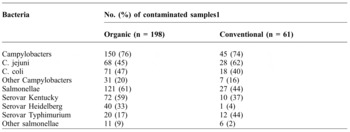
The risk of zoonotic diseases is not strictly related to any specific rearing system, however, in organic poultry production there is increased contact with external vectors. Campylobacter and salmonella are the leading sources of food borne illness in Europe. The prevalence of infection is retained at a greater level in free-range birds compared with those in enclosed housing (McCrea et al., Reference MCCREA, TONOOKA, VANWORTH, BOGGS, ATWILL and SCHRADER2006; Heuer et al., Reference HEUER, PEDERSEN, ANDERSEN and MADSEN2001). Prevalence of salmonella in broilers was found to be similar (approximately 13%) in organic and in conventional systems in the Netherlands (Rodenburg and Koene, 2007). Shenghui et al. (Reference SHENGHUI, BEILEI, ZHENG and MENG2005) studied the prevalence and antimicrobial resistance of Campylobacter spp. and Salmonella serovars in organic chickens. Most organic (76%) and conventional (74%) chickens were contaminated with Campylobacter spp.. Salmonella spp. were recovered from 61% of organic and 44% of conventional chickens. However, whereas Salmonella enterica serovar typhimurium isolates from conventional chickens were resistant to five or more antimicrobials, most isolates (79%) from organic chickens were susceptible to 17 antimicrobials tested (Table 1).
Contamination with salmonella and campylobacter in organic or conventionally produced meat chickens (Shenghui et al., Reference SHENGHUI, BEILEI, ZHENG and MENG2005).

1Twenty-seven samples contained two or more Campylobacter spp, and 21 samples had two or more Salmonella serotypes.
Apart from food safety, there is evidence that eggs and meat from pasture-raised poultry may contain additional nutritional benefits (Chaveiro-Soares et al., Reference CHAVEIRO-SOARES, BRÁS, MENDES, GAMA, PRATES, FERREIRA and FONTES2008). Kühn et al. (Reference KÜHN, SCHUTKOWSKI, KLUGE, HIRCHE and STANGL2014) found that vitamin D3 content of egg yolk was three- to four-fold higher in the groups exposed to sunlight compared with the indoor group. Additionally, access to pastures may contribute to poultry flavour and some forages and herbs may impart in distinctive flavours (Gordon and Charles, Reference GORDON and CHARLES2002).
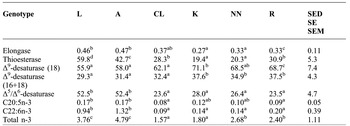
To our knowledge, the effects of pasture intake on broiler performance and meat quality in free-range systems remain largely unknown. Pasture may constitute a source of energy and protein for broilers, and also make available a range of bioactive compounds, such as many antioxidants, hypocholesterolemic and anticarcinogenic compounds (Ponte et al., Reference PONTE, ROSADO, CRESPO, MOURÃO, MIAO, GLATZ and RU2004). The intake of grass and microfauna, connected with the higher ability of slow-growing birds to elongate and desaturate essential fatty acids, can produce meat with high nutritional value (Table 2).
Main estimated indices of fatty acid metabolism and main n-3 fatty acids in breast muscle of different genotypes (Dal Bosco et al., Reference DAL BOSCO, MUGNAI, RUGGERI, MATTIOLI and CASTELLINI2012, modified).

n: 20 per group
a..d: P≤0.05. L: Leghorn; A: Ancona; CL: crossbreed Cornish x Leghorn; R: Robusta maculata; K: Kabir; NN: Nacked neck; R: Ross
In the study of Ponte et al. (Reference PONTE, MENDES, QUARESMA, AGUIAR, LEMOS, FERREIRA, SOARES, ALFAIA, PRATES and FONTES2008), free-range broilers were allowed access to subterranean or white clover based pastures and the sensory attributes, fatty acid profile and the contents of cholesterol, tocopherols and tocotrienols in meat were evaluated. Although the intake of the subterranean clover pasture had no impact on the tenderness, juiciness and flavour of meat, members of the sensory panel classified the meat from grazing broilers at higher scores for overall liking. The authors suggested that pasture intake improved meat sensory attributes, supporting the consumer assumption that poultry products derived from free-range pastured-based systems present better quality.
Napolitano et al. (Reference NAPOLITANO, CASTELLINI, NASPETTI, PIASENTIER, GIROLAMI and BRAGHIERI2013) compared conventional chickens with organic chickens from a slow- or fast-growing strain and showed that only trained panellists were able to discriminate breast meat from different sources. Meat from conventional birds was perceived more tender and fibrous than organic. However, trained panellists are able to discriminate chicken breasts from different sources, whereas untrained consumers are not. Consumer liking seems more affected by the information given on the organic production system than from the sensory differences.
Castellini et al. (Reference CASTELLINI, MUGNAI and DAL BOSCO2002) assessed the effect of organic production on broiler carcass and meat quality. Among their main findings were that the organic chickens produced carcasses with higher breast and drumstick percentages and lower levels of abdominal fat. Muscle tissue had lower ultimate pH and water holding capacity, and cooking loss, colour, shear values, iron, n-3 polyunsaturated fatty acids and oxidative status were higher, giving better sensory quality. The authors concluded that organic production system seemed to be a good alternative method, due to better welfare conditions and good quality of the carcass and meat. A negative aspect was the higher level of lipid peroxidation in the muscles, probably due to increased physical activity.
Horsted et al. (Reference HORSTED, ALLESEN-HOLM, HERMANSEN and KONGSTED2012) evaluated differences in the sensory profiles of breast meat from two conventional standard products and three organic niche genotypes reared in an apple orchard. The sensory profiles differed particularly between conventional standard broilers and organic niche broilers, although differences were found between breeds within the same production system. The study suggests that aroma and taste attributes were more important than meat tenderness for the overall liking of meat.
Conclusions
Pasture management is undoubtedly a key issue for health and welfare standards in the outdoor poultry rearing systems. When inappropriate genetic strains or pasture management systems are employed, serious welfare problems, such as higher mortality and greater rates of dermatitis and skeletal damage in organic and free-range systems, have to be expected. Welfare is likely to increase if more birds are encouraged to go outside. Consequently the qualitative traits of meat are positively affected by pasture availability mainly in term of nutritive value.