Introduction
Global aging is progressively resulting in profound economic and social consequences. As one of the major age-related condition, the prevalence and the incidence of Alzheimer's disease (AD) are increasing. By 2040, the number of people with AD is predicted to be 81.1 million worldwide (Prince et al., Reference Prince, Bryce, Albanese, Wimo, Ribeiro and Ferri2013). As the curative treatment of AD remains elusive, the majority of long-term care is provided informally by family members, friends, and neighbors who provide most of the assistance with daily activities. Informal caregiving is thus a central component of the management of AD with a huge societal, economic, and political impact, which will increase exponentially as AD continues growing as a major public health problem. Recognizing and understanding the burden of informal caregivers in AD is therefore as important as understanding AD itself.
The burden of disabilities associated with AD leads to a corresponding increased need of informal care. The impact on informal caregivers in terms of physical and emotional burden, psychological distress, and disruption of professional and personal roles (Laks et al., Reference Laks, Goren, Duenas, Novick and Kahle-Wrobleski2016) may be enormous. If caregivers became too stressed by the burden and did not receive adequate help themselves, the negative impact of caregiving could lead to deleterious outcomes such as elders’ abuse (Van Durme et al., Reference Van Durme, Macq, Jeanmart and Gobert2012) or institutionalization of patient (Bedard et al., Reference Bedard, Pedlar, Martin, Malott and Stones2000; Van Durme et al., Reference Van Durme, Macq, Jeanmart and Gobert2012). Moreover, previous data suggested that AD patients living with highly distressed caregivers exhibited higher frequencies of behavioral problems and agitation than those living with less distressed caregivers (Vitaliano et al., Reference Vitaliano, Young, Russo, Romano and Magana-Amato1993; Dunkin and Anderson-Hanley, Reference Dunkin and Anderson-Hanley1998). Thus, it is important to identify the factors related to the burden or stress of AD caregivers so they can be addressed and minimized.
Both cross-sectional and prospective studies suggest that diabetes mellitus (DM) is associated with an increased risk of dementia. The Rotterdam study was the first population based cross-sectional study to have used ëdementia’ as a variable in association with DM, and it found an association of DM with AD in subjects treated with insulin (Ott et al., Reference Ott, Stolk, Hofman, van Harskamp, Grobbee and Breteler1996). In recent years, some prospective studies showed the association between DM and an increased risk of AD (Akomolafe et al., Reference Akomolafe2006; Hayden et al., Reference Hayden2006; Irie et al., Reference Irie2008). Li et al. concluded that the incidence of any dementia (included AD) was approximately two-to three- fold higher in people with DM than in those without DM in a systematic review (Li et al., Reference Li, Shao, Gong, Lu, Liu and Li2014). Among the many comorbid conditions that are associated with AD, DM is one requiring constant supervision and support in the management. It involves monitoring blood glucose, managing medication, controlling the diet, and handling complications. It was observed that family caregivers of diabetic patients appeared to be more prone to depression and tended to have a poorer quality of life compared to controls (Anaforoglu et al., Reference Anaforoglu, Ramazanogullari, Algun and Kutanis2012). Caregivers of patients with AD and DM might have to face additional challenges in managing the treatments for both conditions as well as supervising individuals with cognitive (and often behavioral) symptoms (Feil et al., Reference Feil, Lukman, Simon, Walston and Vickrey2011). Although some reports have shown that DM is not an independent predictor of caregiver burden in community-dwelling persons without dementia (Hirakawa et al., Reference Hirakawa, Kuzuya, Masuda, Enoki and Iguchi2008), it is still possible that the metabolic condition (especially due to its need of treatment adherence) might be differently perceived by the caregiver of an AD patient.
The present study was aimed at evaluating whether DM increased caregiver burden in a large sample of community-dwelling older patients with AD. We hypothesized that the presence of DM as comorbidity imposes more burden on caregivers of patients with AD. We studied the impact of comorbid DM on total and factors scores of caregiver burden (measured by the Zarit Burden Interview, ZBI) (Zarit et al., Reference Zarit, Anthony and Boutselis1980) at baseline and longitudinally over a two-year follow-up.
Methods
Data were from the Impact of Cholinergic Treatment Use (ICTUS) study. ICTUS was a multi-center European prospective cohort study aimed at targeted patients diagnosed with probable AD according to the National Institute of Neurological and Communicative Disorders and Stroke-Alzheimer's Disease and Related Disorders Association (NINCDS-ADRDA) criteria with a Mini-Mental State Examination (MMSE) score ranging from 10 to 26, and living in the community with the presence of a well-identified, informal caregiver (Reynish et al., Reference Reynish2007). Participants were followed-up for two years with mid-term re-evaluations every six months. At the baseline assessment and at each follow-up visit, a comprehensive clinical, neuropsychological, and functional assessment was performed.
The study protocol was approved by the Ethics Committee of the Toulouse University Hospital (coordinating center) and at individual centers by local or national ethical committees. All participants or their caregivers, where appropriate, signed written consent to participate in the study.
Assessment of DM
DM was considered present if the participant was taking any antidiabetic medication (i.e. biguanides, sulfonylureas, glinides, insulin) and/or if there was self-report of a history of DM provided by caregiver at the baseline clinical assessment.
Assessment of caregiver burden
Caregiver burden was assessed twice per year using the ZBI scale. The ZBI scale comprises 22 items assessing the caregiver's perception of their caregiving (e.g. Do you feel that your relative asks for more help than he/she needs?) with the response to each item ranging from zero (i.e. never) to four (i.e. nearly always). Therefore, the total ZBI score ranges from 0 to 88, with a higher score indicating a greater degree of burden of the caregiver (Zarit et al., Reference Zarit, Anthony and Boutselis1980).
Several previous reports (Knight et al., Reference Knight, Silverstein, McCallum and Fox2000; Ankri et al., Reference Ankri, Andrieu, Beaufils, Grand and Henrard2005; Cheah et al., Reference Cheah, Han, Chong, Anthony and Lim2012) have shown that the caregiver burden is best conceptualized as a multidimensional construct. In order to reflect the effect of DM on the possible different dimensions of the caregiver burden, we chose the three-factorial model proposed by Ankri and colleagues (Ankri et al., Reference Ankri, Andrieu, Beaufils, Grand and Henrard2005) as they reported a three-factor structure for the ZBI among family caregivers in a French Caucasian population with mild and moderate AD similar to our studied participants. The three dimensions of the caregiver burden identified by the ZBI are the effect on the social and personal life of caregivers (item 6, 10, 11, 12, 13, 17; Factor 1), the psychological burden (item 4, 5, 9, 18, 19, 22; Factor 2), and the feelings of guilt (item 15, 16, 20, 21; Factor 3).
Assessment of covariates
Factors potentially influencing the studied association were considered as covariates in the statistical analyses. In particular, sociodemographic characteristics of patients, comorbidities (i.e. depression, hypertension, hypercholesterolemia, ischemic heart disease, stroke, number of diseases), medications (i.e. use of psychotropic medications, number of other concomitant medications), cognitive and functional status (i.e. Clinical Dementia Rating (CDR), MMSE and ADAS-cog, Activities of Daily Living (ADL), Instrumental ADL (IADL)), behavioral disturbances (assessed using the Neuropsychiatric Inventory (NPI)) of patients (Corte et al., Reference Corte2008), sociodemographic characteristics of the primary caregiver, the time devoted by the caregiver in the care of the participant, and the healthcare resources utilization were all considered in the present analyses as possible confounders.
Statistical methods
For the baseline analysis, comparisons between participants with and without DM were performed with the t-test for continuous variables and with X2 test for proportion. Comparisons were also performed between caregivers caring for AD patient with DM and caregivers caring for AD patient without DM. Whether or not distribution of variables fulfilled assumptions of normality were determined with One-Sample Kolmogorov–Smirnov Test and Normal Q–Q Plot in SPSS. Distribution of Gaussian variables were represented by the mean and SD (mean ± SD). If the distribution of variables did not fulfill assumptions of normality, normal transformation, or non-parametric tests was performed.
Linear mixed effects models were used to examine the scores of ZBI tendency and its different factors over time. We reconstructed data of Zarit from ICTUS Study with SPSS software version 19 at first. Then, the reconstructed data were analyzed with Model 1 and 2. Model 1 was unadjusted and included the following variables as fixed effects: the global scores of ZBI or the scores of every factor, two groups (one group with DM, another group without DM), time, and group*time interaction term. Model 2 was additionally adjusted for covariates and their interaction with time. The covariates were the baseline variables showing significant (i.e. p < 0.05) differences between AD patient with DM and AD patient without DM or between caregivers caring for AD patient with DM and caregivers caring for AD patient without DM at the univariate analyses.
Education time, living alone, comorbidity, ADAS-cog score of patients, and the number of hours per month for ADL of caregivers were included as covariates of the model.
Statistical analyses were performed using SPSS software version 19 (Chicago, IL).
Results
Participants and caregivers characteristics
A total of 1,375 AD subjects were recruited in the ICTUS study. However, the present analyses were conducted on 1,264 subjects after exclusion of participants with missing data for ZBI. In other words, 111 subjects with missing data for ZBI were excluded.
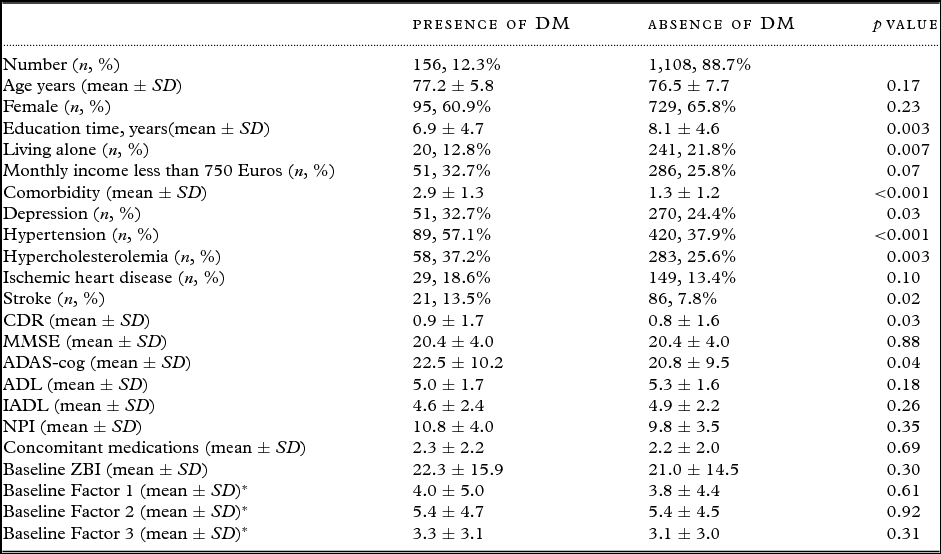
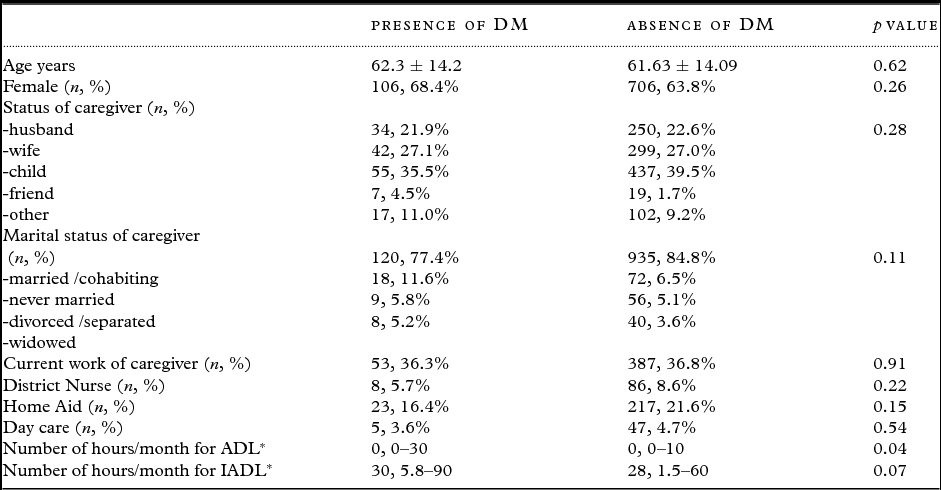
The mean age in this sample was 76.6 (SD = 7.5) years old and 65.2% patients were women. A total of 156 patients (12.3%) had DM. Main characteristics of participants according to the presence of DM were presented in table 1. It showed that AD patients with DM had less education time, less ratio of living alone, more comorbidities, and poor cognitive function (measured by ADAS-cog), compared with those without DM. Caregivers had a mean age of 61.7 (SD = 14.1) years and 64.3% of caregivers were women. The baseline characteristics of caregivers were presented in Table 2. Between caregivers caring for AD patient with DM and caregivers caring for AD patient without DM, there was no difference in the age, gender, relationship with patients, marital status, and current job. The health care resource, such as district nurse, home aid, and day care, which were utilized by patients, did not differ between patients with DM and patients without DM. However, the numbers of hours per day of aid for ADL activities of patients were different between patients with DM and patients without DM.
Baseline characteristic of subjects

*Factor 1: The social and personal life of caregivers.
Factor 2: The psychological burden of caregivers.
Factor 3: The feelings of guilt.
Baseline characteristics of caregivers

*Abnormal distribution, non-parametric tests were done, so median and interquartile range were provided.
Caregiver burden
The baseline ZBI score in our sample was 21.14 (SD = 14.61). We observed that 54.3%, 34.2%, 10.5%, and 1% of the caregivers had absent or mild burden (score < 21), mild to moderate burden (between 21 and 40), moderate to severe burden (between 41 and 60), and severe burden (> 60) (Zarit et al., Reference Zarit, Anthony and Boutselis1980), respectively.
The caregivers of patients with DM had ZBI scores at the baseline similar to those caregivers of non-diabetic patients (22.34 vs. 20.97, p = 0.30, 95% CI: −3.98, 1.22).
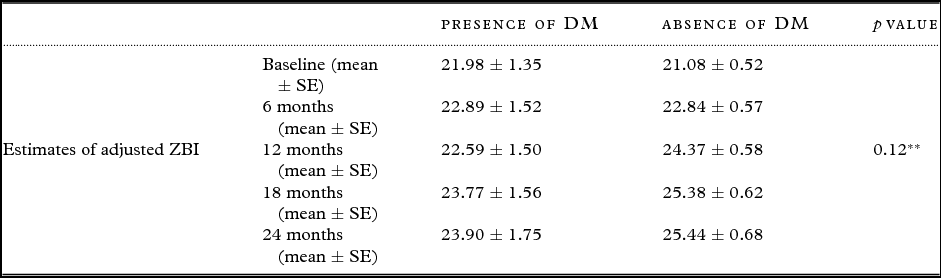
In the entire cohort, the unadjusted linear mixed model indicated that the score of ZBI increased by 4.65 points over a 24-month follow-up (p < 0.001, 95% CI: 22.84, 28.67). The presence/absence of DM did not affect this pattern (p = 0.54, 95% CI: −1.66, 3.18). After taking into account possible confounders (i.e. education, living alone, comorbidity, ADAS-cog score, and the number of hours per month for ADL), the ZBI score was still increasing of 2.98 points during the 24-month follow-up (p = 0.015, 95% CI: 0.58, 5.39), with no significant effect of the DM (p = 0.115, 95% CI: −0.29, 2.70). Table 3 reported the estimates of ZBI using repeated measures linear mixed effects models, showing adjusted ZBI of caregivers of patients with or without DM at the different study assessment visits.
Estimates of adjusted ZBI*

*Results from linear mixed effects models showing the calculated estimates of adjusted ZBI of caregivers of patients with or without DM at the different study assessment visits. Education time, living alone, comorbidity (Hypercholesterolemia, Hypertension, Ischiemic heart disease, Depression, Stroke, Fall, Seizures), ADAS-cog score, and the number of hours per month for ADL were included as covariates of the model.
**The change of adjusted ZBI over a 24-month follow-up did not statistically differ between caregivers of patients with DM and caregivers of patients without DM.
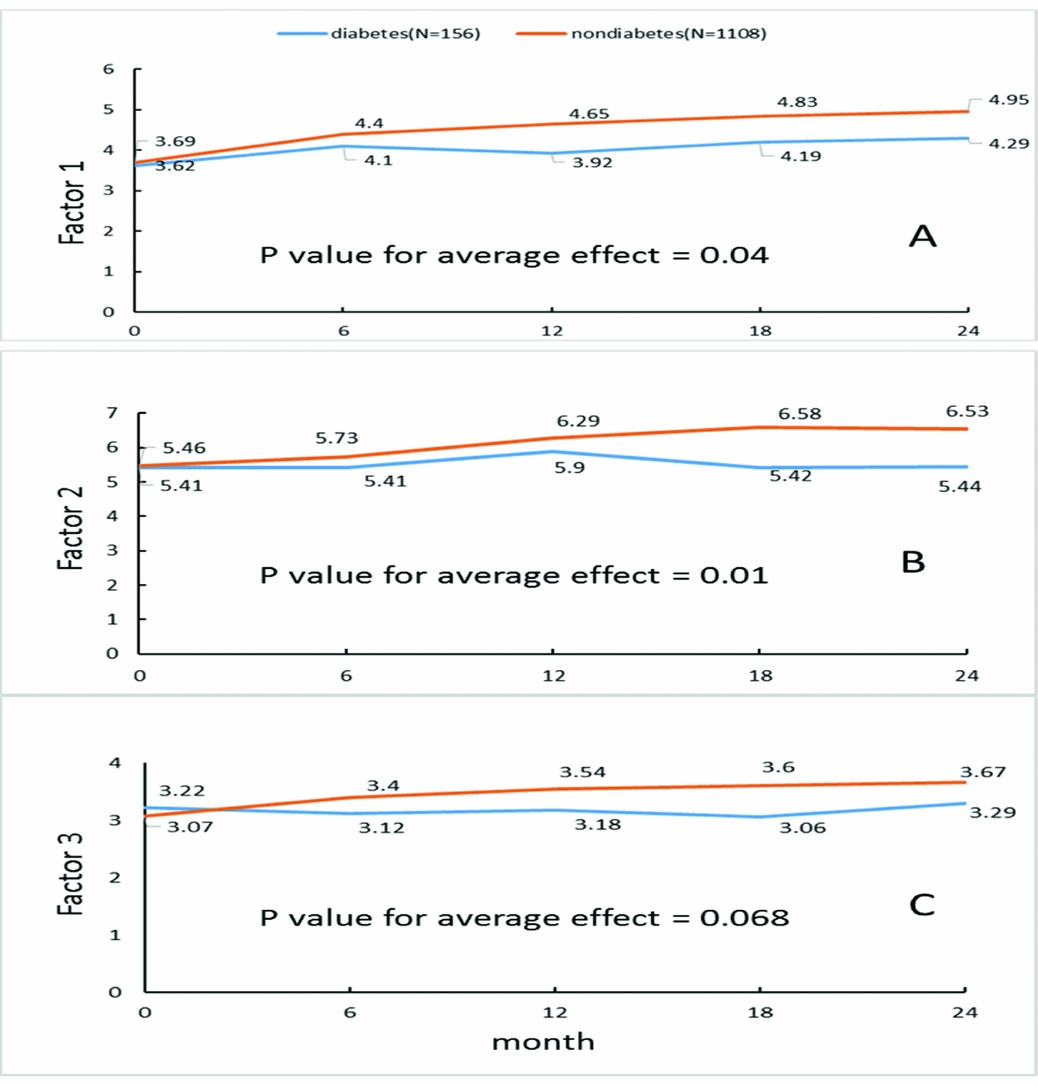
At baseline, the scores of the three different factors of ZBI were similar between caregivers of patients with DM and caregivers of patients without DM (p = 0.61, 95% CI: −0.59, 1.00; p = 0.92, 95% CI: −0.74, 0.82 and p = 0.31, 95% CI: −0.25, 0.79). Similarly, the unadjusted linear mixed model showed that DM was not determining any significant difference in the score of any factor. However, when the model was adjusted for potential confounders, DM was shown to positively affect the scores of factor 1(the social and personal life of caregivers) and 2 (the psychological burden) (p = 0.04, 95% CI: 0.01, 0.95 and p = 0.01, 95% CI: 0.15, 1.05). In the group of caregivers of diabetic patients, the scores of factor 1 and 2 increased more slowly than the scores in the group of caregivers of non-diabetic patients over the two-year follow-up (Figure 1(a) and (b)).
Results from general linear mixed models showing the calculated estimates of adjusted scores of factor 1 (the social and personal life of caregivers) (a), factor 2 (the psychological burden of caregivers) (b), and factor 3 (the feelings of guilt) (c) of ZBI at the different study assessment visits according to the two group. Education time, living alone, comorbidity (Hypercholesterolemia, Hypertension, Ischiemic heart disease, Depression, Stroke, Fall, Seizures), ADAS-cog score, and the number of hours per month for ADL were included as covariates of the model.

Discussion
Our study presented data from a representative sample of community-dwelling patients with AD with the aim of exploring whether DM might play a role in the caregiver's stress. Our initial hypothesis was that the presence of DM as comorbidity imposed more burden on caregivers of patients with AD. However, the hypothesis was not supported by our results. In fact, no significant difference was reported for the global ZBI scores between the caregivers of diabetic and caregivers of non-diabetic patients over the two-year follow-up. And further analysis indicated that in the group of diabetic patients, the caregivers’ social and personal stress and psychological burden increased more slowly than those in the group of non-diabetic patients.
We cannot exclude that our negative findings might be due to a limitation of the ZBI. Due to its excellent internal consistency (Zarit et al., Reference Zarit, Anthony and Boutselis1987; Majerovitz, Reference Majerovitz1995), user-friendliness, and extensive validation, the ZBI remains the most consistently used instrument caregiver burden in dementia (Bedard et al., Reference Bedard, Pedlar, Martin, Malott and Stones2000). It has also shown to provide important insights about longitudinal modifications occurring over time (Zarit et al., Reference Zarit, Anthony and Boutselis1987; Bedard et al., Reference Bedard, Molloy, Pedlar, Lever and Stones1997). However, the ZBI has also been criticized for treating the caregiver burden as a unidimensional variable (Robinson, Reference Robinson1983). Division into multiple dimension can provide more accurate and more comprehensive understanding of caregiver burden than a unique observed score (Lau et al., Reference Lau, Chong, Ali, Chan, Chua and Lim2015). In this context, several studies have examined the factor structure of this instrument in different ethnic samples (Knight et al., Reference Knight, Silverstein, McCallum and Fox2000; Ankri et al., Reference Ankri, Andrieu, Beaufils, Grand and Henrard2005; Cheah et al., Reference Cheah, Han, Chong, Anthony and Lim2012; Lim et al., Reference Lim2014). Interestingly, Ankri and colleagues (Ankri et al., Reference Ankri, Andrieu, Beaufils, Grand and Henrard2005) reported a three-factor structure for the ZBI among family caregivers in a French Caucasian population with mild and moderate AD. Because of the similarity of our studied participants to those of Ankri's study, we used the three-factor model from Ankri's study to evaluate the effect of DM on these three dimensions of the ZBI, and indeed found that DM was associated with a less steep increase of the caregiver's stress for two factors (i.e. the consequences on the social and personal life of caregivers, and the psychological burden). In other words, although the findings excluded a specific global burden brought by DM on the caregiver's feelings, it was still possible that the diabetic comorbidity might modulate the perceived burden under some perspectives.
A possible explanation for the overall negative findings we obtained was that for the patients with AD and DM simultaneously, the burdens perceived by their caregivers were not the simple addition of respective burden from DM and AD. In AD, the severity of psychiatric symptoms, the behavioral disturbances, the decreased function, and the patient's quality of life represented the strongest determinants of the caregivers’ perceived burden (Mohamed et al., Reference Mohamed, Rosenheck, Lyketsos and Schneider2010). The burden of standard diabetic care (e.g. glucose monitoring, medication management, diet control) may likely be not relevant/evident in front of the one caused by the cognitive and behavioral issues. It was reported by Gillette-Guyonnet et al., (Reference Gillette-Guyonnet2000) that caregivers of AD patients may not be willing to invest adequate resources to allow AD patients to properly nourish themselves when they considered themselves overburdened. It could be speculated that caregivers may ignore or avoid the burden for self-protection when they faced the overwhelming burden.
Hence, Test and Stein presented that the instruments assessing burden should be divided into objective and subjective burden measures (Test and Stein, Reference Test and Stein1980). In fact, it was reported that DM imposed a substantial burden on informal caregivers of non-demented individuals, both through objectively increased costs as well as the significant amount of time spent for compensating the patients’ functional limitations (Langa et al., Reference Langa2002). In the present study, it was consistently shown that the group of patients with DM required a higher number of hours per month of support in ADL compared to patients without DM. However, it seemed that the imposed objective burden by DM was not associated with a concomitant significant difference in subjective burden as measured by ZBI.
On the other hand, the clinical diagnosis of AD for all patients was based on the NINCDS-ADRDA criteria in ICTUS, not including neuroimaging and not confirmed neuropathologically, only be designated as “probable.” However, this criteria is the most widely used to diagnose AD by clinician. The latest revision from the International Working Group have demonstrated that typical AD can be made in the presence of an amnestic syndrome associated with various cognitive or behavior changes, and at least one of indicative changes of in-vivo AD's pathology such as a CSF profile consisting of low Aβ1–42 together with increased T-tau or P-tau concentrations, or an increased retention on amyloid PET (Dubois et al., Reference Dubois2014). For the older persons with DM, cerebral microvasculature pathology and its interaction with neuritic plaques and neurofibrillary tangles contributed together to cognitive impairment (Beeri et al., Reference Beeri2005). The group with DM may have more vascular pathology contributing to the initial diagnosis and severity of dementia, but a lower burden of AD pathology. Some previous studies found that DM was associated with less cognitive decline in AD patients (Sanz et al., Reference Sanz, Andrieu, Sinclair, Hanaire and Vellas2009; Dominguez et al., Reference Dominguez, Marschoff, Gonzalez, Repetto and Serra2012; Ascher-Svanum et al., Reference Ascher-Svanum2015) and the possible explanation for this relationship was the failure to differentiate the mixed dementia from AD. Our current study had found that diabetic patients were more likely to have vascular risk factors, such as stroke, hypertension, and hypercholesterolemia, compared with non-diabetic patients. Therefore, diabetic older persons are more likely to have mixed or vascular dementia than those without DM. “Probable” AD patient with diabetes include more pathologically non-AD patients than “probable” AD patient without diabetes. Recent study found that the caregivers of patients with AD showed a significantly higher burden level than those for vascular dementia patients (D'Onofrio et al., Reference D'Onofrio2015). So it can be inferred that the failure to exclude mixed dementia in ICTUS may lead to the finding that DM was associated with a less steep increase of the caregiver's social and personal consequences and psychological burden.
In the unadjusted or adjusted models, DM had no effect on factor 3 (Figure 1(c)), the feeling of guilt (should be doing more, could do a better job in caring). It was showed that the feeling of guilt was mainly related to the family status of caregivers. Prior work demonstrated that child caregiver had higher scores than spouse caregiver (Ankri et al., Reference Ankri, Andrieu, Beaufils, Grand and Henrard2005; Lim et al., Reference Lim2014). In our sample, there was no difference in the family status of caregivers between caregivers caring for AD patient with DM and caregivers caring for AD patient without DM.
A limitation of our study might be identified in the lack of information about the severity of DM, including the time from the first diagnosis, duration of antidiabetic medications use, glycemic control, complications, and adherence to treatment. These factors might have been relevant for the present analysis because of potentially involved and affecting the relationship between DM and caregiver burden.
It had to be noted that our results were derived from a sample of caregivers with mild or moderate degree of burden. So we cannot extend these findings to those with more severe burden.
The number of missing data in our sample might be considered a further limitation of the study, although this is a common problem in long-term studies of older persons with dementia. However, the adopted statistical approach (i.e. linear mixed models) might have partially reduced this issue. These models are advantageous because they use all available data during follow-up and can handle missing data more appropriately than traditional models.
In conclusion, DM was not associated with the global ZBI score of caregivers in AD patients. However, on the basis of factor structure of the ZBI, DM was shown to have effect on the caregivers’ daily social and personal life and psychological burden. Division into factors can provide better understanding of burden of caregivers. More exploratory analyses of factor structure of ZBI should be conducted in order to find the fitted and consistent models. Moreover, further research is needed to make it clear why DM does not increase the burden and stress of caregivers of AD patients. That may help clinicians to properly focus their intervention on more specific aspects of burden which might otherwise be neglected or overemphasized.
Conflict of interest
Dr. Matteo Cesari has received honoraria by Pfizer and Nestlé for presentations at scientific meetings. He has also received a research grant by Pfizer for the conduction of a research project. Dr. Cesari is Workpackage leader and one of the coordinators of an Innovative Medicines Initiative-funded project (SPRINTT) in which several members of the European Federation of Pharmaceutical Industries and Associations (Sanofi, GSK, Novartis, Lilly, Servier) are part of the consortium. Dr. Bruno Vellas has received Gerontopole Research Grants by Abbvie, Affiris, Avid, BMS, Eisai, Elan, Envivo, Exhonit, Genentech, GSK, Ipsen, Lilly (2015), Lundbeck (2014), Medivation, MSD (2015), Nutricia, Otsuka (2015), Pharnext, Pfizer, Pierre-Fabre (2014), Regeneron (2014), Roche (2014), Sanofi (2014), Servier, TauRx Therapeutics, and Wyeth. Dr. Vellas served as one of the scientific board members for the following companies: Biogen (2014), GSK, Lilly (2015), Lundbeck (2014), Medivation (2015), MSD (2015), Nestle (2015), Nutricia, Pfizer, Roche (2015), and Sanofi (2014). All other authors have no conflicts of interest to declare.
Description of author's roles
Jun Li, Matteo Cesari – Study concept and design. Natalia Del Campo, Sandrine Andrieu – acquisition of data. Jun Li, Matteo Cesari – analysis and interpretation. Wee Shiong Lim, Natalia Del Campo – critical revision of the manuscript for important intellectual content. Bruno Vellas, Birong Dong – study supervision.
Acknowledgments
Data are from the ICTUS study. The authors thank the ICTUS/DSA group: ICTUS study Group: Vellas B., Reynish E., Ousset PJ., Andrieu S. (Toulouse), Burns A. (Manchester),Pasquier F. (Lille), Frisoni G.(Brescia),Salmon E. (Liège), Michel J.P., Zekry D.S. (Geneva), Boada M. (Barcelona), Dartigues J.F. (Bordeaux), Olde-Rikkert M.G.M. (Nijmejen), Rigaud A.S. (Paris), Winblad B. (Huddinge), Malick A., Sinclair A. (Warwick), Frölich L.(Mannheim), Scheltens P. (Amsterdam), Ribera C.(Madrid), Touchon J. (Montpellier), Robert P. (Nice), Salva A.(Barcelona), Waldmar G.(Copenhagen),Bullock R.(Swindon), Costa-Tsolaki M. (Thesaloniki), Rodriguez G. (Genoa), Spiru L. (Bucharest), Jones R.W. (Bath), Stiens G., Stoppe G. (Goettingen), Eriksdotter Jönhagen M. (Stockholm), Cherubini A. (Perugia), Lage P.M., Gomez-Isla T. (Pamplona), Camus V. (Tours), Agüera-Morales E., Lopez F.(Cordoba). DSA Group: Andrieu S., Savy S., Cantet C., Coley N. The work was supported by the National Natural Science Foundation of China (Grant No. 81371528 and No. 81300260), the Sichuan Provincial Foundation of Science and Technology (Grant No. 2013SZ0047 and 2014SZ0044) and International Visiting Program for Excellent Young Scholars of Sichuan University.