It is far easier to talk about loss than it is about love. It is easier to articulate the pain of ove’s absence than to describe its presence and meaning in our lives.
—bell hooks ([Reference hooks2000] 2001:xxvi)
To love is to struggle, beyond solitude, with everything in the world that can animate existence.
—Alain Badiou ([Reference Badiou and Truong2009] 2012:104)
How might one sustain love, particularly of an artistic practice, in a loveless world; and how, in turn, might this help to maintain a commitment to a sense of justice and social change?Footnote 1 I am, of course, not alone in my interest in the problem of love in current times and, in fact, I am merely following a burgeoning interest—in both love and related concerns with friendship and our emotional connection to others—that has become a preoccupation of many political and cultural theorists. This covers work as broad as Todd May’s analysis of the importance of friendship in a time of neoliberal economics (2012) to Lauren Berlant’s edited collection on the politics of compassion (2004). However, the philosophy of love has a far more extensive genealogy — going back too far to trace here — which has attempted to articulate love’s significance to people and the societies they inhabit. These debates have troubled thinkers as far back as Socrates, through the love disasters of Kierkegaard in the 19th century, to the search for “authenticity” in love in the existentialism of Simone de Beauvoir and Jean-Paul Sartre (not least in their vision for the love between them). While these antecedents are important, I will be drawing here on writers who have commented on the role of passions and emotions, and in particular love, more recently. They, in different ways, have been influenced by the longer history of writing on love but are applying it in diverse ways to more contemporary concerns. Key here will be Martha Nussbaum’s argument that “love matters for justice” (2013:380), Alain Badiou’s view of love as a “minimal communism” ([2009] 2012:90), Luc Ferry’s “humanism of love” (2013:67), and then the plea in my opening quotation from bell hooks for us to find the language for describing love’s presence in our lives. While these authors do not necessarily agree with each other, they provide some touch points for how attention to love might, in Badiou’s words, “animate existence” in a way that is important for the troubled times in which we live.
Part of my concern here is how I fell out of love with my work in the field of applied or social theatre, and how more recently I have worked to rekindle some of my passion for it. This disengagement happened leading up to and during a theatre and education project in the eastern Democratic Republic of the Congo (DRC) around 2011. I’ve tried to diagnose that process and suggest how we all might hold onto a love that should animate and help sustain socially engaged theatre and performance programs. While as educators, activists, and performance makers we might be comfortable acknowledging the importance of our sensory engagement to practice, the case here is that much development of our professional lives, including our teaching and scholarship, disconnects us from this embodied relation and is premised on a validation of our more cerebral, detached, and dispassionate connections to the work. The suggestion here is that if, as Nussbaum tells us, love does matter for justice, we need to nurture it both for the challenge it offers to our cruel times but also for how it might sustain our commitment to that challenge.
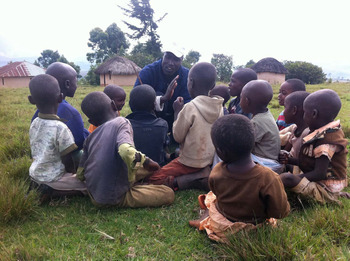
Between 2008 and 2011, I was supporting a theatre program that used short plays performed by community enthusiasts, teachers, and artists in local churches in a chronically poorly served and war-affected province of the DRC called South Kivu (fig. 2). This was part of my broader work with a project called In Place of War that documented and supported arts programs and artists in contemporary war zones. The plays sought to raise the issues of girls’ attendance at local schools, with the ambition of starting a community dialogue that might encourage families to send their girl children to the new schools that the broader project was building. In an area with very limited educational provision, made worse by the years of conflict in the region, families tended to prioritize their boys for any education opportunities that did exist. The project director was a Congolese man, Eraste Rwatangabo — a beautiful person who ran the program with an expertise, dedication, and sense of humanity that in my experience of working in international settings, let alone war zones, were vital qualities that were, sadly, too often missing in many of the senior people with whom I had worked. While juggling multiple demands, hugely complex logistics, and the ever-present dangers of the eastern Congo, Rwatangabo always had a moment for stopping and speaking to members of the community in a way that showed no preoccupation with matters of status or hierarchy (fig. 3). He always shared a smile, a warm comment, and had a wonderful ability to engage with children, who were the primary focus of the project. Throughout my time working on the project, Rwatangabo was my host, guide, and companion, negotiating long journeys, nights alone on the high plateau of South Kivu province, and the ever-challenging demands of performing shows that proposed attention to women and girls’ rights. He visited me in Manchester where I hosted him, showed him my city, and introduced him to friends and family. This article is dedicated to him on two distinct levels: first, Eraste—a name whose Greek origin signifies someone loved or beloved—it is clearly Eraste as love that the article is about, and how he inspired in me a renewed sense of the good of the work in spite of the difficulties presented by the context. My reflections here, now eight years on, are a remembrance of Eraste that has allowed me to sketch a way to fall back in love with a community-based theatre practice. The second aspect of this is harder to write about, and apologies in advance for the explicitness of the account that follows.
(previous page) Eraste Rwatangabo takes time out to entertain children. South Kivu, DRC, June 2011. (Photo by James Thompson)

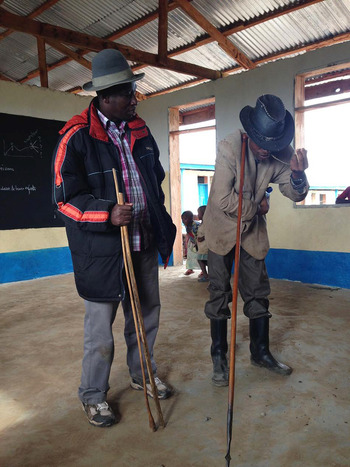
Theatre workshop in South Kivu, DRC, June 2011. (Photo by James Thompson)

Eraste Rwatangabo showing the Manchester City Football Club top gifted by the author. Uvira, South Kivu, DRC, June 2011. (Photo by James Thompson)

Eraste was killed in the course of the project and, therefore, to write of him, to write of love, is also to write about losing him. On 14 October 2011, Eraste was traveling in the project vehicle on a journey I had made three months earlier with him and the team, a 10-hour drive from the low-lying town of Uvira, next to Lake Tanganyika, to the high plateau area of the province of South Kivu, which was the location of the project’s main activities. On route the vehicle was attacked by a local militia group called Mai-Mai Yakutumba. My knowledge of what happened next comes from Antoine Munyiginya, who survived and lived with my family and me in Manchester while undergoing treatment for his injuries. The driver, Musore, who was also my driver during each visit to DRC, was killed by the shots that hit the vehicle to make it stop. The majority of those in the vehicle, including Eraste, were from the Congo’s “Tutsi” Banyamulenge community; the four people who were not from the Banyamulenge community were told to go and they ran away. In a country affected by the repercussions of the 1994 anti-Tutsi genocide in neighboring Rwanda, the Banyamulenge were still frequent targets of the militia groups allied to the original genocidaires. Each Banyamulenge who remained was led away and shot. One person survived by simply running into the jungle; one older woman survived, it is unclear how, with several injuries; and Antoine himself, having received a bullet through his elbow when the vehicle was attacked, survived when an armed man instructed to shoot him inexplicably missed his head. He crawled into the bush leaving the other colleagues: the director, Eraste; the project’s deputy education manager, Kandoti Tite; and another teacher trainer, Gifota Edmond, mortally wounded. Three other occupants of the car, including the sister of another colleague and the father-in-law of Musore, were also killed. A few hours later, still hiding in the bush where he had crawled, Antoine watched as the militia returned and finished off with their machetes those by the vehicle who were not yet dead.
Obviously, to write of love in light of this account could seem disrespectful. Clearly many writers have struggled with and have been criticized for their tone when describing terrible events. Hannah Arendt, most famously, was deemed heartless in the way she wrote of the Holocaust in her account of Eichmann’s trial ([1963] 1994). She responded by questioning “the role of the ‘heart’ in politics” and suggested it can obscure more than reveal the truth ([1963] 1994:247). While I do not aim for the sparse prose she used, and do not agree completely with her belief that philosophy should avoid an emotional register when engaging with horror, I do believe that writing in a somewhat pared down way is not a denial of one’s love or a sign of heartlessness. Ending her chapter on the “scandal” of Arendt’s “tone,” Deborah Nelson writes, “suffering is so much part of her notion of thinking that only by feeling pain can one know that one loves the world properly” (2004:241). Here I seek to strike that balance, to demonstrate love for the world properly. I hope this article in no way diminishes the event and its impact on the families and friends of those who died, and the wider Banyamulenge and Congolese community.
I had the privilege of attending the memorial service a week after the killings. I spent several days with friends, family members, and colleagues. While I have written before about Antoine’s six-month recuperation in Manchester (Thompson Reference Thompson2015), and certainly the care for him inspires some of my comments about vocation, here I mean to make explicit that while losing seven people in the vehicle in the massacre was appalling, it was the loss of Eraste that affected me the most. I struggle to find a way through that loss of love and explain how finding a space for the presence of love in work and in daily life has become my remembrance of him, and I hope, a modest contribution to the literature on love that suggests its importance in our lives.
I have been a writer and practitioner in the field of applied or social theatre my whole professional life. This has involved early years of running an organization dedicated to creating theatre programs for the prison and criminal justice system, and more recently exploring the work of artists in contemporary war zones. I have many excellent colleagues locally in Manchester who have partnered in this work and who have also contributed to the expansion of the boundaries of what might be called applied theatre, community-based performance, socially engaged arts, or any of the other names given to this type of practice. One colleague in Manchester, Simon Parry, in a tongue-in-cheek comment to those of us developing a distinctively Manchester feel for the field, noted that we rarely said anything positive about the practices to which we were apparently dedicated. Our accounts of practice were, in his words, more often downbeat. We were, for Simon, the “miserablist” school of applied theatre (2011). Of course, being miserable and being in love might not necessarily be mutually exclusive emotional states, but for me at least he was accurately noting that there was something of the joy and pleasures of theatre practice that was difficult to locate in our accounts.
I now see this turn to the miserable, the fact that it is “far easier to talk about loss” in hooks’s words, as having been prompted by three different shifts over time: (1) from eulogy to criticism; (2) from vocation to professionalism; and (3) from solidarity to impact. While I am claiming these happened in my own applied theatre scholarship, the broader case I am making is that these shifts are experienced across multiple forms of disciplinary and professional practice. At the level of disciplinary orientation, Robert Solomon has noted this in his own area of philosophy where “what had originally been conceived of as the love of wisdom had become a tedious technical enterprise” (2002:xiii). In our present climate, this turn is unfortunate, and ultimately unhelpful. The three transitions — from eulogy to criticism; from vocation to professionalism; and from solidarity to impact—have taken many of us who claim to be committed to social justice and more equitable communities to uncharted territories. How might we resist some of the implications that arise from these movements? How might we revive the joy, the sense of love, that is vital for the health of our respective fields but perhaps also vital for a progressive politics in a singularly joyless world? How might these stages — the eulogy, the vocation, and the sense of solidarity—reinvigorate a love for our field, and perhaps a more impassioned commitment to social change? The inspiration from Eraste and the experience of the project in the DRC provides a backdrop for these comments.
When I was first in the village of Minembwe, in the high plateau region of South Kivu, I was staying in a room in the Catholic seminary next to the small, rough-and-tumble Catholic church (fig. 4). Eraste, a few others, and I were the only people staying there. We slept in sleeping bags under mosquito nets in a somewhat uncared for building with no electricity or running water, a situation common across the region and not specific to our accommodation. The days were spent visiting local community projects, new schools, and planning the theatre training courses that I would be running. The evenings were candle- and torchlight opportunities for reflecting, chatting, and endlessly staring at the night sky. I can remember confessing to Eraste during one of those evenings that I was uncertain about the theatre work, unsure it was doing what we had planned, and concerned about some of its problems and restrictions. I did not want to alarm him about the project, but I expressed my sense of unease about the practice that I was developing—perhaps a typically miserablist account of what might be accomplished. Eraste was dismissive. Not in a negative sense, but in the spirit of someone light-heartedly rebuking me for thinking any of this was really a problem. In flickering candle-light, I remember him giving me a lecture on the history of the Banyamulenge in the region, the terrible impact of the different civil wars—which had been made very concrete that day in meetings with local widows’ associations (fig. 5) — and his overriding desire to emphasize the good. Somehow dwelling in the multiple and concrete problems of the region, for him, was admitting their hold on the community, their victory. He insisted on giving attention to numerous examples of positive human endeavor, and saw his role as bringing these to life through talking about them, supporting them, and keeping them in full view. It seemed that focusing on the problems meant you became undone by them. To paraphrase him: We know the terrible things that have happened and the problems that are being faced by the communities in the high plateau—now let’s give due regard to the good, for that is what will sustain people. I took the rebuke to heart and my diary had the expression “search for the good” underlined.
Catholic Church, Minembwe, South Kivu, DRC, July 2010. (Photo by James Thompson)

Widows’ association gathering, on the high plateau, South Kivu, DRC, July 2010. (Photo by James Thompson)

Eulogy to Criticism
The philosophical overemphasis on critical thinking had taken a devastating toll on the emotional engagement, personal devotion, and commitment that lies at the heart […] of almost every beginning philosophy student.
—Robert Solomon (Reference Solomon2002:xiv)
As academics we are trained to be critical. We are schooled in finding fault, in doubting given truths, and challenging certainties. There is a presumed virtue in our ability to question comfortable ideas. As practices develop, this is important; ideologies, ethics, and politics in different fields need challenging. Being critical can strengthen and improve both practice and our understanding of that practice. In applied theatre it is relatively easy to show that many early accounts of projects tended to be somewhat “eulogistic” in their tone, and that over-zealous confidence in the transformative potential of participatory theatre perhaps should have been taken down a peg or two. As a given field matures, hyperconfident accounts draw incisive commentary that demonstrates weaknesses, ethical problems, or elisions that need to be acknowledged. Gradually, participants in that field move from a eulogistic phase to a more critical one. However, this critical phase tends to shift towards persistent fault finding, producing its own set of elisions. The “overemphasis on critical thinking,” in Solomon’s word, can take a “devastating toll.” Critical attention to the mistakes, the faults, produces a slow marginalization of, and at worst a gradual obliviousness to, the successes. The shift from eulogy to criticism can mean that we can no longer see the good, and while we might disparage over-confident eulogy, with this shift comes the danger of failing to register the positives of practice.
Another danger lies in this shift from eulogistic accounts to the moderate exercise of critical appreciation to full-throated critique at all costs: these critics — whether targeting themselves or others — can develop a sense of superiority where academic prowess and expertise are used to disparage. This brings to mind the Ghanaian proverb: “A person who rides the donkey does not know the ground is hot.” Maybe the shift I am noting here is a slow process of getting up onto a donkey in order to gain some perspective, but then gradually becoming a little too comfortable in this elevated position that allows us to look down on a field of practice from this “critical distance.” A claim of objectivity can mask a sense of superiority. The word hot in the proverb is crucial. It is not that the heat of the ground represents a more accurate way of understanding our work and the world in which it is situated, but rather refers to a feeling of being in touch that may be lost, and a feeling of warmth—an affectionate connection to the work—that is diminished. Applied theatre practitioners and scholars have offered many impassioned and vital reflections on the field that have looped back as improvements in the respectful practices in many diverse communities. So this is not my own paradoxical fault-finding in my academic colleagues. It is a plea to remember that warmth, so we can maintain a capacity both to talk with warmth about our field, and also to talk of warmth—to engage the positive, heated, powerful moments that energize what we do.
To link this to my particular area of practice means considering the demands of conflict resolution and peacebuilding. One aspect of peacebuilding is finding points of connection between antagonistic parties. Processes seek common interest, however tentative, and areas of consensus, however partial. At some point in peacebuilding work, in what can be a long-term, drawn-out confidence-building process, the default of distrust needs to be overcome, and the good of the other needs to be acknowledged, however compelling the tendency to be critical might be. If we have experienced a shift from eulogy to critique in academic practice, the war zone teaches us that we need to hold on to the ability to appreciate the good, however easy it might be to shift into critical dismissal. I might be highly skilled at finding fault in an opposing party, but success in overcoming situations of violent conflict is more often found by emphasizing points of connection, agreement, or consensus, however tenuous they might appear. War zones for me, and perhaps many other situations for colleagues across the broader field of community-based practice, might necessitate a more mixed register whereby a default critical disposition also takes into account all that is good in a situation.
So sharpening my pencil for a miserablist account of the theatre project in the DRC was a product of that shift in research, where my only perspective demanded an eye for the weaknesses and flaws. Eraste brought that up short and asked me to look again. Look for the love! It was too easy to point out that the plays were not as participatory as we claimed; to question the role of evangelical Christianity that constrained much of what could be said; to challenge the limitations of performances that could only happen in churches; or knowingly to illustrate how the dialogues within communities were too often dominated by men. But these critiques did not help develop the project — although perhaps I could have published a miserable research article by developing a well-argued account of them. Taking up Eraste’s inspiration (rather than the easy targets of the donkey rider) would have meant shifting my perspective to examine how groups negotiated the real constraints and to think seriously how we captured the small extraordinary moments that were threaded through this project. Confidence to focus on the good — often the “in spite of” outcomes — now in hindsight makes me want to acknowledge a human capacity to meet extraordinary challenges through creative and constructive means. In that small corner of South Kivu, girls were now going to school, people were congregating to discuss gender issues, and theatre and the arts were accepted as vehicles for debate, discussion, and learning. Searching and hoping to explain the good of a project reawakens my commitment to it, and builds my optimism about the community’s capacity to recreate a less troubled world. Eraste demonstrated and argued for a practice of being with or alongside — caring for the emergence of the project—not being above and beyond it. It was, in Nussbaum’s words, a form of “imaginative engagement with the lives of others […] nourished by love” (2013:380). She goes on to write that because this matters “especially when justice is incomplete and an aspiration” (380), it is important to emphasize that this kind of optimistic engagement, therefore, is not a suspension of the commitment to a more just outcome, but a reanimation of it.
The first suggestion here is, therefore, that while we might have moved from the eulogy to the critical phase and this might have been the product of many reasonable assumptions, by completely deserting the register of eulogy we fail to recognize the creative capacities of communities, and are blind to the ways in which artistic endeavor can open up moments that suggest something hopeful. To create a more beautiful, artful, and love-filled world, which I would argue are all elements of a more just one, we need to start writing about those moments, rather than hoping that more equitable social arrangements will be built from academic attention to the miserable. To defeat bell hooks’s “loss,” we need to ask ourselves why we keep writing about it rather than learning to identify and speak of love. We have a limited vocabulary for the good in community-based performance and this is something we should be searching for and fashioning. If we seek a world of joy, celebration, and beauty, we need to question why we are far more fluent in speaking of violence, trauma, and horror.
From the Vocational to the Professional
For those of us involved in the arts, in activism, and in education, it is important to acknowledge that motivations shift over time, from when a passion becomes a vocation and from when a vocation morphs into a job, career, or profession. If we are lucky, that is, to be in an occupation that is in any way tied to our personal interests. Of course, there are many tensions in these shifts, perhaps individually from a sense of freedom to the constraints of professional practice, or institutionally from radical new fields of practice to gradually developing codes of conduct and risk management procedures. The gradual “professionalization” of a field is a process familiar to many, whether teachers, aid workers, peacebuilders, performance studies academics, or community-based artists. The shift might be welcomed or resisted. Over-zealous amateur enthusiasm might produce confused, ethically tenuous, and at times downright dangerous practices, and therefore the move to more professional training, support, and structures could have profoundly good intentions. However, the argument here is that this shift also brings with it the risk of losing something, and like the move from eulogy to criticism outlined above, it is a shift that can diminish some of those qualities that sustain and give strength to the practice in the first place. This is, therefore, not a validation of unfettered voluntarism against professional constraint, rather a suggestion that many of the qualities of vocational commitment need to be acknowledged, valued, and somehow maintained.
The DRC experience once again brought the shift I am explaining here into sharp focus. After the attack, I visited my colleague Antoine in the hospital. The doctors there said they had no ability to repair his shattered elbow, so we resolved to find a way to get his arm treated. Over a period of weeks, with multiple colleagues, we worked to get Antoine to the UK. He stayed in my house for six months while receiving treatment in a Manchester hospital. While I know I did not weigh this up too closely at the time, there was a straightforward trade-off here between personal commitment and professional responsibility. I just assumed that we were doing the right thing, and not because it was professionally correct. The boundary between professional and personal was blurred throughout this whole period in a way that forced me to search for a way of speaking simultaneously of the politics of both. It also encouraged me to refuse to resolve — or seek a resolution for—the tension between these two sides, and to acknowledge that the validation of the professional over the more personally vocational had become overstated. In the same way that Eraste insisted on a focus on the good, outside the constraints of a professional capacity to criticize, here a call to help reminded me of the limits of the apparent boundaries created around professional conduct. In a sense, the challenge here reminded me of the vocation that drove me to the work when I first started making theatre in prisons in the 1990s. It was a reminder of a “calling,” a sense of purpose, without which I do not think a commitment would have been developed then or been sustained since.
A key writer on the dangers of institutionalization, particularly in education and health care, was Ivan Illich, a priest and founder of the Center for Intercultural Documentation in Cuernavaca, Mexico, most familiar to educationalists for his seminal Deschooling Society (1971). In many ways the shift I am explaining here is the central trope throughout Illich’s work, which is summarized in his use of the Latin expression Corruptio optimi quae est pessmina or “the corruption of the best is the worst” (in Cayley Reference Cayley2005:xv). Illich’s work documents how schools (and hospitals in his 1976 book Limits to Medicine), while they might start with ambition and the best of intentions, can in the end function in a way that is in opposition to their founding missions. That’s how we have schools that make you less educated and hospitals that make you sick. This emphasis in the account I give here would suggest that the shift from a vocation-driven involvement in community-based performance to a professionalization of the field is a potential danger to its founding ambitions. If we follow Illich, something of “the best” is lost in this transition. For Illich, his skepticism of institutions originates in a critique of the institutionalization of care and hospitality within the Catholic Church. Taking his cue from the parable of the Good Samaritan, Illich demonstrates how the spontaneous demand to take as your neighbor “the beaten-up Jew” (in Cayley Reference Cayley2005:227) — with its radical demand for a limitless duty of care for the other—becomes deflected and limited by a gradual institutionalization of the care for strangers in the early church. For Illich “love is transmogrified into claims for service” (61) and more broadly he links this to the development of paid-for services:
The personal freedom to choose who will be my other has been transformed into the use of power and money to provide a service. This not only deprives the idea of the neighbor of the quality of freedom implied in the story of the Samaritan. It also creates an impersonal view of how a good society ought to work. (56)
For Illich this is the corruption of love, where one is responding to duty rather than answering a call. One of the reasons for our disconnection and failure to respond to others’ needs, and ultimately to assume that we should not get down in the ditch, comes from the very act of institutionalizing the care of others. I might not go as far as Illich in his advocacy of the abolition of existing institutions, but the delegating of care has meant that “power and money” determine its value, rather than an embodied sense of engagement. The shift from vocation to professionalism, therefore, while inevitably making some forms of hospitality manageable and regulated, also detaches it from the human-to-human relation that animates the desire to be actively engaged with acting on injustices in the first place. Delegated care can shift to denigrated care and “professional” can become detached, aloof, more concerned with protocol (and finance) than with actual, direct human need. This ensures a gradual diminishing of the call, the love, for the work which I would argue certainly animates and helps maintain commitment to one’s chosen field.
So, we choose not to condemn the figure of the Good Samaritan who, despite his lack of a professional health care qualification, got down in the ditch to help. A corollary of the donkey rider dismounting the beast to feel the ground’s heat. This is not a denial of the many benefits of the move to a professional approach to practice, but an argument for a way to be less embarrassed when speaking about what might be labeled “a calling.” I believe remembering this sense of unbridled commitment can reanimate and help sustain practice. What we lack is the language to discuss it so we can appropriately use the embodied pull to act hospitably, in solidarity, in a way that ensures we do not progress to an obedient yet “wafer-thin and passionless” practice (Nussbaum Reference Nussbaum2013:43). Professional with a vibrant sense of vocational drive, a “thoughtful love of life,” in Solomon’s words (2002:xii), ensures that we do not screen out the warmth and joy that are important elements of successful work. Rediscovering a sense of vocation is part of the mission to rekindle the appreciation of Eraste’s good.
I did not support and develop theatre projects in war zones because I am a professional, trained, or “qualified” applied theatre practitioner—on a donkey or on the ground—but because I have a commitment to peace, justice, and the arts, and this is how it materialized in my life. Being competent at one’s practice should not mean losing that sense of personal vocation. Your scale of competence does not correspond in some automatic way to your degree of professionalism. We need to find a way to be competent, safe, and excellent in our work without denying or losing sight of our calling—the affective solidarity that materializes as an intense drive and animated bodily commitment to a purpose — that ensures we do not trot off on our donkeys at the first sign of trouble.
From Solidarity to Impact
My final shift traces a movement from actions that originate with a sense of solidarity to a preoccupation with a planned and guaranteed outcome or impact. Being in solidarity with an individual, a group, or a community means seeking to place oneself alongside and at their service. In one understanding I would (of course somewhat romantically) see this as following Che Guevara’s definition that “solidarity means running the same risks” (in Boal Reference Boal1995:3). At a more modest level, I would connect this to Badiou’s definition of love as the kind of world “one sees when one experiences it from the point of view of two and not one” ([2009] 2012:22). This is his “minimal communism” where the passionate coming together as a couple means one attends to more than “the individuals that are its component parts” (90). For me this involves an emb6odied commitment as you place your body next to others and face some of the same demands. I call this an affective solidarity because solidarity is not cerebral but a felt determination that political action requires putting bodies on the line. I fully accept there is a certain naivete about this, but once again the case here is that there has been the loss of this commitment with a slow dissolution of affective solidarity into an overriding concern with impact and predictable outcomes. A sense of coproduction, collaboration, and joint endeavor with a particular community might have prompted an early engagement, whether that was with prisoners, elders, youth, or learning-disabled citizens in a dynamic range of arts and performance projects. That premise was soon not enough and we had to plan, predict, and promise the outcome of our actions. The process started to distance us from the very people we wanted to work with and support.
Now, again, I fully appreciate that projects that were solely based on good intentions could lead to disastrous outcomes, and so this is not a nostalgic demand from an era of thoughtless practice. It is, instead, an argument that the gradual diminution of an articulated sense of activist commitment, replaced by concern directed more towards impact and outcome, denied some of the benefit of maintaining that sense of affective solidarity within our work. The preoccupation with outcome and impact studies, and the necessary research processes that accompany them, can too easily become Solomon’s “tedious technical enterprise.” Do I make theatre with elders because I want to see better health care outcomes? Yes, maybe. Do we work in schools because we want to boost academic attainment and employability rates? Again, maybe. But I would hope we also work with elders and young people because we like them, we enjoy their company, and our love of being with elders and young people is part of a commitment to act with them to try and change their lives for the better.
To return to my example in the DRC and the lessons from my colleague Eraste: When struggling to find value in the theatre work and questioning whether it was, in fact, achieving what it had promised to, I was of course focusing on the outcomes and the impact of the project. I knew that we were all, from our immediate partners and the broader funders of the initiative, to be held to account for how many girl children would now be going to school, how the performances had challenged the community’s habit of giving only boys educational opportunities, and how we might track a wider involvement in primary education and commitment to girls’ rights in the high plateau region. These, of course, were all valid and laudable objectives. However, I had lost sight of Badiou’s minimal communism where the simple act of struggling together, “beyond solitude” ([2009] 2012:104), was valuable and should not be forgotten or downplayed. In the broader politics of South Kivu, at that particular time in the supposedly postconflict context of the eastern DRC, being present on the high plateau was an important issue in and of itself. People were surprised that the project existed (both those who did not go to the high plateau and those who lived there). It took Eraste and his colleagues’ emphasis on just being there, being in attendance, to challenge me to refocus on the importance of collaborative theatre-making as an act of solidarity — something I now believe our miserablist school of applied theatre might have lost sight of. Hoping to find a language of affective, artistic solidarity is, thus, part of the wider process of reanimating my commitment to this and other projects that make up the repertoire of applied theatre and community-based performance.
Ending—from Law to Love
What we have is a shift from Law to love, the move from a purely legal categorical imperative to a categorical imperative linked to the sense of fraternity and sympathy.
—Luc Ferry (Reference Ferry2013:172)
In many ways, what I have traced in this article is the opposite shift to the one outlined above by Luc Ferry. It has been an account of how love for the work of applied and social theatre gradually ossified into the law of that practice, or perhaps more modestly, an analysis of the problems that occur when we do not recognize the issues that arise when law starts to override love. Of course, while Ferry is not presenting a Christian perspective, he is presenting an argument drawn from Christian theology. He is discussing how Jesus announces, in the New Testament, that he is not there to replace the laws of the Old Testament, but to fulfill them. Ferry, arguing from a secular point of view, proposes that “love makes the Law superfluous as law, not because it rejects its message but on the contrary because it embodies it without having to make it into a transcendent categorical imperative” (173). In showing the problems that occur in a movement from love to law, it is ultimately that an overreliance on a “transcendent categorical imperative” needs to be replaced with an embodied one that is firmly of this world. The disciplinary drift, the descent of philosophy into a “tedious, technical enterprise” needs to be reanimated by enthusiastic, love-filled, passionate interest in working, creatively and imaginatively, with people and communities. And this is something for which we take responsibility in the here and now. Acting and creating with communities, being with and of them, should be done with a warmth and an engaging sense of the possible, whether that process is difficult and painful, or rewarding and inspiring. We need to articulate modestly yet firmly the capacity of inter-human relations to be based on a mutual solidarity where we work with our skills in theatre and the arts to create better worlds.
When writing about love we frequently encounter theological, particularly Christian, accounts of its place in human-to-human relations. Many of the writers quoted here acknowledge this, while it is perhaps only Ivan Illich who writes from a Christian perspective (although, ironically, he had a troubled relationship with the Roman Catholic Church). Solomon, for example, while writing against a religious imperative, is seeking to map out what he calls a “naturalistic spirituality” that is searching for nontranscendental language to challenge a dried out analytic rationalism (2002:137). My perspective is also an explicitly secular one, but one that in seeking a language to write and speak of love is content to draw on sources from diverse traditions because we urgently need that register for speaking of our work. We need an embodied commitment to just relations between communities animated by a grounded love rather than any transcendental law. So in agreeing with Nussbaum’s challenge that love matters for justice, we need to be willing to draw from all sources that might have found a means of discussing it openly.
Those who were killed in 2011 are, of course, still terribly missed by their family, friends, and colleagues. Those responsible have not been brought to justice despite pressure from local and international organizations. The incident took its toll on many of my good friends in Children in Crisis, the NGO in London who worked with Eraste and colleagues in the DRC to develop and design the original project. At first, the events marked for me a turning point away from work on theatre and war, towards explorations of the connections between performance and care — directly inspired by the “aesthetics of the care” I witnessed for my colleague Antoine while he lived with us in Manchester (Thompson Reference Thompson2015). This is work I am continuing as I aim to develop ways of writing about theatre and performance in communities that do not rely solely on the tropes of trauma or pain. I had spent nearly 15 years working in that register, and, following the demand of bell hooks, now feel it is time to learn ways to write productively about more positive human capacities. The DRC and the loss of Eraste, the loss of love, was not, therefore, an end point but a turning point. My aim now is to remember my friend, a friend called love, and explore how his inspiration can reanimate my commitment to the joy of theatre and performance and how collaboration in the arts might contribute to challenging the bitterness and antagonisms of our current world.