


Introduction
In 1902, Robert Saundby, professor of medicine at the University of Birmingham and secretary of the British Medical Association, published Medical Ethics: A Guide to Professional Conduct. Footnote 1 In the absence of any formalized professional ethical code, Saundby's guide functioned as an instruction manual, with a view to aiding fellow doctors and medical students through difficult professional circumstances and to highlighting appropriate ways to conduct themselves among colleagues and peers.Footnote 2 Crucially, it provided revisions to outdated tenets of prior published codes in order to make them more relevant to the recent developments in medical practice. The last such code had been written in 1878, some twenty-five years earlier, by Jukes de Styrap, physician at Salop Infirmary and founder of and late honorary secretary to the Salopian Medico-ethical Society, and the Shropshire Ethical Branch of the British Medical Association.Footnote 3 Saundby's most significant revision of de Styrap's guide was his code on patenting: ‘An instrument or other article may be patented to secure proprietary rights, and then sold outright, so as not to retain any commercial interest in it, but it is even better to give such discoveries and inventions freely to the profession and the public.’Footnote 4 In his earlier code, de Styrap had stated in no uncertain terms that it was ‘derogatory to professional character … for a practitioner to hold a patent for any proprietary medicine or surgical instrument’.Footnote 5 The contrast between these two positions can be made sharper by focusing on their primary concerns: Saundby emphasizing commercial interest and de Styrap employing a rhetoric of professional character. By situating patents and attitudes towards patenting within the wider culture of professional practices, we gain new insights into medicine's moral economy.Footnote 6
It is the purpose of this article to examine the changes in attitudes and behaviour among qualified medical practitioners towards patenting between 1870 and 1920, paying particular attention to changes that occurred in the 1890s that warranted Saundby's 1902 revised version of the ethical code. Changes in published codes evidence shifting attitudes and behaviours among a small but growing number of practitioners who began to embrace patenting and question its relation to professionalism found in de Stryap's 1878 guide. Partial rejection of these codes was not without controversy, and served to threaten a practitioner's livelihood. The trajectory of the debate demonstrates an increasing concern within the profession that patenting should not be considered the ethical problem it had once been. More importantly, tracing the changes in ethical codes and in practitioner attitude and behaviour in this period is important because it serves to demonstrate that they did not necessarily correlate; codes of conduct built an ideal rather than reality, with implications for our understanding of medical practice. In this case, it serves to demonstrate that medicine was not a profession isolated from the commercial world, but formed an important and complicit part of it. Practitioners could be self-interested despite the professional ideal and selfless rhetoric of medicine as a vocation, a calling and an art. Some sought to protect their proprietary rights and procure profits from their inventions through the increasingly efficient and widely popular English patent system, and, in so doing, sought to reshape ethical codes of behaviour in line with their interests or the interests of their profession.
The relationship between medicine, commerce and forms of intellectual property is attracting increasing attention from historians. In particular, growing scholarship in this area demonstrates that medicine was not, nor has it ever been, a profession removed from the influence of commerce. In 1993, Robert Baker and Dorothy and Roy Porter identified that the emergence of this tension between professional medicine and commerce as medicine became an increasingly viable and respectable way of making a living from the eighteenth century: ‘At the root of all ethical medicine was the distinction between medicine as an art in service of humanity, and medicine as a commercial endeavour, engaged in primarily for the profit of its practitioners.’Footnote 7 More recent scholarship reinterprets long-standing histories and sociologies of medicine in the nineteenth century, a period during which medicine's status as a profession became formalized in legislation beginning with the 1858 Medical Act.Footnote 8 These histories and sociologies often took the informal codes of ethical conduct that developed alongside medicine's new professional status at face value and assumed that the professional ideal matched individual practitioners’ attitudes and practice. Indeed, as both recent studies and this article recognize, the ‘profession’ was far from one homogeneous group; in reality, it consisted of an assortment of individuals and clusters, from elite metropolitan physicians with university and hospital positions and private practices on Harley Street, to general practitioners with small rural practices, to medical officers with appointments in public institutions, such as workhouses and asylums, and in private firms like insurance companies.Footnote 9 Accordingly, the experiences and behaviours of those within the profession and their attitudes towards commercial matters were wildly diverse, despite the informal codes of conduct established to unite them. Yet, for all of their differences, the diverse individuals who formed part of the profession were undeniably united by certain shared social tenets. These tenets included educational standards and qualifications, as verifiable by the Medical Register, and access to membership and the publications of medical organizations and professional bodies, such as the British Medical Association and the British Medical Journal. It is therefore appropriate to continue to refer to medicine and to its members by the respective descriptors ‘profession’ and ‘practitioners’. While some individuals within the profession were not in practice per se, they themselves often used this term as a self-identifying category and remained part of professional networks.
Recent historiography has been able to present this more diverse picture of late nineteenth-century professional medicine by acknowledging the effect of broader economic shifts on medical supply and demand. In particular, the emergence of corporate capitalism in North America, Britain and much of Europe between the 1880s and the First World War promoted a culture of invention and competition within the profession, a situation that was also compounded by the concomitant outpouring of a tremendous volume of medical consumer goods. To outline a more accurate reconstruction of the economic realities faced by late nineteenth- and early twentieth-century professional medicine, recent studies have examined particular parts of practice in depth. Taking her lead from Peter Bartrip, Lori Loeb has focused on practitioners’ increasing interactions with proprietary and patent medicines following the unprecedented flood of such products into the market from the 1880s and has demonstrated the controversy surrounding their recommendation and prescription into the early twentieth century.Footnote 10 She outlines how practitioners contravened the profession's prohibition of these medicines by prescribing them to their patients. Practitioners who risked their career to prescribe them did so because it was in their financial interest: their patients demanded these products and, in a competitive profession, practitioners ignored their patients’ wishes at their peril. Focusing on pharmaceuticals rather than patent and proprietary medicines, Joseph M. Gabriel has similarly demonstrated that American physicians of the same period were willing to prescribe a growing number of (genuinely) patented products manufactured by multinational pharmaceutical firms because the patents meant that ingredients – which had been subjected to scientific testing – were disclosed.Footnote 11 Gabriel highlights the importance of the expansion of corporate capitalism into professional medicine by highlighting that it represented a ‘decisive shift in the ethical sensibilities of the orthodox medical community toward medical patenting’.Footnote 12
Yet while these studies provide crucial insights into the ways in which practitioners responded to corporate capitalism, our knowledge of practitioner interactions with patents remains limited. Bartrip, Gabriel and Loeb have focused on practitioner interactions with products patented by those from outside the profession and for use by those beyond its professional boundaries, but there has been little mention to date of practitioners filing patents themselves for products they desired to use.Footnote 13 Practitioners did in fact register patents for their own designs and noticeably did so for medical tools and appliances, towards which the elite membership of the British Medical Association and the General Medical Council, the profession's regulatory body, became increasingly hostile. While late nineteenth-century legislation following the Patent Amendment Act of 1852 made the process of obtaining a patent easier and more affordable, it is important to note that the number of practitioners filing patents for their tool designs remained small. Patent numbers for medical appliances reached nowhere near those for pharmaceuticals filed by large corporations, which began to invest heavily in research and development during this period.Footnote 14 Indeed, patents for medical tools as a whole only remained about 5 per cent of the total number of inventions throughout the period and, of those, only approximately 5 per cent were registered by medical practitioners.Footnote 15 While the number of practitioners filing for patents was comparatively small, the phenomenon requires further investigation, not least because it is suggestive of medicine's wider alignment with commerce, and signals the importance of the profession's inventive tradition in this period. The significant developments in practice and profession that characterized late nineteenth- and early twentieth-century medicine – namely antisepsis, asepsis and anaesthesia in surgery, and the emergence of medical specialisms, including orthopaedics and radiology – allowed for more invasive procedures, which were accompanied by developments in a vast array of all manner of surgical instruments and medical appliances. While practitioners rarely patented knives and saws, they did patent appliances crucial for the success of new types of surgical procedure, including anaesthetic inhalers, mouth gags and feet clamps. Patented tools also included those important for diagnosis and rehabilitation, and for non-life-threatening medical conditions, including orthopaedic appliances, artificial teeth and trusses.
Debates over patenting within medicine centred on three important points – the nature of invention, profit and professional sensibility – and were thus analogous to those taking place in other professions with similar ethical concerns, like law and the clergy, and in trades with similar inventive outputs, such as the physical sciences.Footnote 16 In what follows, then, this article traces these three main points of debate and outlines the ways in which some practitioners deviated from, and thus attempted to reshape, professional norms. The debate received extensive coverage in the medical press, in particular in the two leading medical journals of the period, the British Medical Journal and The Lancet, on which this chapter draws. Discussion was usually confined to the correspondence pages and the lack of information contained within editorials on this topic may explain why historians have not yet discussed this debate. Indeed, scholars are only just beginning to draw on evidence contained in extra-marginal text, including correspondence, advertising and notices. Of course, there are inherent problems with using such forms of evidence to uncover practice. The reporting of a practice may have been very different from its actual conduct. Accordingly, I draw on other forms of evidence, such as the patent record and information from business archives, alongside the correspondence, where possible, in order to more faithfully reconstruct the practices at the heart of medical patent cultures in the late nineteenth and early twentieth centuries. In drawing on this evidence, then, my analysis reveals that the patenting of medical tools is an important yet hitherto neglected example of the ways in which professional and commercial medicine interacted and conflicted.
The spirit of invention
Innovation in medical tools and instruments has always been largely driven by the profession itself. In the nineteenth and twentieth centuries, as today, practitioners designed new tools to solve surgical and medical problems and enlisted a preferred instrument-maker to construct them to their exact requirements. While those external to the medical profession manufactured pharmaceuticals and patent medicines, it was practitioners with appropriate medical knowledge within a clinical setting who most frequently invented new tools for the profession's use. A key concern both of the medical profession and of instrument manufacturers was ownership and proprietary rights. The most common form of proprietary recognition for the invention of tools among the profession was not patenting but eponymy. From the sixteenth century (most notably beginning with one of the so-called fathers of surgery, Ambroise Paré), tools became known by the name of their inventor. Among the many examples perhaps the best known is Liston's knife, a surgical knife named after Robert Liston (1794–1847), the pioneering Scottish surgeon, recognizable by its long tapered shape and sharpness designed to enable swifter amputations. At a time before the use of anaesthetics, Liston was reputed to have performed amputations with his knife, and stitch the end of the remaining limb back up, in under 30 seconds. Liston's overwhelming success with this revolutionary surgical practice was a key factor in the commercial success of his knife. The knife was not only continually used by surgeons practising throughout the nineteenth and twentieth centuries but was also modified by them to suit their own particular surgical technique.Footnote 17
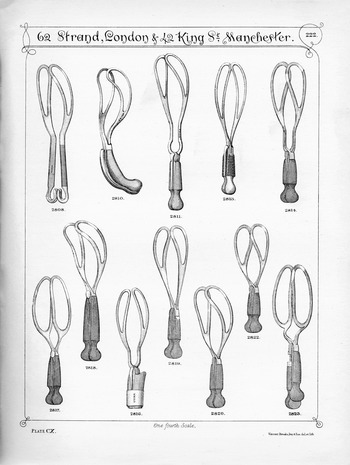
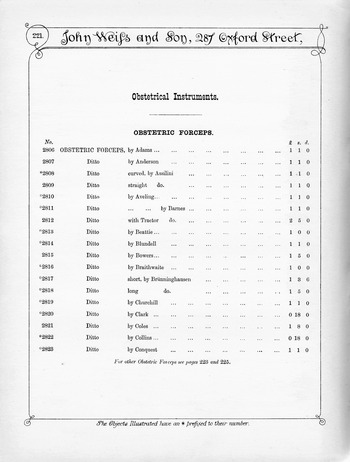
Eponymy began to function as an unofficial trade name for instruments. The ever-increasing invention of new tools during the nineteenth century – many of which were new varieties of the same instrument – rendered eponymy a necessity for practitioners to distinguish between similar inventions. For example, Weiss & Sons, renowned medical instrument-maker of the Strand, London, promoted over fifty different varieties of obstetric forceps in its trade catalogue of 1889, some only varying slightly one from another with a different hinge or handle to address a particular obstetric condition or problem. Each pair of forceps was named after the practitioner who had designed it (Figures 1 and 2).
Part of the extensive range of forceps sold by Weiss & Sons. Weiss & Sons, Catalogue of Surgical Instruments, 1889, p. 222. Reproduced courtesy of the Thackray Medical Museum, Leeds.

A price list for some of the obstetric forceps available through Weiss & Sons, all of which are eponymous. Weiss & Sons, Catalogue of Surgical Instruments, 1889, p. 221. Reproduced courtesy of the Thackray Medical Museum, Leeds.

Eponymizing one's tools, and operative procedures, according to Sally Frampton, was therefore a necessary and accepted practice within the profession; it not only allowed other practitioners to identify specific designs but also crucially created a reputation for the inventor as a medical innovator among both his or her peers and the public.Footnote 18 Medical print culture also played an important role in demonstrating inventor priority. The simple manufacture of a design was often not enough to prove it was the first design of its kind; the publication of practitioner designs in medical periodicals, textbooks and trade catalogues served to trace priority claims chronologically should any disputes arise. Within the confines of the profession, this kind of career advancing was positively encouraged and obtaining such a reputation was seen as a fitting reward to those who allowed medical science to advance through the development of new tools.Footnote 19 Nor was eponymy restricted to surgical devices. Procedures, body parts and diseases all took on the name of their discoverer or originator, so that Fallopian tubes and Parkinson's disease, for example, were forever more associated with a single, heroic medical figure.Footnote 20
While acknowledging proprietary rights, eponymy crucially allowed other members of the medical profession to modify these inventions in order to meet their own practical requirements. Indeed no new tool was ever really a true invention and eponymy allowed both instrument-maker and practitioner to freely borrow elements from existing tools and combine them in a novel configuration, which they later claimed as their own.Footnote 21 This principle is reflected in Saundby's statement about giving discoveries and inventions freely to the profession and the public. The medical journals and trade catalogues of the period are littered with examples of this kind of borrowing. For example, the British Medical Journal in 1903 included information about a new sphygmograph by John Fletcher Little, an elite physician with an established private practice in Harley Street and honorary positions at the North London Hospital for Consumption, the London Temperance Hospital and the West End Hospital for Diseases of the Nervous System. Little was clear to point out that his sphygmograph was a modification of Richardson's sphygmograph, a design developed several years before, but also argued that it aimed to correct several deficiencies of Richardson's model, including the ability to apply more than four ounces of pressure. Allen & Hanburys, the maker of Little's sphygmograph, included extracts from the British Medical Journal’s piece in its promotional catalogue of 1910.Footnote 22
While upholding eponymy as a respectable practice, professional orthodoxy condemned patenting on the grounds that it represented a barrier to medical treatment. It stated that practitioners were unable to modify and improve patented tools because it placed invention and a form of monopolistic ownership in the hands of a sole inventor to the detriment of medical practice and patient safety. The formalized monopoly that individual patentees had over their registered designs restricted medical knowledge and thus medical progress.Footnote 23 This argument against patenting was, of course, not restricted to the medical profession; many of those in trades beyond medicine had long argued that patenting restricted ‘the spirit of invention’.Footnote 24 As Christine Macleod and others have demonstrated over a wider time period, patent systems frequently embodied a tension between patent monopoly as a stimulator of invention among individuals, and as a restriction on innovation among other inventors.Footnote 25 However, professional orthodoxy maintained that by patenting their tools, practitioners were not only restricting invention and innovation, but also putting the lives of their patients at risk. Unlike debates in other trades, the medical profession saw limiting the level of potential inventive activity by patenting as, quite literally, a case of life or death.
Yet despite this professional rhetoric, an examination of the medical press between 1870 and 1920 demonstrates not only that the message presented to practitioners was confused and contradictory, but also that not all practitioners subscribed to the established view that patenting restricted medicine's inventive spirit. Peter Bartrip has demonstrated the British Medical Journal’s lack of ethical consistency through its simultaneous condemnation of patent medicines in its editorial pages and promotion of them in its advertisement sections.Footnote 26 Similarly, during the 1880s and 1890s, the journal published both reviews of books by patent agents and instructions to correspondents who requested information on how to patent an invention, while condemning professional patenting through its continual reference to de Styrap's 1878 Code of Medical Ethics. In 1889, for example, the journal published a review of a book by patent agent William Jordan titled Instructions to Inventors as to Obtaining Letters Patent and Registering Trade Marks and Designs. The review made no mention of the view that patenting restricted medical progress and in fact portrayed the book in a positive light, suggesting it did well ‘to indicate the course which an inventor must pursue in order to obtain proper protection for his skill’.Footnote 27 Simultaneously, the journal responded in no uncertain terms to queries on how to patent inventions from Francis W. Clark in 1892 and five other correspondents between 1893 and 1895, who gave only pseudonyms – ‘Invention’, ‘Medico’ from Co. Clare, ‘Young Practitioner’ from Bournemouth, ‘A Patentee not a Practitioner’ and ‘Surgeon-Captain’ – by referring to patenting's ‘derogatory nature’ as laid out in de Styrap's Code.Footnote 28
Certainly here we can see the encroaching infringement of the professional boundaries of medicine by professionalizing patent agents, who were keen to enlist practitioners as clients, but the fact that the journal responded to Clark under the heading ‘Repeated inquiries on the same subject’ suggests that practitioners were more willing to pursue patents for their inventions than is reflected by the limited number of letters published in the British Medical Journal.Footnote 29 Moreover, the fact that Clark, a recently qualified and therefore relatively inexperienced medical officer practising in South Shields in the north-east of England, was the only one among these correspondents willing to put his name in print suggests a general fear among practitioners of professional reprisal for requesting such information. The use of pseudonyms makes it difficult to identify the other five correspondents, but those given here do, nonetheless, provide clues as to their professional status and thus their stance on patenting ethics; ‘Young Practitioner’ from Bournemouth, along with Clark, was clearly not of high status and thus less likely to be aware of or willing to uphold professional codes of conduct that had been in place long before they had qualified, while ‘Surgeon-Captain’ was of higher professional status but within the navy, a sub-branch of professional medicine that, along with the army, had long been known and recognized for its technical ingenuity and surgical craftsmanship.Footnote 30 Yet, in order to dispel any misapprehension that it was only young, inexperienced or ignorant practitioners or those within the armed forces who dismissed existing professional orthodoxy, the journal was keen to point out that ‘A Patentee not a Practitioner’ was an old graduate of a distinguished university and, although not in actual practice, held an official medical appointment. By referring to himself as ‘A Patentee not a Practitioner’, this correspondent had attempted to make a distinction between those who engaged in patenting and practitioners who formed part of the profession and thus do not patent. Yet, by highlighting the personal information about this correspondent, the journal implied that ‘A Patentee not a Practitioner’ was in fact part of the profession's elite and thus should not be a patentee at all.
From the mid-1890s, when corporate capitalism was beginning to have more of an obvious impact on the medical profession, it remained common for practitioners to enquire about patents in journals with letters marked only with their initials or pseudonyms, but it is also clear that these practitioners were becoming much more vocal in their support of patenting on the grounds that it positively encouraged professional invention. Moreover, for all of its emphasis on de Styrap's Code, the British Medical Journal was playing an increasingly important role in providing a voice to inventive practitioners looking to enhance medical progress by patenting their tools and appliances. A correspondent identified only as ‘H.M’ stated in the journal in 1894 that individual practitioners did not receive anywhere near enough recognition for their professional inventive achievements through eponymy alone. Allowing practitioners to register patents for their designs would encourage them to invent. He asked, ‘why is the medical profession to lay its inventive genius at the foot of manufacturers and let them have all the benefit?’Footnote 31 Indeed, as commentators beyond the profession argued, the granting of patent privileges offered an incentive and reward to inventive minds.Footnote 32 Patents also sat alongside other types of government-controlled incentive during the nineteenth century which were geared towards encouraging invention, such as prizes and publicity.Footnote 33 ‘H.M’ and other fellow practitioners saw patenting as important for the advancement of medical science rather than restrictive, because it protected the intellectual property of members of the profession whilst at the same time allowing disclosure of registered information on the design via the Patent Office.Footnote 34 As some pointed out, the patenting of scientific instruments was doing no harm to the analogous profession of the physical sciences and it therefore would be beneficial to the future of the medical profession if professional codes against patenting were lifted. ‘H.M’ pointed out, ‘One of the most noted scientific men of our day, who has lately been raised to the peerage, patents his apparatus.’Footnote 35 Presumably, ‘H.M’ was referring to Lord Kelvin (1824–1907), who, between 1854 and 1907, successfully filed more than seventy patents for various types of scientific instrument, including electrical conductors for telegraphs and instruments for measuring electric current, without compromising his status as one of the leading figures of British science.Footnote 36
As secretary of the British Medical Association, Robert Saundby was undoubtedly aware of the increasingly vocal support that patenting was receiving from practitioners within the medical press in the 1890s and this seemingly led to his revision of the code on patenting within his 1902 Medical Ethics. The publication of Saundby's less stringent code on patenting, however, did not lead to a reduction in contradictory content within the medical press. In 1903, while the British Medical Journal stated that medical men, ‘like other citizens, can of course take advantage of the patent laws for the protection of their inventions’, The Lancet maintained that the potential to create a trade monopoly under a patent made the process objectionable.Footnote 37 The British Medical Journal responded to a request from ‘R.N.’ in 1908 for information on how to patent an invention by publishing detailed instructions, including ways in which to draw up a provisional specification and a complete specification and the importance of employing a patent agent to assist with the process, and in 1910 published a review by A.A. Thornton, a patent agent, stating that the book was ‘useful to those who have made some invention and desire, before putting themselves in the hands of a patent agent, to see what steps are necessary to obtain a patent’.Footnote 38 The issue whether a patent encouraged or restricted the spirit of invention within medicine continued into the 1920s. In 1920, Walter Gawen King, a retired colonel who had spent much of his career in colonial Madras and was thus of similar professional status to ‘Surgeon-Captain’, argued that it must be possible for leading men of the profession to ‘permit the taking of patents by research workers, under circumstances not calculated to injure the honour of the profession’.Footnote 39
From the 1890s, then, a number of practitioners questioned de Styrap's claim that patenting restricted the inventive spirit of medicine. Far from hampering the development of the profession, these practitioners argued that patenting encouraged inventive spirit because it justly rewarded individual inventors, both financially and through an enhanced reputation, while allowing information to be disclosed via the Patent Office. It is telling, however, that only two of these practitioners – Francis W. Clark and Walter Gawen King – were willing to be identified through their journal correspondence. Neither Clark nor King were members of the elite London-based physicians who most commonly upheld professional orthodoxy; Clark was an inexperienced medical officer in the north-east of England, while King was a respected retired army medical officer who had spent much of his career abroad. Both saw invention as a key way of advancing medicine, and did not see their public announcement of such as potentially damaging to their careers. As a retiree, King clearly had less to fear. The fact that other kinds of supporter of this argument only used initials and pseudonyms, however, suggests that fear of professional reprisal for contravening professional orthodoxy was widespread.
In pursuit of profit
Related to the question whether patenting encouraged or restricted medical tool design was the concept of making profit. Those who upheld professional orthodoxy maintained that practitioners who patented their inventions were doing so to procure a profit, a pursuit they severely condemned. Of course practitioners were expected to exchange their medical services for fees in order to make a reasonable living, but the pursuit of profit through patenting was viewed as an activity for tradesmen, and one in which professional medical men should not be involved. Professional orthodoxy stated that practitioners benefited financially from patents because they not only derived profits through the sale of products they patented, but also were able to increase their income for as long as the patent was valid; the patent itself created an exclusionary right. Conversely, the profession sanctioned eponymy because it meant that no monopoly was created and almost certainly that practitioners would procure no profit. Any profits from product sales would instead go to the instrument-maker enlisted to produce the design. Geoffrey Searle has suggested that the formulation of professional codes of conduct across all Victorian middle-class professions were to ensure that professionals did not practise a trade from which they expected to profit but rather offered the community a service.Footnote 40
Professional opposition to practitioners’ pursuit of profit was intrinsically linked to the sustainability of good intra-professional relationships and aimed to prevent any unnecessary competition between what was already an overcrowded profession, particularly among general practitioners.Footnote 41 Indeed, patenting, as a regulatory micro-economic system, distorted the laissez-faire dynamics of the market and provided patentees with an unfair economic advantage over those who chose not to patent. From this perspective, patents were conceived as a form of advertising or branding, but their impact was considered far worse than any advertisement contained within public prints because of their exclusionary nature. Through advertising, practitioners with similar products could at least compete in the same market with the same product. Just as practitioner support for patenting on the grounds that it positively encouraged professional invention was becoming more prominent in the medical press during the 1890s, issues around professional advertising were discussed in detail at the section on medical ethics at the Sixty-Third Annual Meeting of the British Medical Association in London in 1895. Emphasizing the importance of intra-professional ethics, Cardiff-based practitioner and stalwart of medical ethics Thomas Garrett Horder made a plea in his meeting address: ‘Let us discard as much as possible everything that tends to degrade our calling into a mere money-making concern, and then we shall probably set up a high standard of morality in our dealings with each other.’Footnote 42 Following on from Horder, George W. Potter, a physician based in the well-to-do Kent town of Tunbridge Wells, argued that any practitioner who advertised his services or any product could only be doing so ‘for fame or gain’ and that this equalled serious professional misconduct.Footnote 43
Yet, like those who rejected claims that patenting restricted medical innovation, some practitioners also rejected professional orthodoxy on patents and profit procurement. While some practitioners disputed the fact that advertising was unprofessional following Potter's address at the British Medical Association, others argued that there was nothing unprofessional about procuring financial benefit from patenting.Footnote 44 In 1903, a year after the publication of Saundby's Medical Ethics, which stated that it was better for practitioners not to maintain any commercial interest in inventions, a Lancet correspondent only willing to be identified as ‘Patentee’ pointed out that ‘a search through a file of the Official Journal of Patents will serve to show that your opinions regarding the patenting of medical and surgical apparatus are not shared by many in the profession’. He went on to say, ‘medical men do patent such apparatus and receive royalties on their sale and there is no just and valid reason why they should not’.Footnote 45 Indeed, medical instrument-makers were not alone in investing in the production of new designs and should share profits with practitioners accordingly. This argument was similar to those put forward by supporters of the English patenting system in general, including Scottish economist Henry Dunning Macleod, who stated in 1858 that ‘the productions of a man's mind are now recognized to be as truly his own property and the fruits of his industry as the production of material wealth’.Footnote 46 The Lancet strongly disagreed with ‘Patentee's’ claim that many medical men patented their inventions and, in an effort to uphold professional rhetoric, assured readers that patenting activity was restricted to only a few.Footnote 47 Similarly, elite practitioners, like George H. Colt, senior resident anaesthetist and late house surgeon at St Bartholomew's Hospital, London, maintained that instrument-makers should be the true profiteers of any new design. Colt, a prolific inventor of all manner of medical apparatus, including mouth gags and a portable operating theatre, suggested in 1910 that it was reasonable for instrument-makers to expect a return from the amount of time, skill, patience and money they had invested in developing such appliances, but argued that medical practitioners should give their inventions freely to their profession.Footnote 48 It is interesting to note that Colt patented several of his non-medical inventions both in Britain and in the USA, including an agricultural machine in 1909 and a squash racket court in 1935, signalling that his opposition to patenting only applied to professional medicine.Footnote 49
It is, of course, difficult to ascertain levels of profit procured from patenting either by medical instrument-makers or by individual practitioners during this period. Even among practitioners who we know patented their devices, few accounts, when they exist, reveal such information. Estimating how much profit practitioners procured from their activities was no easy task for the General Medical Council either, as Horder and Potter made clear in their addresses to the British Medical Association in 1895.Footnote 50 While few practitioners who patented their designs seem to have risen in the ranks of the profession or came to hold prominent positions in the British Medical Association or royal colleges, there is no evidence to suggest that any practitioner who did patent an appliance meant for the profession's sole use was ever struck off the medical register, the most serious consequence of being involved in trade activity. In contrast, well-known cases of practitioners struck off the medical register for attempting to procure profits from goods patented and promoted to the general public were viewed as justified. Indeed, the General Medical Council stuck off Henry Arthur Allbutt in 1889 and Thomas Allinson in 1895 for developing, patenting and promoting contraceptive appliances and food products respectively, both of which were aimed at general consumers.Footnote 51 While professional orthodoxy maintained, then, that patenting was unethical because it resulted in profit, individual practitioners increasingly disputed such claims from the early 1900s, arguing that practitioners did receive profit from patenting but that it was not unethical for them to do so. Profit merely rewarded the time and labour they had invested in their inventions and was therefore in the interests of their profession.
Professional sensibility versus proprietary rights
Questions regarding whether patenting encouraged or restricted invention and whether it was ethical for practitioners to profit from their inventions were certainly important to the patenting debate within the medical profession, but their relevance was incorporated into a broader concern, that of professional sensibility. The maintenance of the profession's reputation was seemingly the most significant issue of contention between those who wished to maintain professional orthodoxy and practitioner–patentees during this period of corporate capitalism.Footnote 52 According to late nineteenth- and early twentieth-century professional rhetoric, patenting was considered a trade activity, not only because it resulted in profits but also because it was an ‘ungentlemanly’ pursuit. ‘Gentlemen’ professionals of this period were not supposed to fight over proprietary rights, nor were they meant to attempt to procure profit from a patent. Reminiscent of de Styrap's principle that patenting was ‘derogatory to professional character’, the aforementioned George Colt of St Bartholomew's Hospital pointed out in the British Medical Journal as late as 1910 that ‘the originator of any instrument in surgery does not by the etiquette of his profession patent his invention, neither does he make a penny out of it’.Footnote 53 Patenting was considered damaging to the reputation of the profession because patents filed by practitioners were not confined to the profession as were eponymous tools; patents featured in government-regulated systems alongside patents from trades, including respectable trades such as engineering and aeronautics, but also the less respectable unorthodox medical trade. In turn, the filing of patents for medical tools alongside those of disreputable medical companies resulted in the profession's fear that the public would not be able to distinguish between orthodox medicine and quackery. For example, Cornelius Bennett Harness, founder of the disreputable Medical Battery Company and a medical entrepreneur most feared by the medical profession, registered nineteen British patents for an assortment of medical belts and harnesses in just four years between 1881 and 1885.Footnote 54 The profession were certain that Harness's products had no therapeutic value. The fact that these disreputable appliance-makers used the word ‘patent’ as a way to promote their products – in newspapers and other public prints – also led the profession to reject it. The makers of such appliances were thus no better than vendors of patent medicines.
However, some practitioners seemingly sought to reinvent what it meant to be gentlemanly by defending their own inventive reputation through patents. Indeed, what counted as ‘gentlemanly’ behaviour in late nineteenth- and early twentieth-century Britain was not a fixed rule, but, as in other professions, was in a state of continual negotiation. While many practitioners found it unproblematic that others freely borrowed elements of their designs in a new configuration of an invention, as we saw earlier with John Fletcher Little's modification of Richardson's sphygmograph, others saw it as piracy. Numerous disagreements over who had priority of different designs between practitioners ensued and the correspondence pages of the medical press present many examples of practitioners accusing each other of copying their own unpatented designs or those of colleagues. Such disagreements were particularly prominent in the 1880s when fewer practitioners were vocally supportive of patenting practices. In a letter to The Lancet in 1882, Edward Blake, an elite London physician with practices in Hyde Park and Hampstead, was politely critical of the failure of Hunter Mackenzie, another elite metropolitan physician, to acknowledge the many modifications that had been invented before his so-called new design of an anaesthetic inhaler. In particular, Blake pointed out that the valves Mackenzie claimed made his inhaler unique were curiously like those used by H. Murphy, an obstetrician of University College London, in his inhaler invented twenty-five years earlier.Footnote 55 Similarly, in the same journal a year later in 1883, Lambert H. Ormsby, surgeon to Meath Hospital in Dublin and inventor of a number of medical appliances, claimed ‘that the new cranium holder featured in last Saturday's Lancet bears a very strong resemblance to an instrument I suggested many years ago for the same purpose’.Footnote 56 Ormsby claimed that his publication of a short description of his cranium holder four years earlier in the Medical Press and Circular and its inclusion in Henry Albert Reeves's textbook Human Morphology published in 1882 were proof of his inventive priority. As we saw in the first section, publishing information on new inventions was an important way to secure proprietary recognition in a way that suited professional sensibilities. However, the lack of any formal legal protection through these publications meant that many, if not most, of these disputes remained unresolved.
As with debates surrounding the spirit of invention and profiteering, some practitioners became increasingly vocal in their opinion that patenting was not an ‘ungentlemanly’ practice from the 1890s. With increasing professional resentment towards eponymy and growing concerns over profit procurement and design imitations, these practitioners believed it was unrealistic to oppose patenting in the current commercial climate. The aforementioned ‘Young Practitioner’ from Bournemouth, ‘Medico’ from County Clare, and ‘A Patentee not a Practitioner’ made this point central in their correspondence to the British Medical Journal in 1894 to argue that the profession only continued to adhere to patent prohibition for practitioners because it was a clause that had been first introduced by Thomas Percival, the great physician, in 1807. As ‘A Patentee not a Practitioner’ argued, the professional and commercial circumstances were clearly very different almost one hundred years later. Patents in 1807 had been very costly to register, so would have enhanced the retail price of patented goods to such a level that their use was virtually prohibited. The greatly diminished cost of a patent by the late nineteenth century, in addition to the rise of corporate capitalism, meant that there was no valid reason for retaining patenting prohibition.Footnote 57 The fact that ‘A Patentee not a Practitioner’, an established practitioner with an official medical appointment, argued that codes surrounding the prohibition of patenting needed updating in order to redefine ‘gentility’ in line with the increasing commercialization of everyday life highlights that it was not solely the younger generation of practitioners who felt that codes were outdated. The British Medical Journal correspondence from ‘A Patentee’ in 1903 similarly referred to the outdated nature of the profession's stance on gentility, and in 1912, another anonymous correspondent in American Journal of Surgery stated that ‘the ethical prohibition against patenting surgical instruments is a tradition that has been handed down from one generation to another, and its transmission from one “code” or “principles” to the next seems to us the illogical adherence to a tradition merely as such’.Footnote 58
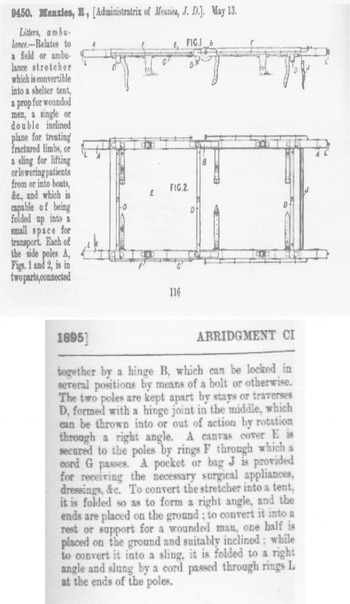
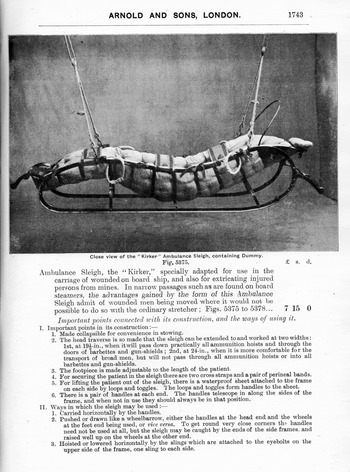
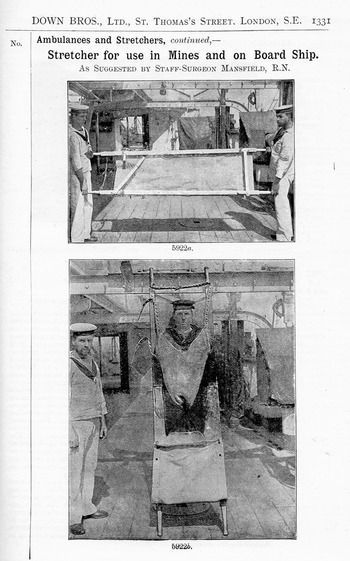
While both young and more established practitioners criticized others for design piracy and for adhering to outdated ethical codes on patenting, it was seemingly only young, ambitious and non-elite practitioners who were willing to defend their inventive reputation by putting their name to patented appliances. This defensive measure reflected a wider concern among practitioners about imitations and counterfeits of their intellectual property. While the historical literature has commonly equated counterfeit concerns with quacks and vendors of patent medicines, it is clear that these concerns also apply to appliances and other practitioners too. The most striking and detailed evidence of a practitioner–patentee from this period aiming to defend his inventive reputation with a patent appears in the business correspondence of the archive of Allen & Hanburys, a well-respected appliance-maker and pharmaceutical company established in 1715. The correspondence between the company and John Duncan Menzies, a young and newly qualified surgeon on board the HMS Halcyon, a torpedo gunboat used by the British Royal Navy until 1919, and son of the surgeon-general Duncan Menzies famed for his service in the Crimean War, reveals that Menzies planned to patent his design for a new stretcher for specific use on naval ships in July 1895. This decision to patent his stretcher followed news that the design had already been ‘filched’ by W.G. Hayward, surgeon on HMS Sharpernation, before Menzies had been able to publish notice of his invention in the pages of the medical press. Menzies was certain that Hayward had been tipped off by a carpenter he had enlisted to help build models of his stretcher because Hayward had registered his patent for a naval stretcher soon after Menzies had made his model in April 1895 (Figures 3 and 4). Yet despite Hayward's patent, Menzies stated in correspondence to Allen & Hanburys, ‘I think I can afford to ignore this Hayward’ and outlined six main points that were novel about his design, including support and prop for broken ribs and the option of incorporating a first-aid bag and pannier into the stretcher. With the inclusion of these novel design features and a prototype produced by Allen & Hanburys, Menzies registered his patent for his ‘improvements in field and ambulance stretcher’ (patent no 9450), which was accepted in March 1896.Footnote 59 While it is not possible to estimate with any accuracy the relative commercial success of stretcher designs by Menzies and Hayward, it is clear that other companies began to produce, promote and sell similar designs. Menzies's patent, of course, protected his six points of novelty (Figures 5 and 6). It is also not possible to determine whether Menzies would have faced any repercussions from the General Medical Council for registering his stretcher patent – the British Medical Journal reported his death as 12 November 1895 at the age of only thirty-four.Footnote 60 However, it is unlikely Menzies would have faced any serious professional consequences, given that other practitioners who patented their designs faced very few.
The abridgement of the patent specification for Menzies's naval stretcher, May 1895.

Design of a naval stretcher, Arnold and Sons, Catalogue of Surgical Instruments, 1904. Reproduced courtesy of the Thackray Medical Museum, Leeds.

Design of a naval stretcher, Down Brothers, Catalogue of Surgical Instruments, 1906. Reproduced courtesy of the Thackray Medical Museum, Leeds.

The concern over imitations and counterfeits that led Menzies to patent his stretcher design was not solely limited to the professional brethren either, but, by the twentieth century, practitioners expressed concerns that their unpatented designs were being copied by instrument-makers too. Indeed, Colt, who defended eponymy ahead of patenting, accused at least two instrument-makers of ‘pirating’ his mouth gag from Down Brothers, its original makers based in London, between 1907 and 1910. According to Colt, the first of these, a large and respected firm, sent travelling representatives around the west of England promoting an inferior imitation of his gag at 30 per cent less than the price of his own design. The second produced another imitation, which they sold at half the price of Colt's original pattern.Footnote 61 Practitioner concern about imitation was as much to do with damage to their own reputations as with patient safety. This final point of debate on professional patenting, then, centred on questions of proprietary recognition and whether claiming ownership for inventions aligned with what it meant to be a ‘gentlemanly’ practitioner in late nineteenth- and early twentieth-century Britain. Some practitioners argued that codes of conduct based on early nineteenth-century conceptions of gentility were outdated and did not reflect the professional or commercial climate of the late nineteenth and early twentieth centuries, while others patented their tools as a defensive measure against practitioners and instrument-makers, who sought to profit from imitating their eponymous designs.
Conclusion
Despite the general increase in patenting activity across the UK between 1870 and 1920, the number of patents registered by medical practitioners for designs of medical tools and appliances remained low. Medical entrepreneurs and pharmaceutical companies increasingly began to patent new designs for appliances and new drug formulas during this period, but there was no corresponding rapid increase in medical-practitioner involvement in patenting during this period. Patenting failed to have the effect on professional medicine it did in other trades with a high level of inventive activity because medical practitioners were, for the most part, adhering to professional orthodoxy on the prohibition against patenting, the most obvious statement on which is contained within de Styrap's 1878 ethical guide. Of course, patenting figures are not in themselves an accurate indicator of inventive activity and not every medical practitioner was an inventor.Footnote 62 Nonetheless, it is clear from examining a combination of the patent record, business correspondence and the medical press that the attitudes and behaviours of some practitioners towards patenting their own inventions were changing, particularly from the 1890s. The supporters of patenting challenged the professional premise that patenting restricted innovation and therefore medical progress; they questioned whether it was unethical to procure profit on the time and money they had devoted to their own inventions; and argued that the patent system was one way they could receive formal priority credit for their designs. Some argued that de Styrap's professional code was outdated and that patenting did not contravene the values and ethics of the profession in the current economic climate; after all, the instrument and pharmaceutical trades and the profession increasingly had to work together during this age of technological medicine and expanding global capitalism. The increasingly vocal and active opposition to restrictions on patenting based on these three main arguments from the 1890s seemingly led to the revision of the code in Saundby's 1902 guide. Saundby's ambiguous statement about patenting within this guide thus reflected professional circumstances at this time. It neither endorsed patenting, nor condemned it. While evidence is still wanting, his nonchalance may have also encouraged others to register patents following the guide's publication. Indeed, the British Medical Journal certainly increased the amount of advice on patenting for its readership following Saundby's guide.
The anonymization of much journal correspondence throughout the period makes it difficult to identify practitioner supporters of patenting and correlate their experiences. Their use of only initials or of pseudonyms is in itself a good indication of the fear of professional reprisal for being vocal in their support. Yet, from existing information, it is clear that these supporters shared certain characteristics: they were often young and therefore inexperienced enough not to know about or be willing to maintain professional orthodoxy surrounding patenting; they practised outside the important medical centre of London and were thus somewhat removed from the reaches of the British Medical Association; and/or they were medical officers within the British army or navy. The young naval surgeon John Duncan Menzies, for example, was a practitioner who felt that patenting was a suitable way to protect his designs from imitations, from both practitioners and appliance-makers. He saw patenting as a benefit rather than a hindrance to the profession, and thus attempted to reshape ethical codes with his pursuit of a patent accordingly. Unlike those who defended professional orthodoxy, such as George Colt, Thomas Horder and George Potter, supporters of patenting were not generally considered among the elite of the profession. That is not to say that elite practitioners were always against patenting. Indeed, the British Medical Journal pointed out the elite professional status of ‘A Patentee not a Practitioner’. But it was generally the more established elite physicians and surgeons, who had trained, practised and thrived in an earlier time when patenting had been doggedly condemned, who most vocally condemned rising support for patenting. The patent system was becoming an important part of the new commercial world in which medicine functioned, one which elite practitioners did not recognize.
Certainly, more research needs to be conducted on professional and personal identities of practitioner supporters of patenting in this period, especially those within the armed services who appeared to be among the most active patentees. Nonetheless, this case study of the patent debate over medical tools and appliances uncovers an important aspect of the moral economy of professional medicine. While medical practitioners were expected to adhere to a set of professional ideals and social values under this rubric of ‘moral economy’, it serves as a helpful reminder that this did not always match the reality of individual practice. Practitioners were committed to their profession, or at least were expected to be, and shared a collective adherence to professional norms. Yet they also clearly had their own individual motivations too and patented their inventions, or wished to, for any number of reasons, including those not covered in this short article. This case study thus reminds us as historians to pay closer attention to individual practice and to deviations in collective discourse over mandates dictated by professional bodies. Having conducted a closer analysis of individual experiences here, it is clear that some were willing to disagree with professional etiquette and push for a much closer relationship between professional medicine and commerce than historians have recognized. Practitioners’ patenting of tool designs was an important manifestation of medicine's involvement in commerce during this period.
Robert Saundby died in 1918, but his guide to professional conduct remained influential long after his death. Certainly no subsequent guide contained as much information on conduct regarding patenting. Indeed, W.G. Aitchison Robertson's Medical Conduct and Practice: A Guide to the Ethics of Medicine published in 1921 made no mention at all of patenting and focused instead on doctor–patient relationships.Footnote 63 The Central Ethical Committee of the British Medical Association held a position as ambiguous as Saundby's when in 1930 it adopted a resolution stating it was ‘ethically undesirable’ for a practitioner to hold a patent.Footnote 64 With no further guidance, practitioners remained divided into the twentieth century on whether to patent their appliances. Many continued to abstain from the practice, giving their intellectual property freely to their profession, allowing others to improve on their designs and sacrificing any potential profit. Some expressed some regret in abstaining, the best-known example being John Charnley, orthopaedic surgeon at Wrightington Hospital in Wigan, who developed a new design of the artificial hip with a Leeds-based instrument-maker in 1960. Charnley's lack of patenting led to the commercial release and availability of a range of imitations and allowed Johnson & Johnson plc to monopolize the market with the patents that they did take out.Footnote 65 The British Medical Journal also continued to promote the latest information regarding patenting.Footnote 66 Of course, late twentieth-century medical practice looked very different from that of the early twentieth century, not least because of the way in which new medical technologies were developed to include collaborations with bio-scientists, medical researchers, medical device technologists, pharmaceutical companies, universities, hospitals and so on. Nonetheless it is clear that codes of professional conduct remain crucial to the image of medicine and that it is necessary for these codes to adapt to recent commercial developments.Footnote 67 By 1950, medical patenting was positively encouraged as long as the patents were assigned to the National Research Development Corporation and not to individual practitioners.Footnote 68 No codes have yet been developed which sanction patenting, and in the meantime practitioners continue to face the tension between the professional ideal and the commercial reality of the ways in which medical technologies are developed today.