INTRODUCTION
In French, causal relations are very often conveyed by the two connectives ‘car’ and ‘parce que’. Contrary to other French causal connectives like ‘puisque’ and ‘comme’, ‘car’ and ‘parce que’ are used to convey causal relations involving a cause that is not presumed to be already known or easily accessible to the addressee. For example, by using ‘parce que’ in (1), the speaker informs the hearer of the reason why the window slammed. By comparison, in (2), by using ‘puisque’, the speaker acknowledges that his addressee is obviously aware of his own presence. The use of ‘parce que’ or ‘car’ would be inappropriate in such contexts (Groupe Lambda-L, Reference Groupe1975; Zufferey, Reference Zufferey2014).
-
(1) La fenêtre a claqué parce qu'il y a du vent.
-
The window slammed, CONNECTIVE it is windy.
-
(2) Donne-moi un coup de main, puisque tu es là.
-
Give me a hand, CONNECTIVE you are here.
In different theoretical and methodological frameworks, the difference between ‘car’ and ‘parce que’ is often explained by the type of causal relation that each connective prototypically conveys (Debaisieux, Reference Debaisieux, Pusch and Raible2002, Reference Debaisieux2004; Degand & Pander Maat, Reference Degand, Pander Maat, Verhagen and van de Weijer2003; Iordanskaja, Reference Iordanskaja1993; Lambda-L Group, Reference Groupe1975; Lambrecht et al., Reference Lambrecht, Bordeaux, Reichle, Nishida and Montreuil2006; Moeschler, Reference Moeschler1987; Reference Moeschler2005). On the one hand, ‘parce que’ is used to relate objective causal relations, that is causal relations between states or events taking place in the world. For example, in (1), the event of having strong wind blowing causes the event of the door slamming. By contrast, ‘car’ is used to convey subjective causal relations, in other words relations between claims or conclusions and arguments justifying them in the mind of the speaker. For example, in (3), the fact that John's jacket is no longer on the coat hanger does not cause his absence, but rather the speaker's conclusion that he must be gone.
-
(3) Jean est parti, car sa veste n'est plus au portemanteau.
-
John has left, CONNECTIVE his jacket is not on the coat hanger anymore.
In addition to French, objective and subjective causal relations are also expressed by two distinct connectives in a variety of typologically diverse languages such as Dutch (Sanders & Stukker, Reference Sanders and Stukker2012), German (Pasch, Reference Pasch1983; Pit, Reference Pit2003; Reference Pit2007), Portuguese (Lopes, Reference Lopes2009) and Mandarin Chinese (Xing, Reference Xing2001). The distinction between objective and subjective causality is, however, not lexicalised in other languages like EnglishFootnote 1 (Sweetser, Reference Sweetser1990).
Recent empirical studies have demonstrated, however, that the situation in Modern French is not as clear-cut as in other languages like Dutch. Diachronically, the distinction between objective and subjective causality seems to have separated ‘car’ and ‘parce que’. Based on a corpus study, Degand and Fagard (Reference Degand and Fagard2012: 160) note that “in Middle French, ‘par ce que’ is employed when the causal relation is factual (less subjective) and ‘car’ is employed when the causal relation is subjective or intersubjective”. Bertin (Reference Bertin1997: 97) also notes that in Old French, the locution ‘por ce que’ was mostly used to justify real (objective) events and often co-occurred with past tenses while ‘car’ was mostly used to justify speech acts and not specifically linked to the use of past tenses. According to Degand and Fagard's (Reference Fagard and Degand2008) quantitative corpus analysis, while ‘car’ does not seem to have undergone a marked semantic evolution in Modern French, ‘parce que’ has evolved as a connective expressing mostly objective relations to a connective expressing both objective and subjective causal relations between Middle French and Modern French, thus replacing ‘car’ as a subjective connective. As a result, the frequency of ‘car’ has steadily dropped from Middle French to Modern French in written data. A similar diachronic evolution is obviously impossible to establish for spoken data, but Degand and Fagard (Reference Degand and Fagard2012: 160) note that in contemporary spoken French, the subjective causal connective ‘car’ “might be considered extinct, except in formal speech”.Footnote 2
The current situation is, however, quite different in writing. Simon and Degand (Reference Simon and Degand2007) report that while in speech ‘parce que’ is 185 times more frequent than ‘car’, in writing the two connectives still have a very similar frequency. In addition, Simon and Degand note that in this mode ‘parce que’ and ‘car’ only have a partially overlapping semantic profile. Based on corpus data, they report that ‘parce que’ is still used more for objective causal relations and ‘car’ for subjective relations. However, there is also evidence in the literature that the distinction between objective and subjective causality, while still existing in the written mode in French, may be to some extent blurring. Zufferey (Reference Zufferey2012) reports a cloze test and an acceptability judgment test indicating that young adult speakers (first-year university students) do not have strong intuitions about the uses of ‘car’ and ‘parce que’ and find them to be interchangeable in many objective and subjective contexts in writing. Nazarenko (Reference Nazarenko2000) also mentions a number of objective causal relations conveyed by ‘car’ in modern written French.
In sum, the distinction between ‘car’ and ‘parce que’ as indicators of subjective and objective causality, that was once present in French according to Degand and Fagard (Reference Degand and Fagard2012), seems to be blurring, and it is an open question whether nowadays French speakers truly perceive a difference in the type of causal relations that each connective conveys. Another question raised by the current status of French causal connectives is whether the evolution observed between ‘car’ and ‘parce que’ in corpus data has implications for language processing. Indeed, connectives encode procedural meaning providing instructions on how to relate discourse segments (Blackmore, Reference Blakemore2002) that provoke visible effects during online reading (Gernbascher, Reference Gernsbacher, Costermans and Fayol1997). If the distinction between ‘car’ and ‘parce que’ is slowly vanishing, does this already have visible repercussions for the way French-speakers process sentences containing these connectives?
In this article, we address these issues in a series of three empirical studies testing French speakers’ intuitions and their online processing of the causal connectives ‘car’ and ‘parce que’. In Section 1, we assess the strength of the distinction between ‘car’ and ‘parce que’ as different means to convey objective and subjective causal relations, by comparing French speakers’ intuitions about these connectives with the intuitions of Dutch-speakers on the same sentences conveyed in Dutch by the connectives ‘want’ and ‘omdat’. Indeed, in Dutch, corpus research has shown that ‘want’ is the connective prototypically used to convey subjective relations while ‘omdat’ is prototypically used to convey objective relations, and contrary to French, both connectives are equally used in speech and writing (Sanders & Spooren, Reference Sanders, Spooren, Sanders and Sweetser2009; Verhagen, Reference Verhagen2005). This experiment will therefore allow us to test whether the very low frequency of ‘car’ in modern spoken French affects the strength of native-speakers’ intuitions about the specificity of each connective compared to a language in which the two connectives are equally used across spoken and written modes. In Section 2, we report an online processing experiment assessing the way French speakers process objective and subjective causal relations containing either ‘car’ or ‘parce que’. This experiment builds on two similar experiments conducted in English and Dutch, that uncovered a major difference in the processing of subjective causal relations between a language in which both types of causal relations are conveyed by the same connective (English) and a language in which the distinction is lexicalised (Dutch). The intermediate status of French as a language having two connectives in writing but only one frequent connective in speech will bring new insights for the role of connectives in language processing. In view of the results of Experiments 1 and 2, in Section 3 we assess an alternative hypothesis regarding the current distinction made by French speakers between ‘car’ and ‘parce que’ as two connectives pertaining to different registers rather than connectives conveying different types of causal relations. We assess the register difference between ‘car’ and ‘parce que’ by means of a completion task involving sentences from formal and informal registers. We discuss the general picture emerging from the three empirical studies in Section 4.
2. CROSS-LINGUISTIC COMPLETION TASK WITH OBJECTIVE AND SUBJECTIVE CAUSAL RELATIONS
2.1. Method
Participants: Forty first-year students of the University of Geneva and 41 first-year students of the University of Utrecht and the Evangelische Hogeschool Amersfoort.
Materials: Forty items containing objective causal relations and 40 items containing subjective causal relations. These items were adapted from the materials used in eye-tracking experiments testing objective and subjective causal relations in English (Traxler et al. Reference Traxler, Bybee and Pickering1997a) and Dutch (Canestrelli et al. Reference Canestrelli, Mak and Sanders2013). These sentences (reproduced in Appendix A for the French materials) were chosen because they represent very clear cases of objective and subjective causal relations.
Procedure: In French, participants were asked to fill in a blank between the two segments with either ‘car’ or ‘parce que’. If they judged that none of the connectives could be used, they were instructed to leave the line blank. Because the word order in the clause is different for ‘omdat’ and ‘want’, the same procedure could not be used in Dutch. Instead, the students saw the first segment, and two versions of the second segment: one with ‘omdat’ and one with ‘want’. They were asked to indicate which of the two connectives they felt was most appropriate.
2.2. Results
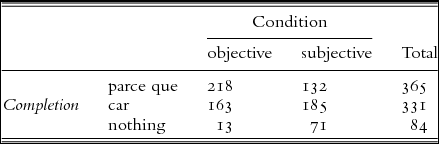
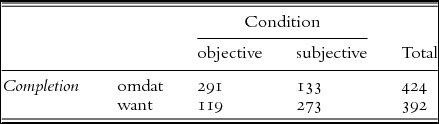
The results are presented in Table 1 for French and Table 2 for Dutch. We analyzed the dataset by means of a multi-level logistic regression (Goldstein, Reference Goldstein1999; Mirman, Dixon & Magnuson, Reference Mirman, Dixon and Magnuson2008) in R using the lme4 package. In this analysis, we compared the preference for ‘car’ versus ‘parce que’ in the relation types.
Completion Task with causal relations in French.

Completion Task with causal relation in Dutch.
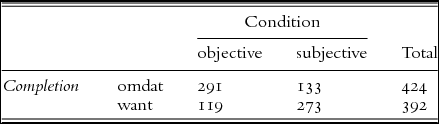
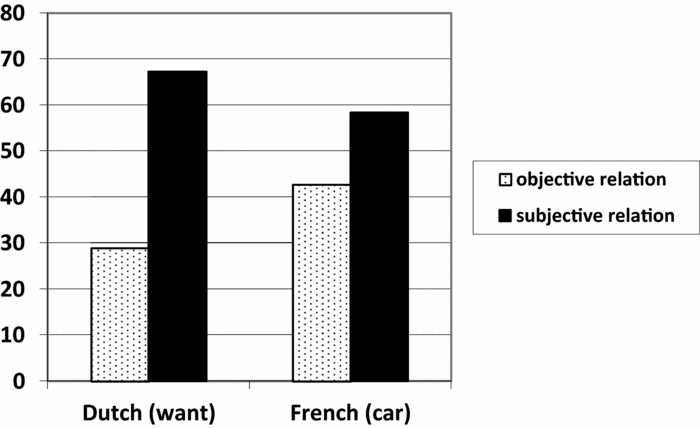
In French, participants used ‘car’ in 58.4% of the cases for subjective relations and 42.8% of the cases for objective relations. This difference was significant (β = -0.791, SE = 0.168, z = -4.72, p < 0.001). In other words, participants preferred using ‘parce que’ for objective relations and ‘car’ for subjective relations. However, subjective relations led subjects to discard both connectives and leave the line blank (indicating that they felt none of the connectives fitted) more often than objective relations (χ2(1) = 40.05, p < 0.001). There was no difference in the analysis between all the subjective items, indicating that all of them potentially lead our participants to leave the line blank. This may reflect the general fact that participants were uncertain about which connective to use in subjective relations. This behaviour could not be compared between French and Dutch participants, as students did not have to insert connectives themselves in the Dutch version of the experiment, but had to pick one of two alternative continuations.
In Dutch, participants were also sensitive to the subjectivity of the relation. They used ‘want’ in subjective relations in 67.2% of the cases against 29.0% only in objective relations. This difference was significant (β = 1.72, SE = 0.155, z = 11.08, p < 0.001).
We compared the preference for ‘car’ and ‘want’ between French and Dutch, in order to check whether the preference for ‘want’ in subjective relations in Dutch was stronger than the preference for ‘car’ in subjective relations in French. Figure 1 shows the percentage of ‘car’ and ‘want’ choices for the two languages and the two relations.
Use of the subjective connective (want in Dutch and car in French) in percentage, split by language and relation.
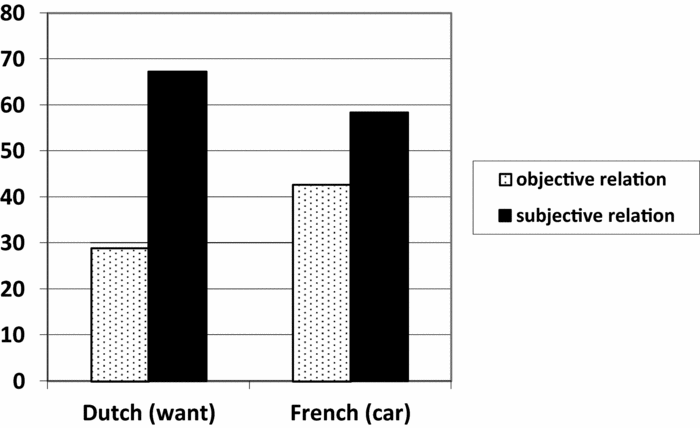
The analysis revealed an interaction of language and relation (β = -1.03, SE = 0.226, z = -4.56, p < 0.001). The difference in the use of ‘car’ between objective and subjective relations in French is significantly smaller than the difference in the use of ‘want’ between objective and subjective relations in Dutch.
2.3. Discussion
This offline cross-linguistic completion task confirms that in both French and Dutch, a specific connective is indeed preferred for objective relations and another one for subjective relations. However, these results also indicate that compared to a language like Dutch, where the two connectives are equally used in the spoken and the written modes, the relation between objective and subjective causal relations and the connectives ‘car’ and ‘parce que’ in French is much less clear cut. In other words, native French speakers’ intuitions about the distinction between ‘car’ and ‘parce que’ are indeed less certain compared to the intuitions of native Dutch-speakers. The question is whether this difference has visible repercussions for the way French-speakers process causal connectives compared to the processing of causal relations in Dutch. We address this issue in the next section.
3. ONLINE PROCESSING OF CAUSAL CONNECTIVES
3.1. The English and Dutch experiments
In an experiment in English, Traxler, Bybee and Pickering (Reference Traxler, Bybee and Pickering1997a) found that the difference between objective and subjective causal relations has visible repercussions for the way both types of relations are processed during reading, even though in English, the distinction between objective and subjective causal relations is not lexicalized, and both relations are prototypically conveyed by the connective ‘because’.
More specifically, in an eye-tracking experiment, Traxler et al. found that subjective relations such as (5) lead to longer reading times in the segment following the connective than objective relations such as (4).
-
(4) Heidi was proud and happy, because she won first prize at the art show.
-
(5) Heidi could imagine and create things, because she won first prize at the art show.
This effect appeared at the region containing the words ‘won first prize’ in (5). At this point in the sentence, readers can infer, based on the semantic content of the segments, that the relation is subjective rather than objective. In English, this effect could not logically appear at an earlier point in the sentence because the connective ‘because’ does not provide a disambiguation between objective and subjective relations.
In another set of experiments, Traxler, Sanford, Aked and Moxey (Reference Traxler, Sanford, Aked and Moxey1997b) have also compared the reading times of objective and subjective relations when a mental state builder clearly indicating subjectivity such as (6) was inserted in the first segment of subjective relations.
-
(6) John thinks that Heidi could imagine and create things, because she won first prize at the art show.
In such cases, the longer reading times for the second segment observed in subjective relations disappeared. This goes to confirm that the effect is related to subjectivity, more precisely to the speaker having to infer that the relation is subjective rather than objective. As this operation is no longer necessary in (6) because the subjective nature of the relation is already disclosed in the first segment, the processing cost of inferring subjectivity in the second segment disappears.
In English, the connective cannot give indications about the type of causality intended by the speaker. However, as discussed above, in other languages such as Dutch, objective and subjective causal relations are prototypically expressed by specific connectives (Degand & Pander Maat, Reference Degand, Pander Maat, Verhagen and van de Weijer2003; Pit, Reference Pit2003; Reference Pit2007; Pander Maat & Sanders, Reference Pander Maat and Sanders2001). Hence, while the connective in English does not provide any information about the objective or subjective nature of the causal relation, in Dutch readers may use the connective to infer what type of causal relation is going to follow. An eye-tracking experiment comparing subjective and objective causal relations in Dutch with the two connectives ‘omdat’ and ‘want’ shows the same difference between conditions as the one found in English, but at an earlier point in the sentence (Canestrelli, Mak & Sanders, Reference Canestrelli, Mak and Sanders2013). In the subjective relation, longer reading times were observed at the words immediately following the connective. At this point in the sentence, the reader cannot infer the subjective nature of the causal relation between the sentences based on the content of the segments, so the effect must be caused by the different connectives that are used. When readers encounter the connective ‘want’, they realize that the first segment is a subjective claim made by the speaker. This subjectivity effect slows them down immediately, but at the region where the semantic content of the relation becomes clear, they do not slow down again, contrary to English readers, because they already know that the relation is subjective. Moreover, when a mental state builder (e.g. ‘According to Peter’) is added to the first segment, the effect following the connective also disappears, which confirms that the effect found in the second segment, be it after the connective in Dutch or later on in the sentence in English, is related to subjectivity.
Canestrelli et al. (Reference Canestrelli, Mak and Sanders2013) also show that when the two Dutch connectives are used in non-typical environments, in other words when ‘omdat’ is used in subjective relations and ‘want’ in objective ones, there is an early slowdown after the connective ‘want’ in objective relations. Even though the relation is objective, readers do slow down because of the signal given by the connective ‘want’. In subjective relations marked by ‘omdat’, readers initially do not slow down, presumably because they take the relation to be objective. However, there is a slowdown at the end of the second segment, due to the fact that ‘omdat’ forces them to interpret the relation as objective while the content of the segments is obviously incompatible with this interpretation. These experiments thus confirm that in Dutch, connectives play a crucial role in determining the objective or subjective nature of the causal relation.
In sum, the eye-tracking experiments conducted in English and Dutch indicate that subjective relations lead to longer processing times than objective relations. However, the location of this effect differs between the two languages: in Dutch the linguistic clue given by connectives leads to an early effect, while in English the subjectivity is inferred later based on the semantic content of the segments, creating a later effect.
3.2. Eye-tracking experiment in French
In this section, we report a processing experiment involving objective and subjective causal relations in French, a language in which the usage of causal connectives shares some features with both English and Dutch. This experiment replicates the English and Dutch experiments, with a French translation of the same sentences. We test for the presence of the following potential effects. If French-speakers still differentiate between ‘car’ and ‘parce que’ in terms of processing instructions, they should behave like Dutch-speakers, and an early slowdown after the connective ‘car’ is expected. If, on the other hand, French-speakers have lost their intuitions about the subjectivity of ‘car’ and do not use it as a clue to infer subjectivity, a later subjectivity effect similar to English is expected, when the semantic content of the segments discloses the nature of the relation.
3.2.1. Method
Participants: Twenty-eight students of the University of Louvain-la-Neuve (Belgium) participated in the experiment. They were all native speakers of French with little to no knowledge of Dutch. All participants had normal or corrected to normal vision. All subjects were paid for their participation.
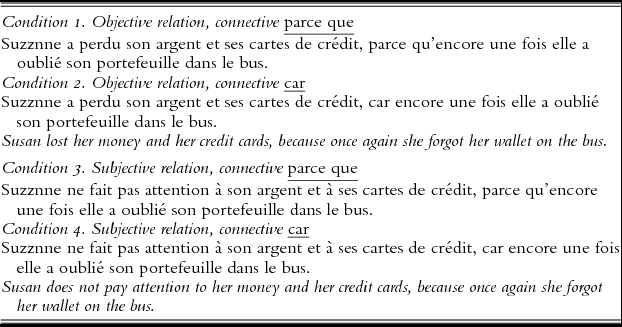
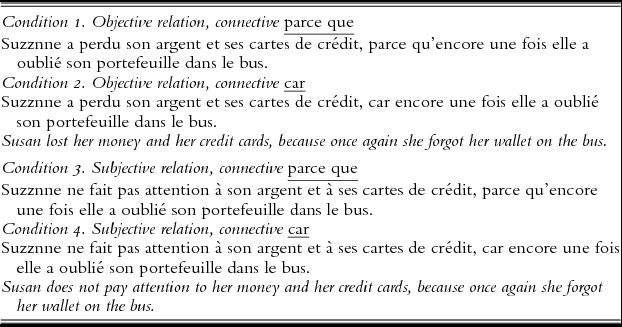
Materials: We constructed 40 items in four conditions, translated from the Dutch experiment. An example is given in Table 3, and a full list of experimental items is given in Appendix A. The relation between the segments was either objective or subjective, and either the connective ‘car’ or ‘parce que’ was used. In addition to the experimental items, there were 32 filler sentences that did not involve discourse connectives.
Example of experimental item.
Procedure: The Tobii T120 eye-tracker was used to set up and run the experiments. Participants sat in front of a computer and read the texts that appeared on the screen. The participants were tested one by one. First, instructions were given on the computer screen. Then a few practice items were presented to enable the participants to get used to the procedure. After that, the next screen told the participants they could start with the experiment itself. Participants were asked to read a text and press a button when they were ready to move to the next item. The order of the trials was randomized. There were 72 trials in total per participant.
Analysis: For the purpose of data analysis, experimental items were divided into the following five regions.
-
1. First-sentence
-
2. Connective
-
3. Subject of the second segment + modifier when the subject is one short word
-
4. Verb + object of the second segment
-
5. Optional complement
Two processing measures were used. First-pass reading time, also called ‘first gaze durations’, is the total time spent in a region before the reader either moves forward or backward to other regions. Regression path duration, also called ‘total pass reading time’ or ‘go past reading time’, is the sum of all fixations from the first fixation in a region until the reader moves on the next region. This second measure thus includes rereading of previous segments.
3.2.2. Results
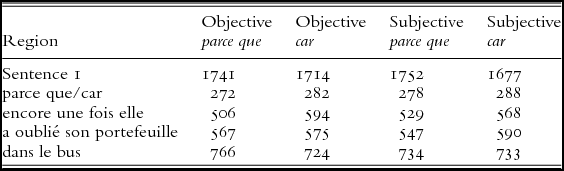
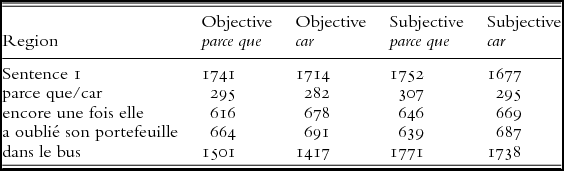
We performed Linear Mixed Effects Regression analyses (LMER) (Baayen, Reference Baayen2008; cf. Brennan & Pylkkänen, Reference Brennan and Pylkkänen2010) on the data, with subjects and items as crossed random effects. Since the models that included random slopes were not significantly better than the models with only random intercepts per subject and item, we report the latter. Connective (‘car’ versus ‘parce que’) and Relation (subjective versus objective) were fixed effects in the model. This technique has several advantages over traditional ANOVA, such as its ability to handle missing data and the fact that it deals with item and subject variability in one model (see Quené & van den Bergh Reference Quené and Van den Bergh2004, Reference Quené and Van den Bergh2008 for more details). Before the analysis, log-transformations were performed on the data in order to meet the normality requirements of linear modelling. However, an analysis of the untransformed data yielded the same pattern of results in both experiments. Markov Chain Monte Carlo sampling was used to estimate the p values (Baayen, Reference Baayen2008). In the following, we will discuss the effects of the two processing measures at the different regions of interest in the sentence. The means per region are presented in Table 4 and 5.
First pass reading time.
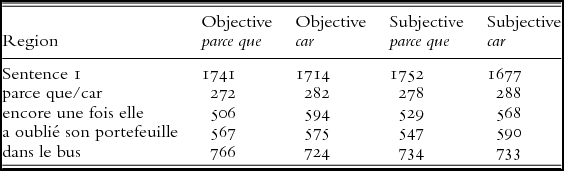
Regression path duration.
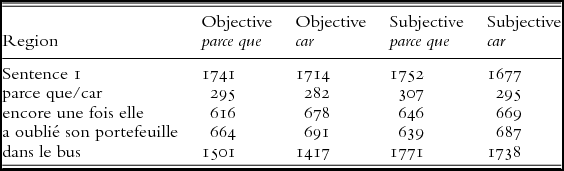
At the first sentence and at the connective there were no effects. At the words following the connective (subject + modifier) an effect of connective was found in first-pass reading times (β = -0.149, SE = 0.031, p = 0.0001) and in regression path duration (β = -0.092, SE = 0.027, p = 0.0008). After ‘car’, reading times were longer than after ‘parce que’. At the next words (verb + complement), there was also a main effect of connective in the same direction, in the first-pass reading times (β = -0.054, SE = 0.026, p = 0.0454). At the sentence-final region there was a main effect of Relation in regression path duration (β = 0.163, SE = 0.034, p = 0.0001). Regression paths were longer in subjective relations than in objective relations.
3.2.3. Discussion of the eye-tracking experiment in French
As was the case in Dutch, there was a slowdown immediately after the connective ‘car’, compared to ‘parce que’. Unlike the Dutch results however, there was a main effect of relation at the end of the sentence. More specifically, in French like in English, subjective relations led to longer reading times at a point in the sentence where the subjectivity of the relation could be inferred based on the semantic content of the segments. In French, this effect occurred irrespective of the connective used. This result demonstrates that the presence of ‘car’ in French does not lead to a disappearance of the slowdown effect at the end of subjective relations, the way the Dutch connective ‘want’ did.
This result raises the question of what other factor than subjectivity could cause the early slowdown observed in the sentences containing ‘car’. Degand and Fagard (Reference Degand and Fagard2012) observe that the distinction between the spoken and the written modes, affecting the use of ‘car’, also corresponds to a difference in features that are linked to these modes, especially in terms of register. This feature could explain the early slowdown provoked by ‘car’: in the non-formal context of the experimental items, the use of ‘car’ represents an unexpected lexical choice. The formal register of ‘car’ may also have caused the relatively high number of cases in which participants did not insert a connective in the French subjective relations in Experiment 1, that involved the same sentences. Participants may have felt that ‘parce que’ did not fit for subjective causality, as in written French speakers are still reluctant to use this connective in subjective relations even though they produce such relations in speech (Zufferey, Reference Zufferey2012). At the same time ‘car’ did not fit either because of a register clash with the type of sentences used in the experiment. As discussed above, these results show that participants still have some intuitions about the use of ‘car’ and ‘parce que’, but these intuitions are much less clear-cut than those of Dutch-speakers and not strong enough to serve as cues influencing their online processing of causal relations.
4. COMPLETION TASK TESTING THE REGISTER HYPOTHESIS
In order to assess the strength of a potential register effect, we designed another completion experiment, involving natural corpus data pertaining to two different registers: sentences taken from children's books representing an informal register as in (7), and sentences from talks at the European parliament from the Europarl corpus (Koehn, Reference Koehn2005), representing a very formal register as in (8).
-
(7) Moi j'aime bien sortir avec papa, _________ il me paie tout le temps des choses.
-
(8) Nous ne sommes pas de son avis sur ce point, _________ cette adhésion, de peu d'utilité pratique, ferait faire à l'Union un saut institutionnel non maîtrisé.
For the children's corpus, sentences containing ‘parce que’ were all taken from ‘Le Petit Nicolas’ stories by Sempé and Goscinny that are written in a very informal tone. Because of this, ‘car’ is barely used in these stories (only five occurrences were found through manual browsing). Thus, in order to reach 10 occurrences of ‘car’, five additional sentences were taken from another children's book dating from the same period (1960s), namely ‘Le gentil petit diable’ by Pierre Gripary. A list of these experimental items is provided in Appendix B.
If we find that the connective ‘car’ is preferred in the formal context of European dates and ‘parce que’ is preferred in children's stories, the hypothesis of a register effect as a cause for the slowdown provoked by ‘car’ will be further corroborated.
4.1. Method
Participants: Forty students from the university of Geneva. The subjects also participated in the first completion experiment testing experimental materials. A repeated-measures design was chosen so that judgments from all three registers could be compared for the same subject.
Materials: Two types of sentences were used: 20 sentences from children's books and 20 sentences from talks at the European parliament from the Europarl corpus (Koehn, Reference Koehn2005). All the sentences were left exactly as they appeared in the text. In the original sentences, 50% contained the connective ‘car’ and 50% the connective ‘parce que’, with a balanced distribution across the two corpora.
Procedure: The students saw the sentences from which the connective had been removed, and had to fill in the blanks with either ‘car’ or ‘parce que’ depending on what they felt to be most appropriate. If they felt that none of the connectives fitted, they were instructed to leave the line blank.
4.1.1. Results
One participant did not complete the test and was left out from the analysis.
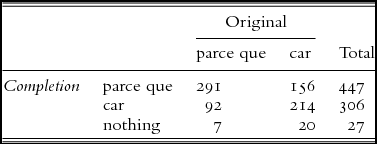
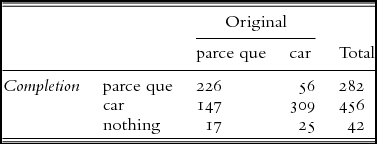
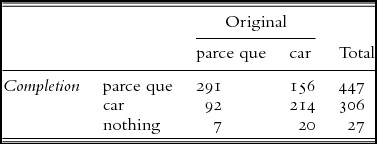
The results for the two types of sentences are given in Tables 6 and 7.
Results of the completion task from children's books.
Results of the completion task from Europarl Corpus.
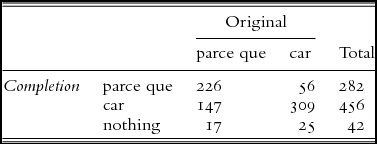
We analyzed the dataset by means of a multi-level logistic regression (Goldstein, Reference Goldstein1999; Mirman, Dixon & Magnuson, Reference Mirman, Dixon and Magnuson2008) in R using the lme4 package. In this analysis, we compared the preference for ‘car’ and ‘parce que’ in the two sets of registers marked items with the preference for ‘car’ in the data of Experiment 1. The preference for ‘car’ in the experimental items tested in Experiment 1 (47.6%) differed from both the preference in the children's books (40.6 %; β = -0.329, SE = 0.125, z = -2.64, p = 0.008) and from the preference in the Europarl sentences (61.7%; β = 0.521, SE = 0.111, z = 4.69, p = < 0.001). In the sentences from children's books there is a preference for ‘parce que’ and in the Europarl sentences there is a preference for ‘car’.
Results also indicate that participants’ choices were often congruent with the connective that was originally used in the sentences. In children's books, there were 505 (67,1 %) matches versus 248 (32,9 %) mismatches (χ2(1) = 96.68, p < 0.001) and in the items from the Europarl corpus, there were 535 (72,5 %) matches versus 203 (27,5 %) mismatches (χ2(1) = 141.8, p < 0.001). Thus, whatever drove the choice of the connective for the writer of these sentences also influenced the choice of the participants in the completion experiment.
Overall the participants left the connective out in more cases when ‘car’ had originally been used (χ2(1) = 6.39, p = 0.01). This effect was similar for both genres (χ2(1) = 1.53, p = 0.22).
4.1.2. Discussion
The offline data from the first completion experiment showed that French speakers are to some extent sensitive to the subjectivity of the relation in their choice of connective, as they chose ‘car’ more often for subjective relations than for objective relations. However, the data from this second completion experiment also show that the difference between ‘car’ and ‘parce que’ has another effect on the participants: they judge ‘parce que’ to be more suitable for stories from children's books with an informal tone, and ‘car’ to be more suitable for the formal texts from the European parliament. The latter fact could therefore provide an explanation for the early slowdown observed after the connective ‘car’ in the eye-tracking experiment, as the sentences were not belonging to a formal register and therefore clashed with the register-bias associated with this connective. The experiment also revealed that participants’ choices were influenced by which connective had been used originally by the writer, as the participants’ choices and the original connective used by the writer were in a majority of cases congruent in our data. This effect can in part be explained by syntactic features of the experimental sentences. Contrary to Experiment 1, these sentences represented natural corpus data involving a variety of different syntactic structures, some of them diminishing the acceptability of ‘car’ as predicted by theoretical analyses of these connectives (e.g. Lambda-L group, Reference Groupe1975). Indeed, participants unanimously chose ‘parce que’ for example in sentences involving a cleft (9) or a left dislocation (10).
-
(9) Si la télédétection se développe, c'est __________elle est un outil d'aménagement du territoire.
-
(10) Mais précisément __________ c'est une affaire très grave, nous avons le devoir de rester calmes. D'autres que moi l'ont dit à l'instant.
In a cloze task, Zufferey (Reference Zufferey2012) also reports that such structures block the choice of ‘car’ for most participants. These observations point to the necessity to explore the link between these syntactic constructions and objective and subjective causal relations in more details in future work.
5. GENERAL DISCUSSION
In this article, we tested the current status of the distinction between the two French causal connectives ‘car’ and ‘parce que’ in terms of objective and subjective causality. We argued that French represents a very interesting case study to assess the relations between language use and its online processing during reading. Indeed, we first demonstrated that an important difference existed in the way objective and subjective causal relations were linked with specific connectives in French (a language in which one of the connectives is restricted to the written mode) and Dutch (a language that uses two distinct causal connectives in speech and writing). In Experiment 1, we found that in Dutch, the division of labor between the connectives ‘want’ and ‘omdat’ is much clearer than the division of labor between ‘car’ and ‘parce que’ in French. In Experiment 2, we demonstrated that this difference affects the way readers process these connectives during reading. In earlier work (Canestrelli et al. Reference Canestrelli, Mak and Sanders2013) it has been shown that because of the clear distinction between ‘omdat’ and ‘want’ in Dutch in terms of subjectivity, the form of the connective serves as a clue informing the reader about the nature of the causal relation. Thus, since the connective ‘want’ is taken as an indication that the first segment is subjective, there is no effect of subjectivity later in the sentence. In other words, in Dutch, the subjectivity effect is carried by the connective. Experiment 2 shows that, by contrast, in French, the less clear-cut domain distinction between connectives in terms of subjectivity has other implications for processing, as the connective ‘car’ does not provide a linguistic clue about the subjective nature of causal relations. Even though readers slow down after reading the connective ‘car’, this effect does not prevent a later slow down at the end of the sentence. This effect is similar to the one found in English (Traxler et al., Reference Traxler, Bybee and Pickering1997a), a language in which both kinds of relations are conveyed by one single connective.
In Dutch, the connective ‘omdat’ is taken to signal an objective relation. As a result, readers experience processing difficulty when the relation between the two segments turns out to be subjective, compared to the same sentence with the connective ‘want’. In French, no such effect is found, because the connective ‘parce que’ is also used to convey subjective relations in speech and thus its acceptability in the same sentences in writing is higher. All this tends to indicate that the distinction between relation types and their encoding in two distinct connectives in French is not salient for readers, who do not use it during processing. Another indicator that this distinction is blurring comes from the completion experiments. In both completion tasks, French-speakers felt uncomfortable using either ‘car’ or ‘parce que’ more often in subjective than in objective relations.
Such uncertainty about the use of ‘car’ and ‘parce que’ in French raises the question of the future of French causal connectives, and more particularly of the subjective connective ‘car’. One possible scenario is that the replacement of ‘car’ by ‘parce que’ that has led to the very low frequency of ‘car’ in speech will also occur in writing, and that French will in time have only one causal connective, the way the English connective ‘because’ has replaced the subjective causal connective ‘for’, a connective that is now seldom used even in formal written registers such as the transcribed and edited debates of the European parliament (Zufferey & Cartoni, Reference Zufferey and Cartoni2012). According to Degand and Fagard (Reference Degand and Fagard2012), ‘car’ and ‘parce que’ have co-existed in French for almost a millennium, but it is only more recently that ‘parce que’ has evolved from an objective connective to a connective that also conveys subjective relations, thus increasing its frequency at the detriment of ‘car’. The register distinction between ‘car’ and ‘parce que’ is, however, not recent, as this comment by Lemare already in 1817 illustratesFootnote 3 (quoted in Bescherelle, Bescherelle & Litais de Gaux, Reference Bescherelle, Becherelle and Litais de1835 : 616): « Qu'on lise les bons auteurs, on y trouvera peu de parce que, même en prose; et beaucoup de car en prose et en vers [. . .] Allez au barreau, ce ne sont que des car. »
Our data does not allow us to speculate about the future of this pair of connectives, but it shows nonetheless they do not seem to carry distinct procedural instructions about the type of causal relation intended by the speaker. Additional processing experiments should enable us to disentangle further the role of subjectivity and register for the two effects found after the use of ‘car’ in our eye-tracking experiment. One way to address this issue is to control for these two parameters in online reading experiments. More precisely, the use of ‘car’ in a subjective relation framed in a formal register should cancel out the slowdown found immediately after the connective, but not the later effect found at the end of the sentence. Conversely, the addition of a mental state builder (e.g. ‘John thinks that’) to the segment preceding the use of car in a neutral register should cancel out the later effect found at the end of the sentence (the way it did in English and Dutch) but not the early slowdown provoked by this connective. We leave these experiments for future work.
In order to design the studies reported in this article, we focused on one specific distinction between ‘car’ and ‘parce que’ in terms of objective and subjective causal relations, using mostly normalized sentences. This study should thus be considered as an attempt to assess the link between speakers’ intuitions about language and their online processing through the case study of French causal connectives, rather than an exhaustive description of their uses. For the latter type of studies, we refer the readers to the numerous detailed qualitative studies that focus on describing the many syntactic, semantic and pragmatic features of these connectives (e.g. Bentolila, Reference Bentolila1986; Debaisieux, Reference Debaisieux, Pusch and Raible2002; Degand & Fagard, Reference Degand and Fagard2012; Fagard & Degand, Reference Fagard and Degand2008; Ferrari, Reference Ferrari1992; Nazarenko, Reference Nazarenko2000; Zufferey, Reference Zufferey2012).
In sum, the online data from our eye-tracking experiment, the offline data from our completion tasks as well as the corpus data from the literature form a coherent picture. In French ‘car’ is not strongly associated with subjective relations, which implies that French-speaking readers do not use ‘car’ to infer the presence of a subjective relation during reading, an observation that is in line with the fact that in corpus data ‘car’ is not strongly associated with subjective relations, and that participants do not have a strong tendency to choose it for subjective relations. By integrating offline and online processing data, our study fills the gap between corpus observations about French connectives and their online processing, thus contributing to pulling the strings of language use and its mental representation together.
APPENDIX A: LIST OF EXPERIMENTAL ITEMS FROM THE SENTENCE COMPLETION TASK (EXPERIMENT 1) AND THE EYE-TRACKING EXPERIMENT (EXPERIMENT 2)
001
Heidi est fière et heureuse, parce que/car encore une fois elle a gagné le premier prix au festival des arts.
Heidi a beaucoup d'imagination, parce que/car encore une fois elle a gagné le premier prix au festival des arts.
002
L’équipe locale a gagné le match parce que/car les adversaires n'ont pas marqué de but.
L’équipe locale est excellente parce que/car les adversaires n'ont pas marqué de but.
003
Bente avait froid quand elle sortait parce qu’/car elle avait encore fait un grand trou dans son pull.
Bente s'est accrochée à un arbuste épineux parce que/car elle avait encore fait un grand trou dans son pull.
004
Susanne a perdu son argent et ses cartes de crédit parce qu’/car elle a oublié son portefeuille dans le bus.
Susanne n'est pas très attentive parce que /car elle a oublié son portefeuille dans le bus.
005
Les élèves avaient peur parce que/car l'instituteur criait souvent très fort.
Les élèves n’étaient pas sages parce que/car l'instituteur criait souvent très fort.
006
Pierre évite de passer sous des échelles parce que/car son horoscope l'inquiète beaucoup.
Pierre est très superstitieux parce que/car son horoscope l'inquiète beaucoup.
007
Karine était jalouse de son amie parce qu’/car le mois dernier elle s’était fiancée à un beau garçon.
Karine avait une amie séduisante parce que/car le mois dernier elle s’était fiancée à un beau garçon.
008
Eva avait eu une grosse augmentation parce que/car son directeur l'avait nommée manager.
Eva travaillait plus dur que les autres parce que/car son directeur l'avait nommée manager.
009
Jeff était fâché contre ses voisins parce que/car leur télévision était allumée toute la journée.
Jeff avait des voisins pénibles parce que/car leur télévision était allumée toute la journée.
010
Barbara est fâchée contre sa sœur parce que/car une fois de plus elle l'a battue au tennis.
Barbara joue moins bien que sa sœur parce que/car une fois de plus elle l'a battue au tennis.
011
Rick a failli mourir parce qu’/car un serpent venimeux lui a mordu la jambe.
Rick se promenait en short dans la jungle parce que/car un serpent venimeux lui a mordu la jambe.
012
Les footballeurs étaient trop ivres pour jouer parce qu’/car comme toujours ils avaient passé la nuit au pub.
Les footballeurs étaient en train de fêter leur victoire parce que/car comme toujours ils avaient passé toute la nuit au pub.
013
Matthieu se musclait les jambes parce qu’/car il allait travailler à bicyclette tous les jours.
Matthieu n'avait pas de voiture parce que/car il allait travailler à bicyclette tous les jours.
014
Bob avait boité pendant deux semaines parce qu’/car une fois de plus il s’était blessé au hockey.
Bob avait reçu un coup d'un autre joueur parce que/car une fois de plus il s’était blessé au hockey.
015
Lise ne pouvait pas regarder sa série préférée parce qu’/car on avait volé son nouveau téléviseur.
La porte d'entrée de Lisa avait été forcée parce que/car on avait volé son nouveau téléviseur.
016
Louise gagnait un peu d'argent parce qu’/car depuis six mois elle travaillait comme ouvrière du bâtiment.
Louise était en bonne forme physique parce que/car depuis six mois elle travaillait comme ouvrière du bâtiment depuis six mois.
017
Diane avait peur de faire du jogging dans le noir parce qu’/car jeudi dernier elle avait failli être renversée par une voiture.
Diane ne portait pas de vêtements fluorescents parce que/car jeudi dernier elle avait failli être renversée par une voiture.
018
Jeanne a plus d'argent sur son compte en banque parce qu’/car ce mois-ci elle a reçu une grosse augmentation.
Jeanne fait du bon travail parce que/car ce mois-ci elle a reçu une grosse augmentation.
019
Le ventre d'Hélène gargouillait parce qu’/car elle avait déjà faim à 11 heures du matin.
Hélène n'avait pas déjeuné ce matin-là parce que/car elle avait déjà faim à 11 heures du matin.
020
Jean devait aller à pied à son travail parce qu’/car hier il s’était fait voler sa bicyclette hier matin.
Jean n'avait pas de câble antivol parce que/car hier il s’était fait voler sa bicyclette hier matin.
021
Tina a fait cinq kilomètres à pied parce que/car sa voiture est tombée en panne sur l'autoroute.
Tina n'avait plus d'essence parce que/car sa voiture est tombée en panne sur l'autoroute.
022
Les sapeurs-pompiers ne pouvaient plus sauver le bâtiment parce que/car le feu s’étendait à une allure foudroyante.
Les sapeurs-pompiers sont arrivés trop tard près du bâtiment parce que/car le feu s’étendait à une allure foudroyante.
023
Elise était à bout de souffle parce qu’/car elle avait descendu les escaliers quatre à quatre.
Elise était pressée, parce que/car elle avait descendu les escaliers quatre à quatre.
024
Line et David ont des courbatures dans les membres parce qu’/car ils ont fait la course ensemble hier soir.
Line et David sont de bons amis parce que/car ils ont fait la course ensemble hier soir.
025
Martine est tombée dans l'eau parce que/car le courant a fait chavirer son bateau.
Martine a été imprudente parce que/car le courant a fait chavirer son bateau.
026
Jacques a perdu son emploi parce qu’/car ce mois-ci il est arrivé cinq fois en retard au travail.
Jacques a des problèmes personnels parce que/car ce mois-ci il est arrivé cinq fois en retard au travail.
027
Ses anciens amis manquent à Valérie parce qu’/car au printemps elle a déménagé en Espagne.
Valérie aime le soleil et la chaleur parce que/car au printemps elle a déménagé en Espagne.
028
François est triste parce qu’/car ce matin il a encore raté son examen de linguistique.
François n'est pas un bon étudiant parce que/car ce matin il a encore raté son examen de linguistique.
029
Anne a attrapé un coup de soleil, parce qu’/car elle est allée skier toute la journée lundi dernier.
Anne a une bonne condition physique, parce que/ car elle est allée skier toute la journée lundi dernier.
030
Pierre est content parce qu’/car il a trois tableaux de Picasso dans son salon.
Pierre est riche parce que/car il a trois tableaux de Picasso dans son salon.
031
Le ministre de l'agriculture est inquiet parce que/car beaucoup de fermiers ont essuyé des pertes d'an dernier.
Le ministre de l'agriculture n'a pas tenu ses promesses parce que/car beaucoup de fermiers ont essuyé des pertes d'an dernier.
032
La compagnie des chemins de fer fait des bénéfices parce que/car de plus en plus de gens prennent le train pour aller travailler.
La compagnie des chemins de fer fournit d'excellents services parce que/car de plus en plus de gens prennent le train pour aller travailler.
033
Les alpinistes n'ont pas réussi à atteindre le sommet parce qu’/car malheureusement ils n'ont pas pris le bon matériel avec eux.
Les alpinistes sont inexpérimentés parce qu’/car malheureusement ils n'ont pas pris le bon matériel avec eux.
034
Les politiciens sont très contents parce que/car leur parti a encore gagné les élections ce mois-ci.
Les politiciens ont mené une bonne campagne parce que/car leur parti a encore gagné les élections ce mois-ci.
035
Ce peintre a pu s'acheter une nouvelle maison parce que/car ses tableaux se vendent partout dans le monde.
Ce peintre est très à la mode parce que/car ses tableaux se vendent partout dans le monde.
036
Les soldats ont été vaincus parce que/car leurs ennemis sont arrivés par surprise depuis la ville voisine.
Les soldats étaient mal préparés parce que/car leurs ennemis sont arrivés par surprise depuis la ville voisine.
037
Les enfants sont joyeux parce qu’/car contre toute attente il n'y a pas école demain matin.
La maîtresse est absente parce que/car contre toute attente il n'y a pas école demain matin.
038
Cette route a été interdite parce que/car chaque année elle cause de nombreux accidents.
Cette route est dangereuse parce que/car chaque année elle cause de nombreux accidents.
039
Ce téléphone est en panne parce que/car ses batteries ont lâché pour la nième fois.
Ce téléphone est de mauvaise qualité parce que/car ses batteries ont lâché pour la nième fois.
040
Max a besoin de mouchoirs, parce qu’/car malheureusement il vient de s'enrhumer à nouveau.
Max est en mauvaise santé parce que/car malheureusement il vient de s'enrhumer à nouveau.
APPENDIX B: LIST OF EXPERIMENTAL ITEMS FROM THE SENTENCE COMPLETION TASK TESTING THE REGISTER HYPOTHESIS (EXPERIMENT 3)
CHILDREN'S BOOKS
Original ‘parce que’ (corpus Le Petit Nicolas)
001
Moi, j'aime assez rester à la maison quand il pleut et qu'il y a du monde, __________ maman prépare des tas de choses chouettes pour le goûter.
002
J'aime bien la grenadine __________ c'est rouge.
003
J’étais drôlement fier, __________ je suis arrivé le premier de tous à l'auto.
004
Ça m'a pris beaucoup de temps d'ouvrir le paquet à cause des ficelles et aussi __________ quand je suis impatient, je tremble et c'est drôlement dur pour défaire les nœuds.
005
Quand maman m'a dit que mémé venait à la maison, moi j'ai été très content __________ j'aime beaucoup mémé.
006
Je dois dire que ça m’a un peu étonné que papa soit si content, __________ lui et mémé ils se disputent un peu quand ils se voient.
007
Je sautais autours de mémé et je regardais sa grosse valise, __________ mémé, quand elle vient, elle a toujours des cadeaux pour moi.
008
Dépêche-toi Nicolas, m'a dit papa, __________ quand je serai prêt je ne t'attendrai pas.
009
Moi j'aime bien sortir avec papa, __________il me paie tout le temps des choses.
010
C'est pas juste, à la fin, _________ si personne ne le voit ce n'est pas la peine d’être bronzé.
Original ‘car’
011 (Le Petit Nicolas)
Si cet élève mettait autant d'énergie au travail qu’à se nourrir, il serait le premier de la classe, _________ il pourrait faire mieux.
012 (Le Petit Nicolas)
Il a eu tort _________ cette fois-ci, c’étaient les œufs durs qui étaient dans la malle marron, qui était elle même dans le fourgon.
013 (Le Petit Nicolas)
Je dois être attentif en classe, au lieu de me distraire en faisant des niaiseries, _________ je suis à l'école pour m'instruire, et non pas pour me dissiper ou m'amuser.
014 (Le Petit Nicolas)
Vous parlerez là-dedans, bien distinctement, sans avoir peur; et ce soir, à huit heures précises, vous pourrez vous écouter, _________ tout ceci est enregistré.
015 (Le Petit Nicolas)
Chez Nicolas, le choix de l'endroit où l'on va passer ces vacances n'est pas un problème, _________ c'est papa qui décide.
016 (Le Gentil Petit Diable)
Cette fois, on fut content de lui, _________ il travaillait de bon cœur.
017 (Le Gentil Petit Diable)
Ne me demandez pas de vous la répétez, _________ si je la savais, je ne serais pas ici, je serais moi-même au ciel.
018 (Le Gentil Petit Diable)
Je suis bien triste, _________ je n'entends pas un mot de ce que vous dites.
019 (Le Gentil Petit Diable)
Cette fois, elle était pleine, _________ c’était l'heure de la récréation.
020 (Le Gentil Petit Diable)
Il a bien du mérite à se trouver parmi nous, _________ il vient de loin.
PARLIAMENTARY DEBATES (EUROPARL CORPUS)
Original ‘parce que’
001
Si la télédétection se développe, c'est __________elle est un outil d'aménagement du territoire.
002
Toutes ces irrégularités tendent à forcer la main des États membres pour avaliser le texte provisoire d'Amsterdam, qui est incohérent __________arrêté dans la confusion si, toutefois, il a jamais été arrêté !
003
Deuxièmement, je crois qu'il y a un certain nombre de nos collègues qui n'ont pas parlé __________ils ont voulu protester contre le fait que nous sommes, effectivement, un vendredi matin.
004
Mais précisément __________ c'est une affaire très grave, nous avons le devoir de rester calmes. D'autres que moi l'ont dit à l'instant.
005
Ce n'est pas __________elle est femme que l'ouvrière des industries textiles a une condition médiocre.
006
Pour toutes ces raisons et __________ je crois que la réflexion n'a pas été conduite assez loin, je suis favorable à un renvoi de ce dossier en commission.
007
Pour une raison de pure tactique: c'est __________ils souhaiteraient qu'on en arrive rapidement à un vote en catimini sur une importante question, celle de la bioéthique.
008
Ni les États membres, qui ont raté le traité d'Amsterdam, __________ils n'ont pas su poser les problèmes de la transformation des institutions de l'Union.
009
Je n'ai pourtant pas voté en sa faveur, __________ je pense qu'il a été malencontreusement défiguré par certains amendements.
010
On a été injuste avec vous, __________à la mesure de l'honnêteté qu'on a exigée de votre Commission, aucun gouvernement des Quinze ne devrait rester en place.
Original ‘car’
011
Au nom du Parlement, j'attends de la Commission qu'elle reprenne les souhaits évoqués plus haut, __________ ils sont essentiels pour nos objectifs politiques de clarté, de transparence et d’équité.
012
C'est absolument nécessaire, __________ aujourd'hui il semble que sans avoir réussi à définir une véritable politique alimentaire, l'Union ait élaboré trop de législation qui, paradoxalement, ne s'est pas traduite par plus d'harmonisation.
013
C'est absolument inacceptable, __________ absolument contraire à notre conception d'une Europe qui respecte ses nations.
014
Nous ne sommes pas de son avis sur ce point, __________ cette adhésion, de peu d'utilité pratique, ferait faire à l'Union un saut institutionnel non maîtrisé.
015
Je pense que la Commission devrait agir très vite __________ il en va de la crédibilité de l'euro dans cette phase intermédiaire.
016
J'attire aussi l'attention de tous nos amis socialistes qui ont écouté ce qu'a dit M. Berthu, __________ M. Berthu a dit exactement la même chose que vous sur certains points.
017
Monsieur le Président, je vous remercie de me donner la parole, __________ je constate que vous avez été un peu vite au cours du vote sur la proposition du groupe ARE.
018
Je m'arrête là en ce qui concerne votre rapport, __________ un certain nombre de questions au sujet du rapport de Mme Riis-Jørgensen attendent aussi une réponse.
019
Mais je souhaite vous demander votre avis sur un sujet qui me préoccupe particulièrement, __________ je suis le rapporteur compétent pour ce budget.
020
Le danger de cette xénophobie - on ne peut pas l'appeler autrement - est grand, __________ comme l'écrivait Gorki: « Il vaut mieux attendre le meilleur de l'homme, en attendre le pire c'est le pervertir ».