Introduction
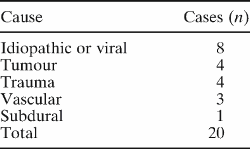
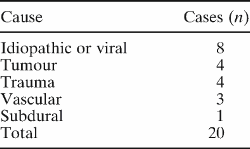
Isolated hypoglossal nerve palsy is rare,Reference Combarros, Alvarez de Arcaya and Berciano1–Reference Thompson and Smoker7 and there is no defined approach to the investigation of this condition in the literature. Most papers report single cases, with only a small number of case series published.Reference Combarros, Alvarez de Arcaya and Berciano1 Numerous papers reporting the condition and its causes do not differentiate the truly isolated palsy from a palsy presenting concomitantly with other neurological abnormalities. Combining smaller series specific to an isolated palsy, only 20 cases are available in the literature (Table I).Reference Shahab, Savy, Croft and Hung2 More commonly, the hypoglossal nerve is involved along with the glossopharyngeal, vagus and spinal accessory nerves within the nearby jugular foramen.Reference Blomquist, Barr and Hurst3, Reference Syms, Tanaka Singson and Burgess9, Reference Lindsay, Mullin and Keefe10
PUBLISHED CASES OF TRULY ISOLATED HYPOGLOSSAL NERVE PALSY
Combarros et al.,1 Giuffrida et al.,6 Tommasi-Davenas et al. 8
Unlike other isolated lower cranial nerve palsies, the presentation of an isolated hypoglossal nerve palsy is an ominous sign. If recent surgery, radiotherapy or trauma are excluded as possible causes, an assessment of the available literature would suggest that 50 per cent of isolated hypoglossal nerve palsies are idiopathic, in much the same way as the mononeuritis of Bell's palsy in the VIIth cranial nerve, with a similarly spontaneous recovery rate. A further 20 per cent are malignant, 20 per cent are vascular, and 10 per cent are due to miscellaneous causes, including systemic bony or autoimmune conditions such as rheumatoid arthritis and Wegener's granulomatosis.Reference Combarros, Alvarez de Arcaya and Berciano1, Reference Tommasi-Davenas, Vighetto, Confavreux and Aimard8
A case is outlined in which the presentation and subsequent investigations helped to elucidate an efficient and logical approach to patients presenting with isolated hypoglossal nerve palsy.
Case presentation
A 53-year-old woman was referred to the otolaryngology clinic with a seven-day history of slurring of speech and an associated swelling of the tongue. An orthopaedic appointment had also been arranged for persistent lower back pain. Examination of the tongue and lower cranial nerves revealed no abnormality, and a further review was arranged in four days' time at the next clinic.
At follow up, a right hypoglossal nerve palsy was now noted. There was no other abnormality on ENT examination.
An urgent magnetic resonance imaging (MRI) scan of the brain and neck was requested and, subsequent to the orthopaedic attendance, the thoracic and lumbar spinal regions were also included.
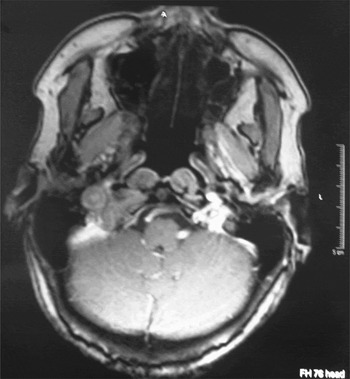
The skull base MRI revealed a 3×2 cm, sclerotic, destructive mass in the region of the right occipital condyle, anterolateral to the foramen magnum (Figure 1). Diffuse metastatic infiltration of the thoracic and lumbar spine was demonstrated on spinal radiology, with multiple liver metastases evident on abdominal ultrasound.
Axial magnetic resonance imaging scan of skull base, showing destructive lesion of right occipital condyle.

Ultrasound-guided liver biopsy was undertaken, revealing histological adenocarcinoma of a tubular type. Further investigations, including mammography, barium swallow and enema, and colonoscopy, failed to identify a primary malignancy.
The patient succumbed to disseminated disease within six weeks of presentation.
Discussion
When assessing an isolated hypoglossal nerve palsy, any history of recent surgery, trauma or radiotherapy should be considered in the first instance. The commonest iatrogenic surgical causes of palsy include carotid endarterectomy and submandibular gland excision.Reference Hoare, Manjalay and Proops5, Reference Keane11, Reference Castling and Hicks12 Radiotherapy has a particular predilection for the XIIth cranial nerve, causing damage either directly or indirectly via vascular ischaemia or fibrosis in the surrounding tissues.Reference Shahab, Savy, Croft and Hung2, Reference Keane11
In the absence of an obvious iatrogenic aetiology, the differential diagnosis can be classified as per Table I.
Idiopathic hypoglossal nerve palsy occurs in up to 50 per cent of cases, and, similar to Bell's palsy of the VIIth cranial nerve, the palsy is transient and reversible and the outcome excellent in most cases.Reference Combarros, Alvarez de Arcaya and Berciano1, Reference Omura, Nakajima, Kobayashi, Ono and Fujita4, Reference Giuffrida, Lo Bartolo, Nicoletti, Reggio, Lo Fermo and Restivo6, Reference Castling and Hicks12, Reference Bagan-Senastian, Milian-Masanet, Penarrocha-Diago and Lloria de Miguel13 Malignant causes are most commonly due to metastatic disease. In the largest series of 100 hypoglossal nerve palsies, albeit without differentiating the truly isolated palsy, nearly half of all cases were caused by tumour, with two-thirds being caused by metastases, chordoma, nasopharyngeal carcinoma or lymphoma.Reference Keane11
On assessment of articles reporting non-traumatic, non-iatrogenic, truly isolated hypoglossal nerve palsies, the incidence of malignant causes falls to 20 per cent.Reference Combarros, Alvarez de Arcaya and Berciano1, Reference Shahab, Savy, Croft and Hung2, Reference Omura, Nakajima, Kobayashi, Ono and Fujita4, Reference Keane11, Reference Bagan-Senastian, Milian-Masanet, Penarrocha-Diago and Lloria de Miguel13 A further 20 per cent of cases have vascular causes and 10 per cent are considered miscellaneous, with cases including systemic bony or autoimmune conditions such as rheumatoid arthritis and Wegener's granulomatosis.Reference Combarros, Alvarez de Arcaya and Berciano1, Reference Tommasi-Davenas, Vighetto, Confavreux and Aimard8
Demyelinating disease remains a possibility, and some would advocate thorough neurological assessment and repeat MRIs every three to five years if there is no recovery.Reference Ho, Fardy and Crean14
Some authors have suggested a blanket approach to investigating the isolated hypoglossal nerve palsy, via an exhaustive battery of tests.Reference Ho, Fardy and Crean14 These include general and specific phlebotomy, radiology and cerebrospinal fluid analysis. Computed tomography scanning has been shown to miss certain causes such as vascular lesions and even bony destruction, and therefore MRI should be the preferred choice.Reference Lindsay, Mullin and Keefe10, Reference Wilding, Howlett, Anderson, Sangle, Violaris and Evans15–Reference Spitzer, Mull and Topper17 We would suggest that all that is required in the first instance is a proper history, thorough examination, and MRI of the course of the nerve.
• A case of isolated hypoglossal palsy is presented, which was due to a metastatic skull base deposit
• The majority of isolated hypoglossal nerve palsies are benign. However, unlike an isolated VIIth cranial nerve palsy, a XIIth nerve palsy has a higher incidence of sinister disease and therefore should be considered a harbinger of malignancy
• Magnetic resonance imaging or magnetic resonance angiography allows assessment of the entire course of the hypoglossal nerve from brain to tongue, and will offer the best option for an immediate diagnosis; it should therefore be considered as the first line of investigation for an isolated hypoglossal nerve palsy