Introduction
Insects in temperate and boreal forest regions are subjected to prolonged periods of extreme cold temperatures (Rochefort et al. Reference Rochefort, Berthiaume, Hebert, Charest and Bauce2011). The physiological mechanisms for tolerating subzero temperatures vary, and sometimes include diapause, a mechanism for escaping harsh environmental conditions. Both cold tolerance and diapause are commonly triggered by environmental cues such as photoperiod and temperature, although the timing of the initiation of diapause and various cold tolerance mechanisms often vary (Denlinger Reference Denlinger1991; Bale and Hayward Reference Bale and Hayward2010; Schiesari and O’Connor Reference Schiesari and O’Connor2013). Insect subzero adaptation mechanisms are commonly divided into two main categories: freeze tolerance or freeze avoidance (Duman Reference Duman2001; Voituron et al. Reference Voituron, Mouquet, de Mazancourt and Clobert2002; Bale and Hayward Reference Bale and Hayward2010). Freeze tolerant insects are able to survive the formation of ice in the extracellular fluid (Zachariassen and Hammel Reference Zachariassen and Hammel1976), while freeze intolerant insects die if frozen and therefore must become freeze avoiding in winter by lowering the supercooling point (temperature of spontaneous ice formation) of their body fluids below temperatures experienced in their habitat (Doucet et al. Reference Doucet, Walker and Qin2009). Both strategies are physiologically complex, and a comprehensive understanding of the cold tolerance and acclimation ability of the insect are required to determine the mechanisms by which these ectotherms survive in regions with low winter temperatures (Zachariassen Reference Zachariassen1985; Duman et al. Reference Duman, Wu, Xu, Tursman and Olsen1991; Clark and Worland Reference Clark and Worland2008; Doucet et al. Reference Doucet, Walker and Qin2009; Denlinger and Lee Reference Denlinger and Lee2010). In addition, deleterious effects of cold that do not involve ice formation, such as membrane malfunction, can be lethal at temperatures above the supercooling point in both freeze tolerant and freeze avoiding species (Lee Reference Lee2010; Lee and Denlinger Reference Lee and Denlinger2010).
Most terrestrial arthropods in North America are freeze-intolerant (Somme Reference Somme1982), using high-energy nutrients to produce antifreeze products such as glycerol, sugars, and other polyols (Doucet et al. Reference Doucet, Walker and Qin2009; Sformo et al. Reference Sformo, McIntyre, Walters, Barnes and Duman2011). The quality and abundance of protective antifreeze products can directly affect overwintering survival, and may be associated with host plant quality (Rochefort et al. Reference Rochefort, Berthiaume, Hebert, Charest and Bauce2011). Previous studies have shown that insect cold tolerance and overwintering success can vary along a latitudinal gradient (Addo-Bediako et al. Reference Addo-Bediako, Chown and Gaston2000), while seasonal temperatures can also play an important role in supercooling variation, increasing glycerol content, and other factors to lower the supercooling point (Somme Reference Somme1964).
Like many insects in temperate/boreal regions, the forest tent caterpillar (Malacosoma disstria Hübner; Lepidoptera: Lasiocampidae) is subjected to an extended period of subzero temperatures (Trudeau et al. Reference Trudeau, Mauffette, Rochefort, Han and Bauce2010). This insect has a broad longitudinal and latitudinal range, extending across North America, from British Columbia to California, and Maine to Florida (Parry et al. Reference Parry, Goyer and Lenhard2001). This folivore feeds in colonies and causes severe, large-scale defoliation during intermittent outbreaks (Wood et al. Reference Wood, Parry, Yanai and Pitel2010). Females oviposit single egg bands around twigs and branches in the crowns of host trees. The pharate larvae undergo diapause during winter (Fitzgerald Reference Fitzgerald1995). Egg bands are covered in spumulin, a foamy coating that hardens when exposed to air (Trudeau et al. Reference Trudeau, Mauffette, Rochefort, Han and Bauce2010). This foamy coating provides a small amount of protection (Parry et al. Reference Parry, Goyer and Lenhard2001), but other than temporary cover by intermittent ice and snow, egg bands are directly exposed to the harsh winter conditions. Glycerol content remains relatively low in the late fall and early winter months (October and November), but triples during the next three months, before returning to late fall levels in March (Hanec Reference Hanec1966).
Pharate larvae emerge from their eggs in early spring in synchrony with budbreak of their host plants. They undergo five larval instars, at approximately one instar per week. Pupation occurs in mid-June, and adults emerge in July, mate, and oviposit. Adults of both sexes are strong fliers (Fullard and Napoleone Reference Fullard and Napoleone2001), with the ability to move up to 19 km a year (Evenden et al. Reference Evenden, Whitehouse and Jones2015). When assisted by turbulent cold air masses, M. disstria can fly even longer distances, with a maximum of 480 km in 12 hours (Brown Reference Brown1965).
Malacosoma disstria causes substantial damage to forests during outbreak years, although populations in the most northern latitudes of its range generally undergo fewer outbreaks, with extreme cold temperatures being partially responsible (Daniel and Myers Reference Daniel and Myers1995). Winter mortality of eggs varies annually within populations (Hanec Reference Hanec1966; Cooke and Roland Reference Cooke and Roland2003).
We measured the supercooling points of pharate M. disstria larvae from populations collected along a 552 km latitudinal gradient, in November, February, and March of 2011–2012. We hypothesised that pharate larvae from northern latitudes would have lower supercooling points than those from more southern latitudes, and that supercooling points would decrease as winter proceeds.
Materials and methods
Insect population sources
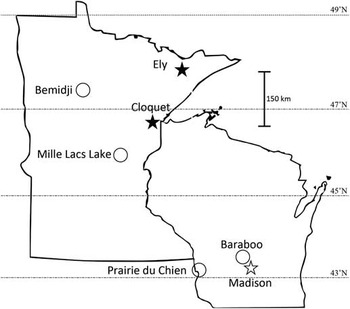
Malacosoma disstria egg bands were collected across a latitudinal gradient from southern Wisconsin to northern Minnesota, United States of America. Four naturally occurring populations were collected in the fall of 2011 (from south to north) near Prairie du Chien, Wisconsin; Baraboo, Wisconsin; Mille Lacs Lake, Minnesota; and Bemidji, Minnesota (Fig. 1). The Prairie du Chien egg bands (42°58'27.98'N, 90°59'10.34'W) were collected during early November to mid-December. The Baraboo egg bands (43°25'12.53'N, 89°38'8.69'W) were collected during mid-October through early November. The Mille Lacs Lake egg bands (46°8'30.15'N, 93°27'33.71'W) were collected on 23 October. The Bemidji egg bands (47°0'14.05'N, 95°2'39.18'W) were collected on 24 October. Egg bands were collected using pruning poles and hand pruners to cut the distal ends of branches off host trees.
Collection sites for Malacosoma disstria egg bands (circles), overwintering site (open and solid stars), and sites of application of controlled spring temperature and recording of egg hatch (solid stars) in Minnesota and Wisconsin, United States of America.

Overwintering of pharate larvae
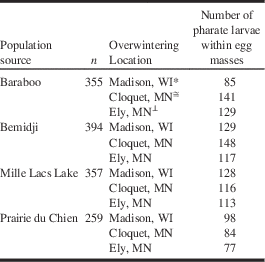
To account for the potential role of winter environment on how pharate larvae respond to variable cold temperatures, and to test whether populations might differ in this regard, we also included three overwintering regimes (Table 1). Egg bands were stored outdoors in mesh bags 152 cm above the ground.
Allocation of overwintering location by population source.
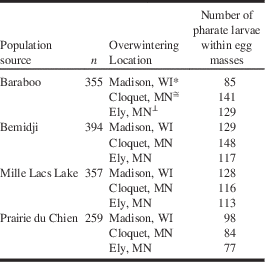
Notes: Pharate Malacosoma disstria larvae began overwintering in early December 2011. Latitude and longitude.
* 43.065817, −89.452843.
≅ 46.673936, −92.508970.
⊥ 47.943320, −91.803195.
WI, Wisconsin; MN, Minnesota.
Supercooling points
Supercooling points (SCPs) were determined using microthermocouples (copper-constantan, 36 gauge) applied to egg bands with petroleum jelly. Sixteen thermocouple leads per supercooling point run were attached to a computer controlled multichannel thermocouple thermometer (Iso-Thermex; Columbus Instruments, Columbus, Ohio, United States of America) that recorded every five seconds. Egg bands were then cooled at 0.2 °C/minute until larval freezing. Supercooling points were identified by an exotherm, a release of energy indicating the latent heat of fusion of each pharate larvae (Sformo et al. Reference Sformo, McIntyre, Walters, Barnes and Duman2011). Typically multiple exotherms were identified by each thermocouple as the exotherms were sufficiently large that freezing events of additional pharate larvae in close proximity to the individual at the exact site of attachment were identified. Therefore, during a typical run each thermocouple identified the SCPs of four to six pharate larvae. The supercooling point of each pharate larva was taken as the lowest recorded temperature before the exotherm was reached.
To determine how the supercooling point of the pharate larvae related to survival and whether the pharate larvae were freeze tolerant, one group (n=52) of eggs collected in March (see below) was cooled (rate=0.2 °C/hour) to a temperature a few degrees below their supercooling points (−45 °C, see Results), while another group (n=38) was cooled to a low temperature that was above the supercooling point (−20 °C) and held for 24 hours. The latter served as a control to determine the level of non-freeze mortality. The eggs were then placed at 20 °C to determine hatch rates.
Sampling periods
Pharate larvae were sampled at three time points during overwintering: 1 November 2011, 1 February 2012, and 9 March 2012. In November, the populations were pooled. In February and March, the four populations were tested separately. The March testing period also accounted for overwintering location (Cloquet or Ely, Minnesota) and interactions between population source and time of collection.
Statistical analyses
Supercooling points were compared using three separate random effects nested analyses of variance to account for the different variables considered at each time period, and for main effect(s) nested within egg bands. The first analysis tested the main effect of time of winter, using Y ij =μ+T i +E j (T i )+e ij , where μ is the overall mean response, T the time point i, E the egg band source j, e ij the whole-plot error, and Y ij the average supercooling point threshold ij. All three sampling times were used in this analysis. Insect population and overwintering locations were pooled. The second analysis tested population source, using Y ij =μ+P i +E j(P i )+e ij , where μ is the overall mean response, P the population source i, E the egg band source j, e ij the whole-plot error, and Y ij the average supercooling point threshold ij. The February and March samples were used in this analysis. The third analysis tested for population source and overwintering location, and their interaction, using Y ijk =μ+P i +O j +PO ij +E k (PO ij ) e ijk , where μ is the overall mean response, P the population source i, O the overwintering location j, E the egg bands source k, e ijk the whole-plot error, and Y ijk the average response for population source i and overwintering location j, from source k. Only the March samples were used in this analysis.
Statistical analyses were performed using Proc GLM (general linearised model) in SAS 9.3 (SAS Institute, Cary, North Carolina, United States of America). Results are reported (type III error) with corresponding P<0.05 as “significant” and 0.05<P⩽0.10 as “marginally significant”.
Results
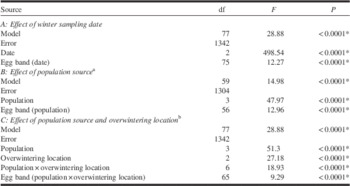
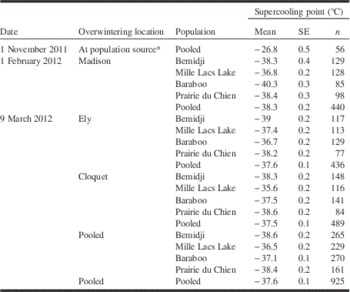
Mean supercooling points varied with the time of the overwintering period in which pharate larvae were collected in the field (Table 2A), population source (Tables 2B, 2C), overwintering location (Table 2C), egg band (for all main effects nested within) (Tables 2A, 2B, 2C), and the interaction between population source and overwintering location (Table 2C). The mean supercooling point value was lowest in February (−38.3 °C), followed by March (−37.6 °C), then November (−26.8 °C) (Table 3). Only the northernmost population, “Bemidji”, had a lower supercooling point in March than February.
Results of analysis of variance (ANOVA), relating the effects of time period (A), population source (B), and population source×overwintering location (C) on supercooling points of Malacosoma disstria pharate larvae.

Note: An asterisk denotes significant factor at P<0.05.
a Egg masses evaluated at the February time period only.
b Egg masses evaluated at the March time period only.
Supercooling points of Malacosoma disstria pharate larvae from various population sources at three time points during overwintering.

* Eggs tested in November did not overwinter, as they were tested immediately after field collection.
Mean supercooling points did not show a simple relationship with latitude of population source, as the lowest supercooling point occurred within the second most southern population, Baraboo (−40.3 °C), and the highest supercooling point occurred within the second most northern population, Lake Mile Lac (−35.6 °C) (Fig. 1). Egg masses that overwintered in the more northern overwintering site, Ely, had a mean supercooling point 0.3 °C lower than those that overwintered in Cloquet (−37.8 °C versus −37.5 °C, respectively).
Based on the supercooling points observed, we conducted a second experiment to determine whether the pharate larvae are freeze tolerant. None of the March pharate larvae held for 24 hours at −45 °C (below the supercooling point) hatched, while 89% of those held at −20 °C (above the supercooling point) hatched.
Discussion
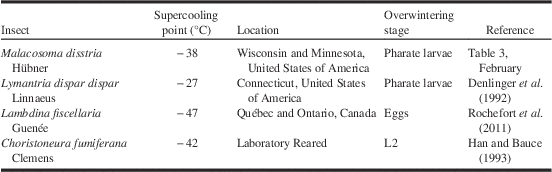
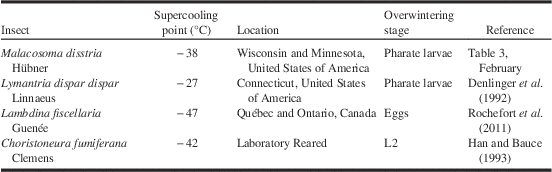
Pharate Malacosoma disstria larvae have a relatively low supercooling point, ranging from −26.8 °C in November to −38.3 °C in March, which is approximately in the middle of values reported for other spring lepidopteran defoliator species in northern climates (summarised in Table 4). The trend for supercooling points to be lower later in winter is consistent with the trend for increasing glycerol content in colder months reported by Hanec (Reference Hanec1966). That is, high supercooling points in November corresponded with low glycerol content, and low supercooling points in February corresponded with high glycerol content. In addition to variation in supercooling points among populations and progeny of females within populations, the environmental factor of overwintering treatment influenced cold tolerance. While these small (0.3 °C) supercooling point differences between Ely and Cloquet are statistically significant, their functional significance is likely inconsequential.
Comparison of supercooling points of early season lepidopteran defoliators in northern forests.
All four M. disstria populations have mean supercooling points that confer adequate protection against the coldest winter months typical for any of the collection or overwintering locations examined. Even the coldest temperatures that occurred at any of the sites during the winter of 2011–2012 (−31.7 °C at Ely in January 2012) (Supplementary Table S1) were above the minimum supercooling point for any M. disstria population (−35.6 °C, Mille Lacs Lake, March). The ability to avoid freezing at these temperatures thus appears more than adequate for surviving most winters in northern Minnesota, during which minimum temperatures can be as low as −20 °C to −30 °C. This margin between observed winter temperatures and insect cold tolerance may explain why population source was not a factor in field overwintering survival of egg bands collected along the same latitudinal range (Uelmen et al. Reference Uelmen, Lindroth, Tobin, Reich, Schwartzberg and Raffa2016). In general, M. disstria egg bands appear to be highly cold tolerant based on SCPs of individual pharate larvae. However, low temperatures above the SCP, especially longer durations of exposure (typically several days to weeks), could become a limiting factor to survival (Blais et al. Reference Blais, Prentice, Sippel and Wallace1955; Turnock et al. Reference Turnock, Lamb and Bodnaryk1983; Turnock and Bilodeau Reference Turnock and Bilodeau1984; Bale Reference Bale1987).
Climate change is likely to facilitate northward expansion of many insect species in north-temperate zones (Netherer and Schopf Reference Netherer and Schopf2010; Jepsen et al. Reference Jepsen, Kapari, Hagen, Schott, Vindstad and Nilssen2011; Price et al. Reference Price, Alfara, Brown, Flannigan, Fleming and Hogg2013). As average temperatures in their northern ranges rise, some insect folivores may experience higher overwintering survival (Ayres and Lombardero Reference Ayres and Lombardero2000) and altered phenological synchrony with hosts (Schwartzberg et al. Reference Schwartzberg, Jamieson, Raffa, Reich, Montgomery and Lindroth2014; Uelmen et al. Reference Uelmen, Lindroth, Tobin, Reich, Schwartzberg and Raffa2016). An Intergovernmental Panel on Climate Change (2014) summary report estimates early spring folivores have the ability to migrate ~100 km per decade, or 10 km per year per female, on average. Previous literature has shown this range is well within the flight capacity of M. disstria (Brown Reference Brown1965; Fullard and Napoleone Reference Fullard and Napoleone2001). These supercooling data suggest that overwintering temperatures may not be a strong limiting factor on the reproductive success of M. disstria that fly north and oviposit after having developed to adulthood at a more southern location. Thus, the combination of strong flight ability, high cold tolerance of the post-migratory, pharate larval stage, and broad host range of the larvae, seem likely to facilitate northern range expansion by M. disstria with a warming climate.
These results provide information that can be used to help model M. disstria outbreaks within its historic range, assist in estimates of future range expansions in response to various climate change scenarios, and facilitate interspecific comparisons based on overwintering strategies, geographic ranges, and phenologies. Future work should sample more populations to obtain a wider geographic range, which would assist with the above comparisons and increase our predictive power of outbreaks and range expansions. Future work should also identify the physiological and biochemical mechanisms involved, increase our cost estimates, and clarify what processes allow us to better integrate physiological mechanisms with environmental factors such as snow, temperature fluxes, and forest structure.
Acknowledgements
The authors thank Sandra Sass (University of Notre Dame) for assisting with supercooling point readings. The Wisconsin Department of Natural Resources; Minnesota Department of Natural Resources; and Jana Albers, Christine Buhl (University of Wisconsin–Madison), Ezra Schwartzberg (University of Wisconsin–Madison), and local citizens assisted in locating and collecting egg masses. This paper is based upon work that is supported by the National Institute of Food and Agriculture, United States Department of Agriculture, (Agriculture and Food Research Initiative (AFRI) project 2011-67013-30147), the University of Wisconsin–Madison College of Agricultural and Life Sciences, a University of Wisconsin–Madison Zoology Department teaching assistantship, and a University of Wisconsin Pre-college Enrichment Opportunity Program for Learning Excellence (PEOPLE) project assistantship. Comments from two anonymous reviewers helped improve the manuscript.
Supplementary Material
To view supplementary material for this article, please visit http://dx.doi.org/10.4039/tce.2015.88