


Introduction
In contrast to a wealth of research on the treatment of Obsessive Compulsive Disorder (OCD), there is a relative paucity of work examining how OCD begins. Initial evidence suggests that the development of the disorder is typically extended over time. For example, early studies showed the development of OCD to be gradual in approximately two-thirds of cases (Angst, Reference Angst, Hollander, Zohar, Marazatti and Olivier1994; Lensi, Cassano, Correddu, Ravagli and Kunovac, Reference Lensi, Cassano, Correddu, Ravagli and Kunovac1996). In addition, recent data suggest that this period of slow development may extend across several years. One study of 100 adults with OCD found a mean age of 12.3 years old in regard to symptom onset followed by a mean age of 16.9 years old in regard to onset of interference and distress (Sobin, Prudic, Devanand and Nobler, Reference Sobin, Prudic, Devanand and Nobler1996). Another large study of 293 patients with OCD replicated this pattern of delay between the development of symptoms and full-blown disorder, finding mean ages of 12.4 and 18.5 respectively (Pinto, Mancebo, Eisen, Pagano and Rasmussen, Reference Pinto, Mancebo, Eisen, Pagano and Rasmussen2006). Finally, a prospective longitudinal study indicated that subclinical symptoms experienced in childhood (age 11) significantly predicted full-blown OCD in adulthood (at ages 26 and 32; Fullana et al., Reference Fullana, Mataix-Cols, Caspi, Harrington, Grisham and Moffitt2009). Therefore, these studies suggest the development of OCD in adulthood is often preceded by many years of OC symptoms. However, information regarding moderators of this delay and explanations for why the symptoms begin to cause interference or distress is lacking. Understanding the extended progression from OC symptoms to the full-blown disorder, OCD, holds promise for informing the development of indicated prevention programs to stop or delay OCD. Specifically, data on the development of OCD are likely to be beneficial in suggesting who the targets of prevention programs should be, when during the illness trajectory prevention programs may be most beneficial, and what potential targets for these programs should be considered.
Prior studies have largely collapsed individuals with early- and late-onset OCD, potentially obscuring differences in the patterns of development between these two subtypes. Although specific age cut-offs used to define early versus late-onset have differed some (e.g. age 18 vs 21), quantitative analysis of age of onset data for OCD supports the long-held notion that there are indeed two onset distributions, with peaks of onset corresponding to early adolescence and early adulthood (mean ages of onset of 11.1 and 23.5 years respectively; Delorme et al., Reference Delorme, Golmard, Chabane, Millet, Krebs and Mouren-Simeoni2005). These findings are consistent with many prior studies that have defined early onset as occurring prior to age 18 (Pinto et al., Reference Pinto, Mancebo, Eisen, Pagano and Rasmussen2006, Uguz et al., 2006; Tukel et al., Reference Tukel, Ertekin, Batmaz, Alyanak, Sozen, Aslantas, Atli and Ozyildrim2005; Fontenelle, Mendlowicz, Marques and Versiani, Reference Fontenelle, Mendlowicz, Marques and Versiani2003). Supporting the utility of this distinction, individuals characterized by early- and late-onset OCD have been shown to differ on severity, gender distribution, neurobiological substrates, and neuropsychological profiles. (Fontenelle et al., Reference Fontenelle, Mendlowicz, Marques and Versiani2003; Hwang et al., Reference Hwang, Kwon, Shin, Lee, Kim and Kim2007) In addition, there is evidence that the relative influences of genetic and environmental contributions vary according to age of onset. For example, in a family study of OCD, no cases of OCD symptoms were observed in relatives of probands who had developed symptoms at or above age 18 (Nestadt et al., Reference Nestadt, Addington, Samuels, Liang, Bienvenu and Riddle2003) and risk of OCD in family members of individuals with childhood-onset OCD has been shown to be double that of relatives of individuals with late-onset OCD (Pauls, Alsobrook, Goodman, Rasmussen and Leckman, Reference Pauls, Alsobrook, Goodman, Rasmussen and Leckman1995). Therefore, as we move forward to deepen our understanding of how OCD unfolds, it is important to consider the potential impact of age of onset. We are aware of only one previous study that examined speed of onset between individuals with early- and late-onset OCD (Pinto et al., Reference Pinto, Mancebo, Eisen, Pagano and Rasmussen2006). Using a cut-off of 3 months to differentiate speed of onset (as sudden versus gradual), a significant between-group difference was not observed. However, this question warrants further attention.
In addition to differentiating early- and late-onset OCD, examination of additional potential moderators of OCD onset will suggest conditions under which OC symptoms may be less entrenched and therefore more amenable to intervention. Initial symptom type represents one area worthy of consideration. Previous studies have shown that the type of symptoms experienced first (obsessions or compulsions) is relatively equally distributed (52.6% reported initially experiencing obsessions prior to compulsions and 47.4% reported compulsions prior to obsessions; Pinto et al., Reference Pinto, Mancebo, Eisen, Pagano and Rasmussen2006). However, one can imagine that the speed with which individuals recognize associated interference or distress may vary according to initial symptom type. For example, experiencing obsessions may portend rapid development of distress given that obsessions are commonly viewed as intrusive and frightening. In contrast, some compulsions, such as ordering and arranging, can be experienced without associated obsessions (or awareness of associated obsessions) and may therefore be present for a period before associated interference or distress manifests. Finally, potential gender moderation should also be tested given data that the onset of full-blown OCD may occur at an earlier age in men compared to women (Lensi et al., Reference Lensi, Cassano, Correddu, Ravagli and Kunovac1996; Maina, Albert, Bogetto, Vaschetto and Ravizza, Reference Maina, Albert, Bogetto, Vaschetto and Ravizza2000).
In summary, OCD appears to be characterized by slow development, with several years of symptoms preceding onset of the full-blown disorder. However, many questions regarding this symptom phase remain unanswered. This state of affairs stands in contrast to the literature on other chronic and severe forms of psychopathology such as psychosis and bipolar disorder for which there have been considerable efforts to elucidate prodromal or risk periods (Cornblatt et al., Reference Cornblatt, Lencz, Smith, Correll, Auther and Nakayama2003; Correll et al., Reference Correll, Penzner, Frederickson, Richter, Auther and Smith2007; Woods et al., Reference Woods, Addington, Cadenhead, Cannon, Cornblatt and Heinssen2009). Indeed, it has been recently noted that more research is needed on the symptom phase preceding OCD and its related variables (Stein, Reference Stein2009).
The current study extends prior work in the following ways. First, we present additional data on the symptom phase preceding the onset of full-blown OCD from a large sample of individuals with OCD. Second, extending prior work, data are presented examining the symptom phase according to age of onset, gender, and initial symptom type (obsessions vs. compulsions). Next, novel data are presented for the length of the symptom phase across developmental periods. And, finally, exploratory analyses are conducted examining how individuals with OCD explain the transition from symptoms to disorder.
Method
Participants and procedure
One hundred and ninety-nine individuals with OCD provided data about the course of development of their OC symptoms and the full-blown disorder, OCD. All participants were adults, with an age range of 18 to 64 (M = 33.95, SD = 11.05). Approximately two-thirds of the sample were female (70.3%) and the large majority were Caucasian (96.9%).
Individuals were recruited via online advertising on the Obsessive Compulsive Foundation webpage and were asked to completed an anonymous 10-minute survey related to the development of their OC symptoms and associated consequences. Use of a brief web-based survey was utilized to increase representativeness of the sample by eliminating several frequent prerequisites to participation that can restrict sampling (e.g. ability and willingness to travel to a specific laboratory/laboratories, and ability/willingness to participate in extended evaluation procedures). In order to increase confidence in the sample, only respondents who stated they had been formally diagnosed with OCD by a medical professional were included. Specifically, the majority of participants were diagnosed by a mental health professional (psychiatrist, psychologist, or social worker, n = 173, 87%) and the remainder were diagnosed by a primary care physician (n = 26, 13%).
At the outset of the survey, brief definitions and examples of obsessions and compulsions were provided so as to standardize conceptualizations of obsessions and compulsions across participants. After these definitions, respondents were asked a series of questions in relation to the onset patterns of their OC symptoms and disorder. Specifically, they were first asked to self-report their perception of whether the development of their OCD was “gradual” or “sudden”. Definitions of these terms were not provided so as to assess patients own impressions of how their disorder developed. Next, respondents were asked to report the age at which: (a) they first experienced obsessions; (b) they first experienced compulsions; (c) their obsessions and/or compulsions began creating significant interference in their life; and (d) their obsessions and/or compulsions began creating significant distress for them. Delay in onset of the disorder was calculated from the youngest self-reported age at which the participant reported obsessions or compulsions and the youngest age at which the participant reported experiencing interference or distress due to these symptoms. In regards to age of onset, respondents were classified as having “early onset” if they experienced interference and/or distress prior to age 18 and “late onset” when interference and/or distress began at or after age 18 (cf. Pinto et al., Reference Pinto, Mancebo, Eisen, Pagano and Rasmussen2006). Finally, qualitative data regarding respondents’ explanations for the development of the disorder (i.e. shift from symptoms alone to symptoms with associated interference and/or distress) were gathered. Specifically, respondents were asked to help us understand why/how their symptoms started to cause significant interference and/or distress and to note what they thought led to their symptoms becoming a problem and whether anything noteworthy had happened around the time that, or just before, their symptoms became a problem.
Results
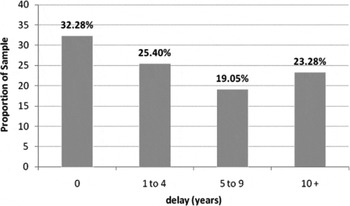
Consistent with previous research (Angst, Reference Angst, Hollander, Zohar, Marazatti and Olivier1994; Lensi et al., Reference Lensi, Cassano, Correddu, Ravagli and Kunovac1996), when surveyed regarding their impressions of the temporal course of their OCD onset, the majority of the individuals with OCD reported the development of their disorder to be “gradual” (72.4%), as opposed to “sudden” (27.6%) in nature. Further, based on calculating the delay between reported age of onset of symptoms and age of onset of interference/distress, individuals with OCD were found to have an average symptom phase of slightly longer than 5 years (M = 5.31, SD = 6.12). A frequency distribution of the length of the symptom phase was plotted to provide a sense of the distribution across individuals. As shown in Figure 1, 67.7% of the sample experienced a symptom phase lasting a year or more, 42.3% of the sample experienced a symptom phase lasting 5 years or more, and 17.5% experienced a symptom phase lasting 10 or more years.
Distribution of delay in years between onset of symptoms and onset of full-blown OCD (with interference and/or distress)

Next, we examined potential moderators of the duration of the symptom phase (in years), including age of onset, gender, and initial symptom type. Supporting the importance of considering these factors in the etiology of OCD, all three variables were found to moderate the length of the symptom phase. First, individuals with late onset (onset of OCD ≥ 18) experienced significantly longer delays than those with early onset, t (187) = 7.89, p < .001, late onset: M = 9.23, SD = 7.62, early onset: M = 2.94, SD = 3.22).Footnote 1 Second, independent samples t-tests revealed that compared to males, females experienced significantly longer delays between the development of symptoms and the development of interference and/or distress (t (182) = 1.97, p = .05; females: M = 5.83, SD = 6.37, males: M = 3.88, SD = 5.09). Finally, a One-Way Analysis of Variance (ANOVA) revealed a significant effect of initial symptom group, F (2,180) = 3.76, p = .03 on the length of the symptom phase. Post-hoc comparisons via Student Newman Keuls tests revealed that individuals with concurrent development of obsessions and compulsions and those with obsessions prior to compulsions, experienced significantly shorter symptom periods (M = 4.55; SD = 6.05, and M = 5.64; SD = 5.53, respectively), in comparison to individuals with compulsions prior to obsessions (M = 8.71; SD = 6.64).
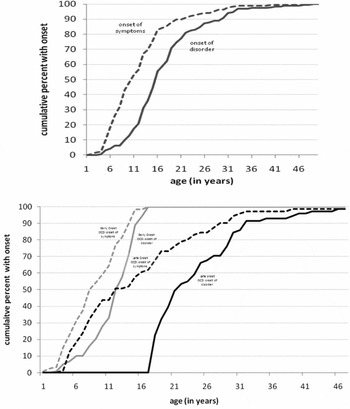
Age at onset distributions were examined for the full sample and according to early- vs. late-onset subgroups. As shown in the top half of Figure 2, the typical age at risk for OC symptoms observed in the current sample extends from childhood through adolescence and the age at risk for the disorder extends throughout adolescence into young adulthood, with medians of 10.0 and 15.0 years respectively. As can also be seen, the symptom phase typically lasts about 5 years. Graphing separate distributions for early- and late-onset of full-blown OCD shows visually that both subgroups experience extended symptom phases and that the delay is more protracted in the later group. In addition, the transition to adolescence appears to be a time of elevated risk for the development of symptoms in those that do not have prior symptoms or for development of the full-blown disorder in individuals with existing symptoms. Interestingly, the later transition to adulthood coincides with increased onset of the disorder in individuals who develop symptoms in adolescence.
Age at onset distributions for full sample (top half) and according to early- vs. late-onset (bottom half)

Finally, the explanations that individuals with OCD provide for the development of the disorder (i.e. transition from symptoms to diagnosis) were explored. Qualitative responses were sorted into higher order categories by 10 individuals with expertise in OCD. Overlap between these categories was then identified by two of the study authors (MC, EJ). This resulted in the coding of data into five categories with reliable consistency across two raters and adequate sample size. The five categories of patients’ explanations for the transition to full-blown OCD and examples from each category are as follows:
(1) Specific stressors or events: examples include family member experiencing a heart attack, death of family member, house fire;
(2) Increases in general stress: examples include job loss, increased stress and loneliness, sibling diagnosed with mental illness, experiencing several life changes in a short time period, experiencing ongoing sexual harassment;
(3) Changes in activities/routines: examples include moving to a new town, starting college or graduate school, leaving home;
(4) Increased recognition of symptoms: examples include realizing thoughts and behaviors weren't “normal”, recognizing impact of behaviors, reading health newsletters, increased recognition of symptoms with age;
(5) Increasing concerns regarding negative evaluation because of symptoms: examples include going through puberty and realizing symptoms affected others in addition to self, start of high school trying to balance need for independence and need to please parents, other people noticing compulsions and teasing about them or repeating them.
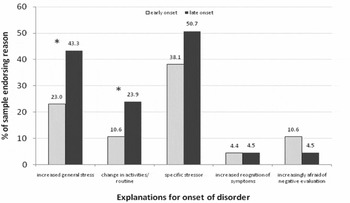
Examining the circumstances reported by the full sample revealed that the most commonly described explanations reflected specific stressors or events (42.8%), followed by increases in general stress (30.6%), and changes in activities/routines (15.6%). Explanations reflecting increased recognition of symptoms (4.4%) and potential negative evaluation (8.3%) were less common. Chi square tests of independence revealed that a significantly higher proportion of late-onset cases were associated with increases in general stress and changes in activities/routines than were early-onset cases (see Figure 3).Footnote 2 Indeed, both of these explanations were nearly twice as common in the late- vs. early-onset group. Significant between group differences were not observed for rates of a specific stressor, increased recognition of symptoms or increased fear of negative evaluation due to symptoms. Despite the lack of significant between group differences, it is interesting to note that increased fear of negative evaluation was the only explanation that was more common in the early onset group. This observation is consistent with the age of OCD onset coinciding with the transition to adolescence in this group, as adolescence is often a period of heightened social anxiety and fear of negative evaluation.
Respondents’ explanations for onset of full-blown OCD following symptom phase

Discussion
Results of the current study revealed that approximately two-thirds of respondents in a large sample of individuals diagnosed with OCD retrospectively reported at least one year of OC symptoms before meeting criteria for the disorder. Further, almost half of the respondents that reported a delay between the development of their OC symptoms and experiencing associated interference or distress reported that the symptom phase lasted 5 or more years.
Extending prior findings, we also examined several potential moderators of the duration of the OC symptom phase. First, evidence was found suggesting that: (1) both early and late onset OCD are preceded by an extended symptom phase, but (2) the symptom phase preceding late-onset OCD is longer than the period preceding early-onset OCD. In addition, the symptom phase was found to be longer for females in comparison to males and in cases where compulsions preceded obsessions. Together, the findings of the present study are consistent with prior research that suggests that OCD typically develops after a significant period of subclinical symptoms (Angst, Reference Angst, Hollander, Zohar, Marazatti and Olivier1994; Eisen and Rasmussen, Reference Eisen, Rasmussen, Stein and Hollander2002; Lensi et al., Reference Lensi, Cassano, Correddu, Ravagli and Kunovac1996; Pinto et al., Reference Pinto, Mancebo, Eisen, Pagano and Rasmussen2006; Sobin et al., Reference Sobin, Prudic, Devanand and Nobler1996). These findings are also consistent with recent epidemiologic data showing that the presence of OC symptoms at age 11 predicted a high risk of an adult OCD diagnosis (Fullana et al., Reference Fullana, Mataix-Cols, Caspi, Harrington, Grisham and Moffitt2009).
The current study also extends previous research by addressing when during development the OC symptom phase typically occurs and by studying potential triggers of the transition to development of the disorder. Examination of age of onset distributions for symptoms and disorder suggest that both OC symptoms and diagnoses begin early in life, with development of symptoms typically by adolescence and criteria for the disorder met by young adulthood. This general pattern is consistent with a potential window of opportunity to intervene during adolescence for youth that have OC symptoms. However, as noted by Stein (Reference Stein2009), there is a need to develop a better understanding of how clinically significant levels of OCD can best be predicted and what variables distinguish between individuals that do and do not go on to develop full-blown OCD. One starting point for understanding the development of the disorder is to delineate how or why OC symptoms have begun to cause interference and/or distress in individuals that have subsequently developed OCD. Qualitative data from the current study offer an initial, albeit modest, starting point. Specifically, when asked directly regarding their understanding of the transition from symptoms to disorder individuals with OCD frequently provided answers reflecting specific stressors, general stress and changes in routine. However, the current data also suggest that the triggers or correlates of this transition may differ, based on age of onset. Specifically, while discrete stressors were common in both early- and late-onset respondents, increases in general stress and changes in activities/routine may be particularly important in OCD that develops in late adolescence/early adulthood. These findings are consistent with literature suggesting that school transitions may play a role in the etiology of anxiety disorders (Spence, Reference Spence, Vasey and Dadds2001). School transitions, including college, are associated with academic, social, and developmental challenges (Bohnert, Aikins and Edidin, Reference Bohnert, Aikins and Edidin2007) and heightened levels of negative life events (Compas, Wagner, Slavin and Vannatta, Reference Compas, Wagner, Slavin and Vannatta1986). Research has also shown that school transitions are linked to a range of emotional and behavioral difficulties (Lapsley, Rice and Shadid, Reference Lapsley, Rice and Shadid1989; Soussignan, Koch and Montagner, Reference Soussignan, Koch and Montagner1988). Changes in living situation, interpersonal relationships and daily rhythms associated with becoming an adult may all play a role in transforming what were once personal habits (e.g. rewriting assignments) into distressing symptoms (e.g. frequently missing 8:30 biology because of staying up late rewriting without parental oversight). Increases in personal responsibility and the perceived importance of success may serve to increase intrusive thoughts. Conservatively, the current findings suggest the utility of monitoring changes in the impact of OC symptoms during periods of increased stress and changes in routines. Such data may also provide the opportunity to disentangle the impact of such transitions vs. a potential tendency to (mis)attribute the development of OCD to memorable events that occurred around the same time as the disorder began (coincidental events).
The findings of the current study add to a body of literature elucidating the slow-development of OCD. However, there is clearly much more work to be done. First, given our efforts to access a wide-range of participants and increase the generalizability of the findings, diagnostic information from structured clinical interviews was not gathered for participants in this study. Therefore, we cannot independently confirm the OCD diagnoses that were assigned by other health-care professionals. However, it is difficult to argue how potential misclassification would systematically bias the current findings. Another limitation of the current design is the reliance on retrospective self-report, thereby potentially introducing memory bias. On average it had been 6.53 years (SD = 11.7) since respondents met criteria for OCD, suggesting that the majority of respondents were not reporting on events from an extremely long time ago. In addition, potential memory bias to “cluster” older events as having occurred all at once would likely bias respondents to underestimate the delay between the development of symptoms and distress/interference, thereby suggesting that the current findings of an extended symptom phase in individuals with both early- and late-onset are likely to be conservative. Finally, findings of a more extended symptom period between the development of compulsions (in contrast to obsessions) and full-blown OCD may reflect failure to recognize thoughts that underlie ritualistic behaviors in some cases.
It is hoped that the data gathered from this retrospective project and others will be useful in identifying variables to be included in future prospective studies. Finally, the use of a retrospective design allowed us to explore potential reasons for the transition from symptoms to disorders. In order to assess patients’ understanding of why their disorder developed, they, by definition, have already experienced the development of the disorder. As with all research, this study leaves many important questions unanswered. For example, given data showing that obsessions and compulsions are common in the general population, what differentiates individuals that will continue to experience only intermittent OC-like experiences from those that will proceed to developing full-blown OCD (Stein, Reference Stein2009)? What are these differences and at what point in the process can they be differentiated? Further, at what point in the trajectory of OCD is intervention most effective? If interventions are applied to individuals experiencing OCD symptoms without associated negative consequences can the development of OCD per se be delayed or prevented?



Comments
No Comments have been published for this article.