INTRODUCTION
In August 2017, Kurt Adams, Finds Liaison Officer for Gloucestershire and Avon, was contacted by a metal-detectorist reporting the discovery of an assemblage of copper-alloy fragments. These proved to be Roman, the cache comprising numerous fragments of copper-alloy sheets and studs, probably from boxes or caskets, vessel fixings, handles, a coin, pieces of a bronze plate inscription (discussed in more detail in appendix 1) and several large sculptural pieces including fragments of a life-size statue and a complete statuette of a hound. While many of the items would fit within a domestic or military/administrative context, the presence of the inscription attesting a collection of funds, the sculptural pieces and what appears to be the butt end of a sceptre for religious practice combine to suggest a different interpretation: we appear to be dealing with a portion of the base-metal accoutrements of a shrine or temple, dismantled and buried in the late fourth century.
The objects, totalling over 5 kg and comprising hundreds of fragments, were deposited bundled closely together within a hole approximately 45 cm below ground level, presumably originally within a bag made of organic material that has since decomposed. The hoard was retrieved in its entirety by the finders at the time of discovery with no archaeologists present; detailed information concerning the immediate context and setting is not available as no subsequent fieldwork has yet taken place. The site, on the southern side of the Severn estuary around 10 km south-west of Gloucester, is located in the vicinity of Roman sites where such a large statue could have been set up, not least at the colonia of Glevum itself.
When discovered, the cache was undisturbed. The objects appeared to have been deposited within specific layers, implying that some sort of sorting took place before they were buried. It would appear that the items were deposited in a pit, possibly for storage. The first item from the assemblage was recovered from a depth of about 30 cm. Most artefacts identified by metal-detectors tend to be within the first 10 cm of the soil, and the depth of this item was at the limit of the machine, giving a very poor signal initially which was almost ignored. This first item was the butt of a staff or spear (appendix 3, no. 23), found just below the plough soil. When this was removed, further signals led down to a layer containing all of the sheet copper-alloy box or casket bindings (nos 7–11), the spoon (no. 22) and the small sculpted human face (no. 4) at a depth of about 35–40 cm. Below these was a layer of the bell-shaped furniture mounts (no. 12b), the buckle (no. 17) and the vessel escutcheons (nos 14b–e). At the bottom, at a depth of 50–60 cm, the final elements of the hoard were found in a tight bundle, presumably originally held together within a sack that had long since rotted away. Here the layering continued, with the casket handles (no. 13) and statue fragments (nos 2–3, 5, 6) forming the upper layers of the fill and the complete statue of the dog (no. 1) at the very lowest level.
The bronze pieces were sold at auction at Christie's in London on 3 July 2019 (Antiquities Sale 17198, Lot 104), though Bristol City Museum and Art Gallery has the objects on temporary loan for two years. The items have already been published online on the Portable Antiquities Scheme (PAS) website (https://finds.org.uk) and a short report is included in the Bulletin of the Association for Roman Archaeology 2017–18.Footnote 1 The present authors are grateful to Kurt Adams, Sally Worrell, John Pearce, Brian Gilmour and Roger Tomlin for their thoughts and contributions, and for the opportunity to present here a more in-depth study of each of the items and of the cache as a whole. We are also very grateful to the administrators of the Haverfield Fund, Oxford, for their financial support and to Sally Worrell for successfully applying for the grant to complete this work. Finally, we would like to thank Matt Phelps for allowing us to use his unpublished XRF composition analysis results for some of the comparative material in table 2, the two anonymous reviewers for their valuable comments and the editorial team at Britannia.
THE SCULPTURAL ITEMS
Twenty of the pieces are interpreted as sculptural, and, though fragmentary, represent a major discovery and addition to the corpus of large bronzes from Britannia. The fragments are small in comparison to the original artefacts when complete, and the identifications are inevitably sometimes provisional. Four sculptures are present: two life-sized and two smaller. The statuette of the dog is the only item complete in itself. Small fragments remain of a life-sized statue of a clothed female figure; another statuette is represented by a face, probably also a young female; and part of the life-sized head of another animal is now only identifiable by what looks like a single eye.
(A) THE HOUND STATUETTE
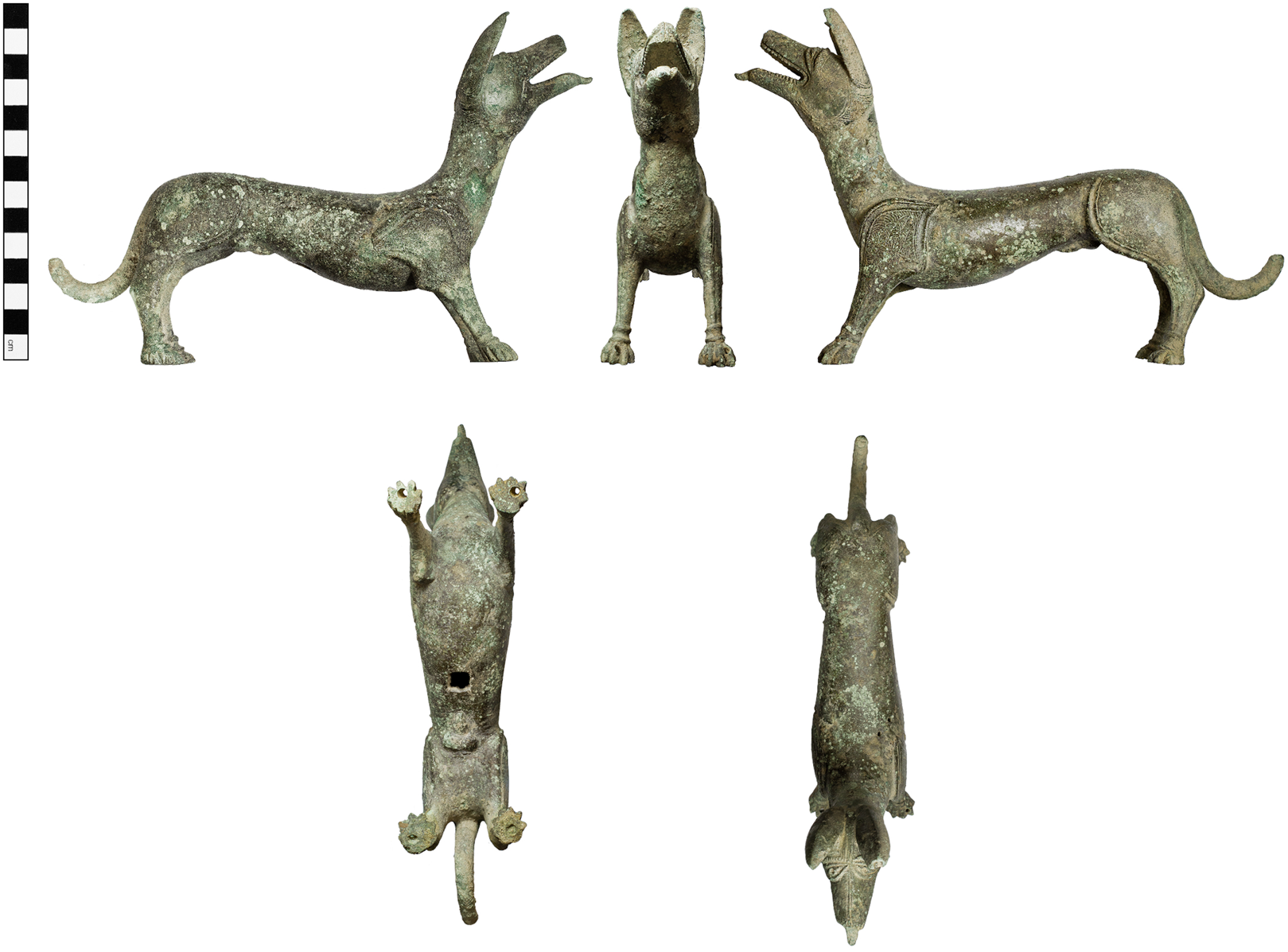
This is by far the most striking item in the cache (fig. 1; appendix 3, no. 1). The dog stands eager and alert, square on all four legs, with muzzle open, teeth showing but not aggressively bared and tongue out. The body is elongated, but the legs rather short and the tail curls up in a U-shape. The whole is stylised and treated decoratively, especially the shoulders with feather-like engraving within a triangular frame, the ruff of incised fur that delineates the hindquarters and the tapering almond-shaped eyes. On the underside, there is a large square hole in the stomach and the genitals are clearly displayed.
Views of the hound statuette (appendix 3, no. 1). (All photographs by Eve Andreski; rights holder: Bristol City Council; used under CC BY attribution licence)

Figurines of dogs are well attested in the north-western Roman provinces. However, while there are analogies to the hounds from Lydney and the patterned style of the canine monsters from Llys Awel, at over 20 cm long, this remains unparalleled in size and quality amongst bronzes depicting canines from the region.Footnote 2 There are, however, divine and heroic human figures of similar scale, about a quarter life-size, from various parts of Britain. Amongst them are statuettes of Mercury from the temple at Gosbecks Farm, Colchester,Footnote 3 a gilt bronze Hercules, perhaps Hercules-Commodus from Birdoswald,Footnote 4 the Barking Hall, Essex ‘Nero’,Footnote 5 a Cupid from Cirencester,Footnote 6 a figure of an archer, probably Hercules, from Cheapside, LondonFootnote 7 and a probable Lar of which only a leg now remains from Porthcasseg Farm, St Arvans, Monmouthshire.Footnote 8
While it is thus possible that the hound, too, is a stand-alone statuette, the combination of the other fragments in the hoard, especially the fragment of a human face which may come from a statuette of similar size, invites identification of it as an attribute, probably dedicated within a sacred context. The holes in the front paws show the hound was affixed by rivets to a base,Footnote 9 while the two small holes on its left shoulder most probably served to steady an associated figure.
If the dog served as an attribute, there are three most likely candidates for the deity. Diana was the most popular hunting deity in the Graeco-Roman world, especially in the statuary type known as Diana Venatrix.Footnote 10 As shall be shown below, we appear to have fragments of a full-size statue of Diana within this cache, and it is possible that there is another smaller figure of the goddess too. She is depicted with her hound on a relief sculpture from the temple site at Nettleton Shrub, Wiltshire,Footnote 11 and a sculpture in the round of Cotswold stone from Cirencester preserves just the surviving paws of a dog.Footnote 12 At Chedworth, a probable hunting estate, there are two further examples,Footnote 13 as well as a relief of Apollo Cunomaglos (Apollo the hound-prince).Footnote 14 Another statue from a putative hunting estate comes from a temple in Greenwich Park, London.Footnote 15 Only an arm remains but the statue evidently depicted Diana drawing an arrow from her quiver and is of the Venatrix type, as is one of the Chedworth figures in which she runs and draws an arrow from her quiver, accompanied by her hound.Footnote 16 This early Hellenistic type is, incidentally, depicted at a tiny scale on a plasma (chrome-rich chalcedony) intaglio of first-century date from Gloucester itself, excavated in 1966–67 from the New Market Hall site near the Eastgate, though from a disturbed, medieval, layer.Footnote 17 A large statuette now in the Albright-Knox Art Gallery in Buffalo, New York, shows Artemis with her hound in bronze.Footnote 18
However, two other deities in the local area are also figured with hounds. One, of course, is Mars Nodens whose sanctuary was at Lydney Park, on the north bank of the Severn. There are a number of hound figurines in stone and copper alloy from the site, but these are generally portrayed as rather placid animals, perhaps the familiars of the deity in a healing cult similar to that of Epidaurus in Greece where hounds were employed to lick the sores of those who came to seek cures. The best example is depicted lying with forelegs outstretched and haunches patterned with its hair portrayed as a swirl.Footnote 19 A very similar bronze is attested at Voorburg in the Netherlands where it was most probably the companion of the goddess Nehalennia.Footnote 20
Alternatively, there is the huntsman with hound, possibly known as Apollo Cunomaglos, attested at a temple at Nettleton Shrub.Footnote 21 He is shown on stone reliefs and statuettes from the Cotswold region as well as in London and Southwark, and there is also a bronze plaque depicting the deity from a funerary context at Kingsholm, Gloucester.Footnote 22 He is sometimes known as the ‘London hunter-god’ although more correctly he should be designated as the Cotswold hunter-god because the Cotswolds would appear to be the origin and centre of the cult. The Gloucester animal is certainly alert and ready to engage actively in the hunt. An especially fine figure of a hound sitting on its haunches in oolitic limestone was excavated from a well beside the temple at Pagans Hill, North Somerset.Footnote 23 This figure was also probably associated with the same deity, a head of what was probably a statue of Apollo Cunomaglos (now lost) described as having come from the site.
(B) THE FULL-SIZE STATUARY
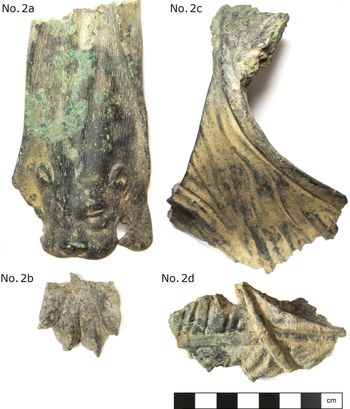
Five pieces appear to come from the same, almost life-size, statue (fig. 2; appendix 3, no. 2a–e), and 11 further fragments, perhaps of drapery, might be from the same figure (no. 3a–k). The five more-certain pieces include an area contiguous to the neck and upper arm of a female figure clad in a tunic with a cloak fastening on top and a fragment with cross-strapping from her upper chest. The cross-strapping is paralleled on a late Classical or Hellenistic bronze statue of Artemis from PiraeusFootnote 24 and, geographically and temporally closer in date and place, by figures in Toulouse and Carnuntum.Footnote 25 A second Piraeus bronze statue with only a single diagonal strap across the body is closely paralleled by a white marble statue from Trier.Footnote 26 It is possible that the Gloucester figure resembled this type, although the folded drapery suggests some movement, more akin to the Diana Venatrix type (see above).Footnote 27
Pieces from a life-sized statue, perhaps of Diana (appendix 3, nos 2a–d).
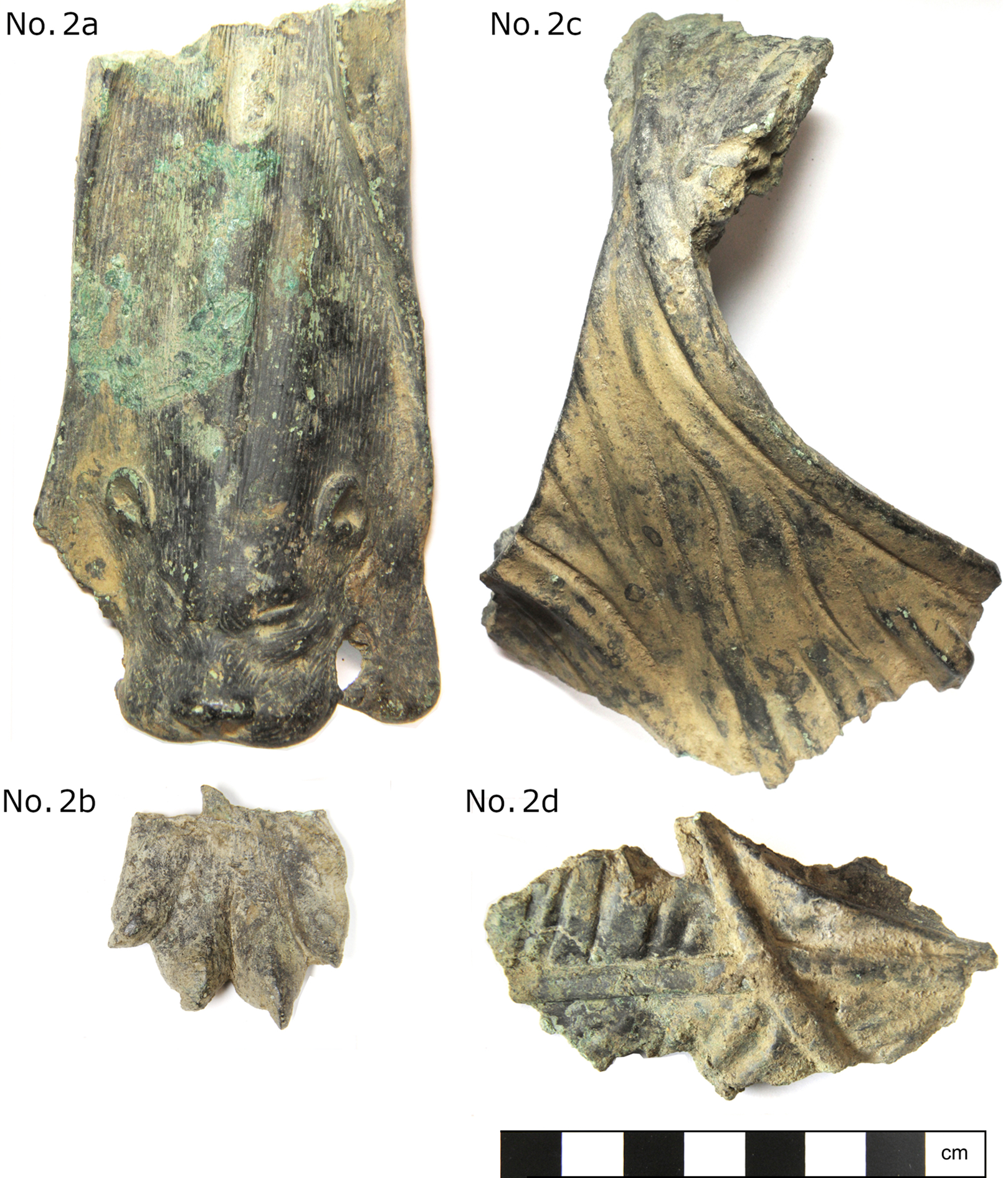
There are also fragments, the head and paws of a nebris, apparently from the pelt of a bear. Diana is generally depicted wearing boots, frequently with lappets, an animal (?bear) head in the centre and a paw at each side. Diana/Artemis as well as Amazons would have need for protection for their feet while hunting or fighting.Footnote 28 Similar boots, often leonine, are typically shown on the feet of statues in military dress, of emperors and deities or mythological figures such as Mars and Virtus.Footnote 29 The combination of such boots with apparently female clothing (as shown by the crossed straps and shoulder pieces) would lend weight to the identification of a statue as Diana, and such an explanation has been advanced for a slender left leg, all that remains of a full figure, shod in such boots, found at Maastricht.Footnote 30 There, the animal's head is facing to the front of the boot and is smaller than the Gloucester example, in order to allow for the foot arch. However, the length of nebris above the head seems rather too long for an adjunct to a boot and it may be preferable to see the object and the accompanying paw as, instead, part of a bear pelt hung alongside the figure, masking a support such as a tree trunk.Footnote 31 An association with bears is inherent in the goddess’ Greek name, Artemis, as well as the Attic site at Brauron and at the sanctuary of Artemis Munichia near Piraeus, where young girls between the ages of five and ten became bears in a ritual known as the arkteia. In Switzerland, a goddess known as Dea Artio is depicted with a bear.Footnote 32 It may be noted that bears had a chthonic importance in leading the deceased to the underworld, but that does not seem to be a likely interpretation here.
The hound discussed above seems far too small to have accompanied the large statuary (it more probably belongs with a statuette). It is depicted standing, inviting attention, ready to spring forward in the characteristic manner of the hound frequently portrayed with Diana Venatrix, and it is possible that the large statue was accompanied by a larger, more Classical hound. The bear pelt, whether worn as a lappet on a boot or simply draped over a tree stump, adds evidence to this identification.
It is tempting to see these fragments as deriving from a high-quality statue of Diana, the cult image from a well-endowed temple. Gloucester, as an early fortress and later a colonia, would have been a fitting location for such a temple and such high-quality bronze sculpture. Another bronze statue from Gloucester, most probably an equestrian statue (though only a few sad fragments now remain), probably stood in the forum and attests the production of large-scale statues here.Footnote 33 The pleating on the saddle cloth, although not identical to the drapery folds on our statue, suggests work of a similar period and similar quality.
Full-size (or larger) statues of deities in copper alloy are comparatively rare survivals, even in fragmentary form, from north-west Europe. In Britain, we have only the head of Sulis-Minerva from Bath, at least life-size (measuring 0.248 m) but lacking its helmet.Footnote 34 There are a few large cult statues still extant in Gaul, amongst them a splendid image of Apollo from Lillebone which stands at 1.94 m in height, a statue of Mars from Coligny which measures 1.70 mFootnote 35 and, only slightly smaller, a figure of Neptune from Lyon at 1.43 m.Footnote 36 However, in size, these pale before the colossal statue of Mercury commissioned in the mid-first century by the civitas of the Arverni, at the cost of 40 million sesterces, from the sculptor Zenodorus. Pliny the Elder tells us that this took him ten years to make, and established Zenodorus’ fame so that he was summoned to Rome by Nero to make a similarly imposing statue of the emperor.Footnote 37
(C) OTHER FIGURES
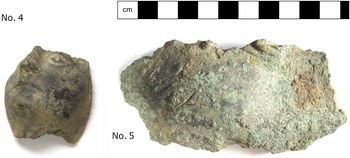
Two other fragments suggest two further figures or statuettes (fig. 3). The small face, also at approximately one-quarter life-size, shares with the dog stylistically similar oval, lidded eyes, but the XRF results (appendix 2) suggest this piece is made of leaded gunmetal (with around 2–3 per cent zinc) rather than the heavily leaded bronze of the dog and other fragments of larger-scale sculpture. While it is not impossible that they were related, this metallurgical analysis renders it less likely.
Two further pieces of figural statuary (appendix 3, nos 4, 5).
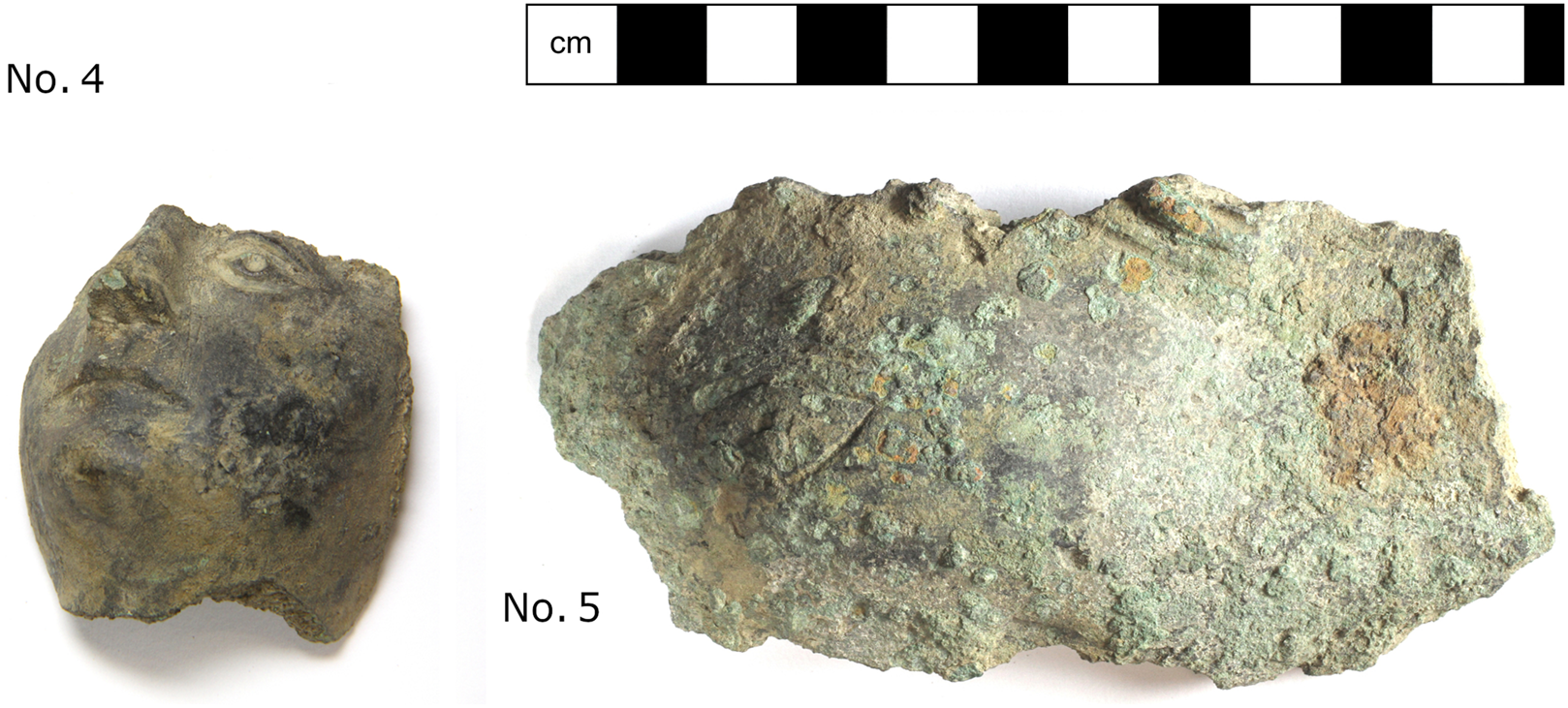
Finally, a coarse, large, heavily corroded fragment retains the hint of an incised eye, while another smaller piece could be from the same object. The larger piece is convex with an eye engraved at the highest point, and it looks more like a fragment of an animal head than a human, perhaps even another dog. The XRF analysis indicates a higher tin content than other pieces, suggesting again a different method of manufacture for this from the large statue and possible statuettes.
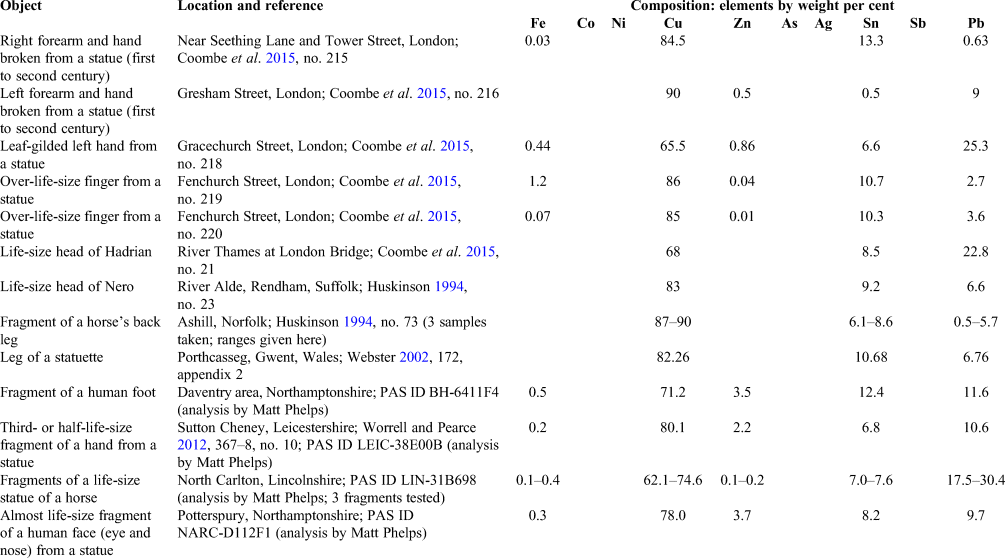
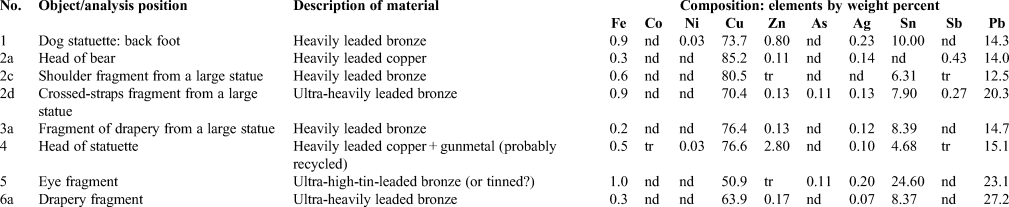
Compositional analysis by XRF (appendix 2) has highlighted that all the statuary pieces tested are made from heavily leaded alloys, as might be expected, since lead helps molten metal to flow. This is found regularly in the composition of other copper-alloy statuary (for Romano-British comparisons, see table 2). There are differences in alloys between the different statues, but also in some cases between different elements of the one statue. While this may be a result of employing recycled metal, recorded zinc levels suggest this was only a small component added to carefully prepared alloys. It is more likely to represent a deliberate choice to create differing visual effects. For instance, the bear head linked to the Diana statue (no. 2a) would have been a much redder alloy (higher copper content), while the eye fragment (no. 5) would have looked more silvery (higher tin).
THE REST OF THE ASSEMBLAGE
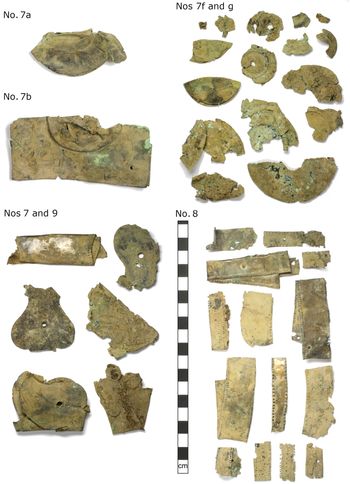
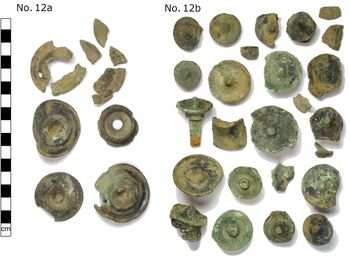
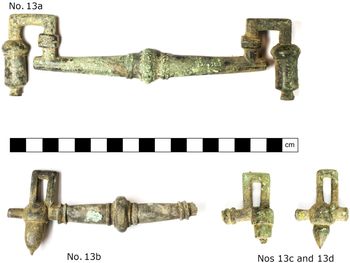
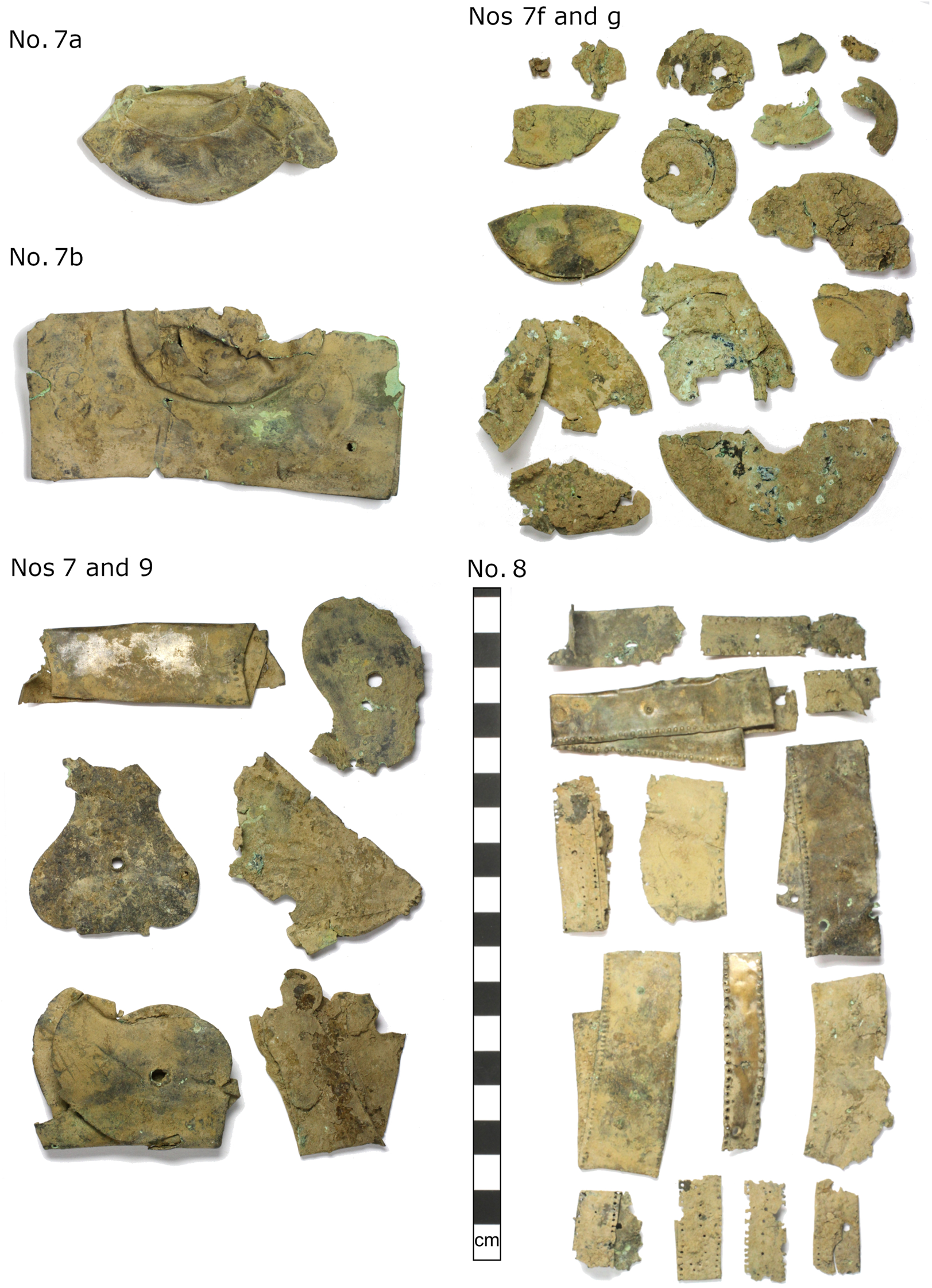
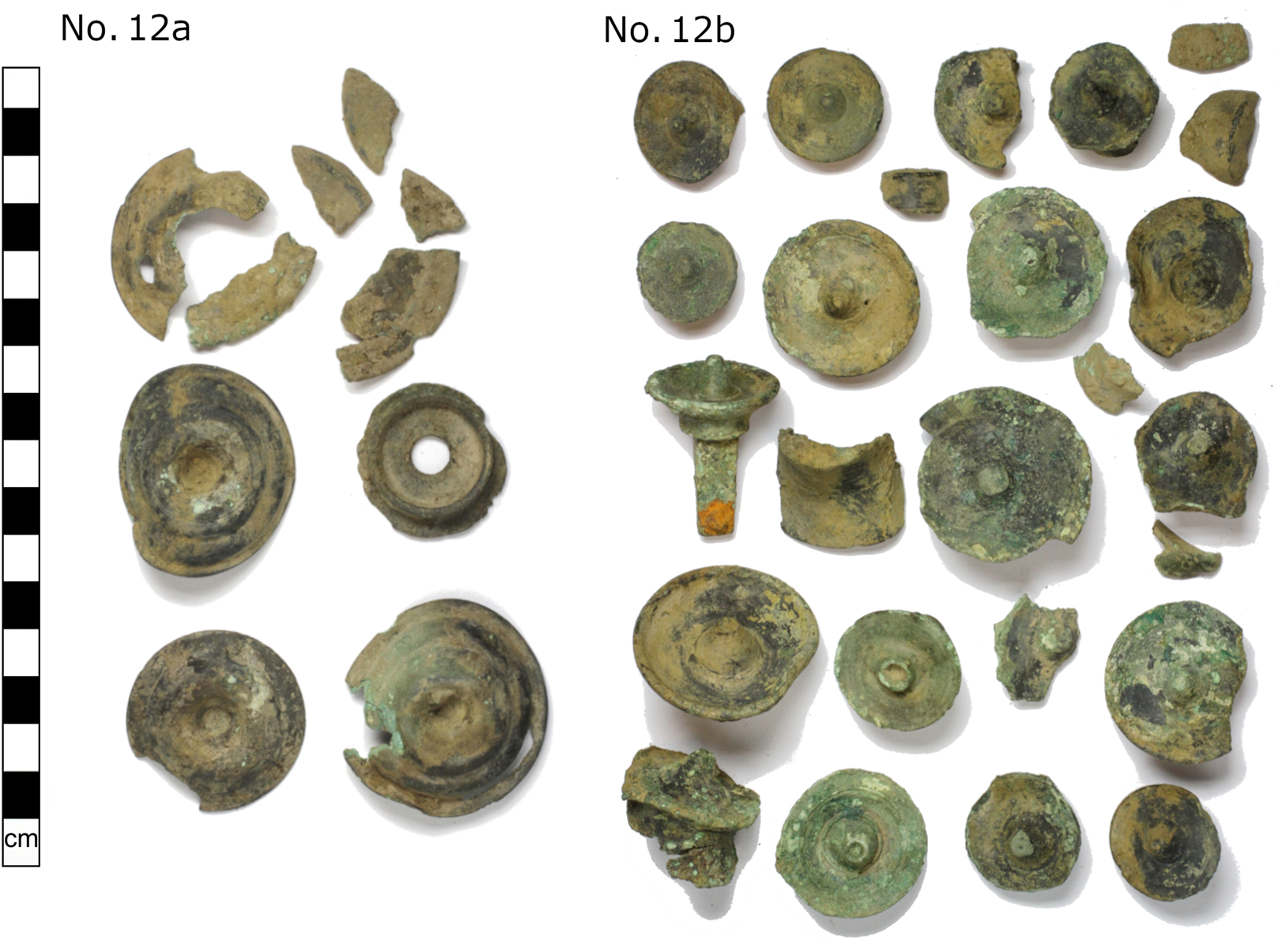
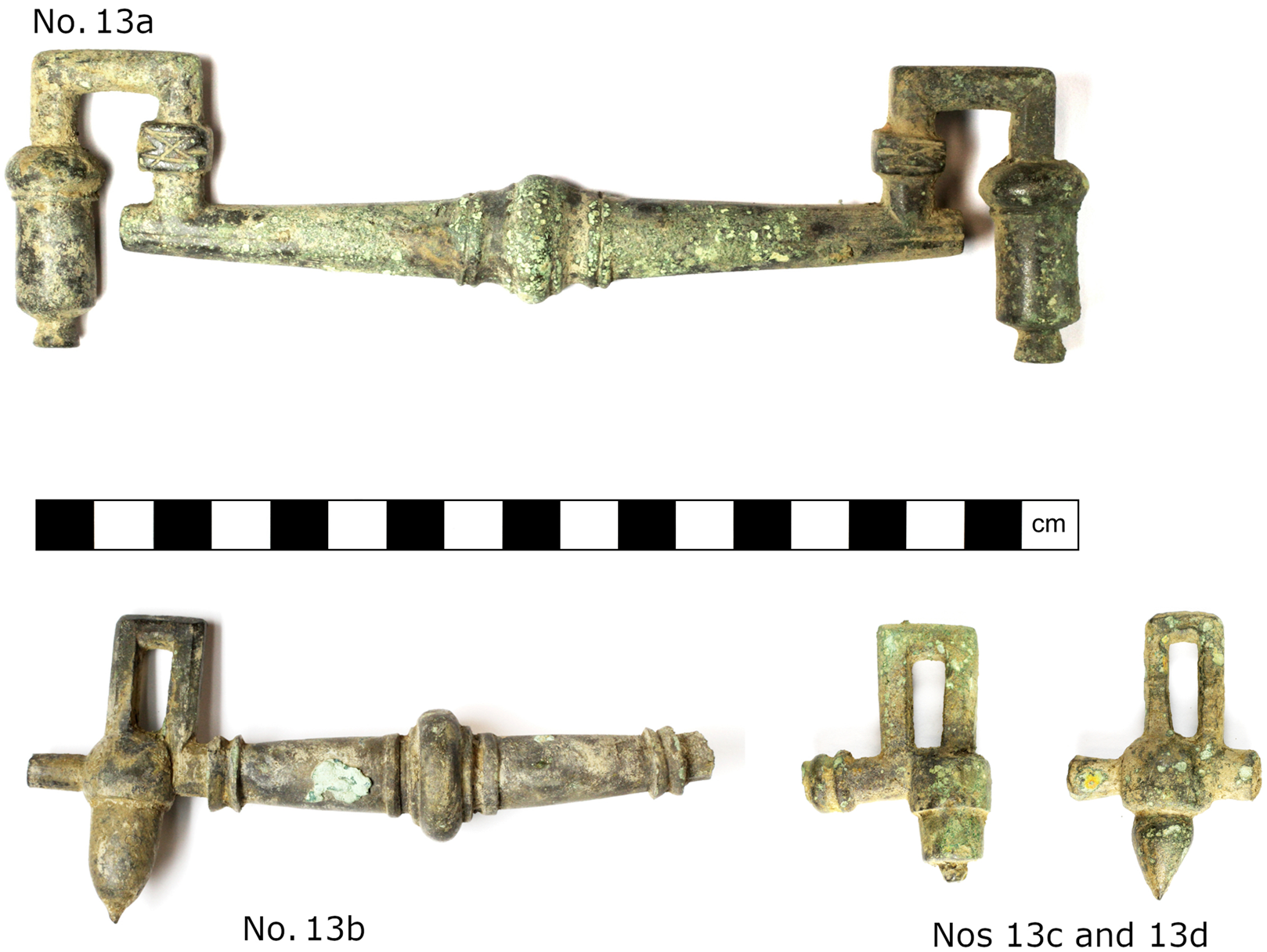
The majority of the other items within the cache are plates, bindings and other fittings from furniture or more probably boxes or chests. A number of decorative cask mountsFootnote 38 and four different handles suggest there were a number of caskets, some decorated with other rectangular or circular thin plates and projecting studs, and reinforced with copper-alloy binding (figs 4, 5 and 6; appendix 3, nos 7–13).Footnote 39 In Britain, boxes are typically found in domestic contexts or reused as containers for cremation burials, but it is proposed here that they served as containers for funds from a temple. The large number of circular or bell-shaped projecting studs (fig. 5; no. 12) could have ornamented such furniture, while the paw-shaped foot to a tripod (online fig. 3; no. 18) emphasises the presence of other functional objects, now only identifiable from the small pieces remaining.
A selection of the box fittings, including plates and strip binding (appendix 3, nos 7–9).
Studs from boxes, caskets or furniture (appendix 3, no. 12).
Handles from boxes or caskets (appendix 3, no. 13).
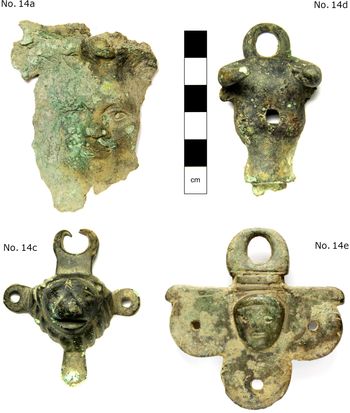
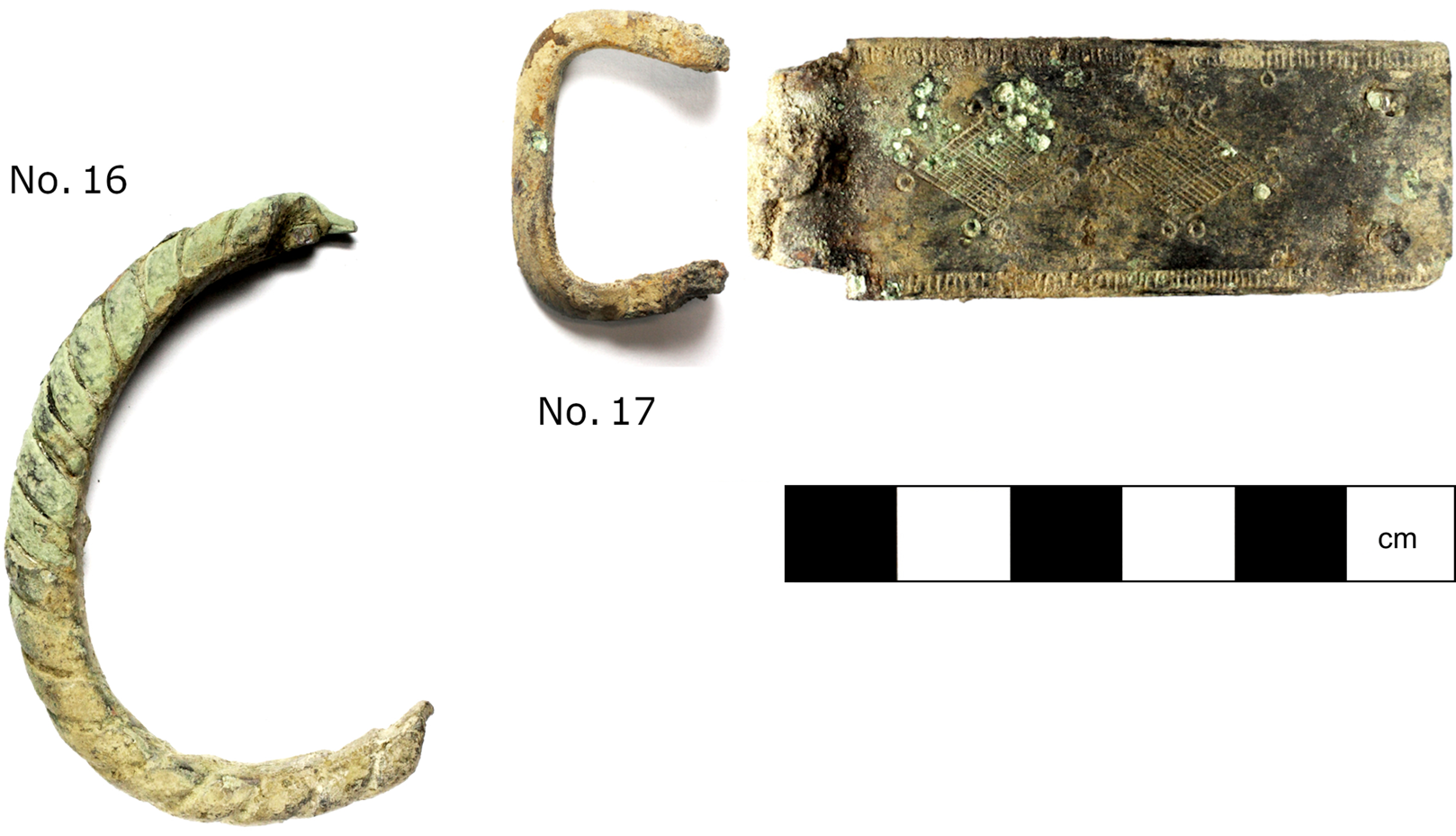
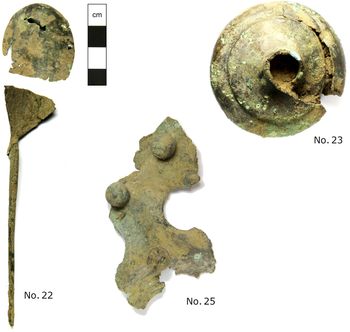
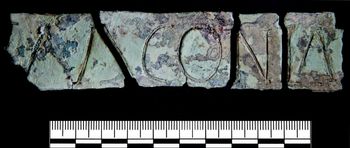
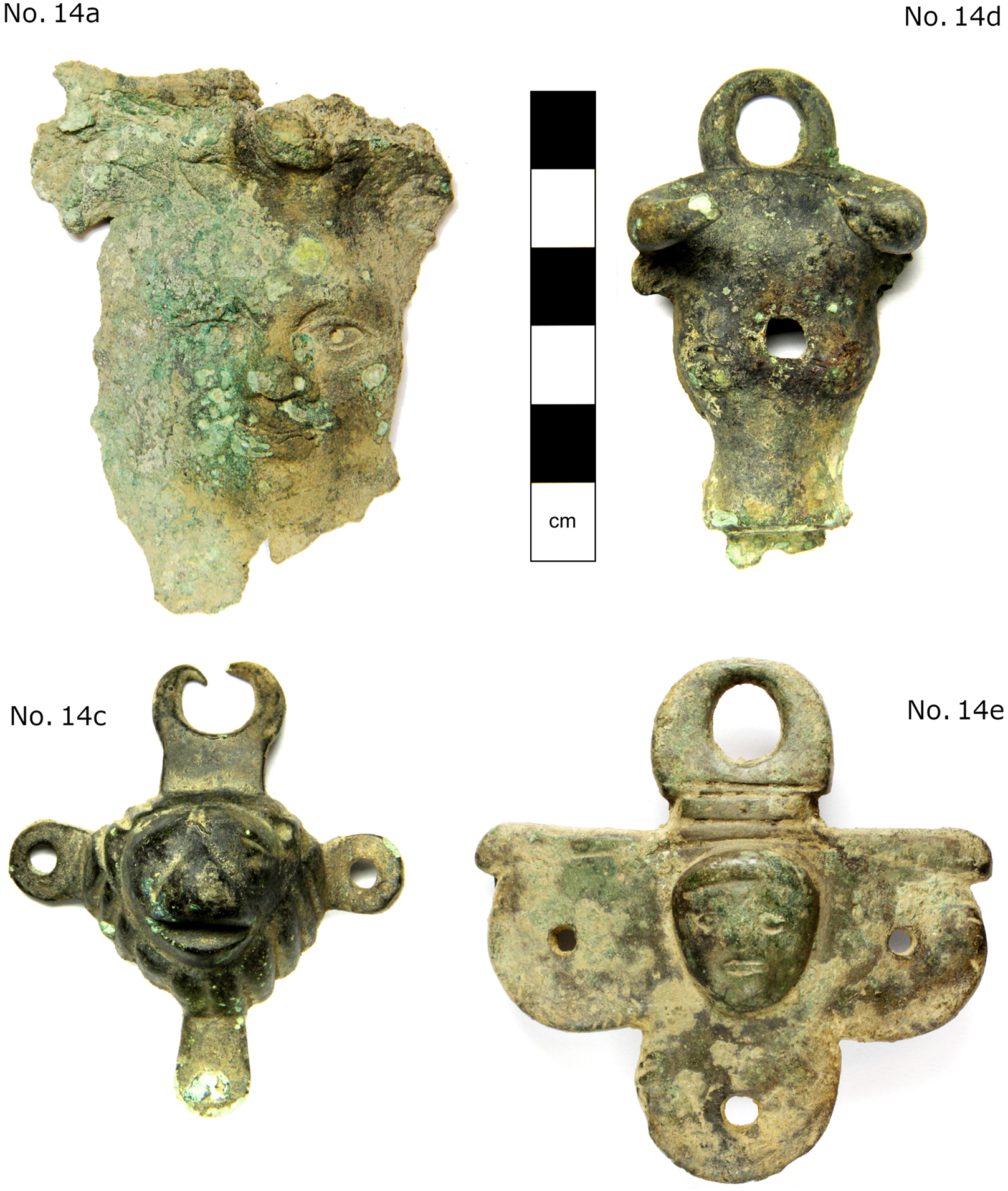
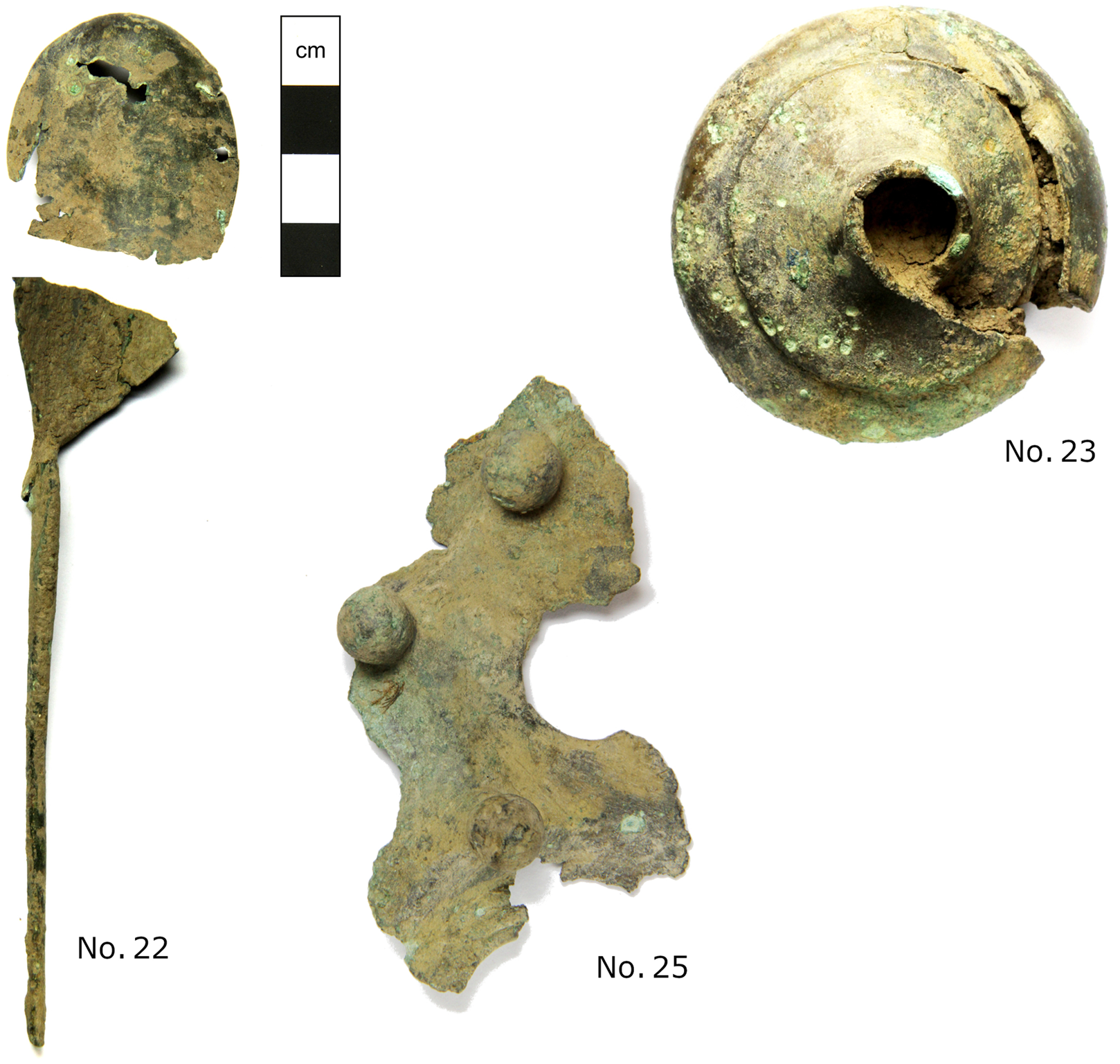
A coin of Constantine's son Crispus (a.d. 310–26) (online fig. 4; appendix 3, no. 28) may be dated to the first third of the fourth century, and there were other late Roman items: a bracelet (no. 16) and a Hawkes and Dunning type 1B buckle (no. 17)Footnote 40 (both fig. 8), a spoon (fig. 9; no. 22) and part of the handle of a folding pan (online fig. 3; no. 20), all of late fourth-century type. Items employed in ritual include possibly the figured escutcheons from buckets (fig. 7; no.14) (although they could have served a more mundane purpose – water would certainly have been required for lustration rituals) and what was almost certainly the base terminal of a sceptre (fig. 9; no. 23). Another possibly religious item is a piece from a dodecahedron (fig. 9; no. 25). Similar escutcheons and a dodecahedron are also recorded at Lydney, though both types of object are also found widely at other categories of site. In addition, we should not omit the fragment of dedicatory inscription (fig. 10; appendix 1; appendix 3, no. 29) which doubtless related to cult.
Figured escutcheons (appendix 3, no. 14).
Items of personal adornment: a bracelet and buckle, both of fourth-century type (appendix 3, nos 16, 17).

Fragments of a spoon, a spear or staff butt and a dodecahedron (appendix 3, nos 22, 23, 25).
Fragment of a bronze incised inscription (appendix 1; appendix 3, no. 29).

Objects of personal adornment are few, comprising just one bracelet (and perhaps fragments of others) and the late buckle (fig. 8), plus a fragment perhaps from tweezers for personal grooming (no. 24). From most other sacred sites, such as Lydney or West Hill, Uley, we find an assortment of rings, pins, amulets, keys, figurines and larger quantities of coins commonly associated with votive deposits at temple or sacred sites, all of which are conspicuously lacking here.
THE STYLE OF THE FRAGMENTS AND IMPLICATIONS FOR MANUFACTURE
At least one of the statues, the one more firmly identified as Diana, was life-size. It was certainly iconographically eclectic; although the upper part of the body bore some resemblance to one of the Greek bronze statues from Piraeus (statue A) with its cross-strapping, the draperies, which appear to belong to the same figure, are much more suggestive of the active Diana Venatrix type. It appears that she wore boots trimmed with the pelts of bears. Such eclecticism with regard to Classical Greek originals is a feature of a great deal of Roman art.
By contrast, the hound, stylised and highly decorative, has more in common with other examples of small bronzes from Britain. Its teardrop-shaped eyes are seen in similar form on small bronze busts of Minerva from Felmingham Hall, Norfolk, and at High Wycombe, Buckinghamshire.Footnote 41 The former was one of a number of statuettes of gods from the Felmingham hoard, which had probably come from a temple site, later buried within a large pottery jar.Footnote 42 Even closer in form are the eyes of the so-called ‘Celtic’ goddess bust from Cirencester, Gloucestershire.Footnote 43 While real, dwarf dogs are relatively well-known on Romano-British sites,Footnote 44 the unusual long body and shorter legs, combined with the detailed patterning, suggest that this animal figurine was intended not only to be conceived naturalistically, but also, and perhaps principally, decoratively in the tradition of toreutic art.
It is tempting to see this hound as the familiar of a further Diana statuette, and, while it is too small to accompany properly the larger life-sized figure, the style is similar to that seen on the small fragment of the face of another (possibly female) statuette. The teardrop eye is also shown there, and the pupil may have been filled with coloured glass, now missing. The differences in composition of the metal between the fragments, however, suggest we are probably dealing with a number of complete objects. Another piece of the hoard, displaying what would seem to be the eye of a large animal, must also come from another statue according to the different metal composition and manufacture, but again implies a local style.
Parallels for other elements of the hoard have also been considered to be of ‘native’ or ‘Celtic’ style: the ox-head bucket mounts were described in this way by Jocelyn Toynbee, for instance, and seen by her as evidence for local production in heritage forms.Footnote 45 More recent scholarship has challenged a divide in interpretation of Romano-British art on stylistic grounds between ‘Roman’ and ‘native’, the definitions of such terms arguably incomplete and at worst meaningless, since accurately attributing identity, origins and intentions based on appearance or style is challenging. Yet, parallels for our objects are found nearby, and dateable pieces cluster in the later Roman period, third to fourth century. It is highly probable that most if not all of these pieces are from statuary that was cast locally, suggestive of some bronze industry near Gloucester even if only for a brief period. Little evidence of metal industrial areas has so far been discovered at Gloucester, and it is virtually impossible to assign bronze objects to certain workshops, even when they are known, but it is not unlikely in a larger town such as Glevum.
POSSIBLE ORIGINAL SITE AND SECONDARY USE: DISPLAY, DISMANTLING AND DEPOSITION
The condition of the Gloucester hoard represents at least three phases of use: primary use; dismantling and collecting; and deposition. While the archaeological context and site of discovery preserves only the last of these, we may suggest options for the original setting of the objects from the contents that remain and their plausible date.
Although it is always possible that the objects are from disparate places, collected together to be melted down and recast for a secondary use, but deposited before that could be enacted, it is unlikely that a deposit of such a distinctive character is a collection of miscellaneous scrap. In the light of the broken-up statuary, the broken-up box-bindings (and the associated coin), our working hypothesis is that these are the remains of money boxes and trappings from a shrine destroyed or taken down perhaps at the time of Magnus Maximus (a.d. 383–88) or under Theodosius (a.d. 379–95). All of these items could have been contained within a sacred area, either given as a votive or used as practical objects within ritual or administration of the temple. The fourth-century cella mosaic at Lydney bears an inscription proclaiming that it was laid ex stipibus, that is from the contributions or fees left by worshippers.Footnote 46 The inscription from the Gloucester hoard also records an episode of collective funding, but is probably too small and flimsy to have been displayed in the open air, outside, on a major statue or central civic space.
While whole bronze statues and statuettes are rare survivals in the north-western provinces, fragments or groups of pieces are increasingly discovered across the region. More often hoards comprise precious metals, gold and silver, but bronzes are also known. A cache of objects from a cellar at Verulamium includes in bronze a large figurine of the goddess Venus, an appliqué mask of Silenus, a spout in the form of a bull's head, a jug and a handle in the form of a dolphin as well as various iron items and a pair of glass beakers. The excavator suggests that the owner was a scrap merchant, though concedes that these objects may have been stored as ‘the result of Christian conversion of the owner’.Footnote 47 Caches of religious material from Britain as well as elsewhere mainly consist of figurines and items of regalia stowed away to preserve them from looters.Footnote 48
As the examples above show, a collection of bronze pieces like the Gloucester cache is by no means unique. Finds of fragments of bronze statuary are increasingly widespread in Britain and include pieces from Billingford, Norfolk,Footnote 49 North Carlton, Lincolnshire,Footnote 50 and Terrington in North Yorkshire.Footnote 51 Some of these examples are most probably imperial portraits, though they could also have come from temples. The few fragments from what may have been (on epigraphic evidence) a temple of Mars Camulos at Tabard Square, Southwark, include a life-sized statue probably of a deity, represented by a sandalled left foot, as well as the cloven foot of an animal or perhaps the god Pan.Footnote 52 These fragments are suggestive of somewhat similar recycling.
Beyond Britain, caches of fragments of bronze statues have been found in various parts of the north-western provinces, with particular concentrations along the Moselle and Rhine rivers, and the military limes.Footnote 53 A number of fragments from Neuenstadt am Kocher, on the eastern bank of the Neckar, were cut down ready for melting down and reworking, while pieces of bronze statuary (sometimes gilded) from military sites at Kalkar, Aalen and Bonn probably represent the remains of Imperial statuary also ready for the foundry.Footnote 54
While the despoliation of religious sites at the end of the fourth century when Christianity took hold was a known phenomenon,Footnote 55 economic expediency of recycling valuable material or even careful curation of pieces of dismembered statuary are also convincing explanations (for instance, the copper-alloy head of Sulis Minerva at Bath and the stone head of Mercury from the cult statue at Uley appear to have been carefully buried), or at least important reminders that the situation may be complex.Footnote 56 The recycling of metal was increasingly commonplace, in both Britain and in the German-Raetian limes area.Footnote 57 No similar comprehensive assessment has been completed for Romano-British fragmentary bronzes as for this part of Germany, but the presence within the Gloucester collection of small pieces of unformed solidified molten bronze suggests some attempt at recycling may already have taken place.
The pieces from the Gloucester hoard, especially the plates and bindings from chests or boxes, have been carefully removed and folded or compressed to reduce their size but maintain their weight. There seems to be little consistency in the weight of the individual pieces, suggesting that the fragments themselves were unlikely to be used as a particular quantity for exchange on their own: the package of the whole seems to be more important here, totalling more than 5 kg or just over 15 Roman librae. Footnote 58 It is suggested, then, that this was a parcel of scrap taken as a measured proportion of copper alloy, perhaps sold off or kept by someone involved in dismantling the temple site. An assemblage like this is rare, although there is a probable parallel in a small group of bronze objects found on a hilltop at Porthcasseg Farm, St Arvans, Monmouthshire. This consists of the damaged right leg of a large statuette, probably of a Lar, part of a left arm seemingly from the same statuette, a solid-cast figurine of Mars and a small square lug, perhaps part of a handle, all apparently collected together for recycling. As at least two images of deities were recovered, this small cache may have comprised part of a parcel of loot from a rural temple in the vicinity.Footnote 59
The sculpture fragments and the hound statuette probably date from around the second century. The stylisation of the hound and the patterning of its flanks bring to mind the hound-like animals from the Llys Awel cache, Conwy, which would appear to have Iron Age antecedents, while the Classical forms of the remains of the human statuary are what one might expect from bronzes of the early Empire. Emma Durham, in assessing the figurines from south-west Britain including the Llys Awel hounds, is hesitant on dating simply on the basis of style.Footnote 60 While it is reasonable to associate the hound with her south-west grouping, it is unlikely that the figural items are post-Antonine, and, if they were in a temple, they probably remained intact well into the fourth century.
The most dateable objects can all be placed in the fourth century or thereabouts. The coin of Crispus was minted at Trier in a.d. 322–23 and is in relatively good, though not perfect condition, perhaps remaining in circulation for some decades beyond the time it was minted. It could have survived in the cache as an overlooked item when the money boxes were destroyed for recycling. Most caskets have been found associated with burials, and to encounter so many pieces of such containers being recycled is unusual. The folding pan is a late Roman type, as is the bracelet and the knobbed spear butt. The belt buckle is a diagnostic late fourth-century type, and is the latest dateable item in the hoard. We could conceive of deposition in the last decades of the fourth century or even in the first decade or so of the fifth century, at which time some of the items would have been no more than 100 years old and some considerably newer.Footnote 61
Our working hypothesis is that this is possible evidence for the closure and abandonment of a temple at one of the coloniae of Roman Britain, perhaps the capital of the province of Britannia Prima, either by Magnus Maximus in the 380s or as a result of the Theodosian decree of a.d. 391 banning pagan worship. The context for the deposition of the cache is likely, in view of the latest objects, to have been towards the end of the fourth century or the beginning of the fifth. There was great diversity of religious cult in Britain throughout the fourth century, and pagan cults continued to flourish. There is widespread evidence for Christianity in late Roman Britain, but in many areas it remained as a minority faith; the Romano-Celtic temple at Caerwent seems to have been newly built next to the forum around a.d. 330, shortly after the Edict of Milan had introduced Christianity across the Empire.Footnote 62 The changing layout of the temple at Nettleton in the fourth century could be explained through the introduction of Christianity (but most likely was a response to structural issues), while a new, stone structure at Uley has been interpreted as a church, though again this is debated.Footnote 63 The Theodosian decree was unlikely to have been effective throughout Britain, but it is plausible that it was enforced in the coloniae such as Gloucester and other major cities.
CONTEXT OF LOCAL ARCHAEOLOGY AND IMPORTANCE NATIONALLY
The origin of the cache cannot be known with certainty, but the presence of full-scale bronze sculpture fragments is suggestive of a major town such as Gloucester or a sanctuary, such as Bath. Gloucester (Glevum) is the nearest major settlement and it is tempting to see it as the source of the bronzes. Founded as a legionary fortress for legio XX, the walled area was refounded as a colonia by Nerva (or possibly, according to Mark Hassall, slightly earlier by Domitian) late in the first century.Footnote 64 Although the sculptures are not closely datable, an early second-century dating would be highly acceptable, more or less contemporary with the Imperial equestrian group in the forum. Henry Hurst suggests that a colonnade along Westgate Street in the north-western segment of the city could have been one side of a peribolos defining a major temple here, and, if so, it too is likely to have housed bronze cult images, all of these major commissions being cast by skilled bronzesmiths on site.Footnote 65 Apart from this, there was certainly sculpture in local stone, and three reliefs depicting Mercury with a female consort are suggestive of a temple of the god, perhaps in the Northgate Street area.Footnote 66 In addition, two sculptures from Gloucester point to a cult of Attis and Cybele.Footnote 67 As has been noted in the discussion of the hunter-god, Apollo Cunomaglos, there is a votive plaque depicting that deity recovered from a Gloucester cemetery.
Temples, both intra- and extra-mural, to a range of Roman deities including Diana would have been expected at any colonia. There was certainly a temple of Diana at Caerleon, where we have a plaque recording its restoration by the legionary legate, Titus Flavius Postumius, in the third century,Footnote 68 and a statue base or altar from Bath set up by a freedman Vettius Benignus.Footnote 69 We might envisage a temple to Diana lying outside the city of Gloucester, perhaps near an amphitheatre (as yet undiscovered and unknown) somewhere south-east of the colonia.Footnote 70 The connection of Diana with amphitheatres where she was often conflated with Nemesis is well known; Tertullian tells us that Diana with Mars was one of the principal patrons of the arena (De spect. xii) and the connection is well exemplified by a curse tablet dedicated Deae Deanae from the London amphitheatre. Nick Bateman reminds us in addition that
altars to Diana are known from places as diverse as Zurich, Aquincum, Rome, and Bonn … At Cologne an inscription records the centurion Q. Tarquitius Restitutus ‘of Legio I Minervia Pia’ Fidelis who thanked her for looking after him in the capture of 50 bears destined for the vivarium and then for the shows either in Germany or Rome. At Teurnia there is a plaque with three armed men, a bear and an altar; the figure on the back appears to be Diana pouring a libation on an altar, though the inscription is to Nemesis. Similarly, at Bonn, an architect of Legio XXII Primigenia honoured Nemesis/Diana jointly.Footnote 71
The connection with hunting of bears is especially apposite considering the bear pelt associated with our statue.
CONCLUDING SUMMARY
The pieces of sculptural bronze, representing at least four separate figures, two life-size and two around a quarter life-size, together with the inscription and other copper-alloy fragments of box fittings and functional items, are individually important and unusual discoveries, but as a cache they are invaluable for the insights they offer into religious culture in late Roman Britain and the ‘afterlife’ of materials. The statuette of a hound, unparalleled amongst known examples, highlights the distinctiveness of insular art in the Roman period. While it can simply be related to other animal images, the accompanying pieces of statuary point to a connection with the goddess Diana who is frequently portrayed with a hound. The statue fragments are indications of sophisticated religious imagery in bronze near Gloucester, and, in conjunction with the equestrian (presumably Imperial) statue already known there, suggest an established industry at least at some time. It is assumed that the temples flourished into the fourth century, when anything of value in their contents was deliberately removed for recycling, including the caskets used as money chests, statuary and regalia. The cache thus spans the establishment of the colonia as a bastion for the dissemination of Roman culture, a veritable microcosm of Rome itself, its floruit and its decline in the late Roman period.
SUPPLEMENTARY MATERIAL
For supplementary material for this article, please visit https://doi.org/10.1017/S0068113X20000501. The supplementary material comprises additional figures.
APPENDIX 1: A FRAGMENTARY INSCRIPTION ON BRONZE FROM THE GLOUCESTER HOARD By John Pearce
The fragment comprises a very thin copper-alloy strip 121.5 mm long, 28 mm high and 1.25 mm thick (fig. 10). It is broken on all sides and carries letters from a single line of text incised in a capital script with broad flat serifs at the ends of the vertical and diagonal strokes. The lettering is well cut, though it lacks the finesse of some more-precisely engraved honorific texts on bronze from the Roman west (see below). The letters are c. 22 mm high, though the A is shorter, sitting above the horizontal stroke of the L to its left. The thinness of the strip accounts for its being broken along the lines of letter strokes into four joining pieces.
Diplomatic text Edited text
[…]VMCONLAT[…] […]um conlat[…]
The letters that survive in full – MCONLA – can easily be read. To the left of M, a slightly angled trace of a letter is preserved, which is most plausibly read as a serif on the second diagonal stroke of a V. At the right-hand end of the strip, slight surviving traces of a letter and the shape of the break show that a T has been engraved. With the evidence for the T, the possibility that CONLA might have belonged to a past participle from the verb conlabor/collabor can be dismissed. As conlat[…] the word must be a past participle from the verb conferre (‘gather’, ‘collect’, etc.): so conlatum, -a, etc. or a noun derived from it.
MONUMENTAL BRONZE INSCRIPTIONS FROM BRITAIN
This discovery is a rare instance of a monumental inscription on bronze from Britain. Military diplomas aside, where bronze is used for inscriptions in the province it more commonly occurs as individual letters, for example the collection from Lydney Park,Footnote 72 as larger bronze letters inlaid into stone at Silchester and ColchesterFootnote 73 or as small votive plaques.Footnote 74 The only other likely examples of monumental inscriptions on bronze so far documented from the province are slightly thicker fragments from Colchester and Canterbury.Footnote 75 In both cases too little is preserved to identify the type of text from which they derive, but, like the Gloucester text, the letter forms, spacing and size suggest that these too derive from shorter monumental inscriptions rather than longer documents such as decrees.Footnote 76 Under-represented in surviving inscriptions because of recycling, bronze was likely the preferred medium in the Roman west for decrees, speeches, patronage and friendship tablets, urban law codes, calendars and regulations related to land allotment or water rights, as well as being occasionally documented among honorific inscriptions.Footnote 77 For example in a.d. 48 the civitas of the Silvanectes, a Gaulish tribe, recorded their dedication of a statue for the emperor Claudius in an eight-line inscription incised on a bronze sheet sheathing a masonry plinth.Footnote 78 Examples from Augst (collected as scrap in the forum in late antiquity) and Ampurias provide further examples of finely cut texts on bronze attached to stone bases.Footnote 79 Augst also illustrates the application of inscribed bronze strips to statue pedestals.Footnote 80 In general, these are thicker than the Gloucester fragment.
USE OF THE TERM CONLATUM OR ITS DERIVATIONS IN BRITAIN AND THE NATURE OF THE GLOUCESTER FRAGMENT
The use in inscriptions either of the participle conlatum or of a noun derived from it, such as conlatio, is typically to report the collection of a sum of money to pay for a statue, commonly to honour a human dedicatee, occasionally a deity.Footnote 81
Five inscriptions from Britain refer, or may refer, to a conlatio/collatio. At Old Carlisle the vikani dedicated an altar to Jupiter and Vulcan for the salus of the emperor Gordian (a.d. 238–44), with the final line A COL A V D being expanded as: a(ere) col(lato) a v(ikanis) d(edicaverunt),Footnote 82 i.e. ‘[the villagers] dedicated [an altar] from the money collected by the villagers’; this is a plausible suggestion, though, if correct, it is the only instance of the aere collato formula being abbreviated in this way.Footnote 83 The seventh line of an incomplete military epitaph from ColchesterFootnote 84 is published as ex ạ[ere collato …] but the reading of the A of aere is very uncertain. Such formulae are in any case very rare on epitaphs and occur only in the context of posthumous honours awarded by a civic body.Footnote 85 The most famous collationes from Britain are those recorded on three similar but incomplete Purbeck marble plaques associated with a temple in Insula XXV south-east of the forum at Silchester.Footnote 86 These were perhaps mortared to statue bases and may record (following G.C. Boon's reconstruction) dedications of statues to Pax, Victoria and Mars by a sponsor from his own resources on behalf of a collegium peregrinorum.Footnote 87 All three texts refer to collationes, but in what way is uncertain because of the incomplete state of all the inscriptions and because in each case the last line also refers to the sponsor's use of their own funds (donum de suo dedit) to pay for the statues concerned. The reconstructed formulae in which collationes appear, sine stipibus aut collationibusFootnote 88 and sine collationibus,Footnote 89 therefore plausibly emphasise the generosity of the patron who ostentatiously relieved collegium members of the burden of contributing to the cost of these images, but they lack direct or approximate surviving parallels.
Unlike the Silchester inscriptions the commonest attested inscriptions containing terms such as conlatio/collatio refer to collections of sums of money from a civic community or its élites to fund a portrait statue in honour of a human benefactor. Less often a smaller corporate group, a collegium for example, honoured a patron in similar form.Footnote 90 Such inscriptions are much more common in the Mediterranean provinces than in the Roman north. The most common formula – ex aere conlato or aere conlato, ‘from the monies collected’ – accounts for 154 of the 259 inscriptions including the letter sequence conlat- in the Clauss-Slaby Epigraphic Database (EDCS; http://www.manfredclauss.de/). An inscription on a statue base from second-century Formiae illustrates dedications of this type.Footnote 91
P(ublio) Acilio P(ubli) f(ilio) Pal(atina) / Restitutiano / IIviro quaest(ori) / alimentor(um) / plebs universa / consentiente / splendidissimo / ordine decur(ionum) / aere conlato / l(ocus) d(atus) d(ecreto) d(ecurionum)
To Publius Acilius Restitutianus, son of Publius, of the Palatina voting tribe, duumvir, quaestor alimentorum, the whole people with the agreement of the most splendid ordo of decurions and the money collected (offered this statue). The place was given by decree of the decurions.
In elaborating on the process by which the monument came into being, the inscription emphasises the community's universal regard for its likely patron and the guiding role of the ordo, typical of texts of this kind.Footnote 92 The reference to the subscription serves to enhance the expression of esteem and to advertise the sparing of public funds in the statue's creation. With exceptions from MainzFootnote 93 and Avenches,Footnote 94 the formula is not (yet) documented in Britain or neighbouring provinces. Surviving examples concentrate overwhelmingly in Italy, North Africa and the Iberian peninsula. Attestations of synonymous formulae such as pecunia conlata, ex pecunia conlata, de pecunia conlata, etc. (19 examples in the EDCS) or ex conlatione/collatione (37 examples) also derive from the same regions.
In the case of the Gloucester fragment the letters preceding CONLAT, i.e. VM, rule out the use of a formula in these particular forms. An alternative might be one of the rare expressions related to the circumstances in which funds were collected, for example ex voluntaria civium conlatione, ‘from the willing collection of the citizens’.Footnote 95 Alternatively, VM might be the end of a name of a collectivity in the genitive plural (i.e. ending in -ium or -orum), followed by a reference to the collection of funds, for example as in two honorific inscriptions made by the ordo Cuiculitanorum in the third century a.d.Footnote 96 or by a collegium at Aquincum in a.d. 223.Footnote 97 Given the findspot, the inscription might conjecturally have recorded an action by the res publica Glevensium, a body attested by many brick-stamps around GloucesterFootnote 98 and its ordo.
However, given the nature of the hoard, the fragment may derive instead from a dedication to a divinity, especially as honorific dedications in Britain to human recipients are very rare.Footnote 99 In a small number of dedications the recipient of an honour funded from a conlatio was divine rather than human, even if none parallel the Gloucester text directly. Other collationes documented from Britain from Old Carlisle and Silchester provide examples of dedications to gods (see above) of this type, as do instances from neighbouring provinces. For example, on a dedication (a.d. 190) from Cologne a crew of sailors dedicates a temple (aedes) for a god whose name is lost aere collat[o].Footnote 100 Payment ex stipe conlata, i.e. with money from a temple's own funds derived from offerings, fees and donations, the stipes, is documented occasionally for statues and shrines (e.g. CIL XII 4321, Narbonne; CIL XIII 3106, Nantes; CIL XIII 6094, Godramstein). Indeed, such a practice is attested not far from the Gloucester hoard findspot in the famous mosaic from Lydney, where the inscription set into the temple cella mosaic records the use of the stipes in the fourth century a.d to support work done at the behest of the enigmatically titled Titus Flavius Victorinus (RIB II.4 2448.3).
Finally, a further possible reading is as an occurrence of the noun collatores/conlatores, the term applied to named dedicators or to anonymised collective subscribers on a handful of votive texts, for example the conlatores on an altar to an unnamed god from Conquista de la Sierra/Turgalium (Spain: CIL II 657), the ceteri conlatores on an altar to Fortuna Augusta from Nyergesujfalu (Hungary: Die römischen Inschriften Ungarns 3, 750) or the collatores on an altar to Jupiter and Juno from Sisak (Serbia: CIL III 15179). The rarity of such a term makes it a less likely possibility than those outlined above.Footnote 101
CONCLUSION
In short, it can be suggested that the Gloucester inscription most likely records the use of collective funds for a dedication, probably after the foundation of the colony at Glevum at the end of the first century a.d., though it cannot be closely dated. If this supposition is correct, the inscription joins a small number of other texts from Britain that attest either to the existence of collective funds used for religious purposes or to the practice of raising such funds. To the Lydney stipes and Silchester and Old Carlisle collationes already mentioned can be added the collective actions recorded by collegia at ChichesterFootnote 102 and Corbridge,Footnote 103 and a vicinia in London,Footnote 104 as well as the reference to the likely arca of a collegium at CaerleonFootnote 105 and a (probable collegium) arkarius at Chichester.Footnote 106 The making of shrines, altars and statues celebrated in these inscriptions parallels the activity documented in the more numerous inscriptions which record individual sponsorship of sacred sites. The box fittings documented in the hoard might indeed be the remnants of the chests in which such funds were kept.
Thus, the size of the Gloucester fragment belies its interest, both as evidence of a medium that was possibly in widespread use for inscriptions and as a witness to collective action in a Romano-British religious and/or urban setting, albeit frustrating in its fragmentary state. Like the fragments of bronze inscriptions from Colchester,Footnote 107 this text hints at a richer epigraphic tradition in the colonial environment of Roman Gloucester than the few surviving stone inscriptions suggest.
ACKNOWLEDGEMENTS
I am very grateful to Kurt Adams and Sally Worrell for the opportunity to study this inscription and to Benet Salway and Roger Tomlin for their comments on this note. Responsibility for errors is my own.
APPENDIX 2: XRF ANALYSIS OF ROMAN COPPER-ALLOY FRAGMENTS FROM THE GLOUCESTER HOARD By Brian Gilmour
A sample batch of eight pieces from this hoard was subjected to energy-dispersive X-ray fluorescence (XRF) analysis to determine the types and variety of copper alloys used, and to see how typical these might be. Seven of the eight pieces are fragments from larger, broken-up objects, while the eighth is a small but complete statuette of a dog.
In each case, the XRF analysisFootnote 108 was carried out on a prepared part of one of the broken edges, except for the dog statuette where a less intrusive area at the back of one foot was chosen. So as to achieve a more representative analysis, an area approximately 5 mm across was selected and the outermost corroded material ground away until clean metal was revealed underneath. The aim was to remove the most corrosion-affected outer layer where corrosion enhancement or depletion of different parts of the alloy will inevitably have occurred during the many centuries these fragments were buried in damp ground. Care was taken to locate the analysis area as near the centre of each fragment as possible, so as to minimise the intrusive effects of corrosion at either side (front and back) of each fragment. Corrosion removal was kept to a minimum and, although shiny metal was revealed, the effects of some deeper inter-dendritic (these being cast objects) or inter-granular corrosion can still be expected to have occurred; this is reflected in the apparent iron content shown in the results (table 1). Previous work on statuary and other similar cast copper-alloy fragmentsFootnote 109 has indicated that very low iron contents can be expected of Roman cast copper-alloy metalwork of this kind (table 2). The apparent iron contents of this set of fragments is therefore a guide to how representative the overall results of the actual composition are in each case.
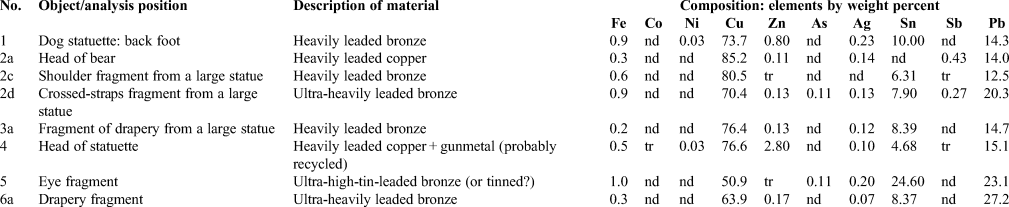
METAL COMPOSITION OF ROMANO-BRITISH STATUARY FRAGMENTS FROM THE GLOUCESTER CACHE: ANALYSIS OF DIFFERENT PARTS BY ENERGY-DISPERSIVE X-RAY FLUORESCENCE (XRF)
(nd = not detected; tr = trace; heavily leaded = 10–15 per cent lead; very heavily leaded = 15–20 per cent lead; ultra-heavily leaded = 20+ per cent lead)
COMPOSITION OF SOME COMPARATIVE PIECES OF ROMANO-BRITISH COPPER-ALLOY STATUARY, WHERE MAIN ELEMENTS ARE KNOWN FROM ANALYSIS
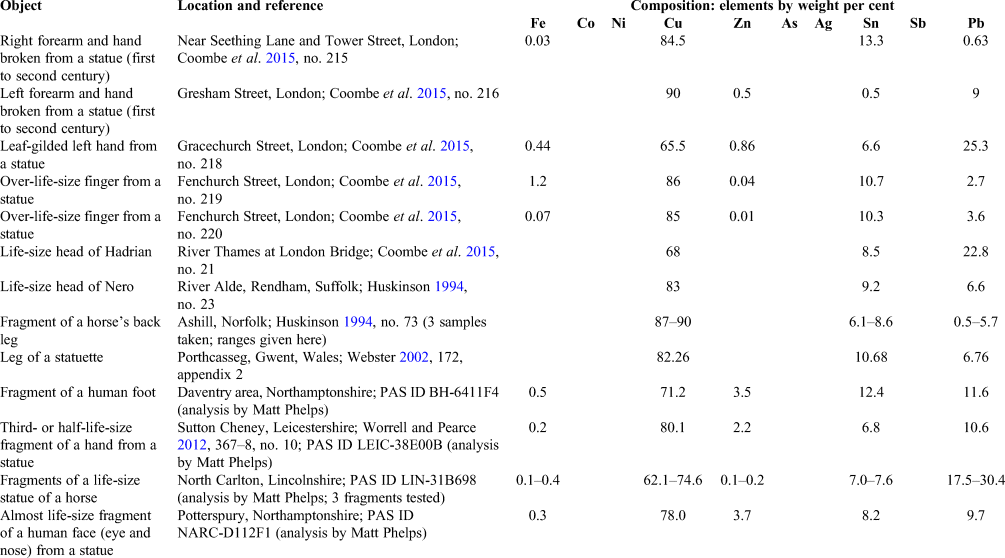
All eight sets of XRF results show that the cast-metal objects consist overall of heavily leaded bronze, though with slightly differing proportions of minor alloying impurities. Although some remaining corrosion enrichment (in tin and lead) and depletion (in copper) is indicated by the apparent iron contents, it seems unlikely that this greatly affected the results presented here and so no attempt has been made to allow for this effect. Zinc – mostly varying between trace amounts and about 1 per cent – is the only significant alloying impurity and most probably reflects the inclusion of some recycled gunmetal or brass in the mainly heavily leaded (raw or recycled) bronze metal.
Allowing for some residual enrichment/depletion, four items (see table 1) consist of heavily leaded bronze. The added lead content was relatively consistent, varying between about 10 per cent and 15 per cent, apart from the possible head of a bear (appendix 3, no. 2a), which is a heavily leaded copper, and the head of a statuette (no. 4), which is nearer to being a leaded gunmetal. Apart from the leaded copper piece (no. 2a) and the statuette head (no. 4), where the tin content is likely to have been near 4 per cent, the tin contents of the other four pieces varies between about 6 per cent and 10 per cent. However, allowing for residual enrichment effects, the tin contents of these four may be approximately within the 5–8 per cent range. Again, allowing for the effects of enrichment/depletion, the statuette head (no. 4) is most likely to consist of a heavily leaded gunmetal copper alloy (one with roughly equal amounts of zinc and tin), with approximately 4 per cent each of zinc and tin, as well as copper, and about 14 per cent (or slightly less) lead.
Of the other two fragments analysed, the piece of possible drapery (no. 6a) is more heavily leaded than the rest, with (allowing for some residual corrosion effects) approximately 25 per cent added lead. The remaining fragment, the possible eye (no. 5), is not only very heavily leaded (around 20 per cent) but an exceptionally high tin content is also indicated – still around 20 per cent even when corrosion effects are allowed for. Given that the analysis was aimed at the broken edge, this seems unlikely to be the result of tinning, and so the remaining alternative is that the eye (and presumably its pair) is made of ‘bell metal’, a bronze alloy typically with approximately 20 to 25 per cent tin (about four parts copper to one part tin); this is also an alloy expected for Roman mirrors. However, in this case, the eye also contains around 20 per cent lead, which, together with the 20 per cent (or thereabouts) of tin, would have yielded a silver-coloured alloy. This seems to have been the intention, suggesting that the eye was made this way, and perhaps then inserted into a bronze statue, in order to achieve a colour contrast.
Overall, it is clear that leaded bronze was the main metal of choice for the eight fragments of statuary and the like analysed as a preliminary group from this particular much larger (5 kg) hoard of copper-alloy pieces. However, it is also clear that there are some interesting and significant differences in the alloys used in two of the eight separate castings represented, both of which are likely to be intentional. Firstly, the bear head was found to be made of copper alloyed with about 14 per cent lead, which would have looked redder as a finished casting – compared to a ‘normal’ heavily leaded bronze – assuming it was all made this way, as seems likely. In the case of the eye, this also seems likely to have been an intentional means to vary the appearance of the complete object, so that the eyes would have looked silvery in contrast to the bronze colour of the rest of the casting, unless other variations were originally present.
The similarities and differences seen here – both in terms of intentional differences and simply variations in the contents of the castings, such as recycled metal, other impurities and so on – suggest that there is likely to be much more of great value to be found in understanding the manufacture of Roman (and other) castings, especially statuary, by analysing more assemblages of copper-alloy fragments. It is hoped that the analysis of a much larger number of copper-alloy pieces can be undertaken in the future, although this will need to be undertaken so as to minimise the enrichment/depletion effects of surface corrosion as far as possible.
APPENDIX 3: CATALOGUE OF OBJECTS By Penny Coombe and Martin Henig
SCULPTURAL FRAGMENTS
(1) Free-standing statuette of a hound, cast in the round (fig. 1): H: 131 mm; L: 211 mm; W: 51 mm; weight: 828 g. Patches of corrosion over much of the surface, especially on the shoulders, neck and haunches of the animal. Copper alloy.
A unique figure, a free-standing hound, is the only major object in the cache that remains almost complete in itself (the end of the tail might be missing). The dog stands alert and eager on four legs, its long muzzle open, its jaws well supplied with teeth and its tongue extended, endowing it with an eager expression inviting attention, as befits a hound ready to engage in the hunt. Two large leaf-shaped ears are pricked up, with wrinkles behind. The body is elongated, but the legs rather short, and the tail is curled up in a U-shape. It has distinctive almond-shaped eyes and a stylised ruff of hair separating its head from its neck; its haunches are also distinctively patterned, especially its front haunches which are defined from its body in a triangular form and engraved with what look like feathers within a frame, presumably selected for their attractiveness as a pattern. Indeed, the whole is stylised and treated decoratively, with each anatomical element outlined in some way: a line of incised fur delineates the hind quarters and there is a ridge running between the eyes to the end of the nose and under the jaw, while above each five-clawed paw, around the ankles, is a ring of fur. Rivet holes in its front paws and depressions on the underside of its rear paws suggest it was originally affixed to a stand. The two pinprick holes in the left shoulder could have allowed fixture. The male genitalia are seen on the underside. A small rectangular hole in the stomach, probably made in casting, emphasises that the body was hollow.
Figurines of dogs are well attested in the north-western provinces including Britain. Apart from the reclining hound from the Lydney Park temple associated with NodensFootnote 110 and a very similar bronze from Voorburg in the Netherlands (probably the familiar of the goddess Nehalennia),Footnote 111 there is a similar seated hound, though without the long muzzle, from Montreux-Châtelard.Footnote 112 Other figurines of hounds are widespread in the region but they are mainly much smaller; they include examples from Colchester,Footnote 113 Trier,Footnote 114 AugstFootnote 115 and Carnuntum.Footnote 116 Perhaps the best parallel amongst these small figures is a hunting hound from Moudon in Switzerland.Footnote 117 Another hound figurine was recently documented from Newchurch on the Isle of Wight.Footnote 118
Here, the treatment of the tongue and the rich patterning bring to mind the hound-like creatures, likewise powerful male animals, from Llys Awel, Conwy in north Wales, which Durham would place in a south-western group of bronzes of early Roman date, though these are depicted squatting on their haunches.Footnote 119
While there are analogies to the species (at Lydney) and the style (at Llys Awel), the Gloucester dog is without parallel in Roman Britain. It is just possible it is associated with the statuette (see no. 4 below), though the metal composition is rather different.
It is worth noting from Kaiseraugst examples of statuettes incorporated on top of donation or money boxes, also seen in Gaul.Footnote 120 Often these are smaller, integrated into the box by being attached to the top, and more common in the private sphere, but one wonders whether the dog could have stood atop a similar, larger box, perhaps pinned by his paws.
(2) Bear skin and paw from covering of tree-trunk support (fig. 2), shoulder piece, crossed straps piece, and perhaps a lock of hair – from a large statue, probably of Diana/Artemis, total weight: 870 g.
The surviving diagnostic pieces of statuary (there are less-diagnostic plain fragments and pieces of drapery listed below) give evidence for an approximately life-sized statue. Figures of such a size are rare in Britain, though new discoveries of a wealth of fragments increases our understanding of the range and quantity of bronze statuary that must once have stood in the province. The quality of the casting and nature of the subject matter (garments from an imperial or, more probably, a sacred figure) make this a truly exceptional discovery of great importance.
As goddess of the hunt, Diana is often accompanied by a hound (see, for instance, examples from Britain in limestone, a relief from Nettleton, Wiltshire,Footnote 121 and a statue from Cirencester,Footnote 122 though there only the paws of the hound remain). Combined with the shoulder piece, the crossed straps and other drapery (described in more detail below), an interpretation of the figure as Diana seems the most plausible identification.
(a) Bear skin with head, part of an animal pelt like a nebris, most probably an adjunct to a tree-trunk support rather than from boots, though similar animal heads are frequently depicted as lappets on boots: H: 121 mm; W: 66 mm; D: 16 mm; weight: 353 g. Broken at the top.
Long flat piece with a bear head on the terminal/lower part. The rounded ears are carefully modelled; the head and length of the piece are detailed with short striations to show the straight fur; the eyes are closed and the broad muzzle rounded where the piece terminates.
The length of the remaining piece suggests identification as a pelt slung over a tree-trunk support,Footnote 123 rather than the bear-head lappets of boots. Such boots were chosen for hunting, and are worn by Diana/Selene on the Hellenistic figure in the Capitoline Museums and a statuette from Asia Minor.Footnote 124 Boots with animal-head and paw lappets can be seen on examples now in the Vatican, at Naples and at Samos, and on a small late Roman marble statuette from Saint-Georges-de-Montagne now in Toulouse.Footnote 125 It is probable that a bear head is a deliberate choice here: Artemis, her Greek equivalent, and the goddess from Berne, Dea Artio, were especially associated with bears.Footnote 126 Note similar examples on military boots worn both by deities and imperial figures: see (in white marble) the sculpture of Mars Ultor in Palazzo Nuovo (Capitoline Museums collection) in Rome;Footnote 127 also of white marble, the colossal mid-second-century legs and feet of two imperial statues from Sagalassos (Burdur Archaeological Museum).Footnote 128 Most typically, the lappets appear to be leonine, particularly on military boots, but in this case appear to be those of a bear. Even though the length of the surviving nebris militates against it being a boot, the animal head certainly brings to mind the examples cited above.
(b) Animal paw, probably also from the covering of a tree-trunk support: L: 42 mm; W: 41 mm; weight: 36 g. Broken off; dark grey/green.
Four claws or toes from the paw of an animal, in relief. Dogs typically have four claws, but this is most probably associated with the bear-head terminal as part of the nebris.
(c) Shoulder fragment: H: 128 mm; W: 85 mm; D: 44 mm; weight: 346 g. Broken entirely on two sides and to some extent on two more. Smooth dark-grey/green finish; some paler green patination/corrosion on rear and at the breaks.
Piece of drapery with banded edging at what must be the shoulder of a life-sized figure. One edge is finished, curving as though to accept another piece, probably at the neck ready for the head. The other side is partly finished, partly broken. This is then most likely a left shoulder. To the outside is a banded edge, and beyond this maybe a brooch with floral motif that would have fixed a cloak, and the start of that drapery. On the other side, towards the neck is a section with flowing ridges for drapery on the figure's front. A slight concave indent beneath the neck could be a curvature of the folds. The edge at the ‘neck’ is reinforced with additional metal, to a depth of 38 mm below the surface of the ‘shoulder’. Elsewhere, the metal is 3–15 mm thick. This seems likely to be from an important figure of an official, a deity or the emperor. The figure appears not to wear armour, and the flowing drapery supports identification as a female figure: see, for instance, the arrangement of drapery at the shoulder of the (white marble) figure of the Cesi Juno, now at the Palazzo Nuovo (Capitoline Museums collection, inv. S 731).Footnote 129
(d) Crossed garment straps: H: 46 mm; W: 83 mm; D: 21 mm; weight: 135 g. Three sides are broken; some patination on the rear; otherwise a dark-green/grey colour
Two rounded straps 6 mm wide cross each other in a wide ‘X’ with arms closer to the horizontal than vertical. The upper strap goes diagonally from top left to bottom right. The top of the piece is a finished edge which curves slightly, probably to accept another section. Behind the finished edge is a thick addition of metal, around 20 mm thick. Underneath the straps are vertical ridges of folded drapery. Crossed straps like this were sometimes used to tie down drapery at the breast of a female figure: note the larger of the two statues of Artemis from Piraeus dated to the fourth century b.c. (Artemis A) with wide cross-bands securing her tunicFootnote 130 or a near copy of the type in Toulouse.Footnote 131 Cross-strapping is also seen on much smaller representations of Diana upon figurines.Footnote 132 The upper part of the figure from the Gloucestershire cache recalls this type, although the flowing drapery is suggestive of a livelier figure, like that in the Vatican depicted with her hound.Footnote 133
(e) Small piece of drapery(?) or perhaps a lock of hair: H: 20 mm; W: 32 mm; D: 15 mm; weight 33 g. Broken on all sides; blackened on the rear.
Small, thick piece with regular, curving strands on one side, like locks of hair, though it could be a piece of drapery. Thick material, rough on the other side.
Artemis/Diana is often shown with hair pulled back and secured with a fillet, or sometimes with short hair (see the Piraeus statue Artemis A, for a late Classical/Hellenistic version).Footnote 134 A lock such as this could have originated from around the face or neckline.
(3) Eleven fragments of copper alloy representing drapery from one or more large statues (online fig. 1). Total weight: 1,179 g.
(a) Flat piece of drapery: H: 132 mm; W: 71 mm; D: 3 mm; weight: 197 g. Broken on all sides, but no casting flaws or patches. Some small patches of corrosion, but largely a darker-green/grey colour. Seven shallow ridges of drapery remain on a flat piece of bronze. There are some granular inclusions of green copper which perhaps have not mixed into the alloy, and the underside is flat but rough.
(b) Tubular piece of metal, probably a drapery fragment: H: 91 mm; W: 38 mm; D: 20 mm; weight: 109 g. A number of patched casting flaws, several of the rectangular patches now missing. Fragment from a curl of drapery, oval-shaped in profile, with folds of drapery on the rounded piece. At least eight patches remain on the surface, some at the location of the breaks (varying sizes and only one remaining in its entirety, 9 by 5 mm; largest is around 8 by 20 mm and probably extends longer), suggesting the casting was not straightforward at this point. Around three patches have remained intact and in position. The bronze is up to 5 mm thick, reducing to 2 mm at the edge where this curve must have joined a larger piece.
(c) Thin piece of metal; a drapery fragment: H: 80 mm; W: 17 mm; D: 6 mm; weight: 41 g. Broken on all sides, from a larger piece. Broken lengthways along two ridges where the metal is thinner. This small piece can also be identified as drapery from a statue and portrays two folds of material (around 10–12 mm wide) and a recession between them. The piece is otherwise flat. The close gathering and slim piece suggest that the drapery is here tightly gathered with many folds.
(d) Flat piece of metal; a drapery fragment: H: 108 mm; W: 77 mm; D: 5 mm; weight: 166 g. Some green patination on the surface. Flat piece with very shallow ridges denoting drapery. There is one deeper dip running the full length and another parallel that is just short of full length. Rear side is rough but flat.
(e) Small, flat piece of metal; a drapery fragment: H: 71 mm; W: 22 mm; D: 5 mm; weight: 28 g. Green patination and corrosion on the surface; broken on all sides from a larger piece. The remains of three folds of drapery are seen on the small piece, the central fold 8 mm wide. Bunched more tightly at the top (if this is the correct orientation); the lower part of the piece is flatter. On the break at the top-left side are the remains of two sides of a rectangular patch to cover a casting flaw. The underside is smooth to the lower part, but lumpier at the end with the patch.
(f) Flat piece of drapery with slight curve: H: 123 mm; W: 60 mm; D: 7 mm; weight: 175 g. Dark-green/grey colour, with a very few areas of corrosion and pitting; broken all around. Slightly curving piece of drapery, with several shallow folds, 3–10 mm wide, and some flatter sections. Remains of three casting-flaw patches (one is 15 mm long and another 3 mm wide; none survives completely) can be seen on two edges, suggesting the breaks fall along a naturally weaker area. The underside is flat but rough, and there are two areas of additional metal deposits formed during casting.
(g) Fragment of drapery: H: 170 mm; W: 43 mm; D: 26 mm; weight: 195 g. Mostly dark grey/green with a little corrosion; broken all around. Long slim piece of drapery with one significant and a few shallower folds. It is curved/turns at 90 degrees, suggesting a deep relief of drapery in three dimensions. Rear side is flat but rough, with some lumpy bits of additional metal.
(h) Small fragment, probably sculptural: H: 14 mm; W: 18 mm; weight: 3 g. Broken all round. Small piece of ribbed statuary, with three ribs.
(i) Small sculptural piece with rectangular casting-flaw patch: H: 29 mm; W: 28 mm; T: 4 mm; weight: 10 g. Broken off; green patination. Part of a larger statue. Three ridges, so perhaps from drapery; but a very small piece which is not really diagnostic.
(j) Fragment of sculpture: H: 30 mm; W: 20 mm; weight: 12 g. Broken off, green patination, some mud adhering. Very small piece of bronze of a thickness suggesting that it is sculptural. Not diagnostic.
(k) Large, perhaps sculptural fragment: H: 114 mm; W: 59 mm; D: 15 mm; weight: 243 g; copper alloy. Some pitting and corrosion. The fragment is broken top and bottom, tapering in between. The slimmer end has an applied patch of rough bronze; the wider end is roughly broken. A thicker flange runs the length of one side. The rear is apparently worked with striations, similar to those seen for the ‘fur’ of the bear on no. 2, and over all this has the shape of a large lappet.
(4) Human face: H: 46 mm; W: 43 mm; D: 21 mm; weight: 84 g (fig. 3). Broken on all sides; perhaps from a statuette; some corrosion on the rear and tip of the nose. Copper alloy, thickness 4 mm.
Youthful face of small size in high relief or three dimensions; the left eye, nose and mouth remain; the rest is broken away. The cheeks are smooth and rather flat, and lack of differentiation of the chin gives the impression of fleshiness. The eye is oval with a slight brow and drilled pupil; the eyes may even have been filled with tiny glass additions for colour, though no evidence remains. The nose is long and straight, and protrudes realistically, and the nostrils are slightly delineated. The lips are downturned. This may be the face of a young clean-shaven male or female figure, as it is smooth, and perhaps originated from a statuette around one-quarter life-size.
(5) An animal face with incised eye: H: 55 mm; W: 112 mm; D: 15 mm; weight: 265 g (fig. 3). Corroded all over, patches of green and orange. The rear is rough and heavily corroded.
Large piece of a face with one summarily incised almond-shaped eye with central circle or dot for the pupil, and perhaps a lock of hair falling over one edge. It is not clear in which orientation we should see this: the striations above/below the eye could be either a brow or wrinkles. The piece falls away on either side, and so this eye would have been prominent on the face, rather than recessed. Possibly from a predatory animal (perhaps even another dog) rather than a human face.
The small sculptural piece 3j, above, is corroded and of similar size to this, and could belong to the same object.
(6) Four plain fragments, probably sculptural: total weight: 240 g.
(a) Probable sculptural fragment: H: 84 mm; W: 48 mm; D: 19 mm; weight: 93 g. Broken on three sides; a small amount of patination. Tubular piece of plain sculptural bronze, with oval profile. A flatter section curves around, with additional flange of metal where it appears to finish on one side (unbroken here?). The inner part is smooth with just one or two additional rough patches.
(b) Probable sculptural fragment: H: 77 mm; W: 47 mm; D: 3 mm; weight: 58 g. A small pinprick-sized hole in the centre; broken all around; some green corrosion on rear. Plain, slightly concave flat piece, rough on the rear.
(c) Probable sculptural fragment: H: 64 mm; W: 40 mm; D: 8 mm; weight: 56 g. Smooth, dark-grey/green colour with minimal corrosion; broken on all sides. Plain, flat piece with 90-degree turn or flange on one long side. Flat along two edges, but all sides are broken.
(d) Probable sculptural fragment: H: 84 mm; W: 19 mm; D: 3 mm; weight: 33 g. Corroded and pitted with bright-green sections and accretions; broken all around. Slim fragment probably from a larger sculpted object. One very shiny scuff on one side could be remains of embellishment or perhaps extraction tool.
SHEET COPPER ALLOY, MAINLY PROBABLY FROM BOX FITTINGS, AND OTHER BOX OR FURNITURE FITTINGS
In all, over 1 kg of sheet copper alloy survives, most likely used as edging and fittings on boxes, later stripped off and folded or broken into pieces before deposition within the hoard. Added to this are 30 decorative studs, which again could have ornamented a chest or box, or alternatively acted as handles on furniture (see fig. 5).Footnote 135 With only these metal additions and none of the casket fabric surviving, which was originally likely to have been wood perhaps covered with leather, it is challenging to posit a reconstruction. The volume of pieces, however, suggests a container of large dimensions or several medium-sized ones: we have four handles, each of different styles.
Large chests are extant from the House of the Menander in Pompeii, one up to 150 cm long by 80 cm wide and ornamented with bronze fittings.Footnote 136 The reconstructed wooden box from Pompeii now in the Naples Museum is covered in hundreds of studs and figured plaques, and has a decorated handle.Footnote 137 This shows the extent to which such items could be decorated, acting both functionally and as show pieces, within a domestic setting.
In Britain, caskets have generally been found as containers for cremation burials, clearly in a secondary use. An example with similar attachments to our Gloucester pieces – rectangular plate with central circle, decorative studs and copper-alloy sheeting as reinforcement – was used in this way at Godmanchester.Footnote 138 Smaller examples (c. 30 by 25 by 15 cm), with bronze additions but less ornament, are known in Kent,Footnote 139 HertfordshireFootnote 140 and Essex.Footnote 141 These are paralleled in Roman Germany too.Footnote 142 These all include circular ring handles, lacking from the Gloucestershire find.
Jewellery boxes are also known, for instance from London,Footnote 143 and one is famously depicted in art on the stele for Regina at South Shields.Footnote 144 A larger chest contained the hoard of military equipment at Corbridge (up to 88 by 58 by 41 cm), and was constructed with dove-tail joints and iron attachments in a different way from that of many boxes cited from Britannia.Footnote 145 Other boxes with iron fittings are known from Silchester and the villa at Brislington, Somerset.Footnote 146
The Gloucester trappings would probably have derived from chests of a different, larger size from these other British examples, closer to the domestic Italian types. Our interpretation sets them originally within a sacred context, where they could have held the temple's wealth, derived from offerings of worshippers. Casket fittings and pieces of copper-alloy sheeting detached from their original settings are amongst the finds, for example, from Victoria Cave, Settle, Yorkshire, a site with multiple and perhaps changing functions, including sacred ones, and from numerous temples, including that at Woodeaton, Oxfordshire and the temple of Mercury at Uley.Footnote 147
It is possible that some pieces of copper sheet were from sceptre-bindings, especially small pieces of stiff and curved metal.Footnote 148
(7) Decorative box plates (fig. 4).
(a) Two circular plates, each folded twice with edges folded into the middle. (i) H: 72 mm: W: 34 mm; D: 7 mm; weight: 20 g. (ii) H: 71 mm; W: 31 mm; D: 3 mm; weight: 15 g. Both pieces are broken, folded and corroded. A central hole in each, with straight top and bulbous central section, is visible, but considered too small to be a keyhole. Rivet holes for fixing are also seen.
(b) One rectangular plate with central circular plate: L: 107 mm; W: 50 mm; weight: 37 g. It is now folded in half and the lower-left part is missing, broken to the upper. The plate would have been square, with a ridged circular centre. Rivet holes remain in the upper corners for fixing.
(c) One circular plate with straight projecting strips, now folded up: H: 82 mm; W: 36 mm; weight: 27 g. The circular sides are folded in, and projecting strips folded on top of that to make a surviving rectangular piece. Rivet holes remaining show it would have been affixed.
(d) Seven rectangular or square plates. (i) H: 80 mm; W: 58 mm; weight: 44 g. (ii) H: 61 mm; W: 68 mm; weight: 27 g. (iii) H: 52 mm; W: 44 mm; weight: 5 g. (iv) H: 70 mm; W: 52 mm; weight: 6 g. (v) H: 40 mm; W: 40 mm; weight: 6 g. (vi) H: 57 mm; W: 55 mm; weight: 11 g. (vii) H: 55 mm; W: 23 mm; weight: 7 g. All fragmentary or folded several times, these would originally have been square or rectangular plates, most with remains of central holes (again, likely to be too small for keyholes) and rivet holes visible.
(e) Six rectangular plates of varying sizes. (i) H: 90 mm; W: 35 mm; weight: 16 g. (ii) H: 53 mm; W: 36 mm; weight: 7 g. (iii) H: 48 mm; W: 91 mm; weight: 27 g. (iv) H: 55 mm; W: 65 mm; weight: 12 g. (v) H: 62 mm; W: 60 mm; weight: 31 g. (vi) H: 45 mm; W: 52 mm; weight: 7 g. Plates (i) and (ii) have moulded ridged frames and are folded up; plate (v) is also folded but plain. The rest are plain and flat, but broken. Nail holes 10 mm in diameter remain in several.
(f) Fourteen circular plates: largest L: 70 mm; smallest length: 17 mm; weight (together): 33 g. All fragmentary and corroded. Probably box additions, some with rivet holes.
(g) A thin circular plate: L: 67 mm; W: 60 mm; weight: 5 g. Now broken on most sides, but originally circular. Central nail hole, with other small holes. Very thin piece.
(8) Strip binding or edging (fig. 4).
(a) Sixteen pieces of narrow strip edging with punched decoration: strips are 13–24 mm wide; weight (together): 61 g. The strip-sheet metal attachments are in many cases folded once or twice. Small punched bosses at regular intervals ornament the edges, and many have rivet holes for fixing.
(b) Eight pieces of narrow strip edging with no decoration: strips are 13–18 mm wide; weight (together): 24 g. Thin strip-sheet metal attachments, some folded.
(c) Six pieces of thick binding. (i) L: 102 mm; W: 35 mm; weight: 51 g. (ii) L: 65 mm; W: 39 mm; weight: 7 g. (iii) L: 79 mm; W: 34 mm; weight: 22 g. (iv) L: 91 mm; W: 30 mm; weight: 13 g. (v) L: 68 mm; W: 37 mm; weight: 13 g. (vi) L: 57 mm; W: 35 mm; weight: 6 g. (i) is a long and wide piece of binding, with three nail/rivet holes. Somewhat turned on the corner (though perhaps this has been bent after being removed from primary use) it could be a plate. (ii) has a punched/repoussé surround and four punched circles arranged as a star or cross around a central punched circle, with more circles next to it. (iii) is folded in two and has one rivet hole and one punched circle. Pieces (v) and (vi) could be from plates or binding, and (vi) has a flange on one side, that could be from a corner or simply an imperfect fold.
(d) A piece of sheeting/edging in a thick strip, but without rivet holes. Joined together: L: 72 mm; H: 17 mm; weight (together): 8 g. Two pieces broken on the diagonal on one end and straight on the other from a longer section; they join. Smaller raised section on one long side, with flatter section twice its width on the other. ‘Pie-crust’ style decoration on the narrower band; diagonal decoration on the wider too. Flat backs.
(e) Four fragments of very thin strip offcuts. Longest is 50 mm; all W: 3 mm; weight (together): 4 g. See below for two possible further fragments, which could be identified as tweezers.
(9) Decorated corner or hinge fittings (fig. 4).
(a) Four fragments of hinge decoration. One complete/folded piece: L: 60 mm; W:50 mm; weight (together): 52 g. Three pieces broken, one folded but probably complete; corroded. One almost complete, but folded into four; two fragments of ‘spade’, or winged lobate corner fitting, shape; one long tail section.Footnote 149 It is possible that pieces catalogued below as miscellaneous (nos 11b and 11c especially) could also derive from hinge or corner fittings.
(b) Piece of decorated sheet metal, with perforated border and punched decoration: L: 75 mm; W: 23 mm; weight: 10 g. Folded into three, broken on the ends. Triangular, concave piece of sheet metal folded twice with three-piece thickness. Some holes in one end for nails/tacks. Decoration of four punched circles on that end in a diamond/lozenge shape.
(10) A large quantity of fragments of plates and binding.
(a) A quantity of thicker pieces of sheet copper alloy, mostly probably from plates and thicker pieces of binding, including at least two or three decorative plates, but now very fragmentary, folded or corroded. Together it weighs 370 g.
(b) A quantity of pieces of thin strip binding and small indeterminate fragments of sheet copper alloy: in total 121 g.
(c) A bag of mixed small copper-alloy pieces and soil: weight: 205 g.
(11) Miscellaneous pieces of sheet copper alloy with rims, fixing or decoration.
(a) Small piece of sheeting with decoration, perhaps a thin plaque: W: 14 mm; L: 15 mm; weight: <1 g. Punched repoussé decoration forming part of a circle with central motif and a straight surround.Footnote 150
(b) Fragment with rivet remaining: L: 26 mm; H: 20 mm; weight: <1 g. End of a strap with a rivet fixing, protruding 5 mm.
(c) Three fragments, perhaps with rims remaining: largest L: 35 mm; smallest H: 14 mm; weight (together): 12 g.
(12) Studs from boxes, caskets or furniture (fig. 5). Similar studs have been identified variously as ‘heavy boss[es] with squarish perforation for iron shank on underside’,Footnote 151 lock pins or bolts for lock plates with perforated holes at the ends of the shanks,Footnote 152 mounts,Footnote 153 furniture fittings or handlesFootnote 154 and studs.Footnote 155 Their use was wide ranging and flexible between furniture and caskets, the precise circumstances probably defined by local context.Footnote 156 Here they are considered to be box fittings.Footnote 157
It is notable that many have been found near fort sites, such as Binchester, South Shields, Housesteads, Newstead and Vindolanda, and at Coventina's Well.Footnote 158
(a) Five plain fittings with no shank behind: (together) weight 51 g. None is complete; three plain circular studs, plus fragments of another. A fifth piece is flat and circular with a small flanged foot and central hole, though thicker than a lock plate. The three plain studs: (i) H: 10 mm; W: 45 mm; (ii) H: 10 mm; W: 45 mm; (iii) H: 8 mm; W: 38 mm.
(b) A further 25 bell-/cup-shaped studs, of mixed sizes, together weighing 422 g. Most are fragmentary, but all have a foot or had a shank behind which remains on some. On many, a central point is ringed by concentric incised ridges as decoration.
(13) Handles (fig. 6).
While all four examples are roughly similar, they are different enough to suggest they are from separate chests or boxes.
(a) Complete handle: H: 51 mm; W: 185 mm; D: 18 mm; weight: 215 g. The drop handle has rectangular looped ends in an n-shape, stylised acorn terminals and a central bead in the plain bar.
(b) Handle, missing the right-hand terminal: H: 53 mm; W: 115 mm; D: 22 mm; weight: 134 g. Another drop handle with rectangular loop ends, naturalistic acorn terminals and a central bead in the plain bar.
(c) A handle terminal: H: 42 mm; W: 30 mm; D: 12 mm; weight: 34 g. Square loop terminal.
(d) A handle terminal: H: 49 mm; W: 33 mm; D: 12 mm; weight: 32 g. Square loop terminal.
The drop handles are amongst the most elaborate from Britain. Comparison may be made with the heavy cast-bronze handles from a villa at Sedgebrook, Plaxtol in Kent,Footnote 159 and from Hacheston, Suffolk.Footnote 160 Most other drop handles from Britain, like those of the Santon Downham casket, Cambridgeshire, are very simple and flimsy.Footnote 161
There are examples from Italy of heavy cast handles, though of a different form.Footnote 162 A couple of handles from Augusta Raurica are broadly comparable,Footnote 163 though many found at that site are of more rounded u-shape or Delphinhenkel form.
ESCUTCHEONS OR VESSEL FITTINGS
(14) Five fixtures from vessels or buckets (fig. 7).
(a) ‘Bacchic’ (a Satyr?) face, probably a handle terminal or other attachment: H: 70 mm; W: 54 mm; D: 10 mm; weight: 48 g; copper alloy, thickness 2–4 mm. Broken on all sides; one part to the right that would have been flat is now folded behind. Green corrosion and pitting, especially on the left side of the face.
A face with chubby cheeks is cast in relief, beneath horizontal additions, possibly horns, identifying the figure as a satyr. The eyes are oval and the pupils drilled. The nose is rounded and the mouth a simple line, slightly upturned as if in good humour. It is tempting to identify this as from another sculpture, perhaps a lappet ornamenting a boot.Footnote 164 However, due to the thinness of the material and the low relief, it might alternatively be an applique to a bucket or similar vessel: see Rolland Reference Rolland1965, 143, no. 305 for a similar face on the terminal of the handle of a vessel, though a little smaller.
(b) Circular escutcheon; copper alloy: D: 53 mm; weight: 19 g. One side broken and green corrosion. Circular fitting with central nail/rivet hole and nicked decoration around the edge.
(c) Lion's-head escutcheon; copper alloy: H: 57 mm; D: 22 mm; weight: 43 g. Complete; some corrosion.
Lion-head mount, with circular attachments either side and below and a hook above, now broken. The head is rendered rather geometrically, the nose in the form of a triangle points up, with eyes above along the two upper sides and the mouth formed along the lower side. The mane is represented by ridges perpendicular to the face. Comparison may be made with a lion-head terminal on a bronze amulet from Hod Hill, Dorset, where the almond-shaped eyes and mane are completed in similar fashion,Footnote 165 but even closer is another lion-head mount from Lydney.Footnote 166
(d) Bull's-head escutcheon; copper alloy: H: 62 mm; W: 38 mm; D: 27 mm; weight: 50 g. Complete; some corrosion.
Head of a bull with rounded protruding horns, ears below, eyes facing forward, nostrils delineated and maybe tongue sticking out. Hook on top and hole through the head to affix. Several other examples are known, and many are dated to the fourth century, though several are more stylised than our example.Footnote 167 Examples are found at various locations: Portchester, Hampshire, and Shakenoak, Oxfordshire, and a number have been reported to the PAS in recent years, including an unusual mount from Compton Abbas.Footnote 168
See also slight variations: an example from Richborough has a human face and bull's horns,Footnote 169 while a three-horned bull-head escutcheon comes from Cookham, Berkshire.Footnote 170 Also note the presence of five ox-head bucket mounts within a hoard from Little Orme, Conwy, dating from the first century b.c. to the first century a.d.Footnote 171
(e) Human (male) head escutcheon; copper alloy: H: 62 mm; W: 62 mm; D: 19 mm; weight: 61 g. Complete.
Three-leaf background with human head facing forward with bowl-style haircut, hook on the back, hole at the top for fixing and three holes in the leaves for attaching. The front-facing head recalls that on a bucket mount from Hod Hill in its execution of the features, though there the mask is female and the mount is rather more elaborate.Footnote 172 An example from Neuss is also rather more elaborate.Footnote 173
TACKS, NAILS, FIXINGS
(15)(a) Three domed pieces, probably the tops of tacks; thin copper alloy: (now) (i) H: 11 mm; W: 35 mm; (ii) H: 13 mm; W: 21 mm; (iii) H: 14 mm; W: 27 mm; weight (together) 10 g. All broken. Perhaps top of a tack or nail or stud, decoratively applied – though no hint of shaft inside.Footnote 174
(b) Two circular ‘cuffs’ and perhaps fragment of a third; copper alloy. The complete circle: H: 15 mm; diameter: 17 mm; fragment: H: 20 mm; W: 19 mm; fragment: H: 19 mm; W: 22 mm; weight (together): 6 g. Broken; green patination on two fragments; the other more complete. Three flat strips of bronze in a circular shape, probably originally like this rather than initially flat and later curled. One is a complete circle and has a small hole punched in one end, suggesting it could have been fixed to something. The other two are mostly broken off. They could have fitted around a piece of furniture or a staff-like object.
(c) Square-headed iron nail or tack: L of shaft including head: 23 mm; W of head: 11 mm; weight: 3 g. Corroded. Perhaps from a box or piece of furniture. This is the only piece in the hoard that is not made of copper alloy.
ITEMS OF PERSONAL ADORNMENT
(16) Twisted-cable bracelet of three strands: H: 7 mm; weight: 23 g. Broken, just over half of the circumference remains (fig. 8).
Three strands of copper alloy are twisted together to form a cable bracelet. This is of a common type:Footnote 175 similar bracelets of three strands were found in third- and fourth-century contexts at Baldock,Footnote 176 LydneyFootnote 177 and Richborough, from the inner stone fort ditch.Footnote 178 Another is recorded from the temple at Nettleton, Wiltshire, where it was associated with a human burial on the western side of the ‘temple’.Footnote 179
(17) Belt buckle and attached plate: L strap: 63 mm; W buckle end: 29 mm; weight (together) 26 g. Broken and corroded (fig. 8).
Strap folded double with two diamond-shaped lozenges with cross hatching, and two punched ring circles at each point. Riveted end on the decorated side; the buckle is plain. It probably dates to the end of the fourth century and may be the latest object contained in the hoard, offering a terminus post quem for its deposition of the last quarter of the fourth century.
It conforms to Hawkes and Dunning's type 1B: see Hawkes and Dunning Reference Hawkes and Dunning1961, 46, ‘P’ for a very similar (marginally smaller) example from Popham, Hampshire, a surface find from a Romano-British building. From South Leigh in Oxfordshire is another, similar example, albeit rather more highly decorated.Footnote 180
MISCELLANEOUS PIECES
(18) Paw end to a tripod(?) leg; copper alloy: H: 43 mm; W: 27 mm; D: 33 mm; weight: 85 g. Broken above the banding on one side; green corrosion (online fig. 3).
The foot of a slim tripod or other furniture leg is cast in the shape of an animal's five-toed paw with claws shown. There are four courses of banding above, three with cable-style hatching. To the sides of the foot, small striations emphasise the furriness of the animal. The rear is lightly incised with diagonal cross marks.
A number of parallels may be cited from Britannia, Germania and Gallia Belgica.Footnote 181
(19) Two parts of a box or stand. The pieces do not join and are of metal of slightly different thicknesses. They could, however, be part of two different sides of an object (online fig. 2).
(a) Part of a box or stand, with a curving foot and the remains of two sides; copper alloy: L: 77 mm; W: 60 mm; H: 36 mm; weight: 135 g. Note a lamp stand from Normandby Park, Flixborough, Lincolnshire, with similar base.Footnote 182 There is a similar stand from Cerro de los Castillones, Campillos, Malaga, in Spain.Footnote 183 For other stands, perhaps for figurines, see Fleischer Reference Fleischer1967, 195–6, no. 286a (Vienna) and 197, no. 290 (Enns).
(b) Part of a box or stand; copper alloy: L: 87 mm; W: 43 mm; H: 17 mm; weight: 108 g.
(20) Part of a folding pan; copper alloy: L: 72 mm; W: 48 mm; weight: 42 g. Broken on the side that would have fixed to the pan (online fig. 3).
Part of a skillet with folding handle. Two holes act as a hinge, to accept the added handle. Similar pans are recorded in both iron and copper alloy.Footnote 184 Although sometimes described as ‘military’, none comes from a military context and, where dated, they appear to be late Roman, third or fourth century, in date.
(21) Part of a key or hinge(?): L: 105 mm; H: 22 mm; W: 13 mm; weight: 33 g. Complete of itself, but may be part of a larger mechanism, perhaps from a lock (online fig. 3).
Piece with sections in two planes, horizontal and vertical. Curved at one end, triangular fin at other, notch on underside of fin.
(22) A long-handled spoon (cochlear) broken into two parts; copper alloy: handle L: 87 mm; bowl L: 58 mm; weight (together): 12 g. Broken into two pieces; some green corrosion (fig. 9).
A thin bronze spoon with shallow bowl, steeper at the sides, now broken into two pieces. The shoulder joining of the handle to the bowl is high and creates a small step down. The handle tapers towards the end. It is plain with no apparent marks on either bowl or handle, though further cleaning is required. Parallels for the shape can be found in later Roman contexts at the villa at Castle Copse, Wiltshire, at Gadebridge Park and Verulamium (in silver) in Hertfordshire, at Portchester in Hampshire and Nettleton in Wiltshire (silvered bronze).Footnote 185 The example from Gadebridge may have been from a votive deposit, and both it and the one from Verulamium were found in rivers, suggesting a possible votive aspect. Many spoons of this late Roman type are in precious metal, and a number derive from hoards.Footnote 186
(23) Knobbed spear butt; copper alloy: H: 34 mm; W: 59 mm; weight: 96 g. Part of the end for connecting this to a shaft is broken off; at the other end, the bulbous top is bashed in; corrosion (fig. 9).
An ovoid or circular terminal, most likely a ‘door-knob spear butt’ or the base end of a staff or sceptre for use in religious practice.Footnote 187 See examples from Yorkshire, Wanborough, and Willingham Fen, Cambridgeshire.Footnote 188 There are also recent discoveries from Suffolk and Hampshire.Footnote 189 Most often it is the upper terminal of these sceptres, representing deities in most instances, that demands attention.Footnote 190
With other recent discoveries from England,Footnote 191 this example lends further weight to Andrew Heald's argument that these are not only confined to Irish and Scottish sites, as once thought.Footnote 192 Several others derive from non-military sites in England, and can be set within later Roman, third- to fourth-century contexts.
(24) Tweezers or a thin strip of binding; copper alloy (thickness 1 mm): L: 59 mm; W: 9 mm; weight: 4 g. One arm of a pair of tweezers, now bent. Alternatively, another offcut of thin binding.
(25) Dodecahedron fragment; copper alloy: H: 87 mm; W: 51 mm; D: 25 mm; the spheres are presumably solid and 11 mm in diameter; weight: 44 g. Broken (fig. 9).
Half of one pentagonal side remains, with three spheres on the corners, and parts of four further sides. Each side would have had a central circular hole, 19 mm in diameter, and solid bronze spheres on each apex. Extensively paralleled in Britain, Gaul and northern Germania, and dating to the first to the fourth century, there has been much debate over the purpose of these objects.Footnote 193
The holes could have allowed them to play a role in geometry or standardised land measurements, though the varying sizes of the objects seem to contradict this. A further use as a game could be envisaged, too,Footnote 194 and use as candle holders has also been entertained.Footnote 195 Although found on a range of sites, including forts, findspots include temple sites (for example the temple at Lydney),Footnote 196 suggesting possible association with ritual or augury.
There is a full list of dodecahedra in Britain and the Continent up to the date of publication in Allason-Jones and Miket Reference Allason-Jones and Miket1984, 217–19, no. 3.741; subsequent finds have been recorded by PAS.Footnote 197 Inclusion of dodecahedra within hoards indicates that these are objects of importance or value to those who owned them.
(26) Unidentifiable pieces.
(a) Flat piece of copper alloy, with repoussé/embossed edging: L: 28 mm; W: 27 mm; weight: 3 g. Small broken piece of repoussé with four raised ‘knuckle bones’ of astragal.
(b) Thick piece with drilled hole and moulded edge; copper alloy (5 mm thickness): H: 46 mm; W: 39 mm; weight: 44 g. Broken on three sides. Drilled hole, slight curvature, perhaps from a vessel or a plaque. Three ridges of decoration on two sides are perpendicular, with some silvering/solder on the flat section, suggestive of an aedicula shape.
(c) Possibly a fragment of a handle; copper alloy: L: 43 mm; H: 24 mm; D: 17 mm; weight: 40 g. Broken all round; much green corrosion. The end of a hollow handle-shaped piece, it has two small semicircular protrusions on one side.
(27) Solidified molten lumps; evidence for bronze-working(?).
(a) Fragment or remains of casting; copper alloy: H: 33 mm; W: 39 mm; D: 11 mm; weight: 39 g. Corroded to a bright green. This could be simply a lump of cooled molten material, remaining after casting, though there are striations in the vertical plane on one side with a slight protrusion to the right. Rear side is rough.
(b) Four pieces of indeterminate shape; remains of casting: longest L: 35 mm; W: 17 mm; weight (together): 64 g. Possible evidence for melting down(?). One piece is very random and bulbous/lumpen; another seems like a drop shape. The other two pieces could be fragments but may also be pieces of solidified molten bronze.
Evidence for casting is paralleled at Woodeaton, Oxfordshire. The first-century temple site there, discovered in 1952, was also the location for bronze-working, as evidenced by lumps of slag and a sprue of solidified metal,Footnote 198 and a casting sprue.Footnote 199
(28) Coin. A copper-alloy nummus of Crispus (a.d. 317–60) from the mint of Trier, probably a.d. 322–23 (online fig. 4).
Obverse: IVL CRISPVS NOB CAES
Reverse: BEATA TRANQVILLITAS. Globe on altar inscribed VOT/IS/XX above PTR mintmark.
See RIC VII, 197, no. 372 for a similar type. It is said to have been ‘found in with the plates’ from the boxes. Therefore, it is suggested that this is the last remnant of the coin held in the boxes, which was missed by those who broke up the money boxes and other items in the cache, perhaps because it had become corroded to one of the metal plates.
(29) Fragment of a copper-alloy strip with incised inscription: H: 28 mm; W: 121.5 mm; D: 1.25 mm (fig. 10; appendix 1).