Introduction
Though depression in late-life is a treatable illness, many do not seek care and suffer needlessly (Kessler et al., Reference Kessler2001; Reynolds et al., Reference Reynolds2010). Today, an older person suffering from depression has several treatment options with demonstrated effectiveness (Arean and Cook, Reference Arean and Cook2002; Nelson et al., Reference Nelson, Delucchi and Schneider2008; Meyers and Jeste, Reference Meyers and Jeste2010). First-line treatments of depression have response rates ranging between 40% and 50%, yet subsequent intensified care management yields full remission in 50% of those partial responders (Reynolds et al., Reference Reynolds2010). Psychotherapies for depression show comparable effectiveness (Arean and Cook, Reference Arean and Cook2002). Therefore, depressed elderly patients can benefit from treatment if they have the tenacity to seek and stay with treatment.
One of the largest barriers to treatment for depressed individuals is stigma (Conner et al., Reference Conner2010a). Negative attitudes about depression, such as the belief that depression is a personal weakness or a normal response to negative life events, prevent acknowledgment of symptoms and hesitancy to take medications (Sheikh and Furnham, Reference Sheikh and Furnham2000; Kirmayer, Reference Kirmayer2001; Weiss et al., Reference Weiss, Jadhav, Raguram, Vounatsou and Littlewood2001; Yap et al., Reference Yap, Wright and Jorm2011). Stigma is particularly pronounced in demographic subgroups such as the minorities and the elderly (Sirey et al., Reference Sirey2001; Conner et al., Reference Conner2010a). Maidment et al. (Reference Maidment, Livingston and Katona2002) examined antidepressant adherence in primary care, where most depression in late-life is treated, and found stigma to be the most fundamental reason why older adults do not seek treatment. Moreover, for those who do seek treatment, stigma is strongly associated with treatment discontinuation (Sirey et al., Reference Sirey2001).
Culture plays a strong role in shaping one's beliefs about depression, as evidenced by differences between demographic subgroups on prevalence and content of stigma (Kirmayer, Reference Kirmayer2001; Griffiths et al., Reference Griffiths, Christensen and Jorm2008; Conner et al., Reference Conner2010b). GAMAIN (Brohan et al., Reference Brohan, Gauci, Sartorius and Thornicroft2011), an international study of stigma in identified depressed and bipolar patients, found high levels of stigma in 13 countries with an average of 21% meeting their a priori criteria of stigma. Yet, there were large differences between countries. As this study examined patients already identified as depressed, it would be informative to examine both depressed and non-depressed patients to determine the general level of stigma in a given culture. Exploration of international differences in attitudes about depression and its treatment will demonstrate that culture shapes stigma and will suggest venues for altering cultural beliefs to improve recognition and treatment of depression.
The aim of the study is to demonstrate cultural differences in attitudes toward depression and its treatment, and to describe the nature of these differences. This is primarily a descriptive study based on a survey presented to patients while seeking care in primary care clinics in three countries with widely different cultural norms – South Korea, Russia, and the USA (Jogerst et al., Reference Jogerst, Zheng, Frolova and Kim2011). One part of the survey was designed to compare attitudes about depression that contribute to stigma. The study focuses on the subgroup highly prone to depression-related stigma in the USA – the elderly. It builds on the GAMAIN study as it (1) examines attitudes about stigma in a general sample of patients seeking care at a family practice or primary care clinic, the setting where most depression in late-life is treated; and (2) presents data from surveys of both depressed and non-depressed family practice patients.
Methods
Between November 2008 and April 2009, all persons aged 60 years and older visiting participating primary care clinics were given a packet of research materials and asked by the clinic receptionists to consider participating in the study. After reading a brief cover letter explaining the research protocol, patients elected to open the packet and complete the questionnaire or to return the packet. All participants provided informed consent to participate.
Three clinics in the USA participated: the Family Medicine and General Internal Medicine clinics at the University of Iowa Hospitals and Clinics and a free-standing primary care office in North Liberty, Iowa. The Center of Family Medicine teaching office of the Medical Academy of Postgraduate Studies in St Petersburg, Russia, served as the Russian primary care clinic. The Korean sites were three primary care clinics of Hallym University Hangang Sacred Heart Hospital in Seoul, South Korea. An estimated 70% of participants who were offered participation in the USA completed the study. In Korea, participation rates were 72%, 84%, and 87% respectively at the three sites. There was an initial break in the protocol at the Russian site. To assure that the same protocol was followed at all sites, these participant data were discarded, and the study enrollment was restarted. This delay and a participation rate of less than 50% led to fewer subjects from the Russian clinic. In Korea, 476 patients participated, 523 participated in the USA, and 95 participated in Russia. Countries were selected based on already established collaborations between the University of Iowa and these medical centers (Jogerst et al., Reference Jogerst, Zheng, Frolova and Kim2011). Nonetheless, these countries are good examples of disparate cultures reflecting Western, European, and Eastern primary care patients.
The survey instrument was four pages containing 38 large-print questions. It included questions about demographics, religious beliefs, chronic medical conditions, and a general rating of health status. The questions were translated by native language speakers and back translated to assure equal meaning across languages. Differences in meanings were addressed and resolved. For example, angina can mean sore throat in Russian, so it was clarified that angina had the meaning of chest pain from heart disease in the Russian translation of the questionnaire.
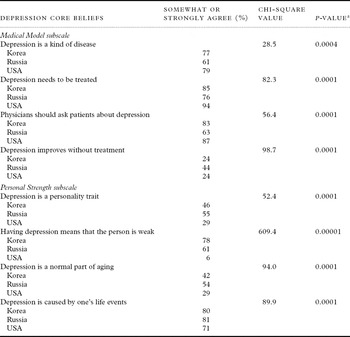
This study presents data on patient responses to a series of questions reflecting attitudes about depression. Participants were asked to indicate on a five-point Likert scale the degree to which they agreed with statements about depression ranging from 1 “Strongly disagree” to 5 “Strongly agree.” These statements reflect core beliefs closely associated with stigma; the specific items are contained in Table 1. Patients indicated the degree to which they believed depression was a medical illness (four questions), a personal weakness (two questions), and a normal response to aging (two questions).
International differences in endorsement of core beliefs about depression

a p-value for the comparison between the three countries on the percentage endorsing each depression belief as either “Somewhat agree” or “Strongly agree.”
The presence or absence of significant cultural differences was examined by conducting chi-square analysis comparing the USA, Russia, and Korea on each of the five-point Likert scale questions. For ease of interpretation, the attitudes toward depression were made dichotomous by presenting the percentage endorsing “Somewhat agree” or “Strongly agree” on each item.
In addition, a principal components factor analysis with quartimax rotation was conducted on the eight items reflecting attitudes about depression. The analysis yielded two factors with eigenvalues greater than 1 and the factors were reasonably interpretable. The first consisted of items indicating that depression is a medical illness and it included the first four items in Table 1. It accounted for 24% of the variance and yielded a coefficient α (Cronbach, Reference Cronbach1951) estimate of internal consistency of 0.63. It will be referred to as the Medical Model subscale. The second factor comprised the remaining four items in Table 1 indicating a view of depression in terms of personal strength and poor response to life events or aging. It accounted for 21% of the variance and had a Cronbach's α of 0.51. It will be referred to as the Personal Strength subscale. Though these estimates of internal consistency are in the moderate to low range, it is important to note that the magnitude of α is limited by the number of items in a measure and these two scales have only four items each. Participants’ total scores on the two subscales were not correlated (r = 0.051, p = 0.10).
Associations between these subscales and age, gender, education (coded as fewer than 12 years, 12–15 years, or 16 years or greater), self-rated health (coded on a scale from 1 = excellent health to 5 = poor health), and presence of depression (whether or not the participant scored a 10 or higher on the nine-item version of the Patient Health Questionnaire (PHQ-9; Kroenke et al., Reference Kroenke, Spitzer and Williams2001)) were calculated for each country. The PHQ-9 is a common screen for depression in primary care, with 10 or higher commonly accepted as the threshold indicating moderate depressive symptoms. Pearson correlations determined the association between the Medical Model and Personal Strength subscales and age, education, and self-rated health. The Kruskal-Wallis test between two groups was used to determine the strength of the association between these scales and gender and presence or absence of depression. To control for multiple comparisons, only associations where the p-value was less than 0.01 were considered statistically significant.
Results
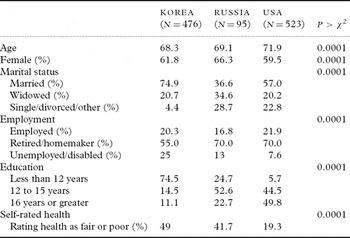
Table 2 presents descriptive data describing the sample for each of the three countries. The nations differed markedly on each of the demographic variables presented. The US patients were older on average and had higher levels of education. All three samples were predominantly female. The Russian sample contained more widows. Koreans rated themselves as less healthy than those in Russia or in the USA.
Sample characteristics from Korean, Russian, and US geriatric primary care patients

a p-value provided for omnibus test of significant differences between the three groups on the variable indicated in the left most column.
Differences among countries in core beliefs about depression are shown in Table 1. The majority of participants in all three countries endorsed “Depression is a kind of disease,” though the USA and Korea were more similar to each other than to Russia. This pattern held for the remaining three questions describing a medical model for depression. Russians were far less likely to endorse that depression needs to be treated, yet more likely to endorse that depression improves without treatment.
In contrast, Russia and Korea were more similar in their endorsement of items reflecting depression as a personal weakness. Only 6% of the elderly in the US sample endorsed “Having depression means that the person is weak,” while a significant majority in both Russia and Korea endorsed this belief. Russians and Koreans were also more likely to view depression as a normal response to aging. All three national samples endorsed highly that life events cause depression.
In addition, demographic and health correlates of the Medical Model and Personal Strength subscales were examined separately for each country. In general, correlation sizes were low to moderate (full results available upon request). Older respondents were less likely to endorse a medical model of depression in the USA (r = −0.16, p = 0.0003) and in Russia (r = −0.21, p = 0.04), though the later statistic did not reach the a priori threshold for significance of p = 0.01. Age did not correlate with either of the subscales in the Korean sample. Education was not associated with depression beliefs in Korea or Russia, but in the USA those with more education (r = −0.19, p = 0.0001) were less likely to view depression as related to personal strength. Self-rated health and gender were not related to either of the subscales in any of the countries. The only significant association found with presence or absence of depression on the PHQ-9 was in the USA. Depressed people (mean = 10.9, SD = 2.9) in the USA were more likely (t = −2.58, p = 0.01, df = 442) to endorse beliefs that depression was related to personal strength than those who were not depressed (mean = 9.7, SD = 3.1).
Discussion
This study demonstrates the cultural influence on beliefs about depression by showing similarities and differences among the elderly from different countries in endorsement of specific statements about the nature of depression. In general, the elderly in the USA held more positive views about depression, while those in Russia endorsed more negative views. The Korean sample tended to fall between these two nations except on items reflecting personal strength and depression. All nations viewed depression as a response to negative life events. There were differences by country in the association between the Medical Model and Personal Strength view of depression and demographic and health variables. These results are consistent with the GAMAIN study (Brohan et al., Reference Brohan, Gauci, Sartorius and Thornicroft2011) in documenting wide variation between countries in the degree to which they endorse negative attitudes about depression.
Though there were marked cultural differences, it is encouraging that the medical model of depression was endorsed highly across countries. It appears that the elderly in all three nations had been exposed to and accepted this more recent formulation of depression. However, high endorsement of a medical model of depression did not preclude beliefs about depression as a weakness or a response to life events or aging. Respondents’ scores on the two scales did not correlate. Therefore, even the elderly who believe that depression is a treatable medical illness may still view it as a moral weakness and this conflict may delay treatment seeking.
The relation between education and beliefs that depression is related to personal strength found in the USA sample is consistent with three prior studies of stigma (Sheikh and Furnham, Reference Sheikh and Furnham2000; Griffiths et al., Reference Griffiths, Christensen and Jorm2008; Brohan et al., Reference Brohan, Gauci, Sartorius and Thornicroft2011). Education predicted more positive views of treatment seeking and of mental problems in a mixed British and Asian sample (Sheikh and Furnham, Reference Sheikh and Furnham2000). It predicted personal stigma in a community sample of more than 5,000 in Australia (Griffiths et al., Reference Griffiths, Christensen and Jorm2008). The GAMAIN study also found education to be protective from stigma. It is unclear why this association was not found in the Russian or Korean samples.
As international data are difficult to collect, this study has many limitations. The sample is primarily a convenience sample of volunteers at selected primary care clinics. It is not possible to determine how well the sample represents the larger population of elderly primary care patients in each of the countries represented. In addition, for this study the Russian sample and response rate is far smaller than that of the USA or Korea making conclusions made about the Russian data more tentative. It also raises the possibility that differences between countries are due to sampling bias rather than cultural differences. The range in response rates is also comparable to the GAMAIN study, which found a 29% response rate in Belgium as compared with a 93% response rate in Macedonia. Another limitation is that data on actual treatment seeking was not gathered, as this would have provided critical information about the degree to which depressive beliefs actually hindered behavior.
This study is a foray into understanding cultural differences in beliefs about depression in samples where depression is most likely to be treated – in family practice or primary care. The elderly are more prone to depression stigma and thus provide a fertile sample for exploring these beliefs. How to change these beliefs is yet another challenge. However, the high rates of endorsement of a more medical model of depression in all three countries give hope that depression-related stigma can be reduced across cultures by increasing education about this complex illness. Future research can continue to describe cultural differences in stigma while developing public health programs targeting specific beliefs. For example, programs addressing the myth of depression as an indicator of personal strength could relieve the elderly in Russia and Korea of these stigmatizing beliefs. Comparable campaigns in the USA can target the tendency toward self-blame or the belief that depression is normal in late-life for the depressed elderly.
Conflict of interest
None.
Description of authors' roles
Carolyn L. Turvey collaborated with Gerald Jogerst on analysis of the data received from all three participating sites and wrote the initial draft of the paper; Gerald Jogerst was the site investigator for data collection in the USA and assisted with writing this paper; Mee Young Kim was the site investigator for data collection in Korea and assisted with writing this paper; and Elena Frolova was the site investigator for data collection in Russia and assisted with writing this paper.
Acknowledgments
This research was supported by Richard O. Emmons Memorial Fund, University of Iowa Foundation.