INTRODUCTION
Stamped tile from Greater Gloucestershire (that is modern day Gloucestershire and parts of the surrounding counties, broadly equating to the territory of the Dobunni) accounts for two thirds of all the non-military stamped tile recorded in Britain.Footnote 1 Over half of this tile was the product of the Gloucester civic tile-works at St Oswald's Priory and the remainder was mainly produced at Minety in north Wiltshire. Both sites appear to have produced stamped tile from the start of the second century for a period of c. 50 years and to have followed parallel paths and used similar styles of dies. These similarities were complemented by a spatial division which suggests that the products were exclusively used within their own localities and raises the possibility that Minety may have been the municipal tilery for the civitas capital at Cirencester, matching the arrangement at Gloucester.
The paper utilises the major assemblages from the St Oswald's Priory and Commercial Road sites for a consideration of the Gloucester civic-stamped tiles. It estimates the number of different dies which were issued and their separate purposes and proposes that many of the stamped tiles known today have come from secondary sites where they have been curated, probably for display rather than for use on roofs. There is an interesting correlation between the dies found at Hucclecote, some 4 km east of Gloucester, and those at St Oswald's Priory which helps demonstrate that Hucclecote may have been a commercial tile-processing and trading site; other potential builders’ merchant sites are also identified.
It has been suggested that the distribution of civic-stamped tiles in the area surrounding Gloucester could give an indication of the territorium attached to the colonia.Footnote 2 However, while this paper presents and discusses the distribution of all the stamped tiles, both civic and private, in Gloucestershire, the determination of territoria requires considerably more evidence than is available from tiles alone. The identification of territoria is therefore beyond the scope of this paper and the term ‘hinterland’ is used to express the association of tiles with Gloucester and Cirencester respectively in order to avoid any implications that this necessarily equates to territorium.
GLOUCESTER CIVIC-STAMPED TILES
Roman Inscriptions of Britain Volume II, Fascicule 5 (henceforth RIB in text and footnotes)Footnote 3 records 288 stamped tiles categorised into 69 different dies all bearing the letters RPG, which RIB expands as Res Publica Glevensium. Some of the dies also name the city magistrates; either the duoviri who were elected annually in the first four years of the administration cycle or the quinquennales who took office every fifth year. Gloucester is the only town in Britain to have such civic stamps. Indeed, although the names of other towns in the Empire appear on stamps such as CARTEIA and MERIDA in Spain,Footnote 4 to the author's knowledge, there is no parallel for a sequence of stamps identifying the town and the names of the annual magistrates as found in Gloucester. Perhaps the closest parallel is the late republican tile-stamps from Praeneste (Palestrina) in Italy which identify six different quaestores, but not the town.Footnote 5 Why Gloucester should, apparently uniquely, have civic dies identifying annual magistrates is not clear. Lincoln was also a colonia based on a legionary fortress and founded within a few years of Gloucester, but there is no evidence for a municipal kiln unless tiles stamped LVLA, LVLD, LVLE and LVLFFootnote 6 can be attributed to such a site, and there is certainly no series of magistrates’ names. Tiles stamped PPBRLONFootnote 7 (and derivative forms) were produced in London in 13 different dies during broadly the same period as civic-stamped tiles in Gloucester but these do not actually name the provincial procurators.Footnote 8
The stamped tiles are believed to have been produced by the municipal kiln at St Oswald's Priory, just outside the city, which was excavated in 1975–6 and published by Heighway and Parker in 1982.Footnote 9 Funding for the excavations was withdrawn before the kilns were reached but sufficient wasters and kiln debris were found to give confidence in their presence. The dies consisting just of the three letters RPG will be referred to as ‘RPG dies’, those with either the names of the duoviri or quinquennales will be referred to as ‘duoviri dies’ and ‘quinquennales dies’; ‘magistrate dies’ will refer to duoviri and quinquennales dies collectively and ‘civic tiles’ to RPG and magistrate tiles collectively.
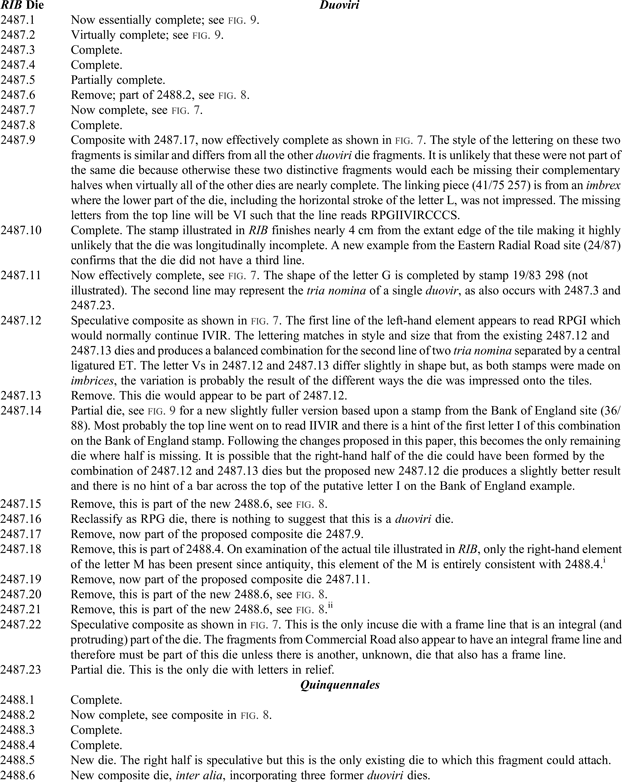
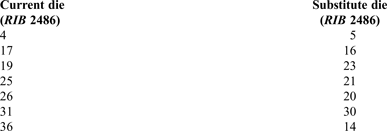
RIB includes all the civic stamps discovered prior to 1980, since when a further 183 identifiable stamps have been excavated which are listed in Appendix 2. This assemblage of new stamps has permitted a reappraisal of the dies in RIB which has resulted in the consolidation of a number of separate magistrate dies into larger composite dies as shown in Appendix 1, thereby reducing the number of magistrate dies from 27 to 20. Only one entirely new die has been identified.Footnote 10 There are seven RPG dies, each represented by just a single example in RIB, consisting of a solitary letter which is marginally different from the same letter in other more complete dies. While these stamps could represent different dies, it is argued in Appendix 1 that it is more likely that they were simply slightly distorted impressions of more complete dies which already exist. These dies have therefore been removed, reducing the number of RPG dies from 43Footnote 11 to 36 and the overall number of civic dies to 56. The revised die-listing proposed in Appendix 1 together with the additional stamps listed in Appendix 2 is used throughout the rest of this paper.
There are many examples of unstamped tegulae from Gloucester with the first cutaway form which dates to the first or early second centuryFootnote 12 including some from St Oswald's Priory itself. As no alternative site has been identified, it seems likely that St Oswald's Priory was the location of the legionary kiln which was subsequently acquired by the civic authorities who were responsible for the magistrate and RPG dies found there in an early second-century context. The foundation date of the colonia is not known with any certainty but the association of Nerva's name with the title of the colonia suggests a date of a.d. 96–8.Footnote 13 Legio II Augusta based at the nearby fortress of Caerleon produced the earliest, datable legionary-stamped tiles in Britain c. a.d. 90–100Footnote 14 and this may have been the spur for the adoption of tile-stamping by the civic authorities in Gloucester a few years later, most probably at the start of the second century.
NUMBER OF DIES ORIGINALLY PRODUCED
The number of different dies originally produced can never be known with absolute certainty but we can make some very strong inferences. For example, if we postulated back in 1980 (after the last site was included in RIB) that just half the dies had been discovered by that time, then we would have projected, other things being equal, that the next stamped tiles recovered would be evenly split between those with known dies and those with newly revealed dies. Of course such a projection would only be accurate if we had an extremely large number of stamped tiles from a very large number of new sites. Nevertheless, as listed in Appendix 2, we do have 183 new, identifiable civic-stamped tiles from 12 post-1980 sites and these have yielded just one new die which was found on two separate sites. So clearly the assumption that half the dies had yet to be found was almost certainly wrong. A more realistic estimate back in 1980 might have been that 10 per cent of the dies were missing, that is, in addition to the 55 dies then known, there were a further 6 undiscovered dies. But even then, if all the distributions were truly random, the probability of finding two or fewer stamps with a newly revealed die from the 183 additional stamps (as actually occurred) is still minute.Footnote 15 Of course the distributions were not random but reflected the particular dies in use on the sites which were excavated; however, as these covered a significant area of the town and much of the material was secondary and therefore probably drawn from an even wider area, it gives confidence that there are fewer than six missing dies, probably just one or two. This conclusion is given added support by the possibility that Commercial Road (discussed later) may have been a site which was used to curate many different dies, yet it yielded only one new die.
Appendix 1 shows the 14 duoviri and 6 quinquennales dies which have been identified. The six quinquennales dies would have spanned five administrative cycles amounting to 26 years, assuming there were no gaps. This would generate a requirement for a minimum of 20 duoviri dies to fill the intermediate years, assuming they were issued continuously and did not overlap the quinquennales dies at either end of the sequence. However, two of the quinquennales diesFootnote 16 refer to magistrates identified by the same initials, C and M, which RIB argues was a unique example of two dies being made for the same pair of magistrates. However, it must also be possible that they could refer to two different sets of magistrates who coincidentally both had names starting C and M, especially as the overall styles of the dies and the lettering within them are different. If RIB is correct then there would be five different sets of magistrates spanning a minimum of 21 years which would generate the requirement for a minimum of 16 duoviri dies to fill the intervals (compared with the 14 duoviri dies so far discovered).
Two of the duoviri dies have ansate frames which are unmatched on any of the other civic dies; one is in relief (fig. 1b) and the other, like all the other civic dies, is incuse (fig. 1c). (figs 1f–h show the comparable development of private tile-stamps which is discussed later.) At the end of the first century legio II Augusta in Caerleon was stamping its production with dies in relief; some of the first-phase dies had rectangular frames (fig. 1e) and others were ansate (fig. 1a).Footnote 17 It is therefore possible to venture that the first civic die was the relief ansate duoviri die (fig. 1b) copying the neighbouring legionary production. Logically the next die must have been the incuse ansate duoviri die (fig. 1c) after which all the dies were incuse without proper frames (fig. 1d). This proposition is supported by the 12 stamps found in the earliest phase of the kiln:Footnote 18 4 were unidentifiable, 4 were different RPG dies and 4 were different duoviri dies including the relief ansate dieFootnote 19 and incuse ansate die.Footnote 20 As there are no ansate quinquennales dies this suggests that tile-stamping in Gloucester began with at least the first two ansate duoviri dies before the first quinquennales administration. As illustrated below, this means that, if we accept the RIB proposition that there were only five different quinquennales administrations, then there would still be a shortfall of at least four duoviri dies and if we hold with six different quinquennales administrations and take a worst case distribution then the shortfall of duoviri dies rises to 14.
Sequence of die styles (half scale). figs 1a and 1e are listed in RIB II, Fascicule 4 (Frere and Tomlin Reference Frere and Tomlin1992); the rest in RIB II, Fascicule 5 (Frere and Tomlin Reference Frere and Tomlin1993).

Minimum duoviri shortfall
DansateDansateQDDDDQDDDDQDDDDQ----Q
Maximum duoviri shortfall
DansateDansateDDQDDDDQDDDDQDD--Q----Q----Q----
Even using the most conservative estimate, the probability that there are four missing magistrate dies is slim and the probability that all four of those dies are duoviri dies is slimmer still. It therefore seems inescapable that magistrate dies were not issued every year, but presumably only in years when there was a requirement for construction or renovation of official buildings.
THE USE OF RPG DIES AND PERIOD OF PRODUCTION
The kiln also produced RPG dies which were found alongside the magistrate dies in the early second-century context at St Oswald's Priory, discussed above, which shows that the RPG dies must have been produced in parallel with the magistrate dies, virtually from the commencement of civic production. This begs the question of what the purpose of the RPG dies was and how that differed from the use of magistrate dies?
Running a tile-works just for official buildings would not have been economic because even a small tilery with a single kiln could produce 11,500 tiles a year, enough for 500 square metres of building assuming equal production of tegulae and imbrices Footnote 21 (although somewhat less if tiles for wall bonding were also required). In fact, if the civic tilery had taken over the old legionary tile-works, then the potential output could have been higher as legionary tile-works typically had multiple kilns. Operating a tilery was a seasonal endeavour as the kiln could only be fired when the weather was sufficiently warm and dry for the tiles to be dried outside prior to firing, while the wood would have been best gathered during the winter months when the trees were bare of leaves. It would be difficult to run such an operation on a purely sporadic campaign basis which the demand for civic buildings might have required, or indeed to retain the necessary skills and labour, so it is reasonable to anticipate that there was some commercial activity, even if it was less than at other tileries. Tiles produced for commercial clients would not have carried magistrate stamps but might well have been given RPG stamps to identify their source.
The first firing of the kiln, normally in late April or May each year, would doubtless have been a significant event in the calendar of the tile-workers and it would have been natural to mark the occasion in a special way — perhaps by the creation of the die for the new magistrates of the year. It is possible that new RPG dies may also have been created each year alongside the magistrate dies. Indeed, as there are 36 RPG dies compared to just 20 magistrate dies, it would appear that RPG dies could have been produced annually even in years when there was no requirement for public buildings and hence no magistrate die. As a result the best indication of the duration of civic tile-stamping may be provided by the 36 RPG dies which, allowing for one or two additional dies yet to be discovered, would suggest that it spanned an interval of c. 40 years. An alternative possibility, which would extend the period of tile-stamping to c. 60 years, is that RPG dies were only produced in years when there was no demand for magistrate tiles. However, this arrangement would imply that either no commercial RPG sales were made in years when magistrate dies were produced or that magistrate tiles were sold commercially: neither of these options seems credible, especially in the light of the distribution analysis considered below.
It would be nice if we were able to stylistically match magistrate and RPG dies from the same years but, while some reasonable matches can be postulated, there are not enough of them. The frequency with which pairs of magistrate and RPG dies are found together in excavations might also be a route for identifying matches but in practice the data are fuzzy and inconclusive. This may partly be because construction of buildings took a number of years but it could also be because most of the stamps have been found in secondary contexts which may not be representative of their original locations.
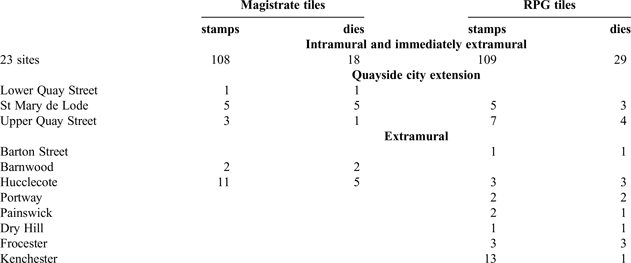
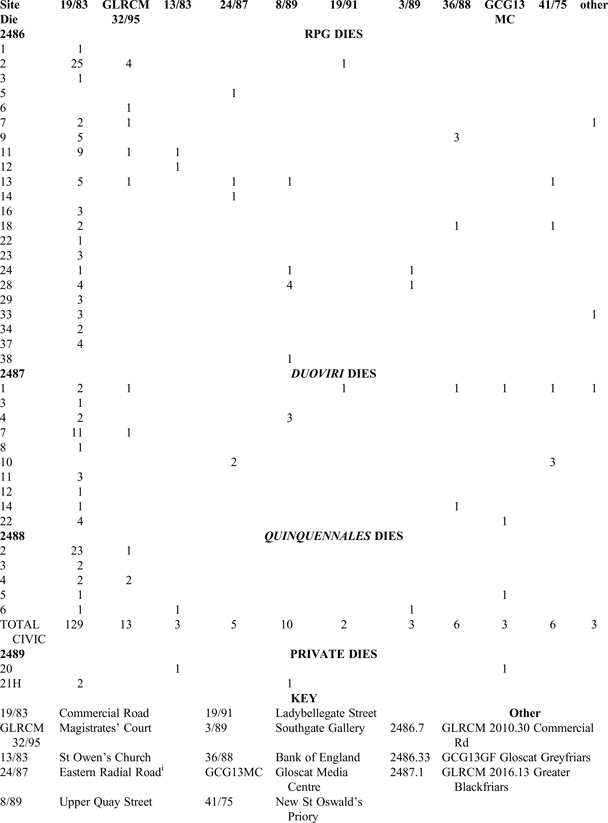
If the distinction between public use for magistrate dies and commercial use for RPG dies is correct then we ought to be able to see different distribution patterns for the two types of die. In particular, we might expect public buildings to be concentrated in the city and the quayside area but to be rare in the surrounding countryside. Table 1 divides the distribution into three categories: firstly intramural sites and directly extramural sites (which seem to represent redeposited material), secondly the extramural area leading to the quayside and thirdly extramural sites listed in order of distance from the city. The kiln site of St Oswald's Priory which lies 250 m to the north-west of the city wall is not included in the table.
DISTRIBUTION OF STAMPS BY TYPE AND LOCATION

As expected, the bulk of the tiles are found in the city and the quayside extension, albeit almost all from secondary contexts which do not necessarily reflect their original use and, in most instances, the sites produce both RPG and magistrate dies. In the early second century all the extramural sites were agricultural/industrial premises, although Portway also housed a wayside shrine,Footnote 22 and these sites, with two exceptions, have only produced RPG dies. The first of the exceptions, Barnwood, is easily explained as this is a cemetery site which has only yielded magistrate dies which were presumably used to recognise some special connection with the departed or to seek the favour of the named magistrates. The second exception is Hucclecote which not only had magistrate and RPG dies but also had many different private tile-makers’ dies. Hucclecote can only properly be considered after the distribution of private dies has been discussed so, if for the present Hucclecote can be excepted, then it seems clear that the distribution of the RPG dies is consistent with the proposition that they were commercial output for general consumption and that magistrate tiles were for use on public buildings which were concentrated in the city and the quayside area.
To summarise the evidence on the duration of tile-stamping:
(1) There are 20 different magistrate dies but the mismatch between duoviri and quinquennales demonstrates that there were more gaps in the sequence than could be explained by dies yet to be found and therefore that these dies were not struck every year.
(2) RPG dies are regularly found in association with magistrate dies and they were found together in early deposits at St Oswald's Priory. Therefore production of the RPG dies appears to have taken place at the same time as magistrate dies and not sequentially.
(3) While it is possible that the 36 RPG dies were simply annual civic dies which for some reason omitted the magistrates’ names, this seems unlikely given the contrasting distributions of RPG and magistrate dies shown in Table 1. The RPG dies were therefore probably issued annually for commercial use, including in years when there was no demand for official projects which would have required the production of a magistrate die. On this basis, allowing for a small number of RPG dies that have yet to be found, civic tile-stamping would have spanned a period of c. 40 years.
Legionary tile-stamping started in neighbouring Caerleon c. a.d. 90 and may have been transmitted to the new colonia at Gloucester, probably founded a.d. 96–8, by veterans from the fortress. The bulk of the civic-stamped tiles have been found in undated or secondary contexts; however, civic tiles were found in an early second-century context at St Oswald's Priory and in a context at Berkeley Street dated to a.d. 110 +/- 10.Footnote 23 In addition civic tiles were found in the destruction layers of an early to mid-second-century building at St Mary de LodeFootnote 24 and have also been found sealed with first-century pottery beneath floor surfaces at the Proposed Magistrates’ Court off Ladybellegate Street, but the dating is probably later.Footnote 25 The few stamped tegulae with diagnostic cutaways all take the second-century form as do all but five of the 31 diagnostic but unstamped tegula fragments from St Oswald's Priory itself (the other five having the first-/early second-century form). Ten stamped tiles from Upper Quay Street are part of a relatively undisturbed second-century assemblage based on unstamped tegulae from the rest of the assemblage.Footnote 26 The absence of stamped tile at the nearby high-status complex at Great Witcombe, where construction probably started in the later second century,Footnote 27 provides a possible terminus ante quem for stamped tile production. It therefore seems reasonable to conclude that civic tile-stamping took place for c. 40 years in the period c. a.d. 100–50.
COMMERCIAL ROAD — A STAMP CURATION SITE?
The Commercial Road site lies just within the city walls at their south-west corner. The excavation was primarily focused on the medieval period resulting in the earlier deposits only being superficially explored; nevertheless, it was possible to interpret the Roman structure as a courtyard building, possibly of late second-century construction.Footnote 28 The successive refurbishment of the building without material modification to its layout led to the suggestion that it may have been a heavily used public building.Footnote 29 However, the most significant aspect of the excavation was the discovery of 167 stamped tiles which is one of the largest collections of stamped tile found in Britain.Footnote 30 If the dating of civic tile production and the tentative dating of the building are correct then all of the stamped tiles must be of secondary origin and have been introduced from other sites.
In total 131 of the stamps were identifiable and, as listed in Table 8, they consisted of 32 different dies made up of 17 RPG, 9 duoviri, 5 quinquennales dies and one private tile-maker's die. By way of comparison the next most prolific Gloucester site (excluding the tile-works at St Oswald's Priory) is New Market Hall which was more than double the size of the Commercial Road excavation and which would have encompassed several Roman buildings; this yielded 13 civic dies (but only 16 stamps) and one private tile-maker's die. The magistrate dies at Commercial Road represent 14 separate years while the five quinquennales dies span a minimum of 21 years, so this assemblage cannot have been generated by any normal construction process.
Another very unusual feature of the Commercial Road assemblage is the proportion of imbrices compared to flat tiles which were stamped (flat tiles are used in preference to tegulae for consistency with the pre-1980 data). As shown in Table 2, the proportion of stamped imbrices across all other sites in the city was 30 per cent which is presumably a fair reflection of the output of the tilery, however at Commercial Road this ratio was reversed with some 66 per cent of the stamped tiles being imbrices. This is a significant difference measured across sample populations of 325 and 134 stamps respectively, especially as the 31 different civic dies at Commercial Road indicate that the difference cannot be attributed to a selected sample of dies. This is clearly not a ‘normal’ assemblage.
RATIO OF STAMPS ON IMBRICES COMPARED TO STAMPS ON FLAT TILES

i Heighway and Parker Reference Heighway and Parker1982, 64, table 6. The bricks and tegulae figures have been aggregated into ‘flat tiles’ as the methodology used to distinguish between the two forms is not entirely satisfactory.
We cannot show directly whether the preponderance of imbrices was only a feature of the stamped tiles or whether it was the result of extensive preferential robbing of flat tile from the site as a whole because the unstamped Ceramic Building Material (CBM) assemblage has not been retained. However another Roman building on the aptly named Proposed Magistrates’ Court site just 20 m north-east of the Commercial Road site offers some supporting evidence. As shown in Table 2, the 13 identifiable stamps from this site were also predominately on imbrices and, as shown in Table 8, eight of its nine different dies were also found amongst Commercial Road's 31 dies (out of a total of 56 known dies). These commonalities make it highly probable that the stamped tiles derive from the same assemblage and conceivably from a single very large building which encompassed both sites, although the wall alignments differ slightly between the sites. The Proposed Magistrates’ Court stamped tiles were integrated into a 350 kg CBM assemblage in which the overall weight of tegulae compared to imbrices was in line with the ratio of the weight of a complete tegula to a complete imbrex and there were also a similar number of tegula fragments as imbrex fragments. This indicates that there had been minimal preferential robbing of flat tiles from the Proposed Magistrates’ Court CBM assemblage and therefore that the predominance of imbrices amongst the stamped tiles in that assemblage was real rather than artificially produced. As the stamped tiles on both sites appear to have been part of the same stamped tile assemblage, it follows that the unusual predominance of imbrices was a real feature on both sites and not caused by any subsequent preferential robbing.
These stamped tiles do not necessarily need to have been introduced when the building was originally constructed; however the multiplicity of different dies and the excavators’ observations make it most unlikely that the tiles were brought onto the site after the end of Roman period, therefore their introduction onto the site, whenever it occurred, was undertaken by the Roman residents of the colonia. Furthermore, while these stamped tiles could have been seeded onto the roof alongside unstamped tiles, it must also be possible given the preponderance of imbrices that they were never intended for the roof, but were specially displayed at a lower level where the stamps would then have been more visible. If these stamped tiles were for display then the choice of imbrices over tegulae may simply have been because imbrices could be more easily lifted from an existing roof and their smaller size would have made them more convenient for display. The idea that stamped tiles might have been sought out for display is not completely without parallel. Several tile-tombs have been found in York where stamped tiles have been deliberately selected for the purpose, normally comprising several different dies and, in one instance, dies from both the legions VI Victrix and IX Hispana.
It is difficult to escape the conclusion that the collection of all these different dies (including 14 of the 20 known magistrate dies) was the result of deliberate curation some years after production of stamped tiles had ceased. Nostalgia for past civic glories is understandable, but it is nevertheless surprising that the builders went to the trouble of finding so many of the RPG dies, particularly as the differences between many of these RPG dies cannot be casually discerned. The assemblage also included two similar examples of a probable private tile-maker's stamp commencing with a letter L. Although the die had been insufficiently impressed into the tiles to make a confident identification, these impressions are consistent with RIB 2489.21H which has also been found at Upper Quay Street. Given the skill of the Commercial Road proprietors in identifying so many different RPG dies, it seems reasonable to assume that the inclusion of the private die was deliberate and not accidental. Could this mean that this apparently private die had some official endorsement?
OTHER EXAMPLES OF CIVIC STAMP CURATION
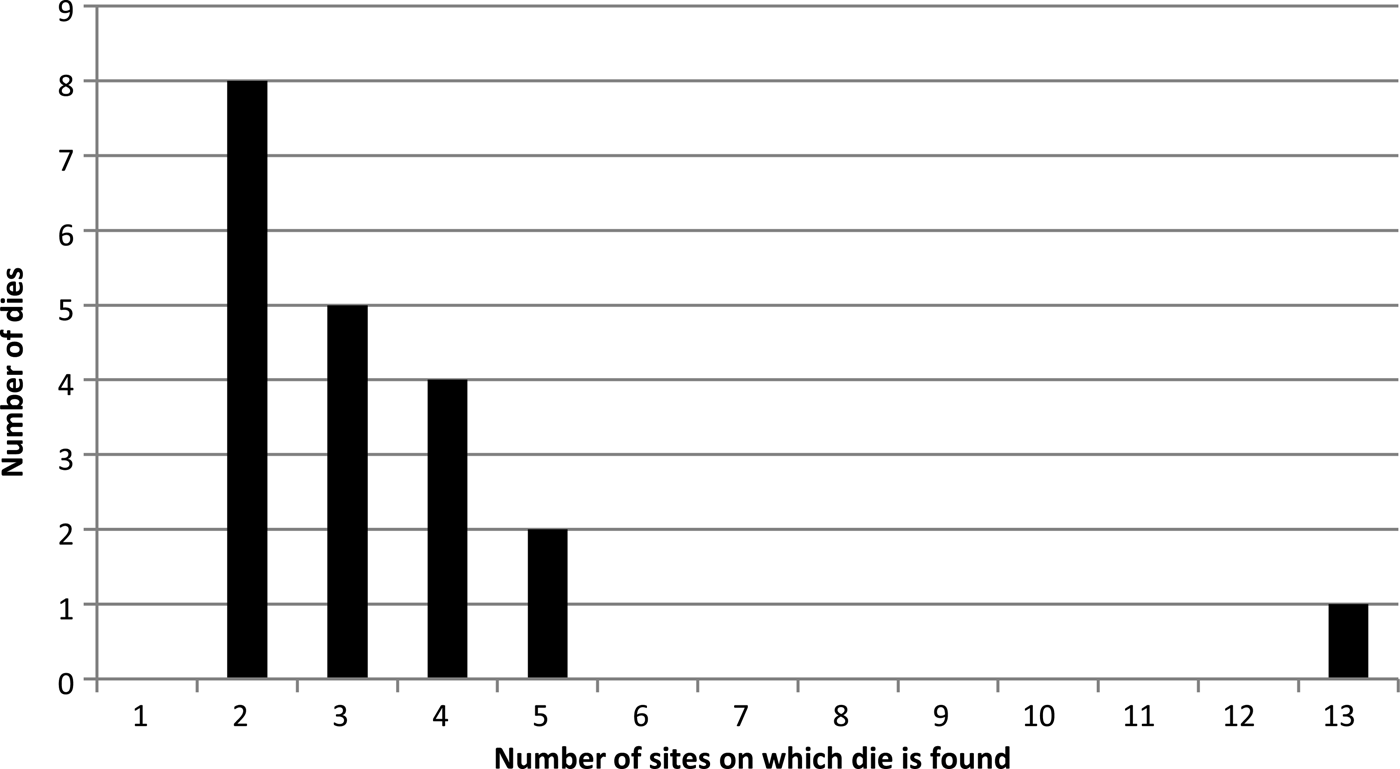
The evidence for the curation of civic tiles at Commercial Road raises the question of whether this was just an isolated incident. There is one duoviri dieFootnote 31 produced for the magistrates Perpetuus and Aprilis (fig. 9), which was used on 13 of the 21 sites where magistrate dies have been found.Footnote 32 This compares with the next most frequently used magistrate dies which appear on just five sites (fig. 2). In total 20 magistrate dies were produced so it would be extraordinary, if all these Perpetuus and Aprilis dies were used for original building or renovation, that such a high proportion of the construction projects in the city took place during their year of administration, and so little when all the other magistrates were in office. A more satisfactory explanation is surely that the administration of Perpetuus and Aprilis was regarded in later times with reverence and placing one of their tiles literally over one's head was felt to provide good fortune or to ward off evil spirits.
Incidence of magistrate dies by number of sites.

Partial confirmation of this comes from the excavation of Lower Quay Street which produced just one stamped tile which was that of Perpetuus and Aprilis. Dating evidence was second or third centuryFootnote 33 but later excavations at Upper Quay Street (where magistrate dies were also found), some 100 m to the east, suggest that this was the location of the second-century city quayside which was subsequently moved west to Lower Quay Street after the original dockside silted up.Footnote 34 While it is possible that the stamped tile arrived at Lower Quay Street in a consignment of building rubble to help consolidate the site, the excavation was not a deep one and it is more likely that the tile was curated to bring the new building good fortune when it was constructed in what must have been the later second or early third century. Further supporting evidence comes from the Barnwood cemetery where one of the two magistrate dies recovered was that of Perpetuus and Aprilis. While this may have been from the tomb of Perpetuus or Aprilis, it is perhaps more probable that it was from an unrelated tomb where the occupant was seeking the protection of the shades of Perpetuus and Aprilis.
Another site worthy of consideration in this context is the St Oswald's Priory tile-works itself. Although some of the tile was found in early second-century contexts, the bulk of it was distributed in thick spreads around the outside of a mid-second-century building.Footnote 35 These tile spreads incorporated third-century pottery.Footnote 36 In all 360 kg of CBM were recovered which was calculated to equate to 66 complete tiles;Footnote 37 the assemblage included 194 stamped tiles constituting 44 different dies. The distribution of the number of tiles found per die is shown by the black bars in fig. 3.
Distribution of the number of examples per die at St Oswald's Priory.

The bulk of the dies are represented by very few tiles and there are 12 dies which are not represented at all in the St Oswald's Priory assemblage, while at the other extreme one dieFootnote 38 was observed on 27 tiles. The light grey bars show the expected distribution which would be achieved from choosing 194 tiles at random from a very large stock of tiles containing equal numbers of each of the 56 civic dies. The shape differs significantly from the solid bars of the observed data and suggests we may be dealing with two separate populations: one part potentially being a random selection as hypothesised above and the other part possibly representing output from the final phases of production which remained unsold when the tilery was closed. Indeed the 27 examples of RIB 2486.14 and the 14 examples of quinquennales die RIB 2488.2 could be the residue of the final year's production, while the other ten dies with five or more examples could represent left-over material from the previous five years of production or unsold batches of historic surplus stock which were overlooked. If all the dies with five or more examples are ignored on the grounds that they represented left-over stock, then this would eliminate 129 tiles leaving just 65 for which a new expected distribution can be calculated. The result is shown with hatched bars; the shape is a much better match to the observed occurrence of dies at the left-hand side of the chart but it remains significantly steeper than the observed distribution which suggests a still more selective mechanism may have been at work. Half the civic dies found in Gloucester are represented at St Oswald's Priory but with just one, two or three examples and, in all, 18 out of the 20 magistrate dies and 26 out of the 36 RPG dies are included in the assemblage. This smacks of deliberate curation rather than random kiln detritus. It is possible that originally all of the civic dies were present but subsequent robbing, after the site fell out of use, has removed the 12 civic dies not represented at St Oswald's Priory. Such a process of deliberate curation could explain the observed, much flatter than statistically expected, distribution.
This argument is reinforced by the observation that, contrary to the experience in the rest of the city, all of the tiles constituting the St Oswald's Priory assemblage appear to have been stamped and had therefore been deliberately selected. To demonstrate this, five complete CBM assemblages from Gloucester sites were examined by the author. These comprised just over a tonne of material and yielded 29 stamps.Footnote 39 Discounting for the medieval material included on two of the sites and adjusting for the presence of first- and third-century material, produces an estimate of 600 kg of second-century material broadly relating to the period when tiles were being stamped. That is roughly 20 kg of tile per stamp found; however, none of the stamps were complete and on average about a third of the original stamp remained. So if each original stamp broke into three pieces then there would have been approximately 60 kg of CBM per complete stamp. A reasonable average weight for second-century Gloucester roof-tiles is 6 kgFootnote 40 implying that only every tenth tile was stamped. In contrast the 360 kg of CBM at St Oswald's Priory produced 188 stamps and if we make the same assumption that each of these equated to around a third of the original stamp then the average weight of CBM per complete stamp is 5.7 kg which closely matches the average tile weight, suggesting that every tile in the original assemblage was stamped.Footnote 41
As the bulk of the St Oswald's Priory assemblage was found in a spread surrounding a mid-second-century building, it is tempting to imagine that the tiles had come from the collapse of its roof but this was not the case. The proportion of tegulae was too high and the spread included bricks and flue tile.Footnote 42 The best interpretation may therefore be that a sample of each year's stamped tiles had always been kept at the tilery as a record of its production. At some point in the third century it was decided to dispose of these curated tiles (all of which would have been complete) together with left-over tiles, inter alia, from the final phases of production and they were all dumped outside the building together with some third-century pottery which was also moved.
GLOUCESTERSHIRE PRIVATE DIES
Turning now to the private tile-makers, Greater Gloucestershire (comprising Gloucestershire and parts of the surrounding counties) was home to a prolific private tile-making industry which accounts for 46 of the 106 private dies listed in RIB.Footnote 43 Appendix 3 lists the stamps which have been found since RIB was published which increases the number of Gloucestershire dies to 49 and the total number of stamps to 310. Almost half the stamps (141) and half the dies (27) have been found in Cirencester, the civitas capital of the Dobunni. Hucclecote villa has 10 private dies and Gloucester 5 but they have no dies in common. Wanborough has 7 dies and 14 stamps, and smaller numbers of dies and stamps are found at other centres. The distribution of the private dies is shown on the schematic map (fig. 4). The Fosse Way and Ermin Street divide the area into four quadrants centred on Cirencester, while the Severn estuary is shown converging on Gloucester. The boxes list the RIB 2489 die numbers found; those at specific locations are attached to the location, while those found more generally within a quadrant are listed in floating boxes. Three separate floating boxes are used in the west quadrant to recognise the distinct distributions of the ‘Upland’ dies from the high ground close to Cirencester, the ‘East Bank’ dies from the Severn plain below Gloucester, and the ‘West Bank’ dies from the far side of the Severn estuary.
Schematic map showing distribution of private dies.

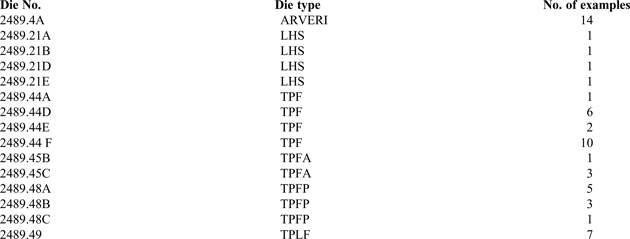
There are two major series of dies, both incuse, which account for over half of the Gloucestershire private dies and almost half of the stamps so far discovered. The ‘TPF’ series comprises dies lettered TPF, TPFA, TPFB, TPFC and TPFP identified by RIB numbers 2489.44, 45, 46, 47 and 48. Each of these letter types is seen in several different die forms identified by suffixes A, B, C etc., yielding in total 21 different dies and 119 stamps. The ‘LHS’ series are all lettered LHS which is found in nine different die forms identified as RIB 2489.21A–H, plus one newly found die, and is represented by 32 stamps. The distribution of these die series is shown in figs 5a and 5b where the darker shading identifies the areas within which the dies have been found. With one exception noted on fig. 5a, all of the TPF series stamps are found in the upland part of the west quadrant and essentially along Ermin Street from Hucclecote to Wanborough. DarvillFootnote 44 analysed a representative sample of these dies and believed, with just two exceptions, that they were all made from Oxford clay, most probably fired at the kilns in Minety just south of Cirencester which lies on the Oxford clay beds. The two exceptions, both from the same die,Footnote 45 were both found at Hucclecote and were made of Lower Lias clay; other examples of this die found at Cirencester were in Oxford clay fabric.Footnote 46 All the other TPF series stamps which were tested at Hucclecote, including another TPF die,Footnote 47 were made from Oxford clay, as were all the other tiles tested in the TPF series from other sites.Footnote 48 The easiest explanation of the die with the anomalous fabric at Hucclecote is that this was the earliest output of the TPF series tilery when it was briefly based on a site with Lower Lias clayFootnote 49 before becoming permanently established at Minety. Once established at Minety, the tilery initially continued with the original die (which is found in Cirencester in Oxford clay) before introducing all the other dies recognised in the TPF series.
Distribution of principal private die series.

As shown in fig. 5b the LHS series dies RIB 2489.21A, B, Ci, D and E are exclusively found in Cirencester, Minety and Wanborough. The remaining dies (the ‘export’ dies) are each found in a discrete area away from Cirencester. This is a most unusual distribution; it is as if the tile-maker used different dies for different destinations or even for different orders. However, the differences in the ‘export’ dies are so slight that they would not have assisted production and warehouse management, so they may be ‘annual’ dies where the whole of that year's production was contracted to a specific export location. The distance these tiles have apparently travelled is also surprising — Kenchester, Old Sarum and Silchester are all c. 70 km from Minety. DarvillFootnote 50 identified the fabric of most of the LHS series tiles he tested as coming from Minety including all the ‘export’ dies, although the examples from the Old Sarum area appeared to contain more chalk than most examples from Minety. There were, however, four LHS series dies from Cirencester which he found in a different fabric.Footnote 51
There are two further dies which share some commonalities: ARVERIFootnote 52 which is incuse, of which 43 examples have been found, and TPLFFootnote 53 which is in relief and is represented by 27 examples. As shown in figs 5c and 5d, both dies have an extensive distribution running from the west bank of the Severn to Cirencester and, in the case of ARVERI, considerably beyond. Darvill found no difference in the fabrics of the TPLF dies including those from the west bank of the Severn. The fabric differed from that used for Minety production but it could, however, have come from the Cirencester area.Footnote 54 Most of the ARVERI tiles were in a fabric which could have come from the same source as the TPLF dies,Footnote 55 though Darvill was not able to examine the examples found to the east of Cirencester and into Warwickshire. There are also similarities between the unusual distinctive signatures found on ARVERI and TPLF tiles.Footnote 56
The TCM series comprises four dies represented by 45 stamps, three read TCM and the fourth TCMF in a very similar style. The distribution is shown in fig. 6a. The largest of the TCM dies was found at HucclecoteFootnote 57 and has also been found at sites adjacent to the Fosse Way as far as Warwickshire. The other three smaller dies have only been found at Cirencester, Driffield and Ebrington. DarvillFootnote 58 identifies six different fabrics for the TCM series and suggests that they were probably produced by itinerant tilers. However, four of his fabrics appear to be very similar on his Ternary diagramFootnote 59 and all of these are examples of the larger die. Thus, if the minor variations in fabric are treated simply as variations in the clay from the same source, then it is possible that the large TCM production was made from a fixed site distributing along the Ermin Street and Fosse Way arteries. Driffield, a small villa site just off Ermin Street to the east of Cirencester and ideally suited for distribution along the Fosse Way, may potentially be the source of the larger TCM die.Footnote 60 The site has yielded tile wasters as well as three examples of the large die and 13 of one of the smaller dies. These smaller dies must represent surplus stock of an itinerant producer unless other sources of clay were also exploited by the postulated Driffield kiln.
Distribution of less common private dies.

There are two less common dies in relief: IVCDIGNIFootnote 61 with 15 examples spread along the modern M4 corridor (fig. 6c) and VLAFootnote 62 with six examples all just to the north of Cirencester (fig. 6d). It is possible that both these dies may be late. Disregarding a couple of dies represented by single examples and the die LLQFootnote 63 which only appears at Lydney on the west bank of the Severn and Cirencester,Footnote 64 all of the remaining dies are found on the east bank of the Severn and at Gloucester. In total there are six diesFootnote 65 which are exclusively found in the Gloucester hinterland and extending north to Wroxeter on the Severn and Kenchester on the Wye. These dies are found nowhere else. Riverine transport probably played a part in the distribution of these dies; for example LCH (fig. 6b) can only sensibly have reached Wroxeter along the Severn, albeit travelling upstream if the source was on the Gloucester plain as seems likely. It is also possible that stamped tiles went to (or came from) Kenchester via the Severn and then the Wye.Footnote 66
EVOLUTION OF PRIVATE TILE-STAMPING AND THE ROLE OF THE MINETY TILERY
There is little dating evidence for the private dies as most of them have been found in secondary deposits or in early excavations. However, most of the nine TPF series dies present at Hucclecote were found in the first-phase building which was demolished c. a.d. 150 to make way for the second phase which had a stone roof.Footnote 67 Also present in the first phase were Gloucester civic dies and the large TCM die (which was stamped on half-box flue tiles which typically date to the first or early second centuries). This would suggest that the incuse TPF series and large TCM die were contemporary with the Gloucester civic dies which were in production c. a.d. 100–50. Further evidence comes from Victoria Road in Cirencester where TPF and LHS series tiles and also some stamped ARVERI and TPLF were found together.Footnote 68 Although they were found in disturbed topsoil, it may still be a reasonable inference that production of these die series was closely spaced in time. In Gloucester several of the private dies have been found in association with civic stamps, albeit all in secondary contexts, which is suggestive of production c. a.d. 100–50 in line with that of the civic tiles.Footnote 69 Of the 23 private-stamped tegulae which have been found with diagnostic cutaways still intact, 19 of these take the Group-B form which dates a.d. 100–80 and 4 the Group-C form which in Cirencester can date from the late first century through to the third century.Footnote 70 The cutaway evidence is therefore generally supportive of production occurring a.d. 100–50.Footnote 71
There are many aspects of the evolution of private tile-stamping in Greater Gloucestershire which appear to match the evolution of civic-stamping in Gloucester. Tile-stamping probably started with TPLF production in relief, matching stamps produced at nearby Caerleon (see figs 1e and 1f for a stylistic comparison) which could suggest it was based on the west bank of the Severn, though a location closer to the centre of its distribution pattern seems more likely.Footnote 72 This was followed by ARVERI, perhaps from the same site or area, with a die in incuse form with a proper frame which was distinct from all the later incuse private dies, but with some similarity to the postulated second civic die (see figs 1g and 1c).Footnote 73 As Cirencester grew, and with it the demand for tiles, a new multi-kiln production site with incuse stamps without proper frames, similar to the civic tiles which Gloucester was then producing (see figs 1h and 1d), was established at Minety, 12 km south of Cirencester. Sometime, probably around the middle of the second century in line with Gloucester, the fashion for stamping tiles waned and Minety may have ceased production or changed hands; tile production continued elsewhere but on a diminishing scale from the early third century onwards as much of its market was displaced by a preference towards stone tiles. This dating is somewhat earlier than might be expected from the stamped tiles associated with the stone-built Cotswold villas whose floreat was in the third/fourth centuries. This could suggest that the stamped tiles were recycled from earlier structures elsewhere, though this would have produced a more random and less patterned distribution than is actually observed. Moreover, by the mid-third century the use of stone tiles was the norm, so it seems probable that the stamped tiles can be attributed directly to the second-century precursor villas of their later grander counterparts.
There are 21 different TPF dies which appear to have originated from Minety which is many more than could be accounted for by the need for replacements of worn-out dies during the c. 50-year life of this die series. While not as many as the 36 different, probably annual, RPG dies from St Oswald's Priory, the 21 TPF dies are sufficient to suggest that Minety may also have replaced its dies on an annual basis.Footnote 74 The distribution of TPF series dies is tightly focused on Cirencester and its immediate neighbourhood (fig. 5a) in a similar way to the civic stamps in and around Gloucester. Of the 427 identified stamped tiles known from Gloucester, only ten were not produced by the civic tilery. In Cirencester, if the (presumed) early TPLF and ARVERI dies are excluded, then just four of the 111 tiles found in the town were not the product of the Minety tilery.Footnote 75 So both tile-works used similar dies which they appear to have changed annually, they operated at much the same time, distributed within a narrow area around their respective towns and succeeded in keeping most of the competing product from other producers out of their towns. All these similarities could suggest that Minety was actually the municipal tilery for Cirencester in exactly the same way as St Oswald's Priory was for Gloucester. If this was correct, then TPF would not represent a tria nomina but could perhaps be expanded as T(egularia) P(ublica) F(ecerunt) — made by (product of) the public (municipal) tile-works — echoing in part Res Publica Glevensium at Gloucester.Footnote 76 An alternative expansion, kindly suggested by Roger Tomlin, reads T(egulariorum) P(ublicorum) F(iglinae).
If the TPF tiles were municipal production then it begs the question as to the role of the LHS tiles which were also produced at Minety. As shown in fig. 5b, the distribution of the LHS dies differs markedly from the TPF series: some of the LHS dies are effectively limited to Cirencester while others (the ‘export’ dies) are used for distribution well outside the Cirencester hinterland; the LHS dies are not found in the upland villas to the west of Cirencester. Although it is tempting to suggest that the LHS dies could have performed a parallel function to the commercial role of the RPG dies at St Oswald's Priory, the facts do not support this. It is possible that LHS was a sub-tenant on the site who was occasionally allowed to supply Cirencester to meet peaks in demand but had to supplement this with export sales outside the Cirencester hinterland when the local demand could be met by the municipal kilns alone. In this construction the dies TPFA, TPFB, TPFC and TPFP would not have represented sequential lessees of the siteFootnote 77 but probably equated to sequential kilns or just possibly to different sub-contractors operating the tilery on behalf of the town.
The presence of the proposed municipal kilns in Gloucester and Cirencester, together with the wider influence of the towns in their respective hinterlands, seems to have created a sharp demarcation in tile distribution. With the exceptions of Hucclecote, which is discussed next, and a single LHS ‘export’ die, no Minety product is found in the Gloucester hinterland and no St Oswald's Priory product in the Cirencester hinterland. The ‘East Bank’ dies do not enter the upland villas despite probably offering easier supply access than from Minety and the TCM dies, possibly made at Driffield, do not penetrate further up Ermin Street than Hucclecote.
The distribution of relief-patterned tile in greater Gloucestershire is also worthy of comment. There are 11 relief-patterned dies from Wanborough while the civitas capital at Cirencester has six dies, four of them in common with Wanborough. However, the colonia at Gloucester has none. In the late first and early second centuries, the expectation would have been that Gloucester would have been the more important town and would have had the grander buildings leading to higher demand for relief-patterned flue tile. So the complete absence of such tile compared to Cirencester, just 30 km away, is surprising. It has been suggested that the curious distribution patterns of this class of tile could have been caused by an imperial monopolyFootnote 78 but this does not explain their absence from Gloucester unless the civic kiln producing its own flue tiles extinguished any requirement.
HUCCLECOTE — A POSSIBLE RECLAMATION YARD/BUILDERS’ MERCHANT
In Roman times the winning and forming of building materials such as stone, timber and tiles would have been a labour-consuming and expensive process. As a result, recycling of building material would have been economically desirable and there is good evidence from many excavations to suggest that this took place. However, recycling would rarely have been as simple as dismantling one building and moving the useful components straight to an adjacent site for incorporation into a new building. Moreover, official permission may have been required before work could even start if the regulations from colonia Gentiva Julia in Spain applied more generally.Footnote 79 Dismantling and construction may not have been possible in parallel and it is unlikely that all of the recyclable material from one demolition would have fitted into the design of the next building. It therefore seems probable that builders would have resorted to reclamation yards where the redundant material could be sorted and stored until required for a new project. There is direct evidence for this practice in an advertisement on a shop wall in PompeiiFootnote 80 which lists various types of second-hand tiles for sale, although, as the rear of the shop has not been excavated, we do not know whether the tiles were stored on site or elsewhere.Footnote 81 VitruviusFootnote 82 recommends the use of old tiles for capping mudbrick walls. Similar reuse could be on an industrial scale, for example, tonnes of old tiles were taken from the legionary fortress of Xanten in Holland and transported 50 km down-river for reuse as road foundations.Footnote 83 The model also exists in Gloucestershire today where scrap-dealers purchase useful material, particularly Cotswold stone roof-tiles, and store and display their material in yards for resale.
The Romano-British scrap-dealer may have supplemented the model by also storing and supplying new materials such as ceramic tiles where their seasonal production cycle might otherwise have denied all-year-round availability. Indeed it would have made sense in a world where communication and transport were more burdensome than they are today, for the dealer to have acted as a building supplies aggregator, bringing together many of the materials which builders would require at a single point and making them available throughout the year: just like a modern builders’ merchant, but with a reclamation yard attached. Darvill and McWhirrFootnote 84 have argued that ‘heavy-sector’ goods such as bricks would not have been stocked by intermediaries but instead delivered direct from the manufacturer to the construction site; however, while direct delivery may have been the majority element of distribution, it is unlikely to have been the only method. Once a tile-works had gathered its wood and prepared its clay for production to restart in the late spring then most of the investment would be committed and it would make sense to keep the kiln running, even if it had no immediate order for delivery. Such surplus production could have been sold to opportunist middle-men who would stock it against the chance of an order, especially during the winter period when the kilns were moth-balled but some construction could still have continued. And, of course, smaller quantities of tile would have been required for repairs and minor refurbishments which would not have justified a special production order. These sorts of orders would have typically been less planned and more urgent, making them difficult to fit into the production schedule of a busy kiln. Indeed, Roman buildings often display elements of makeshift workmanship where inappropriate materials have been usedFootnote 85 presumably because the correct materials were not available or had not arrived, showing that there would have been a business opportunity for a merchant who could fill such gaps.
Romano-British builders’ merchants and reclamation yards would be very hard to spot in the archaeological record because all the recycled material would be indistinguishable from ordinary building rubble and it is often impossible to distinguish between, for example, new tiles stocked for sale and old tiles from a dismantled roof, especially as such a store of material would be an obvious target for robbing in subsequent times.Footnote 86 However, the practice of tile-stamping in Gloucestershire provides an indirect opportunity to identify possible builders’ merchant sites, and Hucclecote villa is a prime candidate.
Hucclecote lies on the Severn plain some 4 km east of Gloucester and c. 300 m north of Ermin Street. The site was first dug in 1910 when the main villa building was exposed, but no record was made apart from a short account which stated, inter alia, ‘tiles were discovered with twenty-three inscriptions, several of which were previously unknown’.Footnote 87 In 1933 the main site was excavated again by Mrs Clifford who identified two principal phases to the building. The first was a four-room structure with opus signinum floors measuring 50 ft by 30 ft, although it is possible that the subsequent phase masked the full size of the original building.Footnote 88 The second phase was rather grander including hypocausts and baths which extended the size to 100 ft by 50 ft.Footnote 89 Clifford dates the second phase to c. a.d. 150, although she does not fully articulate the evidence on which this dating is based.Footnote 90 Coin evidence shows the building continued in use into the fifth century. The stamped tiles ‘were found in the infilling of the building and immediately outside’ the building;Footnote 91 the context of this statement implies that the stamped tiles were subsumed into the foundation of the second-phase building c. a.d. 150. As the stamped tiles included Gloucester civic dies alongside private dies, this dating seems reasonable. In 1958 excavations immediately to the south of the villa uncovered a poor-quality floor surface which was presumed to belong to an outbuilding or workshop from the first phase of the villa. The floor was covered with a large quantity of tegula and imbrex fragments but only one new stamped tile was found.Footnote 92 Excavations and geophysical survey work in 1988 revealed no new significant features and failed to identify any surrounding field-system consistent with farming;Footnote 93 subsequent investigations, however, have yielded field boundaries, a large barn probably for storage and a stone-built corn-drier.Footnote 94 Eleven diagnostic tegulae were found in the 1988 excavation of which ten took the second-century form and one the second-/third-century form. The abundance of stamped tiles and the presence of one TPF die with an unusual fabric has led to the suggestion that there may have been a kiln at Hucclecote but no evidence for this has been found in the excavations or surveys and, to make any sense, such a kiln would have had to have made both private tiles for the Cirencester market and civic tiles for Gloucester which is highly unlikely.
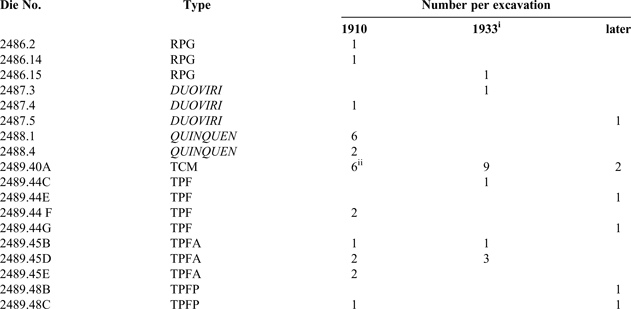
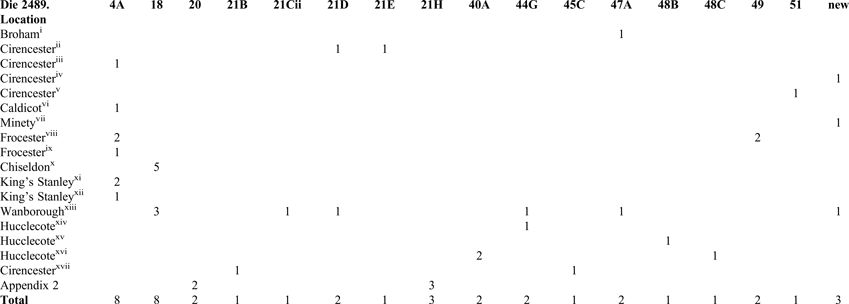
Table 3 summarises all the stamped tiles discovered at Hucclecote although the number of different dies found in the 1910 excavation may be understated because, judging by the quality of the stamps which have been retained, many fragmentary pieces are likely to have been discarded. There is only a limited overlap between the dies found in the 1910 and 1933 excavations even though both focused on the villa building and it is therefore assumed that the 1933 excavation must have explored lower levels than the 1910 excavation. The subsequent excavations all concentrated on areas outside the main villa and most of the dies found differ again from those found in the earlier excavations. Thus it would seem that there was a spatial distribution to the dies whereby specific dies were found in discrete areas rather than being generally distributed across the site. This effect is unlikely to have been produced by the collapse of a roof and might only occur where individual dies (probably reflecting separate deliveries) were placed in distinct locations.
STAMPS FOUND AT HUCCLECOTE ANALYSED BY DIE AND EXCAVATION DATE

i The numbers quoted are from RIB. Clifford 1933, 352 gives slightly different numbers in her excavation report but these are altered in her later review of stamped tiles (Clifford Reference Clifford1955).
ii Clifford Reference Clifford1955, 71 gives this as 23 TCM dies originally excavated but it is clear from the report (Hurry Reference Hurry1911, 13), quoted earlier, that it was 23 tiles with a number of different inscriptions that were actually found.
It is clear that, from the number of different dies, the inclusion of magistrate dies not otherwise found outside of Gloucester and the distribution of these dies on the site, these tiles cannot have come from the construction of the first phase of a modest building measuring just 50 ft by 30 ft. However, if the tiles were sealed by the second-phase building built c. a.d. 150, then it does not really leave sufficient time for these dies to have been recycled from buildings elsewhere which have to have been constructed after a.d. 100 and fallen out of use before a.d. 150. The absence of the probably early TPLF and ARVERI dies from Hucclecote could suggest this window was even narrower.
A possible explanation is that most of the private dies were new stock as is indicated by the number of different variants of individual die types; for example, there are four different dies consisting of just the letters TPF in the assemblage. While it is possible that the presumed sequential Minety kilns represented by the letters TPF, TPFA, TPFB, TPFC and TPFP could have been producing simultaneously, it is much more difficult to believe that the individual dies, for say TPFA, were all in use concurrently. Indeed, other than at suspected builders’ merchant sites, there are no examples of sites producing two variants of the same basic Minety die. New dies were probably either produced annually (as happened with the civic dies) or whenever a replacement was required for a broken or worn-out die. So while we might expect the occasional instance of two variants of the same kiln's output where tiles have been supplied during the transition from one die to another, instances of three or four variants of the same die type being found on the same site suggest something more. As shown in Table 3, Hucclecote had four TPF dies, three TPFA dies and two TPFP dies; the most plausible explanation has to be that these were stock of a builders’ merchant for onward sale to builders. However, if they were stock for sale, then it was not to sites within the Gloucester hinterland where none of these dies have been found. The most probable, but not entirely satisfactory, explanation is that they were destined for the upland villas within the Cirencester territory, some of which could possibly have been more conveniently serviced from Hucclecote than Minety.Footnote 95 Some support for this conjecture comes from the absence of LHS series dies from both Hucclecote and the upland villas: if the TPF series dies were stocked at Hucclecote for a purpose other than the supply of the upland villas then there would be no reason why LHS dies should not also be present at Hucclecote.
It is unlikely that the Gloucester civic dies, especially the magistrate dies, were new stock for sale in the same way that the private dies were, but the suggestion that these were reclamation products is compromised by the shortage of time required between the original use on a building and its subsequent dismantling. This remains problematic even if Clifford's c. a.d. 150 date was actually extended to, say, a.d. 175. However, an alternative solution is suggested by the preponderance of magistrate tiles (5 out of the 8 civic dies and 11 out the 14 stamps found at Hucclecote) compared to the population of civic dies as a whole where there were 50 per cent more RPG stamps than magistrate ones. Although the kiln will have aimed to manufacture only the minimum number of magistrate tiles which were required for building works in the relevant year, occasionally plans will have gone awry resulting in problematic surplus stock. Using tiles bearing the previous magistrates’ names on new official projects might arguably have slighted the work of the incoming magistrates,Footnote 96 yet it might have been considered inappropriate to sell the surplus to commercial sites. As a result one possibility is that surplus tiles were pulverised into powder for use in the production of opus signinum. This is not a simple hammering process because the initial powder generated aggregates around the remaining fragments making it very difficult to break them down further.Footnote 97 As a result an industrial type approach was required and one which would have been best undertaken by a specialist reclamation agent.
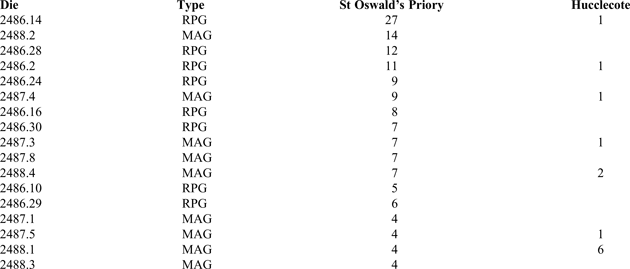
It is possible that the magistrate dies found at Hucclecote may have been accidentally overlooked in the course of providing such a pulverising service to St Oswald's Priory and there is potential corroborative evidence for this at St Oswald's Priory itself. Table 4 is an expansion of fig. 3 which was considered earlier; it concentrates on the dies where four or more examples were found at St Oswald's Priory and therefore where the overall number of stamps may be a consequence of some process or processes which go beyond simple curation. Table 4 suggests there is a correlation between the well-represented dies at St Oswald's Priory, in particular the magistrate dies, and those found at Hucclecote — five of the nine common St Oswald Priory magistrate dies are also present at Hucclecote while none of the nine less common St Oswald's Priory dies are found at Hucclecote. The probability of this happening by chance is smallFootnote 98 indicating that a relationship between the two sites is likely, possibly to do with the management of obsolete magistrate stock. The presence of the three RPG dies at Hucclecote may simply signify that these were commercial tiles for resale as part of Hucclecote's normal business, but the fact that two of the dies are amongst the top three RPG dies at St Oswald's Priory could hint at a closing down sale of RPG dies.
CORRELATION BETWEEN THE MORE COMMON ST OSWALD'S PRIORY DIES AND THOSE AT HUCCLECOTE

In summary, there are far too many different dies at Hucclecote, their spatial distribution is inconsistent with the collapse of a building, there are too many variants of basic die types among the private tiles and they are Minety product when they ought to be from the private tile-makers of the Gloucester hinterland. Magistrate dies should only be found within Gloucester and probably only on public buildings. There appears to have been a commercial linkage between St Oswald's Priory and Hucclecote. The small, modest nature of the building in the first half of the second century and its unprestigious location are consistent with commercial premises, but there is no evidence for a kiln and, even if there was, it would be unlikely to be making tiles with both private and civic dies. The evidence therefore points to Hucclecote being the premises of a builders’ merchant with a reclamation yard for recycling used materials which was supplemented with new stock in order to provide a one-stop service for customers. Its location 4 km from Gloucester may reflect a compromise between servicing the Gloucester and upland villa markets.
OTHER POSSIBLE BUILDERS' MERCHANTS
If Hucclecote was the site of a builders’ merchant then is it possible to identify other sites which might also have served the same purpose? One such site is Building XII.2 at Beeches Road which accounts for 40 per cent of all the stamps found in Cirencester and has almost as many different dies as Hucclecote. Building XII.2 was a fourth-century masonry building close to the town wall.Footnote 99 There was minimal evidence for any previous structures as a consequence of the site being built up with redeposited material to raise it above the then flood level.Footnote 100 Most of the stamped tile was found in the south-west portion of the buildingFootnote 101 and several stamped tiles had been incorporated into pilae which themselves were later insertions into the building.Footnote 102 Both the date of the building and the manner of use of the stamped tiles within it show that they must have been reused material. While the original use and location of the tiles cannot be known, they are unlikely to have been specially selected for their different dies and instead were almost certainly representative of their, presumably local, original source.
Table 5 lists the stamps which were found in Building XII.2.Footnote 103 In addition a single fragment of relief-patterned tile came from an outbuilding on the site.Footnote 104 As at Hucclecote, the multiple variants of LHS, TPF and TPFP dies are unlikely to be consistent with ordinary supplies to a construction project and are best explained as regular supplies to a builders’ merchant for onward sale to clients. In principle the function could have been performed by the tilery at Minety which was only 12 km from the town, so, if Beeches Road was a builders’ merchant, then it would almost certainly have needed to be stocking and recycling other products in addition to tiles. Assuming the tiles originated from nearby, then in the first half of the second century, before the town wall was built, it would have been ideally situated on the edge of the town. There is also a second potential supplier to Cirencester based at Cotswold Community, midway between Cirencester and Minety, where a quantity of ceramic building material including voussoirs, flue tile and one relief-patterned tile was found in an otherwise low-status rural settlement. This has also been interpreted as a tile recycling centre.Footnote 105
DIES FOUND IN BUILDING XII.2 AT BEECHES ROAD, CIRENCESTER

Another site, which bears many similarities with Hucclecote, lies 400 m outside the small Roman town of Kenchester, just west of Hereford, and c. 45 km distant from Gloucester.Footnote 106 The first building on the site originated c. a.d. 70 but by the second century it had become a timber-framed establishment without pretensions, focused on corn production and milling, and possessing a stone-built granary.Footnote 107 However, 13 tiles stamped with RPG die 2486.5 and three with LHS die 2489.21H, and made in Minety fabric,Footnote 108 were found in the second-century deposits. The only other examples of both of these dies have been found in Gloucester. Manifestly we would not expect to find either of these dies in such an industrial setting and so far from their source. While far from conclusive, the idea that this was a miller who doubled up as a builders’ merchant is an attractive possibility. It is also worth noting that the most westerly example of any relief-patterned tile, in a die which has only otherwise been observed in Essex and London, was also found nearby in the town itself, which may also indicate the activity of a builders’ merchant.Footnote 109
The final (but weakest) candidate is Wanborough, some 25 km south-east of Cirencester and lying along Ermin Street. Wanborough was a small town which is normally associated with Durocornovium in the Antonine Itinerary. It probably started life as a Neronian/Vespasian military fort based upon the amount of samian and exotic pottery as well as coins found there.Footnote 110 The early second-century development appeared to be mainly simple timber-framed structures.Footnote 111 At some point a substantial, probable mansio was built, set back 150 m from Ermin Street, but this has not been excavated.Footnote 112 However, from the perspective of the tile industry, the main distinction of Wanborough is the 11 different relief-patterned dies which have been found there.Footnote 113 Relief-patterned tile distribution is focused on south-east England and is often associated with higher-status buildings with hypocausts and flue tiles. Eleven dies is the greatest number of different dies found in any small town, indeed only London, Canterbury and St Albans boast more such dies.
In addition to the relief-patterned tiles, three different TPF dies, two different LHS dies, six examples of the IVCDIGNI die and two further dies unique to Wanborough have also been found in the town.Footnote 114 The LHS dies are probably RIB 2489.21C(ii) and 21D, the first of which is an ‘export’ die which has only otherwise been found in Silchester and the second only in Cirencester. One of the TPF dies is too fragmentary for detailed identification but the other two are RIB 2489.47A and 44G both of which are, inter alia, found in Cirencester. Darvill has identified Minety as the principal source of the LHS and TPF series of dies and suggests that c. 70 per cent of the overall tile assemblage at Wanborough can be attributed to Minety.Footnote 115
Actual findspots are known for only nine of the relief-patterned and stamped tiles and all of these are in the southern end of the town spread along Ermin Street. Four are grouped together in Insula IV at the southern extremity of the town which in Period 2A (c. a.d. 80–150) comprised a roundhouse within which LHS and IVCDIGNI dies were found and less than 10 m away two adjacent timber structures where relief-patterned die 92 was found, while a TPF die was found in open ground between these dies.Footnote 116 Only the relief-patterned die came from a Period 2A context; the other tiles could have been redeposited from elsewhere in the town. Nevertheless the extraordinary array of relief-patterned dies is unlikely to have come from the single high-status building so far discovered at Wanborough, but if it was to be explained by the presence of a builders’ merchant with reclamation yard, then the most likely location would surely be on the fringes of the town and be evidenced by a selection of stamped tiles as found in Insula IV. As the same LHS ‘export’ die and IVCDIGNI dies have been found in both Wanborough and Silchester (which is about four days’ journey for a loaded ox-cart from Minety), it could suggest that the Silchester tiles were originally sold to the builders’ merchant in Wanborough and then sold onward to Silchester, possibly through the hands of another builders’ merchant on the way.
CONCLUSION
The incomplete nature of the evidence inevitably means that the individual conclusions can only be couched in terms of possible or probable rather than certainties, but collectively their coherence lends mutual support and increases the confidence in the overall analysis. Tile-stamping in Greater Gloucestershire probably started c. a.d. 100 copying the newly adopted practice of legio II Augusta in neighbouring Caerleon. Private and civic tile-stamping appear to have marched broadly in parallel commencing with a die in relief, then an incuse die within a frame and thereafter simple, unframed incuse dies. Both Gloucester and Cirencester may have owned or controlled municipal tile kilns which produced new dies annually and continued stamping tiles for c. 40 years. Thereafter the kilns may have moved out of municipal control and had probably ceased production by the start of the third century, if not before.
Both administrations appear to have influenced the supply of tile within their territories such that only tiles from their municipal kilns entered the towns (although some ‘East Bank’ tiles did slip into Gloucester, possibly via the port) and only tiles made by private tile-makers based on their land were used within their wider territories. Relief-patterned tile was not supplied to Gloucester despite its availability in Cirencester and the wider area. The kiln at St Oswald's Priory probably stamped tiles for commercial sale with dies marked RPG which were changed annually. Tiles destined for public buildings were stamped with the names of the annual magistrates, but, most likely, only in years when there was a need for such production. Many of these dies seem to have been subsequently curated with the die of Perpetuus and Aprilis particularly sought after for this purpose.
Some tiles would have been delivered direct from the kiln to the building site but some must have been stocked and distributed by Romano-British builders’ merchants. These merchants would also have acted as reclamation agents to facilitate the recycling of building material which was an important feature of the construction economy. Hucclecote was probably the trading site of such a merchant as is suggested, inter alia, by (a) its modest size and location, (b) the multiplicity of private dies and especially the number of variants of the same letter form, (c) the presence of magistrate dies which should have been restricted to public buildings in Gloucester and (d) the linkage of the specific magistrate dies found at Hucclecote with those found in quantity at St Oswald's Priory. Other possible merchants’ sites were identified at Beeches Road in Cirencester and at Kenchester and Wanborough. All of these, like Hucclecote, were either on the edge of the town or a short distance beyond. No doubt such sites were a common feature of Roman towns but, without the benefit of stamped tiles, they are normally invisible in the archaeological record; indeed, without the stamped tiles, Hucclecote itself would look like any other modest villa.
APPENDIX 1: REVISIONS TO THE GLOUCESTER CIVIC DIES
There are two unusual features of the civic-stamped tiles which complicate their study. The first is that a higher than normal proportion of the stamps occurs on imbrices where the curved surface can introduce differences in the impressions, especially as the civic dies were normally placed on the top of the imbrices at the point of greatest curvature, aligned along their length. The dies were either pressed directly into the clay which gave a similar but more limited impression to that which the dies would form on tegulae, or they could be rolled across the curved surface of the imbrices which produced fuller, but geometrically slightly different, impressions. The other unusual feature of the civic tiles was the frequent use of surprisingly wet clay. This resulted in smudged impressions where letters could appear wider and dies longer than they were on the die itself. It is more noticeable on some dies than othersFootnote 117 which probably reflected sustained periods when wet clay was regularly used rather than random events. A collateral problem caused by using clays of variable moisture content was that the tiles shrank by different amounts in firing, resulting in greater variability in overall stamp size than would normally be expected. Boon measured up to a 7 per cent difference in the size of stamps produced by the same die at Caerleon,Footnote 118 compared with up to a 10 per cent variation recorded at Gloucester by the author.
As a result of these issues a rather wider tolerance should be adopted when matching stamps to the civic dies, particularly when the image of the die is based on an impression made on an imbrex. A good example of the problem concerns dies RIB 2487.6 and 2488.2 which are actually two overlapping ends of the same quinquennales die. They have previously been regarded as separate dies owing to the apparent differences in the detail of the lettering but, as shown in fig. 8, these are the same die. Similarly minor differences in the impressions (all on imbrices) made on RIB 2487.15 and 2487.20 and also between RIB 2487.12 and 2487.13 have prevented these being paired.
Caution should also be exercised with regard to die frames. With one exception,Footnote 119 none of the dies have protruding frame lines and the apparent lines shown on some stamps simply represent the limits of the die tool. The line only becomes apparent when the tool is impressed particularly vigorously or at an angle; as a result the same die may occur both with and without a ‘frame’.
The 183 additional civic stamps listed in Appendix 2 permit a reappraisal of the dies recorded in RIB; however, as demonstrated in this paper, we should not expect this to lead to the discovery of more than a handful of new dies at most. The focus has therefore been on exploring how this new information may enable existing fragmentary dies to be consolidated, rather than seeking to create new ones. The results of this exercise are detailed in Table 6 and shown in figs 7, 8 and 9. In figs 7 and 8 new composite dies are shown at the left while the constituents which make up the revised dies are detailed to the right separated by solid lines (the site names matching the site codes are given in Appendix 2). Where composite dies incorporate one or more existing dies then they are identified by the first RIB number. Where a composite die requires a new number then, for convenience, it has been assigned the next available number in the RIB series.
Proposed composite duoviri dies (half scale).

Proposed composite quinquennales dies (half scale).

Other revised/improved dies (half scale).

PROPOSED REVISIONS TO THE MAGISTRATE DIES LISTED IN RIB

As a result of this exercise, the number of duoviri dies is reduced from 23 down to 14 while the number of quinquennales dies is increased from 4 to 6, one of whichFootnote 120 is entirely new. No new composite dies are suggested for the RPG series although a number of revisions/improvements are proposed in fig. 9. However, there are seven partial RPG dies which consist of just a single letter and in all cases are represented by just a single example of the stamp which differs only marginally from other more complete dies. The variation is similar to that observed between definite impressions from the same die caused by being smudged or distorted by wet clay or the application to imbrices. It is proposed that these dies should be replaced as shown in Table 7. It is also arguable that other RPG die pairsFootnote 121 are actually just single dies whose impressions differ marginally due to shrinkage or the application on imbrices, though no change to the listing is proposed in this regard. The number of RPG dies therefore reduces from 43Footnote 122 to 36 which, with the reduction in magistrate dies, gives an overall total of 56 dies.
SUBSTITUTE DIES FOR DOUBTFUL RPG DIES

APPENDIX 2: CIVIC STAMPS FOUND AFTER 1980 NOT INCLUDED IN RIB
Table 8 lists the 177 identifiable stamped civic tiles and five private stamped tiles excavated in Gloucester since the RIB list was completed. It also includes six stamps from St Oswald's Priory, three of which were inadvertently omitted from RIB Footnote 123 and three identifiable stamps (along with eight which could not be identified) which were found during a re-examination of the CBM from the site. Only those stamps which could be identified with reasonable confidence have been counted, although this includes six Commercial Road stamps which comprise parts of the speculative composite dies in figs 7 and 8 and two with speculative RIB 2489.21H stamps discussed earlier.
STAMPS FROM GLOUCESTER NOT INCLUDED IN RIB

APPENDIX 3: ADDITIONS TO THE PRIVATE DIES LISTED IN RIB
ADDITIONS TO THE PRIVATE DIES LISTED IN RIB

ACKNOWLEDGEMENTS
I am very grateful to Andrew Armstrong, Gloucester City Archaeologist, David Rice at Gloucester City Museum, Stefanie Vincent at Swindon Museum, Hazel O'Neill and Ed McSloy at Cotswold Archaeological Trust and Valentina Perrone for their help in locating and examining relevant assemblages. My thanks also go to Mike Fulford, Neil Holbrook, Tim Darvill and Tim Clerbaut for their invaluable comments and criticism of earlier drafts of this paper.