

Introduction
The calcium silicate wollastonite (CaSiO3) is a common mineral in metamorphic and metasomatic (skarn) rocks (Deer et al., Reference Deer, Howie and Zussman1978) produced in most of cases by the devolatization of an impure limestone precursor. Typically, calcite reacts with silicic magma, even-laminated chert intercalated in carbonate rocks or quartz detrital impurities in limestone in the course of a prograding regional (MacKinnon, Reference MacKinnon1990) or thermal metamorphism to form wollastonite and CO2 that escapes from the rock system. In fact, CO2 escaping from the rocks (open system) is critical to favour an efficient crystallization process in order to reach a deposit of economic size of this mineral, as a low (or alternatively, water-diluted) partial pressure of CO2 favours the crystallization of wollastonite and a difficult reversibility of the reaction. This need of a relatively natural open system is explained in local geological terms (and associated mineral deposit prospecting criteria) in the way that a major fault or structure close to the deposit is needed as a means of a pathway of conduit to deplete the system of CO2 (Beisswenger, Reference Beisswenger1996).
Other natural (non-economic) occurrences of wollastonite have been reported: in marble enclaves reacting with the melt sheet of an impact crater, a very unusual type (Rosa, Reference Rosa2004); in a number of volcanic sites as pyrometamorphic products of enclaves captured by erupting magmas close to the earth surface, or directly on it (see e.g. Lacroix, Reference Lacroix1893; Sabine and Young, Reference Sabine and Young1975; Barker and Black, Reference Baker and Black1980); and as product of mixing of silicate and carbonate magmas (Dawson et al., Reference Dawson, Smith and Steele1992).
Wollastonite synthesis is of twofold interest: in the petrogenesis of metamorphic rocks and in industry. In fact, most metamorphic petrology manuals contain P-T wollastonite synthesis diagrams, but very strikingly not always coincident, especially in the low-temperature field. A review of the literature shows that attempts to build such a diagram have been ongoing for more than a century, both in a theoretical and empirical way, and that all the references currently used lie in the work by Harker and Tuttle (Reference Harker and Tuttle1956) (see references therein). On the other hand, industrial interest (focused on Portland cement clinker and ceramic industries) has led to the creation of the lime–silica phase diagram (Rankin and Wright, Reference Rankin and Wright1915, mainly improved by redefinition of the thermal limits of phase transition by Welch and Gutt, Reference Welch and Gutt1959).
Most of the described cases involving the reactions of magma-limestone enclaves are related to basaltic magma. In some cases, like the Somma-Vesuvius volcanic system, reacted large limestone fragments occur as xenolithic nuclei of large volcanic bombs, both massive or geodic-drusic (Lacroix, Reference Lacroix1893) holding centimetre-sized wollastonite crystals (and a large number of other calc-silicatic minerals). The initial purpose of this experimental work was to explore the mechanisms and timing of wollastonite formation under these conditions (high-temperature and low-pressure range of synthesis), in order to interpret how fast these enclaves might grow when occurring within shallow intrusions of basic magma bodies in extruding magma. The well-known process of other calcosilicate formation associated with wollastonite is not considered here.
In general, CaSiO3 is present in two structurally quite different forms (Hesse, Reference Hesse1984): the phase stable above ~1150°C called pseudowollastonite or α-wollastonite; and the phase stable below 1150°C called β-wollastonite or wollastonite. A number of polytypes of α-wollastonite have been recognized and described (Yamanaka and Mori, Reference Yamanaka and Mori1981); regarding β-wollastonite, the polytypes are distinguished by the symbols nT and nM, where T and M stand for triclinic and monoclinic symmetry and n indicates the number of subcells with d subcell (100) ≈ 7.7 Å. The polytype 2M is commonly called ‘parawollastonite’.
Wollastonite is characterized by an acicular crystal shape, whiteness and fluxing properties; these properties lead to its applications in the fields of tile, paint, paper and vinyl tile manufacture. Ceramics based on wollastonite, for example, are characterized by several advantages: low linear thermal expansion coefficient; high strength; low thermal conductivity; and non-wettability with aluminium melts (Pavlov et al., Reference Pavlov, Shefer and Shabanov2008). In compositions of paints, the needle-laminar shape of wollastonite crystals improves the coverage and strength parameters of coatings and allows for substantial savings in the amount of pigments required (Nikonova et al., Reference Nikonova, Tikhomirova, Belyakov and Zakharov2003). When wollastonite is used in lining in metallurgy, it facilitates fast oxidation of aluminium and the formation of an aluminium oxide film preventing further reaction between wollastonite ceramics and metal melt (Demidenko and Konkina, Reference Demidenko and Konkina2003). Wollastonite is also a candidate material for high frequency insulators owing to its low dielectric loss at high frequency (Lin et al., Reference Lin, Chang and Lu2006). It is also used as a substitute for asbestos in certain situations, as it has not been found to cause any health risks (Nikonova et al., Reference Nikonova, Tikhomirova, Belyakov and Zakharov2003; Teir et al., Reference Teir, Eloneva and Zevenhoven2005; Gladun et al., Reference Gladun, Khol'kin and Akat'eva2007), e.g. replacing potentially hazardous asbestos in automotive brake pads (Justness, Reference Justness, Broekmans and Pöllmann2012). Recently, wollastonite ceramics have been studied as bioactive materials for orthopaedic applications and used to improve the mechanical properties of the biopolymers because of its good bioactivity and biocompatibility (Hench, Reference Hench1991; Lin et al., Reference Lin, Chang and Lu2006).
The world production of wollastonite is ~600,000 tonnes and is largely dominated by China (300–350,000 tonnes), followed by India (100–130,000 tonnes) and the USA (Brown et al., Reference Brown, Bide, Walters, Idoine, Shaw, Hannis, Lusty and Kendall2011), with minor productions in Mexico, Finland and Spain.
As far as synthesis of wollastonite is concerned, experimental procedures refer to the phase reaction method (Kurczyk and Wuhrer, Reference Kurczyk and Wuhrer1971; Kridelbaugh, Reference Kridelbaugh1973; Kurczyk, Reference Kurczyk1977; Kotsis and Balogh, Reference Kotsis and Balogh1989; Ibañez et al., Reference Ibañez, Pena and Sandoval1990; Grigoryan et al., Reference Grigoryan, Arutyunyan, Grigoryan and Khachatryan2010), the hydrothermal process (Glasser and Taylor, Reference Glasser, Taylor and Taylor1978; Grigoryan et al., Reference Grigoryan, Arutyunyan and Grigoryan2006, Reference Grigoryan, Arutyunyan, Baginova and Grigoryan2008, Reference Grigoryan, Arutyunyan, Grigoryan and Khachatryan2010), the glass ceramic method (Philip and Binet, Reference Philip and Binet1971), the sol-gel method (Villegas and Fernandez Navarro, Reference Villegas and Fernandez Navarro1988); the molten salts technique (Trubnikov et al., Reference Trubnikov, Solov'ev and Lupeiko1989); the microwave method (Vichaphund et al., Reference Vichaphund, Kitiwan, Atong and Thavorniti2011) and the hydrothermal microemulsion method (Lin et al., Reference Lin, Chang and Lu2006).
Kridelbaugh (Reference Kridelbaugh1973) studied the kinetics of the reaction calcite(s) + quartz(s) = wollastonite(s) + carbon dioxide(g) using powders of natural calcite and quartz employing cold-seal pressure vessels. Temperature, pressure and grain size were varied to determine their effects upon reaction rate (temperature ranged from 800 to 950°C, pressure varied from 1000 to 25,000 psi and grain size ranged from 10 to 70 µm). Predictably, higher temperatures and finer sizes favoured reaction rates, while variation in pressure produced erratic behaviour. The author explains that in a dry system nucleation of wollastonite occurs on the quartz grains, while in a fluid phase of CO2 and H2O, wollastonite forms on calcite fragments. The activation energy for the reaction CaCO3 + SiO2 = CaSiO3 + CO2 is between 25.5 and 29 kcal/mol and the rate equation is of parabolic form X = ktn, where X is the percent reaction, k the rate constant, t the time and n the order of the reaction.
With regard to the solid-state method, Bryden et al. (Reference Bryden, Konsztowicz, Caley and Kingston1992) and Ibañez and Sandoval (Reference Ibañez and Sandoval1993) pointed out that, when mixing silica and lime raw materials of natural and technogenic occurrences in a wide range of compositions, the first phase identified is a β-calcic orthosilicate; it is a thermodynamically unstable phase that, for molar compositions CaO/SiO2 = 1, transforms into wollastonite according to the diagram of Welch and Gutt (Reference Welch and Gutt1959).
In the past a lot of natural silica-containing materials have been applied in the synthesis of wollastonite: SiO2 smokes (Kotsis and Balogh, Reference Kotsis and Balogh1989; Nour et al., Reference Nour, Mostafa and Ibrahim2008); silica sources characterized by high specific surface; silica gel or amorphous materials such as opal or diatomites (Grigoryan et al., Reference Grigoryan, Arutyunyan, Baginova and Grigoryan2008); or gaizes (Grigoryan et al., Reference Grigoryan, Arutyunyan, Grigoryan and Khachatryan2010). In particular, Grigoryan et al. (Reference Grigoryan, Arutyunyan, Baginova and Grigoryan2008) report on the synthesis of calcium hydromonosilicate from diatomite under hydrothermal conditions (150°C) and its transformation into wollastonite (α + β) at 1150°C. Grigoryan et al. (Reference Grigoryan, Arutyunyan, Grigoryan and Khachatryan2010) report on the synthesis of β-wollastonite by using a natural source of amorphous silica and CaO (a Lithuanian gaize) with different methods, i.e. a phase reaction method, a hydrothermal one and a cogranulated technique. In particular, with the phase reaction method the gaize was mixed to calcium carbonate (providing a CaO/SiO2 molar ratio of 0.95) in the presence of Na2CO3 mineralizer; the mixture was placed in alumina crucibles and exposed for two hours in a furnace at a temperature of 1000°C. The synthesized product reveals an X-ray pattern characteristic of β-wollastonite associated with a phase indicated as β-(CaO)2SiO (probably a β-dicalcic-silicate). However, it should be noted that a very poor characterization of the synthesized products is provided, only establishing the density of the resulting product as 2.7382 g/cm3 and not reporting the X-ray pattern but only the d/n values. The synthesized powders are, in effect, polymineralic, as they contain β-wollastonite associated with the other phase β-(CaO)2SiO; moreover the absence of unreacted phases and/or amorphous components cannot be excluded.
The scope of this work is to synthesize monomineralic powders only constituted by wollastonite-2M by the using a natural source of amorphous silica and CaO that has never been used previously with the solid state method, i.e. a diatomitic rock from Crotone, Italy. Systematic samplings during the experimental run enable the progress in the crystallization of the mineral to be followed and allows the time at which the climax in the crystallization is reached to be obtained due to the absence of other phases. Complementary characterizations (calculation of the density, specific surface, Rietveld structure refinement, morphological analysis, infrared and nuclear magnetic resonance analyses) together with an estimation of the amorphous phase and unreacted CaO in the synthesis powders will represent a complete spectrum of characterization of the synthesized mineral. Furthermore, a discussion on the geological significance of the achieved synthesis is provided, giving special attention to the pyrometamorphic processes related to active volcanism.
Experimental
Methods
Diatomitic rock finely ground (particle size <60 µm) and products of synthesis were analysed by powder X-ray diffraction (PXRD) on a Siemens D5000 diffractometer operating with Bragg-Brentano geometry; CuKα = 1.518 Å, 40 kV, 40 mA, 2–45°, 2–90°2θ scanning interval, step size 0.020° 2θ). Identification of phases and relative peak assignment were performed with reference to the following JCPDS codes (powder diffraction files from the International Centre for Diffraction Data, http://www.icdd.com/): 00-043-1460 for wollastonite-2M; 00-043-1001 for CaO; 00-016-0152 for cristobalite and 00-033-0302 for larnite.
Both the crystalline and amorphous phases in the synthesis powders were estimated using quantitative phase analysis (QPA) applying the combined Rietveld and reference intensity ratio (RIR) methods; corundum NIST 676a was added to each sample, amounting to 10% (according to the strategy proposed by Gualtieri, Reference Gualtieri2000), and the powder mixtures were homogenized by hand-grinding in an agate mortar. Data for the QPA refinement were collected in the angular range 5–120°2θ with steps of 0.02° and 10 s step–1, a divergence slit of 0.5° and a receiving slit of 0.1 mm.
Data were processed with the GSAS software (Larson and Von Dreele, Reference Larson and Von Dreele2004) and the graphical interface EXPGUI (Toby, Reference Toby2001) starting with the structural models proposed by Hesse (Reference Hesse1984) for wollastonite-2M. The following parameters were refined: background parameters, zero shift, cell parameters and peak profiles.
Morphological analyses were obtained by means of scanning electron microscopy (JEOL JSM-840 served by a LINK Microanalysis EDS system, with operating conditions of 15 kV and window conditions ranging from 18 to 22 mm) (Ruggieri et al., Reference Ruggieri, Fernandez–Turiel, Saavedra, Polanco and Naranjo2011).
Induced coupled plasma optical emission spectroscopy (ICP-OES, Perkin Elmer Optima 3200 RL) was performed on synthesized powders, which were prepared by fusion (Pt meltpot) in lithium meta-tetra borate pearls and subsequent acid solubilization and analytical determination following the procedure as explained in Fernandez-Turiel et al. (Reference Fernandez-Turiel, Gimeno, Valero, Carnicero and Rodríguez2003).
Wollastonite-2M density was calculated by He-picnometry using an AccuPyc 1330 pycnometer. The specific surface and porosity were obtained by applying the BET (Brunauer-Emmett-Teller) method with N2 using a Micromeritics ASAP2010 instrument (operating from 10 to 127 kPa), following the procedure as explained in Ruggieri et al. (Reference Ruggieri, Fernandez–Turiel, Saavedra, Gimeno and Garcia-Valles2010).
The infrared analysis was performed with a spectrometer FTLA2000, served by a separator of KBr and a DTGS detector; the source of infrared radiation was a SiC (Globar) filament. Samples were treated according the method of Novembre et al. (Reference Novembre, Di Sabatino, Gimeno and Pace2011) using powder-pressed pellets (KBr/sample ratio of 1/100, pressure undergone prior to determination of 15 t/cm2); spectra were processed with the program GRAMS-Al (GRAMS/AI ™ Spectroscopy Software, Thermo Scientific Company).
29Si magic angle spinning nuclear magnetic resonance (29Si MAS NMR) spectra were recorded using a BRUKER AVANCE-SPECTROSPIN spectrometer (7.05 Tesla). Spectra were processed by the program Bruker XWINNMR. A 90° excitation pulse (8 μs) and a 5 s relaxation delay were used to collect a variable number of scans (from 100 to 400) at 4000 Hz of rotation speed in a 7 mm zirconia rotor. The 29Si chemical shifts were referenced to 3-(trimethylsilyl)-2,2,3,3-tetradeutero propionic acid (sodium salt).
Siliceous raw material: the ‘Tripoli rock’
The diatomitic rock utilized here is a siliceous rock cropping out in the Crotone Basin, in Southern Italy. According to Novembre et al. (Reference Novembre, Di Sabatino, Gimeno, Garcia Valles and Martinez-Manent2004, Reference Novembre, Pace and Gimeno2014) PXRD analysis reveals a general mineralogical composition of amorphous opaline silica, with quartz, montmorillonite, chlorite, kaolinite, ‘K-micas’ and minor carbonate minerals. A vertical and lateral variability in the chemistry of the deposit is observed; calcimetric (volumetric) analysis reveals that the sample used here has a mean value of 10% in CaCO3. Following the method proposed by Novembre et al. (Reference Novembre, Di Sabatino, Gimeno, Garcia Valles and Martinez-Manent2004), i.e. acid solubilization (HCl 36–37%) and successive attack with NaOH (3M), the final composition for ‘Tripoli’ was: 10 wt.% carbonate minerals; 22 wt.% insoluble fraction (clay minerals and quartz); and 68 wt.% opaline silica.
Synthesis
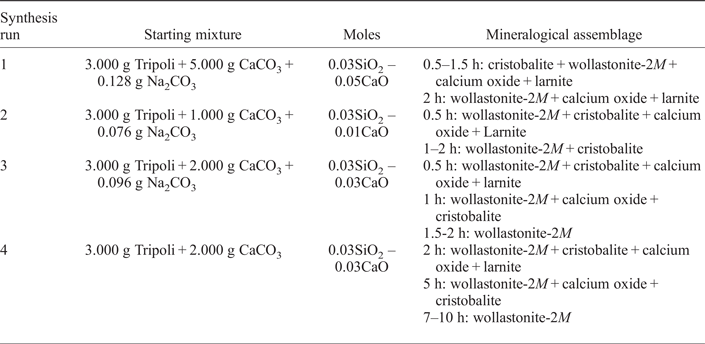
Three series of synthesis were performed, characterized by different stoichiometry, i.e. a fixed amount of Tripoli was mixed with variable amounts of CaCO3 (sample L3 from Ruggieri et al., Reference Ruggieri, Fernandez-Turiel, Gimeno, Valero, Garcia and Medina2008) and sodium carbonate (Na2CO3) was added as a triggering agent (Table 1). A fourth experiment was performed without sodium carbonate. The mixtures, finely ground and powdered, were heated inside alumina crucibles at 1000°C and at ambient pressure for two hours.
Starting mixture weights, molar compositions and relative obtained mineralogical assemblages for experimental runs.

Synthesis products were sampled periodically and a loss of weight of the open crucible was observed and attributed to CO2 diffusion through the granular material (Novembre et al., Reference Novembre, Gimeno, Pasculli and Di Sabatino2010a,Reference Novembre, Pasculli, Pace, Gimeno and Di Sabatinob; Pasculli and Novembre, Reference Pasculli and Novembre2012).
Results and discussion
Mineralogical and chemical characterization of synthetic products
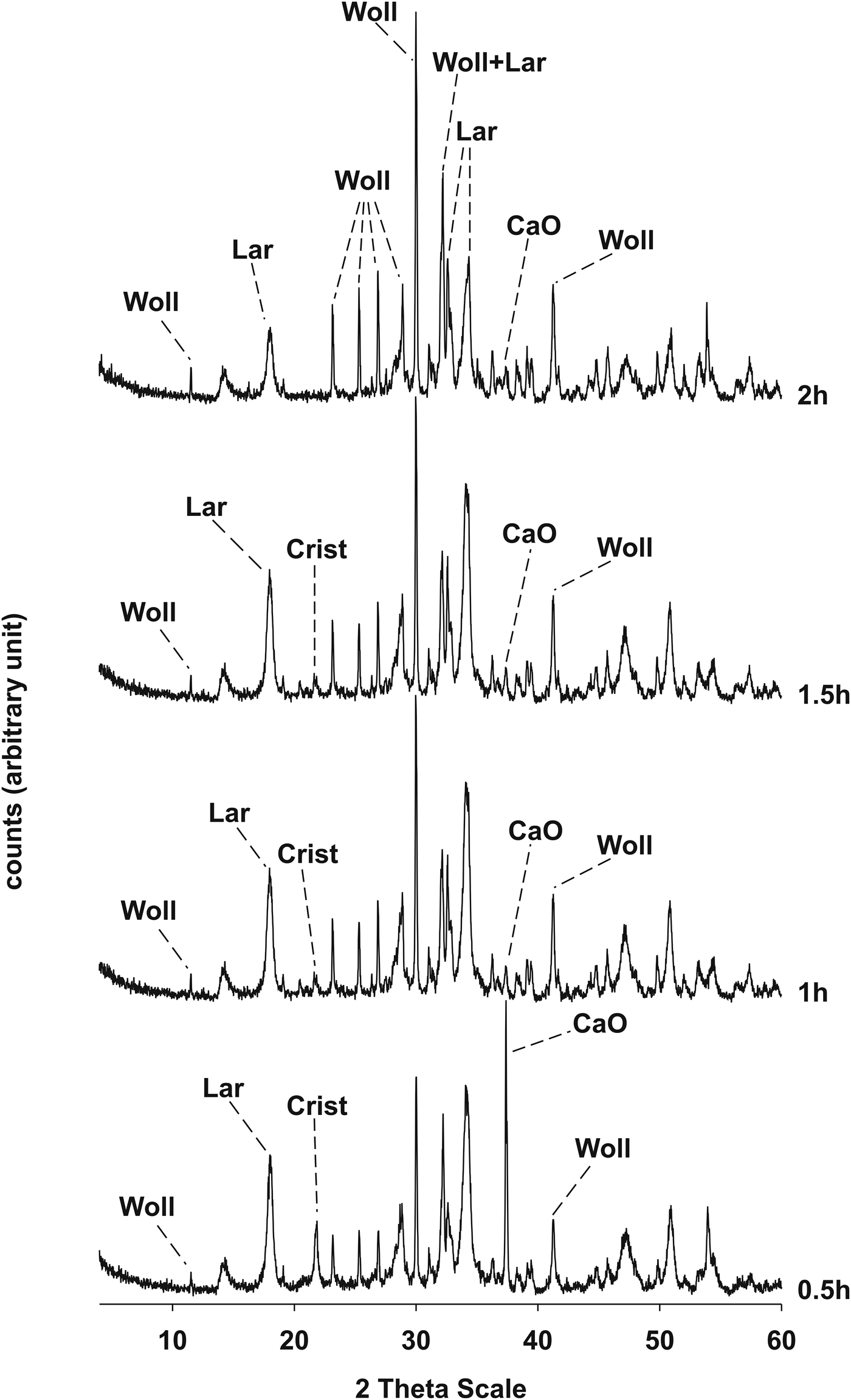
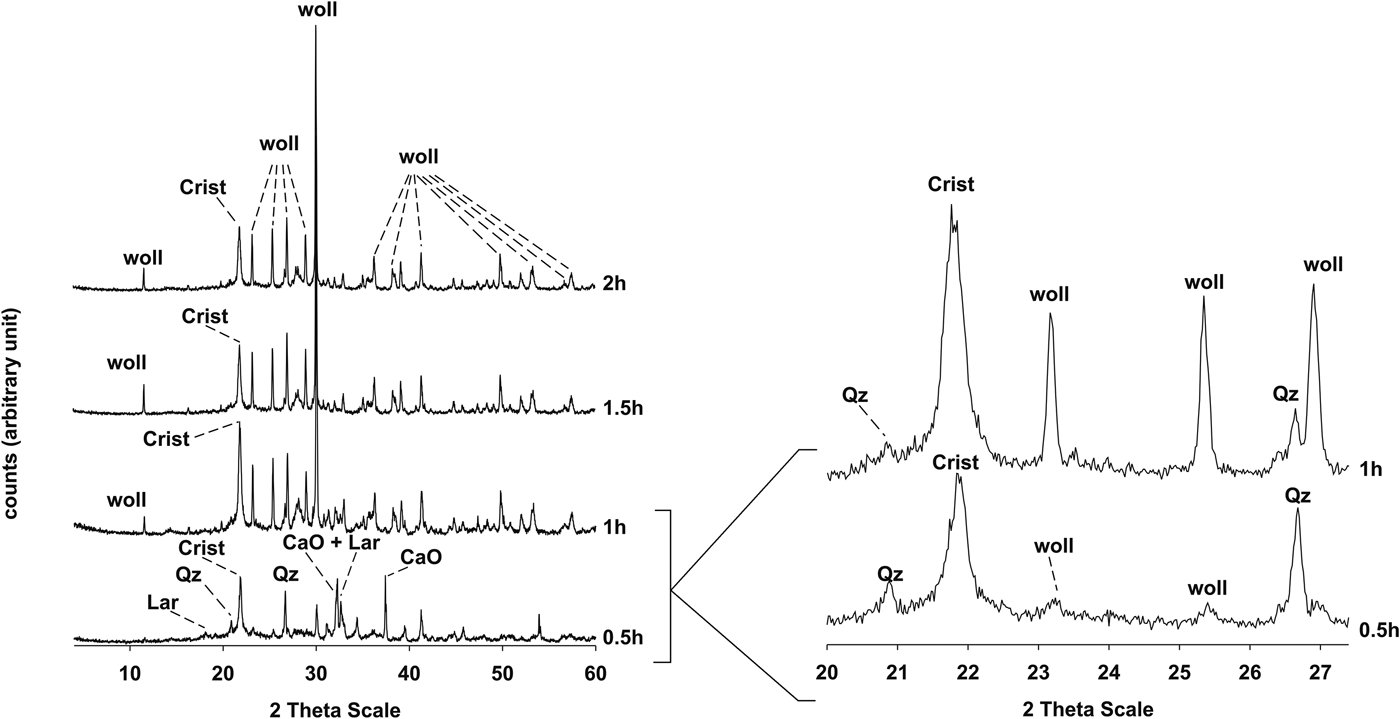
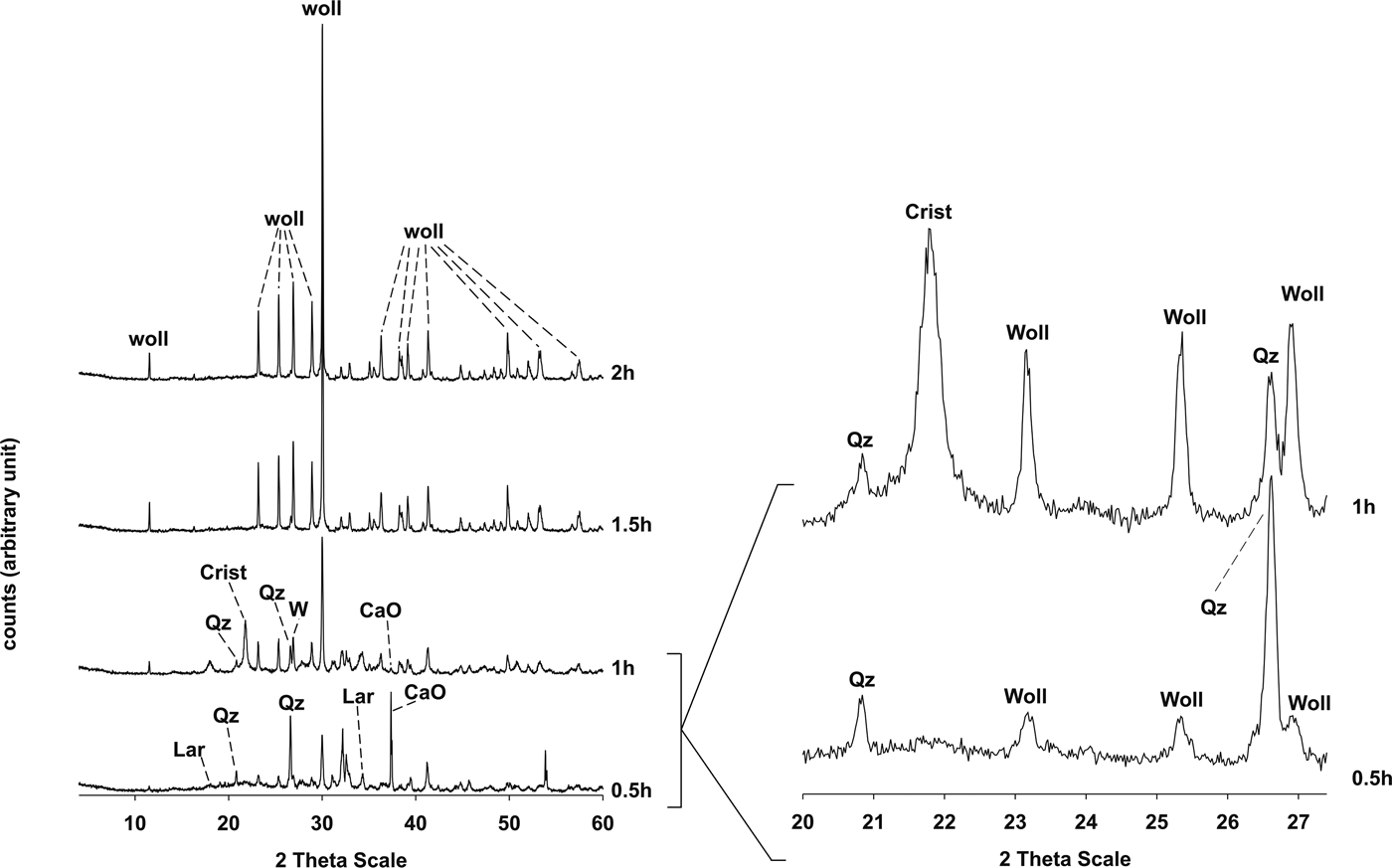
Results of PXRD analyses performed on the three synthesis runs are illustrated in Figs 1, 2 and 3 while the mineralogical assemblages for each synthesis run are reported in Table 1.
PXRD analysis of synthesis run 1. Woll: wollastonite-2M; Lar: Larnite; Crist: cristobalite.

PXRD analysis of synthesis run 2. Woll: wollastonite-2M; Lar: Larnite; Crist: cristobalite; Qz: quartz.

PXRD analysis of synthesis run 3. Woll: wollastonite-2M; Lar: Larnite; Crist: cristobalite; Qz: quartz.

In synthesis run 1 (Fig. 1) the crystallization of wollastonite-2M, formerly associated to that of ‘meta-cristobolite’, unreacted calcium oxide and larnite, is evident in the time interval 0.5–1.5 h; the situation does not change substantially with time, except for the disappearance of ‘meta-cristobolite’, visible in the spectrum at 2 h.
In synthesis run 2 (Fig. 2) the crystallization of wollastonite-2M is associated with ‘meta-cristobolite’, unreacted calcium oxide, larnite and quartz (contained in the starting Tripoli rock) in the time interval 0.5–1 h; longer synthesis periods led to the disappearance of larnite and CaO thus resulting in ‘parawollastonite’ plus ‘meta-cristobolite’ in the time interval 1.5–2 h.
In synthesis run 3 (Fig. 3) wollastonite-2M is associated with: calcium oxide, larnite and quartz at 0.5 h; the appearance of ‘meta-cristobolite’ at 1 h; and in the time interval 1.5–2 h the disappearance of quartz, ‘meta-cristobolite’ and calcium oxide is observed, thus resulting in only wollastonite-2M.
As specified in the above paragraph, ‘Tripoli rock’ contains minor amounts of clay minerals. Pimraksa and Chindaprasirt (Reference Pimraksa and Chindaprasirt2009) studied the diatomaceous earth of the Lampand Province in the north of Thailand and observed that is constituted not only by diatoms, but also by clay minerals such as kaolinite, montmorillonite and illite. They used this diatomaceous earth for the production of lightweight bricks and analysed their pozzolanic behaviour. The authors observed that calcination temperature of 700°C led to dehydroxylation of kaolinite (Le Chatelier, Reference Le Chatelier1887; Jeffries, Reference Jeffries1944; Frost and Vassallo, Reference Frost and Vassallo1996; Fernandez et al., Reference Fernandez, Martirena and Scrivener2011); it resulted in the collapse of the clay minerals structures as confirmed by the disappearance of clay minerals peaks in the XRD spectra, and relative change of the coordination state of Si and Al atoms as traced by NMR (Sanz et al., Reference Sanz, Madani, Serratosa, Moya and Aza1988; Chandrasekhar, Reference Chandrasekhar1996; Gimeno et al., Reference Gimeno, Davidovits, Marini, Rocher, Tocco, Cara, Diaz, Segura and Sistu2003; Drits et al., Reference Drits, Derkowski, Sakharov and Zviagina2016).
Also, in the present case, the calcination temperature of 1000°C causes the disruption of clay minerals structures and this is confirmed by the absence of the peaks characteristic of clay minerals in the XRD spectra of Figs 1, 2 and 3, so we can state that the presence of clay minerals does not constitute an obstacle in the synthesis of wollastonite.
As far as the presence of ‘meta-cristobolite’ in the analysed spectra is concerned, Vakalova et al. (Reference Vakalova, Pogrebenkov and Shlayeva2009) report active crystallization of this phase during heating of an amorphous-crystalline raw material (diatomite) at 1000°C; in particular, the authors explain that crystallization of ‘meta-cristobolite’ can be caused both by transformation of quartz and by crystallization of amorphous silica components. In fact, the ‘Tripoli’ raw mineralogical assemblage is characterized by the presence of minor quantities of crystalline quartz. When analysing the spectrum at 0.5 h (synthesis run 2) the presence of quartz is associated with that of ‘meta-cristobolite’; in the successive spectrum registered at 1 h, a reduction in the height of quartz peaks is evident and a contemporary increase in counts relative to cristobalite peaks is seen (magnified area in Fig. 2). The same considerations can be made for synthesis run 3 the with respect to the sample at 0.5 and 1 h, respectively (magnified area in Fig. 3). In particular, no evidence of ‘meta-cristobolite’ is revealed in the spectrum at 0.5 h of synthesis run 3, thus proving that the rate of transformation of quartz in ‘meta-cristobolite’ is higher in synthesis run 3 than in synthesis run 2.
In run synthesis 1 no evidence of quartz is revealed, this signifying that disruption of this mineral in favour of ‘meta-cristobolite’ proceeds at a higher rate than in the other synthesis runs.
From the analysis of the above spectra, it is clear that all the synthesis runs show the crystallization of wollastonite-2M.
In particular, synthesis runs 1 and 2 always provide the crystallization of wollastonite-2M in association with other phases. The presence of unreacted CaO is confirmed at the end of synthesis run 1, attesting to the non-optimal kinetic condition achieved here; additionally the presence of the dicalcic-silicate larnite is also proven at the end of the run, thus proving a starting mixture characterized by an excess in CaO with respect to the stoichiometry of the wollastonite formula.
However, at the end of synthesis run 2 unreacted CaO was not revealed to be present; it can also be stated that in this case larnite appears as a metastable phase during the transient, fast-disappearing sample at 1 h. On the contrary, ‘meta-cristobolite’ remains at the end of the run in association with wollastonite-2M, and this is due to the starting mixture having an excess of SiO2 with respect to the stoichiometry of the wollastonite formula.
Run synthesis 3 appears to be the most ideal, as wollastonite is the only phase present in the time interval 1.5–2 h.
Once established that the best conditions in the synthesis of wollastonite-2M are those of synthesis run 3, a fourth experiment (synthesis run 4) was performed without the use of Na2CO3, in order to test the real utility of the mineralizer (Table 1). The results of the XRD analyses are reported in Fig. 4.
PXRD analysis of synthesis run 4. Woll: wollastonite-2M; Lar: Larnite; Crist: cristobalite; Qz: quartz.

The results show a slowdown in the kinetics of synthesis: wollastonite-2M is in fact associated with calcium oxide, larnite and quartz at 2 h; appearance of ‘meta-cristobolite’ is observed at 5 h; and in the time interval 7–10 h quartz, ‘meta-cristobolite’ and calcium oxide disappear, thus resulting in pure wollastonite-2M. These results are quite coherent with the ones obtained, at lesser temperatures and much larger times in the classical work of Harker and Tuttle (Reference Harker and Tuttle1956).
The results of synthesis run 4 confirmed the efficacy of the use of Na2CO3 as a triggering agent. For these reasons, only synthesis run 3 was considered for more detailed characterizations.
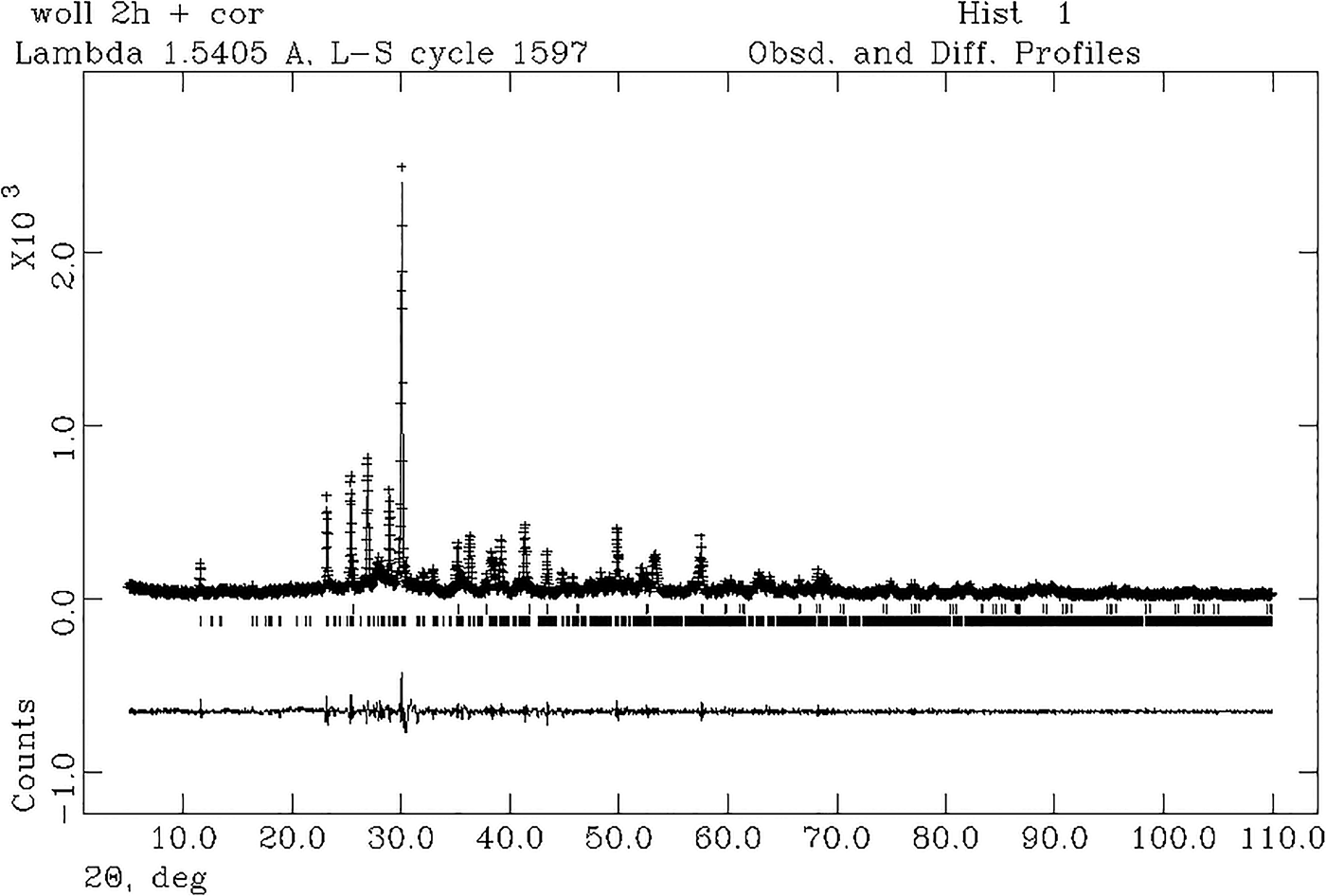
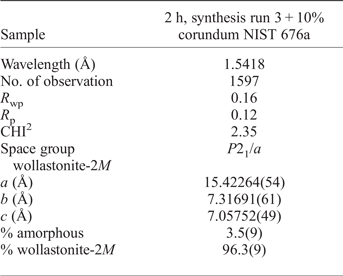
Rietveld structural refinement was conducted on synthesis run 3. In Fig. 5 the observed and calculated profiles and difference plot for wollastonite-2M and corundum NIST 676a with tick marks at the positions of the Bragg peaks are reported for the sample at 2 h of synthesis run 3. Results of the Rietveld refinement are shown in Table 2. The cell parameters, refined with a monoclinic symmetry, space group P21/a, are a 0 = 15.42264(54); b 0 = 7.31691(61) Å and c 0 = 7.05752(49) Å. The results of the QPA (Table 2) indicate that the calculated amorphous phase in the sample at 2 h of synthesis run 3 is 3.5(9)%, thus resulting in a final product of 96.3(9)% wollastonite-2M.
Rietveld refinement plots: Observed (+) and calculated profiles and difference plot for wollastonite-2M and corundum NIST 676a with tick marks at the positions of the Bragg peaks. From the bottom: wollastonite-2M, corundum NIST 676a.

Experimental conditions and crystallographic data for Rietveld refinement.

Chemical analysis of wollastonite-2M (sample at 2 h of synthesis run 3) is reported in Table 3. The values of the SiO2/CaO ratio are in agreement with bibliographic data (Tolliday, Reference Tolliday1959). The chemical formula of wollastonite-2M was calculated to (Si5.91Al0.11)(Ca5.93Mg0.07K0.04)O18.
Chemical analysis of the sample at 2 h, synthesis run 3.

(a) data after Tolliday (Reference Tolliday1959).
Morphological and physical characterization
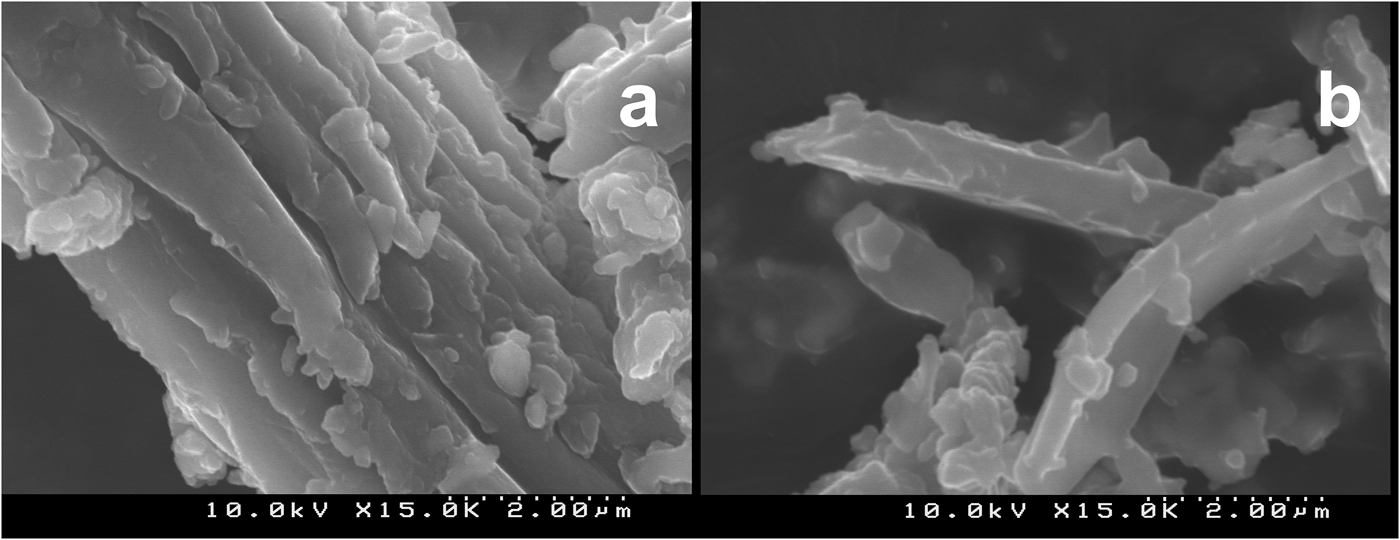
The textural characterization of synthesis run 3 is illustrated in Fig. 6a–b. Clear crystals of ‘parawollastonite’ are visible in the sample at 2 h. They have an acicular-needle shaped morphology; the average size of the crystals is of ~7 µm long and ~0.9 µm wide.
SEM images of wollastonite-2M crystals synthesized at 2 h (run synthesis 3).

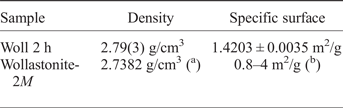
The specific surface of the mineral (Table 4) is 1.4203(35) m2/g, in good agreement with the range interval reported by Teir et al. (Reference Teir, Eloneva and Zevenhoven2005). A density of 2.79(3) g/cm3 was calculated for wollastonite-2M; this value is comparable to that proposed by Grigoryan et al. (Reference Grigoryan, Arutyunyan, Baginova and Grigoryan2008) for the same mineral.
Calculated specific surface and density for wollastonite-2M (sample at 2 h, synthesis run 3) compared to available data.

(a) after Grigoryan et al. (Reference Grigoryan, Arutyunyan, Baginova and Grigoryan2008)
(b) after Teir et al. (Reference Teir, Eloneva and Zevenhoven2005)
Infrared spectroscopy and 29Si magic angle spinning nuclear magnetic resonance
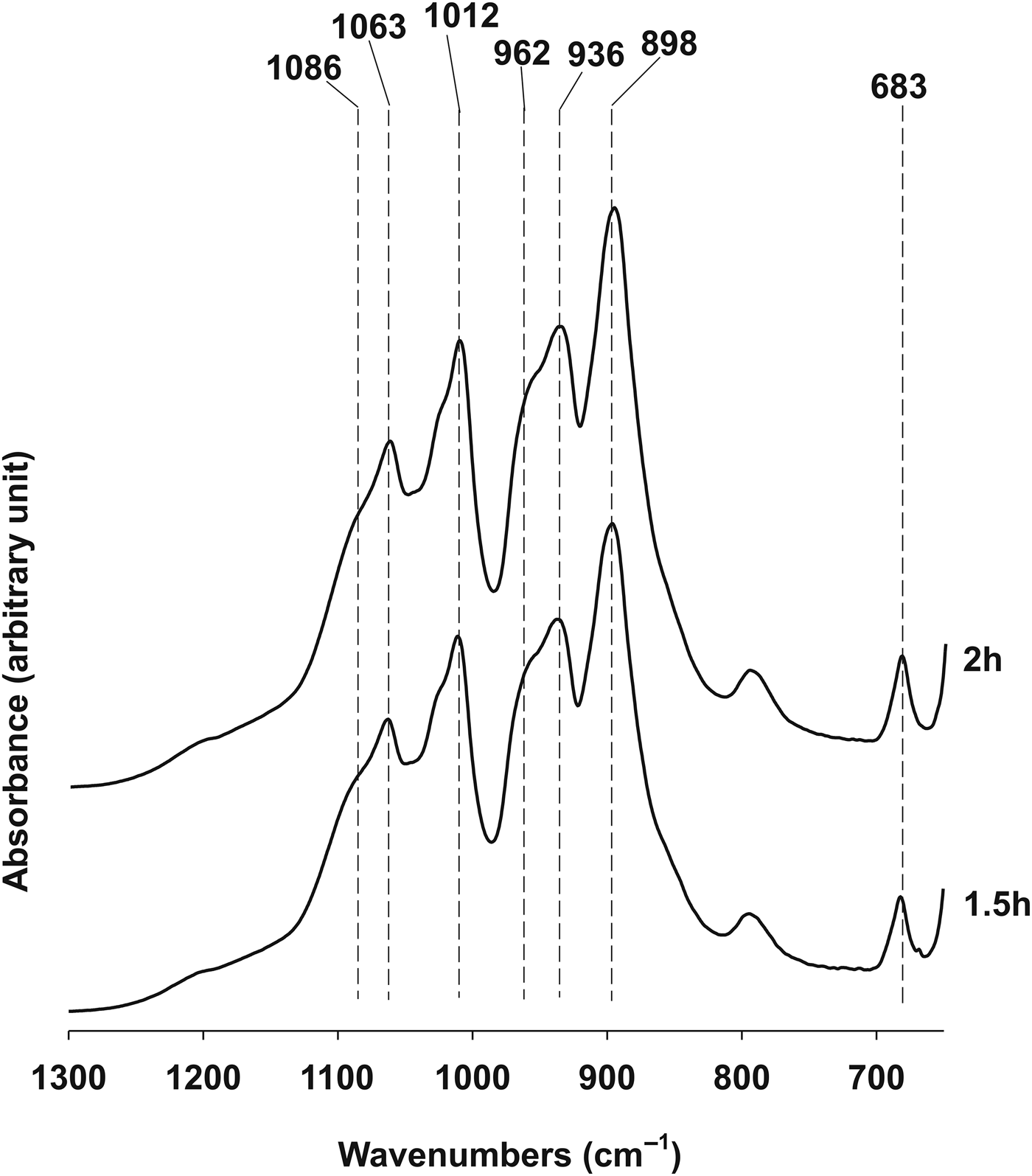
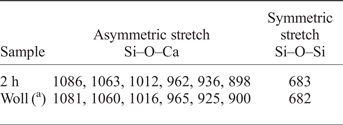
Infrared spectroscopy (IR) absorption spectra obtained from synthesis run 3 (samples at 1.5 and 2 h) are shown in Fig. 7. Values of absorption bands found here are compiled in Table 5 together with known data for ‘parawollastonite’ (Ptacek et al., Reference Ptacek, Noskova, Brandstcetr, Soukal and Opravil2010). In particular, six bands are present in the region of the asymmetric stretch and located, respectively, at 1086, 1063, 1012, 962, 936 and 898 cm–1. On the other hand, a sole band is related to the symmetric stretching band and positioned at 683 cm–1.
Infrared spectra of synthesis run (3).

Infrared adsorption bands for wollastonite-2M, run synthesis (3).

(a) after Ptacek et al. (Reference Ptacek, Noskova, Brandstcetr, Soukal and Opravil2010).
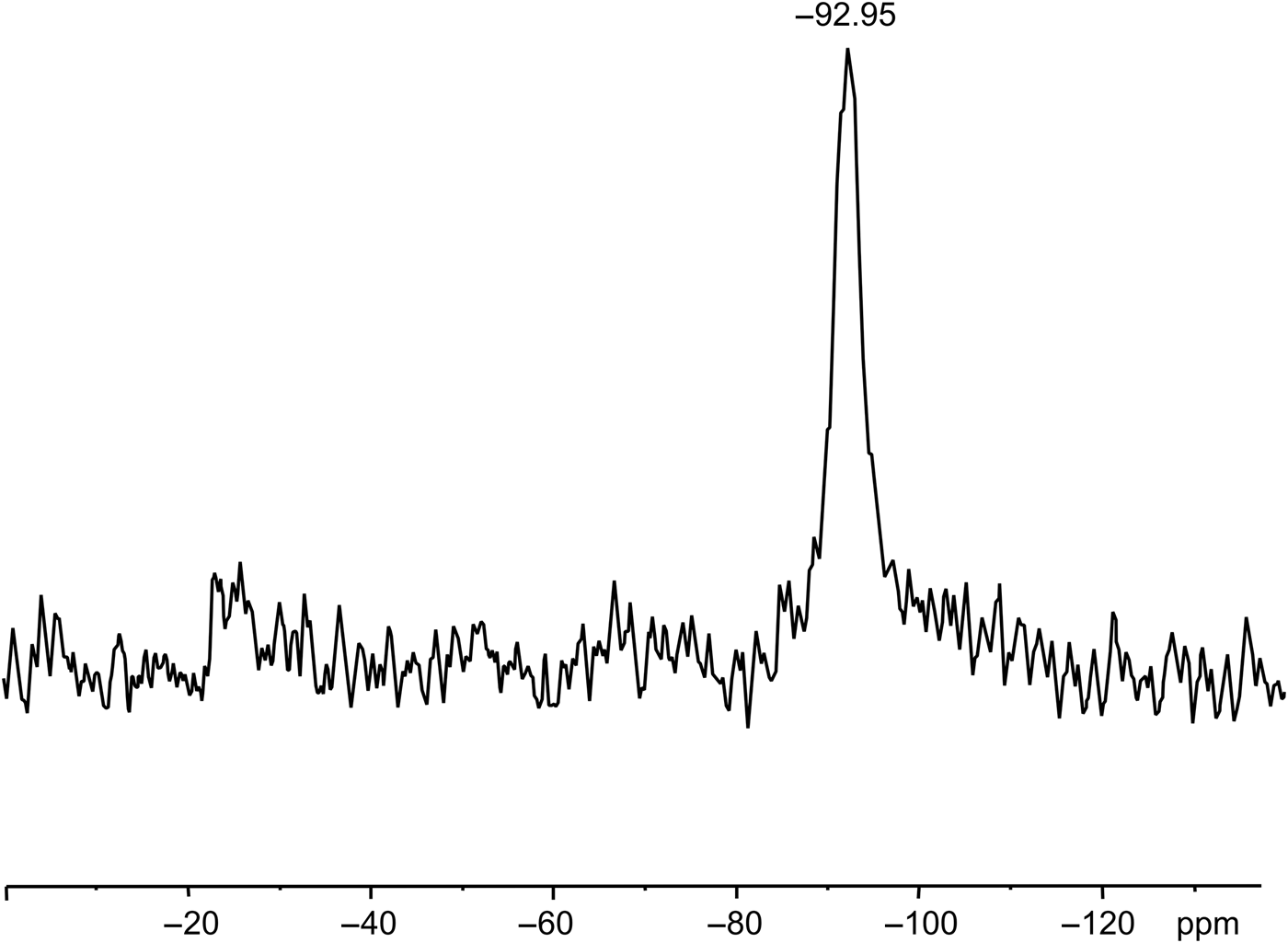
The 29Si MAS-NMR spectrum of wollastonite-2M (sample at 2 h, synthesis run 3) is illustrated in Fig. 8; it reveals a peak at –92.95 ppm attributed to the Si (4Al) site in the mineral structure, a position coherent with data by Gillespie (Reference Gillespie2007).
29Si MAS-NMR spectrum: sample at 2 h (synthesis run 3) of wollastonite-2M.

Geological consequences
The occurrence of wollastonite in plutonic, i.e. (granitic)-carbonatic host-rock contacts is a relatively common and limited (in most cases some cm thick) effect of metasomatism of silica. In these cases evidence of widespread assimilation of limestone by magma seems to be rare, and it is difficult to note these effects on the magmatic side of the contact. In contrast, in volcanic or shallow (basaltic) subvolcanic environments a number of cases (Reverdatto, Reference Reverdatto1970, Nichols, Reference Nichols1971, Sabine and Young, Reference Sabine and Young1975, Baker and Black, Reference Baker and Black1980, Michaud, Reference Michaud1995, Chadwick et al., Reference Chadwick, Troll, Ginibre, Morgan, Gertisser, Waight and Davidson2007) of pyrometamorphism of limestone (and flint) xenoliths have been described, along with limited, but very characteristic, assimilation of lime by magma (increase of total lime of 30–60%); available data suggest that the range of temperature might be 1000–1100°C or higher. Under these circumstances, wollastonite is a common phase in the paragenesis, both on the metamorphic rock and as phenocrysts and microliths in the volcanic rock (see Sabine and Young, Reference Sabine and Young1975, Baker and Black, Reference Baker and Black1980). Precipitation of wollastonite forming liquid has been also described in Ca-rich synthetic medieval glass (see Gimeno and Pugès, Reference Gimeno and Pugès2002) and industrial glass (Pirsson, Reference Pirsson1910). Also, late-stage hydrothermal metasomatic generation of wollastonite (i.e. hydrogrossular) is not uncommon, together with the occurrence of other minerals in the range of 850–650°C or less (Sabine and Young, Reference Sabine and Young1975, Baker and Black, Reference Baker and Black1980).
In most of these occurrences the calc-silicate paragenesis is complex, and therefore it is somewhat difficult to interpret directly in terms of temperature of formation (under low-pressure conditions). Also, some of the characteristic mineral phases of basaltic magma (typically clinopyroxene) continue to change their composition, with a sharp increase of lime in the final stoichiometry of the resulting phase. Thus the approach required to study the types of mineral reactions involved, the phases present (stable and metastable) in the paragenesis, the kinetics of the crystallization process, the telescoping of paragenesis under successive retrograding conditions, the trace-element balance of the assimilation process, and even the true significance and dimension of these assimilations remains obscure. A possible way to increase our knowledge is to continue the work developed here, with the design of specific experiments for the main single phases involved (i.e. diopside, grossular, etc.) in order to clarify the range of temperature and the minimum time required in order to achieve the synthesis of each phase.
A very interesting (and still poorly developed) method for investigating pyrometamorphism and carbonate assimilation processes is the study of radiogenic isotopic mineral chemistry, a fact that has been explored by studying the intracrystalline isotope variation in plagioclase phenocrysts in the case of the Merapi volcano, Java, Indonesia (Chadwick et al., Reference Chadwick, Troll, Ginibre, Morgan, Gertisser, Waight and Davidson2007), the whole rock (and groundwater) strontium exchange in a subvolcanic plug (Sabine et al., Reference Sabine, Beckinsale, Evans and Walsh1982), and, in a pyroclastic context, by the separate study of the mineral radiogenic isotope (Sr) chemistry (diopside, salite, feldspar, glass and whole rock) during the evolution of a single eruptive (Mercato) event of Vesuvius (Aulinas et al., Reference Aulinas, Civetta, Di Vito, Orsi, Gimeno and Fernandez-Turiel2008).
Conclusions
This work has achieved the synthesis of wollastonite-2M from a natural, cheap, and abundant geological resource by a simple chemical process. Among the three synthesis runs proposed, the best results are demonstrated for synthesis run 3; in fact in this case, the presence of ‘parawollastonite’ is shown as isolated after only 1.5 h of thermal treatment. When replicating this experiment in the absence of the mineralizer a remarkable dilation of synthesis rates is shown as the presence of sole wollastonite is reached with 5.5 h of delay. The use of diatomite as a reactant suggests that the synthesis might be enhanced, or at least can produce intermediate products not usually considered in previous investigations.
The efficacy of the experimental protocol proposed here is tested through chemical-physical, crystallographic, morphological and spectroscopic characterization of experimental products of synthesis run 3.
The results give values comparable to those reported in the literature for the mineral. Estimation of the amorphous phase in the synthesis powders gives a final product of 96.3% wollastonite-2M. These results seem to allow transfer to an industrial production scale.
This experimental work can also be applied to the geological problem of pyrometamorphism (sanidinite-facies conditions) of limestone xenoliths by basic magmas in shallow or earth-surface environments. The results suggest that synthesis can be easily achieved in extremely short periods of time (hours) and therefore can be produced during an ongoing eruption, both in thick, quickly deposited, proximal piles of agglomerate (made by bombs with a xenolithic limestone core), in xenolithic limestone-bearing lava flows or in a shallow intrusive environment at the top of a magmatic chamber where the host rocks are constituted by limestone (i.e. Vesuvius). In earth-surface or in a shallow open-system media CO2 can be evacuated and this greatly favours the formation of wollastonite, in contrast to closed-system regional or contact metamorphism.
In addition, this investigation offers new questions to be explored in the future: how comparable is the experimental work conducted with a magma-limestone interaction? How comparable are basic and silicic magmas with respect to wollastonite synthesis (influence of composition, lower temperature in the case of the silicic one, kinetics of the reaction)? It also seems to be necessary to introduce MnO (and FeO) into the reagents in order to reach the best reproduction of natural wollastonite.
On other hand, this study does not clarify the lesser viable temperature conditions for wollastonite synthesis, a fact of twofold interest: industrial and in terms of metamorphic petrology (i.e. does wollastonite develop as an exhalite sediment under high-temperature hydrothermal conditions?).
Last but not least, the use of amorphous silica (diatomite) in the synthesis confirms that ‘meta-cristobolite’ is synthesized and this shows that the well-established SiO2–CaO–CO2 system merits further experimental attention in the low-temperature field.
Acknowledgements
The analytical work was supported by the CGL2011-28022 of MICINN Spanish research contract (responsible D.G.). The chemical treatment of raw material, synthesis processes and XRD characterization of synthesized zeolites were performed at the Dipartimento di Ingegneria e Geologia dell'Università “D'Annunzio”, Chieti, Italy. All the other analyses were conducted at the Centres Científics i Tecnològics of the Universitat de Barcelona (CCiT-UB), Spain. The authors thank the technical staff at CCiT (UB) for their help during the work.