Introduction
Measles is a highly contagious viral illness that can result in encephalitis and death, thus reduction of vaccine coverage in a population can have serious public health consequences. Worldwide, measles remains a leading cause of death for young children despite ongoing immunization campaigns (Measles Fact Sheet, 2017). Even in countries such as the USA, where vaccination has been tremendously successful in reducing the incidence of measles, outbreaks still occur (Measles Cases & Outbreaks, 2017). The national measles vaccine program was implemented in 1963 to combat the ~500 000 annual cases of measles in the USA (Fiebelkorn et al. Reference Fiebelkorn, Redd, Gallagher, Rota, Rota and Bellini2010). The Advisory Committee on Immunization Practices currently recommends a two-dose schedule for the measles, mumps, and rubella (MMR) or MMR-Varicella vaccine with one dose given at 12–15 months of age and the second administered at 4–6 years old, before entering school (McLean et al. Reference McLean, Fiebelkorn, Temte and Wallace2013).
Given that natural measles exposure is rare in the USA, the absence of anti-measles antibodies in an individual can be a result of failure to receive immunization, failure to seroconvert after vaccination, or waning immunity subsequent to seroconversion. However, current MMR vaccination rates in the USA are 91.9% for children aged 19–35 months old and 94.2% for children entering kindergarten (Seither et al. Reference Seither, Calhoun, Mellerson, Knighton, Street and Dietz2016), and only about 5% of individuals vaccinated between the ages of 12 and 15 months fail to seroconvert (Redd et al. Reference Redd, King, Heath, Forghani, Bellini and Markowitz2004). Furthermore, in those who seroconvert, the MMR vaccine-induced immunity to measles, mumps, and rubella is believed to be long-lasting. Nevertheless, several studies have demonstrated that the levels of IgG antibodies decline over time, with one model estimating a decline of approximately 5% per annum in measles antibodies with a half-life of 12 years (Mossong et al. Reference Mossong, Nokes, Edmunds, Cox, Ratnam and Muller1999). Consistent with these data, a 20-year follow-up of 85 children who received MMR doses at 14–18 months old and 6 years old showed that 5% had lost detectable measles antibodies and 13% had equivocal levels of antibodies (Dine et al. Reference Dine, Hutchins, Thomas, Williams, Bellini and Redd2004). Another study, using the more sensitive plaque reduction neutralization assay, found detectable measles antibodies in all 56 participants 26–33 years post vaccination, but 8% had titers below the level considered to be protective against infection (Davidkin et al. Reference Davidkin, Jokinen, Broman, Leinikki and Peltola2008). The factors contributing to this loss of immunity following the MMR are not completely understood.
Depression has been associated with impairment of viral-specific cell-mediated immunity, and vaccine-stimulated immune responses. In a cross-sectional study of elderly community-dwelling adults enrolled in the shingles prevention study, subjects with current major depressive disorder (MDD) had a reduced T-cell response to varicella-zoster virus (VZV) compared with age and sex-matched controls (Irwin et al. Reference Irwin, Levin, Carrillo, Olmstead, Lucko and Lang2011). Moreover, in a 2-year prospective follow-up of the same cohort, Irwin and colleagues showed that the vaccine-stimulated cellular immune response to VZV was reduced in those with untreated depression, and this reduction persisted over 2 years. (Irwin et al. Reference Irwin, Levin, Laudenslager, Olmstead, Lucko and Lang2013). Other studies have found that depression is associated with a reduced vaccine-induced antibody response to hepatitis B virus (HBV) antibody response (Afsar et al. Reference Afsar, Elsurer, Eyileten, Yilmaz and Caglar2009), with similar effects for psychological stress (Kiecolt-Glaser et al. Reference Kiecolt-Glaser, Glaser, Gravenstein, Malarkey and Sheridan1996; Vedhara et al. Reference Vedhara, Cox, Wilcock, Perks, Hunt and Anderson1999; Miller et al. Reference Miller, Cohen, Pressman, Barkin, Rabin and Treanor2004; Segerstrom et al. Reference Segerstrom, Hardy, Evans and Greenberg2012).
Nonetheless, it remains unknown whether depression affects the maintenance of immunity into adulthood following childhood vaccination. Childhood vaccination is critical for the prevention of infectious disease into adulthood. However, major depression is a common disorder with a lifetime prevalence of ~15% in high-income countries and ~11% in low-income countries (Kessler et al. Reference Kessler, Petukhova, Sampson, Zaslavsky and Wittchen2012), which may significantly impair immunity and therefore affect public health. This study addressed this question and hypothesized that adults diagnosed with mood disorders would be less likely than non-depressed comparison controls to test seropositive for measles.
Methods
The study was approved by the Western IRB and was conducted according to the principles expressed in Declaration of Helsinki. The participants, who gave written informed consent to participate and received financial compensation, were between ages 18 and 55 years of age, and were recruited through a variety of sources including: the clinical services of the Laureate Psychiatric Clinic and Hospital (LPCH), newspaper, flyer, radio, Facebook or other media advertisements in the Tulsa metropolitan area.
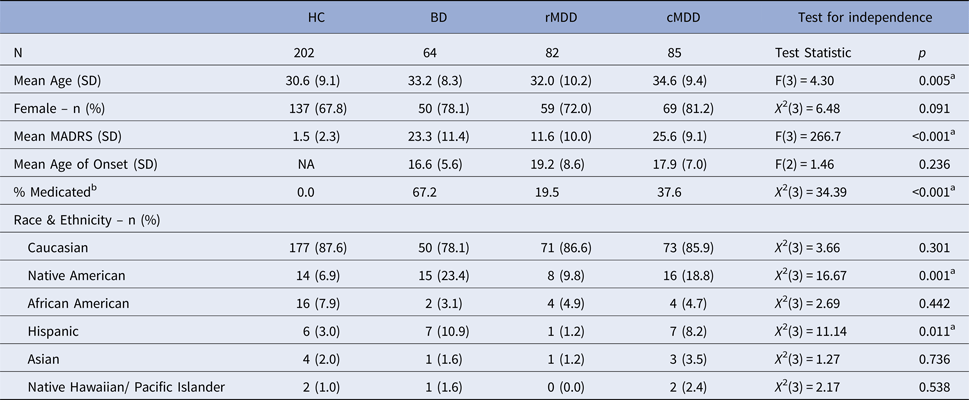
Both participants with a mood disorder and non-depressed comparison controls took part in a study involving neuroimaging and immunophenotyping. As part of the immunophenotyping, measles antibody titers were obtained on 433 participants born after the introduction of the measles vaccine in 1963. The mood disorder group consisted of 82 participants with MDD in full or partial remission (rMDD), 85 with current mild, moderate or severe MDD (cMDD), and 64 with bipolar disorder (BD) type I, type II or not otherwise specified (NOS). Diagnoses were established according to Diagnostic and Statistical Manual of Mental Disorders, Fourth Edition, Text Revision (DSM-IV-TR) using the Structured Clinical Interview for DSM-IV-TR (SCID) administered by a trained clinical interviewer and an unstructured interview with a psychiatrist. Online Supplementary Table S1 details the specific DSM-IV-TR diagnostic classifications within the mood disorder cohort. Measures of depression severity such as the Montgomery-Asberg Depression Rating Scale (MADRS), lifetime number of depressive episodes, and the age of onset were also obtained as part of the clinical assessment. Non-depressed comparison controls (HC, n = 202) had no personal history of psychiatric illness as measured by the SCID. Table 1 summarizes the sample demographics.
Cohort data

HC, healthy control; BD, bipolar disorder; rMDD, remitted major depressive disorder; cMDD, current major depressive disorder; MADRS, Montgomery-Asberg Depression Rating Scale.
a Significant at α = 0.05.
b Use of psychotropic drugs other than sleep aids within 3 weeks (8 for fluoxetine) prior to visit.
Online Supplementary Table S2 summarizes comorbid medical conditions. Exclusion criteria were as follows: serious suicidal ideation or behavior; current medical conditions or concomitant medications likely to influence CNS or immunological function including significant cardiovascular, respiratory, endocrine, and neurological diseases; a history of drug or alcohol abuse within 6 months or a history of drug or alcohol dependence within 1 year (DSM-IV-TR criteria).
Blood samples were collected by venipuncture into Becton-Dickinson Vacutainer tubes containing EDTA. Plasma was separated following standard laboratory protocols and stored at −80°C until testing. Seropositivity was determined for IgG antibodies against measles blind to diagnosis using a commercially available solid phase immunoassay (IBL America, www.ibl-america.com). A sample was considered seropositive if it had an optical density value of ⩾0.5, which is equivalent to approximately 10 international units of antibody.
We determined the relationship between diagnosis and IgG measles serostatus using multivariate logistic regression models, controlling for age, sex, and ethnicity. To maintain statistical power and since 85.7% of all participants reported Caucasian ethnicity, the ethnicity variable was reduced to Caucasian v. non-Caucasian. Results are reported as adjusted odds ratios (OR) and their respective 95% confidence interval (95% CI) along with the p value of the coefficient. Analyses were performed using R version 3.3.2 in RStudio version 1.0.136. Power analyses were performed using Gpower version 3.1.
Since both MDD groups differed from the HC group in serostatus, secondary analyses were performed within the combined MDD group (cMDD and rMDD, n = 167) to determine the relationship between measles serostatus and (a) current use of psychotropic medication, (b) years lived with depression/self-reported lifetime number of depressive episodes, and (c) total MADRS score. To control for false positives, a Bonferroni correction was performed such that the significance threshold was set at p < 0.017 (0.05/3) for these secondary analyses. The medicated subgroup reported the use of psychotropic medication other than sleep aids within the 3 weeks (8 weeks for fluoxetine) prior to visit. Lifetime number of depressive episodes was reported in the psychiatric interview. ‘Too many to count’ was coded as ‘99’ and this accounted for 15.3% of all cases. We, therefore, categorized each participant as either ‘low’ (less than or equal to three episodes) or ‘high’ (greater than three episodes) by the median split and used this binomial variable in the analyses.
Results
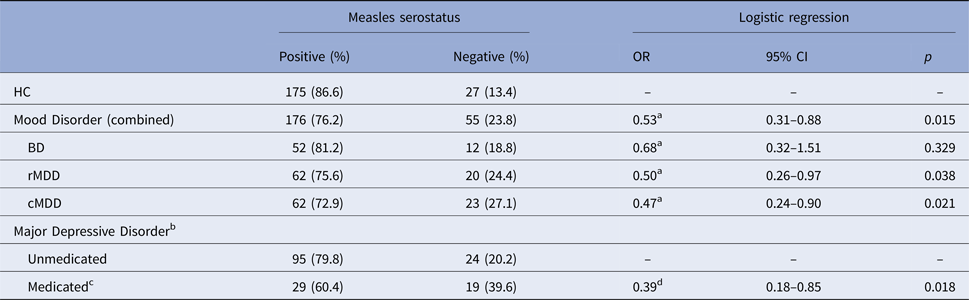
Participants with a mood disorder were less likely to be seropositive for measles (p = 0.015, adjusted OR = 0.53, 95% CI: 0.31–0.88; Table 2). There was no effect of sex (p = 0.376, adjusted OR = 1.30, 95% CI: 0.74–2.37), however, as expected, age was a predictor of serostatus (p = 0.014, adjusted OR = 0.97, 95% CI: 0.94–0.99). In addition, the non-Caucasian group was associated with increased odds of being seropositive (p = 0.015, adjusted OR = 3.29, 95% CI: 1.38–9.78). Within the mood disorder group, both the rMDD (p = 0.038, adjusted OR = 0.50, 95% CI: 0.26–0.97) and the cMDD (p = 0.021, adjusted OR = 0.47, 95% CI: 0.24–0.90) groups showed decreased odds of seropositivity compared with HC (Fig. 1). The likelihood of being seropositive for individuals with BD did not differ either from healthy comparison subjects (p = 0.329), or from the cMDD (p = 0.355) or rMDD (p = 0.449) participants. Post hoc power analysis showed that the model was 70.2% and 78.6% powered to detect differences in the rMDD and cMDD groups, respectively, but only 24.5% powered to detect differences in the BD group.
Bar chart showing the percentage of participants seropositive for measles in each diagnostic group. Both the rMDD and cMDD groups, individually, as well as the combined mood disorder group (rMDD, cMDD, and BD) had lower odds of being seropositive for measles than the HC group, controlling for age, sex, and ethnicity. * logistic regression coefficient p < 0.05. HC, healthy control, rMDD, major depressive disorder in remission; cMDD, current major depressive disorder; BD, bipolar disorder.

Logistic regression results predicting measles seropositivity controlling for age, sex, and ethnicity

HC, healthy control; BD, bipolar disorder; rMDD, remitted major depressive disorder; cMDD, current major depressive disorder
a Compared with HC.
b rMDD + cMDD, n = 167.
c Use of psychotropic drugs other than sleep aids within 3 weeks (8 for fluoxetine) prior to visit.
d Compared with MDD, Unmedicated.
Within the combined MDD group, there was no significant relationship between serostatus and number of previous depressive episodes (p = 0.221, adjusted OR = 1.68, 95% CI: 0.74–3.96), years lived with depression (p = 0.827, adjusted OR = 0.99, 95% CI: 0.92–1.06), or total MADRS score (p = 0.641, adjusted OR = 1.01, 95% CI:0.98–1.04). The currently medicated MDD participants (n = 48, Table S3) showed diminished seropositivity compared with the unmedicated MDD participants (p = 0.018 uncorrected, adjusted OR = 0.39, 95% CI: 0.18–0.85). Compared with the unmedicated MDD group, the medicated group had significantly higher mean years lived with depression (19.1 ± 10.7 v. 12.7 ± 8.2, Welch's t(42.2) = 2.91, p = 0.006). Likewise, current use of medication was associated with a high lifetime number of depressive episodes (63.2% v. 37.2%, X 2(1) = 7.17, p = 0.007). To test whether past use of medication predicted measles serostatus, the currently unmedicated MDD group was subdivided into those with previous use of medication (n = 61) and those naïve to medication (n = 47). The previously medicated group had significantly higher mean years lived with depression (14.55 ± 9.06 years) compared with the naïve group (9.97 ± 6.07 years, Welch's t(69.0) = −2.55, p = 0.013), so this was included as a covariate to control for lifelong depression severity. Past use of medication was not a significant predictor of measles seropositivity (OR = 0.72, 95%CI = 0.17–2.76, p = 0.638) within the currently unmedicated MDD group.
Non-exclusionary comorbid medical illnesses were reported at a higher rate in the mood disorder group than in the HC group. Study personal categorized these reports into constitutional, ear nose throat or mouth, cardiovascular, genitourinary, respiratory, gastrointestinal, musculoskeletal, integumentary, neurological, endocrine or hematologic/lymphatic groups (see online Supplementary Table S2). However, none of these categories were significant predictors of measles serostatus within the combined MDD group (all p’s > 0.1, Table S4).
Because immunization records were not available for the cohort, we attempted to determine if other variables that conceivably could be associated with a lower rate of vaccine uptake (e.g. suboptimal childhood healthcare) were associated with measles serostatus. We hypothesized that a family environment where one or both parents had a mood disorder or substance abuse problem could be related to vaccine uptake. To test this potential effect, we divided our comparison control group into those with a parental mood disorder or substance abuse problem (n = 69) and those without (n = 86). Although the OR was in the direction of decreased seropositivity, the logistic regression coefficient did not reach statistical significance (OR = 0.52, 95%CI: 0.20–1.30, p = 0.165).
Discussion
This study examined and found support for the hypothesis that compared with HC, individuals with adolescent or adult onset depression were less likely to test seropositive for measles because of impaired maintenance of vaccine-induced immunity. There were three main results: first, relative to HC, MDD participants had half the odds of testing seropositive for measles; second, this finding was observed for both currently depressed and remitted individuals with MDD; third, medicated MDD individuals had relatively lower rates of seropositivity than unmedicated MDD subjects. Taken together, these results support the general hypothesis that depression affects the maintenance of immunity into adulthood following childhood vaccination.
This is the first study to report the reduced efficacy of a vaccine administered early in childhood in participants with adolescent or adult-onset MDD. This is a finding of significant clinical importance as the high lifetime prevalence of MDD may weaken population levels of immunity to measles and conceivably other infectious diseases. Globally, measles is the 14th leading cause of disability-adjusted life years (DALYs) in children and adolescents (Kassebaum et al. Reference Kassebaum, Smith, Bernabé, Fleming, Reynolds and Vos2017) and is responsible for approximately 150 000 deaths per annum (Holzmann et al. Reference Holzmann, Hengel, Tenbusch and Doerr2016). In the USA, there were a total of 1558 confirmed cases of measles between 1 January 2010 and 17 June 2017, and a substantial portion (9–20%) of these cases occurred in individuals who had received at least one dose of vaccine (Centers for Disease Control & Prevention (CDC), 2012; Clemmons et al. Reference Clemmons, Gastanaduy, Fiebelkorn, Redd and Wallace2015).
The specific mechanism underlying the impaired maintenance of MMR vaccine-induced immunity to measles in MDD remains unclear. Nevertheless, there are several pathways through which the central nervous system modulates immunity. For instance, the sympathetic nervous system (SNS) regulates the activity of the immune system both directly, through innervation of the primary and secondary lymphoid organs, as well as humorally via catecholamine release (Besedovsky et al. Reference Besedovsky, del Rey, Sorkin, Da Prada and Keller1979; Sanders, Reference Sanders2006). Second, glucocorticoids released by the hypothalamic-pituitary-adrenal (HPA) axis play an important role in regulating the immune response to bacterial and viral infection; excess glucocorticoid release in the context of chronic stress increases susceptibility to viral infections (Cohen & Williamson, Reference Cohen and Williamson1991). Third, shorter sleep duration or sleep restriction, which is associated with reduced antibody titers after vaccination (Spiegel et al. Reference Spiegel, Sheridan and Van Cauter2002; Prather et al. Reference Prather, Hall, Fury, Ross, Muldoon and Cohen2012), may affect the relative frequency of circulating T cells, B cells, and natural killer cells (Suzuki et al. Reference Suzuki, Savitz, Kent Teague, Gandhapudi, Tan and Misaki2017). MDD is frequently characterized by SNS activation, hypercortisolemia, and altered distributions of circulating lymphocytes, potentially explaining why it has not only been linked to impaired vaccine response, but with other characteristics of impaired adaptive immunity such as reduced mitogen-stimulated lymphocyte proliferation, a greater susceptibility to viral infections, reactivation of latent herpesviruses, and slowed wound healing (Cohen & Williamson, Reference Cohen and Williamson1991; Blume et al. Reference Blume, Douglas and Evans2011). Thus, depression may have immunosuppressive effects in a subset of patients.
Loss of immunity to measles and other infectious agents generally occurs in the context of immunosuppression. Anti-measles antibodies and measles antibody-secreting cells are decreased in HIV infected patients (Titanji et al. Reference Titanji, De Milito, Cagigi, Thorstensson, Grützmeier and Atlas2006). In a study of 195 children with a variety of cancers, 27% lost humoral immunity to measles following intensive chemotherapy (Bochennek et al. Reference Bochennek, Allwinn, Langer, Becker, Keppler and Klingebiel2014). Similarly, a loss of IgG-measles antibodies in 65% of previously vaccinated adolescent liver transplant recipients 1 year after surgery was reported (Kano et al. Reference Kano, Mizuta, Sakakihara, Kato, Miki and Shibuya2002). Other studies report a similar loss of immunity in cardiac, renal, and heart-lung transplants for measles and other vaccine-related antibodies (Warmington et al. Reference Warmington, Lee and Robinson2005; Rocca et al. Reference Rocca, Santilli, Cotugno, Concato, Manno and Nocentini2016). Immunosuppressive therapy to prevent graft rejection includes corticosteroids and several classes of drugs that inhibit T cell activation.
As discussed above, other immunosuppressive conditions have previously been associated with a loss of humoral immunity to measles. Thus, one possible explanation for our results is that individuals who go on to develop MDD have a normal rate of seroconversion following vaccination but lose humoral immunity to measles due to the endocrine and immunological abnormalities that occur in the context of depressive episodes. Consistent with this hypothesis, Glaser et al. found that, compared to controls, stressed caregivers of spouses with dementia displayed normal antibody titers 2 weeks following injection with the pneumococcal pneumonia vaccine, but that humoral antibody concentration was significantly diminished 6 months post-vaccination (Glaser et al. Reference Glaser, Sheridan, Malarkey, MacCallum and Kiecolt-Glaser2000). Longitudinal studies of children will be required to determine if this finding extends to childhood vaccine responders who later develop depression. The fact that depression rating scale scores were not associated with serostatus and reduced seropositivity to measles was present in the rMDD as well as the cMDD group suggests that the detrimental effects of depression on immunity are not limited to the symptomatic phase of the disorder.
Depressive episodes could conceivably result in the permanent loss of antibody-secreting plasma and memory B cells. In support of this possibility, the currently medicated MDD subgroup, which had lower rates of seropositivity to measles than the unmedicated MDD subgroup, had experienced more episodes of depression and more years with depression than the unmedicated subgroup prior to our analyses. Nevertheless, recall of age of illness onset and number of depressive episodes by patients is known to be inaccurate and thus this result should be treated with caution.
There is some evidence that psychotropic medications, including selective serotonin reuptake inhibitors, may have immunosuppressive effects (Gobin et al. Reference Gobin, Van Steendam, Denys and Deforce2014). Thus, an alternative explanation for the decrease in seropositivity in the medicated subgroup v. the unmedicated depressed subgroup is that exposure to antidepressant medication rather than depression per se, reduces immunity to measles. The effects of medication exposure v. the effects of depressive episodes cannot be definitively disambiguated in our study. However, in order to partially address this issue, we compared currently unmedicated MDD participants who were psychotropic medication-naïve (n = 47) from currently unmedicated MDD participants with a past history of medication use (n = 61). Controlling for number of years lived with depression, there was no significant effect of past use of medication (p = 0.638) suggesting that immune suppression due to use of medication did not contribute to the loss of immunity to measles in the rMDD and cMDD groups.
Another explanation for the MDD-associated decrease in immunity to measles is that immune dysfunction is already present early in life in a subset of individuals who become depressed in adolescence or adulthood, and that this immune dysfunction results in a reduced frequency of seroconversion to measles after vaccination. The mechanisms underlying this putative immune dysfunction are unclear although genetic factors may be relevant. HLA class I and II genotypes and single nucleotide polymorphisms (SNPs) in cytokine genes, cytokine receptor genes, and the cell surface measles receptor (CD46) gene have been identified as genetic regulators of the vaccine response to measles (Kennedy et al. Reference Kennedy, Ovsyannikova, Haralambieva, O'Byrne, Jacobson and Pankratz2012; Haralambieva et al. Reference Haralambieva, Ovsyannikova, Pankratz, Kennedy, Jacobson and Poland2013). Polymorphisms in one of these genes, interleukin 6 (IL-6), also have been linked with MDD (Zhang et al. Reference Zhang, Wu, Zhao, Wang and Fang2016). Similarly, SNPs in the vicinity of the interferon-induced protein 44 like (IFI44L) gene have been associated with MMR vaccine-related febrile seizures and measles neutralizing antibody response (Feenstra et al. Reference Feenstra, Pasternak, Geller, Carstensen, Wang and Huang2014; Haralambieva et al. Reference Haralambieva, Ovsyannikova, Kennedy, Larrabee, Zimmermann and Grill2017). The IFI44L region also has been associated with risk for BD and schizophrenia in a combined GWAS study (Ruderfer et al. Reference Ruderfer, Fanous, Ripke, McQuillin, Amdur and Gejman2014).
The rate of seropositivity in the BD group was intermediate between that of the HC and MDD groups (Table 1) and did not differ significantly from either of these groups. However, these negative results in the BD group may be due to the reduced statistical power given the smaller sample size in the BD group v. the MDD groups. Thus, larger studies are needed to determine if BD also is associated with a reduction in measles seropositivity.
This study has several limitations. First, immunization records were not available from participants and therefore it is theoretically possible that the MDD participants were less likely to be vaccinated than the HCs. However, this possibility is mitigated by the fact that schools require records of MMR vaccination prior to admission and thus vaccination rates are relatively high (currently 92–94% (Seither et al. Reference Seither, Calhoun, Mellerson, Knighton, Street and Dietz2016)), especially in the generation of individuals who grew-up prior to the erroneous concerns about the link between autism and vaccination. Moreover, to further address the possibility that individuals who later developed depression were less likely to have been vaccinated, we compared measles serostatus in the healthy controls with no family history of depression to those of the healthy controls with at least one parent with a mood disorder or substance abuse problem. Our rationale for this analysis was that if psychiatric illness in the parents of a child had any significant bearing on the likelihood that the child would receive vaccinations, then those healthy individuals with a family history of a mood disorder would be less likely to test seropositive for measles than healthy controls with no family history of depression. Parental history of mood disorder or substance abuse did not significantly decrease the odds of testing seropositive for measles (p = 0.165).
The second limitation of the study is that because post-vaccine antibody titers were not available, we were unable to differentiate between the early-life immune dysfunction and adulthood immune suppression explanations for our results. Third, although serious co-morbid medical disorders such as cardiovascular disease, current cancer, multiple sclerosis, and HIV were exclusionary, the mood disorder group did have a higher rate of medical illness than the HCs. Thus, it is theoretically possible that the difference in serostatus between the groups may be related to these co-morbid illnesses rather than depression per se. Nevertheless, as shown in Table S4, none of the categories of medical illnesses were significantly associated with measles serostatus in the MDD group. Fourth, it remains unclear to what extent vaccine-induced antibodies against the measles virus correlate with protection against either clinical or subclinical infection. However, at least in children, individuals with high antibody levels appear protected against measles, while individuals with low or intermediate titers are more susceptible to clinical or mild infection (Chen et al. Reference Chen, Markowitz, Albrecht, Stewart, Mofenson and Preblud1990)
By measuring antibodies to viruses such as rubella and polio, future studies could evaluate whether the MDD-associated reduction in seropositivity to measles reported here is specific to measles or whether it extends to other pathogens. Second, in the absence of prospective data, re-vaccination of fully remitted individuals who are seronegative for measles (or other relevant viruses) may help to parse out the effects of genetic factors v. acute depressive episodes on vaccine response.
In sum, we found that MDD is associated with significantly lower rates of seropositivity for measles compared with healthy controls. These lower levels of antibodies may be a significant risk factor for susceptibility to measles infection despite previous measles immunization. Our findings may have important implications for public health as the high lifetime prevalence of MDD may weaken population levels of immunity to measles (and potentially other infectious diseases) with a subsequent increase in the risk of transmission of measles (and potentially other viruses) within the population. It is conceivable that health care providers could mitigate this problem by prioritizing depressed populations for antibody screening and re-vaccination efforts.
Supplementary material
The supplementary material for this article can be found at https://doi.org/10.1017/S0033291718000661
Acknowledgements
The authors thank all the research participants and wish to acknowledge the contributions of Brenda Davis, Debbie Neal, Chibing Tan, and Ashlee Rempel from the laboratory of TKT at the University of Oklahoma Integrative Immunology Center towards the transport, processing, and handling of all blood samples. We also thank Dr. Henry Yeh at the Laureate Institute for Brain Research for his advice on the statistical analyses.
This work was supported by the Laureate Institute for Brain Research. JS also received support from the Brain and Behavior Research Foundation and the National Institutes of Health (P20GM121312).
Financial disclosures
Dr. Paulus has received royalties for an article about methamphetamine use disorder from UpToDate. The other authors have no disclosures.
Ethics statement
The authors assert that all procedures contributing to this work comply with the ethical standards of the relevant national and institutional committees on human experimentation and with the Helsinki Declaration of 1975, as revised in 2008.