I. INTRODUCTION
Current difficulties in the Doha Round of multilateral negotiations at the World Trade Organization (‘WTO’) are reflected in the proliferation of bilateral and plurilateral trade agreements according preferential treatment to individual trade partners (generally referred to as preferential, regional or free trade agreements (‘RTAs’)),Footnote 1 as well as the continued use of so-called ‘trade remedies’ (anti-dumping, countervailing, and safeguard measures ostensibly intended to counter ‘unfair’ trade or unexpected increases in imports) as a tool to protect local industry. Both of these developments threaten to undermine the underlying objectives of the WTO, which include enhancing global welfare through trade liberalization while taking into account the particular needs and goals of each WTO Member. This article reflects on the widespread use of RTAs and trade remedies in order to provide lessons for the benefit of all WTO Members. In particular, it explores RTAs as positive models to reduce or eliminate the use of trade remedies among WTO Members, providing a concrete case study of the potential for ‘multilateralizing regionalism’.Footnote 2
Reducing reliance on trade remedies would diminish market distortions and enable fairer competition among producers across the world, bringing the WTO closer to its theoretical foundations (encouraging Members to specialize in areas in which they have a comparative advantage) and hence closer to its broader welfare objectives. This goal is all the more critical in the current global financial climate, when WTO Members worldwide appear particularly tempted to use trade remedies to protect their industries.Footnote 3 The continued and widespread use of trade remedies by WTO Members has led some to conclude that ‘[t]rade remedies appear to be permanent fixtures in international trade agreements’.Footnote 4 It is true that a wide range of developed and developing countries (well beyond the group of traditional users) are now heavily reliant on trade remedies, rendering impossible wholesale reform in the near future. However, this should not prevent thoughtful, steady progress towards the longer-term goal of reducing the use of trade remedies among WTO Members, in order to begin to bridge the gap between economic rationality and political reality regarding trade remedies in the WTO. It may well be too soon to propose the wholesale elimination of anti-dumping measures or any other form of trade remedy in the WTO, but I do not believe it is too late.
Part II of this article describes in more detail the tension that exists between WTO obligations and objectives on the one hand and RTAs and trade remedies on the other, focusing on the theoretical and practical problems created by trade remedies for the multilateral trading system. In doing so, it introduces the exceptions for trade remedies contained in the WTO's General Agreement on Tariffs and Trade 1994 (‘GATT 1994’),Footnote 5 Agreement on Implementation of Article VI of the General Agreement on Tariffs and Trade 1994 (‘Anti-Dumping Agreement’),Footnote 6 Agreement on Subsidies and Countervailing Measures (‘SCM Agreement’),Footnote 7 and Agreement on Safeguards (‘Safeguards Agreement’).Footnote 8 It also outlines possible reforms to improve the current system in the longer term. Part III reviews more than 150 RTAs to determine the extent to which their provisions restrict or eliminate trade remedies among RTA partners, the corresponding implications for international trade, and the conditions that facilitated this result. Part IV considers whether article 41(1) of the Vienna Convention on the Law of Treaties (‘VCLT’),Footnote 9 article XXIV of the GATT 1994, or other WTO provisions allow or require the elimination of trade remedies in RTAs, or whether, conversely, they pose an obstacle to this approach and therefore preclude the use of RTAs as a step towards reducing the use of trade remedies among WTO Members more generally.
The article concludes that a small number of RTAs do provide realistic models for ultimately reducing or eliminating trade remedies across the WTO Membership. That is not to suggest that these RTAs will lead to multilateral reduction in trade remedies or that they are designed to do so. The motivations of RTA partners in reducing trade remedies are not necessarily purely to increase economic efficiency. These partners may also have broader liberalization agenda and political goals of increasing integration and deepening specific relationships. The fact that only a very small proportion of RTAs eliminate trade remedies also confirms the importance of trade remedies in enabling the reduction of other trade barriers in a bilateral or multilateral setting. Nevertheless, the existence of these few RTAs confirms that reducing trade remedies is politically and economically feasible in certain circumstances. Wholesale elimination of trade remedies and the concerns that motivate them will never occur in the WTO. But eventually, WTO Members could instead respond to predatory dumping with competition laws, to illegal subsidies with WTO dispute settlement, and to import surges with safeguards pursuant to a reformed safeguard regime. In the shorter term, WTO provisions do not prevent RTA partners from eliminating trade remedies amongst themselves.
II. THE PROBLEM, AND LONG-TERM SOLUTIONS
A. RTAs and Trade Remedies as Exceptions to Core WTO Disciplines
1. WTO Objectives
The WTO seeks to achieve objectives such as ‘raising standards of living’ and ‘ensuring full employment’ by ‘entering into reciprocal and mutually advantageous arrangements directed to the substantial reduction of tariffs and other barriers to trade and to the elimination of discriminatory treatment in international trade relations’.Footnote 10 Subject to compliance with stringent conditions, WTO rules permit both RTAs and trade remedies, even though they would otherwise violate core obligations or ‘disciplines’ imposed on WTO Members in order to liberalize trade and thereby improve national and global welfare. Thus, trade remedies are ‘trade protection that you can get away with under the anti-dumping agreement’,Footnote 11 the SCM Agreement, and the Safeguards Agreement, and RTAs reflect ‘discriminatory trade policy that you can get away with under article XXIV’Footnote 12 of the GATT 1994.
2. RTAs as an Exception to MFN Treatment
RTAs represent a major exception to the key pillar of non-discrimination in the WTO: the obligation to provide most-favoured nation (‘MFN’) treatment to each WTO Member. The MFN rule in the context of trade in goods means that a Member must provide any benefit it accords to the products of one country (whether or not that country is a WTO Member) to the products of all WTO Members (GATT article I:1). Members' overzealous entry into multiple RTAs in recent years has seriously damaged the MFN rule and the principle of non-discrimination.Footnote 13 One factor that has allowed this explosion of RTAs has been uncertainty surrounding the WTO exception for RTAs,Footnote 14 which arises from ambiguous draftingFootnote 15 and a dearth of relevant and helpful WTO jurisprudence and scholarly investigation. MFN treatment has become the exception rather than the rule, with almost all Members providing preferential treatment to specific Members pursuant to a range of RTAs. This distorts international trade, prevents producers from competing on a level playing field, and negates the benefits of the MFN rule (particularly for smaller and weaker Members). However, RTAs may have some trade-liberalizing effects and thus provide building blocks on the path to multilateral trade liberalization.Footnote 16 For this reason, article XXIV:5 provides an exception for RTAs, as discussed further below.Footnote 17
This article seeks to elucidate WTO law on RTAs and to harness the prevalence of RTAs to turn them from a negative to a positive force with respect to trade remedies. In particular, the existence of RTA partners trading amongst themselves without resorting to trade remedies may provide a valuable basis for learning how to reduce trade remedies in the WTO.
3. Trade Remedies as Established Exceptions to Various WTO Rules
Trade remedies represent a significant incursion into core WTO disciplines created to liberalize trade. These measures are permitted (but not required) by WTO rules. However, in the absence of the existing exceptions in GATT 1994Footnote 18 (as agreed by the WTO Members):
• anti-dumping and countervailing measures (which generally take the form of higher tariffs/customs duties on imports of specific products from particular countries) would violate the MFN rule,Footnote 19 because the imports on which they are imposed receive less favourable treatment than imports from other countries;
• safeguards (which typically take the form of higher tariffs or quantitative restrictions such as import quotas on imports of given products) could violate the general WTO prohibition on quantitative restrictions;Footnote 20 and
• all three trade remedies could violate individual Members' schedules of tariff bindings (ceilings above which the relevant Member has agreed not to impose tariffs on specific products).
In concluding the GATT 1947, negotiators incorporated these exceptions for trade remedies in part because some countries (the United States (‘US’) in particular) would not otherwise have agreed to other aspects of liberalization mandated by that agreement.Footnote 21 The GATT contracting parties maintained and clarified these exceptions in the GATT 1994 and the related trade remedy agreements upon the creation of the WTO. In this sense, trade remedies are not ‘self-balancing’: ‘[t]rade-offs between remedies reform and concessions in other areas seem to be necessary’.Footnote 22 In examining trade remedies in the WTO and RTAs, one must therefore be aware of the significance of trade remedies in facilitating liberalization more generally.
B. The Trouble with Trade Remedies, and Ideas for Reform
Most economists agree that trade remedies (or at least anti-dumping and countervailing measures) are almost invariably inefficient. They disadvantage not only producers and exporters of the products on which they are imposed but also importers, consumers, and industrial users of those products in the countries imposing them.Footnote 23 These harmful effects have led to calls to remove or replace trade remedies, for example by replacing anti-dumping measures with competition disciplines.Footnote 24 In the following paragraphs, I provide a more detailed description of the nature of trade remedies, as defined for the purpose of this article, and their place in the WTO agreements in order to demonstrate their economic and political significance. At the outset, it is worth noting that this article concerns anti-dumping, countervailing and safeguard measures in the context of trade in goods rather than services.Footnote 25
1. Anti-Dumping and Countervailing Measures
Pursuant to GATT article VI and the Anti-Dumping Agreement, a WTO Member may impose anti-dumping measures on imports of a given product from another Member where its investigating authorities have found that the imported product is being ‘dumped’ and thereby causing injury to the domestic industry that produces the like product. Products are essentially dumped when they are sold at a lower price in the importing country than in the exporting country (after making adjustments for transport costs etc).Footnote 26
From the perspective of the importing country at least, anti-dumping measures are economically irrational because they are usually passed on to the consumer by increasing the price of the good. The higher prices paid by the consumer (or industrial user) in the importing country outweigh the benefits gained by the protection afforded to the competing domestic industry. Moreover, several legitimate commercial reasons exist for dumping, so dumping is not necessarily an ‘unfair’ practice for which foreign producers or exporters should be penalized. Anti-dumping measures may therefore hinder legitimate foreign competition, to the detriment of the consumer and the development of the domestic industry, even if the importer or exporter absorbs them rather than adding them to the price of the product. Although anti-dumping measures may be an economically rational response to ‘predatory dumping’ (designed to wipe out the competition before raising the price above a competitive level), this kind of dumping is extremely unlikely to occur in practice. In any case, the Anti-Dumping Agreement does not target predatory dumping by requiring domestic investigating authorities to examine intent before imposing anti-dumping measures.Footnote 27
In contrast, as discussed fully elsewhere,Footnote 28 competition disciplines in place of anti-dumping measures could better focus the response to dumping on commercially illegitimate behaviour. However, the question of interaction between competition policy and international trade is currently outside the negotiating mandate of WTO Members, and harmonized competition laws across the WTO Membership are a long way off.Footnote 29 Moreover, a wide range of developed and developing countries are now heavily reliant on anti-dumping measures: this group has expanded significantly beyond the traditional users. Accordingly, this model for reform does not provide a feasible solution for the medium to short term.
Pursuant to GATT article VI and the SCM Agreement, a WTO Member may impose countervailing measures on imports of a given product where its investigating authorities have determined that it is being subsidized by another Member and thereby causing injury to the domestic industry that produces the like product.Footnote 30 Countervailing measures will only ever be useful where the imposing Member is concerned about the impact of subsidies in its own market (as opposed to the impact in the market of the subsidising Member or in a third country), since countervailing measures are typically imposed in the form of import tariffs in the domestic market.
Like anti-dumping measures, countervailing measures are almost always welfare-reducing in the importing country even though they may protect the competing domestic industry,Footnote 31 because they tend to be passed on so that the consumer pays a higher price for the import. Contrary to their supposed purpose, countervailing measures are also unlikely in practice to induce a State to change its practice or policy of subsidising a particular product.Footnote 32 Finally—again mirroring the Anti-Dumping Agreement—in allowing countervailing measures, Part V of the SCM Agreement does not target predatory conduct that might flow from subsidies.Footnote 33 The agreement has in fact been described as ‘one of the least economics-informed agreements in the WTO’.Footnote 34
One difference between countervailing and anti-dumping measures (or, indeed, safeguards) is that they represent only one of two means of responding to a subsidy, because they target the conduct of a WTO Member rather than commercial actors. Although the WTO Members ‘condem[n]’ dumping that causes or threatens material injury to the domestic industry,Footnote 35 dumping itself is not illegal under WTO rules or challengeable in the WTO dispute settlement system, at least in part because this system is restricted to resolving disputes between WTO Members, and WTO Members themselves do not engage in dumping. In contrast, subsidies involve a ‘financial contribution by a government or any public body’.Footnote 36 The WTO Members have agreed that certain subsidies are harmful and can therefore themselves constitute a violation of Part II (Prohibited Subsidies) or Part III (Actionable Subsidies) of the SCM Agreement. These violations can be challenged in the WTO dispute settlement system.Footnote 37
Pursuing a subsidy through the multilateral route of WTO dispute settlement is generally preferable to imposing countervailing measures from an economic perspective.Footnote 38 Although some (illegal) subsidiesFootnote 39 could be countered with either a countervailing measure or a recommendation of the Dispute Settlement Body,Footnote 40 the former is a unilateral remedy imposed following a domestic proceeding of a WTO Member. This domestic countervailing duty investigation must be conducted in accordance with multilateral rules in the WTO (as reflected in the relevant Member's own laws and regulations), but the domestic producers still get the benefit of the countervailing measures even if the investigation is not conducted in accordance with WTO rules, at least until another Member brings a successful WTO dispute challenging the conduct of the investigation. Accordingly, in the longer term, countervailing duties may be successfully eliminated in the WTO while retaining the possibility of challenging illegal subsidies in the WTO dispute settlement system (recognizing that that system itself is imperfect and that negotiations continue on its reform).
2. Safeguards
Pursuant to GATT article XIX and the Safeguards Agreement, a WTO Member may impose a safeguard where its competent authorities have found in an investigation increased imports of a given product that have arisen from unforeseen developments and are injuring domestic producers of like or directly competitive products.Footnote 41 Other forms of safeguards exist in the WTO but are not the subject of this article.Footnote 42 The so-called ‘global’ safeguards available under GATT article XIX should also be distinguished from the ‘bilateral’ safeguards provided for in many RTAs, as discussed below.Footnote 43
Unlike anti-dumping and countervailing measures, global safeguards do not target allegedly unfair trading practices. Rather, they are intended to provide a ‘safety valve’ or ‘escape clause’Footnote 44 for WTO Members whose domestic industries are facing a sudden flood of imports, and they provide a means for Members to deal with the ‘adjustment costs’ of trade liberalization in an orderly manner. In theory, they may therefore play a particularly significant role in enabling WTO Members to agree to open their markets.Footnote 45 Also in contrast to anti-dumping and countervailing measures, safeguards are a temporary response to an emergency and they must generally be imposed on an MFN basis (ie on imports of the relevant product from all countries).Footnote 46 The Member imposing them must also generally provide compensation to other affected Members who have engaged in consultations on the matter, in order to ensure that its overall level of WTO commitments is unchanged.Footnote 47
These additional conditions on the use of safeguards typically make them preferable, from an economic perspective, to anti-dumping and countervailing measures.Footnote 48 However, perhaps in part because of these additional conditions (and the strict way in which the WTO Appellate Body has interpreted the Safeguards Agreement), Members in fact use safeguards far less frequently than anti-dumping or countervailing measures.Footnote 49 Safeguards also still raise economic concerns in that, for example, they may encourage lobbying of governments by domestic industries in the hope of long-term protection rather than the temporary protection intended,Footnote 50 and they tend to ‘delay the contraction’ of declining or uncompetitive industries.Footnote 51 In addition, safeguards are central to the ambiguity surrounding the relationship between trade remedies and RTAs in the WTO. In particular, no authoritative decision or judgment exists as to whether WTO Members are allowed or required to exclude RTA partners from the application of safeguards, as discussed further below.Footnote 52
Finally, safeguards suffer from a loophole in connection with the WTO dispute settlement system. A Member imposing a safeguard on the basis of an absolute increase in imports need not provide compensation to affected exporting Members for the first three years,Footnote 53 and a safeguard found to be imposed contrary to WTO rules will not need to be remedied until the end of the reasonable period of time for compliance (which may be 15 months or more from the date of adoption of the relevant Panel and Appellate Body Reports),Footnote 54 and then only on a prospective basis. Before that time, a violation may be maintained without being subject to retaliation in the form of suspension of concessions by the complaining Member. Although this feature is characteristic of WTO dispute settlement generally, it is of particular concern in the context of safeguards, because these are intended as emergency measures imposed only on a temporary basis anyway. By the time the dispute settlement process is complete, the safeguards may have already been in place for a significant portion of the usual four-year period,Footnote 55 with the result that the domestic industry gets ‘free’ protection for that temporary period regardless of whether the safeguards comply with WTO rules.Footnote 56
If anti-dumping and countervailing measures are to be ultimately eliminated in the WTO, itself a controversial position, then Members may need to retain the ability to impose safeguards in order to provide a safety net and so prevent a reversal of the liberalization gains that have been made over the last half century. However, the quirk of WTO dispute settlement should be remedied so that Members cannot maintain illegal safeguards for several years without consequence. These changes would likely render the use of safeguards even more unpopular, but it is crucial if trade remedies are to be restricted to legitimate purposes and no longer used as protectionist devices. Furthermore, it could be countered by other changes designed to make safeguards practically workable. As highlighted above, safeguards are intended as ‘adjustment policies in order to become competitive, avoid a social or political crisis, and provide political room for the acceptance by the people of the rest of the WTO rules’, but the Appellate Body's current jurisprudence makes it extremely difficult, if not impossible, for Members to impose safeguards consistently with WTO rules.Footnote 57 Specifically, for reasons ably explained elsewhere, the Appellate Body's invented ‘parallelism’ requirementFootnote 58 should be abolished,Footnote 59 and its stringent conditions concerning matters such as ‘unforeseen developments’Footnote 60 and ‘non-attribution’Footnote 61 revised. As detailed below,Footnote 62 Members should also be reassured that they are entitled to exclude RTA partners from global safeguards, subject to certain conditions.
3. Impact of the Global Financial Crisis
As foreshadowed in the introduction above,Footnote 63 the problem of trade remedies is exacerbated whenever countries face difficult economic circumstances, because the pressure for protection of domestic industries intensifies.Footnote 64 A challenging global financial climate may thus multiply the rates of applications for and imposition of anti-dumping, countervailing and safeguard measures. Indeed, although it may be too early to assess the full effects of the global financial crisis, it does appear to have had some impact on the imposition of trade remedies.
Based on Members' reports, the WTO Secretariat identified a 28 per cent increase in the number of new anti-dumping investigations in 2008 compared to 2007, and a 29 per cent increase in the number of new anti-dumping measures during the same period.Footnote 65 Also based on Members' reports, the number of countervailing investigations exhibited a 27 per cent increase from 2007 and 2008, while the number of countervailing measures imposed shot from two in 2007 to 11 in 2008: an increase of 450 per cent, with the trend continuing in the first half of 2009.Footnote 66 A joint report issued under the responsibility of Pascal Lamy (Director-General of the WTO), Angel Gurría (Secretary-General of the Organisation for Economic Co-operation and Development (‘OECD’)) and Supachai Panitchpakdi (Secretary-General of the United Nations Conference on Trade and Development (‘UNCTAD’) and former WTO Director-General) indicated that the number of new countervailing and safeguard investigations by G20 countries increased substantially from 2008 to 2009.Footnote 67 Finally, Chad Bown's Global Antidumping Database revealed a 52.6 per cent increase in the initiation of anti-dumping, countervailing and safeguard investigations in the third quarter of 2009 compared to the third quarter of 2008, and a 35.7 per cent increase in the imposition of these trade remedy measures in the fourth quarter of 2009 compared to the fourth quarter of 2008.Footnote 68 These increases may be one example of the ‘murky protectionism’ that some commentators feared was developing as a result of the crisis,Footnote 69 rendering all the more important the quest to combat trade remedies.
III. RTAS AS MODELS FOR REDUCING TRADE REMEDIES?
This part details and explores RTAs that include commitments by the parties not to impose trade remedies on each other. Commitments of this kind represent an improvement on existing WTO rules from an economic perspective, and they suggest that practical and political obstacles to reducing the use of trade remedies are not insurmountable. Although the vast majority of RTAs maintain the WTO exceptions allowing trade remedies, some adopt an alternative approach. Below, I first survey the general RTA response to trade remedies, which is to maintain WTO trade remedy provisions with no or only minor modifications. I describe these as ‘WTO-equivalent’ RTAs. I then turn to examine in more detail a number of RTAs that provide more substantial modifications to WTO rules, reducing the application of anti-dumping, countervailing or safeguard measures between RTA partners or limiting their degree.Footnote 70 These are ‘WTO-plus’ RTAs in the sense that they represent more stringent commitments to liberalize trade between the parties than apply generally between WTO Members under the GATT 1994 and its associated trade remedy agreements. However, as discussed further below, these RTAs will not necessarily lead to greater trade liberalization or less trade distortion at a global level.
A. WTO-Equivalent RTAs
As already stated, most RTAs do not vary the general WTO rights to impose trade remedies, or they modify these rights in only a minor way. Annex 1 below summarizes 118 RTAs that fall within this description.
1. Category 1: No Changes to WTO Rules
The 25 RTAs listed in Category 1 of Annex 1 make no mention of WTO anti-dumping, countervailing, or safeguard measures (thus leaving the WTO rules unmodified, and maintaining rights to impose trade remedies in accordance with those rules) or make no significant changes to the WTO trade remedy provisions under examination in this article. Category 1 therefore contains the most ‘WTO-equivalent’ of the RTAs reviewed. However, most of these agreements concern the 12 members of the Commonwealth of Independent States—Armenia, Azerbaijan, Belarus, Georgia, Kazakhstan, Kyrgyz Republic, Moldova, Russian Federation, Tajikistan, Turkmenistan, Ukraine, Uzbekistan—many of which are not yet WTO Members.Footnote 71 Some of the RTAs in Category 1 contain procedural modifications to the WTO rules. For example, the Euro-Mediterranean Association Agreement between the European Communities and EgyptFootnote 72 requires consultations before imposing safeguard measures under the WTO agreements,Footnote 73 and the Melanesian Spearhead Group Trade AgreementFootnote 74 requires consultations before imposing either anti-dumping or countervailing measures.Footnote 75
2. Category 2: Introduction of Bilateral Safeguards
The 28 RTAs listed in Category 2 of Annex 1 either do not mention anti-dumping or countervailing measures at all or explicitly preserve the parties' existing rights to impose these measures under WTO rules or domestic legislation. For example, article 6.2.1 of the Trans-Pacific Strategic Economic Partnership Agreement (‘Trans-Pacific SEP’), between Brunei Darussalam, Chile, New Zealand (‘NZ’), and Singapore,Footnote 76 states:
Nothing in this Agreement affects the rights and obligations of the Parties under Article VI of GATT 1994, the Agreement on Implementation of Article VI of the General Agreement on Tariffs and Trade 1994 which is part of the WTO Agreement (Antidumping Agreement) and the Agreement on Subsidies and Countervailing Measures which is part of the WTO Agreement (SCM Agreement) with regard to the application of antidumping and countervailing duties or any amendments or provisions that supplement or replace them.
The Category 2 RTAs all provide additional rules on bilateral safeguards (that is, safeguards applied between RTA partners as opposed to global safeguards applied to all WTO Members in accordance with GATT article XIX and the Safeguards Agreement). These bilateral safeguards are sometimes described as ‘tariff snapbacks’, because they involve reversion to MFN tariff rates in particular circumstances. Sometimes bilateral safeguards are allowed for a transitional period only and sometimes only in relation to specific products or for specific purposes. For instance, article 6.1.1 of the Trans-Pacific SEP preserves the parties' WTO rights under GATT article XIX and the Safeguards Agreement, and a separate chapter allows Chile to apply a ‘special safeguard measure to a limited number of specified sensitive agricultural goods’ where the quantity of imports of the relevant good exceeds a particular ‘quantity trigger level’.Footnote 77 These kinds of RTAs, in allowing the imposition of global as well as bilateral safeguards, have the potential to increase the use of ‘trade remedies’, broadly defined, among WTO Members. Although some of the agreements specify that global and bilateral safeguards cannot both be applied in the same instance,Footnote 78 these kinds of RTAs do not provide much of a model in demonstrating how to reduce the use of trade remedies in the WTO.
3. Category 3: Procedural Modifications and Bilateral Safeguards
The 66 RTAs listed in Category 3 of Annex 1 make procedural changes to the application of WTO trade remedies and also provide additional rules regarding the application of bilateral safeguards. As with the procedural changes mentioned above in relation to Category 1, these RTAs generally provide for consultations before applying trade remedies. Other procedural changes in these RTAs include enhanced notification requirements before applying trade remedies.Footnote 79 Lee explains how the Republic of Korea largely failed in its attempts to have similar procedural and more substantive requirements included in the United States—Korea Free Trade AgreementFootnote 80 in respect of anti-dumping and countervailing measures.Footnote 81 Although these additional procedural hurdles may encourage RTA partners to reach a mutually agreed solution rather than imposing trade remedies, these are fairly soft obligations and do not assure that result.
B. WTO-Plus RTAs
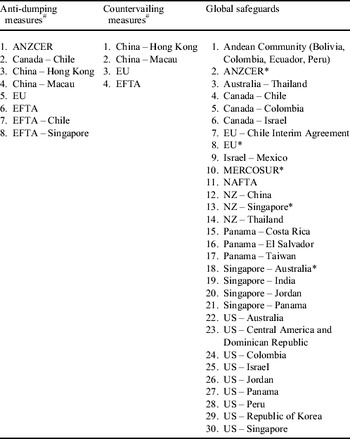
In this section I examine RTAs that substantively modify the WTO rules on trade remedies by restricting or eliminating their use in particular circumstances. Annex 2 lists 32 RTAs that exclude the application of anti-dumping, countervailing and/or safeguard measures as between RTA partners, with some RTAs appearing in more than one column because they limit more than one type of trade remedy.
1. Eliminating Anti-Dumping Measures
The first column of Annex 2 contains eight RTAs that abolish anti-dumping measures between RTA partners. One positive case study is the Australia New Zealand Closer Economic Relations Trade Agreement (‘ANZCER’),Footnote 82 which was signed in 1983 and amended in 1988 by the Protocol to the Australia New Zealand Closer Economic Relations—Trade Agreement on Acceleration of Free Trade in Goods (‘ANZ Protocol’),Footnote 83 under which the parties agree to eliminate anti-dumping measures on goods originating in each other's territory.Footnote 84 Interestingly, this agreement allows the parties to continue to impose countervailing measures on each other's imports, but only ‘when no mutually acceptable alternative course of action has been determined by the Member States’.Footnote 85
In certain European and Chinese agreements,Footnote 86 abolition of anti-dumping measures is similarly associated with deep integration (characterized by ‘harmonized or common behind-the-border measures’, ‘arrangements that allow for free or freer movement of capital and labour’, ‘monetary union or the adoption of a single currency’, or political integration).Footnote 87 However, RTAs with a lower level of integration have also managed to abolish anti-dumping measures,Footnote 88 often linking the abolition directly with the implementation or harmonization of effective competition rules. For example, under the Free Trade Agreement between the [European Free Trade Association (‘EFTA’)] States and the Republic of Chile:Footnote 89
1. A Party shall not apply anti-dumping measures as provided for under the WTO Agreement on Implementation of Article VI of the GATT 1994 in relation to goods of a Party'.
2. The Parties recognise that the effective implementation of competition rules may address economic causes leading to dumping.Footnote 90
De Araujo, Macario and Steinfatt conclude that the degree of integration is a more important factor in allowing for the abolition of anti-dumping measures in RTAs than is the creation of a common competition policy or competition rules to replace anti-dumping at the international level, noting that these different regulatory policies have different objectives. In contrast, they explain the RTA between Canada and ChileFootnote 91 as involving the replacement of anti-dumping with bilateral safeguard measures.Footnote 92 Hoekman and others reach a similar conclusion.Footnote 93 If correct, this is a positive sign, since it means that agreement on competition rules at the multilateral level is not necessarily a precondition to the abolition of anti-dumping measures among WTO Members. Progress on the competition front would certainly not hinder the goal of abolishing anti-dumping, but, as already noted, neither of these issues is currently on the WTO agenda.Footnote 94 Agreement on competition policy beyond national borders is difficult. In the context of the ANZCER, Taylor concludes that ‘[t]he success of replacing anti-dumping laws with competition law … appears to be linked with the high degree of similarity in business practices, legal systems and existing competition law, along with similar social, economic and cultural backgrounds’.Footnote 95 Gradual liberalization within an RTA over an extended period of time may also allow the industries in the partners' markets to adjust and become more closely integrated, facilitating harmonization of competition law and policy.
One concern about restricting anti-dumping measures between RTA parties is that non-parties will suffer greater discrimination with respect to anti-dumping or be subject to more anti-dumping measures by those parties, distorting and restricting international trade.Footnote 96 Teh, Prusa and Budetta express this concern, after determining that 56 in a survey of 74 RTAs either abolish anti-dumping measures or contain specific anti-dumping provisions.Footnote 97 The assumption that WTO Members ‘need’ to engage in a certain degree of protectionism and that this will manifest in the form of anti-dumping measures against imports from one country or another could be valid. However, little empirical evidence exists to support the authors' hypothesis regarding the impact on non-RTA parties of restricting intra-RTA anti-dumping measures, and further economic and statistical analysis is required to assess this conclusion.
Moreover, Members do not impose anti-dumping duties on an MFN basis anyway; nor do the WTO rules require them to do so. Rather, a Member imposing these duties in respect of a given product following an anti-dumping investigation must simply do so ‘on a non-discriminatory basis on imports of such product from all sources found to be dumped and causing injury’,Footnote 98 except for imports from sources that have provided undertakings to revise their prices in accordance with article 8 of the Anti-Dumping Agreement. An anti-dumping investigation is initiated upon an application by or on behalf of the domestic industry or (more rarely) by the investigating authorities themselves, in both cases subject to the existence of sufficient evidence of dumping, injury and causal link to justify the initiation of an investigation.Footnote 99 The domestic industry may choose to target imports from particular countries and not others, in applying to the investigating authorities to commence an anti-dumping investigation. Similarly, Members with particular historical, political or economic ties may choose not to subject each other's imports to anti-dumping investigations, whether or not they have an RTA obligation to refrain from doing so (indeed, with the exception of the EU, the RTAs identified in column 1 of Annex 2 appeared to have little impact on the actual rate of anti-dumping investigations initiated or measures imposed with respect to RTA partners—that is, these partners were not frequent targets anyway). An RTA obligation would of course entrench this approach, removing the discretion of Members to decide from one case to the next whether to investigate imports from specific countries. Nevertheless, given the economic difficulties with anti-dumping measures highlighted earlier, without further investigation, this concern provides an insufficient basis on which to discourage RTAs that abolish anti-dumping measures or discount their potential value as a precedent in reducing anti-dumping measures on a broader scale.
2. Eliminating Countervailing Measures
The second column of Annex 2 contains the only four RTAsFootnote 100 that abolish countervailing measures between RTA partners. This is somewhat surprising, given that, as noted above, WTO Members can challenge prohibited or actionable subsidies in the WTO dispute settlement system. It seems that this additional ‘multilateral’ avenue for obtaining a remedy is insufficient to encourage Members to forego the ‘unilateral’ avenue of countervailing measures, in the absence of a high degree of economic integration or a common approach to subsidies or ‘state aid’.Footnote 101 Teh, Prusa and Budetta speculate that Members may be reluctant to commit to reduce subsidies in RTAs because all WTO Members will reap benefit from this commitment, and so RTA partners are correspondingly reluctant to agree to eliminate countervailing measures.Footnote 102
Any concerns about RTA abolition of countervailing duties leading to increased countervailing duties with respect to non-RTA WTO Members (that is, WTO Members not party to the relevant RTA) is subject to the considerations outlined above in relation to anti-dumping: in particular, countervailing duties are not imposed on an MFN basis against imports of the relevant product from all sources. Article 19.3 of the SCM Agreement merely requires that Members imposing countervailing duties in respect of any given product do so ‘on a non-discriminatory basis on imports of such product from all sources found to be subsidized and causing injury’,Footnote 103 except for imports subject to undertakings in accordance with article 18 of the SCM Agreement. If a Member does not subject imports from a particular exporting country to a countervailing duty investigation, it need not (and cannot) impose countervailing duties on those imports. This means that, even in the absence of an RTA, Members are free to decide which Members to target in a countervailing duty investigation and which to exclude. Thus, an RTA obligation to shield RTA partners from countervailing duties will not necessarily increase the application of countervailing duties to imports of other countries.
3. Eliminating Safeguards
The third column of Annex 2 lists 30 RTAs that allow or require RTA partners to exclude the products of other RTA partners from the application of global safeguards pursuant to GATT article XIX and the Safeguards Agreement, on certain conditions. A number of these RTAs allow RTA partners to impose bilateral safeguards as between themselves, and/or modify the WTO rules regarding anti-dumping or countervailing measures, including by imposing the ‘lesser-duty rule’ in anti-dumping proceedings or raising the de minimis dumping margin from 2 per cent to 5 per cent.Footnote 104 Some RTAs not included in the Annexes contain similar substantive modifications to WTO anti-dumping rules.Footnote 105 Other RTAs that are being negotiated or have not yet entered into force contemplate restricting the application of global safeguards to RTA partners while allowing bilateral safeguards.Footnote 106
As an example of how RTA partners restrict the availability of global safeguards as between themselves, the North American Free Trade Agreement (‘NAFTA’),Footnote 107 between Canada, Mexico and the US, provides:
Any Party taking an emergency action under Article XIX or any such agreement shall exclude imports of a good from each other Party from the action unless:
(a) imports from a Party, considered individually, account for a substantial share of total imports; and
(b) imports from a Party, considered individually, or in exceptional circumstances imports from Parties considered collectively, contribute importantly to the serious injury, or threat thereof, caused by imports.Footnote 108
NAFTA also provides for bilateral safeguards for a transitional period,Footnote 109 as well as independent bi-national panels to assess final determinations in anti-dumping and countervailing duty cases against domestic lawsFootnote 110 (a compromise flowing from Canada's unsuccessful attempt to have anti-dumping measures eliminated from the earlier Canada—United States Free Trade Agreement).Footnote 111
The parties to the New Zealand—China Free Trade AgreementFootnote 112 (the first developed country RTA with China) agree that, when imposing safeguard measures pursuant to GATT article XIX and the Safeguards Agreement, they ‘may exclude imports of an originating good from the other Party from the action if such imports are non-injurious’.Footnote 113 The parties to this RTA otherwise ‘maintain their rights and obligations’ under articles VI and XIX of GATT 1994 and the Anti-Dumping Agreement, SCM Agreement and Safeguards Agreement,Footnote 114 although they also agree not to take any anti-dumping action ‘in an arbitrary or protectionist manner’.Footnote 115
According to Baldwin, Evenett and Low, RTAs under which ‘parties have agreed to exempt other parties from any global safeguards that they impose under the respective WTO agreement’ provide ‘an example of exactly the opposite of multilateralizing regionalism, with RTAs undermining an established non-discriminatory multilateral norm’.Footnote 116 This conclusion assumes, of course, that the WTO rules allow Members to impose global safeguards only on a non-discriminatory basis, an issue discussed further below.Footnote 117 However, if RTAs can constitute an exception to the MFN rule in relation to safeguards under WTO law, then RTAs that allow the exclusion of RTA products from a global safeguard do not alter this position, and even RTAs that require such exclusion simply remove Members' discretion in imposing safeguards (but these RTAs will still need to comply with article XXIV:5 of the GATT 1994).Footnote 118
Nevertheless, regardless of the WTO requirements, the practical impact of allowing or requiring Members to exclude imports of RTA partners from the application of a global safeguard deserves further empirical and economic investigation. In one study, Bown and McCulloch concluded that ‘country exemptions for PTA members and small developing-country suppliers have a discriminatory impact of redistributing import market shares toward these suppliers, at least on average, at the expense of other exporting countries’.Footnote 119 However, the overall impact of excluding RTA partners from global safeguards is likely to differ depending on whether the relevant RTA provides for RTA partners to impose bilateral safeguards on each other's products. All other things being equal, an RTA that precludes a party from imposing bilateral or global safeguards on other RTA parties will be less restrictive of intra-RTA trade than an RTA that allows for bilateral but not global safeguards between RTA parties, even if neither RTA affects the parties' rights to impose global safeguards on other WTO Members. On the other hand, an RTA that prohibits bilateral and global safeguards may increase trade diversion away from non-RTA WTO Members, distorting international trade.
As indicated in Annex 2, only five of the RTAs surveyed exclude both bilateral and global safeguards as between the parties.Footnote 120 This kind of arrangement is generally associated with deeper integration, as in the European Union (‘EU’),Footnote 121 MERCOSUR (the Mercado Común del Cono Sur between Argentina, Brazil, Paraguay, and Uruguay),Footnote 122 and ANZCER.Footnote 123 However, Singapore's RTAs with both Australia and NZ demonstrate that this level of liberalization is possible even in the absence of full or deep economic integration,Footnote 124 providing a useful bilateral lesson for the multilateral stage.
C. Initial Conclusions
Annex 2 reveals only one RTA—the EU Treaty—that has abolished all three forms of trade remedies among its members: anti-dumping, countervailing, and safeguard measures. The number of RTAs excluding either anti-dumping, countervailing, or bilateral and global safeguard measures is also very low (eleven in total), suggesting that the general reluctance across the WTO Membership to contemplate excluding these measures is reflected in RTAs across the globe. Moreover, these eleven RTAs can be broadly identified as customs unionsFootnote 125 (EU, MERCOSUR), single countries (China–Hong Kong, China–Macau), deeply integrated economies (ANZCER, EFTA), or groupings of countries with strong liberalization agenda (Australia, Canada, Chile, New Zealand, Singapore). They are therefore not necessarily representative of what would be politically or economically acceptable in other countries or RTAs.
These results highlight the difficulty in achieving agreement to eliminate trade remedies, even at a plurilateral level, as well as the different considerations applicable to each of the three forms, and the significance of broader and deeper integration in eliminating trade remedies. An advanced degree of intra-RTA trade liberalization may be necessary before RTA partners will agree to remove trade remedies. Before that degree of liberalization is achieved, trade remedies appear to play an important role in enabling liberalization. In other words, RTA partners cannot typically agree on liberalization beyond MFN levels without having trade remedies to fall back on. The common feature of bilateral safeguards (included in all Annex I Categories 2 and 3 RTAs, and most Annex II RTAs) demonstrates the significance of safeguards in particular in facilitating liberalization, confirming the continued need for global safeguards in the WTO, albeit subject to a reformed regime as outlined above.Footnote 126
In the next section, I examine another significant reason that may be fuelling Members' reluctance to remove trade remedies in RTAs: uncertainty regarding the WTO-consistency of such an approach.
IV. LEGALITY OF RTAS RESTRICTING TRADE REMEDIES
In this section, I assess the legality of RTAs that restrict the use of trade remedies among RTA partners. In particular, do the WTO agreements prohibit RTA partners from applying trade remedies against each other or, conversely, do they permit or require RTA partners to do so? Put differently, are RTA provisions that preclude the application of trade remedies among RTA partners mandatory, permissible or prohibited under WTO rules? If WTO rules permit or require these provisions, RTAs may provide a useful framework for reducing trade remedies and a path towards trade remedy reduction in the WTO more broadly. As a preliminary step, I consider whether RTA partners are entitled to modify the WTO agreements amongst themselves (to restrict the use of trade remedies or otherwise) as a matter of public international law. I then turn to the implications of article XXIV of the GATT 1994 for RTAs that restrict the application of safeguards among RTA partners. Safeguards provide the most complicated circumstances when it comes to restricting trade remedies in RTAs, due to the MFN rule reflected in article 2.2 of the Agreement on Safeguards. I then turn to consider the implications of GATT article XXIV for RTAs that restrict the application of anti-dumping or countervailing measures among RTA partners. Finally, I assess whether the Decision on Differential and More Favourable Treatment, Reciprocity, and Fuller Participation of Developing Countries Footnote 127 (‘Enabling Clause’) affects these questions for RTAs among developing country Members.
A. Legality of Inter Se Modifications to the WTO Agreements
If WTO Members are not entitled to make inter se modifications to the WTO agreements at all (that is, modifications amongst some Members only), then an RTA that removed parties' rights to impose trade remedies pursuant to WTO rules might amount to a prohibited modification, even if this particular modification would not otherwise violate individual WTO rules. Accordingly, it is worth considering first whether inter se modifications are allowed in the WTO, before turning to the specific modification of removing trade remedy rights in RTAs.
1. Applicability of Article 41(1) of the VCLT in the WTO
As a general matter, the question whether groups of WTO Members may make inter se modifications to the WTO agreements remains undetermined. Article 41(1) of the VCLT provides guidance on when inter se modifications are allowed. Article 41(1) provides:
Two or more of the parties to a multilateral treaty may conclude an agreement to modify the treaty as between themselves alone if:
(a) the possibility of such a modification is provided for by the treaty; or
(b) the modification in question is not prohibited by the treaty and:
(i) does not affect the enjoyment by the other parties of their rights under the treaty or the performance of their obligations;
(ii) does not relate to a provision, derogation from which is incompatible with the effective execution of the object and purpose of the treaty as a whole.
Panels and the Appellate Body have long recognized the interpretative provisions of articles 31 to 33 of the VCLT as codifying or declaring customary international law. These provisions are therefore widely accepted as crucial in interpreting WTO agreementsFootnote 128 in accordance with article 3.2 of the WTO's Understanding on Rules and Procedures Governing the Settlement of Disputes (the ‘Dispute Settlement Understanding’ or ‘DSU’),Footnote 129 which indicates that one purpose of the WTO dispute settlement system is to ‘clarify the existing provisions of [the WTO] agreements in accordance with customary rules of interpretation of public international law’.
As article 41(1) is not concerned with interpretation, it falls outside the description in article 3.2 of the DSU, and the Appellate Body has not included article 41(1) in this characterization of the VCLT as customary law. Nevertheless, article 41(1) has been recognized outside the WTO as constituting customary international law,Footnote 130 along with most if not all of the VCLT.Footnote 131 Accordingly, leading commentators such as Martti Koskenniemi and Joost Pauwelyn have concluded that article 41 applies to the WTO agreements,Footnote 132 and the Panel in Turkey–Textiles relied on article 41(1)(b)(i) in reaching a conclusion on a customs union.Footnote 133
Moreover, a number of other WTO dispute settlement decisions have applied provisions of the VCLT apart from articles 31 to 33. For example, Arbitrators in proceedings under article 22.6 of the DSU have relied on articles 30, 60 and 70 of the VCLT.Footnote 134 The Appellate Body in Brazil—Desiccated Coconut and Canada—Patent Term and the Panel in EC—Sardines referred to article 28 of the VCLT on ‘Non-retroactivity of treaties’ as a ‘general principle of international law’ and applied it on that basis.Footnote 135 The Appellate Body has also recognized the ‘principle of good faith’ reflected in article 26 of the VCLT.Footnote 136 Similarly, the Panel in Korea—Government Procurement described article 26 of the VCLT as expressing the ‘principle of pacta sunt servanda’, falling with the ‘general principles of customary international law’.Footnote 137 The same Panel applied article 48 of the VCLT (on error in a treaty) on the basis that it represented customary international law.Footnote 138
The language used by Panels and the Appellate Body regarding various VCLT provisions has not always been consistent, but whether these provisions reflect ‘general principles of law’ within the meaning of article 38(1)(c) of the Statute of the International Court of Justice, or rules or principles of ‘customary international law’ pursuant to article 38(1)(b) of that Statute, Panels and the Appellate Body have been ready to apply them. Although the Appellate Body in EC—Sardines relied on the ‘interpretation principle codified in article 28 of the VCLT’,Footnote 139 it arguably applied article 28 rather than merely using it as an interpretative rule.
The Panel in Korea—Procurement went even further than other WTO dispute settlement reports, stating that the relationship between the WTO agreements and customary international law was broader than that expressed in article 3.2 of the DSU. Specifically, ‘[c]ustomary international law … applies to the extent that the WTO treaty agreements do not “contract out” from it’.Footnote 140 This statement goes beyond what the Appellate Body has acknowledged with respect to the relationship between the WTO and public international law more generally.Footnote 141 However, based on the evidence provided above, it is much less controversial to suggest that the VCLT's role in the WTO is not limited to guiding interpretation pursuant to article 3.2 of the DSU. On this basis, I conclude that article 41 does apply to the WTO agreements, except to the extent that specific WTO provisions indicate otherwise.
2. Effect of Articles X and IX of the Marrakesh Agreement
Joel Trachtman maintains that the WTO provisions on amendment and waiver (articles X and IX of the Marrakesh Agreement Establishing the World Trade Organization (‘Marrakesh Agreement’)Footnote 142 respectively) ‘are best understood as contracting out of any possible permission for inter se modification’ pursuant to the VCLT and that, in any case, they amount to a prohibition on inter se modifications pursuant to article 41(1)(b).Footnote 143
The WTO provisions on amendment and waiver do impose specific conditions on certain agreements that are essentially inter se modifications. For example, most amendments, if approved by consensus or the requisite majority of Members pursuant to article X of the Marrakesh Agreement, would take effect only for those Members that have accepted them.Footnote 144 These amendments are therefore inter se modifications of WTO rules between those Members that have accepted them. The Protocol Amending the TRIPS Agreement, if accepted by two-thirds of the WTO membership, would be an example of such an amendment, in accordance with article X:3 of the Marrakesh Agreement.Footnote 145 Similarly, the Ministerial Conference may decide by a three-fourths majority under article IX:3 of the Marrakesh Agreement to waive an obligation imposed on a Member, effectively allowing that Member to modify the WTO rules as between itself and the rest of the WTO, without modifying the rules as between all WTO Members. For instance, in 2006, the General Council extended until 2012 the waiver of MFN and other WTO obligations with respect to measures taken by certain Members to prohibit the import or export of rough diamonds to non-Participants in the Kimberley Process Certification Scheme.Footnote 146
To the extent that articles X and IX of the Marrakesh Agreement allow for inter se modification, they may be seen as providing more detailed rules than article 41 of the VCLT and therefore prevailing over it. However, articles X and IX of the Marrakesh Agreement are not in fact specifically directed at inter se modifications, in the sense of groups of WTO Members seeking to modify the WTO agreements as between themselves. Rather, article X is directed at proposals to amend the WTO agreements as a whole (for all Members), even though in some cases an amendment would apply only to those Members who had accepted it. Similarly, article IX is directed at requests for waivers by individual Members, even though in some cases a number of Members may make a request at the same time and in relation to the same circumstances. These provisions do not clearly exclude the possibility of article 41 of the VCLT playing a role in relation to other kinds of inter se modifications, and so may be properly regarded as falling within the terms of article 41(a): they simply provide one means for WTO Members to achieve inter se modifications.
In determining the implications of article 41 of the VCLT for inter se modifications not governed by articles IX and X of the Marrakesh Agreement, the particular circumstances surrounding the modification in question must be examined. In the context of RTAs, inter se modifications are specifically contemplated in article XXIV of the GATT 1994, as discussed further below. This confirms the conclusion that articles IX and X of the Marrakesh Agreement do not ‘cover the field’ with respect to inter se modifications.
3. Implications of Article 41(1) of the VCLT for RTAs
Article XXIV of the GATT 1994 confirms that Members may enter RTAs modifying their WTO obligations, subject to the conditions laid out in that provision and the rest of the WTO agreements. Specifically, article XXIV:5 states that ‘the provisions of this Agreement shall not prevent, as between the territories of Members, the formation of a customs union or of a free-trade area or the adoption of an interim agreement necessary for the formation of a customs union or of a free-trade area’,Footnote 147 subject to certain conditions.Footnote 148 A free-trade area or customs union will necessarily reduce the ‘duties and other restrictive regulations of commerce’ applicable between the parties,Footnote 149 thereby prohibiting certain trade barriers that may be otherwise permitted under the WTO agreements, and so modifying the WTO agreements between RTA partners. Thus, article XXIV at once provides an exception to the MFN rule (as between RTA partners and other WTO Members) and implicitly authorises inter se modifications (as between RTA partners).
Modifications in RTAs pursuant to article XXIV may therefore fall within article 41(1)(a) of the VCLT. This is apparently the conclusion reached by Koskenniemi for the International Law Commission's Study Group on Fragmentation, as well as Thomas Cottier and Marina Foltea, and James Mathis,Footnote 150 with the result that the WTO rules alone govern modifications in RTAs, leaving no scope for article 41(1)(b) of the VCLT with respect to RTAs. In contrast, Pauwelyn states that the WTO rules prohibit inter se agreements to liberalize trade among WTO Members unless they are extended on an MFN basis to all Members or they comply with the conditions in article XXIV of the GATT 1994 (or the corresponding article V of the General Agreement on Trade in Services (‘GATS’)). Pauwelyn's approach also appears to leave no room for article 41(1)(b)(i) and (ii) of the VCLT with respect to RTAs, because he regards RTAs that do not comply with article XXIV of the GATT 1994 as prohibited within the meaning of the ‘chapeau’ of article 41(1)(b).Footnote 151
However, RTAs are not necessarily entirely trade liberalizing or trade restrictive (to use Pauwelyn's distinction),Footnote 152 and many modifications to WTO rules that arise within RTAs are not expressly addressed in article XXIV of the GATT 1994, or in other WTO provisions. In these circumstances, it is simplistic to suggest that the RTA as a whole either falls within article 41(1)(a) or is prohibited under the chapeau of article 41(1)(b). If a particular modification in an RTA is neither ‘provided for’ nor ‘prohibited by’ a treaty, the remaining conditions in article 41(1)(b) become relevant. For instance, I have elsewhere argued that certain modifications in ‘TRIPS-Plus’ RTAs that limit flexibilities in relation to public health are contrary to article 41(1)(b)(i) and (ii).Footnote 153 Article XXIV of the GATT 1994 and the WTO's Agreement on Trade-Related Aspects of Intellectual Property Rights (‘TRIPS Agreement’)Footnote 154 do not specify whether these kinds of modifications are allowed. Similarly, article XXIV of the GATT 1994 and the DSU do not indicate explicitly whether WTO Members are entitled to modify dispute settlement procedures in RTAs, for example by including a choice of forum clause preventing resort to the WTO dispute settlement system in certain circumstances. This issue is likely to arise in a recent complaint brought by Mexico against the United States regarding tuna products,Footnote 155 and article 41(1)(b) of the VCLT may assist in resolving it.
In order, then, to determine whether an RTA that restricts the application of trade remedies among RTA partners violates WTO law or public international law more generally, we must examine article XXIV of the GATT 1994 in more detail. As we shall see, article XXIV neither clearly provides for nor clearly prohibits such a modification, suggesting that the modification must meet the conditions of article 41(1)(b)(i) of the VCLT (not affecting third party rights or obligations under the WTO agreements) and article 41(1)(b)(ii) of the VCLT (not relating to a provision from which derogation is incompatible with the effective execution of the object and purpose of the WTO agreements as a whole). These conditions lend weight to the purpose of RTAs under article XXIV, and to the importance of maximizing intra-trade liberalization while minimizing trade distortion and diversion with respect to WTO Members outside the RTA. Put differently, the VCLT article 41(1)(b) conditions are reflected in articles XXIV:4 and XXIV:8 of the GATT 1994, as discussed further below.
B. Compliance with GATT Article XXIV
1. Article XXIV:8—Lowering Intra-RTA Barriers
Article XXIV:8 of the GATT 1994 defines a ‘free-trade area’ and a ‘customs union’, both of which fall within the scope of an ‘RTA’ for the purposes of this article.Footnote 156 These definitions make clear that RTAs are allowed under WTO rules because of their potential to act as stepping stones towards greater multilateral trade liberalization. Accordingly, significant intra-RTA trade liberalization is required to qualify as an RTA, and derogation from this requirement could well be ‘incompatible with the effective execution of the object and purpose’ of the WTO agreements as a whole.Footnote 157 This reading is consistent with the purpose of the RTA exception as expressed in article XXIV:4: ‘The Members recognize the desirability of increasing freedom of trade by the development, through voluntary agreements, of closer integration between the economies of the countries parties to such agreements …’.Footnote 158
Article XXIV:8(b) defines a ‘free-trade area’ as:
A group of two or more customs territories in which the duties and other restrictive regulations of commerce (except, where necessary, those permitted under Articles XI, XII, XIII, XIV, XV and XX) are eliminated on substantially all the trade between the constituent territories in products originating in such territories.
Similarly, article XXIV:8(a) defines a ‘customs union’ as the:
substitution of a single customs territory for two or more customs territories, so that:
(i) duties and other restrictive regulations of commerce (except, where necessary, those permitted under Articles XI, XII, XIII, XIV, XV and XX) are eliminated with respect to substantially all the trade between the constituent territories of the union or at least with respect to substantially all the trade in products originating in such territories …
In addition, under article XXIV:8(a)(ii), the members of a customs union must generally apply ‘substantially the same duties and other regulations of commerce … to the trade of territories not included in the union’. This second limb of the definition of a customs union may be relevant when members of a customs union apply trade remedies to non-union members but does not affect the central question of this article, which concerns application by RTA partners of trade remedies among themselves.
Article XXIV:8 of the GATT 1994 has to date been inadequately illuminated in WTO dispute settlement proceedings and academic commentary. Greater certainty about the definition of ‘free-trade areas’ and ‘customs unions’ under this provision, specifically as regards the interaction between RTAs and trade remedies, could assist in encouraging existing RTA partners to amend their agreements and future RTA partners to abolish trade remedies amongst themselves. Below, I examine article XXIV:8 in more detail in relation to the different forms of trade remedy that could be excluded in an RTA.
2. Article XXIV:5—Restricting Impact on Non-RTA Members
An RTA that meets the definition of a ‘free-trade area’ or ‘customs union in article XXIV:8 of the GATT 1994 must also fulfil certain other conditions in order to benefit from the exemption in article XXIV:5. These conditions demonstrate that RTAs must not on the whole lead to greater restrictions on external trade (that is, trade with non-RTA WTO Members); this would ‘affect the enjoyment by the other parties of their rights under the treaty or the performance of their obligations’.Footnote 159 Again, this principle is reflected in article XXIV:4, under which the Members ‘recognize that the purpose of a customs union or of a free-trade area should be to facilitate trade between the constituent territories and not to raise barriers to the trade of other Members with such territories’.Footnote 160 The Appellate Body has recognized article XXIV:4 as setting forth ‘the overriding and pervasive purpose for article XXIV’.Footnote 161
The article XXIV:5 conditions include:
(a) with respect to a customs union, … the duties and other regulations of commerce imposed at the institution of any such union … in respect of trade with Members not parties to such union … shall not on the whole be higher or more restrictive than the general incidence of the duties and regulations of commerce applicable in the constituent territories prior to the formation of such union …;
(b) with respect to a free-trade area, … the duties and other regulations of commerce maintained in each of the constituent territories and applicable at the formation of such free-trade area … to the trade of Members not included in such area or not parties to such agreement shall not be higher or more restrictive than the corresponding duties and other regulations of commerce existing in the same constituent territories prior to the formation of the free-trade area …
I have already discussed the implications of excluding RTA partners from anti-dumping and countervailing measures above, challenging assumptions that this will necessarily increase the application of these measures to WTO Members not party to the relevant RTA or otherwise increase trade distortion.Footnote 162 I further explore the meaning of article XXIV:5 in the context of specific trade remedies below.
3. Eliminating Safeguards
In assessing the WTO-consistency of RTAs that exclude the application of global safeguards among their members, we must bear in mind the underlying purposes and detailed conditions of article XXIV:8 and article XXIV:5 of the GATT 1994. In addition, as noted above, unlike in the context of anti-dumping and countervailing measures, article 2.2 of the Agreement on Safeguards stipulates that ‘Safeguard measures shall be applied to a product being imported irrespective of its source’. In other words, safeguard measures must prima facie be applied on an MFN basis.Footnote 163
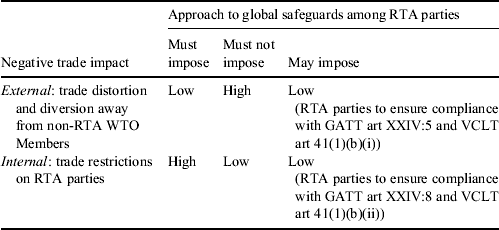
Views on the exclusion of RTA partners from global safeguards generally take three forms:Footnote 164 (i) RTA partners must impose global safeguards on each other's imports;Footnote 165 (ii) RTA partners must not impose global safeguards on each other's imports;Footnote 166 and (iii) RTA partners may impose global safeguards on each other's imports.Footnote 167 The text of the WTO agreements does not clearly correspond to any of these approaches, which is why this is such a difficult issue.Footnote 168 The Appellate Body has to date avoided resolving it in the abstract,Footnote 169 addressing the parallelism requirementFootnote 170 rather than GATT article XXIV in disputes concerning the application of safeguards to RTA partners.
Beginning with the first approach, on its face, the language in parentheses in article XXIV:8 suggests an exhaustive list, meaning that any measure that constitutes a duty or other restrictive regulation of commerce (‘ORRC’) and that is not mentioned in parentheses is included in the requirement to eliminate duties and ORRC on substantially all trade.Footnote 171 As article XIX is not mentioned in the parentheses in article XXIV:8, and as safeguards under article XIX take the form of increased duties or quantitative restrictions that may be described as ORRC,Footnote 172 this means that RTA partners cannot be required to impose safeguards on each other's products. On the contrary, when taken as a whole together with all other duties and ORRC, safeguards should be eliminated on substantially all the relevant trade. Thus, the Panel in Argentina—Footwear (EC) stated: ‘There is also no doubt in our minds that the letter and spirit of article XXIV:8 of GATT permit member States of a customs union to agree on the elimination of the possibility to impose safeguard measures between the constituent territories’.Footnote 173
How does this interpretation of article XXIV:8 of the GATT 1994 (and the allowance under article XXIV:5 for RTAs as defined in article XXIV:8) sit with article 2.2 of the Agreement on Safeguards? Any conflict between article XXIV:5 of the GATT 1994 and article 2.2 of the Agreement on Safeguards would ordinarily be resolved in favour of the latter,Footnote 174 such that RTA partners would have to impose global safeguards on each other's imports. However, rather than viewing these provisions as conflicting, they should be interpreted harmoniously where possible, particularly given that these are both parts of the same treaty and that the Agreement on Safeguards constitutes an elaboration of GATT article XIX.Footnote 175 This is consistent with Footnote 1 of the Agreement on Safeguards, which specifically states that ‘Nothing in this Agreement prejudges the interpretation of the relationship between Article XIX and paragraph 8 of article XXIV of GATT 1994’. It is also consistent with the general rule of interpretation set out in article 31(1) of the VCLT, which requires a treaty to be interpreted ‘in good faith in accordance with the ordinary meaning to be given to the terms of the treaty in their context and in the light of its object and purpose’.Footnote 176 On this reading, article 2.2 need not override article XXIV:5 and article XXIV:8; read together, article XXIV:5 of the GATT 1994 provides an exception to the MFN rule in article 2.2 of the Agreement on Safeguards (with the words ‘this Agreement’ in article XXIV:5 referring to the WTO treaty as a whole, rather than just the GATT 1994).Footnote 177
The drafting history of article XXIV may be referred to pursuant to article 32 of the VCLT to confirm the meaning resulting from the application of article 31. Article 32 does indeed confirm the inapplicability of the first approach, given that the debate about the relationship between articles XIX and XXIV centred on the second two approaches, and whether RTA partners either ‘need not’ or ‘should not’ apply safeguards to each other's imports.Footnote 178 The drafting history also indicates that article XIX was deliberately omitted from the list of exceptions.Footnote 179 Although article XXI (security exceptions) is similarly omitted from the list of exceptions in parentheses, this omission is also arguably explained by the drafting history.Footnote 180
Turning then to the second approach, requiring RTA partners to exempt each other from global safeguards may be consistent with the MFN rule in article 2.2 of the Agreement on Safeguards. However, it is inconsistent with the language of article XXIV:8. Even assuming that safeguards constitute ORRC and that the exceptions listed in parentheses in article XXIV:8 comprise an exhaustive list (as suggested above), flexibility remains inherent in article XXIV:8 because the obligation on RTA partners is simply to eliminate duties and ORRC on substantially all the relevant trade rather than on all the trade. The Panel in Argentina—Footwear (EC) and a number of commentators have reached a similar conclusion.Footnote 181
The first two approaches also seem inconsistent with the purpose of RTAs as expressed in article XXIV:4. If RTA partners must impose global safeguards on each other's imports, this is consistent with article 2.2 and will reduce trade distortion and diversion in accordance with article XXIV:5, but it will restrict intra-RTA trade contrary to the principle behind article XXIV:8, defeating the purpose of allowing RTAs in the first place. At the same time, requiring RTA partners to impose global safeguards on each other may contravene article 41(1)(b)(ii) of the VCLT, since it derogates from the purpose of the WTO agreements of promoting trade liberalization as a means to improving global welfare. Conversely, if RTA partners must not impose global safeguards on each other's imports, this will have a positive impact on intra-RTA trade liberalization in accordance with article XXIV:8 of the GATT 1994, but it will necessarily create trade distortion and diversion of trade away from WTO Members not party to the relevant RTA, contrary to the principle behind article XXIV:5 of the GATT 1994, article 2.2 of the Agreement on Safeguards, and article 41(1)(b)(i) of the VCLT.
The third approach, in contrast, leaves flexibility to RTA partners and charges them with the responsibility of ensuring compliance with the letter and spirit of the WTO rules. In particular, in accordance with GATT article XXIV:5 and VCLT article 41(1)(b)(i), RTA partners need to minimize the impact on other WTO Members of excluding each other from global safeguards, should they choose to do so. At the same time, pursuant to GATT article XXIV:8 and VCLT article 41(1)(b)(ii), RTA partners need to ensure sufficient intra-RTA trade liberalization should they decide to impose global safeguards on each other.
This approach does not necessarily render the list of exceptions in article XXIV:8 redundant, as argued by Estrella and Horlick.Footnote 182 Rather, provisions falling within that list may be maintained as long as they are ‘necessary’ (as stated in article XXIV:8), whereas duties and other ORRC not falling within that list must be eliminated on substantially all the trade. It is true that this means that the WTO-consistency of the RTA could vary from time to time,Footnote 183 but that is the case with respect to any RTA anyway. Assessing consistency with article XXIV:8 is a difficult task requiring substantial evidence and fact collection because ‘the entire gamut of duties and other regulations of commerce must be examined’,Footnote 184 and ‘the examination of individual measures, regulations, products covered and trade flows affected may be required’.Footnote 185 Under this third approach, safeguards are assessed along with all the other remaining restrictive trade measures, given that maintaining either will have similar trade effects.Footnote 186 The Appellate Body's decision in Turkey—Textiles also does not preclude this third approach. As explained elsewhere, the Appellate Body's ‘timing’ and ‘necessity’ requirements should be read as applying (if at all)Footnote 187 only to article XXIV:5 (external trade) and not to article XXIV:8 (internal trade).Footnote 188
My assessment of the three approaches with respect to the purpose of RTAs is summarized in the table below.
4. Eliminating Anti-Dumping and Countervailing Measures
Like article XIX, article VI of the GATT 1994 is not included in the list of exceptions in article XXIV:8. However, as anti-dumping and countervailing measures are not imposed on an MFN basis,Footnote 189 many of the difficulties associated with analysing safeguards in RTAs do not arise. In particular, the potential conflict between the MFN provision in article 2.2 of the Agreement on Safeguards and the exception in GATT article XXIV disappears in the context of anti-dumping and countervailing measures. Nevertheless, agreeing not to impose anti-dumping or countervailing measures on RTA partners would probably violate the general MFN rule in GATT article I:1, and so such an RTA would still need to rely on the exception in article XXIV.
In interpreting the meaning of article XXIV for such an RTA, the option of requiring RTA partners to actually impose anti-dumping and countervailing measures on each other makes little sense, since all WTO Members are free not to impose any such measures or not to impose them on imports from particular countries. This leaves the options of requiring RTA partners to eliminate anti-dumping and countervailing measures, or permitting RTA partners to apply these measures. In 1994, Gabrielle Marceau called for the elimination of anti-dumping duties within free-trade areas.Footnote 190
A free-trade area where anti-dumping duties are phased out appears to be the minimum level integration necessary for a successful trade deal. … This crucial legal step, phasing out of internal anti-dumping duties, will further integration and push free-trade areas closer to customs union. This would explain why free-trade areas, imperfect customs unions, were accepted: they can effectively lead to further integration. Regional and multilateral trade can therefore be reconciled with GATT.
The benefits of excluding RTA partners from anti-dumping and countervailing measures are clear, given their doubtful economic foundations.Footnote 191 However, keeping in mind the potential problem of such exclusion leading to greater imposition of anti-dumping and countervailing measures on other WTO Members,Footnote 192 and the flexibility inherent in article XXIV:8,Footnote 193 I conclude that RTA partners have the same obligations with respect to anti-dumping and countervailing measures as they do with respect to safeguards: namely, they are entitled to impose them on each other provided that they ensure compliance with article XXIV:5 and XXIV:8 of the GATT 1994, and article 41(1)(b) of the VCLT.
One possible contrary argument is that anti-dumping and countervailing measures are not ORRCs at all, and therefore RTA partners have no obligation to reduce them pursuant to article XXIV:8. This argument is premised on the assumption that anti-dumping and countervailing measures are designed to offset unfair trading practices of other Members (in the form of dumping or subsidization) and thus do not represent restrictive measures of the imposing Member. However, even accepting this assumption, it does not explain why provisions such as GATT article XX (General Exceptions) are included in the article XXIV:8 list, when measures falling under article XX are also aimed at specific legitimate purposes and therefore justified derogations from other WTO provisions. If exceptions to WTO rules were not intended to fall within the description of ORRCs, the drafters need not have included GATT article XX in the list of provisions in article XXIV:8.
C. Compliance with the Enabling Clause
Paragraph 2(c) of the Enabling Clause applies the exemption from MFN treatment in paragraph 1 to:
Regional or global arrangements entered into amongst developing country Members for the mutual reduction or elimination of tariffs and, in accordance with criteria or conditions which may be prescribed by the Ministerial Conference, for the mutual reduction or elimination of non-tariff measures, on products imported from one another …
This provision may be seen as equivalent to GATT article XXIV in the context of RTAs among developing country Members. Additional conditions on these RTAs are found in paragraph 3 of the Enabling Clause, which provides that ‘differential and more favourable treatment’ provided under the Enabling Clause:
(a) shall be designed to facilitate and promote the trade of developing countries and not to raise barriers to or create undue difficulties for the trade of any other contracting parties;
(b) shall not constitute an impediment to the reduction or elimination of tariffs and other restrictions to trade on a most-favoured-nation basis …
These conditions reflect concerns similar to those encompassed in article XXIV:5 and XXIV:8 of the GATT 1994Footnote 194 and article 41(1)(b) of the VCLT, and the above analysis in relation to the three types of trade remedies apply equally to RTAs among developing country Members. Requiring these RTA partners to impose safeguards against each other would be contrary to the purpose of promoting the trade of developing countries as set out in paragraph 3(a) of the Enabling Clause, and requiring them to impose anti-dumping or countervailing measures is contrary to the non-MFN basis on which they are imposed in any case. Requiring them to eliminate trade remedies against each other could raise barriers to non-RTA partners, particularly through trade diversion arising from global safeguards applied on a discriminatory basis, contrary to paragraph 3(a) and 3(b). An approach that grants RTA partners flexibility in choosing whether to impose particular trade remedies against each other properly places the onus on the relevant Members to maintain compliance with the Enabling Clause.
V. CONCLUSION
A few existing RTAs as identified in this article demonstrate that some WTO Members may be willing to restrict various forms of trade remedies amongst themselves, and that this is a feasible and realistic approach, even in the absence of deep integration between the RTA parties. The above analysis of WTO rules concerning trade remedies in RTAs shows that RTA partners are permitted to exclude the application of anti-dumping, countervailing and safeguard measures among themselves, provided that they continue to limit negative trade impacts on non-RTA WTO Members in accordance with article XXIV:5 of the GATT 1994, article 41(1)(b)(i) of the VCLT, and paragraph 3(a) and 3(b) of the Enabling Clause. Doing so will further the underlying objectives of allowing RTAs in the WTO and increase intra-RTA trade liberalization in accordance with GATT article XXIV:8, VCLT article 41(1)(b)(ii), and Enabling Clause paragraph 3(a). This reading should assist in increasing certainty about the interaction between RTAs and trade remedies with the goal of encouraging existing RTA parties to amend their agreements and future RTA parties to abolish or at least restrict trade remedies among themselves. The political significance of trade remedies and the industries that benefit from them make this a difficult task.
As noted at the outset, the mere existence of RTAs that reduce trade remedies is unlikely to lead to a reduction of trade remedies at the multilateral level. However, we can legitimately look to RTAs to understand the perspectives of negotiators on trade remedies around the world. In addition, the provisions of RTAs—including those that reduce trade remedies—both reflect and influence how individual consumers, producers, importers and exporters operate from day to day. This issue deserves further scholarly attention, especially from a legal and economic perspective and drawing on the wealth of raw material available in the context of RTAs. Perhaps one day, the WTO will see its way towards replacing anti-dumping measures with competition disciplines, countervailing measures with WTO dispute settlement, and safeguards with a reformed regime. Understanding how trade remedies come to be reduced in RTAs, and the impact of such reduction, may ultimately assist in limiting trade remedies among WTO Members.
ANNEX 1: WTO-EQUIVALENT RTAS
This Annex categorizes 118 RTAs that do not change WTO trade remedy rules or make only minor modifications to those rules.
The following Category 1 RTAs do not mention WTO trade remedies or make no significant change to the relevant WTO provisions:
1. Agreement on Foundation of Eurasian Economic Community (Belarus, Kazakhstan, Kyrgyz Republic, Russian Federation, Tajikistan)
2. Armenia – Kazakhstan
3. Armenia – Moldova
4. Armenia – Russian Federation
5. Armenia – Turkmenistan
6. Armenia – Ukraine
7. Australia – Chile
8. Commonwealth of Independent States (Armenia, Azerbaijan, Belarus, Georgia, Kazakhstan, Kyrgyz Republic, Moldova, Russian Federation, Tajikistan, Turkmenistan, Ukraine, Uzbekistan; not yet ratified by all parties)
9. EU – Egypt
10. Faroe Islands – Switzerland
11. Georgia – Armenia
12. Georgia – Azerbaijan
13. Georgia – Kazakhstan
14. Georgia – Russian Federation
15. Georgia – Turkmenistan
16. Georgia – Ukraine
17. Kyrgyz Republic – Armenia
18. Kyrgyz Republic – Kazakhstan
19. Kyrgyz Republic – Moldova
20. Kyrgyz Republic – Russian Federation
21. Kyrgyz Republic – Ukraine
22. Kyrgyz Republic – Uzbekistan
23. Melanesian Spearhead Group Trade Agreement (Papua New Guinea, Solomon Islands, Vanuatu)
24. Southern African Development Community (Botswana, Lesotho, Madagascar, Malawi, Mauritius, Mozambique, Namibia, South Africa, Swaziland, Tanzania, Zambia, Zimbabwe; Angola and the Democratic Republic of Congo still to join)
25. The Unified Economic Agreement Between the Countries of the Gulf Cooperation Council (Bahrain, Kuwait, Oman, Qatar, Saudi Arabia, United Arab Emirates)
The following Category 2 RTAs allow for the imposition of bilateral safeguards without otherwise changing WTO trade remedy rules:
1. Albania – Bosnia Herzegovina
2. Albania – Bulgaria
3. Albania – FYROM
4. Albania – Moldova
5. Albania – Serbia & Montenegro
6. Asia-Pacific Trade Agreement (Bangladesh, China, India, Laos, Republic of Korea, Sri Lanka)
7. Association of Southeast Asian Nations (‘ASEAN’: Brunei Darussalam, Cambodia, Indonesia, Laos, Malaysia, Myanmar, Philippines, Singapore, Thailand, Vietnam) – China
8. ASEAN – Republic of Korea
9. Bulgaria – Bosnia Herzegovina
10. Chile – China
11. Chile – India
12. Chile – Japan
13. Chile – Republic of Korea
14. China – Pakistan
15. Croatia – Albania
16. EU – Mexico
17. EU – South Africa
18. EU – Turkey Customs Union
19. India – Afghanistan
20. India – MERCOSUR
21. India – Sri Lanka
22. Japan – ASEAN
23. Japan – Malaysia
24. Japan – Mexico
25. Trans-Pacific Strategic Economic Partnership Agreement (Brunei Darussalam, Chile, NZ, Singapore)
26. US – Chile
27. US – Morocco
28. US – Oman
The following Category 3 RTAs make procedural changes to the application of trade remedies under WTO rules and provide additional rules for the application of bilateral safeguards:
1. Albania – Kosovo
2. Albania – Romania
3. ASEAN
4. Bulgaria – Former Yugoslav Republic of Macedonia (‘FYROM’)
5. Bulgaria – Israel
6. Bulgaria – Serbia & Montenegro
7. Canada – Costa Rica
8. Central European Free Trade Agreement (Bulgaria, Croatia, Czech Republic, Hungary, Poland, Romania, Slovak Republic)
9. Chile – Costa Rica
10. Chile – El Salvador
11. Croatia – Bosnia Herzegovina
12. Croatia – FYROM
13. Croatia – Serbia & Montenegro
14. East African Community (Kenya, Uganda, Tanzania)
15. EU – Algeria
16. EU – Bulgaria
17. EU – FYROM
18. EU – Iceland
19. EU – Israel
20. EU – Jordan
21. EU – Lebanon
22. EU – Morocco
23. EU – Norway
24. EU – Palestine Liberation Organization (‘PLO’)
25. EU – Romania
26. EU – Syria
27. EU – Switzerland and Liechtenstein
28. EU – Tunisia
29. Economic Cooperation Organisation Trade Agreement (Afghanistan, Azerbaijan, Iran, Kazakhstan, Kyrgyz Republic, Pakistan, Tajikistan, Turkey, Turkmenistan, Uzbekistan)
30. EFTA – Bulgaria
31. EFTA – Canada
32. EFTA – Croatia
33. EFTA – Israel
34. EFTA – Jordan
35. EFTA – Lebanon
36. EFTA – Macedonia
37. EFTA – Mexico
38. EFTA – Morocco
39. EFTA – Palestinian Authority
40. EFTA – Romania
41. EFTA – Tunisia
42. EFTA – Turkey
43. Faroe Islands – Iceland
44. Faroe Islands – Norway
45. FYROM – Bosnia Herzegovina
46. Israel – Turkey
47. Japan – Singapore
48. Moldova – Bosnia Herzegovina
49. Moldova – Bulgaria
50. Moldova – Croatia
51. Moldova – FYROM
52. Moldova – Serbia & Montenegro
53. Romania – Bosnia Herzegovina
54. Romania – FYROM
55. Romania – Israel
56. Romania – Moldova
57. Romania – Serbia & Montenegro
58. Romania – Turkey
59. South Asian Free Trade Area (Bangladesh, Bhutan, India, Maldives, Nepal, Pakistan, Sri Lanka)
60. Turkey – Bosnia Herzegovina
61. Turkey – Bulgaria
62. Turkey – Croatia
63. Turkey – FYROM
64. Turkey – Morocco
65. Turkey – PLO
66. Turkey – Tunisia
ANNEX 2: WTO-PLUS RTAS
The following RTAs restrict the application of these trade remedies between RTA partners:

# Anti-dumping and countervailing measures are also excluded under the EEA in most sectors. See above nn 86, 100.
* These RTAs preclude both global and bilateral safeguards between the RTA partners.