





Introduction
Healthcare-associated infections (HAIs) remain a widespread concern for patients, especially older adults with various functional impairments. Older patients remain at an increased risk for infections due to their increased prevalence of comorbidities which may complicate treatment and lead to increased morbidity, mortality, and higher healthcare costs.Reference Cristina, Spagnolo, Giribone, Demartini and Sartini1–Reference Koch, Nilsen, Eriksen, Cox and Harthug2 The overuse of antibiotics and presence of indwelling devices, such as urinary catheters and feeding tubes, in patients in nursing homes (NHs) also contribute to infections in this population.Reference van Buul, van der Steen and Veenhuizen3–Reference Mody, Maheshwari, Galecki, Kauffman and Bradley4 Because of these, the prevalence of multi-drug resistant organisms (MDROs) in NHs is high.Reference McKinnell, Miller and Singh5–Reference Cao, Min, Lansing, Foxman and Mody7 Given this higher risk faced by residents in NHs, novel infection control and prevention approaches are necessary in this setting.
Hand hygiene remains an effective strategy for preventing infections and decreasing colonization of patients with MDROs.Reference Barnes, Morgan, Harris, Carling and Thom8–Reference Pittet, Allegranzi and Sax9 Recent literature underscores that targeted interventions in hand hygiene can reduce transmission of pathogens within healthcare settings by up to 50%, yet sustained improvements, especially among NH residents, remain a significant challenge.Reference Afework and Tamene10 Research efforts and resources have primarily focused on improving healthcare personnel (HCP) hand hygiene as a central strategy.Reference Lotfinejad, Peters, Tartari, Fankhauser-Rodriguez, Pires and Pittet11–Reference Gould, Moralejo, Drey, Chudleigh and Taljaard13 The systematic change to alcohol-based hand rubs, educational hand hygiene programs and guidelines for HCP and feedback and auditing strategies address barriers to hand hygiene compliance and improve hand hygiene practice among HCP.Reference Lotfinejad, Peters, Tartari, Fankhauser-Rodriguez, Pires and Pittet11 However, addressing patient, particularly NH resident, hand hygiene remains an understudied and underutilized strategy and poses an additional opportunity to further prevent infections. Due to the potential of transmission of pathogens from a resident’s hands to the environment, HCP, and other residents, prioritizing NH resident hand hygiene could reduce the spread of pathogens in these facilities.Reference Mody, Washer and Kaye14
The purpose of this study was to characterize NH residents’ (1) hand hygiene knowledge, (2) their hand hygiene habits at the NH compared to their previous residence, and (3) their bathing practices at the NH. We were particularly interested in identifying barriers to resident hand hygiene and areas where new interventions or policy changes could be implemented.
Methods
Study design and population
This survey was conducted as part of the Nursing Home Public Health Response Network, a collaboration between eight academic sites across the United States, their network of NHs, and a centralized laboratory. The collaborative was funded by the Centers for Disease Control and Prevention primarily to better understand viral transmission and inform infection prevention and control strategies in NHs and was contracted through Abt Global (Rockville, MD).Reference Katz, Reeves and Harris15 The survey was administered at 20 NHs across six academic sites in the network from December 2023 through July 2024 (Supplement 1). Residents were eligible if they were English-speaking, not receiving end-of-life care, and capable of providing informed consent without the use of a legally authorized representative (LAR) or Durable Power of Attorney (DPOA). Nursing home staff aided study staff in identifying eligible residents. Eligible residents were approached by study staff and invited to participate, with verbal informed consent obtained from residents who wished to participate. Trained study staff verbally administered the survey to residents, and survey responses were recorded by study staff using a tablet or laptop computer into a central Research Electronic Data Capture (REDCap) survey online platform developed by Abt Global and hosted at Vanderbilt University. Residents were compensated a nominal amount for participating in the survey, with exact amounts varying by academic site.
Questionnaire design
This exploratory survey consisted of 22 items, including a section on demographic characteristics (5 questions), a section testing residents’ hand hygiene knowledge (3 questions), and two sections asking about residents’ hand hygiene habits at their previous residence and at the NH (5 questions for each section). A resident’s previous residence referred to the last place that the resident was living prior to NH admission. The questions in this survey were pretested by a focus group of older adults. This study served to further validate these questions for future studies.
Demographic questions addressed the resident’s age, race, ethnicity, sex, and resident status (short-stay vs long-stay). Temporary/short-stay residents are those who remain at the NH for only a short period (usually under 100 days) for postacute or rehabilitative care, whereas permanent/long-stay residents are those who remain at the NH for an extended amount of time (more than 100 days) due to physical or mental limitations and/or the need for assistance.16
The knowledge-based questions assessed residents’ understanding of the recommended length of time to wash hands and use hand sanitizer in addition to when hand washing should be utilized instead of hand sanitizer. The questions addressing residents’ hand hygiene habits pertained to how often residents wash their hands, how residents wash and dry their hands, when they wash their hands, and any challenges that may inhibit handwashing.
Two additional questions asked about hand sanitizer use and the frequency of staff reminders to wash hands at the NH. A final section of two questions addressed residents’ bathing practices at the NH compared to their previous residence including how often residents bathe and why residents may be bathing less often at the NH. Bathing practices could include showers, tub baths, or bed baths. A complete version of the survey is included as Supplement 2.
The same study protocol, survey tool, and standard operating procedures were used by all the participating sites. The Abt Institutional Review Board (IRB) served as the central IRB and the study was approved by the Abt IRB and the participating sites’ IRBs: Case Western Reserve University, Johns Hopkins University, Oregon State University, Rhode Island Hospital, University of Michigan, and University of Wisconsin (See 45 C.F.R. part 46.101(c); 21 C.F.R. part 56).
Statistical analysis
Descriptive statistics were conducted on all survey questions. χ2 and Fisher’s exact tests were used to compare categorical variables. A McNemar’s test was used to compare residents’ responses to the five questions addressing residents’ hand hygiene habits at their previous residence and at the NH. A hand hygiene knowledge score was created based on the number of correct responses given to the three knowledge-based questions. For analysis purposes, residents who answered “Don’t know” or “Decline to answer” were excluded from analyses. All analyses were conducted using SAS 9.4. Results were considered statistically significant if the P-value was <.05.
Three open-response questions were reviewed for key themes: (1) residents’ handwashing challenges/barriers at their previous residence, (2) residents’ handwashing challenges/barriers at the NH, and (3) residents’ reasons for bathing less often at the NH. The responses were reviewed and coded into categories based on definitions set forth by the authors HB, AP, and LM. Responses were coded into multiple categories if more than one theme was identified in the response. The themes and corresponding responses in each category were reviewed by the entire University of Michigan team and any discrepancies were discussed and resolved by consensus.
Results
Resident characteristics
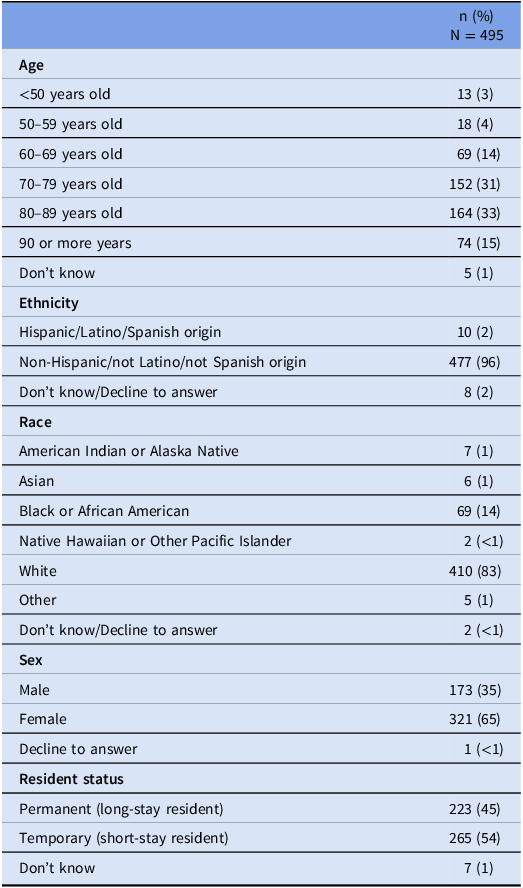
The survey was completed by 495 NH residents. More than half (64%) of the residents were between the ages of 70 and 89 years old with 15% of residents being 90 years or older. Approximately 96% of residents were non-Hispanic, 83% were White, 65% were female, and 54% were temporary/short-stay residents (Table 1).
Demographic characteristics of nursing home respondents at 20 nursing homes

Table 1. Long description
A table with demographic characteristics of nursing home respondents at 20 nursing homes. The table has 12 rows and 4 columns. Column headers are Age, Ethnicity, Race, Sex, Resident status. Row 1: Age, less than 50 years old, 13 (3 percent); 50 to 59 years old, 18 (4 percent); 60 to 69 years old, 69 (14 percent); 70 to 79 years old, 152 (31 percent); 80 to 89 years old, 164 (33 percent); 90 or more years, 74 (15 percent); Don’t know, 5 (1 percent). Row 2: Ethnicity, Hispanic/Latino/Spanish origin, 10 (2 percent); Non-Hispanic/not Latino/not Spanish origin, 477 (96 percent); Don’t know/Decline to answer, 8 (2 percent). Row 3: Race, American Indian or Alaska Native, 7 (1 percent); Asian, 6 (1 percent); Black or African American, 69 (14 percent); Native Hawaiian or Other Pacific Islander, 2 (less than 1 percent); White, 410 (83 percent); Other, 5 (1 percent); Don’t know/Decline to answer, 2 (less than 1 percent). Row 4: Sex, Male, 173 (35 percent); Female, 321 (65 percent); Decline to answer, 1 (less than 1 percent). Row 5: Resident status, Permanent (long-stay resident), 223 (45 percent); Temporary (short-stay resident), 265 (54 percent); Don’t know, 7 (1 percent).
Resident hand hygiene knowledge
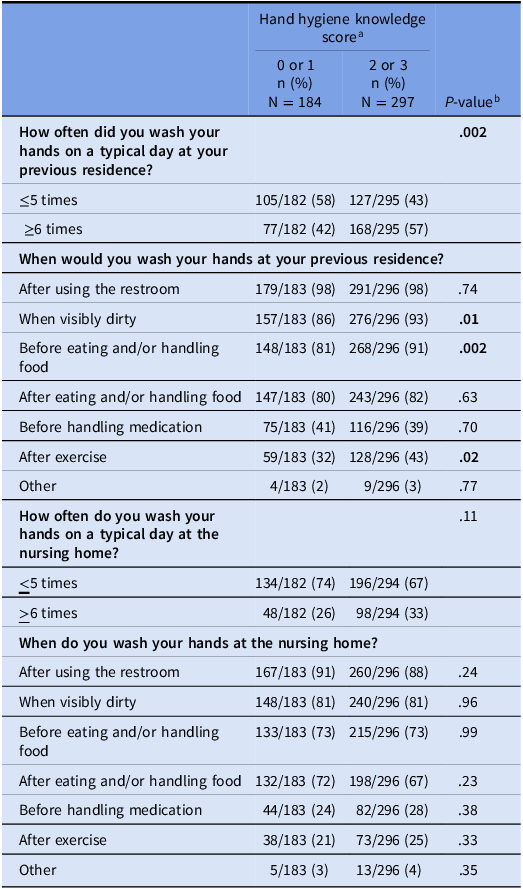
One hundred forty-two (29%) residents correctly answered all three knowledge-based questions. Table 2 displays the association between the hand hygiene habits of those who answered two or three of the questions correctly compared to those who answered zero or one correctly. Residents who answered two or three questions correctly washed their hands more frequently on a typical day (six or more times) at their previous residence compared to residents who answered zero or one correctly (57% vs 42%, P = .002). There was not a statistically significant difference in hand washing frequency at the NH between the two groups (P = .11). Residents who answered two or three questions correctly were significantly more likely to wash their hands when they are visibly dirty (93% vs 86%), before eating and/or handling food (91% vs 81%), and after exercising (43% vs 32%) at their previous residence. When comparing the hand hygiene habits of the two groups at the NH, no significant differences were observed for any of the instances.
Relationship between residents’ hand hygiene knowledge and hand hygiene habits

Table 2. Long description
The table presents data on hand hygiene habits and knowledge scores among residents. It has 12 rows and 5 columns. The columns are labeled ‘Hand hygiene knowledge score’, ‘0 or 1 n (%)’, ‘2 or 3 n (%)’, and ‘P-value’. The rows are grouped into sections with headings like ‘How often did you wash your hands on a typical day at your previous residence?’, ‘When would you wash your hands at your previous residence?’, ‘How often do you wash your hands on a typical day at the nursing home?’, and ‘When do you wash your hands at the nursing home?’. Each row provides specific data points for the frequency and occasions of hand washing. Notable trends include higher hand washing frequency among those with higher knowledge scores at their previous residence and no significant difference in hand washing frequency at the nursing home.
Results were considered statistically significant if the P-value was < .05 and are highlighted in bold.
a The hand hygiene knowledge score is based on the number of correct responses to the three knowledge-based questions. Twelve residents answered zero questions correctly, 172 residents answered one question correctly, 155 residents answered two questions correctly and 142 residents answered all three questions correctly. Fourteen residents declined to answer at least one of the questions and were excluded.
b Significance evaluated using Pearson’s χ2 test/Fisher’s exact test.
Resident hand hygiene habits
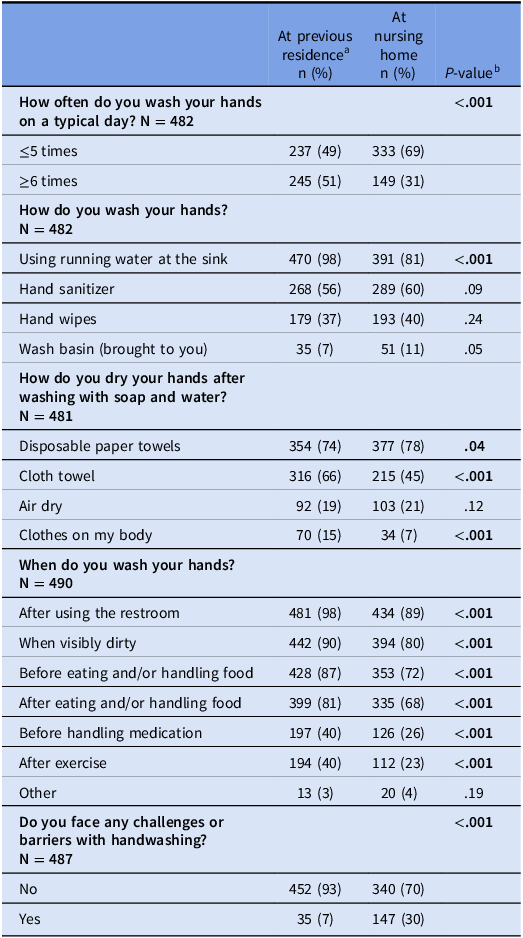
Data also showed differences in hand hygiene behavior during a resident’s NH stay compared to their previous residence. Residents reported washing their hands more frequently on a typical day (six or more times) at their previous residence compared to the NH (51% vs 31%, P < .001). Residents washed their hands using running water at the sink less often at the NH compared to their previous residence (81% vs 98%, P < .001). Residents also reported washing their hands significantly less often at the NH after using the restroom (89% vs 98%), when their hands are visibly dirty (80% vs 90%), before eating and/or handling food (72% vs 87%), after eating and/or handling food (68% vs 81%), before handling medication (26% vs 40%), and after exercising (23% vs 40%) compared to their previous residence (Table 3).
Differences in residents’ hand hygiene habits at their previous residence compared to the nursing home

Table 3. Long description
A table comparing hand hygiene habits at previous residence and nursing home. The table has 6 rows and 5 columns. Column headers are How often do you wash your hands on a typical day? N = 482, At previous residence n (%), At nursing home n (%), P-valueb. Row 1: <5 times, 237 (49), 333 (69), <.001. Row 2: ≥6 times, 245 (51), 149 (31), <.001. Row 3: Using running water at the sink, 470 (98), 391 (81), <.001. Row 4: Hand sanitizer, 268 (56), 289 (60), .09. Row 5: Hand wipes, 179 (37), 193 (40), .24. Row 6: Wash basin (brought to you), 35 (7), 51 (11), .05.
Results were considered statistically significant if the P-value was < .05 and are highlighted in bold.
a Previous residence refers to the last place that the resident was staying prior to nursing home admission.
b Significance evaluated using McNemar test.
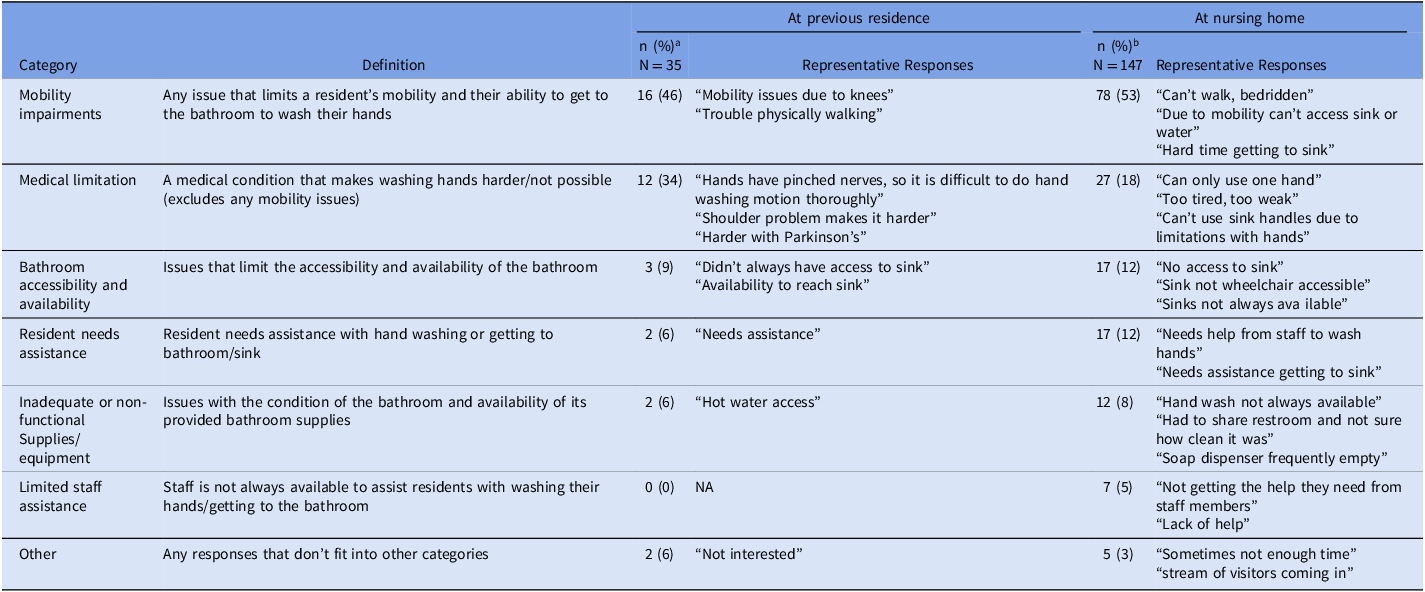
Thirty percent of residents reported facing a challenge or barrier to handwashing at the NH compared to 7% at their previous residence (Table 3). The challenges/barriers reported by residents were grouped into the following categories: mobility impairments, medical limitations, bathroom accessibility and availability, resident needs assistance, inadequate or non-functional supplies/equipment, limited staff assistance, and other. Table 4 shows the definition, the number of responses that corresponded to that category, and representative responses for each category. The most frequently reported challenge encompassing 46% of responses pertaining to residents’ previous residences and 53% of the responses pertaining to the NH was mobility impairments.
Thematic analysis of residents’ reported hand washing challenges

Table 4. Long description
A table comparing hand washing challenges faced by residents at previous residences and nursing homes. The table has 7 rows and 6 columns. Column headers are Category, Definition, At previous residence n (%), At previous residence N=35, At nursing home n (%), and At nursing home N=147. Row labels are Mobility impairments, Medical limitation, Bathroom accessibility and availability, Resident needs assistance, Inadequate or non-functional Supplies/equipment, Limited staff assistance, and Other. Each row provides the definition, the number of responses that corresponded to that category, and representative responses for each category. Mobility impairments are the most frequently reported challenge, encompassing 46% of responses pertaining to residents’ previous residences and 53% of the responses pertaining to the nursing home.
a 2 of the responses were categorized into multiple categories.
b 16 of the responses were categorized into multiple categories.
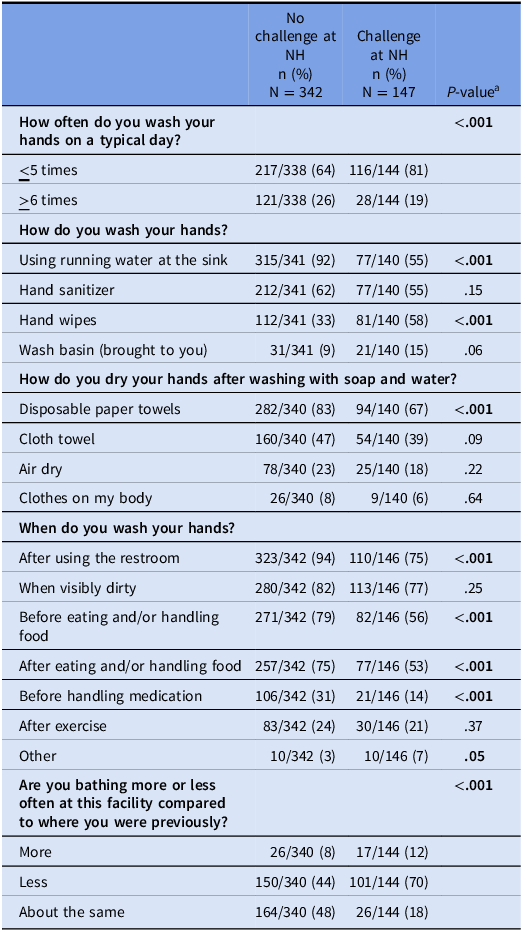
Residents who reported facing a challenge with handwashing at the NH washed their hands less frequently at the NH compared to those who did not. Residents with a reported handwashing challenge washed their hands less using running water at the sink (55% vs 92%, P < .001) and more often with hand wipes (58% vs 33%, P < .001). Residents with a handwashing challenge also washed their hands significantly less after using the restroom (75% vs 94%), before eating and/or handling food (56% vs 79%), after eating and/or handling food (53% vs 75%), and before handling medication (14% vs 31%) (Table 5).
Differences in handwashing and bathing habits among residents with a reported handwashing challenge at the nursing home compared to residents without a challenge

Table 5. Long description
The table presents data on handwashing habits among residents with and without a reported handwashing challenge at a nursing home. It has 11 rows and 5 columns. The columns are labeled ‘No challenge at NH n (%)’, ‘Challenge at NH n (%)’, and ‘P-value’. The rows are labeled with questions and options about handwashing frequency, methods, drying methods, and specific times for washing hands. Row 1: How often do you wash your hands on a typical day? Row 2: <5 times. Row 3: >=6 times. Row 4: How do you wash your hands? Row 5: Using running water at the sink. Row 6: Hand sanitizer. Row 7: Hand wipes. Row 8: Wash basin (brought to you). Row 9: How do you dry your hands after washing with soap and water? Row 10: Disposable paper towels. Row 11: Cloth towel. Row 12: Air dry. Row 13: Clothes on my body. Row 14: When do you wash your hands? Row 15: After using the restroom. Row 16: When visibly dirty. Row 17: Before eating and/or handling food. Row 18: After eating and/or handling food. Row 19: Before handling medication. Row 20: After exercise. Row 21: Other. Row 22: Are you bathing more or less often at this facility compared to where you were previously? Row 23: More. Row 24: Less. Row 25: About the same. The table shows the number and percentage of residents in each category for both groups, along with the P-value indicating the significance of the differences observed.
Results were considered statistically significant if the P-value was < .05 and are highlighted in bold.
a Significance evaluated using Pearson’s χ2 test.
Residents were also asked how often they were reminded to wash their hands (Supplement 3) and if they would use hand sanitizer if it were easily accessible (Supplement 4). Over half (53%) of residents reported never being reminded to wash their hands by staff members. While 60% of residents answered that they would use hand sanitizer if it were easily accessible, only 14% stated they already had easy access to hand sanitizer.
Resident bathing
When residents were asked if they bathed more or less often at the NH compared to their previous residence, 252 residents (51%) reported that they bathed less often. Of these 252 residents, 134 (53%) residents provided some “other” reason for bathing less often (Figure 1). These responses were categorized into the major themes of nursing home policy, medical limitations, mobility impairments, resident needs assistance, inadequate or non-functional supplies/equipment, limited staff assistance, personal choice, bathroom accessibility and availability, and other. Representative quotes provided by residents can be found in Figure 1. Nursing home policy was the most commonly reported theme with 54% of the responses referring to this theme. Seventy percent of residents who reported facing a challenge with handwashing said that they bathed less often at the NH compared to 44% of residents who did not face a handwashing challenge (Table 5).
Bathing habits of nursing home residents.
Note: a7 of the responses were categorized into multiple categories.

Discussion
We first examined the influence of a resident’s knowledge on their hand hygiene habits. Only 29% of residents correctly answered all three knowledge-based questions indicating a need for enhanced hand hygiene education. Educating residents on the proper length of time to effectively perform hand hygiene remains an important strategy for improving hand hygiene. In our study, 60% of respondents correctly answered the appropriate length of time for using soap and water and only 33% for using alcohol-based hand rub. As expected, residents who correctly answered more of the knowledge-based questions washed their hands more frequently at their previous residence highlighting the importance of hand hygiene education. However, knowledge was found to have less impact on hand hygiene habits at the NH suggesting structural barriers to hand hygiene while in the NHs.
At the NH, other factors, such as the handwashing challenges reported by residents, could be contributing to the lower hand hygiene frequency reported. We found that the frequency of hand hygiene among all residents was lower at the NH compared to residents’ previous residences including how often, when, and how residents wash their hands. When comparing residents with and without a handwashing challenge at the NH, residents with reported challenges washed their hands less often and fewer residents reported using running water at the sink to wash their hands (92% vs 55%). Mobility impairments affecting a resident’s ability to access the sink were the most commonly reported challenge followed by medical limitations that impaired handwashing ability. Targeted attention and staff assistance to these specific residents could be utilized to improve the hand hygiene habits in these groups.
Residents also mentioned inadequate or non-functional bathroom supplies, such as empty soap dispensers or not knowing whether the bathroom is clean, as barriers to handwashing. Regular inspections of bathrooms and their supplies could better ensure residents have the necessary supplies for proper hand hygiene. Also, providing other means of handwashing besides the sink, such as hand sanitizer or hand wipes, would promote improved hand hygiene as 60% of residents said that they would use hand sanitizer to clean their hands if it was easily accessible, while only 14% said they already had easy access to hand sanitizer. Iverson et al found that making alcohol-based hand sanitizer more accessible for HCP led to higher hand hygiene compliance.Reference Iversen, Hansen, Munster, Kristensen and Ellerman-Eriksen17 While requirements exist regarding hand sanitizer storage and placement of dispensers in facilities, steps to make them more accessible to residents should be investigated.18
Residents also reported needing help from staff with handwashing but noted that staff assistance was often limited or unavailable. We found that 53% of residents reported never being reminded or assisted with washing their hands. Staffing shortages remain a significant concern in NHs and likely contribute to these gaps in staff assistance.Reference Heiks and Sabine19 Resources and strategies aimed at staff recruitment and retainment are greatly needed to address this and to ensure residents receive a high quality of care.Reference Chen, Goodwin, Bailey, Bowblis, Li and Xu20 Also, incorporating hand hygiene reminders into existing staff-resident interactions and establishing a collaborative approach to educating and promoting proper resident hand hygiene by involving all staff with patient contact could reduce the added burden on staff members as smaller, manageable interventions have been found to make staff feel less overburdened.Reference Mills, Pimentel and Snow21,Reference Hu, Wang and Rui22 Further exploring the relationship between staffing levels and the frequency of resident hand hygiene would be valuable.
Residents’ responses to the two bathing questions indicate the need for changes to current policies regarding the frequency of resident bathing in NHs. About half (51%) of residents reported that they were bathing less at the NH compared to their previous residence. More than half of the “other” responses that residents provided for bathing less related to NH policy and that it is “the policy of the facility to bathe twice a week.” Endorsing a more resident-directed approach to bathing would better reflect a resident’s individual needs and improve quality of care.Reference Ebrahimi, Patel, Wijk, Ekman and Olaya-Contreras23 Moving away from a set frequency of bathing, such as the twice-a-week standard typically seen in NHs, would allow for an individualized approach to bathing that factors in a resident’s input on an appropriate frequency of bathing that meets their own desired needs, while also aligning with any specific medical needs the resident may have. Centers for Medicare and Medicaid Services (CMS) Section 483.24 emphasizes the importance of maintaining a resident’s quality of life and hygiene based on their own individual assessment and care plan.24 Considering different approaches to bathing, such as chlorhexidine bathing, could further improve patient outcomes.Reference Miller, McKinnell and Singh25 In addition, 70% of residents who reported facing a challenge with handwashing at the NH also said that they were bathing less often, making it especially important to focus on these residents as they may face physical or cognitive impairments that affect their ability to bathe as often. Ensuring that staffing levels are adequate, that staff are trained in proper bathing practices, and promoting more open communication in the facilities about the importance of an individualized approach to bathing could further aid in improving bathing practices in NHs.Reference Papathanasiou, Tzenetidis, Tsaras, Zyga and Malliarou26
A limitation of this study was that we only include residents who could provide their own consent and respond to survey questions themselves. As a result, this survey may not be generalizable to all NH residents. We would expect that residents who can’t consent for themselves would have greater challenges with performing hand hygiene and bathing, and our results do not address this. Additionally, this survey was administered verbally to residents potentially causing residents to be less forthcoming in their responses. However, residents would most likely overestimate how often and the instances in which they wash their hands, supporting our conclusion that NH resident hand hygiene does need to be improved and prioritized. Despite this being a survey and not direct observation of hand hygiene and bathing, resident perception of hygienic practices is critically important for creating a more home-like environment for residents.Reference Davis, Decort and Hart27 Lastly, while geographically diverse, the NHs that participated in this study may not be representative of all NH facilities.
In conclusion, survey results indicate NH residents perform hand hygiene and bathe less frequently at the NH compared to their previous residence. Addressing the handwashing challenges and barriers reported by residents through specific, targeted interventions could improve resident hand hygiene at the NH. Additionally, policy changes regarding the frequency of resident bathing and more comprehensive education on bathing procedures would further benefit residents and create an environment resembling a home.
Supplementary material
The supplementary material for this article can be found at https://doi.org/10.1017/ice.2026.10537.
Acknowledgements
None.
Financial support
This work is funded by the US Centers for Disease Control and Prevention, Contract number 75D30121D12704. The findings and conclusions in this report do not necessarily represent the official position of the Centers for Disease Control and Prevention.
Competing interests
JM reports receiving honoraria from hospitals and professional societies devoted to complication prevention for lectures and teaching related to prevention and value-based purchasing policies involving catheter-associated urinary tract infection and hospital-acquired pressure ulcers. KMJ reports employment with Wolters Kluwer. JPF reports research funding from Merck and Co, Inc.


 Open access

