INTRODUCTION
The Gulf of Gabès, located along the south-east coast of Tunisia, is endowed with rich aquatic resources contributing about 65% of the national fish production in Tunisia (CGP, 1996). On the other hand, several findings have provided evidence that zooplankton preys such as copepods make a major contribution to optimal growth and survival in fish (Daan, Reference Daan1989; Hop et al., Reference Hop, Tonn and Welch1997; Tudela & Palomera, Reference Tudela and Palomera1997) corals (Duineveld et al., Reference Duineveld, Lavaleye and Berghuis2004) and invertebrates (Leising et al., Reference Leising, Pierson, Halsband-Lenk, Horner and Postel2005). Therefore, it is important that quantitative information on copepod population dynamics in relation to environmental variables should be examined in the Gulf of Gabès. The distribution of copepod assemblages has been extensively studied along the European coasts (Bonnet et al., Reference Bonnet, Richardson, Harris, Hirst, Beaugrand, Edwards, Ceballos, Diekman, Lopez-Urrutia, Valdes, Carlotti, Molinero, Weikert, Greve, Lucic, Albaina, Yahia, Umani, Miranda, Dos Santos, Cook, Robinson and Fernandez de Puelles2005), in the Bay of Tunis (south-western Mediterranean Sea) (Souissi et al., Reference Souissi, Daly-Yahia Kefi and Daly-Yahia2000) and in the Tunis North Lagoon (south-western Mediterranean Sea) (Annabi-Trabelsi et al., Reference Annabi-Trabelsi, Daly-Yahia, Romdhane and Ben Maïz2005), while the Gulf of Gabès was poorly explored (Souissi et al., Reference Souissi, Daly-Yahia Kefi and Daly-Yahia2000). There is now good evidence that copepods are capable of extreme flexibility to environmental variability (Mauchline, Reference Mauchline and Blaxter1998; Aleya et al., Reference Aleya, Michard, Khattabi and Devaux2006) and hydrographic conditions (Mazzocchi & Ribera d'Alcala, Reference Mazzocchi and Ribera d'Alcala1995; Shih & Chiu, Reference Shih and Chiu1998; Calbet et al., Reference Calbet, Garrido, Saiz, Alcarz and Durate2001; Vidjak et al., Reference Vidjak, Bojanic, Kuspilic, Marasovic, Gladan and Brautovic2006). The objective of this work is to study, from the coast to the open water, the horizontal copepod summer distribution across the Mediterranean waters to Modified Atlantic Water (MAW) zones. The Gulf of Gabès in which advection prevailed in spring and Winter, and the MAW flows in the surface layer and weakens during the summer (Béranger et al., Reference Béranger, Mortier, Gasparini, Gervasio, Astraldi and Crepon2004) has been subjected to several investigations on phytoplankton (Drira et al., Reference Drira, Hamza, Bel Hassen, Ayadi, Bouaïn and Aleya2008, Reference Drira, Bel Hassen, Hamza, Rebai, Bouaïn, Ayadi and Aleya2009), marine bivalve Ruditapes decussates (Hamza-Chaffai et al., Reference Hamza-Chaffai, Pellerin and Amiard2003), pelagic anchovies (Souissi et al., Reference Souissi, Daly Yahia and Daly Yahia-Kéfi2001) and pollutants (Hamza-Chaffai et al., Reference Hamza-Chaffai, Amiard, Pellerin, Joux and Berthet2000), but data on the distribution of copepod assemblages are scarce or absent. This is, to our knowledge, the first contribution on the horizontal distribution of copepod assemblages in this area, with emphasis on the main environmental factors that might determine the distribution of the most abundant copepod species.
MATERIALS AND METHODS
Study site
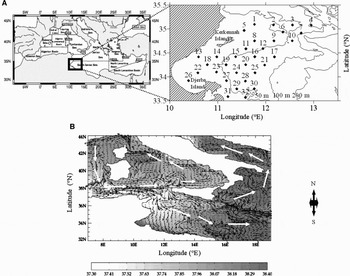
This study was conducted in the Gulf of Gabès located in the southern Ionian Sea (between 35°N and 33°N) (Figure 1A). It has a 700 km coastline stretching from the coastal zone of Tunis to the industrial town of Gabès. Its climate is dry (average annual precipitation: 210 mm year−1) and sunny with strong easterly winds resulting in severe aeolian erosion. The Gulf of Gabès opens to the offshore area and has a wide continental shelf. The tide is semidiurnal, with a maximum range of about 2 m. Lecombe & Tchernia (Reference Lecombe, Tchernia and Stanley1972) reported that a fraction of the MAW detached from the south of the Lampedusa Island (Italy) to invade the Gulf of Gabès and recirculated anticyclonally on the Tunisian shelf. These observations were corroborated by Béranger et al.'s (Reference Béranger, Mortier, Gasparini, Gervasio, Astraldi and Crepon2004) model which showed that the Algerian Current brought the upper layer eastwards and splits into two branches at the entrance of the Sicily Strait, one flowing to the Tyrrhenian Sea, the other into the Sicily Strait. The latter is composed of two streams referred to as the Atlantic Ionian Stream (AIS) and the Atlantic Tunisian Current (ATC). Along the Tunisian coast and during the cold period (winter–spring) (Figure 1B), the salinity of the MAW was low (37.3 to 37.5 psu) very close to that of the superficial layers. Conversely, during the warm season, the salinity increased strongly (38 psu) and pronounced local circulation patterns were detected, most likely linked to a decline in the east in the MAW-induced advection (Béranger et al., Reference Béranger, Mortier, Gasparini, Gervasio, Astraldi and Crepon2004).
Geographical map focusing on the zooplankton sampling stations in the Gulf of Gabès (A). Scheme of the surface circulation based on simulation model superimposed to the mean surface salinity in January 2001 (adapted from Béranger et al., Reference Béranger, Mortier, Gasparini, Gervasio, Astraldi and Crepon2004) (B).

Sampling
Samples for zooplankton, phytoplankton and nutrients compounds were collected in July 2005 in 32 stations in the Gulf of Gabès (Figure 1A). The coastal water depth in 18 sampling stations (Stations 1, 2, 3, 5, 6, 8, 9, 11, 12, 13, 14, 18, 22, 23, 26, 27, 31 and 32) was < 50 m and offshore water depth in the remaining 14 stations (Stations 4, 7, 10, 15, 16, 17, 19, 20, 21, 24, 25, 28, 29 and 30) was > 50 m.
Physico-chemical factors
Water samples for physico-chemical analyses were collected by a seabird conductivity–temperature–depth (CTD) sensor (SBE 9, Seabird Electronics, USA) equipped with 12 l Niskin bottles CTD from 3 different depths (surface, middle of water column and bottom) in stations < 50 m deep; and from 5 various depths (surface, –10 m, –20 m, thermocline and bottom) in stations > 50 m deep. The pH was measured immediately after sampling using a Met Röhm® type pH meter. Samples for chemical analyses (nitrite, nitrate, ammonium, orthophosphate, silicate, total nitrogen and total phosphate) were collected in the 32 stations and stored at –20°C until analysis with an automatic BRAN and LUEBBE type 3 analyser. Concentrations were determined colorimetrically according to Grasshof (Reference Grasshof, Grasshoff, Ehradt and Kremling1983).
Zooplankton
Zooplankton was collected at the previously mentioned 32 stations using a cylindro-conical net (30 cm aperture, 100 cm height and 100 µm mesh size) equipped with a Hydro-Bios flowmeter. The net was towed obliquely from a depth near the bottom to the surface in each station during day and at night at a mean speed of 1 m s−1 for 10 minutes. After collection, zooplankton samples were rapidly preserved in 2% buffered formaldehyde solution. They were stained with rose Bengal to identify internal tissues of the different zooplankton species and also to facilitate dissection of copepods. Zooplankton samples, especially planktonic copepods, were identified according to Rose (Reference Rose1933) and Bradford-Grieve et al. (Reference Bradford-Grieve, Markhaseva, Rocha and Abiahy1999) and sorted into four demographic classes (nauplii, copepodits, adult males and adult females). The tintinnids and other meta-zooplankton such as Appendicularia, Lamellibranchia, Neogasteropoda, Doliolida, Cladocera, Ostracoda, Radiolaria, Mysidacea, Amphipoda, Siphonophora, Achantaria and the Foraminifera were also counted according to Tregouboff & Rose (Reference Tregouboff and Rose1978a, Reference Tregouboff and Roseb). Enumeration was performed under a vertically mounted deep-focus dissecting microscope (Olympus TL 2). The zooplankton density was expressed as:  , where N = number of individuals sampled, r = 15 cm: half of the diameter of the plankton net and s = turn numbers shown by the flowmeter.
Species diversity was assessed by the Shannon diversity index (Shannon & Weaver, Reference Shannon and Weaner1949). The dominance index for the copepods is calculated according to the formula δ = (n1+n2)/N, where δ is the dominance index that is equal to the percentage of contribution of the two most important species (n 1+n 2) of the total standing stock and N the total individual abundance.
Phytoplankton and chlorophyll-a
For phytoplankton analyses, seawater samples (1 l) were collected by CTD from both the neritic (surface, middle of water column and bottom) and open sea (surface, –10 m, –20 m, thermocline and bottom) areas. After fixation with Lugol (4%) iodine solution (Bourrelly, Reference Bourrelly1985), the samples were stored in the dark at low temperature until enumeration. Sub-samples (50 ml) were enumerated under an inverted microscope using the Utermöhl method (Reference Utermöhl1958). Identification of algal taxa was achieved according to Tregouboff & Rose (Reference Tregouboff and Rose1957), Huber-Pestalozzi (Reference Huber-Pestalozzi1968), Dodge (Reference Dodge1985), Balech (Reference Balech1988) and Tomas et al. (Reference Tomas, Hasle, Steidinger, Syvertsen and Tangen1996). Samples for chlorophyll-a analysis were filtered by vacuum filtration onto Whatman GF/F glass fibre filter. Filters were then immediately stored at –20°C. Pigment analysis was performed by HPLC according to Pinckney (Pinckney et al., Reference Pinckney, Richardson, Millie and Paerl2001).
Statistical analyses
The data recorded in this study were submitted to a canonical correspondence analysis (CCA) (Ter-Braak, Reference Ter-Braak1986). Physical (temperature, salinity, sigma-t, pH and suspended matter), chemical (NO3−, NO2−, NH4+, PO43−, T-N, T-P, N/P ratio and Si(OH)4) and biological parameters (31 copepods species, total phytoplankton, Dictyochophyceae, Bacillariophyceae, Dinophyceae, Cyanobacteriae, Euglenophyceae and tintinnids densities and chlorophyll-a concentration) assessed by over 32 observations (32 stations) were considered.
Cluster analysis (CA) was performed using PRIMER v5.0 for Windows XP (Clarke & Gorley, Reference Clarke and Gorley2001) to identify different copepod groups, clustering the samples with a similar species composition. CA was undertaken according to the Ward-algorithmic method. Results were illustrated in a dendrogram where steps in the hierarchical clustering solution and values of the squared Euclidean distances between clusters were shown.
ANOVA was applied to identify significant differences between the coastal and oceanic areas for each biological and physico-chemical parameter studied.
RESULTS
Physico-chemical parameters
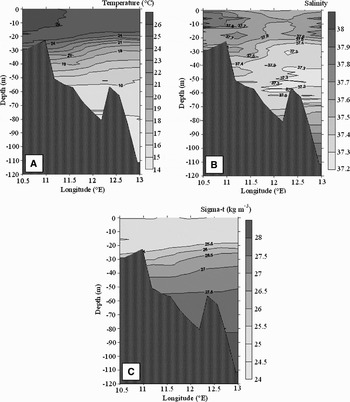
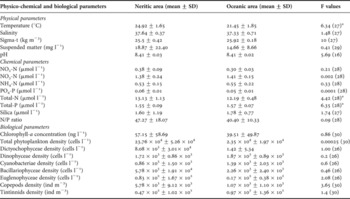
The water temperature varied from 14 to 26°C (mean±SD = 23.07±2.47°C) (Figure 2A), increasing from the offshore to the coast and from the bottom to the surface. Temperature in coastal samples (mean±SD = 24.92±1.65°C) was higher than in the open sea (mean±SD = 21.45±1.85°C) (Table 1; Figure 2A). The water column was strongly stratified with a thermocline establishing at nearly 25 m in depth. Salinity varied from 37.2 to 38 psu (mean±SD = 37.52±0.29 psu), with the lowest values (37.2–37.4 psu) being recorded at a mean depth of 65 m between 11°E and 13°E, and the highest in coastal waters at a mean depth of 33 m between 10.5°E and 11°E (Figure 2B). The vertical distribution in salinity exhibited a surface longitudinal gradient. Sigma-t ranged between 24 and 29 kg m−3 (mean±SD = 25.6±0.41 kg m−3) (Figure 2C), decreasing from the coast (<50 m) to the open sea. The depth-integrated sigma-t and temperature showed that the distribution of sigma-t was driven primarily by temperature (Figure 2A, C). Sigma-t is overall negatively correlated with salinity but not significantly (r = –0.183, N = 32, P < 0.05) (Figure 2B, C). This relation was particularly clear at 50 m depth in Stations 1, 4, 9, 10, 11 and 14 where increases in sigma-t coincided with low salinity. This result suggests the presence of Atlantic waters in the Gulf of Gabès, flowing between two layers having both high salinity and low sigma-t (Figure 2B, C). However, the low sigma-t and high salinity recorded in coastal samples were probably relatable to water evaporation.
Contour plots of temperature (A) salinity (B) and sigma-t (C) along a longitudinal gradient in the 0–120 m layer.

Mean values and standard deviation (SD) of several biological and physico-chemical parameters in neritic and oceanic areas of the Gulf of Gabès. In the last column are shown results of one-way ANOVA. F values: between-groups mean square/within-groups mean square. *Significant difference between neritic and oceanic areas: (*P < 0.05).

The physico-chemical variables (nitrite, nitrate, ammonium, total nitrogen, orthophosphate, total phosphate, silica, N/P ratio and pH) and chlorophyll-a studied during this survey are given in Table 1. Concentrations in nutrients were generally homogeneous throughout the sampled stations. Apparent station-to-station differences were obvious for total nitrogen whose concentration was slightly higher in neritic (13.13±1.13 µmol l−1) than in oceanic (12.19±0.48 µmol l−1) areas, as for total P with 1.55±0.09 and 1.57±0.07, respectively. The distribution of the pH was homogenous in both areas.
Spatial distribution of zooplankton populations
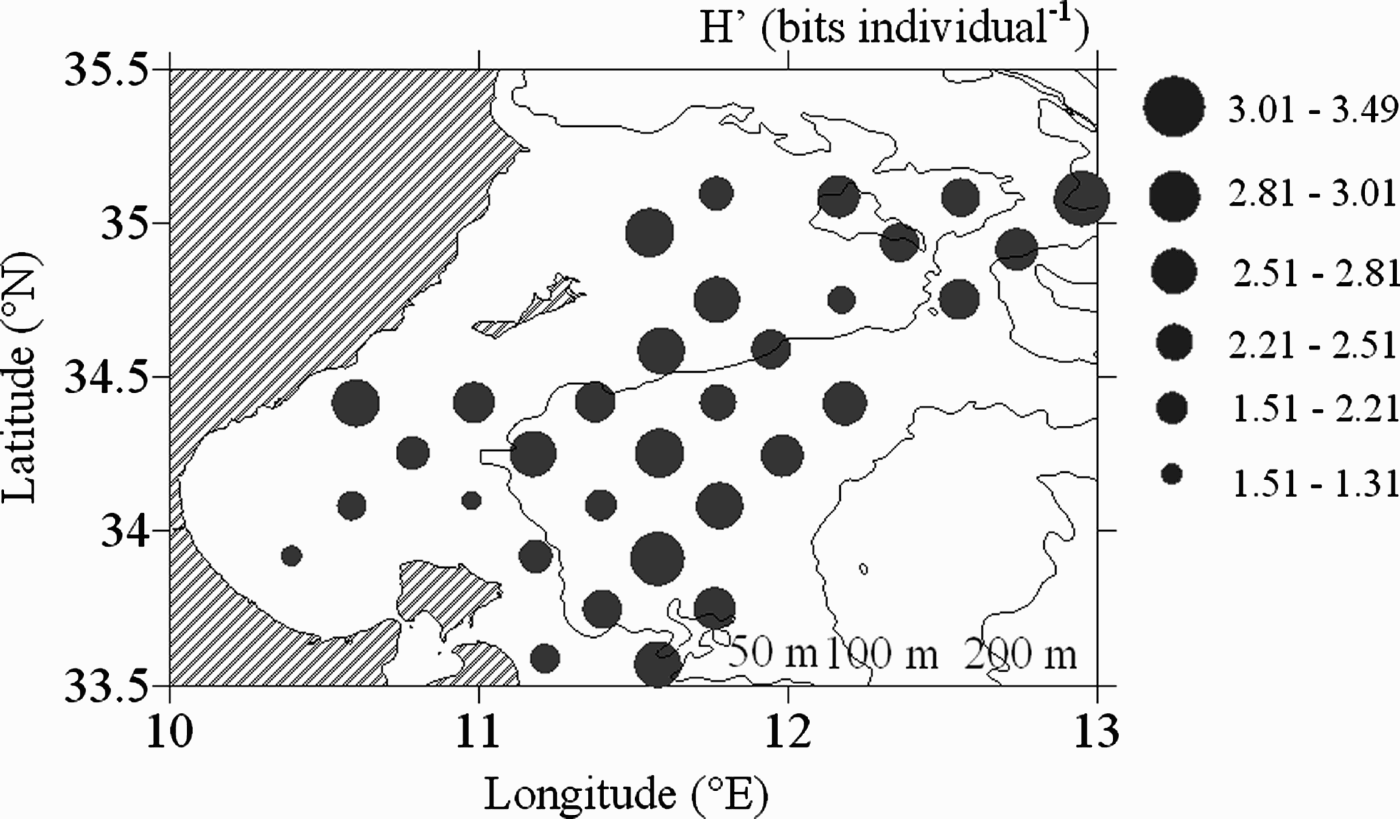
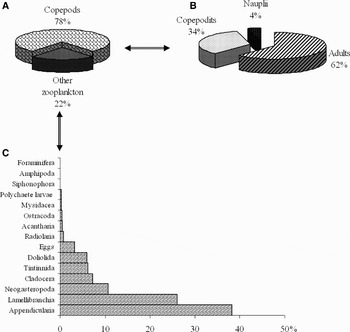
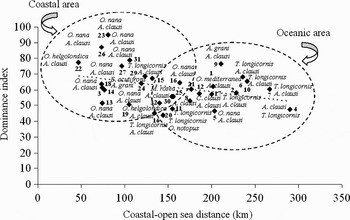
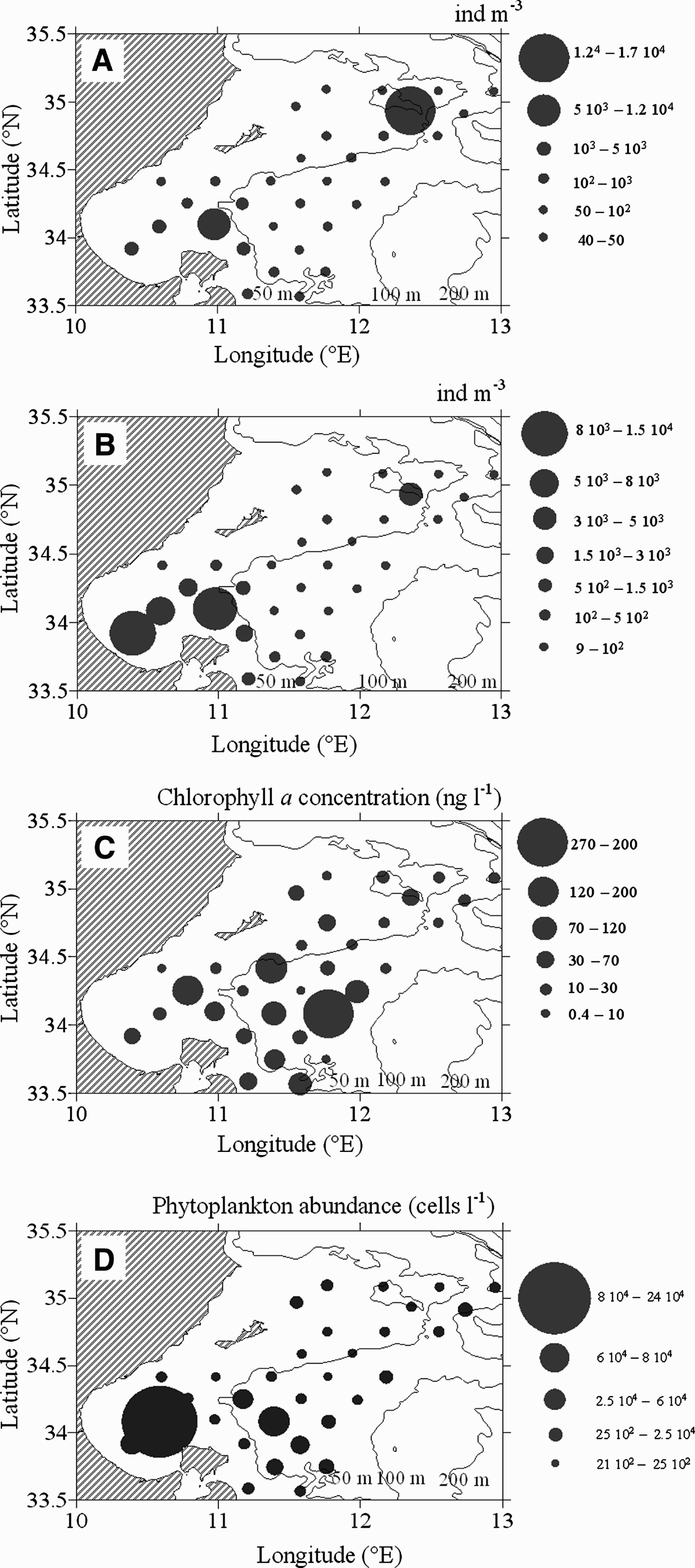
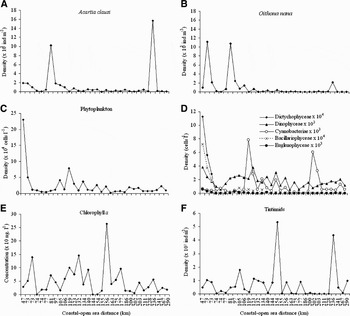
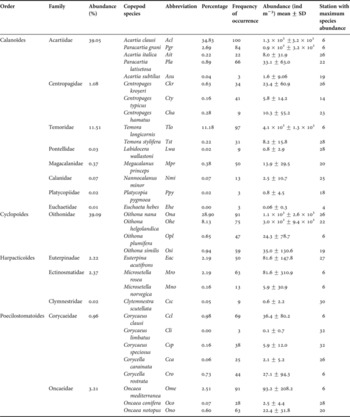
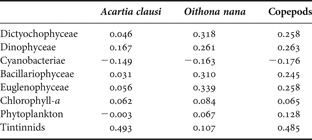
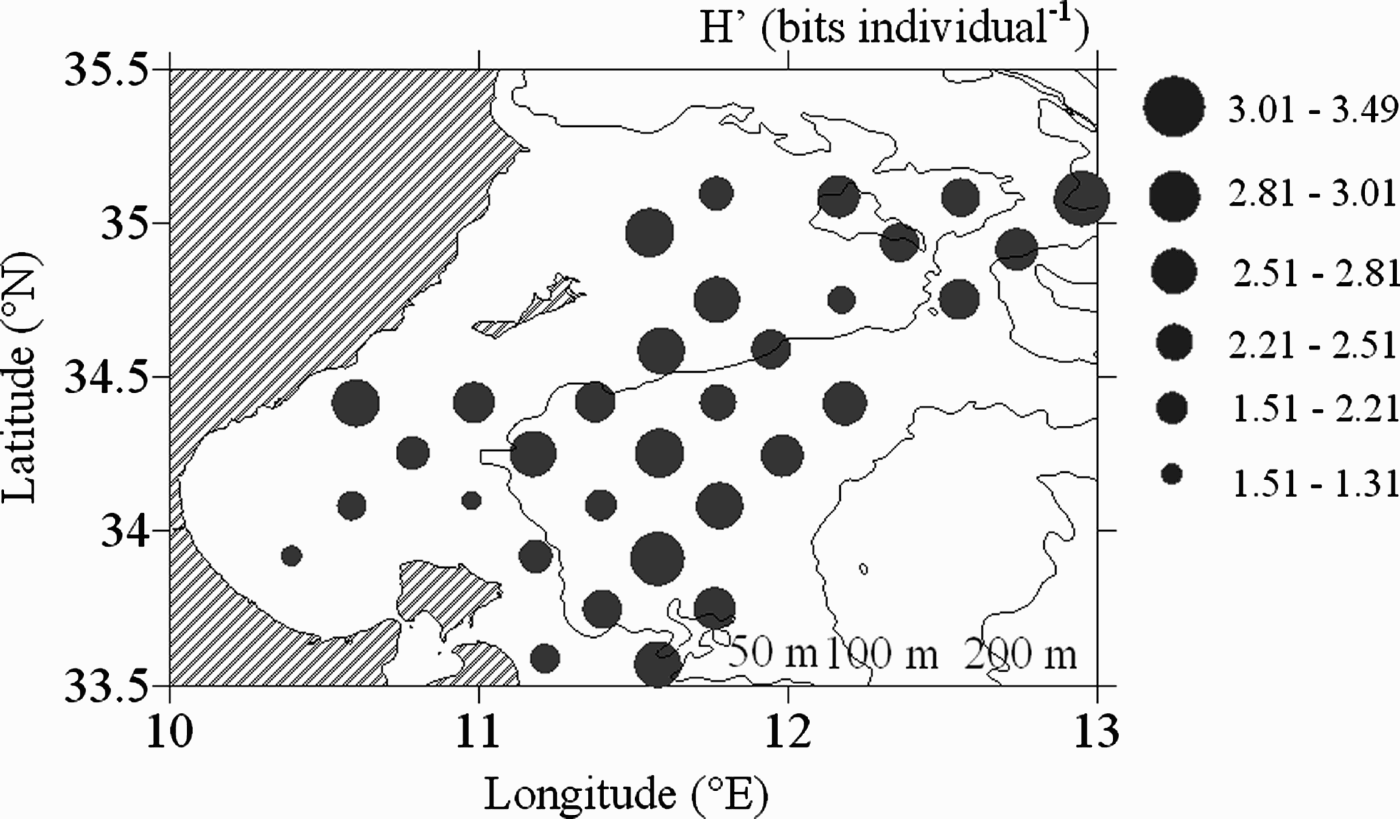
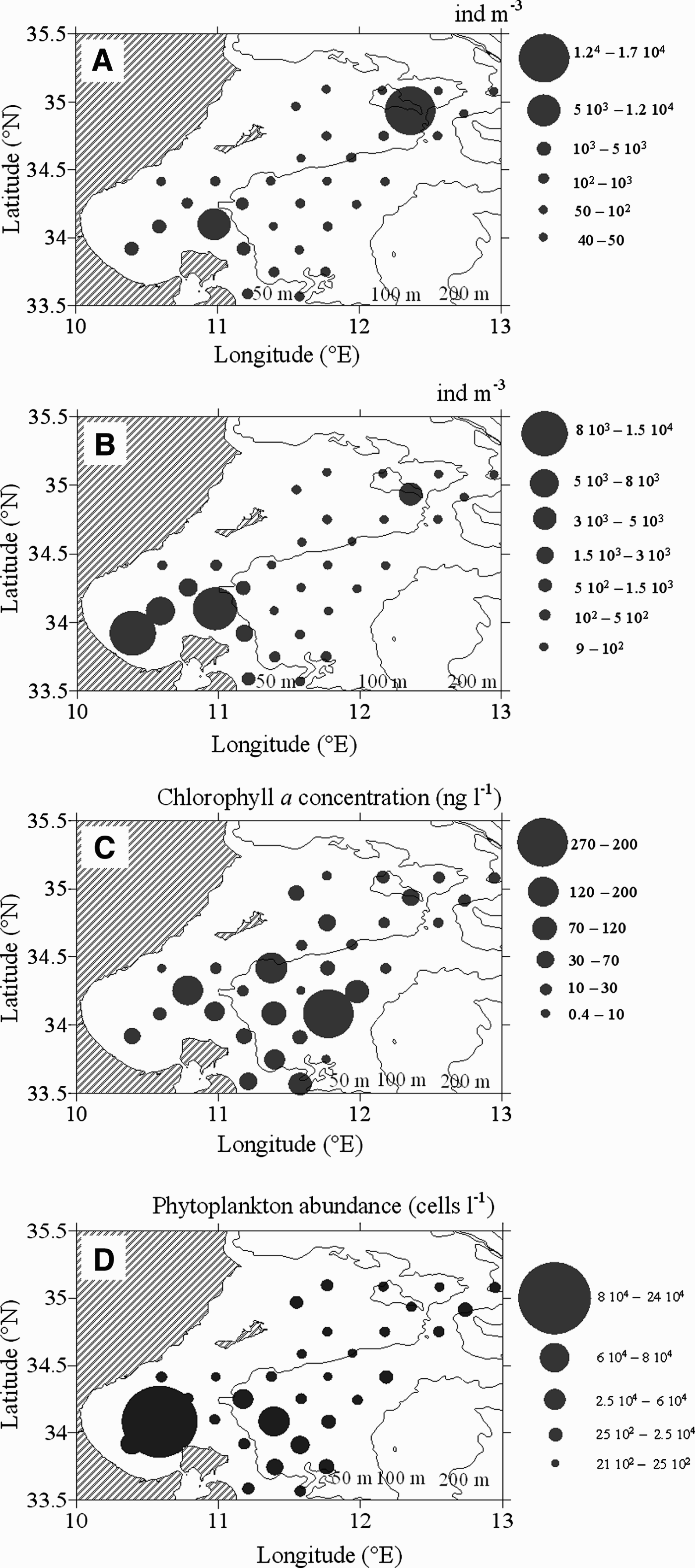
Zooplankton assemblages in the Gulf of Gabès were dominated by copepods with a total of 31 species. The diversity of the copepod community increased from the coast (H′ = 1.34 bits individual−1, 10 species) in Station 26 to the open sea where H′ reached a maximum (3.47 bits individual−1) (mean±SD = 2.55±0.50 bits individual−1) in Station 4 (Figure 3) due to the presence of 20 copepod species, accounting for 78% of the total zooplankton abundance (Figure 4A). We observed high numbers of adults (62%) with a clear female dominance (79%), and low larval stage numbers (copepodits 34% and nauplii 4%) (Figure 4B). The other zooplankton species (22%) showed a broad size spectrum ranging from (131.9±60.6 µm) for Tintinnida to (567.1±419.5 µm) for Neogasteropoda (Figure 4C). A total of 14 copepod families were found in all stations, with Acartiidae and Oithonidae dominating the total abundance (39.05 and 39.09%, respectively) (Table 2). Among the species representing Acartiidae and Oithonidae, Acartia clausi (53% of the Acartiidae) and Oithona nana (75% of the Oithonidae) were the most abundant with an average of 1.3 × 10³±3.2 × 10³ individuals m−3 recorded in Stations 6 and 1.1 × 10³±2.6 × 10³ individuals m−3 in Station 26, respectively (Table 2). Abundance of Acartiidae was overall higher near 50 m bathymetry than in coastal waters, whereas the reverse was observed for Oithonidae which developed abundantly in the coastal zone. Indeed, a significant negative correlation (r =−0.817; N = 32, P < 0.05) was found between the dominance index and distance from the coast (Figure 5). The genus Oithona dominated in the coastal zone while the genus Acartia proliferated in the off-shore zone near 50 m bathymetry. The genus Temora was found in substantial amounts between the coastal (2.37 × 10² ind m−3) and oceanic areas (1.63 × 10² ind m−3) (Figure 5). The spatial distribution of dominant zooplankton families (Figure 6A) illustrates high copepod density (1.7 × 10⁴ ind m−3) at 50 m depth, in the northern part of the Gulf of Gabès, associated with Acartiidae proliferation. Oithonidae aggregations were exclusively concentrated in coastal samples (1.1 × 10⁴ ind m−3) (Figure 6B). Chlorophyll-a concentration was slightly more important in coast (57.15±58.69 ng l−1) than in offshore (39.51±49.87 ng l−1) samples (Table 1; Figure 6C). The phytoplankton community was more abundant in the coast of the Gulf of Gabès (mean±SD = 23.76 × 10⁴±5.26 × 10⁴ cells l−1) than in the oceanic area (mean±SD = 2.35 × 10⁴±1.97 × 10⁴ cells l−1) (Table 1; Figure 6D). Acartia clausi and Oithona nana spatial distribution and abundances with the prevailing potential preys (tintinnids and phytoplankton taxa) according to coastal–open sea distance is illustrated in Figure 7. The coastal distribution of Oithona nana was significantly correlated with phytoplankton groups such as Dictyochophyceae which were exclusively neritic (r = 0.318, N = 32, P < 0.05), Dinophyceae (r = 0.261, N = 32, P < 0.05), Bacillariophyceae (r = 0.310, N = 32, P < 0.05) and Euglenophyceae (r = 0.339, N = 32, P < 0.05). However, we did not detect a significant correlation between abundances of O. nana and tintinnids (r = 0.107, N = 32, P < 0.05) (Figure 7). This contrasted with the distribution of A. clausi whose abundances were significantly correlated with those of tintinnids (r = 0.493, N = 32, P < 0.05), but non-significant correlations were found between A. clausi and the aforementioned phytoplankton groups (Table 3).
Distribution of the diversity index (bits. individual−1) for the copepod community.
Contribution of copepods and other zooplankton to total zooplankton (A), the relative contributions of nauplii, copepodits and adult to the total copepod abundance (B) and of the other zooplankton groups (C).

Relationships between the dominance index and distance to the coast. The two most dominant species are indicated for each sampled station.

Contour plots of the most dominant zooplankton families in the Gulf of Gabès: (A) Acartiidae; (B) Oithonidae; (C) chlorophyll-a concentrations; and (D) the total phytoplankton density. Zooplankton and phytoplankton abundances are expressed as individuals m−3 and cells l−1, respectively.
Spatial distribution densities of Acartia clausi (A), Oithona nana (B), phytoplankton (C), the several phytoplankton taxa (D), the chlorophyll-a concentrations (E) and tintinnids density (F).

Taxonomic composition of the copepod community in the Gulf of Gabès during July 2005 and some quantitative aspects. Stations with maximum abundance are listed for each taxon.

Correlation matrix (Pearson test) made with XL-Stat for dominant copepod species (Acartia clausi and Oithona nana) in the Gulf of Gabès with the main phytoplankton taxa, chlorophyll-a and tintinnids (P < 0.05).

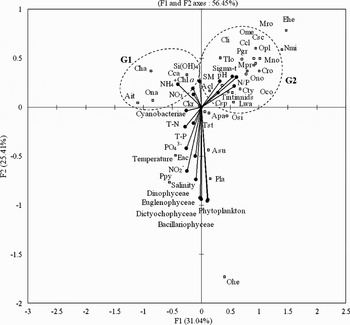
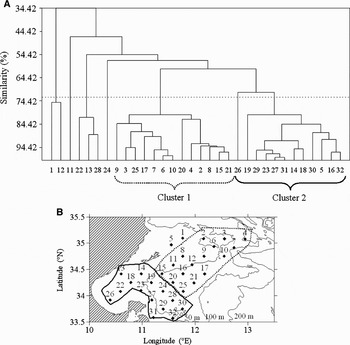
The canonical correspondence analysis (CCA) which confirms our previous observations allowed the discrimination of two groups around the F1 and F2 axes components (Figure 8), explaining 56.45% of the variance. These axes components selected positively the group G1 with O. nana correlated with several physico-chemical (nitrate, ammonium and silicate) and biological (chlorophyll-a) and the group G2 mainly constituted by A. clausi which was with several physico-chemical (sigma-t, pH, suspended matter and N/P ratio) and biological (tintinnids, r = 0.493, N = 32, P < 0.05) variables (Figure 8). The dendrogram from the cluster analysis illustrates 2 groups of species at a linkage distance 60%: cluster 1 (Stations 2, 3, 4, 6, 7, 8, 9, 10 15, 17, 20, 21 and 25) dominated by A. clausi (near 50 m bathymetry) and cluster 2 (Stations 14, 18, 19, 23, 26, 27, 29, 30, 31 and 32) dominated by O. nana (coastal) (Figure 9A, B).
Canonical correspondence analysis (CCA) made on the abundance of different copepod species and selected environmental variables in the Gulf of Gabès during July (summer). Same abbreviations as in Table 2.

Dendrogram of the Euclidean distance between the sampled stations (A). The two identified clusters are highlighted in the map (B).

DISCUSSION
This study indicates that copepods were the most abundant zooplankton in the Gulf of Gabès, (78% of total zooplankton, 14 families). Similar results were reported in the Tunis North Lagoon (70%; Annabi-Trabelsi et al., Reference Annabi-Trabelsi, Daly-Yahia, Romdhane and Ben Maïz2005), in the Bay of Tunis (40%; Daly Yahia et al., Reference Daly Yahia, Souissi and Daly Yahia-Kéfi2004), in the Alborán Sea (western Mediterranean) (66–71%; Gaudy & Youssara, Reference Gaudy and Youssara2003) and in the Algerian Basin (72%; Riandey et al., Reference Riandey, Champalbert, Carlotti, Taupier-Letage and Thibault-Botha2005). In the Balearic Sea, copepods were also the most abundant group (54%; Fernandez de Puelles et al., Reference Fernandez de Puelles, Valencia and Vicente2004). The species O. nana and A. clausi were the most abundant copepods found in coast samples and near 50 m bathymetry, respectively. The prevalence of these two taxa was otherwise reported for the Bay of Tunis (Daly Yahia et al., Reference Daly Yahia, Souissi and Daly Yahia-Kéfi2004), the Mondego Estuary southern arm (western Portugal) (Vieira et al., Reference Vieira, Azeiteiro, Ré, Pastorinho, Marques and Morgado2003) and the Algerian Basin (western Mediterranean Sea) (Riandey et al., Reference Riandey, Champalbert, Carlotti, Taupier-Letage and Thibault-Botha2005). Oithona nana was also observed in tropical seagrass beds where copepods were able to resist water movements (Emery, Reference Emery1968). The dominance of O. nana and A. clausi in various marine ecosystems was inferred to their adaptive strategies (Lee & McAlice, Reference Lee and McAlice1979; Riccardi & Mariotto, Reference Riccardi and Mariotto2000), allowing them to perform well in a large spectrum of existing conditions such as temperature (Lee & McAlice, Reference Lee and McAlice1979; Riccardi & Mariotto, Reference Riccardi and Mariotto2000) and salinity (Miller & Marcus, Reference Miller and Marcus1994; Gaudy et al., Reference Gaudy, Cervetto and Pagano1998; Cervetto et al., Reference Cervetto, Gaudy and Pagano1999). For example, despite the intensive urban pressure exerted on the Tunis North Lagoon, O. nana was the dominant neritic copepod sampled in this area (Annabi-Trabelsi et al., Reference Annabi-Trabelsi, Daly-Yahia, Romdhane and Ben Maïz2005). Our study from the polluted Gulf of Gabès and those from the Tunis North Lagoon (Annabi-Trabelsi et al., Reference Annabi-Trabelsi, Daly-Yahia, Romdhane and Ben Maïz2005) showed that O. nana under this latitude was also able to overcome environmental constraints and was significantly correlated with water temperature (r = 0.350, N = 32, P < 0.05). Concerning Acartia clausi which was abundant near 50 m bathymetry, we infer that this species might have escaped the high salinity (38 psu) of the coastal area of the Gulf of Gabès, as suggested by the negative correlation obtained between its abundance and water salinity but not significantly (r = –0.150, N = 32, P < 0.05). Acartia clausi exhibited a high spectrum of distribution in the Mediterranean Sea, being neritic in the Balearic Sea (Fernandez de Puelles et al., Reference Fernandez de Puelles, Gras and Hernandez-Leon2003) or spreading in the open sea of the western occidental Mediterranean Sea (Vives, Reference Vives1978). This species was also present in high numbers from other Mediterranean ecosystems (Blanc et al., Reference Blanc, Leveau and Kerambrun1975; Benon et al., Reference Benon, Blanc, Bourgade, Charpy, Kantin, Kerambrun, Leveau, Romano and Sautriot1976; Calbet et al., Reference Calbet, Garrido, Saiz, Alcarz and Durate2001) and Atlantic temperate regions (Heinle, Reference Heinle1966; Jeffries, Reference Jeffries and Lauff1967; Richardson et al., Reference Richardson, John, Irigoien, Harris and Hays2004). We found O. nana in both the coastal and oceanic zones of the Gulf of Gabès (<220 km from the coasts), which highlights the epiplanktonic characteristics of this species (Giron, Reference Giron1963). Other studies indicated that Oithona sp. dominated in summer in the Bay of Blanes (coastal north-western Mediterranean Sea) (Calbet et al., Reference Calbet, Garrido, Saiz, Alcarz and Durate2001) and in the Tunis North Lagoon (Annabi-Trabelsi et al., Reference Annabi-Trabelsi, Daly-Yahia, Romdhane and Ben Maïz2005). Moreover, copepods feeding on tintinnids (Kleppel et al., Reference Kleppel, Holliday and Pieper1991; Gifford, Reference Gifford1993; Fessenden & Cowles, Reference Fessenden and Cowles1994; Atkinson, Reference Atkinson1996) diatoms, flagellates, sinking aggregates and faeces (Dagg, Reference Dagg1993; Gifford, Reference Gifford1993; Kobari et al., Reference Kobari, Shinada and Tsuda2003) have been reported for various coastal waters. In our study, O. nana was well adapted to high salinity (r = 0.838, N = 32, P < 0.05) and has probably preyed on various phytoplankton groups (Table 3; Figure 7). This contrasted with A. clausi which most likely was able to digest animal food such as tintinnids. These loricate ciliates were quantitatively important and probably accounted for a major fraction in the diet of suspension-feeding copepods going in line with other findings (Stoecker & Capuzzo, Reference Stoecker and Capuzzo1990; Šimek et al., Reference Šimek, Bobkova, Macek, Nemoda and Psenner1995). Therefore, a substantial amount of the ciliate biomass was probably cleared by these filter-feeding copepods which have also been found in other aquatic environments to efficiently ingest protozoans (Lampert et al., Reference Lampert, Fleckner, Rai and Taylor1986; Atkinson Reference Atkinson1996) as well as in laboratory conditions (Tiselius, Reference Tiselius1989; Hartmann et al., Reference Hartmann, Taleb, Aleya and Lair1993; Pérez et al., Reference Pérez, Dolan and Fukai1997). The cyclopoid morphology may express a greater ability of flexibility to environmental constraints than calanoids (Paffenhöfer, Reference Paffenhöfer1993). Indeed, studies in the Mediterranean showed that, although cyclopoid copepods are known to develop in spring, they were also found in high numbers in winter (Mazzocchi & Ribera d'Alcalà, Reference Mazzocchi and Ribera d'Alcala1995; Siokou-Frangou, Reference Siokou-Frangou1996). In other studies, Acartia clausi was found in the open sea (Lakkis, Reference Lakkis1976; Gucu, Reference Gucu1987); however, because of its inability to feed on phytoplankton below a certain cell concentration (Thor, Reference Thor2000), it might be confined to near-shore environments. In our study, given that Oithonidae and Acartiidae families clustered at 50 m and deeper, respectively (Figure 9), we suspect the environmental conditions such as temperature and salinity and the prey availability as being probably the most important factors shaping the zooplankton community in the Gulf of Gabès. The low chlorophyll-a concentration recorded in the open sea suggests that phytoplankton might be nutrient-limited, particularly the phosphate concentrations were rather low and yielded high N/P ratio (Table 1). Indeed, the first cluster (<50 m) was exclusively found within the zone of minimum chlorophyll-a concentration, suggesting efficient grazing activities; whereas the second cluster which included both high and low chlorophyll-a concentrations was probably an indicator of the poor ability of copepods to select their preys. However, the copepods belonging to the Acartiidae group, particularly Acartia clausi, which developed near 50 m bathymetry (low chlorophyll-a concentrations), appeared to be both non-opportunistic and omnivorous (Cotonnec et al., Reference Cotonnec, Brunet, Sautour and Thoumelin2001). Similar results were reported for the Tunis North Lagoon, in which Acartia clausi has been identified as a non-opportunistic feeder adapted to low chlorophyll-a concentrations, and has also been suggested as an omnivorous species (Annabi-Trabelsi et al., Reference Annabi-Trabelsi, Daly-Yahia, Romdhane and Ben Maïz2005).
CONCLUSION
This study indicates that copepods were the most abundant zooplankton in the Gulf of Gabès, with O. nana and A. clausi spreading abundantly along the coast and near 50 m bathymetry, respectively. The spatial distribution of dominant species seems to be dependent on salinity and probably on their capability of exploiting a wide range of food resources including phytoplankton or animal preys (e.g. tintinnids). We make the hypothesis that copepods may serve as a substantial food link towards higher trophic levels of this area. Obviously, future studies are needed to elucidate these relationships over a seasonal survey of the zooplankton community structure embracing the same transect.
ACKNOWLEDGEMENTS
This work was supported by the Tunisian funded project POEMM (LR02INSTM04) conducted in the National Institute of Marine Sciences and Technologies (INSTM) and Biodiversity and Aquatic Ecosystems UR/05ES05 Unit Research of the University of Sfax. The authors wish to thank the crew of the RV ‘Hannibal’ for their assistance and the participants to the cruise ‘ESPOIR 6’. This study was conducted in the framework of the PhD of Zaher Drira (UMR CNRS 6249 of University of Franche-Comté: France–University of Sfax: Tunisia).