1. Introduction
There is a long history of scholarship suggesting that the title ‘the elect lady’ (ἐκλεκτὴ κυρία) in 2 John 1 may symbolically represent ‘a church’ rather than refer to an actual woman leader.Footnote 1 For instance, Hans-Josef Klauck posits that ‘the elect lady’ is referred to by a rhetorical device of fictio personae, in which a community is personified as an individual.Footnote 2 Georg Strecker, in defining 2 John as a community letter, suggests that through ‘the elect lady’ (ἐκλεκτὴ κυρία), the author of 2 John refers to the community that receives this letter as ‘the elect lady’.Footnote 3 R. Alan Culpepper, writes ‘… it is generally agreed that this title [i.e. the elect lady] refers to a sister church’.Footnote 4 Paul Trebilco mentions the following: ‘Given that “the elect lady” is almost certainly a symbolic designation for the church, her “children” are members of that church.’Footnote 5
In particular, Raymond E. Brown regards ‘the elect lady’ as representing a local church rather than the universal church. He provides the evidence to support the interpretation that it is a reference to a church or congregation, as follows.Footnote 6 Firstly, he points out that in the Hebrew Bible, Israel is referred to as a maiden (e.g. Jeremiah 31.21, etc.) and a daughter (e.g. Jeremiah 6.23; Lamentations 4.2–3, etc.), while in Acts 18–19, the church is symbolically represented as a woman (cf. Galatians 4.25–6). Furthermore, there are several instances in early Christian writings where the communities of the saints are called ἐκλεκτή (the chosen or the elect; e.g. Romans 8.33; Colossians 3.12; 2 Timothy 2.10; Revelation 17.14; the Shepherd of Hermas; Tertullian, Ad martyras). Brown also notes instances in the epigraphic evidence where κυρία ἡ ἐκκλησία is used and suggests translating it as ‘lady congregation’ based on its BAGD’s category. Specifically, Brown points out that in early Christian literature, the Shepherd of Hermas refers to the church as an elderly woman which is addressed as κυρία (Vis. 3.1.3), and Tertullian addresses the church as domina mater ecclesia (Lady mother church; Ad martyras 1.1).Footnote 7
Brown’s interpretation, however, warrants several critiques. While in the Shepherd of Hermas, the church is symbolised as a feminine figure (see Vis. 2.4.1; 3.3.3), especially, an elderly woman or a woman elder (ἡ πρεσβυτέρα [Vis. 2.1.3; 3.1.2; 3.10.6; 3.10.9, etc.]), the term κυρία is not used to represent the church. Instead, it is simply used as a title to address πρεσβυτέρα (an elderly woman who symbolises the church) in the given context (e.g. ‘Hello, lady [κυρία]’ [Vis. 1.2.2; see also 2.1.3]; ‘Lady [κυρία], to which part of the field?’ [Vis. 3.1.3; see also 3.3.1; 3.4.3; 3.6.5; 3.8.6; 4.2.2, etc.]).Footnote 8
In a similar manner, an angel or shepherd is addressed with the vocative κύριε in Vis. 4.3.1; 4.1.1; 6.1.1, etc. However, it is unreasonable to assume that the term κύριος symbolises an angel in the Shepherd in Hermas. For the same reason, it cannot be inferred that the title κυρία was used as a symbol of the church in the Shepherd of Hermas. Thus, both κύριε and κυρία are simply employed as polite forms of address for superior figures in the Shepherd in Hermas.
The phrase domina mater ecclesia (lady mother church) mentioned by Tertullian (Ad martyras 1.1) reflects the concept of the church as the mother of the saints, and also highlights the contextual connection between the title domina and the term mater, signifying the church’s role as a mother. In this context, domina can be understood as an additional title linked to mater, referring to the church as a materfamilias within the given context. It is crucial to note that Tertullian did not use the title domina independently to symbolise the church without the term mater. The title domina in Ad martyras 1.1 is used as a kinship term to refer to mater ecclesia rather than as a symbol of the church. As Eleanor Dickey notes, the title domina is used ‘in the situations where some politeness is required’.Footnote 9 There is no instance in early Christian literature where domina is used to personify or symbolise the church without mentioning ecclesia.
Exceptionally, it is imperative to consider the interpretations of Elisabeth Schüssler Fiorenza and Ruth Edwards, who interpret ‘the elect lady’ as referring to an actual woman leader. Fiorenza, taking into account that the title κυρία is given to materfamilias, suggests that ‘the elect lady’ is an appropriate title for ‘the women leaders of house churches’.Footnote 10 On the other hand, Edwards points out that symbolising local churches as women is not often observed in early Christian literature. She highlights the possibility that κυρία or ἐκλεκτή might be actual names of women, or if both are common nouns, then the title ἐκλεκτὴ κυρία could be a sobriquet for a specific person similar to ‘the disciple whom Jesus loved’ mentioned in the Gospel of John, rather than signifying a group.Footnote 11 However, detailed philological research to support these views has yet to be conducted.
As shown above, the majority of scholars interpret the phrase ἐκλεκτὴ κυρία in 2 John 1 as referring to a personified church. However, there has been a lack of in-depth historical and philological study of whether the term κυρία could symbolically denote the church. On the other hand, some other interpreters argue that the phrase ἐκλεκτὴ κυρία is a title given to an actual woman leader, but there is also a dearth of scholarly research that approaches the title κυρία in terms of ‘a Greek form of address’.Footnote 12
In this context, I will examine the phrase ἐκλεκτὴ κυρία in terms of its contemporaneous usage. Specifically, the meaning and origin of the title κυρία will be explored in light of the uses from the first to fourth centuries ce. To this end, I will investigate documentary evidence, including 200 papyrus lettersFootnote 13 found primarily in Roman Egypt and eighty-seven inscriptions discovered in Greece, Asia Minor and Syria, in which the title κυρία was used. Initially, the origin and the uses of the Greek address κυρία will be considered as follows.
2. Κυρία as a Greek Form of Address
In this section, I will consider the use of the term κυρία as an honorific title which conveys a courteous attitude towards a woman recipient. Dickey writes that during the first century ce, the forms of address κύριε and κυρία were incorporated into the everyday Greek address system.Footnote 14 Dickey also mentions that in the first-century papyri, it is observed that the forms of address κύριε and κυρία are used both when addressing distant or superior individuals and when addressing family or relatives.Footnote 15 Furthermore, she notes that in papyrus documents from the second century ce, approximately two-thirds of the forms of address κύριε and κυρία are used to address superiors who are distant from the author of the document.Footnote 16 Dickey posits that the increased use of the vocative form κύριε in the second century compared to the first century can be attributed to its frequent appearance in petitions addressed to officials in second–century papyrus documents. The remaining one-third of instances are used to address relatives, including peers, friends, parents, siblings and children, as well as subordinates.
While the masculine κύριε has been studied in great detail by Dickey, specific statistical data regarding the instances of κυρία as a form of address have rarely been provided by scholars. Accordingly, the following points should be considered below: Was κυρία used as an address for unrelated or distant superiors in the first and second centuries? Or was it used to address family members or relatives? Did the meaning of κυρία change over time? What is the exact meaning of κυρία? Since these instances of κυρία as a title have not been specifically studied, our research may be justified in addressing these questions.
2.1 The Usage of κυρία
In this section, I will statistically analyse the usage of κυρία through papyrus letters. I will categorise instances in which κυρία is used in papyrus documents dating from 1 ce to 400 ce as follows:
1) to address a goddess.
2) an amatory sense.
3) to address business partners.
4) to address distanced superiors or their wives or sisters.
5) to address mothers, mothers-in-law, etc.
6) to address older sisters or older relatives.
7) to address wives.
8) to address their mistresses by freedmen or slaves.
9) to address daughters.
10) figuratively to address a community.
11) the cases in which the context is unclear.
This list includes not only papyrus documents from Roman Egypt but also P.Mich. 8.465 (107 ce) and P.Mich. 8.466 (107 ce) found in Bostra, Jordan. Table 1 organises the uses of κυρία in ancient papyri.
The uses of κυρία in ancient papyri

Table 1 Long description
Categories of address purpose across six columns: 99 to 1 before common era, 1 to 99 common era, 100 to 199 common era, 200 to 299 common era, 300 to 399 common era and Total. Each cell lists documentary source references. The table contains 13 rows plus a grand total row. Row 1: To address a goddess, total 45. Row 2: The amatory usage, total 3. Row 3: To address business partners, total blank. Row 4: To address a distanced superior or their wives or sisters, total 7. Row 5: To address mothers, mothers-in-law and similar, total 63. Row 6: To address older sisters, total 17. Row 7: To address older relatives, total 1. Row 8: To address wives, total 29. Row 9: To address their mistresses by freedmen or slaves, total 10. Row 10: To address daughters, total 7. Row 11: The cases in which the context is unclear, total 18. Row 12: Figuratively to address a community, total 0. Row 13: Total row, grand total 200. The highest individual total is 63 for addressing mothers and related figures. The category figuratively to address a community records zero attestations across all periods. The 100 to 199 common era column contains the largest number of listed sources across most categories.
i This is an exceptional use of κυρία. In the case of O.Krok. 219, given the mention of πραισίδιον (garrison) and the request to send Isidora from the garrison, along with the mention of receiving 72 drachmas, I infer that Isidora addressed as κυρία is likely to have been a prostitute. In this case, the title κυρία may have been influenced by the Latin domina which was commonly used in an amatory sense.
ii Rowlandson argues that Serenia, addressed as κυρία in P.Oxy. 1.112, is likely to have been a prominent landowner in the region. Jane Rowlandson, Women and Society in Greek and Roman Egypt: A Sourcebook (Cambridge: Cambridge University Press, 1998) 68.
iii In P.Köln. 13.537, the title τῇ κυρίᾳ μου μητρί given to Herakleia may seem to refer to a mother. However, the subsequent mention of ἡ μήτηρ μου Ἀΐα (my mother Aia) suggests that Aia is a biological mother to the letter writer Timotheos (Τιμόθεος), while Herakleia is someone else superior to him but perhaps not a relative.
iv P.Mert. 1.22 is a letter sent to the letter writer’s father, Apollonios. In the phrase ἀσπάζου τὴν κυρίαν ἡμῶν Ἀρία̣ν̣ (greet our lady Aria), the expression κυρία ἡμῶν could be interpreted as the letter writer’s mother and Apollonios’ wife.
v In the case of O.Claud. 1.138, the phrase τῇ ἀδελφῇ κυ̣ρ̣ί̣ᾳ̣ is a common form of address given to one’s siblings. In addition, the phrase ἄσσπασε τὸν ἀ̣δ̣ελφόν μου (greet my brother) suggests a sibling relationship between the author of the letter and the recipient.
vi In the case of BGU 4.1081, the phrase ἀσπάζονταί σε υἱοί σου (your sons greet you) suggests that the κυρία is a wife of the recipient of the letter. If the recipient was a mother, a more appropriate expression would have been ‘my brothers’. While the exact date of this letter is uncertain, it is estimated to have been composed after the year 100 ce, primarily due to the use of the phrase εὔχομαι τοῖς θεοῖς ὑπὲ[ρ] σοῦ (I pray to the gods on your behalf), which became more common in writings after the second century ce.
vii In O.Krok. 2.284, it is clear that Ischyras and Secunda (Σεκουνδά) are in a marital relationship. The following expression implies that Ischyras and Secunda are husband and wife: τῆς κυρίας μου [Σεκ]ο̣υ̣νδάτος καὶ το͂ν [ἀβ]ασ̣κ̣άντον σου παιδίο̣ν̣.
viii In P.Ifao. 2.41, the mention of frustration (εμη ἀθυμεῖ…[it is frustrating to me]) implies that the letter writer and the recipient have a close relationship.
ix In P.Kell. 1.5 (300–350 ce), the mention of sons suggests that the letter writer and Tame, who is addressed as κυρία, likely had a marital relationship.
x In P.Rein. 1.41 (1–99 ce), the letter writer must be a freed slave or servant of Eudaimon. The mention of ‘my lady and the lords’ (τὴν κυρίαν μου καὶ τοὺς κυρίους) in line 10 probably refers to Eudaimon’s family members, as inferred by the context. The tone of the letter itself does not seem to suggest a distant relationship between the letter writer and Eudaimon’s family.
xi As Rowlandson suggests, it is likely that Teeus was a servant within the household in P.Giss. 1.77. Rowlandson, Women and Society, 124.
xii In O.Krok. 2.282; O.Krok. 2.288; 2.299; 2.302–303, it appears that Ischyras is the freed slave of Zosime (referred to as κυρία). In O.Krok. 2.288, the use of the term κυρία implies that Ischyras is politely addressing Zosime as his patroness. See the references in O.Krok. 2.307, where Ζωσίμῃ, ἐμῇ δὲ κυρίᾳ is mentioned, as well as in O.Krok. 2.289; 2.313, where the expression Ζωσίμῃ τῇ κυρίᾳ καὶ ἀδελφῇ is used. Note the mention of olive oil in O.Krok. 2.282 and the references to λοικύθιν μύρου (small bottle of myrrh) in O.Krok. 2.288; 2.299. Based on O.Krok. 2.282; 2.283, it can be inferred that Zosime and Parabolos are a married couple and business partners. The use of κυρία in O.Krok. 2.281 to refer to Zosime as Parabolos’ sister does not necessarily indicate a physical sibling relationship between them.
xiii In the case of O.Did. 426, the request for cabbage (π̣έμψον μοι λάχανα) suggests that the recipient of the letter is probably the daughter of the letter writer, and the term κυρία could possibly refer to the mother. However, it is also possible that they had a business partner relationship.
xiv In the case of P.Strasb. 4.170, the relationship between the letter’s author and recipient is not definitively clear. However, it is presumed that Sotirichos, mentioned in lines 7–8, may have been the recipient’s freedman or slave. The recipient, referred to as κυρία (lady), is likely presumed to be the wife of the letter writer. Alternatively, it is possible that the letter writer is not making the request directly to the woman referred to as κυρία but is doing so indirectly through Sotirichos, suggesting that this woman, addressed as κυρία, might hold a higher social status than the letter writer. An interesting aspect of this letter is the absence of the names of the letter writer and the recipient, similar to the absence of names in 2 John. The use of the optative form χαίροις and the vocative κυρία, rather than the more typical χαίρειν + vocative, signifies a deviation from the conventional greeting formula. Such a variation is indicative of conveying either familiarity or politeness in communicating with the recipient.
xv In PSI 15.1555, the term κυρία (lady) can be assumed to refer to either a wife or a business partner.
xvi In P.Col. 11.299 (300–399 ce), where names are also not mentioned, the recipient of the letter is referred to as τῇ δεσπ[οί]ν̣ῃ μου καὶ [τ]ιμι̣ω̣[τάτῃ ἀ]δ̣[ελφ]ῇ̣, considering that the term δεσπ[οί]ν̣ῃ is a title rarely given to relatives, it is likely that the recipient was a distanced superior of the letter writer. The second line is difficult to identify, but there is also the possibility that the recipient’s name is mentioned in the second line.
From the above list, we can gain several insights into the use of the term κυρία. Firstly, it is obvious that the use of the title κυρία in papyrus letters dates back to the middle of the first century bce.
Secondly, it is noteworthy that this address, which in many cases refers to a goddess, begins to appear predominantly from the second century ce onwards (one case in the first century ce; thirty-four cases in the second century ce). This increase in frequency can be attributed to the formalisation of ‘προσκύνημα formula’ as a conventional greeting formula in Roman-Egyptian letters from the second to the fourth century ce.Footnote 17 The use of κυρία as a title designating a goddess declined with the demise of pagan religions, especially from the fourth century ce.
Thirdly, this title was predominantly used as kinship terminology to refer to mothers, wives and patronesses during the first and second centuries ce. In our test group, there are a few instances in which it is used to refer to distant superiors or business partners in the first and second centuries ce (distant superiors: 0 occurrence, business partners: 0 occurrence). Conversely, as we move beyond the second century ce, we begin to discover instances in which the title κυρία is applied to distant superiors (seven instances) or business partners (two instances) in the third and fourth centuries ce, suggesting an expanding range of usage for κυρία over the course of two centuries. Apart from goddesses, we have no knowledge of κυρία being used as a title for anyone other than family members and relatives in Greek private letters written in the first and second centuries ce. Figure 1 summarises the instances where the title κυρία was given to actual persons other than goddesses in the first and second centuries ce.
The title κυρία as a kinship term in first- and second-century CE papyri

As noted above, during the first and second centuries ce, κυρία was used primarily as an honorific and favourable address within the realm of family relationships, representing mothers (20 times), wives (14 times), sisters (7 times) and patronesses (11 times). However, we are not aware of any instances in papyrus letters where κυρία is used to refer symbolically or metaphorically to a particular community. While the term κύριος, which refers to a male superior, was used during the first and second centuries ce for distant superiors, κυρία could be construed as having narrower instances of use during this period compared to κύριος. According to our research, instances of κυρία being used to address distant superiors before the third century ce are rare (see the table above).Footnote 18 Based on the above statistics, the title κυρία is primarily used as family language before the third century ce. On the other hand, when addressing superiors or business partners, non-family members, the term δέσποινα (which could be used for generic women superiors) is usually preferred over κυρία in the first and second centuries ce.Footnote 19
In summary, the title κυρία in ancient Greek correspondence during the first and second centuries ce referred primarily to family members (wives, mothers and patronesses) and generally conveyed a polite and intimate atmosphere. This suggests that during the first and second centuries ce, κυρία was an honorific title given to a narrower range of individuals (especially within the family) compared to the masculine κύριος, which can be used in a broader range of contexts.Footnote 20 In addition to the papyrological evidence, Table 2 summarises the instances of κυρία found in inscriptions from various regions, including Greece, Thrace, Asia Minor, Jordan, Syria and Palestine.
The Uses of κυρία in Ancient Inscriptions

Table 2 Long description
A table organising ancient inscription counts by purpose of address and time period. Rows represent ten purpose categories. Columns represent five date ranges: 99-1 BCE, 1-99 CE, 100-199 CE, 200-299 CE and 300-399 CE, plus a Total column. Each cell lists inscription references; the Total column gives the count of references per category across all eras. The ten row categories are: to be used to a goddess; to address business partners; to address distanced superiors or their wives or sisters; to address mothers, mothers-in-law, etc.; to address older sisters; to address older relatives; to address wives; to address their mistresses by freedmen or slaves; to address daughters; the cases in which the context is unclear; and figuratively to address a community. Key counts by category total: to be used to a goddess has the highest total at 57, with the large majority of its references falling in the 100-199 CE era. To address wives totals 6, with references spread across 1-99 CE and 100-199 CE. The cases in which the context is unclear totals 18, with references appearing in 100-199 CE, 200-299 CE and 300-399 CE. To address mothers, mothers-in-law, etc. totals 3, with references in 100-199 CE. To address older sisters totals 1, with a reference in 100-199 CE. To address daughters totals 1, with a reference in 200-299 CE. Figuratively to address a community totals 2, with references in 100-199 CE. Four categories show a total of 0: to address business partners, to address distanced superiors or their wives or sisters, to address older relatives and to address their mistresses by freedmen or slaves. The grand total row at the bottom shows 87 inscription references across all categories and eras.
i In SEG 40.592 (Scythia Minor), κυρία is addressed without any other name, but the name of the goddess seems to have been erased. We can infer from this epigraphic evidence that when κυρία is used to refer to a goddess, the name of the goddess is always mentioned alongside it. Pattern: κυρίᾳ + name of goddess.
ii In SEG 39.1507, the identity of Antipatra (Ἀντιπάτρᾳ τῇ κυρίᾳ) is not clear. In the absence of a sister’s title, she is probably assumed to be the mother.
iii EKM 1.Beroia 49 (181 ce; Macedonia) records Ariagne, Daughter of Bastos, dedicating her slave Elpis to the Aphrodite temple. In this inscription, Ariagne is referred to as τῇ κυρίᾳ ἀδελφῇ by her brothers Herakleides and Syros (Ἡρακλείδης Βάστου καὶ Σύρος Βάστου).
iv In IG X,2 1 870, Triboulle is addressed as τῇ κυρίᾳ καὶ ἀδελφῇ, suggesting that she is probably either a wife or a sister. What is certain is that Triboulle was a member of the family.
Several characteristics of the usage of κυρία in the inscriptions from the above list can be summarised as follows. Firstly, the one most often addressed with the title κυρία is a goddess (57 cases). This usage can be traced back to the first century bce, but it appears more frequently from the second century bce onwards.
Secondly, it has been believed that κυρία can also be used symbolically to refer to a community, especially a city. Rudolf Schnackenburg observes the expression κυρίᾳ πατρίδι (‘to lady homeland’) in Greek inscriptions, arguing that κυρία was used as an honorific title conferred upon political communities.Footnote 21 In this vein, Schnackenburg suggests that the use of κυρία as an expression symbolising a community within a civic context may have been adopted in early Christianity. However, it should be noted that interpretations by epigraphers regarding the phrase κυρίᾳ πατρίδι, a dedicatory formula found in regions such as Asia Minor, Syria and Arabia, have not reached a consensus. For instance, Werner Eck mentions, ‘How exactly the phrase [κυρίᾳ πατρίδι] should be understood here must remain open’,Footnote 22 interpreting κυρίᾳ πατρίδι as meaning ‘lordly father city’.Footnote 23 In other words, Eck interprets κυρία not as a noun but as an adjective with the meaning ‘lordly’. The following example of a dedicatory inscription also signals that κυρία is used as an adjective rather than as a noun.Footnote 24
SEG 60.1303 (Sardis, 211-212 ce):
A[ὐτοκράτορι Καίσαρι Μ(άρκῳ)] Αὐρ(ηλίῳ) Ἀντωνεί[νῳ Σεβαστῷ καὶ Αὐτοκράτορι] Καί〚[σαρι Πο(πλίῳ) Σεπτιμίῳ Γέτᾳ Σεβασ]〛τῷ σὺν παντὶ ο[ἴκῳ θεὰν Κόρην ὑπὲρ] ἀ̣σ̣ε̣ί̣[σ]τ̣ο̣[υ] τῆς βασιλείας καὶ τῆς διηνεκοῦς καὶ ἀνεικήτο[υ διαμο]- νῆς καὶ κράτους ἀδιαλείπτου, ∙ Κόρης παίδας Κόρον Εὐπο[σίαν Πλοῦτον] ὑπὲρ εὐετερίας καὶ εὐθαλείας πόλεως καὶ περιχώρου Σαρδέ[ων μητροπόλεως] ἀνέθηκεν Γλύκων Γλύκωνος ἐκ τῶν ἰδίων τῇ γλυκυτάτῃ καὶ κ[υ]ρί[ᾳ πατρίδι] πρωτόχθονι καὶ βʹ νεωκόρῳ.
To the Emperor Caesar Marcus Aurelius Antoninus Augustus and the Emperor Caesar Publius Septimius Geta Augustus, together with all the household, the goddess Kore on behalf of the stability of the empire and the continuous and unconquered permanence and uninterrupted power, Kore’s children Koros Euposia Ploutos for the welfare and prosperity of the city and the region of Sardis, the mother-city. Glykon, son of Glykon, from his own resources erected this to his most beloved and lordly homeland, the first-born and second neokoros.
Georg Petzl interprets the phrase γλυκυτάτῃ καὶ κ[υ]ρίᾳ πατρίδι to mean ‘to his well-beloved native city, his mistress’.Footnote 25 However, in my opinion, it is more likely that κυρία functions as an adjective in the phrase γλυκυτάτῃ καὶ κυρίᾳ πατρίδι. In this inscription, πατρίδι is modified by both γλυκυτάτῃ (most beloved) and κυρίᾳ. If κυρία were intended as a noun, it would have been grammatically smoother for the inscription to read γλυκυτάτῃ κυρίᾳ πατρίδι without the conjunction καί. In the inscription above, κυρίᾳ is juxtaposed with the adjective γλυκυτάτῃ, separated by καί, suggesting that κυρία serves as an adjective. As an adjective, κυρία could convey a meaning such as ‘important’ or ‘principal’.Footnote 26 Given its position alongside γλυκυτάτῃ (most beloved), I believe that κυρίᾳ here likely carries a sense closer to ‘important’ or ‘lordly,’ as suggested by Eck.
Furthermore, it is of importance to observe that in other dedicatory inscriptions, the phrase γλυκυτάτῃ πατρίδι (to the most beloved city) could be used in place of the phrase κυρίᾳ πατρίδι.Footnote 27 This indicates that in dedicatory inscriptions, κυρίᾳ and γλυκυτάτῃ were likely interchangeable terms. Thus, just as γλυκυτάτῃ functions as an adjective in γλυκυτάτῃ πατρίδι, we should consider that κυρίᾳ in κυρίᾳ πατρίδι also likely serves as an adjective. This leads to the inference that κυρίᾳ πατρίδι conveys a sense similar to ‘to the lordly city’. Therefore, rather than interpreting κυρίᾳ πατρίδι as referring to the city itself as κυρία (mistress), we can view κυρία as an adjective modifying πόλις (city). Thus, contrary to the claims of many interpreters, the phrase κυρίᾳ πατρίδι should not be considered the evidence that κυρία ‘symbolises’ a particular community.
Furthermore, in 2 John 1, the title κυρία is clearly employed in kinship language, in conjunction with the phrase τοῖς τέκνοις αὐτῆς. As discussed earlier, when the title κυρία is attributed to a goddess or a city, it can be understood as an equivalent appellation to κύριος, given to male deities, and in this case, it is not mentioned in a familial context. Therefore, the designation in 2 John 1 in a familial context is consistent with the honorific title given to female family members in papyrus letters.
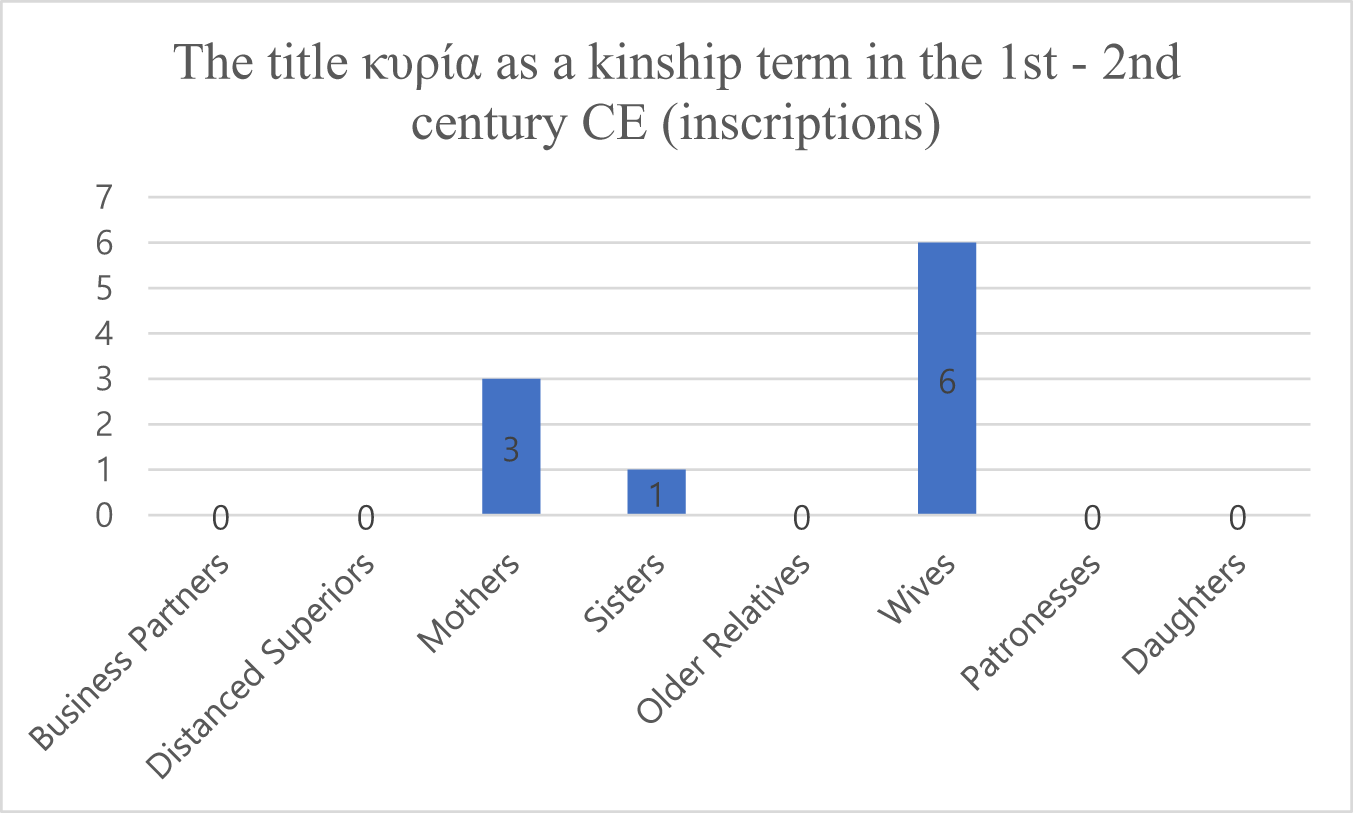
So, when we consider entities other than goddesses and cities, the use of κυρία is predominantly limited to familial contexts. Figure 2 summarises the frequency of κυρία as a kinship term in inscriptions from the first and second centuries ce.
Figure 2.

While our test group may be relatively limited in scope (87 cases), an examination of the table provided reveals a notable absence of κυρία used as an address for business associates or distant superiors, as found in papyrus letters from the first to second centuries ce. Instead, the instances of κυρία in papyrus letters from this period are predominantly limited to familial contexts (three times for mothers, once for sisters, and six times for wives). It is noteworthy that inscriptions found in the Phrygian region explicitly indicate that κυρία was used exclusively as a term of address for wives. Examples of this usage can be found in the works of Sterrett, including WE 382,557 (Phrygia; undated), EJ 167, 159 (Phrygia; undated), WE 389,564 (Phrygia; undated), as well as in MAMA IV 263 (Phrygia; third century ce) and MAMA IV 261 (Phrygia; undated). Thus, it can be concluded that in the epigraphic evidence of the first to second centuries ce, κυρία functioned primarily as an honorific, used primarily in familial contexts, with the exception of the use of κυρία as a title for feminine deities or cities.
In summary, based on the analysis of papyrus letters and inscriptions, excluding the cases of cities and their tutelary goddesses, the address κυρία was mainly used as a form of address for female family members, such as mothers, wives, sisters and patronesses, and functions to create a polite atmosphere by using this address during the first and second centuries ce. When the term κυρία is used in reference to a city, it is always accompanied by the word ‘hometown’ (πατρίς) and employed as an adjective (‘lordly’), not a symbol of πατρίς. Thus, the cases in which the term κυρία symbolises a particular city or community are not attested in papyri and ancient inscriptions.
2.2 Unnamed κυρία
We have noted that in 2 John 1, the specific name of the κυρία is not mentioned. Given the presence of κυρία without a specific name, can we conclude that κυρία symbolises a community? In this section, we will examine the cases from papyrus letters where, as in 2 John 1, no specific name is given with the title of κυρία.Footnote 28 In private Greek correspondence, it is common for the name of the specific person to be given along with the title κυρία. There are, however, exceptions to this practice.Footnote 29 In other words, if the writer and the recipient of the letter addressed as κυρία were well acquainted, it was possible to omit the specific name of the recipient and to address her by the title κυρία.
CPR 7.57 (200–299 ce):
τῇ κυ̣ρ̣ί̣ᾳ̣ μου̣ ἀ̣δελφ̣[ῇ]
[…]λ̣ί̣ν̣[η] χ̣[αίρε]ι̣ν̣.
πρὸ π̣[αντ]ὸ̣ς̣ π̣ο̣λ̣λὰ ε̣ὔ̣χ̣ο̣μ̣α̣[ί] σ̣ε̣
[ὁλο]κ̣ληρ̣[ε]ῖ̣ν̣ κ̣α̣ὶ̣ ὑ̣[γ]ι̣α̣ίνειν. τοὺ̣ς̣
ἀδελφούς̣ σου πά[ντ]α̣ς̣ ἀ̣σ̣πά-
ζ̣ο̣μ̣αι. γ̣ράφ̣[ω σοι κ]α̣ὶ̣ ἀξσ̣-
ι̣ῶ̣ δ̣η̣λ̣ῶσαί [μο]ι̣ π̣ε̣ρ̣ὶ̣ τ̣[ῆς]
̣ ̣ ̣ κ̣α̣ὶ̣ [π]ε̣ρ̣ὶ τ̣ῆς σωτ̣[η]ρ̣[ίας].
…
εὔχομαι κυρία
μου ἀδελφὴ
πολλοῖς χρόνοις.
To my lady sister, From […]line, greetings.
Above all, I pray for you
to be well and healthy. I greet all
your brothers. I write to you and I request
you to inform me about
[ ̣ ̣ ̣] and about health.
[ ̣ ̣ ̣] letter [ ̣]
…
I pray that you are well,
my lady sister,
always.
This letter was sent to an unnamed recipient, referred to as κυρία μου ἀδελφή, and it mentions someone’s debt (ὀφείλι; line 12: ‘find that she owed, I wrote that she is required to give it back’) and inquires about the recipient’s well-being while requesting a response. Probably, the κυρία’s name would have been written on the verso of the letter, but the poor preservation state of the papyrus makes it impossible to reconstruct the name on the verso. However, in this letter, which includes a wish for good health, the writer makes a request related to the debt in a polite tone, and it signals that the letter writer and the κυρία were well acquainted. In such cases where the relationship between both parties is well established, we find the examples where the name of the recipient is omitted and is referred to only as κυρία.
A similar case is found in P.Fouad. 80 (300–399 ce). This letter is written by Eudaimon to his mother and siblings. In the letter, Eudaimon addresses his mother without mentioning her name and without using an article, simply as κυρίᾳ μου μητρί (my dear mother). Similarly, in cases where both parties are clearly familiar with each other, it was possible for the letter writer to address the recipient as κυρία without mentioning her name.
Thus, if the letter writer and the addressee were well acquainted with each other, it was possible for the addressee’s name to be omitted, and for the writer to refer to her simply as κυρία. Specifically, this can be categorised into two cases: 1) the specific name addressed as κυρία on the front (recto) is not mentioned, but the name appears on the back (verso); 2) the name is not present on either the recto or the verso of the letter.
1) The cases in which κυρία is used without a name on both the recto and the verso of the letter: e.g. P.Strasb. 4.170 (100–199 ce); P.Berl.Zill. 12 (250–399 ce).
2) The cases in which κυρία is used without a name on the recto, but the name of κυρία appears on the verso: e.g. P.Oxy. 17.2151 (200–299 ce); P.Rein 2.118 (275–299 ce); P.Bour. 25 (300–400 ce).
It is of particular importance to consider the possibility that a name may be present on the verso even though it is not on the recto of the letter.Footnote 30
P.Bour. 25 (300–400 ce):
Recto:
κυρίᾳ μου καὶ ἐπιποθήτῃ θείᾳ, Τάρη
θυγάτηρ ἀδελφῆς σου Ἀλλοῦτος ἐν θ(ε)ῷ χαίρειν.
πρὸ παντὸς εὔχομε τῷ θ(ε)ῷ ὑγιένουσάν
σε καὶ εὐθυμοῦσαν ἀπολαβῖν τὰ παρʼ ἐμοῦ
γράμματα· αὕτη γὰρ μού ἐστιν εὐχή. γεί-
νωσκε δέ, κυρία μου, ὅτι ἀπὸ τῶν Πάσχω(ν)
ἡ μήτηρ μου, ἡ ἀδελφή σου, ἐτελε[ύτη]σεν.
ὅ[τ]ε δὲ τὴν μητέρα μου εἶχα, μεθʼ [ἑ]αυτῆς
ὅλον τὸ γένος μου αὕτη ἦν· ἀφʼ οὗ δ[ὲ] ἐτε-
λεύτησεν, ἔμινα ἔρημος, μ[η]δένα ἔχουσα
ἐπὶ ξένοις τόποις. μνημόνευε οὖν,
θεία, ὡς ζητούσης τῆς μητρός μου, εἵνα εἴ τι-
να εὑρίσκις πέμπε πρὸς ἐμέ. προσα-
γόρευε πᾶσαν τὴν συγγένιαν ἡμῶν.
ἐρρωμένην σε ὁ κ(ύριο)ς διαφυ-
λάττοι μακροῖς καὶ εἰρη-
νικοῖς χρόνοις, κυρία μου.
Verso:
[ἀπό]δος τὴν ἐπιστολὴν
Ὡρείνᾳ, ἀδελφῇ Ἀπολλωνίου, Κοπτιτίσᾳ, παρὰ
Τάρης, θυγατρὸς ἀδελφῆς αὐτῆς, ἀπὸ Ἀπαμίας.
Recto:
To my lady and beloved aunt. From Tare, daughter of your sister Alloes, greetings in God. Above all, we pray to God for your health, and to receive my letter with a joyful spirit; for this is my wish. Learn, my lady, that since Pascha, my mother, your sister, has passed away. When I had my mother with me, she was my whole family. But since she has departed, I have remained alone, having nothing, in a foreign land. Therefore, remember, aunt, that if you seek my mother, send someone to me if you find anything. Greet all our relatives. May the Lord preserve you in good health with long and peaceful years, my lady.
Verso:
Deliver the letter to Horeina, sister of Apollonios, from Koptis, from Tare, daughter of her sister, from Apamea.

Used by Permission (© Institut de Papyrologie, Sorbonne, Paris)
In this papyrus letter, the identity of κυρία μου (underlined above) is not specified on the recto except for the fact that she is the aunt of the letter writer.

Used by Permission (© Institut de Papyrologie, Sorbonne, Paris)
However, the specific name (Horeina) of κυρία is given on the verso (underlined above). The verso of the letter serves as the outer cover, where the actual name of the person addressed as κυρία on the recto is written as Horeina. Thus, we observe that in ancient letters, it was possible to leave out the name of the recipient and to address her only with an honorific κυρία. Especially in cases where the person addressed as κυρία is in a close relationship, the name often appears along with the title κυρία.Footnote 31
Since the original letter of 2 John is not extant, we cannot definitively ascertain that the name of the recipient was written on the verso of the original letter of 2 John. However, by examining cases such as P.Bour. 25 and P.Harr. 1.103, where the specific name of the recipient of the letter is found on the verso, it is probable that the specific name of the ἐκλεκτὴ κυρία was written on the verso of the original letter of 2 John.
In summary, I have examined the cases where κυρία is used in Greek private letters without mentioning a name. I have considered that, when the letter writer and recipient knew each other well, the recipient’s name could be omitted, and she could simply be addressed by an honorific title such as κυρία. In some instances where the recipient of the letter was addressed as κυρία without her name on the recto, the recipient’s name could be written on the verso of the letter.
3. The Identity of κυρία in 2 John
In this section, I will build upon the previous discussions to explore the specific meaning of ἐκλεκτὴ κυρία and critically examine the interpretations put forth by scholars. Raymond E. Brown contends that κυρία is used as an epithet representing a church.Footnote 32 However, as Hans-Josef Klauck notes,Footnote 33 the expression κυρία ἐκκλησία, which is frequently found in Hellenistic documents, cannot be translated as ‘lady congregation’. Klauck correctly considers that κυρία ἐκκλησία refers to ‘a regular assembly occurring approximately once a month’ (etwa monatliche Hauptversammlung). In what follows, I will examine the meaning of the phrase κυρία εκκλησία using epigraphic evidence that Klauck did not consider. This phrase is typically used in ancient inscriptions in the following form:Footnote 34
IG II3, 1 983 (Athens; 254–253 bce):
ἐπὶ Φιλίνου ἄρχοντος ἐπὶ τῆς Αἰγεῖδος πρώτης πρυτανείας ἧ-
ι Θεότιμος Στρατοκλέους Θοραιεὺς ἐγραμμάτευεν· Ἑκατομ-
βαιῶνος ἑνδεκάτει Ἔστι τῆς πρυτανείας· ἐκκλησία κυ-
ρία· τῶν προέδρων ἐπεψήφιζεν Ἀρεσίας Λαμπροκλέους Πειρα-
ιεὺς καὶ συμπρόεδροι·
During the archonship of Philinos, in the first prytany of the Aigeis, on the eleventh day of Hekatombaion, the regular assembly (ἐκκλησία κυρία) was held. Aresias, son of Lamprokles and Peiraieus, presided over the meeting as president, and the co-presidents.
As observed in the inscription of a civic assembly mentioned above, ἐκκλησία κυρία in civic inscriptions does not refer to a personified community as ‘lady ἐκκλησία’ but should be translated as ‘regular assembly’ or ‘ordinary meeting’ held on the eleventh day of Hekatombaion.Footnote 35 In this context, κυρία functions as an adjective modifying the feminine noun ἐκκλησία, and it should be understood to convey the meaning of ‘regular’ as an adjective. Similar expressions in civic assembly inscriptions, such as ἀγορὰ κυρία, also signify a regular assembly.Footnote 36 Hence, Brown’s interpretation of the phrase ἐκκλησία κυρία in ancient civic inscriptions is incorrect, and it is not feasible to interpret ἐκκλησία κυρία as a case where κυρία personifies ἐκκλησία.Footnote 37
Brown also argues that the anarthrous ἐκλεκτῇ κυρίᾳ indicates that the term κυρία does not refer to a specific individual, and he suggests that 2 John implies ‘a circular letter meant to be read in several communities’.Footnote 38 However, the present author observes the cases in papyrus letters where κυρία without an article is used to refer to specific individuals. In our test group consisting of papyrus letters written between the first century bce and the fourth century ce, in many cases (135 instances), the article is inserted before κυρία. On the other hand, there are forty-four cases where κυρία is used without an article to refer to specific persons. For example:Footnote 39
P.Prag. 2.191 (200–299 ce):
κυρίᾳ μου μητρὶ Καλήμερος.
To my lady mother. From Kalemeros.
P.Oxy. 17.2151 (200–299 ce):
Recto:
κυρίᾳ μου μητρὶ καὶ κυρίᾳ μου
ἀδελφῇ Ἰταλικὸς χαίρε̣ιν.
To my lady mother and my lady sister. From Italikos. Greetings.
Verso:
κυρίᾳ μου μητρὶ Περικ[…]
To my lady mother Perik…
P.Rein. 2.118 (275–299 ce)
κυρίᾳ μου μητρὶ
ἡ θυγάτηρ χαίριν
To my lady mother. From your daughter. Greetings.
In this way, it should be understood that the title κυρία could be used without an article as a form of address in Greco-Roman society.
The address κυρία should be considered as an honorific in the context of politeness. Moulton and Milligan point out the following aspects: κυρία (‘lady’) is a ‘courteous, and even affectionate, form of address in the ordinary correspondence of the time’.Footnote 40 In this sense, κυρία is an expression that clearly indicates the respect and affection towards the letter-recipients.
Interpreting κυρία not as a symbolic title given to the church but as referring to a specific woman leader in family language is congruent with the subsequent mention of the collective recipients (τοῖς τέκνοις αὐτῆς) in 2 John 1. This fits with the use of the term elder in 1 John 1.1; 1.12; 5.21; and 3 John 4, where the elder addresses the Christ-followers as their children (τέκνα; τεκνία).Footnote 41 As noted earlier, when κυρία is used for an individual, it is employed primarily in a familial context and not merely as an honorific for a superior. Therefore, addressing Christ-followers as children (τέκνα) as members of the community, along with addressing women leaders with κυρία in kinship language, seems consistent.
In 2 John 5, the vocative κυρία is juxtaposed with the formula of request (ἐρωτῶ σε), a usage commonly found in ancient private letters addressed by κυρία to a particular elderly woman.
2 John 5: καὶ νῦν ἐρωτῶ σε, κυρία, οὐχ ὡς ἐντολὴν γράφων σοι καινὴν ἀλλ’ ἣν εἴχομεν ἀπ’ ἀρχῆς, ἵνα ἀγαπῶμεν ἀλλήλους.
But now, dear lady, I ask you, not as though I were writing you a new commandment, but one we have had from the beginning, let us love one another [NRSVUE].
O.Krok. 2.288 (98–117 ce): ἐρωτῶ σε, κυρία, φύλαξόν μου τὰς ἐντωλὰς ἅς σοι ἐνετιλάμην.
I ask you, lady, to observe my guidelines that I have given you.
In O.Krok. 2.288, Ischyras addresses his patroness, Zosime, as κυρία while making a request (ἐρωτῶ σε) for her to observe the guidelines (ἐντωλάς) he had previously given. In this manner, the courteous yet intimate address, κυρία, in 2 John 5 and O.Krok. 2.288 matches well with the atmosphere conveyed by the polite requests. Furthermore, the use of κυρία in these letters does not appear to be a symbolic title bestowed upon a community, but rather serves as an honorific address for an actual woman in the family.
In addition, it should be noted that the use of the title κυρία as a polite address in the correspondence matches well with the overall favourable rhetoric of the letter. In the subsequent letter, κυρία could be employed alongside an affectionate tone.
BGU 4.1081(1–300 ce):
Δίδυμο[ς] Ἑρμιόνῃ τῇ κυρίᾳ πο[λλ]ὰ χαίρειν.
εὐκαιρί̣α̣ν εὑρὼν τοῦ πρὸς σὲ ἐρχομένου
ἐχάρην, ἵνα σὲ ἀσπάζομαι καὶ εὔχομαι τοῖς
θεοῖς ὑπὲ[ρ] σοῦ, ἵνα σὲ διαφυλά[ξ]ωσι καὶ ἤδη καλῶς
ποιήσ[ει]ς ἐπιστείλας ἡμεῖν περὶ τῆς σῆς ὑγίας.
ἀσπάζονταί σε υἱοί σου, ἀσπάζομαι Εὐδαίμονα
καὶ Σουεροῦν καὶ Εὐδαιμονίδα καὶ ε̣λκικη̣ν̣
ἔρρω[σο].
From Didymos, to Hermione, lady, Many greetings. I am delighted in finding an opportunity to come to you. So, I send my greeting to you and pray to the gods on your behalf, and ensure that they protect you. Please send us a message about your health. Your sons greet you. I greet Eudaemon, and Severus, and Eudaemonis, and Helkike. Farewell.
In the letter above, Didymos sends a letter inquiring about the well-being of his wife, Hermione. This letter uses the formula of joy (ἐχάρην) and conveys an intention to visit his wife. It also includes warm inquiries about the recipient’s health and conveys a friendly message. Thus, κυρία is suitable in courteous and affectionate correspondence as well.Footnote 42 In 2 John 4, the formula of joy is employed with a favourable tone.
Ἐχάρην λίαν ὅτι εὕρηκα ἐκ τῶν τέκνων σου περιπατοῦντας ἐν ἀληθείᾳ, καθὼς ἐντολὴν ἐλάβομεν παρὰ τοῦ πατρός.
The use of the formula of joy serves to create a courteous and favourable atmosphere. As seen in the earlier part of 2 John, just as in BGU 4.1081, κυρία is employed within a cordial context (see also 2 John 1–3). This corresponds to the fact that κυρία functions as a courteous and affectionate title in a familial setting. In 2 John, the elder conveys a positive and favourable expression towards the recipients in the letter opening, rather than establishing his authority. As a courteous title, κυρία fits well with the tone of this proem. The friendly tone established in the opening and the formula of joy in 2 John indicate the positive relationship between the letter writer and the recipients, and serve as implicit requests to live up to what are described in the letter introduction.
Finally, in 2 John 1, the adjective ἐκλεκτή appears to imply the theological concept of election.Footnote 43 However, since addressing the letter-recipients as ἐκλεκτός is something of a rarity in ancient Greek correspondence, it is essential to consider the rhetorical function of this expression. When individuals are addressed as ἐκλεκτός, it mostly carries the meaning of ‘appointed’ or ‘elected’.Footnote 44 There is an exceptional case of addressing individuals as ἐκλεκτός in early Christian correspondence:
P.Oxy. 31.2603 (200-400 ce):
ἀσπάσαι κα̣[ὶ] τοὺς σὺν̣σοὶ πάντας ἀδελφοὺς ἐκλεκτού[ς] τε καὶ [κα-]τηχ̣ουμένους.
Greet all the chosen brothers with you, those who are instructed.
Using the term ‘chosen’ in this way can be understood as a way of expressing goodwill. In ancient Greek correspondence, it was common to include favourable adjectives such as the following when addressing the recipient in order to convey respect or goodwill towards the recipient:Footnote 45
P.Mich. 8.466 (107 ce)
Ἰ[ο]ύλιος Ἀπ[ολινάριος Ἰο]υλίῳ Σαβείνωι τῶιγλυκυ[τάτῳ πα]τρὶ πλεῖστα χαίρειν.
Iulius Apollinarius to Iulius Sabinus, dearest father, very many greetings.
Thus, in ancient correspondence, it was possible to address recipients with additional adjectives to express goodwill towards the addressee. In early Christian correspondence, this is expressed as follows:
Greetings in the Lord. Beloved brother Paul. I, Sotas, greet you.
Chr.Wilck. 130 (375–399 ce):
ἀγαθότατον πατερ
Most excellent father.
In the letters above, when addressing the recipients, the letter writers were able to convey politeness and respect towards the addressees by the addition of favourable adjectives (beloved or most excellent). In Phlm 1.1, the phrase τῷ ἀγαπητῷ qualifies the name of the recipient of the letter, Philemon, and this expression creates a cordial atmosphere and perhaps facilitates a request to Philemon. Similarly, in 2 John 1, the term ἐκλεκτή matches well with the pattern of ‘adjective + address to the letter recipient’ as described above. Furthermore, ἐκλεκτή was not a stereotypical address in ancient correspondence, but by such an address with special theological implications, the elder probably intended to show courtesy and respect to the woman leader.
Therefore, the use of κυρία in both 2 John 1 and 5 implies that the elder is addressing a woman leader with a term of familial and affectionate meaning, thereby conveying a sense of courtesy. In addition, the elder seems to be conveying politeness and respect to the κυρία through the rare designation ἐκλεκτή in ancient Greek letters.
4. Conclusion
The use of the title κυρία in 2 John 1 corresponds to the epistolary convention of addressing an individual woman recipient in ancient letters. Thus, the present author concludes that the title κυρία in 2 John 1.1 is not used as a symbolic appellation for a church, but rather refers to a woman church leader. It is significant to consider that in the first and second centuries ce, κυρία was employed as a term of respect for a woman of high or equal status within the household. In this vein, the use of κυρία in 2 John signals that the elder courteously addresses the recipient with the honorific title κυρία.
My examination of the papyrological and epigraphic evidence indicates that, apart from the title designating a goddess, κυρία was primarily a polite address given to women within the family context, such as mothers, wives and sisters. In the preceding analysis, it has been noted that κυρία is employed as a title for πατρίς. However, we should discern between a mere titular designation and a symbolic representation. Moreover, in the phrase ‘κυρίᾳ πατρίδι’, κυρία can be understood as an adjective, and this expression should be translated as ‘to the lordly father-city’, rather than ‘to lady father-city’. Thus, in papyri and inscriptions, instances where κυρία ‘symbolises’ a specific community are not substantiated.
Accordingly, in 2 John 1 and 5, it could be inferred that the elder is addressing a specific woman leader using kinship language. Based on this argument, it is important to recognise that interpreting ἐκλεκτὴ κυρία in 2 John 1 as symbolising ‘a church’ could inadvertently obscure the possibility that there were women leaders in the Johannine community.
I have found no clear evidence that the title κυρία could have been used for distant superiors in the first and second centuries. The present author has suggested that the title κυρία had a narrower usage in the first and second centuries ce compared to the masculine address κύριε. Instead, κυρία served primarily as a polite and affectionate address in the context of the family, typically addressed to mothers, wives and patronesses.
The present author observes the cases in ancient private letters, such as P.Oxy. 17.2151, P.Rein 2.118 and P.Bour. 25, where the name of κυρία is given on the verso even if her identity is not specified on the recto. In situations where the letter writer and recipient were in an established relationship,Footnote 47 the name of κυρία could be omitted on the recto of the letter. While it is impossible to make definitive claims due to the absence of the original letter of 2 John, the present author does not exclude the possibility that the identity of κυρία may have been recorded on the verso of the original letter. Thus, 2 John can be defined as a letter of exhortation designed to remind a woman leader and her church of the pastoral principles.Footnote 48
Thus, this article reinterprets the ‘elect lady’ in 2 John 1 as a woman leader, offering a fresh perspective concerning the leadership of the Johannine communities. The socio-cultural context of first- and second-century Asia Minor was distinctive, existing under Roman rule but shaped by a unique fusion of local traditions. Particularly concerning female leadership within poleis, the situation in Asia Minor might have been markedly different from the broader Roman Empire. While women’s public roles were generally restricted in Rome, local elite women in Asia Minor often served as civic benefactors and ritual leaders, patronising public architecture and presiding over religious ceremonies.Footnote 49 For instance, Plancia Magna constructed the gate of Perge between 119 and 122 ce, served as a priestess of Artemis, the city’s patron deity, and held a priestly role in the imperial cult. Her activities were not confined to the early second century; the origins of such female leadership trace back to the first century.Footnote 50 Thus, women in first- and second-century Asia Minor could assume prominent religious leadership roles. Within this first- and second-century context, the term ‘elect lady’ calls for a reassessment of the leadership structures within early Christian communities in Asia Minor, suggesting it represents more than an honorific title.
Acknowledgment
This work was supported by the Ministry of Education of the Republic of Korea and the National Research Foundation of Korea (NRF-2024S1A5A01027764).
Competing interests
The author declares none.