Introduction
Alzheimer’s disease (AD) causes a protracted period of pathological changes that may begin years before a clinical diagnosis of cognitive impairment (Jack et al., Reference Jack, Knopman, Jagust, Petersen, Weiner, Aisen and Trojanowski2013; Sperling et al., Reference Sperling, Aisen, Beckett, Bennett, Craft, Fagan and Phelps2011; Vos et al., Reference Vos, Xiong, Visser, Jasielec, Hassenstab, Grant and Fagan2013). Treatment effectiveness, and the prospect of prevention therapies, depend on improving the detection of individuals who, while cognitively unimpaired, are at increased risk for AD-related clinical cognitive decline (i.e., mild cognitive impairment or dementia). For an early detection approach to be feasible, there is a need for widely available, affordable, and minimally invasive tools that can support diagnostic procedures.
According to some conceptual models, cognitive assessment, which is relatively affordable and noninvasive, can help with the early detection of higher AD risk (Caselli & Reiman, Reference Caselli and Reiman2013; Han, Nguyen, Stricker, & Nation, Reference Han, Nguyen, Stricker and Nation2017; Edmonds, Delano-Wood, Galasko, Salmon, & Bondi, Reference Edmonds, Delano-Wood, Galasko, Salmon and Bondi2015). Numerous studies have indicated that cognitive alterations do not arise abruptly, but rather slowly accumulate following a similar trajectory as the neuropathological processes that underlie AD. For instance, cognitively unimpaired middle-aged and older carriers of the e4 allele of the apolipoprotein E gene (APOE4), which increases the risk for clinical AD at least two to threefold (Corder et al., Reference Corder, Saunders, Strittmatter, Schmechel, Gaskell, Small and Pericak-Vance1993), show a more rapid cognitive decline when followed over several years (Bretsk, Guralnik, Launer, Albert, & Seeman, Reference Bretsky, Guralnik, Launer, Albert and Seeman2003; Caselli et al., Reference Caselli, Reiman, Osborne, Hentz, Baxter, Hernandez and Alexander2004; Reference Caselli, Dueck, Osborne, Sabbagh, Connor, Ahern and Reiman2009; Reference Caselli, Dueck, Locke, Hoffman-Synder, Woodruff, Rapcsak and Reiman2011). Recent longitudinal studies have also revealed that accelerated cognitive decline is detectable up to 20 years before a diagnosis of mild cognitive impairment (Caselli et al., in press) and is predictive of clinical conversion in individuals who are amyloid beta (Aβ) positive (Papp et al., in press). Studies that have measured subtle cognitive alterations cross-sectionally with neuropsychological profiles have shown a similar link to later AD-related clinical cognitive impairment (Edmonds et al., Reference Edmonds, Delano-Wood, Galasko, Salmon and Bondi2015; Osuna et al., Reference Osuna, Thomas, Edmonds, Bangen, Weigand, Wong and Bondi2019).
In light of the evidence linking cognitive alterations to increased risk for developing clinical AD, there has been much interest in identifying cognitive tests that are sensitive to early AD neuropathology, with the goal of creating more precise composites for diagnosis and clinical trials (Papp et al., in press; Parra et al., Reference Parra, Della Sala, Abrahams, Logie, Méndez and Lopera2011; Rentz et al., Reference Rentz, Parra Rodriguez, Amariglio, Stern, Sperling and Ferris2013). We recently proposed that one potentially effective approach is to focus on episodic memory tests that place heavy computational demands on the interaction between the medial temporal lobe and its cortical connections (Grilli, Wank, Bercel, & Ryan, Reference Grilli, Wank, Bercel and Ryan2018). Our hypothesis is based on two key points. The first is that the early trajectory of hallmark AD neuropathological processes, namely Aβ and tau accumulation, affect much of the distributed medial temporal lobe–cortical network that supports episodic memory (Benoit & Schacter, Reference Benoit and Schacter2015; Ranganath & Ritchey, Reference Ranganath and Ritchey2012; Reagh & Ranganath, Reference Reagh and Ranganath2018; Rugg & Vilberg, Reference Rugg and Vilberg2013). Aβ is focused in anterior and posterior cortical regions, including medial and lateral prefrontal cortex and medial regions of the parietal cortex (e.g., precuneus, posterior cingulate cortex), and tau accumulation and neurodegeneration begin in the medial temporal lobes (entorhinal/perirhinal, parahippocampal, and hippocampal regions) (Masters et al., Reference Masters, Bateman, Blennow, Rowe, Sperling and Cummings2015; Sperling et al., Reference Sperling, Aisen, Beckett, Bennett, Craft, Fagan and Phelps2011). The second point is that while the amyloid hypothesis proposes that Aβ proceeds tau accumulation, both pathologies are believed to progress for years before a clinical cognitive diagnosis is warranted (Jack et al., Reference Jack, Knopman, Jagust, Petersen, Weiner, Aisen and Trojanowski2013; Sperling et al., Reference Sperling, Aisen, Beckett, Bennett, Craft, Fagan and Phelps2011), and in some individuals, tau accumulation/neurodegeneration can outpace Aβ (Edmonds et al., Reference Edmonds, Delano-Wood, Galasko, Salmon and Bondi2015). Given the localization of these pathologies, and heterogeneity in trajectories, we, therefore, suggest that cognitive tests that tax medial temporal lobe–cortical interaction may be well suited to amplify the signal of subtle cognitive alterations that arise from distributed AD pathologies.
The retrieval of episodic autobiographical memories (EAMs), meaning memories for real-world, personal events, has been strongly linked to the medial temporal lobe–cortical network that is vulnerable to early AD pathology (Martinelli et al., Reference Martinelli, Sperduti and Piolino2013; Svoboda et al., Reference Svoboda, McKinnon and Levine2006). According to several theories, the interaction between these cortical regions and the medial temporal lobe is essential for the retrieval of detailed EAMs (Eichenbaum, Yonelinas, & Ranganath, Reference Eichenbaum, Yonelinas and Ranganath2007; Moscovitch, Cabeza, Winocur, & Nadel, Reference Moscovitch, Cabeza, Winocur and Nadel2016; Ranganath & Ritchey, Reference Ranganath and Ritchey2012). Both natural lesion studies (Berryhill, Phuong, Picasso, Cabeza, & Olson, Reference Berryhill, Phuong, Picasso, Cabeza and Olson2007; Bertossi, Tesini, Cappelli, & Ciaramelli, Reference Bertossi, Tesini, Cappelli and Ciaramelli2016; Grilli & Verfaellie, Reference Grilli and Verfaellie2014; Philippi, Tranel, Duff, & Rudrauf, Reference Philippi, Tranel, Duff and Rudrauf2013; Rosenbaum et al., Reference Rosenbaum, Moscovitch, Foster, Schnyer, Gao, Kovacevic and Levine2008), and research using transcranial magnetic stimulation (Bonnici, Cheke, Green, Fitzgerald, & Simons, Reference Bonnici, Cheke, Green, Fitzgerald and Simons2018; Thakral, Madore, & Schacter, Reference Thakral, Madore and Schacter2017), have supported a medial temporal lobe–cortical interaction viewpoint, showing that the ability to retrieve EAMs, or episodic details of singular events, is compromised by disruption to the medial temporal lobe, or its anterior and posterior cortical connections. In fact, task-based functional magnetic resonance imaging (fMRI) findings suggest that EAMs may uniquely tax interaction within this network relative to other types of episodic memory (Chen, Gilmore, Nelson, & McDermott, Reference Chen, Gilmore, Nelson and McDermott2017; Monge, Wing, Stokes, & Cabeza, Reference Monge, Wing, Stokes and Cabeza2018). Similarly, the results from some neuropsychological studies of individuals with anterior or posterior cortical lesions have indicated that EAM appears to be more severely affected than performance on many other episodic memory tests (Berryhill et al., Reference Berryhill, Phuong, Picasso, Cabeza and Olson2007; Bertossi et al., Reference Bertossi, Tesini, Cappelli and Ciaramelli2016; Davidson et al., Reference Davidson, Anaki, Ciaramelli, Cohn, Kim, Murphy and Levine2008). Thus, compared to other means for assessing episodic memory, EAM may be particularly sensitive to subtle changes in a neural network that if compromised, increases the risk for conversion to clinical AD.
We recently provided initial support for a link between EAM and subtle cognitive alterations by comparing autobiographical memory in cognitively unimpaired middle-aged and older adults who varied in their APOE4 status (Grilli et al., Reference Grilli, Wank, Bercel and Ryan2018). Notably, cognitively unimpaired middle-aged and older APOE4 carriers are at greater risk for a number of AD suggestive alterations that affect the medial temporal lobe–cortical network underlying episodic memory. For instance, clinically normal APOE4 carriers in this age group tend to have a higher Aβ burden (Jack et al., Reference Jack, Wiste, Weigand, Knopman, Vemuri, Mielke and Petersen2015). Cognitively unimpaired APOE4 carriers also show greater medial temporal lobe volume loss over several years, independent of Aβ (Montandon et al., Reference Montandon, Herrmann, Garibotto, Rodriguez, Haller and Giannakopoulos2020). Additional structural and functional alterations in the medial temporal lobe–cortical network that supports episodic memory also have been reported in cognitively unimpaired, middle-aged and older adult APOE4 carriers (Reiman et al., Reference Reiman, Chen, Alexander, Caselli, Bandy, Osborne and Hardy2005; Ryan et al., Reference Ryan, Walther, Bendlin, Lue, Walker and Glisky2011; Sheline et al., Reference Sheline, Morris, Snyder, Price, Yan, D’Angelo and Mintun2010) in ways that are consistent with broader indicators of the preclinical progression of AD (Sheline & Raichle, Reference Sheline and Raichle2013). Therefore, while comparing APOE4 carriers to noncarriers cross-sectionally cannot predict individual conversion, such an approach can evaluate whether autobiographical memory is linked to a higher risk for clinical AD.
In Grilli and colleagues (Grilli et al., Reference Grilli, Wank, Bercel and Ryan2018), we had participants narrate autobiographical events, and we scored their narratives for their episodic and non-episodic detail makeup, using a well-established autobiographical interview approach and scoring protocol (Levine, Svoboda, Hay, Winocur, & Moscovitch, Reference Levine, Svoboda, Hay, Winocur and Moscovitch2002). We found that the APOE4 carrier group showed a reduction in episodic specificity across remote and recent time periods, meaning that when they described autobiographical events, the APOE4 group generated fewer perceptual, action, scene, and related details that added to the vividness and uniqueness of the events. In comparison, the APOE4 carrier group did not generate fewer non-episodic details in their narratives, including semantic and other language-based details, nor were they reduced on a battery of neuropsychological tests. Taken together, we interpreted these findings as evidence that reduced EAM may be a sign of higher risk for clinical AD.
Present Study
In the present study, we asked two follow-up questions about the EAM hypothesis. Our initial study of autobiographical memory in APOE4 middle-aged and older adults showed reduced episodic detail generation while narrating unique events, reflecting a deficit in EAM elaboration. According to cognitive models of autobiographical memory, before a memory can be elaborated, one’s autobiographical memory knowledge base must be mentally searched and an EAM selected (Addis et al., Reference Addis, Knapp, Roberts and Schacter2012; Conway, Reference Conway2005). Therefore, the first objective of the present study was to evaluate whether autobiographical memory selection is compromised in cognitively unimpaired APOE4 carriers. The autobiographical interview approach that we used in our initial study also explicitly directed participants to retrieve episodic details to describe the events. While semantic details are nonetheless often generated, they are far less frequent and may not reflect an individual’s capacity to access semantic details for events. In fact, according to Conway’s (Reference Conway2005) model of autobiographical memory organization, reduced access to episodic memory may limit how efficiently a person can mentally search for “personal semantics,” meaning semantic knowledge about the self. Also, prior research has shown that some personal semantics have episodic qualities that may translate to shared dependence on the medial temporal lobe–cortical network that supports episodic memory (Renoult et al., Reference Renoult, Davidson, Palombo, Moscovitch and Levine2012). For instance, autobiographical facts attached to a spatiotemporal context, such as a repeated event (e.g., social gatherings after work) or lifetime period (e.g., college years), are dependent on the medial temporal lobe (Grilli & Verfaellie, Reference Grilli and Verfaellie2014; Reference Grilli and Verfaellie2016). Collectively, reduced episodic memory, along with lower access to knowledge related to repeated events and lifetime periods, may have consequences for retrieval of a wide range of personal semantics. Therefore, our second objective was to evaluate whether cognitively unimpaired APOE4 middle-aged and older adults show an alteration in personal semantic selection.
To address these questions, we built on prior studies that have modified traditional category fluency tasks to target rapid and repeated autobiographical memory selection, or autobiographical fluency (Dritschel et al., Reference Dritschel, Williams, Baddeley and Nimmo-Smith1992). These studies have shown that autobiographical fluency depends on medial temporal lobe–cortical interaction (Greenberg et al., Reference Greenberg, Keane, Ryan and Verfaellie2009; Ryan, Cox, Hayes, & Nadel, Reference Ryan, Cox, Hayes and Nadel2008; Sheldon & Moscovitch, Reference Sheldon and Moscovitch2012; Sheldon, McAndrews, Pruessner, & Moscovitch, Reference Sheldon, McAndrews, Pruessner and Moscovitch2016), and is sensitive to aging (Piolino et al., Reference Piolino, Coste, Martinelli, Macé, Quinette, Guillery-Girard and Belleville2010) and clinical AD, including in individuals who have Aβ-positive mild cognitive impairment (Tomadesso et al., Reference Tomadesso, Gonneaud, Egret, Perrotin, Pélerin, de Flores and La Joie2019). In the present study, we adopted a well-established autobiographical fluency task that evaluates both episodic memory and personal semantic category exemplar generation (Dritschel et al., Reference Dritschel, Williams, Baddeley and Nimmo-Smith1992) and has been used with clinical AD (Addis & Tippett, Reference Addis and Tippett2004). In this particular task, the retrieval of personal semantics is targeted by recalling the names of personally known people. Prior fMRI and neuropsychological studies have shown that fluent retrieval from seemingly abstract autobiographical categories, like names of familiar people, is related to medial temporal and connected cortical regions (Greenberg, Keane, Ryan, & Verfaellie, Reference Greenberg, Keane, Ryan and Verfaellie2009; Sheldon & Moscovitch, Reference Sheldon and Moscovitch2012). This particular autobiographical fluency task also attaches the category of names to specific time periods (e.g., early adulthood), which may further increase demands on episodic mental search and retrieval strategies that depend on the medial temporal lobe. Therefore, while the task targets an abstract type of semantic knowledge (i.e., names of personally known people), it can be viewed as a good assessment of the possibility that personal semantics are reduced in older APOE4 carriers, at least under high autobiographical fluency retrieval demands. To contextualize our autobiographical memory findings, participants also completed standard neuropsychological fluency tasks targeting non-autobiographical categories.
We hypothesized that if individuals at higher risk of clinical AD tend to exhibit reduced episodic specificity selection, the APOE4 group would generate fewer unique events on the autobiographical fluency task. Given that personal semantic fluency may be linked to medial temporal lobe–cortical interaction, we also hypothesized that the APOE4 group may show reduced fluency for generating personally familiar names from identified lifetime periods.
Methods
Participants
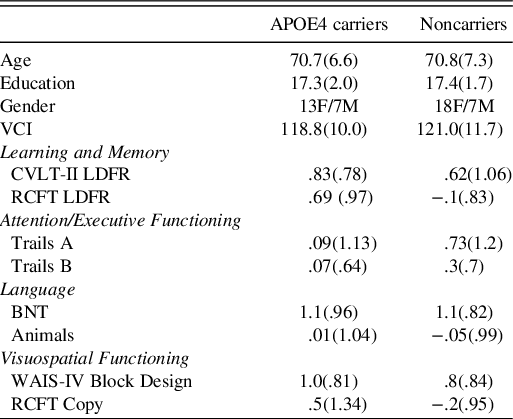
Forty-five middle-aged and older adults (aged 53–84) were included in the present study. All participants were characterized as cognitively unimpaired according to a neuropsychological profile approach based on eight neuropsychological test scores, which are reported in Table 1. Consistent with past studies (Bondi et al., Reference Bondi, Edmonds, Jak, Clark, Delano-Wood, McDonald and Salmon2014; Bondi et al., Reference Bondi, Jak, Delano-Wood, Jacobson, Delis and Salmon2008; Grilli et al., Reference Grilli, Wank, Bercel and Ryan2018), two neuropsychological test scores were selected from multiple cognitive domains, namely learning and memory, attention/executive functioning, language, and visuospatial functioning, and individuals were considered cognitively unimpaired if neither of the following was met: (1) they performed more than 1 standard deviation below the age-corrected (and education-corrected if available) normative mean on both scores in one cognitive domain or (2) they performed more than 1 standard deviation below the age-corrected (and education-corrected if available) normative mean on one test in three cognitive domains. In addition, to be included participants had to score below the ≥ 16 cutoff for depression on the Center for Epidemiological Studies Depression Scale (Radloff, Reference Radloff1977), they had to deny a remarkable history of neurologic conditions that could have cognitive effects, and they had to report being independent in activities of daily living. Self-reported race/ethnicity was Non-Hispanic White for 44 participants and Hispanic for 1 participant.
Means and standard deviations (in parenthesis) for demographics and neuropsychological test scores (Z scores) for APOE4 carriers and noncarriers.

The APOE4 carriers were matched to the noncarriers on the group level for age, education, gender, and verbal comprehension (VCI). To be eligible for the study, participants had to perform largely within normal limits on a battery of neuropsychological tests (see Participants section). Data represent means with standard deviations in parenthesis. VCI = Verbal Comprehension Index; CVLT LDFR = California Verbal Learning Test Long Delay Free Recall; RCFT LDFR = Rey–Osterrieth Complex Figure Test Long Delay Free Recall; BNT = Boston Naming Test; WAIS = Wechsler Adult Intelligence Scale. For the neuropsychological tests, VCI scores are scaled scores and the remaining scores are age (and education if available) corrected Z scores.
Table 1 shows that as a group, the APOE4 carriers were matched to the APOE4 noncarriers on age, gender, education, and intelligence, as measured by the Verbal Comprehension Index from the Wechsler Adult Intelligence Scale – Fourth Edition (WAIS-IV; Wechsler, Reference Wechsler2008), p’s ≥ .50.
For APOE genotyping, we collected saliva samples from each participant using the Oragene DNA Collection Kit (DNA Genotek, Ottawa, ON, Canada). APOE rs429358 and APOE rs7412 genotyping, which was completed at The Translational Genomics Research Institute in Phoenix, Arizona, was carried out using TaqMan allelic discrimination (Applied Biosystems, Foster City, CA, United States of America) and ABI Prism 7000 sequence detection (Applied Biosystems, Foster City, CA, United States of America), as described in Corneveaux and colleagues (Corneveaux et al., Reference Corneveaux, Liang, Reiman, Webster, Myers, Zismann and Huentelman2010). Some participants were recruited from our existing database and others were newly recruited for the present study. Twenty of the participants were APOE4 carriers (all e3/e4 heterozygotes) and 25 were APOE4 noncarriers (23 e3/e3 homozygotes and 2 e2/e3 heterozygotes).
Power Analysis
We used G*Power 3.1 for our power analysis (Faul, Erdfelder, Lang, & Buchner, Reference Faul, Erdfelder, Lang and Buchner2007). We assumed that an APOE effect on autobiographical fluency would be similar in magnitude to the effect that was found in Grilli and colleagues (Grilli et al., Reference Grilli, Wank, Bercel and Ryan2018), which was d = .87 for the difference in episodic detail generation in autobiographical event narratives. We also assumed that if there is a significant interaction between group and episodic memory versus personal semantic fluency, the magnitude would be similar to that of Grilli and colleagues (Grilli et al., Reference Grilli, Wank, Bercel and Ryan2018), which was medium to large, partial η2 = .19. With these effects, and α = .05 and power (1−β) = .80, our estimated required sample size was 44.
Procedures
Participants were drawn from a multi-session project of cognitive aging and AD risk, which included neuropsychological testing and experimental behavioral testing.
Standard Neuropsychological Testing
As mentioned, participants underwent standard neuropsychological testing as part of our screening for study eligibility. Our neuropsychological battery consists of the subtests for the Verbal Comprehension Index on the WAIS-IV (Wechsler, Reference Wechsler2008), the California Verbal Learning Test (CVLT-II; Delis Kramer, Kaplan, and Ober, Reference Delis, Kramer, Kaplan and Ober2000), which is a auditory word-list learning task, the Rey–Osterrieth Complex Figure Test (RCFT; Rey, Reference Rey1941), which is a complex figure visuospatial memory task, Trail Making Tests A and B (Reitan & Wolfson, Reference Reitan and Wolfson1993), which measures mental processing speed and executive functioning, the Boston Naming Test (BNT; Goodglass, Kaplan, & Barresi, Reference Goodglass, Kaplan and Barresi2001), which assesses confrontation naming, and the Controlled Oral Word Association Test (COWAT; Benton, Reference Benton1969), which requires generating exemplars to letters and general semantic categories. In regard to the COWAT, participants generated word exemplars for three letters, namely “F,” “A,” and “S.” They also generated exemplars to the categories “animals” and “fruits and vegetables.” Notably, while animal fluency is part of our battery for assessing cognitive status, we added the additional categories for additional information about participants’ performance on non-autobiographical category/semantic fluency abilities.
Autobiographical Fluency Task
For the present study, the experimental behavioral task of interest was an autobiographical fluency task, which we adapted from Addis and Tippett (Addis & Tippett, Reference Addis and Tippett2004) and builds on the initial autobiographical fluency task by Dritschel and colleagues (Dritschel et al., Reference Dritschel, Williams, Baddeley and Nimmo-Smith1992). Consistent with Addis and Tippett (Addis & Tippett, Reference Addis and Tippett2004), our autobiographical fluency task required generating exemplars from an episodic category (i.e., unique events) and a personal semantic category (i.e., names of family/friends/other personally known people). For each category, participants were asked to generate exemplars from three time periods presented in chronological order: childhood (i.e., up to age 18), early adulthood (i.e., 18–35), and recent life (i.e., the past 15 years). For each time period, participants first completed the personal semantic category followed by the episodic memory category. For the personal semantic category, participants were instructed to “name people that you knew” during each time period. For the episodic category, participants were instructed to “recall unique events that happened” during each time period. They were further told that “a unique event is an experience that never happened twice in the same way. For example, recalling the one time your parents forgot to pick you up from soccer practice would be a unique event. However, recalling participating in soccer practices would not be a unique event, because that sounds like something that happened many times.” Similar to prior research (Addis & Tippett, Reference Addis and Tippett2004), we instructed participants to provide a short title for each event, rather than describe the events in great detail. We gave participants an example of how to report a unique event with a short title for each time period (e.g., childhood: “the one time I was left at soccer practice”). Consistent with Addis and Tippett (Reference Addis and Tippett2004), for each category at each time period, participants were given 90 s to generate exemplars. Responses were audio-recorded for later scoring.
In regard to scoring, first, we tallied each response provided for the time periods, separated by category. Consistent with standard category fluency tasks, from the total tallied responses, we separated “correct” responses from repetitions and “intrusions,” meaning responses that were not names or unique events. Unique events were defined as events that would unfold in less than a day and made reference to a unique feature (e.g., action) that would separate the description from one that could be a repeated experience (Levine et al., Reference Levine, Svoboda, Hay, Winocur and Moscovitch2002). Our primary outcome was total “correct” in each category, whether that be unique events or names. We are not using “correct” in the sense that memories were verified, but rather that we judged them as within the rules of the task (e.g., they were a person’s name). However, we also analyzed the correct summed with intrusions, addressing a concern about scoring. Finally, we scored for repetitions within a time period. We did not score for repetitions across time periods, because we assumed that some names would be relevant to more than one time period, and we did not want to uniquely alter the task demands or the dependence between time periods for the personal semantic fluency task.
Analyses
To contextualize our autobiographical memory results, we compared APOE4 carriers and noncarriers on the eight neuropsychological test scores used in our screening battery, contrasting raw scores with independent samples t tests. We also investigated whether there were APOE4 differences on two more neuropsychological fluency tests that were not part of our screener, namely fruits/vegetables exemplar generation and FAS letter exemplar generation.
Our primary model of interest was a 2 (Group: APOE4 carrier vs. noncarrier) × 2 (Autobiographical category: episodic vs. personal semantic) mixed-design analysis of variance (ANOVA) examining total correct responses across all time periods. As reported below, we found main effects without an interaction and followed-up with independent samples t tests to better understand the effect of APOE4 on both categories. We repeated our ANOVA and follow-up t tests replacing total correct with total correct plus total intrusions to evaluate whether our exclusion of some exemplars on the fluency task altered the outcomes. We also used an independent samples t test to evaluate whether there were differences in repetitions.
We conducted a few follow-up analyses. We compared the word count per response in the episodic fluency task with an independent samples t test to determine whether APOE4 carriers and noncarriers were similar in their adherence to our instructions to provide short titles for events. Our intention for using multiple time points for each category was to increase our sampling rate and improve the reliability of our estimates for each category. Notably, in Grilli and colleagues (Grilli et al., Reference Grilli, Wank, Bercel and Ryan2018), we did not find a relationship between the APOE4 effect and remoteness, nor did Addis and Tippett (Reference Addis and Tippett2004) in their study of AD dementia. Yet, for each autobiographical fluency category, we also followed-up with an exploratory 2 (Group: APOE carrier vs. noncarrier) × 3 (Time period: childhood vs. early adulthood vs. recent life) mixed-design ANOVA. Significant interactions were further examined with independent samples t tests of relevant autobiographical categories.
We used JASP for our analyses (JASP Team, 2020). All visualizations of the data were created in R (R Core Team, 2019).
Results
Standard Neuropsychological Tests
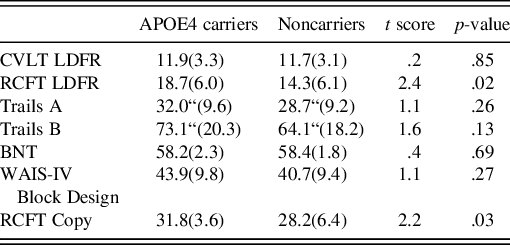
The APOE4 carrier group was not significantly reduced on any of the 10 neuropsychological test scores. The APOE4 carriers actually performed better than the noncarriers on the RCFT copy and recall trials. Table 2 shows the raw scores for the seven non-fluency-based neuropsychological test scores along with t scores and associated p-values.
Means and standard deviations (in parenthesis) for raw scores on the neuropsychological tests for the APOE4 carriers and noncarriers, along with results from independent samples t tests.

As a group, the APOE4 carriers were not significantly lower than the noncarriers for raw scores on any of the standard neuropsychological tests that were included in the cognitive screening battery. Rather, the APOE4 carriers performed better than noncarriers for our RCFT measures. CVLT LDFR = California Verbal Learning Test Long Delay Free Recall; RCFT LDFR = Rey–Osterrieth Complex Figure Test Long Delay Free Recall; BNT = Boston Naming Test; WAIS-IV = Wechsler Adult Intelligence Scale – Fourth Edition.
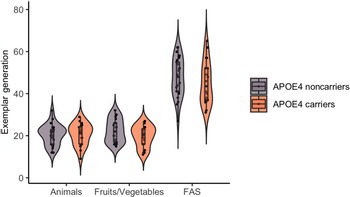
In Figure 1, we show performance on the three standard neuropsychological fluency tests, which assess general, non-autobiographical categories. As noted, APOE4 carriers and noncarriers did not significantly differ on our standard neuropsychological tests of category fluency for letters (i.e., FAS), t(43) < 1, animals, t(43) < 1, or fruits and vegetables, t(43) = 1.7, p = .11.
APOE4 carriers were not significantly reduced on general semantic fluency. Figure 1 shows a hybrid violin/box/dot plot of exemplar generation for APOE4 carriers and noncarrier groups on the standard neuropsychological tests of category fluency, which required generating category exemplars of animals, fruits/vegetables, and the letters “F”, “A”, and “S”. APOE4 carriers were not significantly reduced on these general semantic fluency tasks. The contour of the violin plot represents the distribution of the data, and the dots are jittered. For the boxplot, the line within the box represents the medians, horizontal edges represent first and third quartiles, and whiskers represent 1.5 standard deviations above the upper quartile and below the lower quartile. Figure 1 is created using RStudio and the ggplot2 package (Wickham, Reference Wickham2016).

Episodic and Personal Semantic Autobiographical Memory Fluency
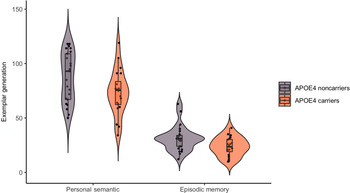
On average, APOE4 carriers generated a total of 73.5 correct names (range: 34–119) and 23.7 correct episodic memories (range: 10–41) on the autobiographical fluency tasks. In comparison, on average, APOE4 noncarriers generated a total of 87.4 correct names (range: 50–118) and 31.0 correct episodic memories (range: 12–63) on the fluency task. As shown in Figure 2, our 2 (Group: APOE4 carrier vs. noncarrier) × 2 (Autobiographical category: episodic vs. personal semantic) mixed-design ANOVA revealed a main effect of group, F(1,43) = 6.34, p = .02, η2 = .13, such that APOE4 carriers generated fewer exemplars overall on the autobiographical fluency task. There also was a main effect of category, F(1,43) = 334.88, p < .001, partial η2 = .89, with participants generating more exemplars for personal semantic relative to episodic memory fluency. However, there was not a significant interaction between group and category, F(1,43) = 1.31, p = .26. Critically, APOE4 carriers exhibited a significant reduction for episodic memory fluency, t(43) = 2.4, p = .02, d = .71, 95% CI [.1, 1.31], and personal semantic fluency, t(43) = 2.1, p = .04, d = .64, 95% CI [.03, 1.24].Footnote 1
APOE4 carriers were significantly reduced for both personal semantic and episodic memory fluency. Figure 2 shows a hybrid violin/box/dot plot of exemplar generation for APOE4 carriers and noncarrier groups on the autobiographical category fluency tasks. The APOE4 carriers, as a group, generated fewer familiar names (personal semantic) and episodic memory exemplars. The contour of the violin plot represents the distribution of the data, and the dots are jittered. For the boxplot, the line within the box represents the medians, horizontal edges represent first and third quartiles, and whiskers represent 1.5 standard deviations above the upper quartile and below the lower quartile. Figure 2 is created using RStudio and the ggplot2 package (Wickham, Reference Wickham2016).

On average, both APOE4 carriers and noncarriers generated few intrusions on the episodic memory fluency trials (M carrier = 3.3; M non-carrier = 3.4), and only one APOE4 noncarrier generated any intrusions on the personal semantic fluency trials. As such, not surprisingly, replacing total correct with total correct plus total intrusions did not significantly alter the outcomes. APOE4 carriers generated fewer exemplars, as evidenced by a main effect of group, F(1,43) = 6.2, p = .02, η2 = .13, and fluency was higher for personal semantics exemplars versus episodic memory exemplars, as shown by a main effect of category, F(1,43) = 295.51, p < .001, partial η2 = .87. The magnitude of the APOE4 fluency reduction also did not significantly differ for the autobiographical categories, as shown by the lack of a significant interaction between group and category, F(1,43) = 1.36, p = .25, η2 = .03, with APOE4 carriers showing a significant reduction for both, t’s ≥ 2.2, p’s ≤ .04, d’s ≥ .65.
Total repetitions across the entire fluency task also were quite low per person (M carrier = 1.1; M non-carrier = .8) and did not significantly differ by APOE4 group, t(43) < 1.
Follow-up Autobiographical Memory Analyses
Although participants were instructed to provide short titles for events on the episodic fluency task, one possibility is that APOE4 carriers were more descriptive in their reports, which would limit their ability to generate as many events under time constraints. However, this was not the case, as the number of words used to describe each event by APOE4 carriers (M = 6.1, SD = 1.9) did not significantly differ from noncarriers (M = 6.7, SD = 2.3), t = .88, p = .38.
As mentioned, we followed-up our main analyses with exploratory analyses of the relationship between remoteness and the APOE fluency reduction. For personal semantic fluency, there was a main effect of remoteness, F(2,86) = 9.97, p < .001, partial η2 = .19, such that childhood exemplar generation (M = 30, SD = 8.1) was significantly greater than both early adulthood (M = 24.6, SD = 8.9) and recent life (M = 26.7, SD = 9.5), t’s ≥ 2.54, p’s ≤ .01, d’s ≥ .38, which did not differ, t = 2.00, p = .052. However, there was not a significant interaction between group and remoteness, F(2,86) < 1.
In contrast, for episodic memory fluency, while there was not a main effect of remoteness, F(2,86) < 1, there was a significant interaction between remoteness and APOE status, F(2,86) = 4.6, p = .01, partial η2 = .10. APOE4 carriers demonstrated reduced fluency for childhood (M carrier = 7.3, SD = 3.1; M non-carrier = 10.6, SD = 4.0) and recent time periods (M carrier = 7.2, SD = 3.6; M non-carrier = 10.6, SD = 4.5), t’s ≥ 2.8, p’s ≤ .004, but not early adulthood (M carrier = 9.3, SD = 3.6; M non-carrier = 9.8, SD = 4.7), t < 1.
Discussion
Autobiographical Memory Fluency and APOE4
On an autobiographical fluency task, a group of cognitively unimpaired middle-aged and older APOE4 carriers generated fewer category exemplars for unique events relative to a group of APOE4 noncarriers who were comparable on age, verbal intelligence, and a host of neuropsychological tests, including general category fluency. The present study, therefore, revealed that APOE4 status not only affects EAM elaboration (Grilli et al., Reference Grilli, Wank, Bercel and Ryan2018), but also the ability to rapidly search for and repeatedly select EAMs. Given prior fMRI (Ryan et al., Reference Ryan, Cox, Hayes and Nadel2008; Sheldon et al., 2012; Reference Sheldon, McAndrews, Pruessner and Moscovitch2016) and neuropsychological (Greenberg et al., Reference Greenberg, Keane, Ryan and Verfaellie2009) evidence of medial temporal lobe–cortical involvement in category fluency for episodic/spatial autobiographical memory, we interpret our findings as consistent with the notion that tasks placing heavy computational demands on the neural network that is most vulnerable to clinical AD can amplify signs of subtle cognitive alteration in higher risk individuals.
Our EAM category fluency findings build on recent work by Tomadesso and colleagues (Tomadesso et al., Reference Tomadesso, Gonneaud, Egret, Perrotin, Pélerin, de Flores and La Joie2019). In their study, EAM exemplar generation on a fluency task was compared across three groups: cognitively normal older adults, older adults with Aβ-positive mild cognitive impairment, and older adults with Aβ-negative mild cognitive impairment. Both mild cognitive impairment groups demonstrated reduced autobiographical fluency for remote and recent time periods, and the Aβ-positive group showed a trend for more severe reductions relative to the Aβ-negative group, despite comparable performance between clinical groups on a host of standard neuropsychological tests. Although we do not have Aβ or tau biomarkers in our sample, the results of Tomadesso and colleagues (Tomadesso et al., Reference Tomadesso, Gonneaud, Egret, Perrotin, Pélerin, de Flores and La Joie2019) raise the possibility that nonclinical levels of AD pathology, for which APOE4 carriers are at increased risk for at late middle and older ages (Caselli & Reiman, Reference Caselli and Reiman2013), may alter autobiographical fluency.
In addition to reduced episodic memory fluency, as a group, the APOE4 carriers also generated fewer exemplars for the personal semantic category (i.e., names). In fact, the APOE4-related reduction in personal semantic fluency was comparable to that of episodic memory fluency, as measured by their similar effect sizes, which were medium in magnitude. These findings suggest that autobiographical memory deficits in cognitively unimpaired older adults at higher risk for developing AD dementia can extend to personal semantics, at least when such knowledge is assessed under high autobiographical retrieval fluency demands. This conclusion is consistent with fMRI and neuropsychological studies showing that fluent retrieval of exemplars from seemingly abstract autobiographical categories is supported by the medial temporal lobe (Greenberg et al., Reference Greenberg, Keane, Ryan and Verfaellie2009; Sheldon & Moscovitch, Reference Sheldon and Moscovitch2012). Medial temporal lobe involvement in this sort of fluency task could reflect autobiographical memory organization (Conway, Reference Conway2005) and the possibility that episodic memories and repeated event/lifetime period knowledge may be used to cue the retrieval of more abstract personal semantic category exemplars, including names of people. Relatedly, our personal semantic fluency task required that participants search for exemplars from particular lifetime periods. This added spatiotemporal retrieval demand strikes another commonality with the way EAMs may be searched for and retrieved. Therefore, while a familiar person’s name is a type of abstract personal semantic knowledge, the retrieval strategies used to fluently generate exemplars from this category may draw on episodic mental search routes and content.
Why personal semantic fluency, but not general semantic fluency, was compromised in the group of APOE4 carriers could be related to a few differences in task demands. For instance, the mental search strategies used to generate personally known names may be more episodic relative to the strategies used to fluently generate exemplars from general semantic categories. Relatedly, the fact that our personal semantic fluency task had an added spatiotemporal context, namely lifetime periods, could have further increased demands on medial temporal lobe involvement relative to the general semantic fluency tasks. Another difference is that the personal semantic fluency task required retrieving unique names, whereas the general semantic fluency tasks probed basic level category knowledge. The greater specificity of the personal semantic fluency task may have placed higher cognitive demands on anterior lateral and medial temporal lobe regions that have been implicated in specific concepts (e.g., items) and naming (Clarke & Tyler, Reference Clarke and Tyler2014; Tranel, Reference Tranel2009). Notably, remoteness of knowledge acquisition seems like an unlikely explanation for the difference between autobiographical fluency and general semantic fluency. While the basic level general categories that we assessed reflect knowledge that was likely acquired remotely, APOE4 carriers as a group showed reduced personal semantics and episodic memory for remote and recent time periods.
Overall, the findings suggest that cognitive assessments that track fluency of autobiographical memory generation may be valuable tools for early detection of increased risk for clinical AD. In this regard, it is noteworthy that our exploratory analyses revealed that while remoteness did not have a significant effect on personal semantic fluency, the APOE4 reduction for episodic memory fluency was not detected for the early adulthood period. Interestingly, the early adulthood period overlaps with the reminiscence bump in autobiographical memory, which is a period consisting of highly accessible episodic memories (Conway & Rubin, Reference Conway, Rubin, Collins, Gathercole, Conway and Morris1993; Rubin et al., Reference Rubin, Wetzler, Nebes and Rubin1986). We suggest that the reminiscence bump, which contains many firsts and self-defining moments (Rathbone et al., Reference Rathbone, Moulin and Conway2008; Thomsen et al., Reference Thomsen, Pillemer and Ivcevic2011), may account for the lack of an APOE4 effect in this time period. However, future research will need to examine the effect of remoteness more closely, because we used relatively coarse time periods.
Limitations and Future Directions
The present study has a few limitations that will need follow-up. First, while APOE4 is associated with increased risk for clinical AD, not all APOE4 carriers develop mild cognitive impairment or dementia. As shown in Figure 1, not surprisingly there is overlap in fluency performance between the APOE4 carrier and noncarrier groups, possibly reflecting individual risk profiles. However, a longitudinal study is required to evaluate the degree to which reduced fluency predicts later conversion to mild cognitive impairment or dementia. Second, future research will need to investigate whether reduced autobiographical fluency is sensitive to biomarkers of amyloid or tau, given the need for more sensitive cognitive tools for assessing these pathologies and cognitive endpoints for clinical trials. Third, although prior fMRI and neuropsychological research have shown that autobiographical category fluency tasks are associated with medial temporal lobe and cortical involvement (Ryan et al., Reference Ryan, Cox, Hayes and Nadel2008; Sheldon & Moscovitch, Reference Sheldon and Moscovitch2012; Sheldon et al., Reference Sheldon, McAndrews, Pruessner and Moscovitch2016), it will be important to reveal the neural underpinnings of the APOE4 associated reduction that was captured here. Fourth, consistent with prior research (Addis & Tippett, Reference Addis and Tippett2004; Dritschel, Williams, Baddeley, & Nimmo-Smith, Reference Dritschel, Williams, Baddeley and Nimmo-Smith1992), we always administered the personal semantic category before the episodic memory category within each time period. A future study could evaluate whether probing episodic memories first affects the sensitivity of APOE4 status to personal semantic fluency, or if the magnitude of the episodic memory fluency reduction is altered. Finally, the demographics of our sample are notably high for education and IQ, and the sample is almost entirely Non-Hispanic White. Future research will need to examine the degree to which reduced autobiographical memory is associated with a higher risk for AD in more diverse groups.
Conclusions
We found that middle-aged and older APOE4 carriers, despite being cognitively unimpaired, tended to show reduced autobiographical fluency relative to age and cognitively similar APOE4 noncarriers. Overall, these findings indicate that there may be broad autobiographical memory alterations associated with increased risk for clinical AD.
Acknowledgments
Research reported in this publication was supported by the Arizona Department of Health Services/Arizona Alzheimer’s Consortium (MDG) and the National Institute on Aging of the National Institutes of Health under Award Number R03AG060271 (MDG). The content is solely the responsibility of the authors and does not necessarily represent the official views of the National Institutes of Health.
Conflict of Interest
The author(s) have nothing to disclose.
Ethics Statement
This study was approved by the Institutional Review Board at the University of Arizona.
Data Availability
All data are deposited here: https://osf.io/4c8dr/?view_only=4c3f80d5c40f46a08eb2fb2ab0e8110f.