How and where potters living in the limestone-dominated Maya lowlands produced ceramic vessels containing volcanic ash have puzzled scholars since Anna Shepard (Reference Shepard and Thompson1939) first identified ash-tempered pottery from San Jose, Belize. Since then, researchers have documented pottery containing volcanic inclusions across the lowlands dating from the earliest occupation of the region in the Preclassic (ca. 1000/900 BC; Ebert et al. Reference Ebert, Pierce and Awe2019; Neivens Reference Neivens2018; Sullivan and Awe Reference Sullivan, Awe and Aimers2013) through the Postclassic period (Aimers Reference Aimers2002; Gifford Reference Gifford1976), although production and consumption peaked in the Late to Terminal Classic periods (AD 700–900). Explanations for the widespread consumption of these ceramics include importing finished vessels from volcanic regions of Mesoamerica or importing the volcanic ash and completely local production in the lowlands. Variation in the type of volcanic inclusions and regional differences in vessel form and decoration indicate that the pottery was produced by different groups of potters using a variety of clays and added tempers. Barton Ramie and Baking Pot in the Belize Valley in west-central Belize are two sites where volcanic ash tempered pottery is hypothesized to have been produced based on abundance (Figure 1; Aimers Reference Aimers2002; Chase and Chase Reference Chase and Chase2012; Hammond et al. Reference Hammond, Harbottle and Gazard1976; Reents-Budet et al. Reference Reents-Budet, Bishop, Carolyn Audet and James Blackman2005; Willey et al. Reference Willey, Bullard, Glass and Gifford1965).
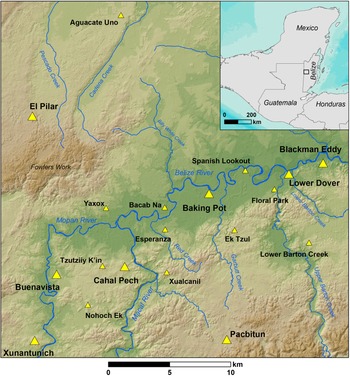
Map of the Belize River Valley (map by Claire E. Ebert).

In this article, we characterize volcanic ash tempered pottery (n = 68) recovered from Baking Pot household contexts and clay samples (n = 12) from across the Belize Valley using thin-section petrography and neutron activation analysis (NAA). The goals of this study are (1) to explore mineralogical and chemical variability in the Late to Terminal Classic volcanic ash ceramic assemblage at Baking Pot and (2) to determine provenance for pottery production. All samples belong to a single petrographic fabric group characterized by the addition of fresh volcanic ash temper to a carbonate-rich, micritic clay. The micritic clay is composed of very fine carbonate inclusions (micrite) evenly distributed throughout the fabric, indicative of a naturally occurring inclusion in the clay. Although there are slight variations in paste recipe and chemical composition, we found that a general method for pottery production was shared by potters who produced monochrome red, bichrome, and polychrome volcanic ash ware pottery. We argue that this paste recipe was local to the Belize Valley based on comparative petrographic and NAA data. Variations in paste recipe and chemical composition are likely due to multiple production groups, slightly different provenance within the Belize Valley region, and postdepositional carbonate removal. This study underscores the importance of using mineralogical and chemical analytical techniques to evaluate pottery production in Mesoamerica (Day et al. Reference Day, Evangelia Kiriatzi and Kilikoglou1999). Differences in resource acquisition critical to understanding pottery production and the effects of postdepositional alteration cannot be determined using chemical data alone.
Background
Geology and Raw Materials Sources
The geology of the Maya lowlands is almost entirely composed of carbonate rocks of varying compositions and textures (e.g., limestone, marl, dolomite, gypsum, and other evaporites). The nearest active volcanos are located more than 400 km south–southwest from the Maya lowlands in the Central American Volcanic Belt that extends from Mexico to Costa Rica (Ford et al. Reference Ford, Spera, Christensen, Ownby, Druc and Masucci2014). The Maya Mountains, located in the central portion of Belize and southeast Guatemala, are the only region of the Maya lowlands with volcanic rocks. The Bladen Volcanic Member is a thick sequence of volcanic rocks along the southern edge of the Maya Mountains. It is composed of lavas, pyroclastic rocks, and volcanic sediments (Bateson and Hall Reference Bateson and Hall1977), including rhyolitic-dacitic lava flows and tuffs (Martens et al. Reference Martens, Weber and Valencia2010:818). The Belize Valley is located approximately 75 km north of the Maya Mountains and is geographically circumscribed by Cretaceous limestones and dolomites to the south of the Belize River and Tertiary formations located to the north. Lenses of Miocene marl (sascab, micrite) up to 12 m thick are also found to the north of the Belize River (Flores Reference Flores1952; Jenkin et al. Reference Jenkin, Innes, Dunsmore, Walker, Birchall and Brigs1976).
After analyzing ceramics from Uaxactun using thin-section petrography, Shepard (Reference Shepard1962) concluded for several reasons that pottery containing volcanic ash from that site was likely produced in multiple locations. First, she found that several varieties of ash were used as temper, and some of the vessels contained mineral grains too large to have been transported via the wind. Second, pumice fragments in some vessels were impregnated with calcite that did not infill cracks/vughs, suggesting that the carbonate could not be attributed to postdepositional processes. The few petrographic studies on pottery produced in the Early (1200–900 BC) to Middle Preclassic (900–300 BC) found that Maya potters used a variety of volcanic materials—either as fresh ash, weathered ash, or other volcanic inclusions (e.g., rhyolitic tuff)—to produce ceramic vessels using multiple paste recipes (Callaghan et al. Reference Callaghan, Pierce and Gilstrap2018; Hardy Reference Hardy2006; Shepard Reference Shepard and Smith1955; Sullivan Reference Sullivan and Garber2006; Villareal and Brown Reference Villarreal, Kathryn Brown, Kathryn Brown, Yaeger and Cap2018). Petrographic data have been collected on Late to Terminal Classic pottery containing volcanic ash in multiple locations that support Shepard's observations at Uaxactun, but debate continues over where and how ancient Maya potters produced ceramic vessels containing volcanic materials (see Supplemental Text 1 for comparative petrographic information).
Weathered volcanic ash has been documented in pottery consumed in many different locations, including Usumacinta (Cabadas-Báez et al. Reference Cabadas-Báez, Solís-Castillo, Solleiro-Rebolledo, Sedov, Leonard, Teranishi-Castillo, Liendo-Stuardo and Korneychick2017), the Petén Lakes region (Moriarty Reference Moriarty2012), Yucatan, and Chiapas (Cabadas-Báez et al. Reference Cabadas-Báez, Sedov, del Pilar Jiménez-Álvarez, Leonard, Lailson-Tinoco, García-Moll, Ancona-Aragón and Hernández-Velázquez2018). Reworked and weathered volcanic ash has been identified in soils of the Usumacinta River, Mexico (Cabadas-Báez et al. Reference Cabadas-Báez, Solís-Castillo, Solleiro-Rebolledo, Sedov, Leonard, Teranishi-Castillo, Liendo-Stuardo and Korneychick2017); northern Belize (Simmons and Brem Reference Simmons and Brem1979); and a reservoir at Tikal, Guatemala (Tankersley et al. Reference Tankersley, Scarborough, Nicholas Dunning, Maynard and Gerke2011). Potters would have had to procure the weathered ash from soils, and this ash may have been an inclusion in the clay rather than an added temper. Weathered ash was used in pottery production for a long period of time in multiple areas of the Maya lowlands, suggesting that soils containing volcanic materials were more widespread than has been documented. Pottery containing other weathered volcanic materials, such as basalt, rhyolite, devitrified glass, or welded tuff, was likely produced in or used materials derived from the Bladen Volcanic Member of the Maya Mountains (Howie Reference Howie2005, Reference Howie2012; Ting Reference Ting2018; Ting et al. Reference Ting, Źralka and Hermes2021).
Most volcanic material used in the production of Late to Terminal Classic pottery, on the other hand, is consistent with fresh ash from a recent volcanic eruption. The morphology (bi- and tricuspid glass shards), sorting, and size are indicative of airfall distribution, and there is no evidence of weathering (Ford et al. Reference Ford, Spera, Christensen, Ownby, Druc and Masucci2014; Shepard Reference Shepard1962). Anabel Ford and colleagues have conducted extensive research to identify the source of volcanic ash in Late Classic pottery (see Catlin Reference Catlin2008; Coffey et al. Reference Coffey, Schmitt, Ford, Spera, Christensen and Garrison2014; Ford and Glicken Reference Ford, Glicken, Rice and Sharer1987; Ford and Rose Reference Ford and Rose1995; Ford and Spera Reference Ford and Spera2007; Ford et al. Reference Ford, Spera, Christensen, Ownby, Druc and Masucci2014). The high silica content of the ash indicates that it came from a rhyolite volcano capable of “propelling a highly explosive fine-grained volcanic ash high into the air for distant distribution by the winds aloft” (Ford et al. Reference Ford, Spera, Christensen, Ownby, Druc and Masucci2014:40). The volcanic ash source is likely not El Chichón in Chiapas, Mexico (Catlin Reference Catlin2008; Ford and Spera Reference Ford and Spera2007), or Ilopango in El Salvador (Coffey et al. Reference Coffey, Schmitt, Ford, Spera, Christensen and Garrison2014).
Ash Procurement Hypotheses
Potters required an abundant, continuous, and reliable source of fresh ash, and Ford and Glicken (Reference Ford, Glicken, Rice and Sharer1987:492) estimate that potters would have used 800,000 kg of ash per year in the area surrounding Tikal. Fresh ash procurement hypotheses fall into three primary categories: (1) whole vessels imported into the lowlands from volcanic regions, (2) fresh ash temper imported into the lowlands from volcanic regions, and (3) completely local production using ash expelled from a volcano that landed in limestone-dominated regions. Kay Sunahara (Reference Sunahara2003) argues for trade in finished ceramic vessels into the Belize Valley from locations with reliable access to volcanic ash, namely the Maya Highlands: it is “questionable that Maya potters were dependent on unpredictable wind carried ash deposits” (Sunahara Reference Sunahara2003: 126). However, the Late Classic ash-tempered vessels in the Belize Valley are local forms, and the paste contains carbonate inclusions, which suggests a production locale in the lowlands (for an alternative argument, see Sunahara Reference Sunahara2003). Others (Jones Reference Jones1986; Miloš et al. Reference Miloš, Kováč, Kovác, Hulínek, Bonatz and Kováč2015; Simmons and Brem Reference Simmons and Brem1979) argue that importing the ash is a more plausible scenario. Although imported materials would have provided potters with a relatively reliable source of imported ash to mix with locally available clays, ethnographic research indicates that potters do not travel long distances for raw materials and that temper is the least likely material to be obtained from a nonlocal source (Arnold Reference Arnold1985). A third camp argues for completely local production in which potters collected fresh ash fall and added it to locally available clays (Ford et al. Reference Ford, Spera, Christensen, Ownby, Druc and Masucci2014). Although recent volcanic eruptions have expelled ash into the Maya lowlands—ash from the 1982 El Chichón eruption landed in Belize (Ford et al. Reference Ford, Spera, Christensen, Ownby, Druc and Masucci2014)—none have come close to the magnitude required to produce thousands of ceramic vessels over an approximate 200-year period.
The Belize River Valley as a Locus for Production
Pottery containing volcanic ash was consumed in all time periods in the Belize River Valley but most abundantly in the Late to Terminal Classic period Spanish Lookout Ceramic Complex (Aimers Reference Aimers2002, Gifford Reference Gifford1976). Most ceramic analysts agree that volcanic ash pottery must have been produced in the Belize Valley, likely near the sites of Baking Pot and Barton Ramie, based on the criterion of abundance (Aimers Reference Aimers2002; Bishop et al. Reference Bishop, Rands, Holley and Schiffer1982; Chase and Chase Reference Chase and Chase2012; Gifford Reference Gifford1976; Willey et al. Reference Willey, Bullard, Glass and Gifford1965). Pottery containing volcanic ash, which includes British Honduras Volcanic Ash and Vinaceous Tawny wares, accounts for 43% of the Late to Terminal Classic Spanish Lookout Complex at Barton Ramie (Chase and Chase Reference Chase and Chase2012; Gifford Reference Gifford1976). The Spanish Lookout ceramic assemblage from Baking Pot, located less than 10 km upriver from Barton Ramie, similarly comprises an abundance of volcanic ash tempered pottery. Excavations at Baking Pot have revealed high percentages of Belize Group ceramics, in select areas up to 80%–90% of Spanish Lookout ceramic assemblages (Julia A. Hoggarth, personal communication 2021; Piehl Reference Piehl2005). On average, in household contexts, around 38% of the Spanish Lookout ceramics recovered were Belize Group ceramics (Piehl Reference Piehl2005:Appendix B, Tables 2–54) that are characterized by volcanic ash temper. The proportion of pottery containing volcanic ash at sites across the eastern Maya lowlands decreases as one moves away from Baking Pot, Barton Ramie, and the Belize Valley (Table 1; for a thorough discussion of distribution, see Chase and Chase Reference Chase and Chase2012).
Percentage of Volcanic Ash Tempered Pottery at Sites in the Eastern Maya Lowlands in the Late to Terminal Classic.

Ceramic Sample Including Petrographic Groups, Chemical Groups, and Descriptive Data.

Baking Pot
Baking Pot is located on the southern bank of the Belize River. It was established by the Middle Preclassic period (700–400 BC) and comprises two monumental groups surrounded by eight distinct residential clusters in the settlement area (Hoggarth Reference Hoggarth2012). At its apogee in the Late to Terminal Classic periods (AD 600–900/1000), Baking Pot supported a maximum population of approximately 3,000 people in its immediate hinterland area (Hoggarth 2012:54). Current evidence suggests that political activities and large-scale occupation ceased at the end of the Classic period (AD 800–1000), with reoccupation in the settlement area in the Late Postclassic period after AD 1250 (Hoggarth et al. Reference Hoggarth, Culleton, Awe and Kennett2014).
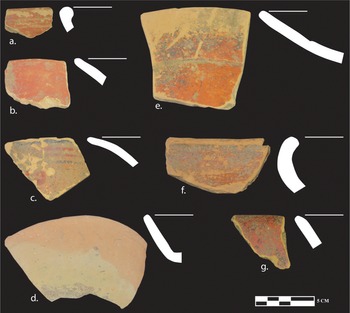
Ceramics analyzed for this study (n = 68) were recovered from nine structures (M90 and M91; M109, M110, and M111; M100 and M101; M181; M184) organized within five household groups in a single settlement cluster (Settlement Cluster C) in the Baking Pot periphery (Hoggarth Reference Hoggarth2012). All samples were analyzed using both thin-section petrography and NAA. Our sample includes British Honduras Volcanic Ash Wares (Belize Red [n = 45], Platon Punctated-Incised [n = 12], and McRae Impressed [n = 4]) and Vinaceous Tawny Wares (Xunantunich Black-on-orange [n = 3] and Benque Viejo Polychrome [n = 4)]). We selected the types and vessel forms to explore variability within volcanic ash wares to determine local versus nonlocal production, identify different local fabric groups, and ascertain whether different paste recipes were used in the production of different decorative types; for example, monochrome versus monochrome incised versus polychrome; Figure 2, Table 2; see Supplemental Text 1 for full descriptive data). Seventeen clay samples were collected across the Belize Valley from riverine, drainage, and alluvial terrace locations. We conducted petrography on all 17 clay samples and subsampled 14 for NAA.
The Ceramic sample: (a) Platon Punctated-Incised bowl (Sample 145), (b) Belize Red serving vessel (Sample 113), (c) Benque Viejo Polychrome dish (Sample 107), (d) Belize Red bowl (Sample 161), (e) Belize Red dish (Sample 96), (f) Belize Red bowl (Sample 147), and (g) Belize Red serving vessel (Sample 143). (Color online)

Methods and Results
Thin-Section Petrography
Petrographic analysis was conducted using a Leica DM750P polarizing light microscope and followed the descriptive system developed by Whitbread (Reference Whitbread and Maniatis1989, Reference Whitbread1995, Reference Whitbread and Hunt2017) for the examination and characterization of ceramic fabrics. The descriptive system is a qualitative method that combines aspects of sedimentary petrography and soil micromorphology, in addition to rock and mineral identification. All samples were assigned to a petrographic fabric group and clays were described using a similar approach to permit comparisons.
Our analysis reveals that all 68 samples belong to the Volcanic Glass A fabric group. Forty-one samples were assigned to the Volcanic Glass A main fabric group, and 27 were assigned to a subgroup characterized by mineralogical differences. This petrographic group was first identified and described by Howie (Reference Howie2005, Reference Howie2012) at Lamanai. Our data from Baking Pot expand this fabric groups and establishes three new subgroups, which reflect the variation evident with a larger sample size (see Supplemental Text 1 for full fabric descriptions and additional micrographs). Only two clay samples were composed of micritic clay, but they contain numerous fossils and differ from the clays used in the production of volcanic ash tempered pottery. The sampled clays are also not chemically identical to the pottery. However, they plot between volcanic ash tempered pottery and locally produced carbonate pottery, suggesting at least a broad, regional chemical similarity (Supplemental Text 2).
The Volcanic Glass A main fabric group (n = 41) is characterized by fresh volcanic ash and tuff added to a micritic clay matrix with lumps of micrite, some containing volcanic ash inclusions. Other inclusions include quartz, plagioclase feldspar, and biotite. The volcanic ash is sickle, lunate, and lath-like and does not show evidence of weathering, indicating that it was added as fresh ash. This description of the volcanic inclusions applies to all Volcanic Glass A fabrics and subgroups. The quartz and plagioclase inclusions occur as both angular, euhedral grains associated with the volcanic temper and as rounded grains occurring naturally in the clay.
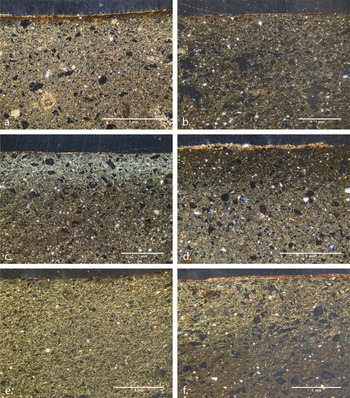
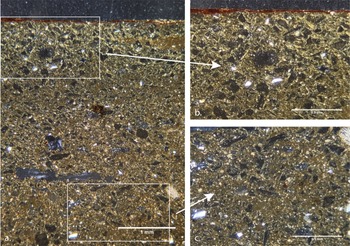
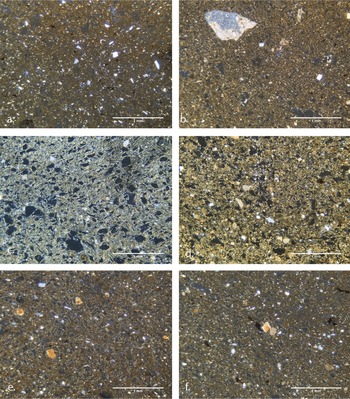
The optical activity of the micromass (i.e., matrix) is highly variable across the fabric group and occasionally within a single sample. The micromass is material less than 10μ in size and is composed of fired clay and silt (Whitbread Reference Whitbread1995:381). Within the Volcanic Glass A fabric group, fabrics either are optically active throughout (Figure 3a, e), show no optical activity (Figure 3b), have optically active margins (Figure 3c, f), or have optically active cores (Figure 3d). The variability suggests that potters did not have a great deal of control over the firing temperature, atmosphere, or both. Samples also exhibit mineralogical variation ranging from micrite present throughout the fabric (Figure 3a, d), being only present in the core but absent from the margins (Figure 3c), or being completely absent from the fabric (Figure 3b, e, f). The presence of micrite only in certain areas of the fabric indicates that the calcium carbonate was once present in all the samples but was removed, likely as a result of postdepositional alteration (Figure 4).
Variation in the Volcanic Glass A Fabric Group (all images in XPL): (a) optically active micromass, carbonate throughout (Sample 102); (b) optically inactive micromass, no carbonate (Sample 128); (c) optically active margins, optically inactive interior, carbonate absent from margins (Sample 114); (d) optically inactive margins, optically active interior, carbonate throughout (Sample 97); (e) optically active micromass, no carbonate (Sample 143); and (f) optically active margins, inactive interior, no carbonate (Sample 125). (Color online)

Variation in the Volcanic Glass A Fabric Group (all images in XPL): (a) Carbonate present in the interior but absent in the margins, (b) higher magnification of the margin showing no micrite, and (c) higher magnification of the interior showing micritic clay (Sample 151, Subgroup B). (Color online)

Subgroup A contains more abundant quartz (mono- and polycrystalline), chert, and chalcedony (n = 2). It is consistent with Howie's mineralogical variant subgroup and represents a different clay with more naturally occurring quartz, chert, and chalcedony (Figure 5a).
Volcanic Glass A Subgroups (all images in XPL): (a) Subgroup A, Abundant Quartz (Sample 126); (b) Subgroup D, Sparry Calcite (Sample 108); (c) Subgroup C1, Minimal Carbonate Sand (Sample 133); (d) Subgroup C2, Abundant Carbonate Sand (Sample 154); (e) Subgroup B, Large frayed biotite without micrite (Sample 117); and (f) Subgroup B, Large frayed biotite with micrite (Sample 147). (Color online)

Subgroup B commonly contains large, frayed biotite inclusions (n = 9). The frayed biotite suggests that these inclusions were naturally occurring in the clay and are indicative of a different provenance from the Volcanic Glass A main group and subgroups A, C, and D. These inclusions differ from the thin, lath-like biotite that was part of the added volcanic temper. Sample 117 is consistent with the Volcanic Ash Subgroup B fabric group described by Ting (Reference Ting2013) as a slightly optically active to optically inactive fabric with no calcium carbonate and large biotite inclusions (Figure 5e). The rest of the samples assigned to this subgroup contain varying amounts of micrite, from isolated micrite lumps to micritic clay throughout (Figure 5f).
The primary distinguishing attribute for Subgroup C is the presence of carbonate sand (n = 12). We divided this subgroup into samples with abundant carbonate sand (Subgroup C1; Figure 5c) and minimal carbonate sand (Subgroup C2; Figure 5d). Subgroup C1 comprises all polychromes sampled for this study. The polychrome vessels contain abundant carbonate sand compared to the monochrome vessels, which is indicative of a different provenance and perhaps a different potting group.
Subgroup D contains fine to medium crystalline sparry calcite (n = 4). These fabrics are identical in all respects to Volcanic Glass A, except they contain very rare sparry calcite inclusions: there are only one to two sparry calcite inclusions in each sample. These samples were assigned to a subgroup to facilitate comparisons with previous studies because they are consistent with Sunahara's (Reference Sunahara2003:97–99) Volcanic Ash 2 Petrofabric. That there are only a few sparry calcite inclusions suggests that they occurred as part of the clay and likely have the same provenance as the main fabric group (Figure 5b).
Neutron Activation Analysis (NAA)
Compositional analysis focused on three primary goals: (1) to understand the relationship between the petrographic subgroups, (2) to identify distinct homogeneous clusters within the sample, and (3) to determine provenance through comparisons with other datasets. NAA was conducted at the University of Missouri Research Reactor (MURR) using standard operating procedures there (Glascock Reference Glascock and Neff1992, Reference Glascock, Glascock, Neff and Vaughn2019). A sample of each artifact roughly 2 cm2 in area was removed; then, all surfaces of this sample were removed using a tungsten-carbide drill burr to account for slipping or painting of the surface and any pre- or postdepositional contamination. This piece was cleaned, dried, and crushed into a powder, which was then irradiated three separate times, allowing determination of yields for a total of 33 elements. Known reference standards (SRM-1633a, SRM-688, SRM-278, and Ohio Red Clay) were also sampled to ensure the process was accurate. Groups were formed through a combination of bivariate and multivariate statistical techniques, including hierarchical cluster analysis, principal components analysis, and visual inspection of bivariate scatterplots depicting elemental values (Neff Reference Neff, Glowacki and Neff2002). Group membership was refined based on Mahalanobis distances (Bishop and Neff Reference Bishop, Neff and Allen1989). Our materials were also compared against MURR's Mesoamerican database using the statistical analyses listed earlier, as well as Euclidean distance searches (Goodwin and MacDonald Reference Goodwin and MacDonald2021). A principal components analysis (PCA) was used to understand the most significant elements driving variation within the sample. Calcium and other alkaline earth metals (Sr, Ba) were identified as significant drivers of variation within the volcanic ash-tempered sample (see Supplemental Text 2 for elemental loadings for principal components axes 1–6 based on the variance-covariance matrix).
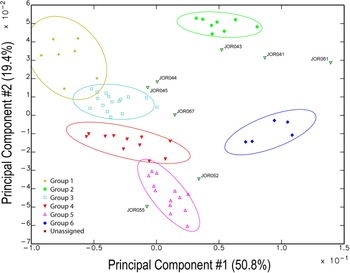
Six compositional subgroups were identified within the volcanic ash-tempered sample (Figures 6 and 7; Table 2). Groups 1 and 3 are highest in calcium, followed by Groups 2, 4, 5, and 6. When compared with data on carbonate removal, these trends suggest that postdepositional carbonate dissolution may play a factor in internal variation within the ash-tempered dataset. For the Volcanic Ash A main group, nearly all samples with carbonate removed were assigned to Group 5 and Group 6; most samples with carbonate intact were assigned to Group 3 or Group 4. This supports that postdepositional alteration affects chemical variability, but the relationship between the two will be the subject of future research (see Gilstrap et al. Reference Ford, Spera, Christensen, Ownby, Druc and Masucci2021). Groups 2 and 6, however, are also enriched in rare earth elements and in most alkali earth metals relative to the remainder of the ash-tempered sample, which suggests that local differences in provenance (i.e., within the same region) play a role as well (see Supplemental Text 2 for Mahalanobis group membership probabilities).
Biplot of the first two principal components calculated for the ash-tempered sample. Labeled vectors demonstrate the loading of individual elements.

Scatterplot of the first two principal components calculated for the ash sample with subgroups plotted. Ellipses represent 90% confidence interval of group membership. (Color online)

The chemical data correspond well with two fabric subgroups: Group 1 (Subgroup C1, abundant carbonate sand) and Group 2 (Subgroup B, frayed biotite). This correspondence supports the petrographic data, suggesting different production groups, different provenance, or both. Group 1 comprises only bichrome and polychrome vessels, but these vessels are distributed across multiple chemical groups. Chemical groups for monochrome serving vessels cross-cut ceramic types and vessel forms. All six chemical groups contain samples from multiple petrographic subgroups and a variety of pottery types and forms (see Table 2 for the relationship between fabric group, NAA group, and descriptive information for each sample). Comparative materials demonstrate clear ties between the current sample and existing reference groups from within the Belize River Valley. Euclidean distance searches, which return the top 10 closest, most chemically similar matches for each specimen in the current dataset to other specimens in the database, consistently indicated that other samples from the Belize River Valley were the most similar to the current one, specifically specimens from the nearby site of Cahal Pech (Douglas et al. Reference Douglas, McDonald, Ebert, Awe, Dussubiuex and Klesner2021; Ebert et al. Reference Ebert, Pierce and Awe2019).
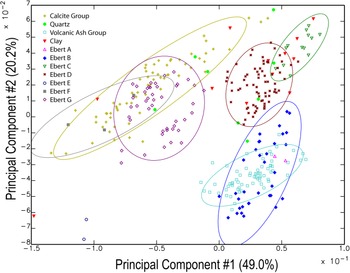
Detailed comparisons between the samples from Baking Pot and Cahal Pech indicate overlap between volcanic ash tempered (Ebert's Group B) reference groups (Figure 8). Ebert's Group B mostly comprises Cunil complex ceramics from the Early Preclassic period, recovered from the site core at Cahal Pech (Ebert et al. Reference Ebert, Pierce and Awe2019:1277). There is remarkable similarity between the chemical signatures of the two ash-tempered groups given that they are separated by more than a thousand years, with each group having some specimens that could reasonably be placed in the other group. However, slight differences are evident along several elements. We are not suggesting continuity in production practice from the Middle Preclassic into the Late Classic period in the Belize Valley. These data support our assertion that the ash-tempered vessels from Baking Pot were produced locally, but similarities and differences in resource acquisition and production practice over time await future petrographic analysis.
Scatterplot of the first two principal components calculated for reference groups from the Belize Valley (Ebert et al. Reference Ebert, Pierce and Awe2019) and current groups. Ellipses represent 90% confidence interval of group membership. (Color online)

Discussion and Conclusions
Methodological Considerations
Using both thin-section petrography and NAA on all samples provided vital information about provenance and production that could not have been obtained by either one alone. Analyzing a large dataset from a single site provides insight into within-group differences and potential local production differences. To deal with the uncertainty introduced into bulk chemical data by the issue of postdepositional calcite dissolution (see Gilstrap et al. Reference Gilstrap, Meanwell, Paris, Bravo and Day2021), we examined the variation within our sample in several ways (see Goodwin and MacDonald Reference Goodwin and MacDonald2021). All the volcanic ash tempered subgroups, with the exception of Group 1, contain specimens with some degree of carbonate removal. The patterns in our chemical data appear to overcome the complications resulting from postdepositional alteration at the current level of analysis. These alterations also do not seem to impede our ability to make meaningful comparisons with other datasets in the region.
Yet, the presence of carbonate has been used to determine whether the pottery was produced within the limestone-dominated Maya lowlands. Analysts with a small sample size would undoubtedly place these sherds into different fabric groups because the data suggest different depositional environments for the clays. A provenance within the limestone-dominated region versus one outside it is a crucial distinction for volcanic ash tempered pottery and one that may have been incorrectly determined in past studies. Fully relying on a single analytical technique does not provide a complete and accurate assessment of provenance and technology (Day et al. Reference Day, Evangelia Kiriatzi and Kilikoglou1999), and failure to consider postdepositional alteration (Gilstrap et al. Reference Gilstrap, Meanwell, Paris, Bravo and Day2021) could lead to erroneous conclusions.
Technology
All the samples analyzed for this study were produced in the same way using very similar raw materials. Potters added fresh volcanic ash to a very fine, micritic clay with very few naturally occurring inclusions. They had a clear preference for micritic clay, a completely different choice of clay from those used to produce most contemporaneous Late Classic limestone-tempered vessels in the Belize Valley (Jordan et al. Reference Jordan, Hoggarth and Awe2020). Potters may have used volcanic ash temper because it facilitated smoothing and caused no firing defects (Shepard Reference Shepard1962), required minimal processing (Jones Reference Jones1986), permitted higher firing compared to limestone temper (Rice Reference Rice2009), or for all these reasons. The fact that potters were specifically using micritic clay, however, suggests that they were aware of the physical properties of volcanic ash when it is mixed with fine carbonate and fired. The ancient Maya also added volcanic ash to slaked lime when making plaster to produce pozzolanic limes, which had greater compressive strength. The high-silica ash (>70% SiO2) from rhyolitic volcanoes make the type of ash used in plaster and pottery ideal for creating pozzolanic plaster (Gillot Reference Gillot2014; Ting et al. Reference Ting, Martin, Graham and Helmke2015; Villaseñor and Graham Reference Villaseñor and Graham2010). Adding high-silica volcanic ash to very fine-grained micritic clay may have resulted in similar reactions (e.g., promoting vitrification), creating a more durable, and thus more desirable, ceramic vessel. The use of a specific type of clay that was not widely sourced to produce other contemporaneous ceramic vessels suggests that the micritic clay had a function beyond simply being locally available.
Provenance
Our argument for production at Baking Pot echoes previous research citing the abundance of this type of pottery in all Late to Terminal Classic contexts at the site (Aimers Reference Aimers2002; Bishop et al. Reference Bishop, Rands, Holley and Schiffer1982; Chase and Chase Reference Chase and Chase2012; Gifford Reference Gifford1976; Willey et al. Reference Willey, Bullard, Glass and Gifford1965). However, our data provide additional information, allowing us to better understand variability and production. All the fabrics documented in this study have been described before, but they were assigned different provenances for a variety of reasons (see Ford et al. Reference Ford, Spera, Christensen, Ownby, Druc and Masucci2014; Howie Reference Howie2012; Sunahara Reference Sunahara2003; Ting Reference Ting2013). We encountered difficulties in comparing the Baking Pot sample to other petrographic studies because of the various methods used to analyze and report the data and, in some cases, a lack of clear photomicrographs. We compiled a presence/absence chart for petrographic studies of volcanic ash-tempered pottery in the southern and northern Maya lowlands (Supplemental Text 1). All the pottery contains quartz, feldspar (plagioclase), and biotite. Quartz, feldspar, and biotite are minerals present in the tuff fragments, and primarily the quartz and feldspar were also natural components of the clay. Pottery containing amphiboles (hornblende) tend to cluster in the Tikal-Uaxactún region of the Peten and may be a provenance indicator for that region. Very few analysts report the presence of calcium carbonate. Although the data reporting is inconsistent, the micritic clay described for the Baking Pot sample is distinctive enough that it would likely be included in fabric descriptions, regardless of methodology. Comparative petrographic data suggests that Volcanic Glass A fabric group and its subgroups were local and specific to the Belize River Valley. More consistent reporting of petrographic data and micrographs (in PPL) from different regions is required to conclusively determine whether the Belize Valley region is the only place where micritic clays were preferentially selected by potters for volcanic ash-tempered vessels.
The NAA data further support a local provenance for this volcanic ash tempered paste recipe in the Belize Valley. Overall, the sample demonstrates low variability within compositional groups and internal homogeneity relative to the rest of the Mesoamerican database. The Baking Pot samples are distinct from other samples in the MURR database and are most consistent with Early Preclassic period ash-tempered pottery from Cahal Pech (Ebert et al. Reference Ebert, Pierce and Awe2019). Although we identified six compositional groups, the NAA data do not suggest that these were produced in vastly different locations. Rather, the differences can be attributed to different production groups, a slightly difference provenance, and possibly postdepositional alteration. Only two chemical groups, Group 1 (carbonate sand fabric subgroup) and Group 6 (frayed biotite fabric subgroup), clearly correspond with mineralogical differences. The factors generating differences in the other four chemical groups are currently unclear, but postdepositional carbonate removal appears to play a role. To determine whether these chemical differences also represent provenance differences, we will need to collect and analyze additional clay samples. The thick marl depositions and associated soils to the north of the Belize River in the vicinity of Baking Pot and Barton Ramie represent the most likely locations for micritic clay procurement based on geology reports (e.g., Jenkin et al. Reference Jenkin, Innes, Dunsmore, Walker, Birchall and Brigs1976).
Our data from Baking Pot stand in contrast to Shepard's (Reference Shepard1962) work at Uaxactun and Howie's (Reference Howie2005, Reference Howie2012) data from Lamanai, in which volcanic ash tempered pottery exhibited much variation indicative of multiple production locales. The lack of variability suggests that Baking Pot households consumed locally produced pottery containing volcanic ash. The petrographic and chemical data indicate that this pottery was produced within the Belize Valley, likely at the sites of Baking Pot and Barton Ramie based on abundance; however, it is not clear whether production differed between these two sites or production also occurred at smaller sites in the region. We hope that providing petrographic fabric descriptions (including micrographs in PPL and XPL) and the complete NAA dataset as Supplemental Text 3 will yield more detailed information on provenance through future comparative research.
Our data indicate that Late to Terminal Classic pottery produced using fresh volcanic ash temper added to micritic clay was local to the Belize Valley. Potters would have needed regular and reliable access to fresh volcanic ash to produce the quantity of vessels documented across the eastern Maya lowlands. Our data cannot determine whether the ash was imported or collected locally. However, the ash importation hypothesis seems unlikely given the amount of temper required and ethnographic data on the distance that potters will travel to procure resources. Although there is no evidence of a large, volcanic eruption blanketing the Maya lowlands in volcanic ash during this time, the tropical environment would have rapidly broken down the fresh ash.
Consumption of volcanic ash pottery increased dramatically in the Belize Valley and across the Maya lowlands during the Late Classic period. Although ash-tempered pottery is present prior to AD 680, it was only present in minor amounts, and the descriptions of the paste differ from British Honduras Volcanic. The rapid increase around AD 700 suggests a major shift in both production practice and consumer demand, but many questions remain. Why the Belize Valley? If a massive volcanic eruption did indeed blanket the region with fresh ash, why was pottery production localized around the sites of Baking Pot and Barton Ramie? It is possible that the use of volcanic ash with micritic clay produced a stronger, durable, and more desirable vessel. We intend to explore these questions in future research.
Acknowledgments
Excavations at Baking Pot were conducted by the Belize Valley Archaeological Reconnaissance (BVAR) Project directed by Jaime Awe, Julie Hoggarth, and Claire Ebert. Thank you to the BVAR Project staff, students, and local colleagues for participating in excavation and cataloging of the ceramic sample. We thank John Morris and the Belize Institute of Archaeology (IA) for permission to conduct research and export the pottery analyzed in this study. Permission for excavations was given to Jaime J. Awe by the Belize IA. Funding for ceramic analysis was provided by two Wenner-Gren Foundation Grants to Jillian Jordan (Dissertation Fieldwork Grant [8954] and Post-PhD Research Grant [9701]). This project was supported in part by NSF grant BCS-1912776 to the Archaeometry Laboratory at the University of Missouri Research Reactor. We appreciate Matthew Longstaffe for reading a draft of the article and providing thoughtful comments. We would also like to thank the three anonymous reviewers.
Data Availability Statement
The full NAA dataset will be available on the MURR website (https://archaeometry.missouri.edu/murr_database.html).
Competing Interests
The authors declare none.
Supplemental Material
For supplemental material accompanying this article, visit https://doi.org/10.1017/laq.2022.11.
Supplemental Text 1. Thin-Section Petrography.
Supplemental Text 2. Neutron Activation Analysis (NAA).
Supplemental Text 3. Complete Neutron Activation Analysis (NAA) Dataset.