Introduction
Root-knot nematodes (RKNs), Meloidogyne spp. are considered, worldwide, as one of the main pathogens of solanaceous crops (Khan and Haider, Reference Khan and Haider1991). In protected crops of sweet pepper in south-eastern Spain, Meloidogyne incognita is the predominant RKN species (Robertson et al., Reference Robertson, López-Pérez, Bello, Díez-Rojo, Escuer, Piedra-Buena, Ros and Martínez2006; Talavera et al., Reference Talavera, Sayadi, Chirrosa-Ríos, Salmerón, Flor-Peregrín and Verdejo-Lucas2012; Guerrero-Díaz et al., Reference Guerrero-Díaz, Lacasa-Marínez, Hernández-Piñera, Martínez-Alarcón and Lacasa-Plasencia2013) and it is estimated to cause a loss of approximately 30% in crop production (Talavera et al., Reference Talavera, Sayadi, Chirrosa-Ríos, Salmerón, Flor-Peregrín and Verdejo-Lucas2012). Traditionally, control has been exercised through chemical soil disinfectants. However, in recent years, their use has been dramatically restricted for environmental reasons, leading to the search for alternatives.
Genetic resistance is one of the best methods for controlling diseases in general and RKNs in particular, for both its food and environmental safety as for its economic sustainability (Djian-Caporalino et al., Reference Djian-Caporalino, Molinari, Palloix, Ciancio, Fazari, Marteu, Ris and Castagnone-Sereno2011; Colla et al., Reference Colla, Gillardi and Gullino2012), factors that explain the efforts being put into breeding programs for the selection of resistant cultivars. However, among the pepper cultivars predominantly used in greenhouses in south-east Spain, there are hardly any RKN-resistant elite cultivars, hence growers have resorted to the use of resistant rootstocks, which are also effective in controlling Phytophthora spp. (Ros et al., Reference Ros, Guerrero, Martínez, Barceló, Martínez, Rodríguez, Guirao, Bello and Lacasa2005; Sánchez et al., Reference Sánchez, Hernández, Lacasa, Martínez, Guerrero, Sánchez, Gomariz, Ros, Lacasa, Lanteri and Rotino2013). Similarly, advantages of grafting pepper to increase tolerance to abiotic stresses have been described (Schwarz et al., Reference Schwarz, Rouphael, Colla and Venema2010), confirming that sweet pepper cultivars grafted on selected rootstocks show better behaviour than the same (ungrafted) cultivars under high temperature (López-Marín et al., Reference López-Marín, González, Pérez-Alfocea, Egea-Gilabert and Fernández2013) and salinity (Penella et al., Reference Penella, Nebauer, López-Galarza, SanBautista, Gorbe and Calatayud2013) conditions.
In pepper (Capsicum annuum L.), only the dominant Me1, Me3 and N resistant genes are effective against M. incognita (Hare, Reference Hare1956; Hendy et al., Reference Hendy, Pochard and Damalso1985; Djian-Caporalino et al., Reference Djian-Caporalino, Pijarowski, Januel, Lefebvre, Daubeze, Palloix, Dalmasso and Abad1999; Thies and Fery, Reference Thies and Fery2003). These resistant (R) genes, identified in geographically and genetically distant lines, are co-localized in a cluster on the pepper P9 chromosome (Fazari et al., Reference Fazari, Palloix, Wang, Hua, Sage-Palloix, Zhang and Djian-Caporalino2012). However, in the case of N and Me3 genes, the emergence of virulent populations has questioned their effectiveness (Castagnone-Sereno et al., Reference Castagnone-Sereno, Bongiovanni, Palloix and Dalmasso1996; Thies, Reference Thies2011). Similarly, under greenhouse cultivation, the emergence of virulent populations has been reported when crops of resistant rootstocks are reiterated for several consecutive years (Ros-Ibáñez et al., Reference Ros-Ibáñez, Robertson, Martínez-Lluch, Cano-García and Lacasa-Plasencia2014). All the above explain why there is a need to search for and use germplasm to act as a new source of resistance. Indeed, this has emphasized the importance of the genetic background in the durability of the resistance conferred by the Me genes and demonstrated that certain backgrounds where R genes are introgressed can prevent resistance breakdown (Barbary et al., Reference Barbary, Palloix, Fazari, Marteu, Castagnone-Sereno and Djian-Caporalino2014). Moreover, other strategies of using R genes, such as pyramiding the Me1 and Me3 genes in the same genotype or alternating them in consecutive crops, have been shown to increase the durability of resistant cultivars and improve nematode control (Djian-Caporalino et al., Reference Djian-Caporalino, Palloix, Fazari, Marteu, Barbary, Abad, Sage-Palloix, Mateille, Risso, Lanza, Taussig and Castagnone-Sereno2014).
The objective of this study was to evaluate, under greenhouse crop conditions, the resistance to M. incognita and the agronomic behaviour as rootstocks of nine C. annuum accessions, to be used in future study of rootstock breeding and research into the influence of genetic background on the expression of resistance to M. incognita.
Materials and methods
Plant material
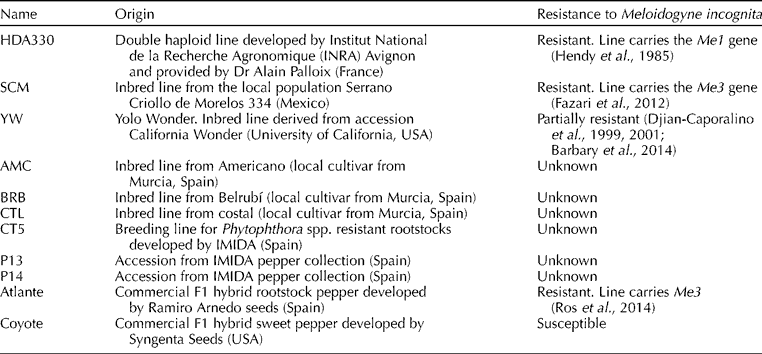
The nine C. annuum accessions evaluated (Table 1) were from the Instituto Murciano de Investigación y Desarrollo Agrario y Alimentario (IMIDA) germplasm bank and these were chosen for their different characteristics: HDA330 and SCM carrying a R gene; YW is considered partially resistant and also is widely referenced in several works; AMC, BRB and CTL accessions are inbred lines from landraces cultivated in the study area and therefore well adapted to the growing conditions and CT5, P13 and P14 showed good vigour and agronomic behaviour in a previous work (E. Sánchez-López, unpublished data). All the accessions were cultivated as rootstocks and used as scion to the Coyote, an F1 commercial cultivar of a pepper varietal type predominant in greenhouse crops of south-east Spain (California type). Japanese top graft procedure was used for grafting. The commercial resistant rootstock Atlante was used as reference and Coyote ungrafted as susceptible control.
Origin and characteristics of the Capsicum annuum L. accessions used in this work

Experimental greenhouses
The evaluation was carried out in two experimental greenhouses (GH-1 and GH-2), located at the ‘Torreblanca’ Experimental Station of IMIDA in Murcia, south-east Spain (latitude 37°45′N, longitude 0°59′W). In both greenhouses, the soil is clay loam and naturally infested with M. incognita race 2 (Robertson et al., Reference Robertson, López-Pérez, Bello, Díez-Rojo, Escuer, Piedra-Buena, Ros and Martínez2006). The M. incognita population of GH-1 is considered avirulent to R genes, while the M. incognita population of GH-2 is virulent to the Me3 gene, since resistant rootstocks had been cultivated in this greenhouse for the three previous years and a high degree of infestation was found in those Me3 gene carriers.
Experimental procedures and evaluation
All accessions were grown in both greenhouses, except P14 that was grown only in GH-1. A randomized block design with three repetitions per accession was established in each greenhouse. Each elemental plot consisted of a row of 26 plants in GH-1 and 20 plants in GH-2. Plants were spaced 0.40 m apart in the row and there was 1.00 m gap between rows (2.5 plants/m2). The crops were grown from early January to August, following the cultural practices used in commercial sweet pepper production in this area.
At the end of the growing period, the resistance to M. incognita was evaluated. For this, ten random plants were removed from each row and taken to the laboratory, where the roots were washed and examined. The percentage of infected plants was calculated according to the ability of M. incognita to reproduce in the same plant (i.e. the presence of galls and egg masses). The gall index was also evaluated following the 0–10 scale developed by Bridge and Page (Reference Bridge and Page1980). This parameter is frequently used to evaluate resistance to RKN in pepper (Djian-Caporalino et al., Reference Djian-Caporalino, Palloix, Fazari, Marteu, Barbary, Abad, Sage-Palloix, Mateille, Risso, Lanza, Taussig and Castagnone-Sereno2014; Ros-Ibáñez et al., Reference Ros-Ibáñez, Robertson, Martínez-Lluch, Cano-García and Lacasa-Plasencia2014) and other horticultural crops (Abu Irmaileh et al., Reference Abu Irmaileh, Mansour, Al Banna and Badwan2013). In addition, in GH-1, the marketable yield of each accession was measured, obtaining the partial yields for three harvest periods – initial (period 1), central (period 2) and final (period 3). The total marketable yield (MY-T) was given by the sum of the values of the three successive harvests.
Statistical analysis
Using the StatGraphics statistical package (Statpoint Technologies, Inc., Warrenton, Virginia, USA), an analysis of variance (ANOVA) was performed on the data for the gall index, percentage of plants affected and the interaction accession X greenhouse. A least significant difference (LSD) test at 95% confidence level was used to differentiate means between accessions. Previously, the data were transformed using log10 (X+1) for the gall index and arcsine√x for the percentage of affected plants. The data of the total and partial marketable yields were also analysed by ANOVA and subsequent LSD tests to differentiate the means for each accession, after transforming the data log10 (X+1). Furthermore, a correlation analysis was performed between the factors gall index and MY-T using the means of all the accessions. Atlante rootstock and ungrafted Coyote were excluded in this analysis, because hybrid character could have interfered with interpretation of the results.
Results
Meloidogyne resistance
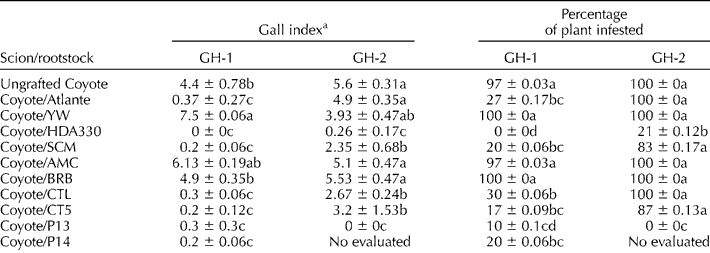
In both greenhouses, differences between accessions (Table 2) and also in the interaction accession X greenhouse (P< 0.00) were found in both the gall index and the percentage of infested plants.
Gall index and percentage of plants infested (mean±standard error) by Meloidogyne incognita for each greenhouse and pepper accession

GH-1, greenhouse-1; GH-2, greenhose-2.
Values with different letters were significantly different (P< 0.05; ANOVA and LSD test).
a Scale gall index (0–10) according to Bridge and Page (Reference Bridge and Page1980).
In GH-1, hardly any damage caused by M. incognita was found in six of the accessions (gall index values less than 1, similar to that of the Me3-carrier Atlante). YW, AMC and BRB were infested with gall index values similar to or greater than ungrafted Coyote. In GH-2, only HDA330 and P13 showed a gall index value of less than 1. AMC, BRB, ungrafted Coyote and Atlante showed the highest gall index values (between 4.9 and 5.6). CT5, CTL and SCM accessions showed intermediate values (between 2.3 and 3.2) that differed from all other accessions except YW, although not different from ungrafted Coyote.
In one-third of the accessions evaluated in greenhouse GH-1, more than 96% of plants were infested, similar to the figure for ungrafted Coyote. Another third (SCM, CTL and P14) showed values of between 20 and 30%, similar to Atlante. In the other three accessions, galls were found on less than 20% of the plants. In GH-2, six of the eight accessions showed values of above 82% of plants affected by M. incognita, rising to 100% in four of them (similar levels to Atlante and ungrafted Coyote). Only HDA330 (21%) and P13 (0%) showed differences for the gall index.
Marketable yield
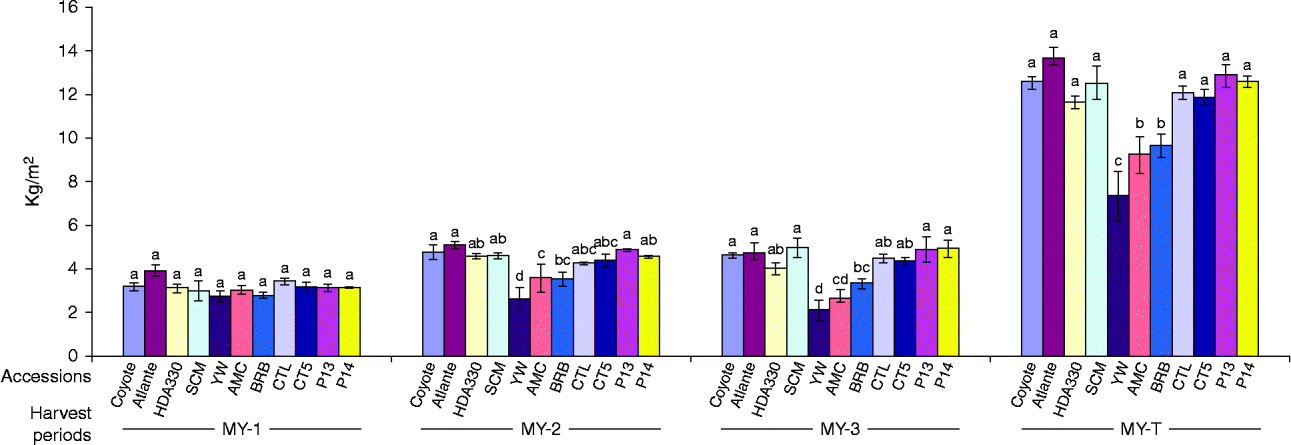
Peppers were picked on seven occasions between April 19 and August 10. The first two harvests were assigned to period 1 (initial), the following three harvests to period 2 (central) and the last two were assigned to period 3 (final). Significant differences between accessions were found for MY-T and the marketable yield of periods 2 and 3 (Fig. 1). Of the nine accessions evaluated, P13 (12.87 kg/m2) provided the highest MY-T, although with no statistical differences with respect to HDA330, SCM, CTL, CT5 and P14, or from Atlante and ungrafted Coyote. The lowest productive accession was YW, with a 40% lower MY-T than P13, followed by AMC and BRB, whose total yields were more than 25% lower than that of P13.
Marketable yield, in Kg/m2, of accessions growing in GH-1. MY-1, MY-2 and MY-3 correspond to the production obtained during harvest periods 1 (initial), 2 (middle) and 3 (final), respectively. MY-T corresponds to the total marketable yield. Different letters in the same harvest periods indicate significant differences (P< 0.05; ANOVA and LSD test).

In period 1, the yield ranged from 3.40 kg/m2 for CTL to 2.69 kg/m2 for YW, with no statistical differences. In period 2, the greatest yield corresponded to P13 (4.88 kg/m2), but with no statistical differences from the other five accessions, or with respect to ungrafted Coyote and Atlante. The least productive accessions were YW, with a 47% lower yield than P13, and AMC and BRB, with 23% lower yields. In the last harvest period, SCM, P13 and P14 were the three most productive accessions, showing no differences when compared with ungrafted Coyote and Atlante. The least productive were YW, which had a 50% lower yield than the most productive accessions, followed by AMC and BRB (46 and 37% lower than SCM). The yields of HDA330, CTL and CT5 did not differ from the yields of the most productive accessions or BRB.
Correlation between gall index and marketable yield
A strong inverse correlation (P= 0.000, value − 0.9656) was found between gall index and marketable yield.
Discussion
The accessions showed different degrees of resistance/susceptibility to M. incognita, and some behaved differently in each greenhouse. The results for the gall index and percentage of infested plant coincided in the valuation of each accession, although discrepancies for some materials in GH-2 were found, when the percentage of infested plants was more discriminatory.
HDA330, a carrier of Me1, was resistant in both greenhouses. SCM and Atlante, carriers of Me3, were resistant in GH-1, but were infested in GH-2, due to the virulent nature of the nematode population in this greenhouse. Under the conditions of the tests, the resistance conferred by the Me1 gene was more robust than that conferred by Me3, which agrees with the results of other studies in which cases of virulence for Me3 gene have been reported, but not for Me1 gene (Castagnone et al., Reference Castagnone-Sereno, Bongiovanni, Palloix and Dalmasso1996; Djian-Caporalino et al., Reference Djian-Caporalino, Molinari, Palloix, Ciancio, Fazari, Marteu, Ris and Castagnone-Sereno2011). Notably, there is also difference between SCM and Atlante in the greenhouse GH-2, despite carrying the same R gene, SCM behaving as partially resistant but Atlante as susceptible (infested to the same extent as ungrafted Coyote). This may be due to the genetic background, the influence of which on the resistance genes has been proven in recent studies (Barbary et al., Reference Barbary, Palloix, Fazari, Marteu, Castagnone-Sereno and Djian-Caporalino2014).
Another four accessions showed resistance to M. incognita, although the genetic source is unknown. Thus, P13 was as resistant as HDA330 in both greenhouses. Furthermore, both CTL and CT5 showed a similar behaviour to SCM, being resistant in GH-1 and partially resistant in GH-2. P14 was resistant in GH-1 although not evaluated in GH-2. The resistance of these four accessions may be due to known genes (Me or N) or may be conferred by new genetic sources. In this regard, we believe it very likely that new resistance factors are involved in one or more of these accessions, based on the different origins of the lines where Me and N genes have been identified and on the results of resistance tests in controlled conditions, whereby CTL was infested at a low level with avirulent populations of M. incognita (F. Sánchez-Solana, unpublished data). This fact raises suspicions concerning the possible absence of major genes (e.g. Me and N) in this accession. Whatever the case may be, this hypothesis must be verified by appropriate genetic analyses.
AMC, BRB and YW, similar to ungrafted Coyote (susceptible control), were susceptible to M. incognita in both greenhouses. However, in other studies, YW was considered partially resistant to M. incognita (Djian-Caporalino et al., Reference Djian-Caporalino, Molinari, Palloix, Ciancio, Fazari, Marteu, Ris and Castagnone-Sereno2011; Barbary et al., Reference Barbary, Palloix, Fazari, Marteu, Castagnone-Sereno and Djian-Caporalino2014). This discrepancy would probably be due to the different conditions in which the evaluations were performed, since, in the cited works, the populations of M. incognita used were obtained from a single egg (i.e. with little genetic variability), whereas, in our case, YW was evaluated in greenhouses with natural populations (heterogeneous) of M. incognita, making more likely a selection to individuals more aggressive toward YW. Djian-Caporalino et al. (Reference Djian-Caporalino, Molinari, Palloix, Ciancio, Fazari, Marteu, Ris and Castagnone-Sereno2011) observed that the potential reproduction of certain isolated and natural populations of M. incognita obtained in YW is similar to that obtained in susceptible pepper.
The agronomic behaviour as rootstocks, measured by marketable yield, differed among accessions. The greatest marketable yields (similar to that of the commercial rootstock Atlante used as reference) were obtained with HDA330, SCM, CTL, CT5, P13 and P14. The lowest marketable yields were obtained with YW, AMC and BRB. However, as shown by the results for each harvest period, these differences between accessions were not significant at the beginning of the growing period (no difference between them in period 1), but became more evident as the crop progressed.
Of note is the coincidence observed between resistance and marketable yield – the six resistant accessions (HDA330, SCM, CTL, CT5, P13 and P14) were also the most productive – while the three susceptible accessions (YW, AMC and BRB) were the least productive. In fact, the value obtained for the correlation analysis between the two factors ( − 0.9656) makes it very clear that accessions with higher root damages caused by M. incognita produced lower yields as rootstocks. However, an inverse relationship between gall index and marketable yield cannot be established because the intrinsic potential of each accession as rootstock is unknown; although considering the randomness for this factor in choosing the accessions, we consider this hypothesis very likely. Besides, production decreased in susceptible accessions in the later phases of the growing period and this could be explained by the fact that the nematodes had reached sufficient densities by this time to influence the harvest, as has previously been reported for pepper (Di Vito et al., Reference Di Vito, Greco and Carrela1985) and tomato (Ehwaeti et al., Reference Ehwaeti, Phillips and Trudgill1998; Kamran et al., Reference Kamran, Anwar, Javed, Khan, Abbas, Iqbal and Zohaib2013).
However, ungrafted Coyote, which is susceptible to the pathogen, had a much higher yield than that found for plants grafted on susceptible accessions (YW, AMC and BRB), which contrasts with the observed relationship between root damage and yield. Possibly, these differences are influenced by graft-related aspects. In fact, other studies have not always found that the use of rootstocks is an improvement in pepper yield. In trials carried out on soil without nematodes, no differences were observed in production between grafted and non-grafted plants (Jang et al., Reference Jang, Moon, Lee, Lee, Kim and Chun2013), or were only observed in the case of certain, more productive rootstocks (López-Marín et al., Reference López-Marín, González, Pérez-Alfocea, Egea-Gilabert and Fernández2013). Similarly, Leal-Fernández et al. (Reference Leal-Fernández, Godoy-Hernández, Núñez-Colín, Anaya-López, Villalobos-Reyes and Castellanos2013) reported a lower yield for Triple Star grafted onto SCM334 than the same variety ungrafted. However, in our study, we found no differences between Coyote grafted onto SCM and ungrafted Coyote. Therefore, the disparity in the results obtained from different works indicates that several factors are involved in the yield of grafted plants, such as the scion–rootstock interaction, the presence of other pathogens, and/or environmental conditions, among others.
In conclusion, this study has shown that under greenhouse crop conditions and using the plant material as rootstocks, the Me1 gene present in HDA330 confers stronger resistance against M. incognita than the Me3 gene present in SCM and Atlante. We also identified four new accessions with resistance to M. incognita (P13, CTL, CT5 and P14), the first showing the same level of resistance as HDA330. These accessions proved to be interesting material for use in the genetic breeding of varieties and as rootstocks in pepper. Genetic tests to determine the inheritance of these resistances (currently in progress) will be of major interest due to the possible presence of new genetic resistances or favorable genetic backgrounds for their expression. A close relationship between resistance to M. incognita and yield was also found, with the more resistant accessions showing better agronomic performance as rootstocks, which is consistent with the negative effects on plant growth attributed to the nematode.
Acknowledgements
This research was financially supported by the INIA RTA2009-0058 project affected by FEDER. Fulgencio Sánchez-Solana obtained a PhD fellowship from INIA. The authors thank Josefa Gomariz for providing the pepper accessions and Jerónimo Torres for helping with experimental procedures, and Dr Alain Palloix and Dr Caroline Djian-Caporalino from INRA for providing the HDA330 accession.