INTRODUCTION
The continental shelf of southern Brazil is a dynamic and productive area. The seasonal oceanographic and ecological processes which in turn support a high abundance and diversity of species and fishing activities in this area suggests that it should be considered a discrete unit for management purposes (Castello et al., Reference Castello, Haimovici, Odebrecht, Vooren, Seeliger, Odebrecht and Castello1997; Vooren, Reference Vooren, Seeliger, Odebrecht and Castello1997; Odebrecht & Castello, Reference Odebrecht, Castello, Seeliger and Kjerfve2001; Vooren & Klippel, Reference Vooren and Klippel2005; Braga & Niencheski, Reference Braga, Niencheski, Rossi-Wongtschowski and Madureira2006). High densities of benthic macroinvertebrates can occur in the inner surf zone, and are an important food source for a variety of species, including Plata pompano Trachinotus marginatus, the mullets Mugil liza and M. curema, Gulf kingcroaker Menticirrhus littoralis, southern kingcroaker Menticirrhus americanus, whitemouth croaker Micropogonias furnieri and several species of rays and sharks (Garcia & Gianuca, Reference Garcia, Gianuca, Seeliger, Odebrecht and Castello1997). Diversity and abundance of these species is higher in spring and summer (Rodrigues & Vieira, Reference Rodrigues and Vieira2010, Reference Rodrigues and Vieira2013).
During the summer, the inner areas of the continental shelf are important spawning grounds for commercially important teleosts (including young of the year Argentine anchovy Engraulis anchoita) and elasmobranchs (Brazilian guitarfish Pseudobatos horkelii, scalloped hammerhead Sphyrna lewini, and myliobatid rays) (Castello et al., Reference Castello, Haimovici, Odebrecht, Vooren, Seeliger, Odebrecht and Castello1997). According to Vooren & Klippel (Reference Vooren and Klippel2005), these are key areas for the reproduction of 21 species of elasmobranchs in the southernmost coastal waters of Brazil.
The southern Brazilian coastal zone and continental shelf is also an area of intense fishing activities due to the high diversity and abundance of both elasmobranchs and teleosts, which may be targeted or taken as bycatch in commercial fisheries (Vooren, Reference Vooren, Seeliger, Odebrecht and Castello1997; Boffo & Reis, Reference Boffo and Reis2003). Artisanal fishing fleets also operate in fresh water, estuaries and coastal waters. Fishing operations as a whole have intensified in coastal grounds because of the overexploitation of estuarine resources (Reis et al., Reference Reis, Vieira and Duarte1994; Lucena & Reis, Reference Lucena and Reis1998; Haimovici et al., Reference Haimovici, Vasconcellos, Kalikoski, Abdallah, Castello, Hellebrandt, Isaac, Martins, Haimovici and Andriguetto2006). The coastal fishery activities in the region that capture Myliobatis rays are beach seine fishing (Vooren, Reference Vooren, Seeliger, Odebrecht and Castello1997; Velasco et al., Reference Velasco, Oddone and Lopes2011) and a new fishing gear, locally known as ‘lance de praia’. The ‘lance de praia’ is a drifting gill-net used perpendicularly to the coast line, which has not been recorded in technical or peer-reviewed publications previously (see details below).
Micropogonias furnieri is the target species for beach seine fishing, which is a traditional fishing gear in the area. This type of fishing uses a motorized boat (up to 8.0 m long, and up to 18 HP power engine), and a beach seine. This is enabled by Federal Ordinance. The beach seine consists of two lateral sections (wings 600 m long, 8 m high and 140 mm mesh size, knot to knot) and a central bag section (100 m long, 25 m high and 90 mm mesh size), where the fishes are retained (Vooren & Klippel, Reference Vooren and Klippel2005).
The drifting gill-net ‘lance de praia’ fishery targets various members of the family Sciaenidae (e.g. Menticirrhus littoralis, M. americanus and Macrodon atricauda). The gill-net is, on average, 1098 m long and 2.75–3.66 m high, with a mesh size of 70 mm, knot to knot (CEPERG/IBAMA, 2011). The beach drifting gill-net is not formally recognized in the current Brazilian fisheries regulations as a specific fishing gear, although it is considered under the ‘Diversified Coastal Fishery’ category by the fisheries authorities in order to make the legal use of the gear possible (Weigert, Reference Weigert2012).
Myliobatids are viviparous, aplacentary matrotrophic rays that live in coastal waters from the tropics to warm temperate regions. They have a wide disk, elongated thin tails with strong stinging thorns, more or less lateral eyes in the head and small mouth, with teeth forming grinding plates adapted for feeding on crustaceans, molluscs and other invertebrates (Bigelow & Schroeder, Reference Bigelow, Schroeder, Tee-Van, Breder, Parr, Schroeder and Schultz1953; Bond, Reference Bond1996; Hamlett, Reference Hamlett1999; McEachran & de Carvalho, Reference McEachran, de Carvalho and Carpenter2002). In the southern continental shelf of Brazil, three species of the genus Myliobatis occur: M. freminvillei Lesueur, 1824, M. goodei Garman, 1885, and M. ridens Ruocco, Lucifora, Astarloa, Mabragaña & Delpiani, Reference Ruocco, Lucifora, Astarloa, Mabragaña and Delpiani2012 (Vooren, Reference Vooren, Seeliger, Odebrecht and Castello1997). The latter was described by Ruocco et al. (Reference Ruocco, Lucifora, Astarloa, Mabragaña and Delpiani2012) and was previously treated as Myliobatis BT ‘broad teeth’ by Vooren (Reference Vooren, Seeliger, Odebrecht and Castello1997).
In southern Brazil, Myliobatis spp. are an incidental catch in coastal fisheries (Vooren & Klippel, Reference Vooren and Klippel2005; Velasco et al., Reference Velasco, Oddone and Lopes2011; Velasco & Oddone, Reference Velasco and Oddone2015), with both adults and neonates of M. goodei and M. ridens occurring along the coast of the Rio Grande do Sul state (Vooren & Klippel, Reference Vooren and Klippel2005). The bycatch of myliobatids from beach seine fisheries in this area has been highlighted in recent years. Up to 150 individuals were observed as being caught and discarded in a single throw (Velasco et al., Reference Velasco, Oddone and Lopes2011), and there is a report of 178 individuals discarded during fishing operations in spring (Velasco & Oddone, Reference Velasco and Oddone2015). Nevertheless, details about the fishing mortality of Myliobatis spp. are still unknown. The aim of this study was to characterize the incidental capture of these species and other elasmobranchs by the coastal artisanal fishery in southern Brazil, so as to better understand the potential impacts and to better support the design of potential conservation measures for Myliobatis spp.
MATERIALS AND METHODS
Study area
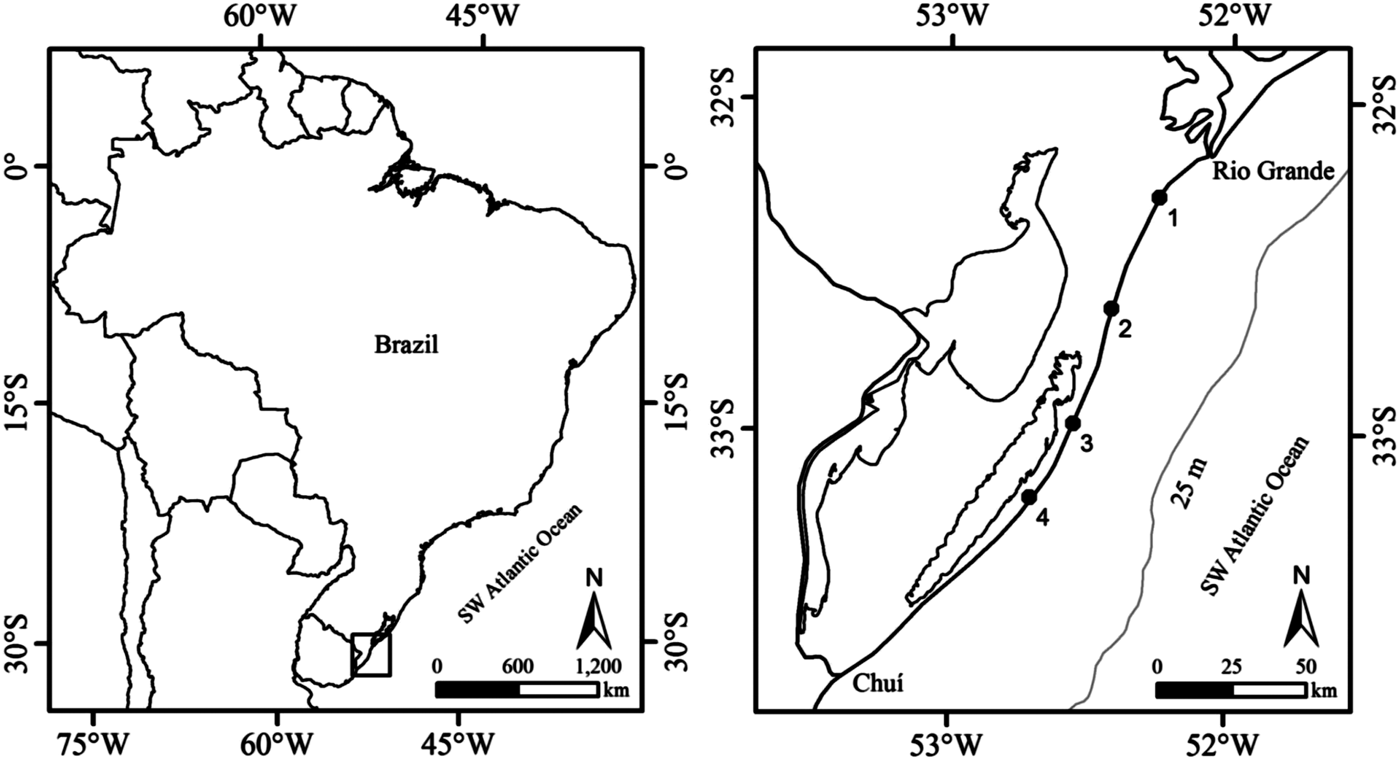
The study was conducted on Cassino Beach, part of a 110 km stretch of coastline between latitudes 32°17′30.83″S and 33°11′55.6″S and longitudes 52°15′41″W and 52°41′48.1″W (Figure 1). This area is an intermediate beach with moderate or low mobility (Figueiredo & Calliari, Reference Figueiredo and Calliari2006; Pereira et al., Reference Pereira, Calliari and Barletta2010) and is one of the main fishing grounds for coastal artisanal and industrial fishing fleets in south and south-west Brazil (Vooren & Klippel, Reference Vooren and Klippel2005; Velasco et al., Reference Velasco, Oddone and Lopes2011).
Map of the study area showing South America (left) and details of the study area, Cassino Beach, southern Brazil (right). Coordinates system and Datum WGS84; Polyconic projection. Produced by Marco Antonio de Oliveira. 1 – Ship Altair; 2 – Sarita lighthouse; 3 – Verga Small lighthouse; 4 – Albardão lighthouse.

The fishing gear
In the beach seine fishery, the boat enters the water perpendicularly to the beach, and travels to beyond the surf zone ~300–400 m away from the shore, where the net is set in waters of between 6–8 m water depth. The shore-based fishermen (~16) then pull each end of the net, closing the seine, and the operation is finished when the central section of the net is landed. The captured specimens are found in a sac in this central section of the net. According to the fishermen, the whitemouth croaker season extends from October to January, although catches were low during the study period. The beach seine fishery operated more frequently at sites 1 and 2 (Figure 1), although it was also carried out near site 4 (Figure 1).
In the drifting gill-net fishery ‘lance de praia’, the boat enters the water perpendicularly to the beach. Immediately after the first or second sandbar (~3 m water depth), the net is set parallel to the shore-line. The shore-based fishermen (~8) then pull one end of the net in the same direction as the coastal current and towards the other end of the net, which is kept secure by one fisherman. When both ends of the net are closer together, then the fishers redistribute themselves to pull the two ends simultaneously, until the net is landed. The kingcroaker is the main target of this fishery, with the main fishing season from May to September. The main fishing grounds for this gear were sites 1 and 2 (Figure 1), but it was also carried out at site 4.
Sampling and data handling
Weekly samples were collected between November 2012 and July 2014, across a total of 114 field trips. The artisanal fishing operations were observed in full, and all captured species were registered (targeted and bycatch). The specimens of Myliobatis spp. captured and/or already discarded by the fishermen were recorded and taken for analysis in the laboratory when possible. The fishermen were interviewed for detailed information on the fishing gear, such as the net size and mesh size, as well as fishing time, number of throws per day, catch estimate by throw, and name and size of the boat.
The ‘fishing discards’ refer to situations in which only the carcasses of myliobatids and other elasmobranchs were found on the beach with no evidence of the type of fishery that discarded them. And when neither fishery operation nor carcasses were observed on the beach the field trips were classified as ‘without sampling’.
Specimens of Myliobatis were identified according to Figueiredo (Reference Figueiredo1977), Bigelow & Schroeder (Reference Bigelow, Schroeder, Tee-Van, Breder, Parr, Schroeder and Schultz1953) and Ruocco et al. (Reference Ruocco, Lucifora, Astarloa, Mabragaña and Delpiani2012), the latter was used specially to identify M. ridens. Specimens that were in an advanced state of decomposition and the identification to the species level was not possible are referred to as Myliobatis spp. in this study. Specimens were sexed and disc width (DW; the pectoral fins measured from tip to tip), and length of the body (LB) (measured from the tip of the snout to the posterior margin of the pelvic fin) were recorded in centimetres. The state of maturation of the gonads was analysed macroscopically and was determined based on the proposed maturity scale for matrotrophic viviparous elasmobranchs of the International Council for the Exploration of the Sea (ICES, 2010, 2013).
The CPUE (catch per unit of fishing effort) was calculated as the number of specimens of Myliobatis rays captured by a given fishing operation, i.e. each haul, for both gears, independently.
A multivariate approach (Principal Coordinates Analysis, PCoA) was applied to explore the presence/absence of specimens depending on four factors: seasons, origin of the sample (beach seine fishery; drifting gill-net ‘lance de praia’; and fishing discards), sex and state of maturity. Three different types of PCoA were used to understand the relationships between (a) occurrence of species of Myliobatis rays and origin of the sample; and the origin of the sample and the seasonal occurrence of each sex and state of maturation of (b) M. goodei and (c) M. ridens. This type of multivariate approach aims to extract the relationships between variables or objects based on a matrix with indices of similarity or dissimilarity (Manly, Reference Manly2008). In PCoA, the binary variable, i.e., presence (1) or absence (0), was analysed using the Jaccard similarity index (Romesburg, Reference Romesburg1984).
RESULTS
Incidental capture of Myliobatis rays
A total of 359 Myliobatis rays (94 M. goodei; 179 M. ridens; two M. freminvillei and 84 unidentified Myliobatis spp.) were collected between November 2012 to July 2014. There were differences between seasons: 191 individuals were recorded in spring (October to December), 108 in autumn (April to June), and 11 in winter (July to September) and 32 in summer (January to March). The eagle ray M. freminvillei was excluded from further analysis, as only two specimens were recorded.
BEACH SEINE FISHERY
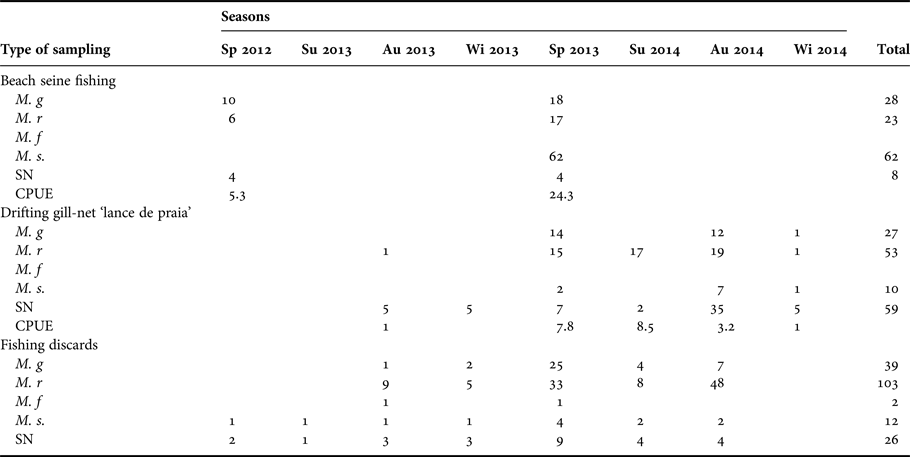
A total of eight operations were observed (all during the spring), of which seven captured Myliobatis rays. This fishing gear captured 16 Myliobatis rays in spring 2012 and 97 in spring 2013 (Table 1). For each operation observed (sampling units), the CPUE ranged from zero to 56 (Table 1). Samples of M. goodei (N = 28) comprised 11 males (one immature, eight developing and two mature) and 17 females (two immature, eight developing and seven mature, of which three were pregnant). Samples of M. ridens (N = 23) comprised nine males (four immature and five developing) and 14 females (seven immature, two developing and five mature, of which four were pregnant). A further 62 specimens could only be recorded to genus (Table 2). Other elasmobranchs recorded in this fishery were Sphyrna lewini, Mustelus schmitti, Narcine brasiliensis, Pseudobatos horkelii, Gymnura altavela and Dasyatis sp.
Number of each Myliobatis species observed for each sampling type by season; number of each sampling type observed by season, and CPUE (number of Myliobatis rays/fishing operation) average for each fishing gear by season between spring 2012 and winter 2014 in southern Brazil.

SP, spring; SU, summer; AU, autumn; WI, winter; M. g, M. goodie; M. r, Myliobatis ridens; M. f, M. freminvillei; M. s, Myliobatis spp.; SN, sampling number.
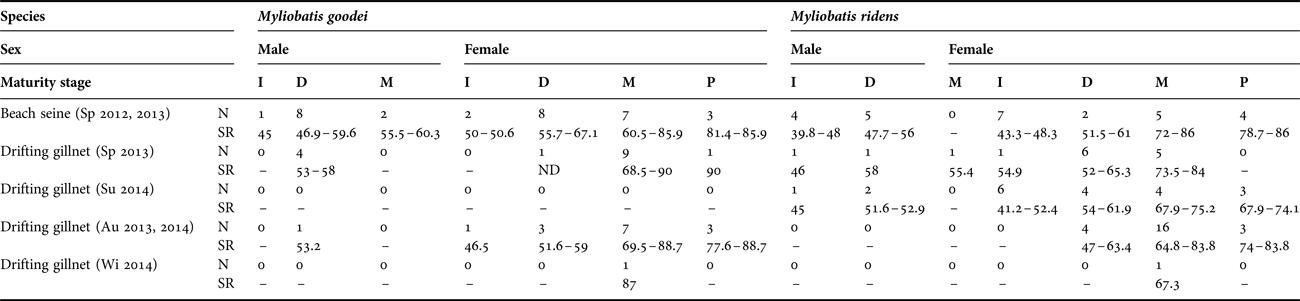
Number of Myliobatis goodei Garman, 1885, and Myliobatis ridens Ruocco, Lucifora, Astarloa, Mabragaña & Delpiani, Reference Ruocco, Lucifora, Astarloa, Mabragaña and Delpiani2012, identified in relation to the maturity stage and sex captured by beach seine fishing and drifting gill-net ‘lance de praia’ between spring 2012 and winter 2014 in southern Brazil.

SP, spring; SU, summer; AU, autumn; WI, winter; I, immature, D, developing; M, mature; P, pregnant; N, number of individuals; SR, size range; ND, no data.
DRIFTING GILL-NET ‘LANCE DE PRAIA’ FISHERY
A total of 59 operations were observed, of which 22 captured Myliobatis rays. This fishing gear captured one Myliobatis ray in autumn 2013, 31 in spring 2013, 17 in summer 2014, 38 in autumn 2014 and three individuals in winter 2014 (Table 1). The CPUE ranged from zero to 23 (Table 1). Samples of M. goodei (N = 27) comprised five developing males and 22 females (one immature, four developing and 17 mature, of which four were pregnant). Samples of M. ridens (N = 53) comprised six males (two immature, three developing and one mature) and 47 females (seven immature, 14 developing and 26 mature, of which six were pregnant). Ten specimens were recorded to genus only (Table 2). This fishery also caught specimens of Squatina guggenheim, Sympterygia acuta, S. bonapartii, Pseudobatos horkelii, Sphyrna spp., Rhizoprionodon lalandii, Mustelus fasciatus, Mustelus schmitti and Carcharias taurus.
FISHING DISCARDS
Fishing discards were recorded during 26 field trips (one in spring 2012, one in summer 2013, 12 in autumn 2013, eight in winter 2013, 63 in spring 2013, 14 in summer 2014 and 57 individuals in autumn 2014; Table 1). Samples of M. goodei (N = 39, including one unsexed) comprised eight males (one immature, six developing and one mature) and 30 females (five immature, nine developing and 16 mature, of which one was pregnant). Samples of M. ridens (N = 103, including seven unsexed) comprised nine males (two immature and seven developing) and 87 females (six immature, 22 maturing and 59 mature, of which seven were pregnant). Fishing discards also included M. f reminvillei (N = 2) and unidentified Myliobatis spp. (N = 12).
SIZE OF SPECIMENS
Specimens of M. goodei taken in the beach seine fishery were 45–85.9 cm DW, the ‘lance de praia’ fishery captured specimens of 46.5–90 cm DW and in the fishing discard specimens of 43.3–115 cm DW were recorded. Overall, the size of M. goodei ranged from 45.0–65.0 cm DW (males) and 43.3–115.0 cm DW (females). Immature, developing and mature males were observed over the size ranges 45, 46.9–59.6 and 60.3–65 cm DW, respectively. The observed size ranges of immature, developing and mature females were 43.3–59, 51.6–72 and 68.5–115 cm DW, respectively. Pregnant females were 77.6–98 cm DW (Table 2).
Specimens of M. ridens caught by the beach seine fishery were 39.8–86 cm DW, whilst the ‘lance de praia’ fishery captured specimens of 41.2–84 cm DW and in the fishing discard were recorded specimens of 42.2–98 cm DW. Overall, M. ridens were observed over a length range of 45.0 and 59.0 cm DW (males) and 41.2–98.0 cm DW (females). Immature, developing and mature males were observed over the size ranges 39.8–48.5, 47.7–59 and 55.4 cm DW, respectively. The observed size ranges of immature, developing and mature females were 41.2–56, 47–66.7 and 60.3–98 cm DW, respectively. Pregnant females were 67.9–86 cm DW (Table 2).
Characterization of captures of Myliobatis spp
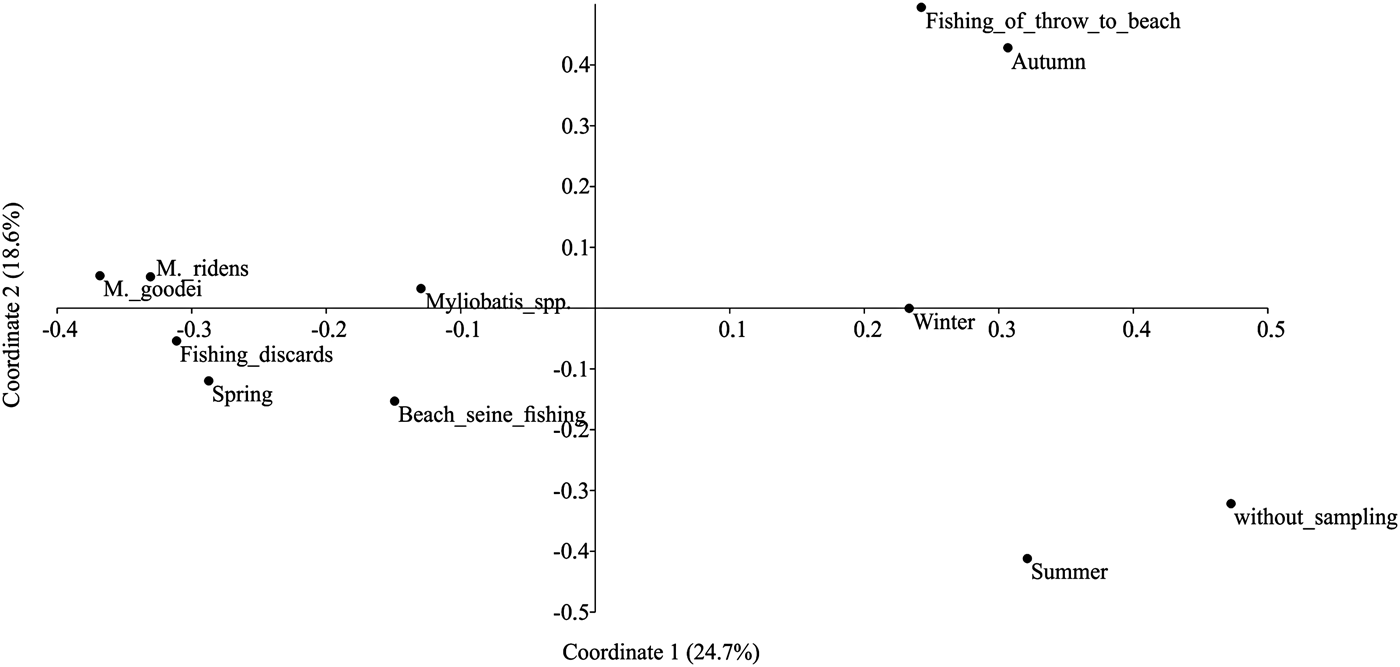
According to the Principal Coordinates Analysis (PCoA) that looked into the seasonal occurrence of species of Myliobatis rays and origin of the sample (Figure 2), axis I had 24.7% of the explained variance and axis II had 18.6%. On axis I, the field trips ‘without sampling’ were more frequent in the summer. Myliobatis goodei and M. ridens had a higher occurrence in fishing discards in the spring. Unidentified Myliobatis spp. were common in beach seine fishing because they were returned alive to the sea by fishermen immediately after their capture, preventing the sampling and classification. On axis II, the drifting gill-net ‘lance de praia’ was more frequent in autumn and winter (Figure 2).
Principal Coordinates Analysis related to seasons, occurrence of species of Myliobatis rays (including the unidentified individuals) and type of sampling between spring 2012 and winter 2014 in southern Brazil.

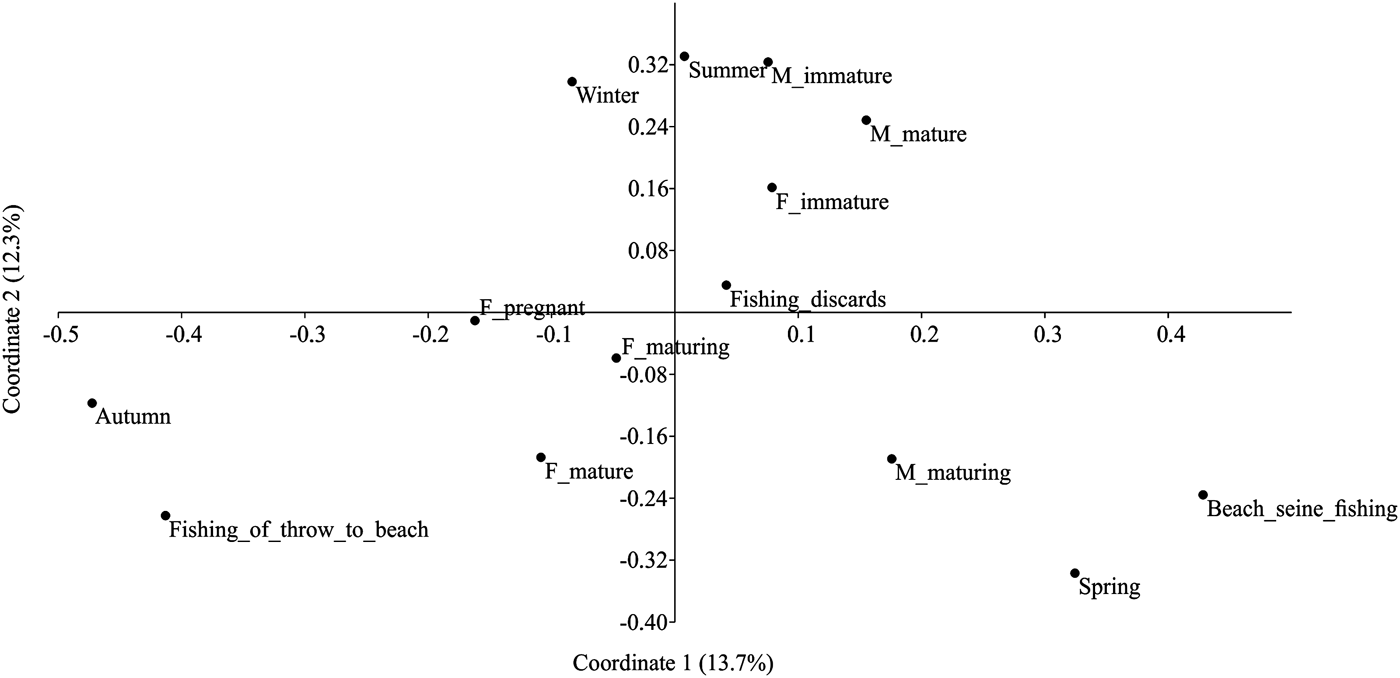
In the PCoA that included the origin of the sample and the seasonal occurrence of each sex and maturity stage of Myliobatis goodei (Figure 3), axis I accounted for 13.7% of the explained variance and axis II accounted for 12.3%. On axis I, developing males were more frequent in the beach seine fishery in spring. Females were more frequent in the drifting gill-net ‘lance de praia’ fishery in autumn. On axis II, immature females and males were more frequent in the fishing discards in winter and summer (Figure 3).
Principal Coordinates Analysis of seasons, type of sampling and the occurrence for each sex and state of maturation of Myliobatis goodei Garman, 1885, between spring 2012 and winter 2014 in southern Brazil. F, Female; M, male.

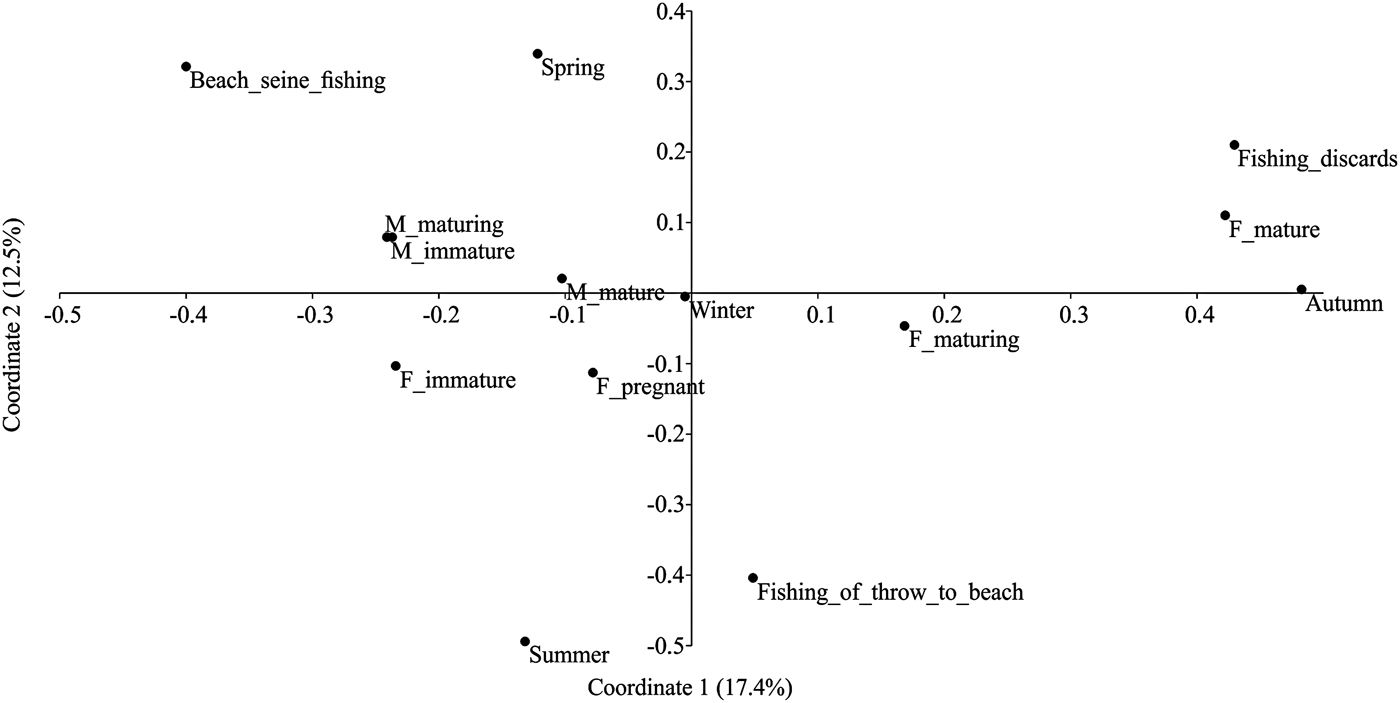
Finally, in the PCoA with the origin of the sample and the seasonal occurrence of each sex and maturity stage of Myliobatis ridens (Figure 4), axis I accounted for 17.4% of the explained variance and axis II for 12.5%. On axis I, developing and mature females were more frequent in the fishing discards in autumn. Males and immature and pregnant females were more frequent in the beach seine fishery in spring. On axis II, the drifting gill-net ‘lance de praia’ fishery captured more M. ridens in summer (Figure 4).
Principal Coordinates Analysis of the seasons, the type of sampling and the occurrence of each sex and state of maturation of Myliobatis ridens Ruocco et al., Reference Ruocco, Lucifora, Astarloa, Mabragaña and Delpiani2012, between spring 2012 and winter 2014 in southern Brazil. F, Female; M, male.

DISCUSSION
This study showed that Myliobatis goodei and M. ridens move to the shallower waters off southern Brazil during the warmest periods of the year, probably to give birth. More studies with artisanal fisheries in coastal waters are needed in order to provide reliable data for the management of such vulnerable elasmobranch species.
Unidentified Myliobatis spp. made up the majority of the samples, as during the fishing operations the fishermen released rays back into the water before it was possible to identify the exact species, as reliable identification requires close observation of the mouth and dental plates (Ruocco et al., Reference Ruocco, Lucifora, Astarloa, Mabragaña and Delpiani2012). The difficulty in identifying discarded specimens found along the shore, due to their advanced state of decomposition, also contributed to the high frequency of unidentified individuals. Such fishing discards represented the largest samples of Myliobatis rays during the study, occurring primarily in spring. It was not possible to determine the type of fishing gear responsible for each sample, as both drifting gill-net ‘lance de praia’ and beach seine fisheries operated, sometimes, in the same sites and seasons.
The fishing discards are specimens brought ashore, but are not sold or consumed. The myliobatids released alive do not show post-release mortality. The discards registered in the shoreline come from fisheries carried out some hours ago, and due to this long time the individuals don't survive.
The two fishing gears use different materials and techniques. Because of this, the composition of the capture of Myliobatis rays also was different. The beach seine fishing had the highest CPUE values. This fishing gear has a greater capacity to catch large numbers of individuals (of both target species and bycatch), due to the greater height and resistant material of the central section of the net. The beach seine mesh size is larger than in the drifting ‘lance de praia’ gill-net, and the whitemouth croaker season coincides with the period of parturition of Myliobatis spp. Therefore, the beach seine fishery has a high potential for capturing these rays, as shown in the present work.
In contrast, the drifting gill-net ‘lance de praia’ has a mesh size specifically designed to capture relatively smaller target species, and sharks and rays may not get entangled and retained by the smaller mesh size. Additionally, the net does not encircle an area, which might allow larger and faster-moving species to escape. Furthermore, the Kingcroaker season occurs during the coldest part of the year, when Myliobatis rays are found in deeper waters (Vooren, Reference Vooren, Seeliger, Odebrecht and Castello1997), so this fishery may have fewer interactions.
In the present study, only two individuals of Myliobatis freminvillei were found. According to Vooren (Reference Vooren, Seeliger, Odebrecht and Castello1997), this species is a summer migrant on the southern continental shelf off Brazil. The species is a subtropical marine ray, found between the shore-line and down to 100 m deep, and it is distributed in two sections of the Atlantic Ocean: from Massachusetts to south-east Florida, USA; and from south-eastern Brazil to Argentina (McEachran & de Carvalho, Reference McEachran, de Carvalho and Carpenter2002; Cousseau et al., Reference Cousseau, Figueroa, Díaz De Astarloa, Mabragaña and Lucifora2007).
Although the other two Myliobatis species occurred together in the three types of sampling (beach seine fishing, drifting gill-net ‘lance de praia’, and fishing discards), especially in spring and autumn, M. ridens was more frequent than M. goodei. Mature females of both species occurred in all seasons, although were particularly frequent in spring and autumn, whereas immature and developing males and females occurred, almost exclusively, in summer. During autumn, groups of M. goodei and M. ridens, including females in early pregnancy, concentrated in the shallow waters of the southern continental shelf of Brazil to feed, coinciding with the activities of the drifting gill-net ‘lance de praia’ fishery (Araújo, personal observation). Pregnant females with near-term embryos (fully developed) were found in spring, when they give birth, coinciding with the activities of the beach seine fishery.
According to Capapé et al. (Reference Capapé, Guélorget, Vergne and Quignard2007), Myliobatis aquila uses the shallow coastal waters of southern France during the warmest part of the year to give birth, feed and mate, coinciding with the fishing practices in this region. Martin & Cailliet (Reference Martin and Cailliet1988) suggested that M. californica is a summer breeder in the shallow waters of California with a reasonably well-defined annual reproductive cycle. In Anegada Bay, Argentina, Myliobatis spp. (given as M. goodei, as data were collected prior to the description of M. ridens in 2012) occurs only during spring and summer, suggesting the use of sheltered, inshore areas to maximize the survival of newborns (Molina & Lopez Cazorla, Reference Molina and Lopez Cazorla2015).
In this study, both species had a higher number of individuals recorded in the fishing discards. Regarding the type of fishing gear, the drifting gill-net ‘lance de praia’ captured more M. ridens and the beach seine fishing captured more M. goodei. It has been suggested that M. ridens lives in relatively shallow water, so the drifting gill-net ‘lance de praia’, which operates at depths down to 3 m, tends to capture this species more often (P.R.V. Araújo, personal observation). On the other hand, M. goodei lives in slightly deeper waters and is therefore more vulnerable to beach seine fishing, which operates at depths down to 8 m. The males of both species had the greatest number of individuals captured by beach seine fishing in the spring, so this suggests that they live at greater depths than the females.
Similarly, in Argentina, Myliobatis goodei showed a wider bathymetric distribution (5–45 m) than M. ridens (5–25 m) (Ruocco, Reference Ruocco2012). According to Vooren (Reference Vooren, Seeliger, Odebrecht and Castello1997), on the continental shelf of the Rio Grande do Sul state, Myliobatis ridens lives in the coastal area (from the coast to 90 m), while the distribution of Myliobatis goodei extends from coastal waters down to 180 m deep. According to Crespi-Abril et al. (Reference Crespi-Abril, Pedraza, García and Crespo2013), in a study of bottom trawling in Patagonia, Myliobatis rays were found only sporadically throughout the samples because they are coastal species.
Myliobatis rays on the southern shelf off Brazil use shallow waters in the warmest periods of the year to give birth; however, the bathymetric distribution differences between the two species could also be due to feeding habits. According to Ruocco (Reference Ruocco2012) and Rezende et al. (Reference Rezende, Capitoli and Vooren2015), M. goodei consumes mainly polychaetes, and Myliobatis ridens consumes bivalves and gastropods. In Anegada Bay, Argentina, M. goodei had a diet composed mainly of bivalves, even though those authors did not know there could be two species, as M. ridens was described only in 2012 (Molina & Lopez Cazorla, Reference Molina and Lopez Cazorla2015). The differences in feeding habitats of the two species are related to the differences in the mouth and head morphometry. Myliobatis goodei has a small mouth and delicate dental plates that are adapted to soft and small prey, whereas M. ridens has a bigger mouth and more robust dental plates that are adapted to eat prey with harder shells (Ruocco, Reference Ruocco2012; Rezende et al., Reference Rezende, Capitoli and Vooren2015). These differences may also explain the bathymetric distributions of these rays. In the southern continental shelf off Brazil, the vertical distribution of benthic macroinvertebrates in the surf zone is influenced by depth. The shallow waters (2–5 m) are inhabited mainly by gastropods and bivalves; molluscs, gastropods and polychaetes occur in waters of 5–8 m depth; and polychaetes are dominant in deeper (8–10 m) water (Gianuca, Reference Gianuca, Seeliger, Odebrecht and Castello1997). Therefore, M. goodei that consumes polychaetes feeds in deeper waters and M. ridens that eats bivalves and gastropods feeds in shallower waters.
The movements of Myliobatis goodei and M. ridens groups to the shallow waters off southern Brazil during the warmest seasons coincides with the activities of the beach seine fishing and the drifting gill-net ‘lance de praia’ in the region. Comparing the two types of fishing gear, the beach seine fishing presented a greater potential for incidentally capturing Myliobatis rays and other elasmobranchs. The gear used in drifting gill-net ‘lance de praia’ is more specific and selective for its target species and does not threaten bycatch species, and therefore can be implemented without major concerns. Despite such promising findings, the high vulnerability of Myliobatis rays reinforces the need for specific conservation measures in southern Brazil to prevent their decline and avoid what happened with the Brazilian guitarfish, a viviparous elasmobranch with restricted geographic distribution (Camhi et al., Reference Camhi, Fowler, Musick, Bräutigam and Fordham1998). It is therefore necessary: (1) to monitor the artisanal fisheries in this region, (2) to develop tools to communicate key facts about the biology of these species effectively to fishermen, (3) to determine the critical areas and the critical periods to prevent or minimize the incidental capture of elasmobranchs during periods of parturition, and (4) promote the live release of incidental bycatch.
ACKNOWLEDGEMENTS
The authors are grateful to M. A. Oliveira for his contribution to the map drawing. O. F. Gadig, F. Dumont and S. Weigert reviewed different version of the manuscript, suggesting some improvements. The authors are particularly grateful to D. Hellebrandt.