Introduction
Cholesteatoma is a benign, slowly expanding epithelial lesion of the temporal bone that is responsible for many complications related to chronic otitis media including those caused by bone destruction. Bone destruction caused by cholesteatoma in the ossicular chain, otic capsule and other adjacent bone structures can result in hearing loss, facial paralysis, vestibular dysfunction and intracranial complications.Reference Kuo, Liao and Shiao1,Reference Olszewska, Wagner, Bernal-Sprekelsen, Ebmeyer, Dazert and Hildmann2 The cellular and molecular mechanisms of cholesteatoma-related bone destruction have not yet been fully elucidated. However, studies that further the understanding of these mechanisms are increasing rapidly. The data obtained from these studies contribute both to explanations of how cholesteatoma causes bone destruction and to research on non-surgical treatment methods.Reference Hamed, Nakata, Sayed, Ueda, Badawy and Nishimura3,Reference Xie, Wang, Ren and Liu4
Many theories related to cholesteatoma-related bone destruction, such as the osteoclast activation theory, pressure necrosis theory, acid lysis theory, enzyme-mediated theory and inflammatory mediators theory, have been suggested. However, none of these theories can independently explain the destruction that occurs.Reference Hamed, Nakata, Sayed, Ueda, Badawy and Nishimura3,Reference Xie, Wang, Ren and Liu4 The most emphasised theory in recent years is the osteoclast activation theory. However, the effectiveness of the role of osteoclasts in cholesteatoma-related bone destruction is controversial. Some studies have shown that osteoclasts play an active role in bone destruction.Reference Jeong, Park, Tae, Lee, Shin and Kim5,Reference Imai, Sato, Iwamoto, Hanada, Terao and Ohta6 In other studies, contrary to expectations, osteoclasts have not been shown to play an active role in bone destruction, and there are even fewer osteoclasts in pathological bone tissue than in healthy bone tissue.Reference Koizumi, Suzuki, Ikezaki, Ohbuchi, Hashida and Sakai7,Reference Koizumi, Suzuki, Kawaguchi, Hashida, Hohchi and Ohkubo8 In another study we conducted using bone turnover markers in patients with chronic otitis media, both bone destruction enzymes and bone construction enzymes in local tissue decreased in patients with cholesteatoma-related bone destruction.Reference Yemis, Ozgur, Basbulut, Ozdemir, Akgul and Mehel9 These findings suggest that osteoclastic activity does not play an active role in cholesteatoma-related bone destruction as previously thought.
Tartrate-resistant acid phosphatases are a group of metalloenzymes that catalyse the hydrolysis of various phosphatases. These phosphatases have two forms that circulate in human blood: tartrate-resistant acid phosphatase 5a and tartrate-resistant acid phosphatase 5b. Tartrate-resistant acid phosphatase 5a is produced in dendritic cells and macrophages, and tartrate-resistant acid phosphatase 5b is produced in osteoclasts.Reference Oddie, Schenk, Angel, Walsh, Guddat and de Jersey10,Reference Rissanen, Suominen, Peng and Halleen11 Since tartrate-resistant acid phosphatase 5b is directly related to osteoclast activation, it has been shown to increase bone metastasis in many types of cancer.Reference Lyubimova, Pashkov, Tyulyandin, Gol'dberg and Kushlinskii12,Reference Reithmeier, Norgard, Ek-Rylander, Nareoja and Andersson13 Experimental studies have demonstrated that tartrate-resistant acid phosphatase 5b can be used as a marker to determine the number of osteoclasts.Reference Rissanen, Suominen, Peng and Halleen11,Reference Lv, Wang, Xu, Tao, Lv and Wang14 However, no study has evaluated the tartrate-resistant acid phosphatase 5b enzyme level in cholesteatoma-related bone destruction in the literature that we reviewed.
This study aimed to evaluate osteoclastic activity in cholesteatoma-related bone destruction using tartrate-resistant acid phosphatase 5b, an enzyme specific to osteoclastic activity. Furthermore, we aimed to increase the understanding of the mechanism of cholesteatoma-related bone destruction.
Materials and methods
Patients and study design
This study was conducted with the approval of the University of Health Sciences Samsun Education and Research Hospital Clinical Research Ethics Committee (decision number: 2019/4/31) and the support of the Scientific Research Projects Coordinatorship of the University of Health Sciences, Turkey (project number: 2019/107).
Patients who signed an informed consent form to participate in the study and who underwent surgery for chronic otitis media between October 2019 and April 2020 at the otorhinolaryngology clinic of University of Health Sciences Samsun Education and Research Hospital were included in the study. The patients were divided into two groups: those with bone destruction and those without bone destruction.
Patients who were pathologically confirmed to have cholesteatoma and in whom the destruction of bone structures was determined during surgery were included in the group with bone destruction. Patients in whom no destruction was observed during surgery or the radiological investigation were included in the group without bone destruction. A total of 72 patients were included in the study. Patients under 18 years of age, postmenopausal women, patients with metabolic bone disease (osteoporosis, osteogenesis imperfecta, Paget's disease and so on) and patients with abnormal (high or low) blood calcium levels were excluded from the study. The serum tartrate-resistant acid phosphatase 5b level was measured, and the middle-ear tissue samples of all patients were included in the study.
Samples and measurement
Venous blood samples were collected from the patients for evaluation before the operation and centrifuged for 20 minutes at 3000 rpm, and the serum was separated and stored at –80°C until evaluation. In the group with bone destruction, samples were collected from the cholesteatoma tissue adjacent to the region of destruction. In the group without bone destruction, samples were collected from the inflamed mucosa adjacent to the bone in the posterior upper part of the middle-ear cavity. After tissue samples were frozen with liquid nitrogen protoxide, they were kept at 2–8°C in phosphate-buffered saline (pH 7.4) solution at 10 times the tissue volume. Subsequently, the tissues were dissolved at room temperature and homogenised (Ultra Turrax T25, Ika Werke, Staufen, Germany). Following centrifugation of the samples at 3000 rpm for 20 minutes, the tartrate-resistant acid phosphatase 5b values were stored at –20°C until analysis.
The enzyme levels of the samples were measured with the Human Tartrate Resistant Acid Phosphatase 5b enzyme-linked immunosorbent assay kit (Bioassay Technology Laboratory, Shanghai, China) and the sandwich enzyme-linked immunosorbent assay technique described by Mira-Pascual et al.Reference Mira-Pascual, Patlaka, Desai, Paulie, Nareoja and Lang15
Statistical analysis
In statistical comparisons between groups, the t-test was used for continuous changing data, and the chi-square test was used for discontinuous data. In all measurements, a p-value less than 0.05 was considered statistically significant. All statistical analyses were conducted using SPSS® statistical software.
Results
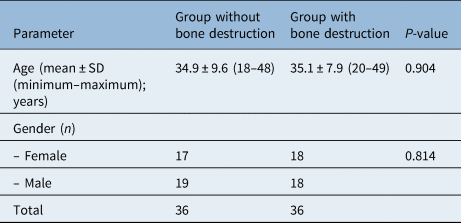
The study was conducted with 72 patients with and without bone destruction, with 36 patients in each group. Both groups had similar characteristics of age and gender. Demographic data of the groups are shown in Table 1.
Demographic data of the groups

SD = Standard deviation
The tartrate-resistant acid phosphatase 5b enzyme levels detected in the serum and tissue samples are shown in Table 2. No significant difference was observed in the serum enzyme levels between the two groups. However, the tartrate-resistant acid phosphatase 5b enzyme levels were significantly lower in the tissue samples from the bone destruction group compared with those from the non-destruction group. These findings suggest that the local osteoclastic activity may have decreased.
Tartrate-resistant acid phosphatase 5b enzyme levels obtained from serum and tissue

*Statistically significant. SD = Standard deviation
Discussion
Many studies and theories have been developed in recent years in order to explain the cellular and molecular mechanism of cholesteatoma-related bone destruction in otitis media. However, none of these theories alone is sufficient to explain the mechanism of this destruction. It is very important to carry out these studies in order to both illuminate the destruction mechanism and to support the development of non-surgical treatments for cholesteatoma.Reference Hamed, Nakata, Sayed, Ueda, Badawy and Nishimura3 This study, to the best of our knowledge, is the first study in the literature that evaluates the local and systemic levels of tartrate-resistant acid phosphatase 5b, which is an enzyme specific for osteoclastic activity in cholesteatoma-related bone destruction.
• Tartrate-resistant acid phosphatase 5b is locally decreased in cholesteatoma-related bone destruction
• Osteoclastic activity may decrease in cholesteatoma-related bone destruction
Although there is no consensus in the literature, the theory that suggests cholesteatoma-related bone destruction is caused by increased osteoclastic activity is one of the most commonly discussed and widely acclaimed hypotheses. The study by Jeong et al. reported that the level of receptor activator of nuclear factor kappa B ligand, which is a molecule that stimulates osteoclastic activity in fibroblasts, was increased in cholesteatoma perimatrix.Reference Jeong, Park, Tae, Lee, Shin and Kim5 Similar to this finding, Imai et al. reported increased receptor activator of nuclear factor kappa B ligand protein in fibroblasts in the cholesteatoma perimatrix and increased number of osteoclasts in the bone tissue adjacent to the cholesteatoma tissue.Reference Imai, Sato, Iwamoto, Hanada, Terao and Ohta6 Additionally, Hamzei et al. reported an increase in the level of molecules that help activation of osteoclasts, such as receptor activator of nuclear factor kappa B ligand and osteoprotegerin; however, no increase in osteoclast number was observed.Reference Hamzei, Ventriglia, Hagnia, Antonopolous, Bernal-Sprekelsen and Dazert16 On the other hand, there are several studies that report no increased osteoclastic activity in cholesteatoma. For instance, Koizumi et al.Reference Koizumi, Suzuki, Ikezaki, Ohbuchi, Hashida and Sakai7 first reported that there was no increase in molecules that activate osteoclasts, such as receptor activator of nuclear factor kappa B ligand and osteoprotegerin in bone tissues with or without cholesteatoma and later showed that osteoclast density was decreased in cholesteatoma patients.Reference Koizumi, Suzuki, Kawaguchi, Hashida, Hohchi and Ohkubo8
In a previous study we conducted, we found that the activity of both bone formation and destruction enzymes were decreased in cholesteatoma-related bone destruction and concluded that osteoclastic activity might have been decreased in cholesteatoma.Reference Yemis, Ozgur, Basbulut, Ozdemir, Akgul and Mehel9 However, in the aforementioned study, we had not studied any enzyme that can specifically demonstrate osteoclastic activity. In the current study, we show that the level of tartrate-resistant acid phosphatase 5b, which is an enzyme specific for osteoclastic activity, is decreased locally. This new finding provides supporting evidence to our previous study and suggests that osteoclastic activity decreases in cholesteatoma-related destruction.
Tartrate-resistant acid phosphatase 5b is a reliable marker that has been used for many years to show the presence of bone metastases in certain types of cancer, such as breast cancer and prostate cancer.Reference Lyubimova, Pashkov, Tyulyandin, Gol'dberg and Kushlinskii12,Reference Capeller, Caffier, Sutterlin and Dietl17,Reference Tauchert, di Liberto, Cordes, Thill, Salehin and Friedrich18 Since the enzyme is specific to osteoclastic activity, its level increases in many metabolic events that result in bone destruction. An experimental study by Rissanen et al. showed that the level of tartrate-resistant acid phosphatase 5b is a reliable marker for osteoclast number.Reference Rissanen, Suominen, Peng and Halleen11 Another study indicated that there is a direct correlation between the level of tartrate-resistant acid phosphatase 5b and the number of osteoclasts. The same study also showed that the level of tartrate-resistant acid phosphatase 5b, as well as the number and volume of osteoclasts, were increased in cell cultures stimulated with receptor activator of nuclear factor kappa B ligand.Reference Lv, Wang, Xu, Tao, Lv and Wang14 These findings suggest that tartrate-resistant acid phosphatase 5b, which we used in our study to demonstrate osteoclastic activity in cholesteatoma-related bone destruction, is a reliable marker. In the current study, no significant difference in systemic tartrate-resistant acid phosphatase 5b levels between the two groups were detected. However, local tartrate-resistant acid phosphatase 5b level was found to be decreased in the bone destruction group. We believe this might be due to the area of destruction being rather small.
The data obtained from our current and previous study suggest that osteoclastic activity is decreased locally in cholesteatoma-related bone destruction. In 1998, Chole showed that the number of osteoclasts decreased in cholesteatoma-related bone destruction and suggested that this reduction might be caused by the process of bone destruction being chronic.Reference Chole19 There are many studies in the literature with different results that support this idea. For this reason, we think the data that we gathered in the current study suggest a decrease in osteoclastic activity; however, this decrease might not be effective in bone destruction.
Although the data we obtained in our study provides important information about osteoclastic activity in cholesteatoma-related bone destruction, the lack of association between clinical parameters, such as the degree and duration of destruction, presence of ear discharge, the severity of hearing loss, and enzyme levels is a prominent limitation to the current study. Besides this, we measured the enzyme levels in the inflamed mucosa of chronic otitis patients without bone destruction as a control, which can be considered limiting for the effectiveness of our study. However, studies investigating the mechanism of cholesteatoma-related bone destruction generally compare cholesteatoma tissue with skin tissue taken from behind the ear because of their histological similarity.Reference Jeong, Park, Tae, Lee, Shin and Kim5,Reference Imai, Sato, Iwamoto, Hanada, Terao and Ohta6,Reference Xie, Pan, Yin, Ren and Liu20 In such studies, molecules that stimulate osteoclasts, such as receptor activator of nuclear factor kappa B ligand and osteoprotegerin, were evaluated, and the level of these molecules were shown to be higher in cholesteatoma compared with skin. However, it is known that these molecules that take an active role in bone turnover are secreted locally and then affect the neighbouring areas. Furthermore, the bone turnover cycle is affected by inflammation.Reference Walsh and Choi21 For this reason, we propose that the inflamed middle-ear mucosa is more suitable as a control tissue for comparison with cholesteatoma tissue, since this tissue is similar in its inflammatory properties to the cholesteatoma tissue and its closer proximity to the bone tissue than the retroauricular skin tissue is more relevant with regard to bone turnover enzymes.
Conclusion
We determined that the level of tartrate-resistant acid phosphatase 5b, a specific enzyme for osteoclastic activity in cholesteatoma-related bone destruction, is locally decreased. This data suggests that osteoclastic activity may decrease in cholesteatoma-related bone destruction. However, further experimental and clinical studies are required to clarify this highly complex mechanism.
Acknowledgements
This study was supported by the Scientific Research Projects Coordinatorship of the University of Health Sciences Turkey (project number: 2019/107).
Competing interests
None declared