Implications
Sheep can, to some extent, overcome unusual (and potentially aversive) plant characteristics within forage shrubs to actively select a dietary source rich in vitamin E, if the animals are given sufficient time to learn about their feeds. Forage shrubs, such as saltbush, could represent a low-cost management opportunity for the livestock industry in areas where the incidence of vitamin E deficiency and the associated nutritional myopathy are high due to a lack of green pastures during dry seasons.
Introduction
Vitamin E is a potent lipid-soluble antioxidant that works in conjunction with selenium to maintain health by protecting cells from oxidative damage (Freer and Dove, Reference Freer and Dove2002). In farming systems, sheep can become deficient in vitamin E when green vegetation is scarce (Gabbedy et al., Reference Gabbedy, Masters and Boddington1977; Steele et al., Reference Steele, Peet, Skirrow, Hopkinson and Masters1980; Pearce et al., Reference Pearce, Norman and Hopkins2005). Vitamin E deficiency is a major problem for fast-growing young sheep (Steele et al., Reference Steele, Peet, Skirrow, Hopkinson and Masters1980), as they have an increased demand for vitamin E (Gabbedy et al., Reference Gabbedy, Masters and Boddington1977). In areas with only seasonal supply of green feed, one option for sheep farmers is to plant drought-tolerant perennial shrubs to provide green feed and thereby improve vitamin E intake. For example, old man saltbush (Atriplex nummularia) has the potential to reduce the incidence of vitamin E deficiency in sheep because it contains high levels of vitamin E, up to 139 mg/kg dry matter (DM; Pearce et al., Reference Pearce, Norman and Hopkins2005), and it remains green throughout summer and autumn in semi-arid, Mediterranean or temperate climates (Pearce et al., Reference Pearce, Masters, Smith, Jacob and Pethick2010). However, many drought-tolerant perennial shrubs can contain high levels of minerals (Na, Cl, K, Se and S) and secondary compounds (oxalates, nitrates, tannins and saponins), which can have anti-nutritional properties that limit voluntary feed intake (Norman et al., Reference Norman, Masters and Barrett-Lennard2013). Ruminants do learn to consume particular feeds because they raise fitness, for example sheep have been shown to self-medicate when they have consumed illness-inducing feeds (Villalba et al., Reference Villalba, Provenza and Hall2006a; Howery et al., Reference Howery, Provenza and Burritt2010). It is possible that sheep may also learn to overcome the aversive effects of the unfavourable characteristics of the feeds and consume adequate amounts to remediate a vitamin E deficiency.
There is evidence that ruminants can learn to associate what they eat with the metabolic consequences of eating it and they change food preference according to their experience and nutritional status (Provenza, Reference Provenza1995). When ruminants experience deficiencies, they alter food preferences accordingly to include different and sometimes unusual feeds in their diet to rectify imbalances and meet their specific needs (Blair-West et al., Reference Blair-West, Denton, McKinley, Radden, Ramshaw and Wark1992; Villalba et al., Reference Villalba, Provenza, Hall and Lisonbee2008). Ruminants exhibit preference, when offered choice, toward essential nutrients such as energy, protein and minerals (phosphorus, calcium and sodium) to remediate specific deficiencies (Villalba and Provenza, Reference Villalba and Provenza1997a; Villalba et al., Reference Villalba, Provenza, Hall and Lisonbee2008; Bach et al., Reference Bach, Villalba and Ipharraguerre2012). Given the incidence of vitamin E deficiency in dry climates and the unusual nutritional profiles of the few perennial forage options that can provide vitamin E, there is a need to investigate if sheep deficient in vitamin E will modify their preferences to increase their intake of a vitamin E.
We hypothesised that sheep deficient in vitamin E would alter their preference and voluntarily consume more of a vitamin E-rich feed to alleviate the deficiency. To test the hypothesis, a vitamin E deficiency was induced in a group of fast-growing lambs. Preference for feeds enriched or deficient in vitamin E was compared with another group not experiencing the deficiency. The term ‘preference’ was defined as a behavioural characteristic of an animal by which it voluntarily and actively selected one feed over another. Thus, when offered a choice of feeds, one feed was indicated as ‘preferred’ if the animal selected more of it than the other feed on offer.
Material and methods
Animals
Fifty-six Dohne Merino ewe lambs aged eight months, with an average live weight of 37.5±0.5 kg (SEM) were selected based on weight, condition score and visual health status. Health records indicated that the lambs were previously vaccinated with Websters Low Volume 3 in 1 vaccine with Selenium and vitamin B12 (Virbac Animal Health Pty Ltd, NSW, Australia). In addition, the lambs had been given Cydectin Weanerguard Se B12 6 in 1 Vaccine and Wormer (Virbac Animal Health Pty Ltd) and were shorn on the farm of origin 2 weeks prior to transportation to the research facility. After transportation, the animals were acclimatised to humans and the research environment for 2 weeks. The lambs had ad libitum access to water and they were exercised on a weekly basis by allowing them to walk freely in a large sand yard adjacent to the animal house. The experimental protocol was approved as conforming to the Australian Code of Practice for the Care and Use of Animals for Scientific Purposes, by the CSIRO Centre for Environment and Life Sciences Animal Ethics Committee (Project 1203).
Experimental design
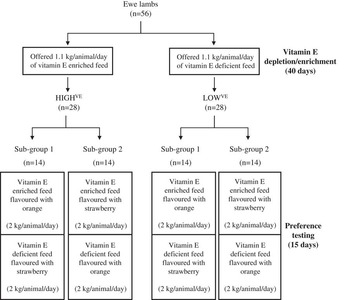
The 56 ewe lambs were stratified according to the following parameters: plasma vitamin E level (α-tocopherol concentration in the plasma, see below), live weight, condition score, and genetics (lambs were either second or third cross) and randomly allocated to individual pens in the animal house. Half of the animals were subjected to a vitamin E depletion and the other half to an enrichment period for 40 days to form two treatment groups, with low (LOWVE) or high (HIGHVE) concentrations of vitamin E in the plasma (n=28; Figure 1). Following the depletion/enrichment period, the lambs were tested for their diet preference for 15 days. Each group (LOWVE and HIGHVE) was divided into two sub-groups. One sub-group (n=14, Figure 1) was offered a choice between vitamin E-enriched feed flavoured with strawberry (+VEST) and vitamin E-deficient feed flavoured with orange (−VEOR). The other sub-group was offered the same choice of two diets but with the flavours reversed (vitamin E-enriched feed flavoured with orange (+VEOR) and vitamin E-deficient feed flavoured with strawberry (−VEST). Swapping the two flavours between sub-groups allowed us to determine whether feed preference was due to the vitamin E content of the feed or the flavour. The flavours were used as ‘dietary cues’ to allow the sheep to differentiate between the vitamin E-enriched and deficient feeds and to associate the flavour in the feed with post-ingestive feedbacks (presumably, positive feedback associated with a recovery from vitamin E deficiency and negative feedback due to the aggravation of the deficiency). Animals were randomly allocated to pens in the animal house.
Diagrammatic representation of the experimental design indicating the vitamin E depletion/enrichment and preference testing periods of the experiment, period duration and feed provided to the sheep in each period.

Experimental feeds
The feed offered was based on commercially available pellets composed of wheat, lupin seeds and cereal straw. The animals did not have any bedding or other feeds. The pellets provided 160 g/kg DM CP, had a DM digestibility of 700 g/kg and 12.1 MJ/kg DM of metabolisable energy. The pellets were specifically formulated with adequate minerals and vitamins, apart for vitamin E, for young lambs to grow at about 200 g/day when consuming 1.1 kg/day. No synthetic vitamin E was added to the pellets, so the pellets only contained the natural source of the vitamin (6.9 mg/kg α-tocopherol). To create the vitamin E-enriched diet, pellets were sprayed with liquid vitamin E while being rotated in a portable concrete mixer for 5 min. The concentrated solution of the vitamin (250 IU d-α-tocopherol per 1 ml, equivalent to 168 mg/ml) was diluted (1 part to 34 parts of water) and the resultant solution applied using a manual trigger sprayer at a rate of 75 mg of vitamin E per kg of pellets (Nanodispersed Natural-Source Vitamin E by Kentucky Equine Research, Victoria, Australia). The recommended level of vitamin E in the diet of sheep is 10 to 20 mg/kg DM diet (Agricultural Research Council, 1980). The pellets were examined to check that the liquid vitamin was distributed evenly and the structure of the pellets was not affected (no visual or textural changes).
The strawberry and orange flavours were synthetic water-soluble, flavouring agents for human food (Queen Fine Foods Pty Ltd, Queensland, Australia). The flavours were diluted in tap water (1 part flavour to 1 part tap water) and applied to the pellets at a rate of 1% using a manual trigger sprayer in two different concrete mixers, one for each flavour. After flavouring the pellets, people were able to reliably identify the orange and strawberry treatments by their smell. The addition of the flavours did not affect the energy, protein or vitamin E content of the pellets. Pellets were prepared on a daily basis and stored in the animal facility in dark tubs before feeding. The experiment was conducted in winter/spring where temperatures in the animal facility did not exceed 25°C.
Protocol to induce vitamin E depletion or enrichment, definition of vitamin E efficiency and the diagnosis of nutritional myopathy
Individual lambs in the LOWVE and HIGHVE groups were offered 1.1 kg/day of the vitamin E-enriched or deficient pellets, at 0900 h, for 40 consecutive days (Figure 1). During the last 7 days, the same 1.1 kg feeds were divided and offered in two separate but adjacent buckets to familiarise the animals with the ‘two bucket’ presentation procedure used during the preference test.
Lambs were defined as vitamin E deficient if their plasma α-tocopherol was between 0.5 and 0.7 mg/l as outlined by White and Rewell (Reference White and Rewell2007). A sufficient level of vitamin E in the plasma was defined as having plasma α-tocopherol ⩾2 mg/l. Nineteen of the 28 lambs in the deficiency-inducing group exhibited plasma concentrations of vitamin E below the critical level of 0.5 mg/l on day 24 of the depletion/enrichment period. To circumvent welfare issues, on the same day (day 24), those 19 lambs were drenched with 4 ml of vitamin E (Nanodispersed Natural-Source Vitamin E, Kentucky 173 Equine Research, Victoria, Australia). The plasma levels of vitamin E of the drenched lambs were checked after 10 days and were within the defined deficiency range. In addition to monitoring the vitamin E concentration in the plasma, evidence of sub-clinical nutritional myopathy was monitored by testing plasma for creatine kinase (CK) and alanine aminotransferase (ALT) enzyme activity using commercial kits (Roche Diagnostics, F Hoffman-La Roche Ltd, Basel, Switzerland). The two tests have a sensitivity of 98% for the diagnosis of subclinical nutritional myopathy (Fry et al., Reference Fry, Allen, Speijers and Roberts1994). Throughout the study, there was no evidence of sub-clinical nutritional myopathy in any lambs as indicated by the activity of CK and ALT.
Preference test
The preference testing was conducted for 15 successive days. Each morning at 0900 h the lambs were offered two buckets, each containing 2 kg of pellets. It was established prior to the experiment that that 2 kg exceeded daily ad libitum intake. One bucket contained vitamin E-enriched, flavoured with strawberry or orange, the other contained the vitamin E-deficient feed, flavoured with orange or strawberry (see Figure 1). The two different diets were therefore offered simultaneously in two separate but adjacent buckets of identical size and colour. The same buckets were used for the same feed type and flavour for the duration of the experiment to avoid any cross-contamination of vitamin E or flavour. The relative position of the flavoured feeds for each lamb was alternated from left to right daily to eliminate any positional bias. The residual pellets for each diet were weighed every morning before feeding and discarded.
Feed intake and preference measurements
Feed intake (as-fed basis) was measured and the relative preference for the vitamin E-enriched feed when fed in combination with the vitamin E-deficient feed was calculated using the preference index (PI) equation (1), which is commonly used to calculate relative preference (Colebrook et al., Reference Colebrook, Black, Purser, Collins and Rossiter1990). To account for instances when the intake was equal to zero, a value of 5 g was added to the numerator and denominator of the PI equation. The value of 5 g was chosen as it was less than the smallest feed intake measured throughout the experiment (11 g):
 $${\rm Preference\,\atop{\rm i}\rm ndex\,(PI)}={\displaystyle{\rm Intake\,of\,vitamin\,E{\rm {\hbox-}}\rm enriched\,feed\,{\plus}5\,\:g} \over {\displaystyle(\rm Intake\,of\,vitamin\,E{\rm {\hbox-}}enriched\,feed\,{\plus}\rm 5\,\:g)\atop{\displaystyle{\plus}(\rm Intake\,of\,deficient\,feed\,{\plus}5\,\:g)}}$$
The index has a scale from 0 to 1, with a PI value of 0.5 indicating an equal preference, PI values below 0.5 indicating a low relative preference for the vitamin E-enriched feed, and values higher than 0.5 indicating a high preference.
Animal measurements
Live weight and condition scores were measured weekly in the morning at 0800 h, before feeding. Blood samples were taken from all animals before feeding at 0730 h every 10 days, starting at the beginning of the depletion/enrichment period. Ten millilitres of blood were collected from the jugular vein using a 10 ml syringe and transferred into lithium-heparin tubes, kept on ice and protected from the light for up to 30 min before processing. After centrifugation at 2000×g for 20 min, plasma was withdrawn and stored at −20°C until analysed. The plasma samples were analysed for α-tocopherol using high-performance liquid chromatography with a fluorometric detection technique according to the method described by McMurray and Blanchflower (McMurray and Blanchflower, Reference McMurray and Blanchflower1979). The intra- and inter-assay coefficient of variation was 1% and 2%.
Statistical analyses
All statistical analyses were conducted using the Genstat statistical package with a confidence level of 95% (Genstat 2012, VSN International Ltd, Hemel Hempstead, UK). A repeated measures ANOVA with mixed models was fitted using a Residual Maximum Likelihood (REML) method to test the interaction between the main effects of time, vitamin E status (HIGHVE and LOWVE groups), feed combination (vitamin E-deficient or enriched), and flavours (strawberry and orange) on diet selection and preference (expressed as feed intake and PI) across the preference testing period of 15 days. In this model, HIGHVE and LOWVE groups, vitamin E-enriched and deficient feeds (each flavoured with either strawberry or orange flavours) were used as fixed factors, and individual animals (n=56) and time (n=15 days) were used as random factors.
In the second model, the period of the 15-day preference testing was divided into two time periods: the first 9 days (the training period) and the last 6 days (post-training period) in order to determine in which period the treatment (high/low vitamin E level) had an effect on diet selection and preference. The HIGHVE and LOWVE groups, feed combination (vitamin E-enriched and deficient feeds, each with either flavour), training and post-training periods were used as fixed factors, with individual animals and time (15 days) used as random factors. Examination of the distribution of the residual values was conducted for both models using repeated measures ANOVA (mixed models REML) and the results indicated that the assumptions concerning homogeneity of variance and normality of data were adequately met.
Results
Plasma α-tocopherol, voluntary feed intake and growth rate
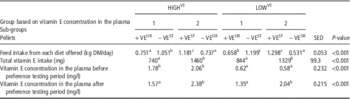
The mean daily feed intake for the lambs averaged across the 15 days preference testing period, was similar between the HIGHVE and LOWVE groups (0.92±0.03 kg v. 0.93±0.03kg; P=0.962). However, there was an overall effect of flavour on feed intake. The intake of strawberry-flavoured feed was greater than that of orange-flavoured feed in both the LOWVE and HIGHVE groups (P<0.001; Table 1). The growth rate of individual lambs in the HIGHVE and LOWVE groups was similar during the depletion/enrichment period (0.108 kg/day for HIGHVE v. 0.107 kg/day for LOWVE; P=0.859) and during preference testing (0.205 kg/day for HIGHVE v. 0.214 kg/day for LOWVE; P=0.598).
Mean daily feed and vitamin E intake during the preference testing period and mean concentrations of vitamin E (mg/l) before and after preference testing of sheep within each treatment subgroup

DM=dry matter.
The subgroups are sheep with relatively high and low plasma vitamin E (HIGHVE, LOWVE), offered two pelletted diets; high vitamin E (+VE) and low vitamin E (−VE) diets paired with either strawberry (ST) or orange flavours (OR).
Values within a row with different superscripts differ significantly at P<0.05.
At the end the depletion/enrichment period, the average plasma concentrations of vitamin E was higher in the HIGHVE group (1.92±0.16 mg/l) than in the LOWVE group (0.60±0.04 mg/l) (P<0.001). By the end of the preference-testing period, the concentrations of vitamin E in plasma were similar (P=0.122) between the two groups (1.98±0.14 for HIGHVE v. 1.69±0.11 for LOWVE). During the 15 days of preference testing, the total vitamin E intake of the vitamin E-deficient lambs (LOWVE) was greater when high vitamin E was paired with strawberry flavour (+VEST) than when paired with orange flavour (+VEOR) (1328 v. 844 mg; P<0.001; Table 1). The intake of vitamin E from the diet and the plasma concentrations of vitamin E were positively correlated in the LOWVE group (y=0.234+0.0013x, R 2=0.63, P<0.001) but not for the HIGHVE group.
The effect of vitamin E deficiency on the feed preference of sheep
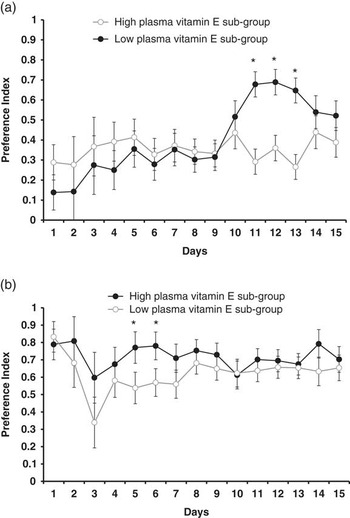
There was a significant three-way interaction (P=0.002) between the initial plasma concentrations of vitamin E (HIGHVE and LOWVE), feed combination (vitamin E in the feed+flavours), and time (days) on feed preferences. Animals selected more of the vitamin E-enriched diet when they were deficient in vitamin E (LOWVE) but the pattern of intake over the 15 days depended on whether the vitamin E-enriched diet was paired with strawberry or orange flavour. If paired with strawberry, intake was reasonably steady, and high, throughout the 15-day period but if paired with orange, their intake increased from a low level to a high level during the 15 days (Figure 2). Throughout the 15 days of preference testing, preference for the strawberry-flavoured feed was greater than the orange flavoured feed in both the HIGHVE and LOWVE groups (P<0.001; Figure 2).
The preference index sheep within the high vitamin E (HIGHVE, black circles) and low vitamin E (LOWVE, white circles) sub-groups across the preference testing period (15 days; mean±SE). Preference index highlights animal preference towards the Vitamin E-enriched diet flavoured with orange (a, +VEOR, top panel) or flavoured with strawberry (b, +VEST, bottom panel). The index ranges from 0 to 1 indicating the extent to which a particular feed is preferred by animals. The asterisk (*) indicates significant differences between HIGHVE and LOWVE groups in their preference toward +VEOR and +VEST feeds (P<0.05).

The feed preferences of the HIGHVE and LOWVE groups were different between the first 9 days and the last 6 days of the preference testing period (P=0.001). The HIGHVE and LOWVE sub-groups offered the combination of +VEOR and −VEST feeds both had low preferences (P=0.241) toward the +VEOR feed during the first 9 days of preference testing (Figure 2a). The preference of the +VEOR feed by the LOWVE sub-group increased (P=0.008) from days 10 to 12 (whereas it remained low for the HIGHVE sub-group), followed by a gradual reduction over days 13–15 (Figure 2a). By contrast, the HIGHVE and LOWVE sub-groups offered +VEST and −VEOR feeds had a greater preference toward the +VEST feed across all 15 days of the preference testing period (P>0.05; Figure 2b).
The selection of vitamin E enriched feed by individual animals
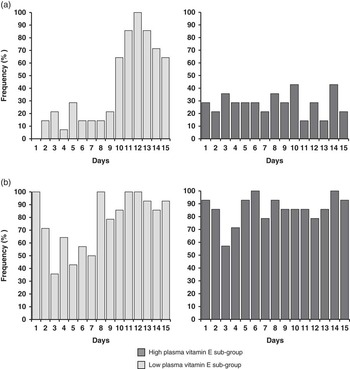
Across the 15 days of the preference-testing period, the number of individual sheep with greater preference (PI>0.5) for the +VEOR and +VEST feeds changed over time in both the HIGHVE and LOWVE groups (Figure 3). In the LOWVE group, 15% of animals had a greater preference for the +VEOR feed during the first 9 days of preference testing, than during the last 6 days of testing where 80% of the lambs showed a high preference for +VEOR (Figure 3a). By contrast, in the HIGHVE group receiving the same combination of feeds and flavouring, the proportion of the animals showing high preferences for +VEOR was steady; 29% in the first 9 days and 27% in the last 6 days of the preference testing period (Figure 3a).
Daily proportion (%) of sheep in the low vitamin E (LOWVE) group (left panels − open columns) and high vitamin E (HIGHVE) group (right panels − black columns) selecting the vitamin E-enriched orange flavoured feed (a) and vitamin E-enriched strawberry flavoured feed (b) with preference index >0.5.

For the LOWVE group offered the +VEST feed, 67% of the lambs selected the +VEST feed with greater preference during the first 9 days of preference testing and 93% during the last 6 days of testing (Figure 3b). For the HIGHVE group offered the same combination of feed and flavouring, the animals maintained a steady selection pattern with 84% selecting the +VEST feed in the first 9 days and 88% in the last 6 days of preference testing (Figure 3b).
Discussion
The hypothesis that sheep experiencing a vitamin E deficiency would voluntarily select more of a vitamin E-enriched feed compared with non-deficient sheep was supported. Our results showed that all sheep in the LOWVE and HIGHVE groups preferred the vitamin E-enriched feed when it was flavoured with strawberry, but only the LOWVE group preferred the vitamin E-enriched feed when flavoured with orange. To our knowledge, the present study represents the first demonstration of the ability of any mammal experiencing a vitamin E deficiency to voluntarily alter their preference and select for vitamin E-rich feed, presumably to remediate the deficiency. It appears that the deficient animals were able to associate the flavours of food with positive post-ingestive consequences associated with the alleviation of the vitamin E deficiency that occurred when they consumed the vitamin E-enriched diet. As a response to the vitamin E intake, the LOWVE group remediated their deficiency as evidenced by α-tocopherol concentrations in the plasma increasing to adequate concentrations (>1 mg/l; Smith et al., Reference Smith, Fry, Allen and Costa1994) by the end of the preference-testing period. Several experiments have indicated that sheep associate the pre-ingestive sensory characteristics of food with the post-ingestive consequences (positive or negative feedbacks) occurring at the gut level (Villalba and Provenza, Reference Villalba and Provenza1997a) and on that basis animals adjust their feed choices accordingly (Forbes and Provenza, Reference Forbes and Provenza2000). The results of the present study suggest that post-ingestive feedback to influence feeding behaviour can occur, not only at the gut level, but also at the tissue level where the antioxidant properties of vitamin E are likely to have their metabolic effects. It also suggests that the post-ingestive feedback mechanisms associated with vitamin E are sensitive enough that animals are changing dietary preferences before the vitamin E status is low enough (plasma α-tocopherol below 0.5 mg/l) for clinical symptoms to emerge.
To our knowledge, no study has been published describing whether ruminants or non-ruminants can select vitamin E-rich diets as a response to their low vitamin E status. The results of the current study are consistent with other studies where animals have changed preference and selected for other nutrients, including some vitamins (Tribe and Gordon, Reference Tribe and Gordon1953; Bernard and Halpern, Reference Bernard and Halpern1968) that were limited in their diets. In another study, lambs provided diets deficient in CP adjusted for the deficiency when an alternative diet with an appropriate level of protein was offered (Bach et al., Reference Bach, Villalba and Ipharraguerre2012). Lambs preferred to consume more of straw flavoured with either onion or oregano in preference to unflavoured straw, when low doses of starch or propionate were infused into their rumen after the flavoured straw was consumed (Villalba and Provenza, Reference Villalba and Provenza1997a). Similarly, sheep experiencing mineral deficiencies, such as P and Ca, were able to identify the diet containing the required mineral and exhibit a strong preference toward the feed supplying the mineral (Villalba et al., Reference Villalba, Provenza, Hall and Peterson2006b; Villalba et al., Reference Villalba, Provenza, Hall and Lisonbee2008). For example, sheep deficient in Na had higher intake of plant species containing high levels of Na in preference to other plants deficient in Na (Arnold, Reference Arnold1964). In other circumstances, sheep have voluntarily ingested soil, bones, urine and manure and this has been linked to deficiency of P and Ca (Blair-West et al., Reference Blair-West, Denton, McKinley, Radden, Ramshaw and Wark1992; Villalba et al., Reference Villalba, Provenza, Hall and Lisonbee2008). The drive to consume vitamin E seems to be very strong since the vitamin E-deficient animals overcame their original dislike for the orange flavour if that flavour was paired with a feed that, when eaten, was able to overcome a deficiency (i.e. the vitamin E-enriched diet). The physiological and/or molecular mechanisms underlying the regulation of vitamin E intake in living organisms are not clearly defined in the literature and it is not known how animals deficient in vitamin E could physiologically detect the deficiency and select for the feed containing vitamin E.
The rate of learning to select an appropriate diet to overcome a vitamin E deficiency does not seem to be greatly influenced by the flavour of the feed. The LOWVE group in this study took 9 days to exhibit preferences for the vitamin E-enriched feed paired with the flavour they originally avoided (orange). This was evidenced by the greater preferences (PI>0.5) and greater proportion (80%) of individuals preferring the +VEOR feed during the last 6 days as opposed to the first 9 days of preference testing. Similarly, when the vitamin E-enriched feed was flavoured with strawberry, which they initially preferred, it still took 8 days to establish a strong and consistent preference that continued to day 15 of preference testing. These results support the notion that ruminants do not instinctively detect the needed nutrients (or medicines) available in the feeds but they take time to learn about their feeds by associating the sensory properties of feeds with post-ingestive feedbacks (Provenza and Balph, Reference Provenza and Balph1990). The association, by animals, of post-ingestive effects with food flavours has been identified as a means through which herbivores learn about the consequences of feeds (Duncan and Young, Reference Duncan, Elwert, Villalba, Yearsley, Pouloupoulou and Gordon2002). Learning about components of the feedbase is an important tool that herbivores use to modify foraging behaviour (either to prefer or to avoid feeds) in order to cope and adapt quickly to the changing internal and external environments for the achievement of nutritional homoeostasis (Villalba et al., Reference Villalba, Provenza and Hall2006a; Howery et al., Reference Howery, Provenza and Burritt2010).
It has been experimentally established that foraging behaviour is formed by two learning mechanisms: self-learning from experience and trial and error by relying on post-ingestive feedbacks and learning from peers or from the mother (Provenza and Balph, Reference Provenza and Balph1990). In this study, where sheep were confined in individual pens and social interactions between animals were restricted, the sheep had to learn about their feeds by themselves and this may have delayed their learning process. In addition, recent research has demonstrated that process of learning about diets is delayed when experimental procedures become complex (Duncan and Young, Reference Duncan, Elwert, Villalba, Yearsley, Pouloupoulou and Gordon2002) by offering several feeds simultaneously (Duncan et al., Reference Duncan and Young2007) and by increasing the number of consequences associated with the ingestion of feeds (Ginane et al., Reference Ginane, Duncan, Young, Elston and Gordon2005). The complexity of the feeding procedure in this study and the novelty of flavours to the sheep might have contributed to the delayed association of the flavours with the post-ingestive signals.
Throughout the preference testing period, a strong flavour effect was observed. Sheep in both the HIGHVE and LOWVE groups preferred strawberry flavour as opposed to the orange flavour. Greater intakes of strawberry-flavoured feeds could have been due to the sweet taste of the flavour, which might have stimulated feed intake (McMeniman et al., Reference McMeniman, Rivera, Schlegel, Rounds and Galyean2006) compared with the orange citric flavour that may have limited intake (Bampidis and Robinson, Reference Bampidis and Robinson2006). Nevertheless, our results demonstrated that, from day 10 onwards, the LOWVE group was able to overcome the aversive effect of orange flavour to compensate for vitamin E deficiency, as evidenced by greater preferences for the +VEOR feed as opposed to the −VEST feed.
The ability of the vitamin-E deficient sheep to consume feeds paired with a less preferred flavour is consistent with a number of studies where ruminants have learnt to consume feeds or substances that were previously less preferred, if the consumption of those feeds (or substances) provided a remedy to illnesses or internal burdens and increased fitness (Phy and Provenza, Reference Phy and Provenza1998; Villalba and Provenza, Reference Villalba and Provenza2001; Villalba et al., Reference Villalba, Provenza and Shaw2010). As the sheep in this study were able to overcome the ‘aversive effect’ of the orange flavour to select for vitamin E nutrient in the feed, it is highly likely that sheep could learn to overcome unusual (and potentially aversive) plant characteristics in perennial forage shrubs to actively select a vitamin E when it is scarce. Allowing lambs access to saltbush has been shown to reduce vitamin E deficiency during summer and autumn in the Mediterranean climate areas of southern Australia (Pearce et al. Reference Pearce, Masters, Smith, Jacob and Pethick2010). Ultimately, increasing diversity in the feed base for livestock through the inclusion of plants such as perennial forage shrubs can improve not only animal health and productivity, but also have beneficial effects on the management and use of marginal lands in a changing climate (Masters et al., Reference Masters, Revell and Norman2010). These benefits include a reduction of dryland salinity, a decrease in soil erosion and the provision of shade and shelter to livestock, which will potentially boost livestock production within the context of clean, green, and ethical approaches.
Conclusion
This study provides the first demonstration of the ability of a mammal experiencing a vitamin E deficiency to voluntarily increase their consumption of a vitamin E-enriched feed; even when it required consumption of a flavour that was originally less preferred. The sensory cues (flavours) used in the experimental feed facilitated the processes that allowed the sheep to associate a particular flavour (orange or strawberry) of a vitamin E-enriched feed and with its post-ingestive signals. The rate of learning was not particularly influenced by the flavour of the feeds even though the flavours initially affected the amount of each diet consumed. Sheep learnt to consume more of a vitamin E-enriched feed after 8–9 days and thereby overcome a subclinical deficiency of vitamin E.
The findings of this study have the potential to provide low-cost management opportunities for the livestock industry in areas where the incidence of vitamin E deficiency and the associated nutritional myopathy are high due to a lack of green pastures during dry seasons. Our results suggest it is likely that sheep will, to some extent, overcome unusual (and potentially aversive) plant characteristics within forage shrubs to actively select a dietary source rich in vitamin E, if the animals are given sufficient time to learn about their feeds.
Acknowledgements
The authors would like to thank Paul Young and Elizabeth Hulm (CSIRO) for their expertise in the laboratory; Miranda Macintyre, Nathan Phillips and Andrew Toovey (CSIRO) for animal house assistance; Malcolm McGrath and Gerard Smith (Department of Agriculture and Food Western Australia) for analyses and advice; Jane Speijers for the provision of statistical advice; and Mr Noel Chamberlain and Dr David Masters for valuable insights and wise words. This work was supported with funding from the CSIRO Agriculture Flagship. AusAID Australian Awards provided D. Amanoel a scholarship to study at UWA through the Australia – Iraq Agricultural scholarship (AIAS).