

In January 1915, Sir William Grenfell Max-Müller, an intelligence officer in the British Foreign Office, recorded the following remark from a German trade journal.
As long as the confidence in military and political victory continues, we need not fear our paper system and its consequences. But one sees immediately what would be bound to threaten us in the contrary case—a ruin to avoid which we are compelled to sacrifice the last man and the last penny.Footnote 1
Max-Müller himself agreed with this evaluation of Germany's financial situation. As Germany's third war loan approached, he suggested that public confidence in Germany's capability to pay its debt would persist “so long as people have reason to believe in the ultimate victory of German arms and the extraction of a gigantic indemnity from the vanquished foe.”Footnote 2 As late as the summer of 1917, he remained convinced that “it will not be until the German people lose all faith in its government and in the army, and openly despair of the future, that the empire will begin to experience difficulty in raising the necessary money to finance the war.”Footnote 3 Despite this guarded admiration, from the beginning Max-Müller remained convinced that Germany's loan banks, or Darlehnskassen, would pose a grave danger to the Reich's financial soundness “when normal business resumed. It is then that the Darlehnskassen will have to enter on their business with a vengeance, and that in all probability we shall see financial cataclysm in Germany.”Footnote 4
Contemporary opinions regarding Germany's financial situation were ambiguous: just six months into the war, observers both inside and outside the Reich realized the risk involved in the policies of Reichsbank director Rudolf Havenstein and Finance Minister Karl Helfferich.Footnote 5 Yet these same observers recognized that such policies would be viable if the German government were able to sustain the confidence of its people and its financial community. In this respect, with the support of many financial commentators who justified its policies, the Reich achieved remarkable success. Despite the suspension of gold convertibility, despite loan banks that unleashed the “potential for unlimited monetary growth,”Footnote 6 despite short-term debt and paper currency that ballooned with the Hindenburg Program of 1916/7, the Reich enjoyed a relatively low-interest rate on its debt, and the public accepted the flood of paper notes and widely subscribed to eight of the nine war loans. Most importantly, financial collapse did not come before the military disintegration in the fall of 1918.
This paper applies Michael Bordo's conceptual framework of a credible commitment under the classic gold standard to understand how the German Reich maintained public confidence in its financial policies during World War I, policies that many historians have judged to be dubious at best, disastrous or reckless at worst.Footnote 7 The gold standard allowed central banks to circulate paper money within limits of a fixed ratio of gold to paper.Footnote 8 According to Bordo, “adherence to the fixed price of gold served as a credible pre-commitment mechanism to prevent governments from following the otherwise time-inconsistent policies of creating surprise fiduciary money issues in order to capture seigniorage revenue, or default on outstanding debt.”Footnote 9 During periods of crisis, war in particular, however, under the gold standard regime it could be legitimate to suspend convertibility: the gold standard was a “contingent rule or rule with escape clauses.”Footnote 10 This would allow governments to access seigniorage and bond finance at favorable terms during the war, as long as the business community and the public remained convinced of the state's commitment to return to convertibility and to repay its debt at the end of the crisis. The Reich provided such a commitment, yet it did not accomplish this on its own, rather it was supported voluntarily by many academic economists, bankers, and other financial commentators who helped to legitimate its policies and sell them to the banking community and the wider public. Bordo ends his narrative of the gold standard in 1914, picking it up again only in the 1920s. He treats World War I as a decisive rupture between the classic and the interwar gold standards. That the German Reich did not have an established reputation for honoring war bonds after a war made World War I the first true test of its credible commitment to gold.Footnote 11 Yet the question of how contemporaries greeted that rupture remains unanswered.
German war finance merits special attention because contemporaries in the 1920s and later historians have frequently blamed Germany's hyperinflation on the decision in 1914 by the financial community to embark on a course it knew could be disastrously inflationary.Footnote 12 In doing so, many historians see the years from 1914 to 1924 as one single period of inflationary crisis.Footnote 13 But few have approached war finance through the eyes of contemporaries, to ask why they accepted the credibility of their government's untested commitment to gold and to repay its war-time debts in the face of such drastic changes to the financial system. Recent work by Albrecht Ritschl suggests the need to look at war finance on its own terms, distinct from the postwar inflation. In one sense returning to the arguments both Helfferich and Havenstein put forth after 1918, Ritschl suggests that the monetization of short-term debt during the war did not drive postwar hyperinflation, rather other mechanisms were at work.Footnote 14 Historians of the German inflation have tended to see the Reich's financial policies as a failure, in the sense that with the advent of the Hindenburg Program in fall 1916, the long-term debt acquired through war loans ceased to cover war-related expenditure.Footnote 15 When viewed in a comparative light, however, Germany's financial policies do not appear so disastrous: by the end of the war, the ratio of Germany's short-term, inflationary debt to overall debt was smaller than that of France.Footnote 16 Moreover, recent studies by Stephen Broadberry and Mark Harrison, Niall Ferguson, and Theo Balderston have illustrated how all belligerents relied much more on debt and inflation to pay for the war than taxation.Footnote 17
This paper expands the challenge to the traditional narrative of war finance by showing how the government and the German financial community fostered a belief among investors that the state offered a credible commitment to its currency, to its public debt, and to the return to the gold standard after the war was over. I show how the German financial community reacted to and ultimately supported the suspension of convertibility, and how gold, even as it lost its functional role, became more important symbolically during the war than it was before 1914. To do this, I examine the Bank Laws of August 1914 and the three policy fields that were the centerpiece of the Reich's commitment to credibility: gold reserves; loan banks and their potential for inflation; and war loans and the prospect of an indemnity. In each case, I will illustrate how academic economists and other financial commentators responded to and justified these policies, and how the terms of the debate shifted with the Hindenburg Program, the decisive moment when war-loan subscriptions failed to keep up with expenditures.
Bank Laws of August 1914
For the international financial community, Austria-Hungary's declaration of war on July 28 and the subsequent declarations by the Great Powers were “just as if one gave a violent kick to an anthill. … The top of the anthill was off, and for a moment there was great fright.”Footnote 18 This international financial crisis presented two challenges to governments across Europe: how to prevent a run on central-bank gold by citizens seeking to hoard hard currency, and how to maintain liquidity in the economy in the face of interrupted foreign trade and investment. While most states solved these problems with a bank holiday and a moratorium on foreign bills of exchange, Germany met these challenges in a different manner with a set of wide-ranging laws.Footnote 19
The Bank Laws of August 4, 1914, fulfilled a decade-long program of Germany's financial leaders to prepare their country for war by augmenting its gold reserves, issuing more paper money and less coinage, and protecting Germany's highly extended credit.Footnote 20 Like their colleagues on the general staff, Germany's financial leaders dating back to Johann von Miquel planned for a war of months, not years.Footnote 21 When military crises and financial panics in 1905, 1907, and 1911 demonstrated Germany's financial weakness, Secretary of Finance Adolf Wermuth and Reichsbank director Havenstein took the lead in planning for the prospect of a short war.Footnote 22 The model of 1870 pointed the way: loan banks, or Darlehnskassen, would provide easy credit to the private economy during the first phase of the war, short-term debt would cover the initial costs of war, and long-term war loans to the public would pay for subsequent military expenditures.Footnote 23
The concrete results of these plans were four decrees issued by the Reichsbank in early August 1914. First, to prevent further gold losses after the difficult weeks of late July, the Reichsbank suspended the requirement for banks to redeem paper money for gold.Footnote 24 Although the Reichsbank upheld its obligation, established in 1876, to cover one-third of all Reichsbank notes by gold or foreign currency, this gold remained inaccessible to the public. With the elimination of gold convertibility, the Reichsbank began a relentless public advertising campaign to draw gold out of circulation and into its vaults.Footnote 25 In an accompanying symbolic gesture, the Reich transferred its gold from the Julius Turm to the Reichsbank.Footnote 26 In a second decree, to cover immediate expenses the Reichsbank was authorized to discount short-term treasury bills in addition to commercial bills. This allowed the Reichsbank to act as a lender of last resort and to print new paper money to meet the financial needs of the Reich.Footnote 27 In addition, this law permitted treasury bills held by the Reichsbank to serve as secondary coverage for those Reichsbank notes in circulation not covered by gold, a task previously reserved for commercial bills. This second decree, when taken alongside a third one that eliminated the tax levied on Reichsbank notes in circulation above the legal one-third limit, meant that the only fetter restraining the Reichsbank from printing unlimited paper currency was the amount of gold, or gold-equivalent, reserves held in its vaults.
The Reichsbank circumvented this final obstacle to printing money with a fourth decree that established Darlehnskassen, loan banks where people, firms, and municipalities could mortgage their illiquid securities and commodity assets as collateral for money in the form of Darlehnskassenscheine, loan bureau bills accepted as legal tender at all government agencies. Darlehnskassen helped Germany avoid a general moratorium, unique among the belligerent countries, and gave private enterprises and local governments a place to discount bills.Footnote 28 Beyond this, the Reich encouraged loans secured from the Darlehnskassen to be invested in federal war bonds. People could then take these war bonds to the Darlehnskassen as collateral for yet further loans, creating the potential for a continuous cycle of money production.Footnote 29 The key aspect of the Darlehnskassenscheine was that they did not have to be covered by gold held at the Reichsbank. Rather, when Darlehnskassenscheine were held by the Reichsbank, they acted as a gold surrogate that covered the issue of new Reichsbank notes.
Historians, both recently and in the immediate postwar period, have judged these laws harshly, observing how they “altered materially the fundamental principles of central banking which were embodied in the act of 1875.”Footnote 30 Contemporary Germans, however, initially saw them in a much different light. The historical success of the Darlehnskassen in 1848, 1866, and 1870, alongside the widespread belief that a long war would be financially unimaginable, led many German economic thinkers to greet the August laws with applause.Footnote 31 Before the outbreak of hostilities, Dr. Hermann Schumaker, professor of political economy at the University of Bonn, observed, “in recent years the Reichsbank has strengthened its position enormously … The increase in the Reichsbank's gold reserves to one and a third billion marks represents not only quantitatively, but also qualitatively, a great improvement in the event of a crisis.”Footnote 32 With the passing of the initial financial crisis in September 1914, the reluctance of some in the banking community to follow Havenstein's prewar initiatives quickly changed to widespread approval. Franz Eulenburg, a professor of economics at Aachen who also worked at the statistical offices in Breslau and later Berlin, is characteristic in his praise: “It is above all to the credit of Reichsbank president Havenstein, whose opportune preparations hit the mark and made the Reichsbank into a truly strong war bank.”Footnote 33 Support for Havenstein's “farsighted” policies continued in the popular press throughout the war, long after the novelty of the August decrees had worn off.Footnote 34
Only a few critics within Germany dampened the effusive praise for the August laws, most noteworthy being monetary theorist Friedrich Bendixen. A student of Georg Friedrich Knapp, the leading proponent of the state theory of money, Bendixen heavily criticized Germany's financial policies throughout the war.Footnote 35 “As I see it, the greatest danger of the present enthusiasm for the Reichsbank is for the entire world to take the bank laws for perfect and unimprovable, while only the cleverness and skill of the Reichsbank leadership has overshadowed the grave deficiencies of these laws.”Footnote 36 At the time of his writing (1915), Bendixen himself remarked that the August laws enjoyed confidence from the overwhelming majority of German economic thinkers.
Bordo's argument that a government could effectively suspend convertibility in a crisis and still enjoy the confidence of its financial community hinges on the commitment to restore full convertibility after the end of the crisis. Despite the potential for endless inflation, the majority of German economists commenting on the August laws did not perceive them as a breech of that commitment. Rather their confidence in the Reichsbank, based partly on the memory of the short war in 1870/1 where inflation proved insignificant despite the use of Darlehnskassen, remained unshaken as of 1915 when Ludwig Bendix, Franz Eulenburg, Dr. Weber, and others published their assessment of Germany's financial situation.Footnote 37 Across the channel, however, British commentators unsurprisingly greeted the Bank Laws of August 4 with skepticism and pointed out the danger in the assumption of a short war. The words of The Economist in 1915 capture the initial skepticism of British commentators about Germany's August laws: “For the moment it may be pointed out that [Germany's financial measures] will save Germany from complete financial ruin only in the case of decided victory. What will follow on defeat, or even a long drawn-out war, is hardly possible to imagine.”Footnote 38
A Long War
A “long, drawn-out war” is precisely what occurred, and Germany used a combination of inflation and debt to finance it. Early comparative studies on finance in World War I have argued that German war finance in particular, and continental European more generally, differed fundamentally from that of Great Britain in its reliance on debt and inflation.Footnote 39 Yet in his comparison of British and German financial policies during World War I, Theo Balderston has shown that when the federal nature of the German Reich is considered—counting state and municipal alongside federal taxation—the percentage of the war cost covered by taxation did not differ substantially between these two countries: 13.9 percent in Germany versus 18.2 percent in Britain.Footnote 40 Many contemporary German commentators, from Secretaries of Finance Karl Helfferich and Count Siegfried von Roedern to academics Moritz Julius Bonn and Julius Wolf, held this opinion as well, arguing that at an aggregate level Germany's tax coverage of the war costs approached Britain's.Footnote 41 Although the burden on the average taxpayer differed, at an aggregate national level both relied primarily on public debt of one sort or another to pay for the war.
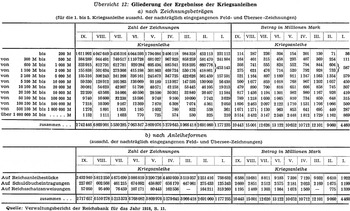
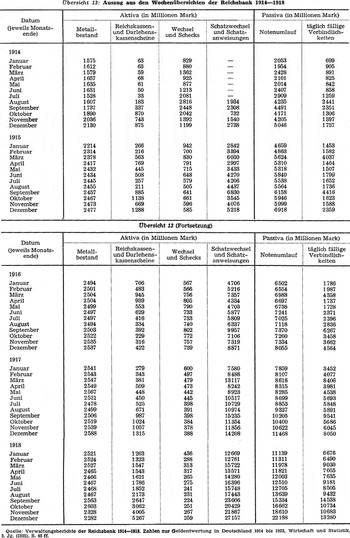
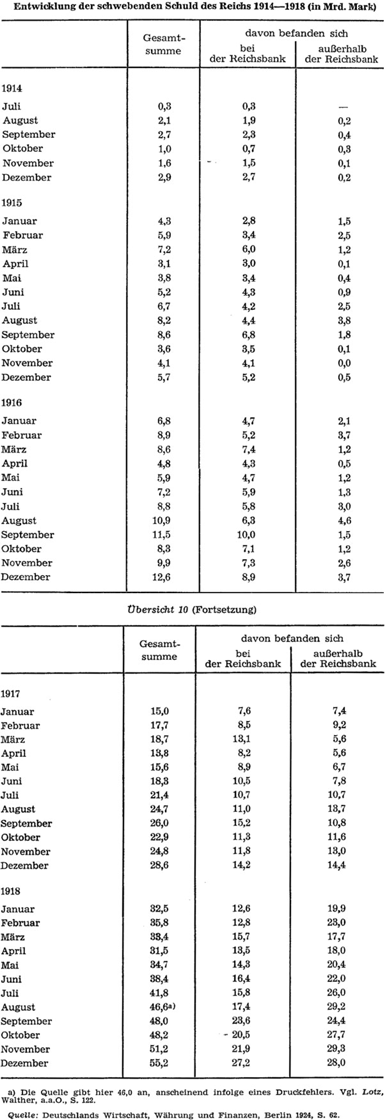
In Germany this took the form of nine long-term war loans, one issued every half year beginning in September 1914, and short-term debt that bridged the gap between war loans (see Table 1).Footnote 42 A routine cycle developed where the Reich continuously floated short-term treasury bills on the money market, and soaked them up every March and September with a war loan to the general public. This is reflected in the relative peaks of treasury bills in circulation every March and September (see Tables 2 and 3).Footnote 43 From 1914 until the late summer of 1916, the Reich's floating debt rose only gradually and the total number of treasury bills in circulation never topped nine billion marks. Up to and including the fourth war loan in March 1916, the “proceeds were in each case greater than the short-term debt outstanding.”Footnote 44
The Structure of War Loan Subscription

Source: Konrad Roesler, Die Finanzpolitik des Deutschen Reiches im Ersten Weltkrieg (Berlin: Duncker & Humblot, 1967), Appendix Table 12.
The Reichbank's Balance Sheet

Source: Roesler, Die Finanzpolitik des Deutschen Reiches im Ersten Weltkrieg, Appendix Table 13.
The German Empire's Floating Debt
Source: Roesler, Die Finanzpolitik des Deutschen Reiches im Ersten Weltkrieg, Appendix Table 10.
The advent of the Hindenburg plan in the fall of 1916 changed this by vastly increasing armaments expenditure, however. The full effect of this on the quantity of treasury bills in circulation did not materialize until the end of 1916, when their numbers exploded and as a consequence, the notes in circulation began to rise steeply. Until the Hindenburg plan, the Reich's finances were in order. After the summer of 1916 the revenue from war loans failed to cover the short-term debt.Footnote 45 One mitigating factor was the gradual acceptance by private banks of more and more of the Reich's treasury bills. The percentage of short-term debt held outside the Reichsbank remained well below fifty percent until 1916, hovering around twenty-five percent with wide fluctuations, while after 1917 it increased to roughly sixty percent (see Table 3).Footnote 46 Although private banks purchased a growing percentage of the short-term debt, preventing it from being monetized, this did not offset the vast increase in the absolute amount of floating debt issued. By 1918, the Reich's floating debt, including states and municipalities, reached thirty percent of its total debt.Footnote 47 Germany's money supply and price level by various counts rose dramatically over the course of the war, although this was not abnormal among belligerents. The amount of currency in circulation in Germany rose 599 percent by 1918. Among Germany's main competitors Britain, France, and Russia, the money supply rose 91, 386, and 1,102 percent respectively.Footnote 48 The gap between Germany and Great Britain appears less drastic when measuring inflation by the cost of living or wholesale price indices—which by 1918 in Germany had risen 105 and 204 percent respectively against 127 and 110 in Great Britain.Footnote 49 Both of these indices reflect Germany's price controls.
The central point is that the number of circulating Reichsbank notes was still legally limited to three times the amount of gold, or gold equivalent, held by the Reichsbank. To accommodate the higher military expenditure of the Hindenburg Program with a greater circulation of printed money, the Reichsbank had either to increase its gold reserves, circumvent the one-third limit by means of the Dahrlehnskassen, or follow some combination of these two policies.
In pursuing the former course, the Reichsbank met with remarkable success in continuing its prewar campaign of culling gold out of circulation and into its vaults, replacing coins with paper notes. In speeches to the Reichstag in the spring and summer of 1915, Finance Minister Karl Helfferich explained the Reichsbank's need to maintain its reserves and the one-third coverage even though convertibility was suspended. First, and most fundamentally, gold reserves offered a way to compare the relative financial strengths of the belligerent countries. Helfferich argued that the German public could rest easy because the Reichsbank had achieved the highest gold to paper ratio among central banks, whereas the British public should be nervous on account of their central bank's low gold reserves.Footnote 50 Second, the Reichsbank's high gold reserves had kept Germany out of a serious financial crisis during the outbreak of war. By emphasizing the public's role in augmenting the Reichsbank's gold reserves, Helfferich wanted to give the German public a sense of achievement and a stake in sustaining the Reichsbank's future policies. Finally, the gold ratio would convince the public that Germany was not financing its war solely through the use of printing money; one of many British “defamations that must be discredited” at all costs.Footnote 51
An intensive advertising campaign run with the assistance of the press accompanied these official statements, which encouraged pastors, mayors, and minor officials to urge people to surrender their gold.Footnote 52 The press played a pivotal role in preventing a rush on the Reichsbank, reassuring the public of the value of the new Reichsbank notes.Footnote 53 The accumulation of gold reserves slowed during the spring of 1915, and tapered off entirely by 1916 because the Reichsbank's campaign was so successful: virtually no gold remained in private circulation. Reserves declined in 1918 as the Reichsbank used a portion of them to buy essential imports (see Table 2).Footnote 54
Golden Rhetoric
A few contemporary British observers recognized that the success of the Reichsbank's gold campaign reflected the changing nature of gold in Germany's financial system.Footnote 55 According to John Maynard Keynes, an official in Britain's Treasury department during the war, gold in Germany had lost its physical role and retained only a symbolic one. In an article published in December, 1914, Keynes discusses the psychological nature of gold:
Ratios, which began by being little more than the results of chance, have been sanctified by time… . a gold reserve is thought of as being some sort of charm, the presence of which is valuable quite apart from there being any idea of dissipating it—as the emblem, rather than the prop, of respectability. It would be consistent with these ideas to melt the reserve into a great golden image of the chief cashier and place it on a monument so high that it could never be got down again. If any doubt comes to be felt about the financial stability of the country, a glance upwards at the image will, it is thought, restore confidence. If confidence is not restored, this only shows that the image is not quite big enough.Footnote 56
Here Keynes emphasizes a different aspect of credibility than Bordo does. Not only must the government create a credible commitment to return to a gold basis and repay its public debt after the war, but during the war it also needs to instill public confidence in the currency itself, which became currency by fiat with the abandonment of gold.Footnote 57 Targeted government propaganda, a supportive press, and the rhetoric of German economists turned gold into a symbolic representation of the overall strength of Germany's war-time financial capabilities, allowing the Reich to increase its paper currency on the basis of that strength.
Among historians of German war finance, Gerald Feldman has recognized how the government's drive to acquire gold took on a “patriotic and fetishistic quality of previously unimagined proportions … such a preoccupation with gold as that demonstrated by the Reichsbank is to be found only in Richard Wagner's Das Rheingold.”Footnote 58 Yet few historians have emphasized the new symbolic importance of gold, nor have they considered the extent to which this new role depended on the intellectual support of writers in the financial and academic community, who helped to legitimize the Reichsbank's one-third coverage policy and reassure the public that everything was in order.Footnote 59
German economic commentators were roughly divided in their theories of money into two camps: bullionists and nominalists. The former believed that the value of paper money depended on its connection to the commodity of gold, whereas the latter were disciples of Georg Friedrich Knapp, who argued in 1905 “that money was not a commodity, but rather a purely functional instrument created by the state.”Footnote 60 In his speeches to the Reichstag, Helfferich was a bullionist, and with a few exceptions, many economists writing about war finance echoed his broad interpretation of money. Ludwig Bendix, a Berlin lawyer and cofounder of the journal Die Justiz, and Dr. Weber, both writing for the periodical Krieg und Volkswirtschaft in 1915, argued that by adhering to the gold ratio, the Reichsbank could extend needed credit to the banking system, keep the money market liquid, and foster confidence that the Reichsbank would act as lender of last resort.Footnote 61 “Gold inflow to the Reichsbank has made war finance easier and has allowed [the Reichsbank] to fully support the private economy.”Footnote 62
Aachen Professor Franz Eulenburg added that the Reichsbank's maintenance of the gold ratio and suspension of convertibility not only allowed the bank to issue more notes, but would also improve the quality of notes. Writing in 1915, before the circulation of paper money exploded, Eulenburg criticized Germany for lagging behind France, Britain, and America in adopting paper money, arguing that the increase of paper money in Germany would be beneficial. Like many others he called for the public to accustom themselves to paper money and support the Reichsbank's campaign to augment its gold reserves.Footnote 63
With one blow ample quantities of cash have been created, indeed, cash that is sufficiently covered. … All of the gold flowing into the Reichsbank serves to increase the quantity of circulating money and to strengthen the coverage of printed notes. It is necessary that we unflinchingly adhere to the one-third coverage. Only then will our banknotes truly have their full worth: when this gold reserve forms the basis of them.Footnote 64
Bullionist economists writing in 1915 supported the gold ratio insofar as it allowed the government to create more money, with either greater credit or more paper notes. In this way they legitimized the Reich's future reliance on expansionary money policies once war loans no longer covered the short-term debt. Moreover, through their optimism about the Reich's current financial situation, they hoped to reassure the financial community about the future. Because the present gold reserves were so high, “after the war people will have the utmost trust and comfort that the money market will be supported by the Reichsbank.”Footnote 65
Even some monetary nominalists, such as Werner Sombart, supported the Reichsbank's gold coverage policy. Writing a series of articles for the Berliner Tageblatt in August 1914, Sombart reassured readers that fear of an Assignat-like inflation was a “misconception” and even in a military defeat “paper money would retain its full worth.”Footnote 66 Although Sombart forcefully argued that the public should accept Reichsbank notes because the state had ordained them a “legal means of payment,” he reassured those “gold fetishists” that Germany's paper money still rested on a golden basis. “The foundation of our bank laws remain unchanged: each note must be covered by one third of hard currency and two-thirds through good bills with at least two signatures.”Footnote 67
Friedrich Bendixen stands out as one of the few German critics who appreciated the arbitrary nature of the gold ratio. As a disciple of Knapp, Bendixen's stance toward the Reich's finances was complex. For while most other private economists praised the Reichsbank for its actions in August, Bendixen remained unimpressed because he had suggested this move to a fiat system—proclaiming credit guarantees for private banks and eliminating gold convertibility—be taken in 1908. To the extent that the one-third gold ratio was predictable it could be a stabilizing element in the economy. Beyond this, though, he saw the ratio concept as more of a cult:
Today, one considers it as a law of nature, that for every golden twenty-mark piece, three paper twenty-mark pieces can be put into circulation. Naturally that is completely false. But for the public the proposition that gold metamorphisizes into three times its worth in paper works like a graceful wonder, and gold flows into the Reichsbank in an ever unbroken stream. So this absurdity generates a highly desirable result [that paper money is used and accepted by the public].Footnote 68
Ultimately he hoped that the Reichsbank would avoid falling victim to what he deemed to be a popular belief. Thus, while Bendixen aspired to a purely fiat system of paper currency, the transitional stage of a currency based on the symbol of gold instead of the abstract strength of the state had no place in his logic. Overreliance on gold could be dangerous, and perhaps on account of this belief and his outspoken criticism of the Reichsbank, the Reich censored him, his book reaching publication only in 1919.Footnote 69 “The confidence of the people in Havenstein had to be spared.”Footnote 70
Circumventing the Gold Ratio
Despite widespread support among the financial community for the Reichsbank's gold campaign, the rising cost of war and the ballooning paper currency associated with the Hindenburg Program of 1916–17 meant that not enough specie resided in Germany to sustain the one-third ratio in its prewar form. It was during 1916–17, when the Reichsbank had culled nearly all specie out of circulation, that the Darlehnskassen began to play their infamous role in helping the Reich circumvent the gold ratio: printing more money while maintaining the illusion that this money was backed by hard gold.
While historians largely agree that with the Darlehnskassen “the way to an obstacle-free paper note printing stood open, and it was only a question of time before the flood of notes would swell,”Footnote 71 there is disagreement over the relative merits of this financial mechanism. On the one hand, Robert Knauss identified the duplicity involved in the Reichsbank's policy: “instead of candidly annulling the one-third coverage and informing their own people about the seriousness of the economic and financial situation, the German leadership believed they could reassure the public by means of a ‘nasty ruse’ unworthy of the German name.”Footnote 72 On the other hand, Walther Lotz pointed out that if the Darlehnskassen had been limited to the immediate financial panic of August and September 1914, then the “continuous inflationary effects would not have set in.”Footnote 73
In fact, in the first two years of the war, the German economy relied to a limited extent on Darlehnskassen. In 1916 only twenty-five percent of all loans made in the economy were issued by them. By the end of 1917 this number had risen to seventy-five percent.Footnote 74 When counting Darlehnskassenscheine as gold, the Reichsbank notes in circulation began the war with an official coverage level of almost fifty-four percent. This decreased dangerously close to the thirty-three percent limit by early 1917, and hovered there for the remainder of the war. When the war ended in November 1918, according to official Reichsbank calculations the legal coverage reserves consisted of 2,328 million marks of gold specie and coin and 4,005 million marks of Darlehnskassenscheine. These covered a total of 18,610 million marks of Reichsbank notes in circulation: a ratio of thirty-four percent (see Table 2).Footnote 75 If Darlehnskassenscheine are counted not as gold but as paper issue, however, these figures change significantly, and the Reichsbank falls far below the one-third level by the end of the war. Total publicly issued paper in circulation—Reichsbank notes plus Darlehnskassenscheine plus Reichskassenscheine—amounted to 28,834 million marks, roughly one-third of which, 9,868 million marks, were Darlehnskassenscheine. Thus by the end of the war, the ratio of all publicly issued notes covered by specie alone, closer to the spirit of the gold ratio framework, had fallen to eight percent.Footnote 76
Ironically, the majority of German economic commentators supported the use of Darlehnskassenscheine even though they undermined the very gold ratio these writers cherished so much. Some believed the Darlehnskassenscheine to be monetarily sound because of the good quality of their collateral, which included commercial goods as well as paper securities.Footnote 77 Others viewed them as a successful means to avert the moratorium on the bills of exchange that plagued other belligerents.Footnote 78 A final group hailed them as solving the dearth of small coinage that affected Germany as people brought their metal coins to the Reichsbank vaults.Footnote 79 Two of the largest commercial banks, the Deutsche Bank and the Dresdner Bank, both argued in their official publications that the Darlehnskassen were relatively benign.Footnote 80 Among those economists concerned about the potential for inflation, most, such as Ludwig Bendix and Julius Wolf, remained optimistic that the Darlehnskassen could be kept within limits.Footnote 81
Darlehnskassen succeeded remarkably well in circumventing the gold ratio without damaging public confidence in the Reich's currency. Nor did they undermine the Reich's ability to issue public debt. According to Roesler, “the statistics of the subscriptions show that, until the last loan, really all circles of the population participated in subscribing, even if the numerically less high subscriptions were pivotal for the loan proceeds.”Footnote 82 Feldman points out that the lower-income investors purchased less and less government debt as the war continued, and that larger institutional investors played an increasingly dominant role. When compared with the three British war loans, however, the German ones showed a remarkable appeal to the small investor.
Up through 1916, Helfferich, Havenstein, and many in the German financial community touted the Reich's low rate of interest—between 4.5 and 5 percentFootnote 83—and its success in repeatedly floating long-term loans to the public as evidence of its financial strength in comparison with Britain and France.Footnote 84 Popular subscription to war loans continued throughout the war. The second-to-last war loan in March 1918 accumulated by far the largest subscription of marks in nominal terms—15.1 billion compared with 13.1 in March 1917—and had the second-largest number of subscribers, only a few hundred thousand short of the peak in the sixth war loan (see Table 1).Footnote 85
The majority of German commentators in academic circles and in the press praised the Darlehnskassen for making war loans accessible to the small investor, thereby demonstrating Germany's financial strength.Footnote 86 Through them “the bulk of the German loans … has reached what might be called the ultimate consumer. The German loans are popular loans… . The German war-loan banks have played a sound and honorable part in the floating of the great German war loans. There is no mystery about them.”Footnote 87 In this way, many German economists helped to legitimize the use of Darlehnskassenscheine within the German economy. The major exception was again Friedrich Bendixen. He was unenthusiastic that Darlehnskassenscheine, alongside Reichskassenscheine and Reichsbank notes, were now the third type of paper currency issued in Germany, fearing that more than one variety would make the potential for inflation unpredictable. He regarded the official policy of counting Darlehnskassenscheine as coverage toward other notes as a “character flaw” of the Reichsbank, believing instead that the bank should have issued the notes themselves. Yet he forgave much of this because he hoped that Darlehnskassenscheine would encourage the greater use of paper money in the private economy.Footnote 88
While the Darlehnskassen remained the primary method of circumventing the gold ratio, the encouragement of cashless payments through Giro and postal accounts acted toward this end as well and continued the Reichsbank's prewar trend of encouraging such transactions.Footnote 89 To remedy the perception that Germany was behind Britain and America in its use of cashless payments, the Reichsbank unified Germany's postal and Giro accounts in a series of laws between 1914 and 1916, and began in summer 1916 seriously to promote the use of these institutions.Footnote 90 Deposits in these accounts increased dramatically, but remained a small amount relative to the absolute number of notes in circulation.Footnote 91
The relevance of the Giro and postal accounts lies less in their actual use than in the discussion surrounding them in the press and among economists, which justified the burgeoning money supply as harmless or natural. According to Hans Schippel, a senior executive with the Dresdner Bank after the war, writing in 1917, the velocity of money circulating in Germany had declined since the outbreak of war for a number of reasons. Germany's expanded geography naturally slowed transactions since money now traveled greater distances. In addition, payment to the German troops took longer as they dispersed across the occupied territories of Europe. Finally, the fewer number of bank employees and their shorter hours also slowed down transactions. The Berliner Tageblatt echoed many of these claims in its periodic reports about the state of the Reichsbank.Footnote 92 However dubious the reasoning, were such a decline in monetary velocity real, it would pose a problem for Germany's level of output. Using the quantity theory of money, Schippel argued that a slower velocity of money would also lower output. Although Schippel's preferred solution was to speed up transactions with a greater reliance on cashless payments, he also supported the Reichsbank in raising the money supply since it counterbalanced the slowdown in velocity.Footnote 93
The heightened use during the war of both Darlehnskassen and cashless payments effectively bypassed the gold ratio. Yet they did so subtly, and without creating the perception that Germany's credible commitment to the gold standard was blatantly being flouted.Footnote 94 The popularity of the Darlehnskassen continued throughout the war, and confidence in the Reich's ability to pay off government debt only came under serious scrutiny in fall 1917.
Trust in Public Credit
In his retrospective on the economic and social aspects of Germany's war-time performance, Albrecht Mendelssohn-Bartholdy maintained that public credit “did better, on the whole, than could have been expected. Its chief mainstay, during that period, was the profound belief of the people, and especially [those] with small savings and a moderate income, in the war as their common destiny.” Because the general public believed it was not a planned war, this conviction allowed them to carry a heavier load than otherwise.Footnote 95
Yet this only goes so far in explaining the willingness of investors to purchase government debt. Bordo's credible commitment framework supplements this notion of a “common destiny” and helps to understand how and why confidence in Germany's public debt began to change with the Hindenburg Program. Public confidence in the government's commitment to repay its war loans—Zahlungsfähigkeit—required first and foremost acceptance of the currency, something the Reichsbank ensured with its gold campaign and which economic commentators supported in their writings. Yet, such confidence also rested on the prospects of a war indemnity and ultimately on “confidence in the favorable outcome of the war,”Footnote 96 both of which came to be seen as increasingly unlikely by 1918 or earlier by many Germans.
The “Fata Morgana” of an indemnity pervaded German discussion about war finance.Footnote 97 With the results of the Franco-Prussian war clearly in mind, Helfferich's initial plan to finance the war with loans, as laid out in his speeches to parliament in spring 1915, was based on the idea that a massive indemnity would be the panacea to Germany's war debt.Footnote 98 Siegfried von Roedern, Financial Secretary after Helfferich, and Havenstein returned to the idea of an indemnity in 1917.Footnote 99 Much of the press remained optimistic that “without a doubt the war will be financed until the end.”Footnote 100 According to the British Foreign Office, no newspaper except the left-leaning Vorwärts consistently doubted the prospects of obtaining an indemnity.Footnote 101 And as late as May 1918, influential members of the financial community such as Max Warburg “continued to envisage reparations as high as 100 bn. Marks.”Footnote 102 No doubt the military successes on the eastern front played a role in sustaining people's hopes that late into the war.
When the financial implications of the Hindenburg Program became apparent by late summer 1917, however, some German economists acknowledged that the costs of war were too large for any indemnity to cover, and many began proposing alternative methods to finance the debt.Footnote 103 Dr. R. Kuczynski, director of the Statistical Office of Berlin-Schöneberg, spearheaded the public debate with an article in the Berliner Tageblatt calling for postwar direct taxes on income and wealth to pay off the debt.Footnote 104 Writing in August 1917, Kuczynski aimed to reassure a growing number of voices that doubted Germany's ability to fulfill its financial obligations after the war.Footnote 105 He is representative of a trend among many economists who wanted to pass war-time legislation to mandate an increase in direct federal taxes immediately after the end of hostilities in order to instill confidence among government war-debt holders.Footnote 106 Ultimately this movement failed. With the exception of Helfferich's war-profits tax of 1916, significant tax reform was postponed until after the war as Treasury and Reichsbank officials felt such legislation would prove too socially divisive while hostilities were still underway.Footnote 107
Once economists and investors became skeptical of an indemnity, the Reich's credible commitment to finance its debt came under scrutiny. The war loan of September 1917 reflected this skepticism as both the number of subscribers and the total amount floated declined significantly from the previous loan. The treaty of Brest-Litovsk in early 1918 created grounds for optimism among German investors, as Germany's foreign exchange improved significantly in the winter of 1917/18 and the penultimate war loan in March 1918 saw an extremely high level of subscriptions.Footnote 108 Despite this turn for the better, however, doubt in the prospects of a war indemnity only continued to grow among the majority of investors.Footnote 109
It is difficult to measure precisely the confidence of investors in a German military victory. Clearly, early optimism about the war translated into large war-loan subscriptions, the results of which surpassed expectations.Footnote 110 According to the British Foreign Officer Max-Müller,
In spite of all that can be urged against the finance methods of the German government, it would be idle to deny that to raise over 600 million pounds in the 14th month of the war is a sign of great financial strength and of unbounded confidence on the part of the people in a victorious outcome of the war and prosperous future for their country.Footnote 111
Throughout the war, the German press, Vorwärts included, printed patriotic articles emphasizing that “the Reich will honor its obligations, that it will promptly pay any interest coming when it is victorious in the war,”Footnote 112 and “that beyond a doubt, the war will be financed until the very end.”Footnote 113 Moreover, after 1916 private German banks held progressively higher amounts of the Reich's short-term debt, and as late as 1917 influential German bankers insisted that this remained a sound investment (see Table 3).Footnote 114 Just as clear, though, is the extent to which opposition in Germany to the war increased dramatically after 1916 in the form of strikes, crimes against public order, and the peace resolution debate in July 1917.Footnote 115 How these broader trends affected investor confidence in Germany's military victory is more difficult to say.
Niall Ferguson has used wartime yields of British and French bonds in New York as a proxy for the market's confidence in the Allied war effort.Footnote 116 Although this method has its limitations, freely functioning capital markets reflect the subjective expectations about the future held by the financial community, which has a stake in a careful evaluation since any “errors directly affect their pocketbooks.”Footnote 117 While a comparable, extended series for German war bonds is lacking, a few end-of-the-year prices for prewar government bonds are available. The German stock exchanges remained closed through most of the war. Only in December 1917 did the Berlin exchange, followed by others, allow select securities to be publicly traded and their prices reported; government bonds were not among them. Speculation outside the official exchanges in war and other state bonds took place, but at the behest of the government, newspapers agreed not to publish any prices.Footnote 118 The Volkswirtschaftliche Chronik, however, recorded the year-end, unofficial prices of prewar 3-percent Prussian and 3-percent Imperial German consols, which “showed in their price movement a remarkable resilience” that lasted until at least the end of 1917. Prussian consols, which traded at 72 in July 1914, dipped down to 67 by the end of 1916 before returning to 72 by the close of the following year. Prewar Imperial bonds, also trading at 72 before the war, followed a similar course.Footnote 119 The Volkswirtschaftliche Chronik points out that as late as 1917, German prewar bonds performed well in comparison to the course of French prewar 3-percent rentes and English 2.5-percent consols. At the end of July 1914, the former traded at 78 and the latter at just over 70. By December 1917, they had declined to 58.20 and 54.24 respectively.Footnote 120
For neutral markets, even less information is available. In New York before 1917 Germany was able to raise $27 million in loans in comparison with over $2 billion for the Entente. Neither the Wall Street Journal nor the New York Times reported the prices of German government securities, however, and “by the end of 1915 the Reichsbank regarded the U.S. bill market as effectively closed.”Footnote 121 Likewise, in Switzerland the Entente dominated the market for government bonds largely because of France's strong presence there before 1914. In August 1916, an estimated 125 billion Swiss franks' worth of foreign war loans were floated in Switzerland, 100 million of which were French.Footnote 122 Despite a vigorous newspaper advertisement campaign by German banks, German war loans saw little subscription in the Swiss market, and major newspapers did not record the price of German bonds.Footnote 123
This rough picture of price stability for government bonds in the Berlin market suggests that German investors retained confidence in the German government and its financial policies through 1917, if not longer. In the end, however, war-loan subscriptions themselves remain the best gauge for the public's continued willingness to buy government debt well into 1918, and the degree to which that public willingness fluctuated with particular vigor after 1916.
Conclusion
The conventional narrative of German war finance, which castigates the German financial community for relying inordinately on debt instead of taxation, gambling on a quick military victory, and pursuing a policy it knew would end in disaster in the event of a long war, requires revision. The first claim has been contested by recent comparative studies illustrating how the Reich's reliance on taxation was not much lower in overall terms than even Great Britain.Footnote 124 The latter claim misconstrues the stance of contemporaries. Although the Bank Laws of 1914 were designed with a short war in mind, with the exception of Friedrich Bendixen, the majority of Germany's financial intellectuals and government officials firmly believed that confidence in an eventual military victory, in an indemnity, and in the symbol of gold would sustain German finances in even a long war. “So long as confidence can be maintained, the technique of war finance will hold out, especially as paper and the printing press are not only able to provide money for the time being, but are also an admirable means of producing a brilliant illusion.”Footnote 125 Many British commentators agreed. As long as the conviction prevailed that German arms would win the day, war-loan subscriptions continued apace and the price of prewar government bonds remained relatively stable until at least 1917. Although the first serious faltering began with the seventh loan in September 1917, war-loan subscriptions did not collapse until after the western front disintegrated.Footnote 126
During the war itself, Germany reaped exactly the rewards that Michael Bordo's model of a successfully applied credible commitment predicts: low-interest rates on government debt, a high level of popular subscription to state war loans, and a circulation of paper currency that many would have considered impossible on the eve of war. Although the debate about Germany's financial policies shifted in summer and fall 1917 when the monetary effects of the Hindenburg Program became apparent, financial collapse came only in 1923. It is an obvious point, but it bears emphasizing that writers such as Ivan Bloch and Norman Angell were wrong, in Germany's case, to believe that war-time financial problems could bring a great power to its knees. Rather, German financial policies earned the guarded admiration of influential British observers such as John Maynard Keynes and William Grenfell Max-Müller.
This revision, however, should not detract from the fact that Germany's financial policies rested on an illusion of sorts, albeit one that the financial community conceived of and thoroughly believed in. The Reichsbank's campaign to augment its gold reserves and uphold the one-third gold ratio obscure the fact that the Bank Laws and Darlehnskassen undermined the very ratio that many cherished so strongly. These laws created an inflationary constellation, one, however, that was common to all major belligerent states.Footnote 127 Decisions after 1918 would be necessary to turn that potential into a hyperinflationary reality; the road from the August laws of 1914 to the hyperinflation of 1923 was not a straight and direct one.
Germany avoided a financial collapse during the war first and foremost by turning gold into a symbol of trust and confidence. Bordo bases his idea of a credible commitment on the government's promise to return to convertibility and repay its debts after the crisis had passed. This paper has shown how the new symbolic nature of gold during the war, as an abstract measure of financial strength, was just as crucial. In fact, gold came to have an even greater symbolic meaning for the financial community during the war than it did before 1914: it became the “emblem of respectability,” reassuring investors that the paper currency retained its worth and that their government could and would return to gold convertibility after the war. By praising the Bank Laws of August 1914 and by reinforcing official spokesmen such as Helfferich and Havenstein, contemporary German economists legitimized the use of gold as a symbol, basing its strength on the sanctity of the one-third coverage in order to “prove the un-shakeability of the Reichsbank's credit” and currency.Footnote 128 With the exception of Friedrich Bendixen, however, many of these economists failed to recognize that gold's role had become a purely symbolic one. It was primarily British financial commentators, such as Max-Müller and Keynes, who understood that gold ceased to be a functional component of the domestic currency and became “very largely a question of psychology.”Footnote 129
It remains to be explored, exactly, how the legacy of this new, fetishistic, and symbolic understanding of gold may have reinforced Weimar's disastrous deflationary monetary policies during the Great Depression. Yet, the roots of such a rigid adherence to gold and to the gold standard during the post-1918 peace lie earlier than the hyperinflation of 1923, and stem in large part from the discussion surrounding monetary policy among Germany's financial leadership in World War I.