In the 1970s, London's arts scenes witnessed an explosion of political organization, theoretical debate, and activist endeavours to clarify the relationship between culture and radical politics. In this article, I intend to document the activities of one of these endeavours, Music for Socialism (MFS), which was founded in 1977 and fizzled in 1978. While other contemporaneous music-based organizations – most notably Rock Against Racism – directly confronted emerging threats from the right, MFS contributed to a more theoretical sociology of culture from the left that ranged from the Birmingham Centre for Cultural Studies to smaller, non-institutional, and self-organized ventures. While Anglophone musicology in the academy began engaging with Theodor Adorno's writings as they were translated into English, a parallel conversation unfolded on the street, where rock, folk, and jazz intellectuals debated such matters as the meaning of ‘revolutionary content’, as well as the content of the form, both of which were among the topics of debate at MFS events. Most importantly, MFS constituted a self-organized forum where musicians, music writers, and organizers could theorize and debate their positions in the social field, instead of simply assuming the roles that might be defined for them by scholars, political parties, or organized labour.
As I will detail, many individuals contributed to organizing the activities of MFS, but several members of the rock band Henry Cow took prominent roles in founding the group and developing several of its projects. Henry Cow's interest in self-determination, autonomy, and the critique of capitalism owed in large part to their experiences as a working band. Founded in 1968 by two Cambridge University undergraduates, Fred Frith and Tim Hodgkinson, the group existed for a decade and included more than ten members across those years. In 1973, they signed to Virgin Records, for whom they would record three studio albums between 1973 and 1975 (and one live double-LP released through a Virgin subsidiary in the UK). They recorded their fourth studio album in 1978 and published it on their own label after they had broken up. Although they had signed their Virgin deal with some scepticism, they enjoyed the largesse and support of the company for a few years, only growing disillusioned when Virgin failed to generate gratifying touring possibilities and then forbade them from negotiating their own licensing agreements with distributors outside the UK, where Henry Cow spent most of the year touring and enjoyed a considerable fan base with no easy access to their LPs.
If these experiences with the music business informed Henry Cow's organizational efforts on behalf of MFS, then their eclectic musical backgrounds and wide range of aesthetic reference encouraged a cross-genre conversation about music and politics, in spite of their experience with censorious music journalists who policed the edges of rock and discouraged listeners from developing adventurous listening practices. Frith grew up playing blues and folk music, while Hodgkinson was a fan of free jazz, Béla Bartók, and Igor Stravinsky; drummer Chris Cutler loved pop, R&B, and psychedelic music, not to mention Sun Ra and Edgard Varèse. When reeds player Lindsay Cooper stepped in for saxophonist Geoff Leigh, the band's improvised sound tilted towards contemporary classical music, owing to her conservatory training and the timbral palette of her main instruments: bassoon and oboe. Likewise, the classically trained cellist Georgina Born's replacement of John Greaves on bass pulled them away from his jazzier, dance-band roots and further into the aesthetic zone of Western art music. These varied tastes and backgrounds fed into their music-making. Although they wrote and performed plenty of conventional ‘songs’ and more substantial, notated compositions, the band explored open group improvisation from its beginnings; their stylistic references ranged from post-Impulse! energy music to static electronic textures and acoustic chamber music.
After the summer of 1975, Henry Cow toured extensively in Western Europe and Scandinavia. In France, they followed the circuit established some years earlier by Giorgio Gomelsky, the manager of Magma; by 1975, he had established a reliable, decentralized touring circuit of 120 venues, many of them youth houses of culture (Maisons des Jeunes et de la Culture) associated with local socialist and communist parties.Footnote 1 Their contacts in the Netherlands had consistently arranged gigs in similar institutions. In Italy, Henry Cow played to general, diverse audiences at open-air festivals sponsored by the Partito Communista Italiano and other left-wing political parties. In Norway and Sweden, they associated with various self-starters who had founded their own record labels, distribution companies, and touring routes.
Henry Cow's experience with all these cultural workers led them to wonder why England seemed to lack such strong initiatives for alternative means of production. As Cutler told the Evening Standard around this time, in Europe ‘people have worked out alternative set-ups to fund gigs; there are even co-operative record companies. The cultural climate is more stimulating. Fans are constructively critical. Here they usually say “You were great” or they say nothing. Compared with Europe, the cultural and political inertia in Britain is so frustrating.’Footnote 2 Although they rarely played at home anymore, the band had earned a certain credibility among left intellectuals in Britain. Ian Hoare, an MFS organizer and self-described ‘soul nut’ who had co-written The Soul Book in 1976, testifies to their reputation among non-fans like himself: ‘Even if you didn't like the music, you respected what they were doing. That was the key thing. You thought, “These are kind of cool characters. They're very intelligent, they know what they're doing, and their music is sort of interesting.” I never liked it, really – it was hard work for me, to listen to that stuff.’Footnote 3 Despite their ‘difficulty’, Henry Cow had earned a certain respect among the intellectuals who would gather in MFS.
Against capitalism, for socialism
Back in the spring of 1976, Henry Cow had befriended some leftist musicians outside Stockholm and engaged them in a running debate on the proper form for anti-capitalist expressions in music. The Swedes thought that Henry Cow's avant-garde language was hopelessly bourgeois, while the Cows castigated the Swedish intellectuals (many of whom were associated with SAM, an alternative music distributor) for putting socialist lyrics on top of the most banal music product. The Swedish political song movement had produced a documentary film, We Have Our Own Song, about the 1975 Alternative Festival to counter Eurovision, and the Cow (or possibly their former soundperson, Neil Sandford, who had cultivated many contacts there) acquired a print of the film and arranged a concert, screening, and discussion at the Other Cinema in London on 19 December.Footnote 4 The band had to cancel at the last minute due to illness, but saxophonist Evan Parker played a solo set and the audience, including Henry Cow, pursued a lively debate on the topic of socialism and music.
A sign-up sheet circulated among attendees, and among the thirty people to sign it were several left intellectuals active at the intersection of culture and politics: the musicians Steve Beresford (London Musicians Collective), Bob Cubitt (Elevator), Tony Haines (Redbrass), Laurie Baker (People's Liberation Music), Martin King (Elevator); journalists Marion Fudger (Spare Rib, also the bassist for the Derelicts), Dave Laing (Let it Rock; Rock Writers Coop), Mike Flood Page (Rock Writers Coop), Penny Valentine (Disc, Sounds), Ian Hoare (BBC; Rock Writers Coop), and John Hoyland (Let it Rock); theatre director Bruce Birchall; and representatives of the Hackney and Islington Music Workshop and the Unity Theatre Folk Club. Consolidated onto one page in Hodgkinson's hand, these interested parties were invited to a second meeting in January; the provisional title of the group would be ‘Music Against Capitalism’.Footnote 5
This name would be one of the first things to go. Hoare recalls himself and others asking, ‘Can we turn it into something more positive than just simply being “against”? Rather than “Rock Against Racism,” “Music for something” – and make it something very specific, make it more politically committed.’Footnote 6 The reference to Rock Against Racism (RAR) was hardly coincidental, as that organization had recently been founded by a group of Socialist Workers Party (SWP) members and would make a significant contribution to anti-racist politics until its demise in 1982. Unlike RAR, however, Music for Socialism, as they would call the new group, would examine the very relation between music and left politics. Dave Laing explains, ‘Rock Against Racism was brilliantly focused to fight a part of the political struggle, whereas [MFS] was deliberately not a political organization, where we all had to sign up to one set of beliefs, or strategies, or intentions. It was an umbrella organization.’Footnote 7
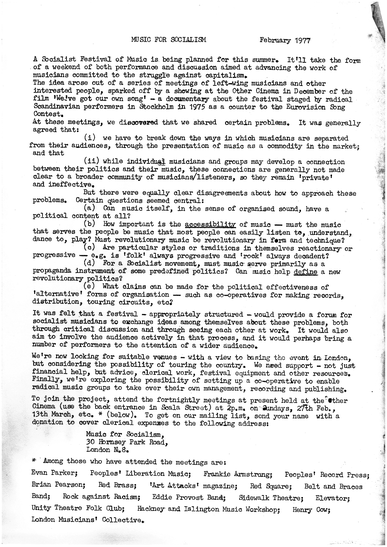
‘What is such an organization for? This is the question’, Hodgkinson recalls. ‘It's very interesting just to sit down with a folk singer, a rock musician, and a contemporary composer, all of whom are musicians, and all of whom are socialists, and to see what's going on here.’Footnote 8 Over a series of meetings into February, the participants discovered that they shared certain problems, which were enumerated in a February briefing document, along with matters for debate (see Figure 1).Footnote 9 Questions about propaganda, accessibility, and the progressive potential of specific styles were raised infrequently but consistently in the mainstream and alternative rock press since the early 1970s, but the discussion points of MFS bear the strong imprint of Henry Cow, and indeed Hodgkinson, Cooper, and Born were active in these early meetings (Cutler, Krause, and Frith less so).Footnote 10
MFS planning document, February 1977.

Revolution planned for 28 May
The February MFS planning document also announced a festival that ‘would provide a forum for socialist musicians to exchange ideas among themselves about these problems’. The aim would be to foster critical discussion, to expose participants to the musical practices of their comrades, and to involve the audience in the conversation. Hodgkinson seems to have taken a formative role in the early direction of the organization – his surviving notes bear a strong resemblance to the public MFS documents. Soon enough, however, Henry Cow were swept away by winter and spring touring commitments in Europe, and by May 1977, the festival organizing committee included no Cows. They were Sue Steward, one of Virgin Records’ earliest employees, who had recently quit in protest at their changed artistic direction in summer 1976; guitarist Gerry Fitzgerald; Sandford; and Hoare.
The festival, titled simply ‘Music for Socialism’, would take place on 28 May at the Battersea Arts Centre in Wandsworth.Footnote 11 About 600 people attended, 100 of them as musicians or participants.Footnote 12 After the Arts Centre withdrew its 50 per cent funding (because rules forbade the sponsorship of ‘political events’), the festival was funded through small loans from individuals. Its promotional materials promised a new type of event, ‘a kind of conference, with each “concert” followed by an open discussion on particular aspects of the relationship between socialism and music’.Footnote 13 The day began in the morning with five concurrent workshops. Frith and Fitzgerald led a session on the guitar, while folk singer Frankie Armstrong headed one on the voice. Steve Skinner of CounterAct, a left agit-prop theatre group, fronted the session on songwriting, stressing the importance of humour and satire without selling the workers short. Other musicians played some songs with Brecht texts, and then Pete Devenport of the Progressive Cultural Association explained that the problem of how to write socialist music can only be understood in light of the main contradiction in the world, the one between monopoly capitalists and the working classes. Then he sang the nineteenth-century revolutionary song, ‘Dawn is Breaking over Ireland’. A vituperative discussion about the possible reactionariness of old folk forms in the present moment ensued.Footnote 14 Meanwhile, the Hackney and Islington Music Workshop sang songs ‘to show how they collect and distribute music’.Footnote 15 Finally, the Women's Liberation Music Project organized a practical workshop for women only, providing a context in which they could experiment with instruments and equipment, get some information about lessons and other workshops, and simply derive pleasure from creating music for themselves.Footnote 16 One of the organizers, Nicolle Freni, later commented that she and her comrades were forced to defend the importance and relevance of their project to male cynics for the rest of the day.Footnote 17 Nonetheless, she judged the session a great success, and they even continued their activities into the afternoon in a different room upstairs because the interest was so great. Outside of these set workshops and performances, a team of ‘floaters’ staged mobile and guerrilla concerts around the Arts Centre.
After a brief lunchtime discussion of the aims of the festival, the action again split into concurrent afternoon concert/debate sessions. The first, ‘Women in Music’, featured performances by Frankie Armstrong, The Women's Theatre Group, and Clapperclaw – Carol Grimes had been slated to appear, but dropped out at the last minute. Among the questions they would examine were: ‘In what ways are women using music to fight oppression? What innovations can feminist practice offer to questions of form, style, presentation, ownership, distribution and organisation?’ (A neighbouring room hosted ‘an exhibition of sexist record sleeves and similar items from the industry's publicity machine’.)Footnote 18
The second afternoon concert/discussion, called ‘Culture and Tradition’, sought to question whether particular genres, such as folk or rock, are in themselves progressive or reactionary. ‘What's the importance of a music having roots in a culture or community? And is there a crucial distinction to be made between “mass” music and “popular” music?’Footnote 19 Musicians included Talisker, Ken Hyder's Scottish folk/jazz band; Earthforce, an instrumental group opposed to ‘the urban tradition’ who performed three ragas; Jack Warshaw (US) and Donal Maguire (Irish), who created the temporary atmosphere of a folk club; Jackson Kanjela, who performed Namibian folk and freedom music; and Will and Ian Menter, free jazz improvisers from the Bristol Musicians’ Co-operative. In MFS organizer Les Levidov's account, the discussion touched on whether it was possible or desirable for Earthforce or anybody else to escape the influence of urban industrial cultures, especially since they depend upon modern mass communications to learn about their source material, and audience members also queried Maguire and Warshaw on whether the relevance of old-school folk depended merely on the correct selection of songs, or if the entire style might present problems of contemporary relevance. Kanjela faced questions about the feasibility of revising traditional Namibian tunes in the context of contemporary liberation struggles, and whether his use of the guitar and English lyrics indicated that his innovations depend on cultural imperialism. Finally, the Menters’ performance seems to have elicited the only direct discussion of jazz and race. Was jazz still the music of an oppressed people?Footnote 20
The third afternoon event, ‘Musical and Political Action’, included People's Liberation Music (PLM), the agit-prop band of John Tilbury, Laurie Baker, Geoff Pearce, and Cornelius Cardew; Elevator, a minimalist project by Bob Cubitt; Leon Rosselson, a well-known political folk singer from the Hackney and Islington Music Workshop; and Red Balune, the musical theatre group of Geoff Leigh and Cathy Williams (the former had previously been a member of Henry Cow). Hodgkinson's text in the program states that they hoped
to clarify the relationship between two apparently quite opposed views – on the one hand, music as the instrument of a previously and separately defined politics; and on the other, music as a means of helping to define a new politics by giving it a consciously cultural dimension. It seems clear that if you want to use music to gain support for ideas about other political issues, then you'd logically use forms which are already popular – which leads us into the notion of ‘accessibility’ and what that means for socialist music.Footnote 21
As it turned out, the animated confab that took place after the session would dominate the rest of the day's discussion, spilling over into the evening plenary, the next afternoon's sessions, and retrospective accounts of the festival. Although its members were accomplished classical musicians, PLM had less of a feel for popular repertories and their concerts of workers’ songs had little overlap with contemporary pop styles. According to Ian Walker, the brief time for discussion was initiated by a woman who launched into a critique against PLM, ‘screaming that “their music was devoid of all human content”’.Footnote 22
‘Is there anybody from PLM here to answer these charges?’ asked the moderator, Hodgkinson. Silence, then howls of derision.
‘That's just typical!’ said Leigh, ‘They're professional politicians. They've probably gone off to address another meeting.’ The discussion turned to Red Balune's dada performance, which featured one artist dancing with a broom. Cardew, returning to the hall to answer his critics, asked, ‘If musicians started playing brooms, what kind of music would the people have?’ Over Leigh's exasperated protests, Cardew went on to state that music should serve the politics, and not vice versa – Red Balune's experimentalism amounted to nothing more than a bourgeois affectation. In PLM's proper, proletarian socialism, Cardew later explained, a strong political theory dictates how music must serve the workers’ struggle.Footnote 23 Bourgeois, reformist socialisms – the Communist Party of Great Britain in their ‘Moving Left Revue’ and the Socialist Workers Party in Rock Against Racism – deny the bourgeois character of popular music, which had been a powerful weapon in US and British imperialism; pop's ‘ideological heart is slavery and degradation’. Given that it was the middle of 1977, the conversation inevitably turned to punk. Walker reported, ‘PLM trotted out the party line: “The monopoly capitalist class consciously selects for promotion the most reactionary elements of culture. Punk is fascist.” (Groans.) “Clash promote anarchy.” (Cheers from the libertarians.)’ Cardew later clarified that punk was a ‘fascist cult associated with self-mutilation, exhibitionism and the glorification of decay and despair’.Footnote 24
Although Cardew thought that PLM's set ‘showed the historical continuity and international breadth of proletarian revolutionary music’, most of the audience held the opinion that marching songs from the 1930s and Irish Republican tunes from the nineteenth century could not speak well to the current crisis. Moreover, in the words of Cutler, ‘The quality of their performance was wooden and devoid of musical interest.’Footnote 25 In an extended critique published later that summer in Musics, Cutler wrote that PLM's uptight musicianship might fly at a demonstration, but its deficiencies were obvious in a concert setting; they had not adjusted their practice to its context. Furthermore, PLM could have engaged in self-criticism about the fiasco, but instead they defended their position, and did so theoretically instead of empirically. ‘And there is where their theory collapses’, Cutler wrote. ‘Here then is Cornelius Cardew defending his rotten performance because he says it has “correct theory”. He ignores the affective aesthetic aspects of what he does, yet it is only these which validate his work.’Footnote 26
For an improviser in the Henry Cow mould, restricting oneself to the theoretical domain was fatally flawed. And the particular flaw of PLM's set – not attending to the specificities of the performance setting and changing their practice accordingly – mirrored the general error in Cardew's approach to music and politics. Cutler wrote that we must ‘draw our analysis from the real contradictions and interrelations of our political and social environment and not superimpose an analysis . . . onto whatever situation we are in’.Footnote 27 In their actual historical circumstances, musicians can only struggle against capitalism (Cutler was clearly opposed to MFS's earlier name change), and that meant working inside of contradictions and in tension with the popular music industry itself.
The day concluded with a plenary performance by the composer Tim Souster's group, 0dB, as well as Henry Cow. Their concert, including a guest spot for Frankie Armstrong, was followed by a spirited debate into the early morning. Warshaw recounted, ‘After a shaky start, the impassioned backbiting and manoeuvring on questions of musical form, which had been more latent during the day, flourished.’Footnote 28 Various accounts suggest that punk was again the big topic, with one belligerent guest (Henry Cow crewmember Jack Balchin recalls that it was Genesis P-Orridge of Throbbing Gristle) disrupting the discussion before getting thrown out by a quartet of feminists. The festival continued the next day at Oval House, where representatives of the Musicians Union joined rock journalists Dave Laing, Simon Frith, and Gary Herman to discuss the music industry, broadcasting, the significance of punk, ‘alternative’ record labels, and the future of MFS. The Bicycle Thieves, Dave Holland, and the Workers’ Music Association Choir all gave performances, and they also screened a film on Pierre Boulez and Sex Pistols Number 1 by Julien Temple.Footnote 29 As Walker reported, the day's arguments centred on punk and new wave, with Simon Frith concluding, ‘Punks tell us more about the record business than they do about unemployed kids.’Footnote 30 Subsequent publications by Simon Frith, Laing, Hoare, and Herman likewise show that these critics maintained a sceptical view of the revolutionary potential or working-class credentials of punk.Footnote 31
In his introduction to a print forum on the MFS festival in Musics later that summer, Hoare reminded readers that the event was an experimental format to encourage discussion, clarify differences, and survey a heterogeneous field of performers considered ‘non-commercial’ by the industry.Footnote 32 And he invited several participants to share their impressions of the festival and suggest how similar events might be better organized in the future. Apart from the usual anti-intellectual griping about too much talk, too little music, some commentators noted that the formal, auditorium setting might have hampered the free flow of ideas. A few participants – Beresford, Leigh, and Kim Green of the Bicycle Thieves – questioned the apparent divergence between the music (and musicians) on offer and the ‘real’ working classes, echoing Cardew's earlier criticism of Red Balune.Footnote 33 Green wrote, ‘There were not enough rock bands at the festival, which pissed me off because rock is the music most working class kids listen to . . . Many of the performers were “avant garde”; although I dug what they were doing, I couldn't see how much of it could relate to workers.’Footnote 34
The Musicians Union (MU) had provided support to the festival, and their rock organizer, Mike Evans, roamed the premises on Saturday, distributing a flyer making the case for the MU as the only organized voice for musicians in the UK.Footnote 35 Representing them on the Sunday sessions, Brian Blane urged all socialists to joint the MU and agitate for change from inside the organization, a process that would necessitate interaction with the union's more reactionary members. Despite a warm reception to his speech, he reported, none of his points were taken up during the general discussion. It's likely that few in attendance saw the MU as an active ally in their struggles; the orchestral, dance band, and wind band musicians who constituted its traditional membership had a far greater record for rank-and-file solidarity than did itinerant jazz, rock, or improvised music artists. Nonetheless, the archive of the central London branch of the MU reveals that Cardew, Pearce, Baker, Beresford, and Nicols were vocal participants in the London Branch during the 1970s, and Hodgkinson and Cooper regularly attended meetings and occasionally stood for election to become delegates to the Trade Union Conference or members of the District Council.Footnote 36
But apart from these complaints, many participants appreciated the variety of political commitments on display, and that was all the organizers had hoped to achieve. As Rosselson noted afterward, the formation of a correct party line was not the goal; unfortunately, he continued, the political and musical divisions among many of the acts might be even greater than anticipated.Footnote 37 After just a few meetings in January, MFS had agreed to set aside direct theoretical discussion of socialism and music in favour of practical planning for the festival. The problem with this decision, Cutler later noted, was that, without a clear political theory, it was impossible to determine which individual musicians should be invited to perform, and therefore almost everyone considered was given a spot at the event. Consequently, they had to plan parallel sessions, which barred any single attendee from assembling an overall picture of the contradictions and patterns. And those who had not attended the ‘Music and Political Action’ session could not participate in the later conversations, which all grew out of the debate over punk that had begun there. So the next step in MFS's plan – take what they had learned in the festival and begin to move towards concrete policies – had been rendered problematic. Cutler held that PLM garnered the most attention at the event because they were the only group who came with a clear and strong political theory (even if others might want to argue with it).
Though the political theory may have been clear in Cardew's case, his essay in Musics was light on specifics. The only concrete proposal to appear after the event came from Nick Hobbs, who had joined Henry Cow as their administrator in early 1977. Alternative institutions in the UK – the Musicians Union, the Jazz Centre Society, the London Musicians Collective – ‘have limited functions and seem unable to offer a lead to musicians who are critical of the system and who wish to change it’, Hobbs wrote.Footnote 38 While the UK offered a surfeit of apathy, the Italian and Scandinavian cases had shown Henry Cow that it was possible for audiences to support politically and artistically progressive music. The industry's domination of popular music meant that even independent musical movements such as punk would be quickly co-opted. Hobbs advocated for what Berthold Brecht called ‘functional transformation’, in which the intelligentsia not only supplies the production apparatus with progressive material, but also transforms that means of production towards socialism.Footnote 39 In Hobbs's terms, ‘Taking over the means of production is a revolutionary step. If a group of musicians own their own means of production it means that the onus is on them – the responsibility falls into their hands whether to continue capitalist economic relations or not.’Footnote 40 Therefore, MFS had to continue to increase its numbers to give it financial strength, then acquire recording and amplification equipment for the benefit of all members, he averred. The organization also needed to set up a record company and alternative network for the presentation of live music, and they needed to pressure the Arts Council to support politically and artistically progressive music. Although jazz had already produced a deep and sustained conversation about autonomy and commercial exploitation, similar precedents in the rock field are exceedingly difficult to summon.
Overall, the Battersea festival gathered dozens of left musicians and their audiences to discuss matters of cultural politics, and it did so in a manner that fostered cross-genre exchange. Like-minded socialists at the folk club, the jazz gig, or the Marxist reading group were seldom tested about how exactly their musical practices might advance political ideals. Without any such unspoken consensus, however, participants at the festival were forced to articulate their positions and consider the critical responses of others. Pop music in general and punk in particular dominated the conversation not only because it had only been one year since punk had broken, but also because the US/European left had really only recently begun taking popular music seriously.Footnote 41 Conspicuous in their absence – from the view of forty years later – were black musics of any genre and colleagues of colour who might have spoken about their experiences in the former colonies of Great Britain or its European allies (Jackson Kanjela being the one exception). No soul, no reggae, no dub, no funk, and hardly any jazz. These absences represented the intellectual as well as the musical circuits of the organizers: neither the Institute of Race Relations or the Race Today Collective – to name two prominent organizations for postcolonial intellectuals in London – seem to have taken part. This shortcoming was not marked at the time as such – Jack Warshaw was the only writer to make note of it in his Musics essays – but the participants did come out of the event with a view to addressing another of its problems, namely the tendency of group discussions to escape coherence. As we will see, their next set of events attempted to create a tighter sense of structure.
Getting to work: events and publications
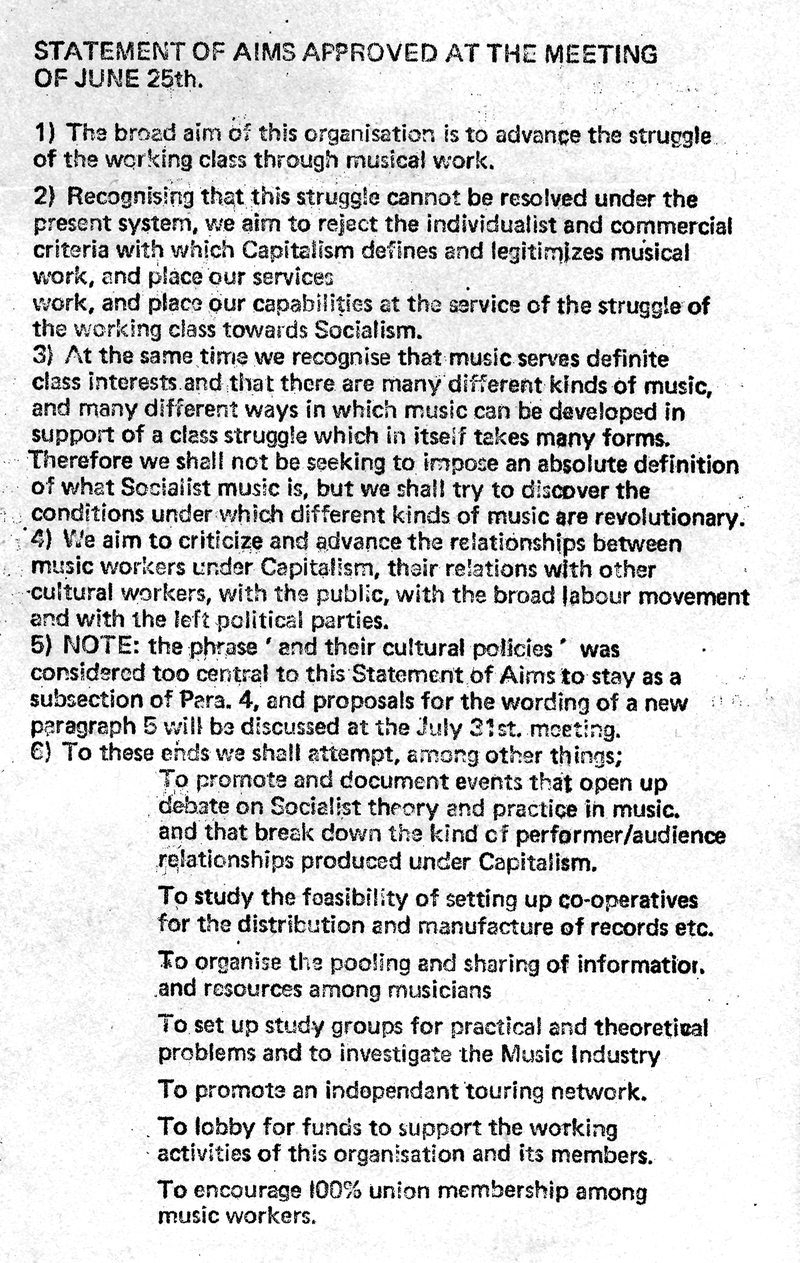
In the meetings that followed the May festival, MFS constituted itself as an organization. Hodgkinson drafted a statement of aims and a constitution, which were revised and adopted later that summer – they appeared in the August newsletter (see Figure 2).Footnote 42 Committing to advance the struggle of the working class towards socialism, the organization would explicitly decline to impose a definition of what socialist music is. Instead, they would explore how to establish an extra-commercial infrastructure for live touring and record manufacture and distribution while opening up debate on the relationships among musicians, audiences, politics, and the left. Their field of action and analysis, in other words, would remain in music itself – their charge did not include questions about how music could support political or labour organization. MFS set up working parties to finish the constitution, find premises for an office, and locate venues for fundraising events. A list of attendees to a 4 September meeting indicates that the coordinating committee included Nigel Willmott, Neil Sandford, Tony Haynes, Steve Beresford, Ian Hoare, and Georgina Born, and the contact address in these early months was 30 Hornsey Park Road, where Hoare lived with a smattering of leftwing and countercultural figures, including Gary Herman.Footnote 43 Willmott, Sandford, and Les Levidov appear to have taken the lion's share of responsibility for the newsletter after the first few issues. The publication, which had existed in the form of a few single-sheet issues, began in earnest in August and became a repository of information and announcements: how to book a benefit gig; solicitations to support the Community Record Press; invitations to community sing-alongs; updates on Rock Against Racism; proposals for Swedish/English rock exchanges; reports on the MU; translation of Swedish song texts; communiques from the Swedish MFS equivalent, Contact-Net; solicitations for a women's songbook; gig listings; reports from the new Leeds chapter of MFS; and reviews and discussion of various left music events (and a few Henry Cow gigs) around London. They were printing 1,000 copies by October.
MFS statement of aims, 25 June 1977.

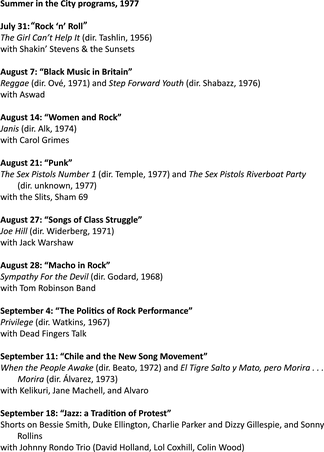
The organization's next big event was a concert/film series at the Other Cinema, which presented nine programmes from late July to September (see Figure 3). Titled ‘Summer in the City,’ the events featured a film or two, a musical performer (sometimes two), and a discussion led by an MFS-affiliated figure. Judging by the retrospective reports from organizers, ‘Summer in the City’ was gratifying and frustrating in equal measure. Although they had presented an impressively diverse collection of time-based arts, the post-performance discussion often disappointed, suffering in Sandford's view from a tendency for the musicians and their ‘sycophants’ to disappear to the pub.Footnote 44 In her memoir, however, journalist Val Wilmer testifies that not only musicians abandoned the discussion in favour of lighter entertainments: ‘To us . . . the level of discussion was rather earnest and tedious, and we sought refuge in the bar together with others bemused by something at odds with their idea of fun.’Footnote 45 Beyond these problems with attendees more interested in hip derision than ‘earnest’ discussion, MFS organizers were often stymied by remedial contributions by newcomers to the whole scene.Footnote 46
MFS summer programmes, 1977.

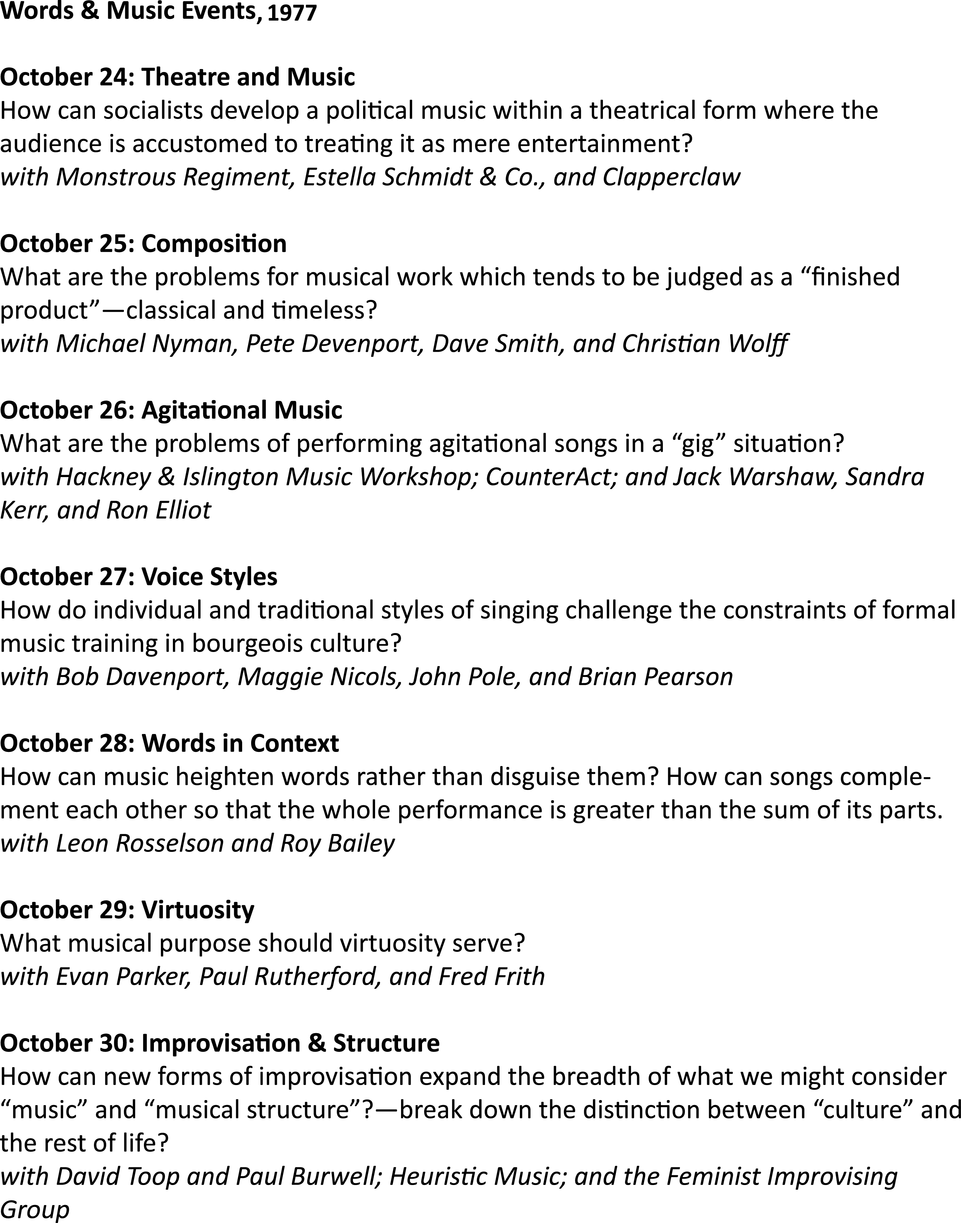
They tried a new approach for the late October ‘Words and Music’ series at the Almost Free Theatre (see Figure 4). Like their previous two public forums, ‘Words and Music’ embodied the aim to break down the separation between musicians and their audience; therefore, like the Battersea festival and ‘Summer in the City’, it would attach music to open discussion with the audience, but this time they set out specific questions for each event and requested that the musicians provide a written statement before their performance. Sensing that they previously had gotten bogged down on the question of lyrics and their intelligibility, they wanted to unseat the idea that music was merely a delivery system for progressive or reactionary verbal ‘content’: ‘By putting forth as debatable issues that which had previously been treated as unquestioned assumptions, we could better focus the discussion and keep it from degenerating from dogmatic assertions as in previous MFS events.’Footnote 47 There were evenings devoted to socialist musical theatre (Monstrous Regiment, Estella Schmidt & co., and Clapperclaw), composition (Michael Nyman, Pete Devenport, Dave Smith, and a visiting Christian Wolff), agitational music (Hackney & Islington Music Workshop; CounterAct; Jack Warshaw, Sandra Kerr, Ron Elliot), voice styles (Bob Davenport, Maggie Nicols, John Pole, Brian Pearson), Words in Context (Leon Rosselson and Roy Bailey); virtuosity (Evan Parker, Paul Rutherford, and Fred Frith); and improvisation and structure (Steve Beresford; David Toop and Paul Burwell; heuristic music; the Feminist Improvising Group). According to Les Levidov, the discussions improved as the organizers had hoped.Footnote 48
MFS ‘Words and Music’ programme, 1977.

Sandwiched between ‘Summer in the City’ and ‘Words and Music’ was a conference organized by Music for Socialism on the subject of alternative record and tape distribution networks, one of Henry Cow's idées fixes. It took place on 1–2 October at the Oval House. Henry Cow was on tour in Italy and therefore could not attend, but owners or representatives from a handful of small UK labels participated, along with a few independent/socialist bands and collectives. This British contingent, numbering only about a dozen, was dwarfed by their foreign counterparts (Sweden alone had sent about fifteen representatives), an embarrassing showing that had resulted from errors in publicizing the event. The European labels and distributors included SAM, Plattlarngana, and Kontaktnatet (Sweden); LOVE (Finland); DEMOS (Denmark); l'Orchestra Cooperativa (Italy); and Diffusion Alternative (Belgium). A European contact list was started with about fifty names.
Summarizing the impressions of David Toop (LMC), Gavin Richards (Belt & Braces), Max Boucher (LMC/Musics), and Tony Haynes (Redbrass), Hodgkinson called the conference an organizational mess in the MFS newsletter – it proffered little UK representation and unclear aims.Footnote 49 The participants possessed varying opinions about the possible directions that an MFS-led distribution network could take. Boucher advocated collective skill-sharing – including record production, not just distribution – over ‘centralised hierarchical pseudo-networks’, while Toop thought there was already a substantial body of socialist music on record, and that the issue was distribution. Criticizing what he thought was the ‘main direction’ of MFS, Richards warned against an overemphasis on ‘freedom’ and ‘self-expression’, which were vestiges of a bourgeois worldview that the organization was supposedly trying to think beyond. Haynes averred that a solid live touring circuit with strong regional support would be a prerequisite for any record distribution.
Hoare published his preliminary notes on the conference and a follow-up meeting of the MFS coordinating committee in the MFS newsletter. Given their available resources, would a left record and tape distribution network constitute a realistic project? The committee had concluded, in classic left fashion, that ‘MFS must never fall into the trap of concentrating on recordings at the expense of live music. Our efforts in the record distribution field must be tied in with our attempts to build up alternative venues for socialist performers.’Footnote 50 Nonetheless, the committee did see the value of canned music, too, and resolved to consider production from the outset, rather than solely distribution. Hoare wrote that they would approach the radical press distributor, Publications Distribution Coop (PDC), to see if they would add LPs to their network. Otherwise, MFS needed more information about existing channels and help from their membership. (PDC would eventually distribute the newsletter, too.) Subsequent issues of the newsletter indicate that they eventually assembled a directory of resources for the production and distribution of records and tapes, a kind of DIY guide for socialist musicians.
Joyless intellectuals: Music for Socialism and Rock Against Racism
In subsequent appraisals of MFS, the group has suffered from comparisons with Rock Against Racism, the wildly successful offshoot of the SWP that lasted until 1982 and is widely agreed to have pulled audiences for punk and reggae away from fascism and towards the left. Ian Goodyer, for example, off-handedly describes MFS as an ‘elitist’ and ‘narrowly didactic’ group that faced ‘the implausible task of dictating the tastes of a generation of music fans and, in the process, weaning them off the products of the commercial music industry’.Footnote 51 As perceptive as he is on the political currents that produced RAR, Goodyer misunderstands MFS's concern with the politics of music, rather than politics in music. As Laing makes clear in his classic analysis of punk rock, MFS were not the only music intellectuals of the time to concentrate on relations of production rather than revolutionary content. (Indeed, the many varieties of small-scale punk production that followed in the wake of the Buzzcocks’ Spiral Scratch did not need MFS to tell them that musician-controlled production was the way to go.)Footnote 52 But their point of focus on production relations meant that their aims were often more analytical and theoretical than those of RAR; their concrete goals concerned the working conditions and productive apparatus of musicians themselves, rather than specific electoral objectives or increasing party memberships.
Furthermore, the understanding of MFS as elitist and out of touch with the newest trends in pop music hastily interprets the public statements of some participants (PLM, the folk musicians) as a ‘correct line’ developed in common by the organization's membership. On the contrary, most of MFS's active members – Sandford, Hoare, Laing, Henry Cow, Steward, Herman – had long worked in the rock field and were eager to produce a theory of popular music's progressive potential. ‘In fact, highly-politicised people don't really like us’, Frith told the Evening Standard: ‘We don't toe the party line, you see. For them it has to be folk, the music of protest – though jazz gets in by the back door because of its black roots. Most of us have a rock background, which is of course highly bourgeois and decadent!’Footnote 53 In fact, Hodgkinson retains notes from this period in which he prepared a defence of pop music for his comrades in the Balham branch of the Communist Party of Great Britain, which he had joined earlier in 1977. (He referred to a ‘partial or potential collectivization of the production of music, of a type probably unique to this area’.Footnote 54) Many MFS organizers admitted that their struggles to put on ‘rock’ gigs had given them a reputation as ‘joyless intellectuals’, but they had a point that their concert/debate format seemed ill-suited to rock, and simply putting on rock gigs as usual would do nothing special to advance the analyses they were interested in.Footnote 55
What RAR possessed that MFS lacked was not simply an appreciation of pop music; rather it was a disciplined group of young, energetic workers who could devote their time and the Socialist Worker Party's resources to the administration of an organization.Footnote 56 With separate full-time jobs, no office facilities, and no printing capabilities, MFS trotted just to stay in place. If anything, their lack of unity and poor organizational performance testified to the great difficulty of theoretical production in such circumstances of material duress. As Haynes told Hodgkinson at the time, ‘decisions and agreements got reversed and confused, without continuity of attendance’.Footnote 57 Working musicians coordinating their own gigs, tours, recordings, and publicity were too burdened with their own affairs to bring a consistent discipline to MFS; during the organization's eighteen months of existence, for instance, Henry Cow embarked on more than fifteen tours in the UK and Europe.
Supported and coordinated by their SWP sponsors, RAR activists used punk and reggae to achieve commonly held political goals that did not directly target expressive culture, whereas MFS sought to clarify differences about what the goals for radical musicians might be; moreover, MFS's membership comprised music workers committed to analysing and changing their conditions of labour, and therefore it had a kind of grassroots quality missing from RAR, which was directed from the top by SWP activists (even if it had arisen spontaneously in 1976). In other words, neither the Clash nor Steel Pulse directed RAR. They played their events, but did not make up the organization. RAR's instrumentalization of popular music towards a pre-defined political end represented precisely the kind of relationship between music and politics that MFS sought to interrogate. Might not there exist an implicit bourgeois politics embedded in the very form of rock spectacle and stardom that RAR had redirected to such powerful ends? This was the kind of question that motivated MFS. As Hoare wrote at the time:
[RAR] put on considerable numbers of well-intended and often inspiring gigs without asking too many awkward questions about the political-cultural meaning of the ‘gig’ format itself . . . Socialists who get involved in this area should be wary of going along with the musicbiz entrepreneurs in the view that the audience are – in the language of the rock elite – ‘punters’, whose function is merely to turn up with the appropriate stickers and badges and pay for the privilege of witnessing their heros [sic] go through their act.Footnote 58
RAR found impressive solutions to England's rightward shift in the late 1970s, but MFS shared Henry Cow's view that the issue of politics and culture was a problem that required an open-ended investigation based on empirical testing, exchange, and argument. For Laing, it was this connection of theory to practice that made the organization special: ‘I think it was important that socialist-identified musicians of all kinds, and their associated publicists, or journalists, or critics or whatever, did actually gather together, did have exchanges of views, did collaborate from time to time.’ But MFS suffered from its inability to develop these conversations into a unified and coherent theory of music and socialism, which was no minor failing. Hodgkinson called these problems of theoretical clarity and procedural order both chronic and serious. He wrote, ‘Without more continuity and discipline at the core it is difficult to see how we can progress at all. We readily admit that our organisation is slack but we haven't often admitted that this seriously impedes even theoretical advance. But continuity seems almost impossible for working musicians: This is the central contradiction of Music for Socialism.’Footnote 59 Theoretical advances would come, but it would take a few years for Cutler and Laing to produce books on issues related to those of MFS; as we will see, Cooper published her article, ‘Women, Music, Feminism – Notes’, later in 1977, and Hodgkinson would place several essays in the para-academic and scholarly press over the next three decades.
Music Net against New Wave capitalists
Although Music for Socialism would continue publishing their newsletter until the summer of 1978, Henry Cow's involvement in the organization diminished over the course of the autumn. They were touring again extensively across Europe, fretting about an upcoming recording session, and pursuing their own administrative projects, many of which continued to show up in the pages of the MFS newsletter.
Chief among these was a project called ‘Music Net’, which launched in January 1978 as a kind of MFS subgroup to continue advancing their interest in an alternative network of venues, promoters, publicity, and personal contacts.Footnote 60 The group's membership included Cutler, Hodgkinson, Hobbs, Beresford, Haynes, Leigh, Williams, and Dick Witts (Normedia and the New Music Exchange (Manchester)); their contact address, 5 Silverthorne Road, was also Henry Cow headquarters, suggesting that Hobbs and Cutler had taken a leadership role. The group thought that a split from MFS was necessary because once the network was up and running, it would require a full-time administrator, which in turn would require funds for a salary. Applying to the Gulbenkian Foundation or the Arts Council for such a reason would be hopeless with a name that included the word socialism, ergo ‘Music Net’. They wanted somebody to spend April to September travelling the country and making contacts with existing small-scale institutions, then write up a report for MFS. This person would also begin applying for grants to subsidize their work.Footnote 61
A typewritten proposal for Music Net (dated 2 April 1978) in Hodgkinson's personal archive evidences a noteworthy narrowing of MFS's more ecumenical scope – Music Net would work for the interests of many MFS members, but not folk musicians such as Rosselson or doctrinal Marxist–Leninists such as PLM. The proposal concentrated on market representation and sources of support for ‘alternative’ musics, including possible state subsidy and special relationships with college entertainment committees and other non-commercial cultural organizations. The anonymous author explains that while art musics (classical and jazz) receive state patronage and folk music gets support in the isolated cell of the folk club, pop and rock live in a world created by the music industry. But some musics enjoy none of these forms of support: ‘These kinds of music are generally the most experimental. This experiment takes several forms – mainly – improvising music, progressive rock and jazz, and political music.’Footnote 62
Experimental music ‘explores new forms’, is ‘socially relevant’, and is not necessarily ‘unpopular’ – these were the justifications given in the document for creating, supporting, and consuming experimental music. But this list fails to mention what was perhaps the most important justification for experimentalism from Henry Cow's perspective (or at least that of Hodgkinson, Cutler, Hobbs, Cooper, and possibly Born), which was the way in which it contributed to the functional transformation of a social mode of musical production, moving it towards socialism. As Cutler would write a few years later, ‘The politicisation of music would mean, in our industrial, urban, commodity-alienated context, the revolutionary transformation of the prevailing relations of production, circulation and consumption.’Footnote 63
For a few years, Henry Cow had subscribed to the notion that politically progressive music had to present innovative musical form, not simply revolutionary content (i.e., lyrics and tunes). This difference lay at the heart of their critique of the stale music of PLM or their Swedish friends, for example, to which Cutler would later refer as ‘the cultural bankruptcy of sloganistic doggerel glued onto rewarmed American Rock music’.Footnote 64 When popular music is nothing more than sugar around the pill of correct political doctrine, it ensures ‘the continued passivity and pliability of the mass and the minimising of critical consciousness within it’.Footnote 65 To the charge that this approach eventuated in elitist or inaccessible music, they would have responded that the music industry – record companies, concert promotion, and journalism – exerted a deleterious control over the tastes of the public.Footnote 66 Their experience in France, Italy, and Scandinavia had shown them that more complicated or unusual music could indeed capture the interest of a diverse audience that was less administered by the Anglo-American entertainment industry. According to Cutler, Henry Cow's revolutionary transformation of production consisted in its refusal of the split between composer and performer (practised most of all, but not exclusively, in open improvisation), collective authorship, and employment of electronic instruments and the recording process.Footnote 67 Through these practices, the band reasoned, they negated the existing (capitalist) relations of art music and commodified popular music, which Cutler called hierarchical, money-mediated, and exploitative. The result was an incremental move towards socialism, within the limits of the possible.
For Henry Cow, these changes in production would also effect changes in reception. To negate the existing relationships between artist and listener, a relationship mediated by the commodity form, they sought exchanges based on communication rather than consumption (of an LP, a concert experience, or a pop star). Improvisation forged numerous channels of dialogue, but so too did written compositions. Unfamiliar, non-idiomatic, or ‘difficult’ material could confound the ‘automatic consumption reflex’.Footnote 68 Above all, Cutler later explained, they worked to engage their audience – ‘we shall have to be prepared to discuss and to take criticism seriously’.Footnote 69
If Henry Cow had been pursuing this politicization of musical production and consumption for many years, the ‘revolutionary transformation’ of circulation had emerged more recently as a topic of intense interest, since the band had grown exasperated with Virgin to the point of exploring alternative means of getting their music to its audience. Virgin's early years may have been rhetorically marked by an allegiance to oddball acts and low-sellers with ‘integrity’, but by 1977 it had become obvious to Henry Cow and others that all big record companies only released music that was ‘worth’ releasing, and ‘worth’ was measured by projected sales. There would always be freak successes such as Mike Oldfield's Tubular Bells (1973), the sales of which buoyed Virgin through its first three years; but on the whole companies could not afford to speculate, Cutler pointed out, and therefore the industry pitched against innovative content.Footnote 70
Nonetheless, conversations with their Swedish and Italian comrades had yielded a strong hope for independent production and distribution, and this was exactly the direction that Henry Cow was pointing in 1977 (Cutler told journalist Kenneth Ansell in June 1976 of his plans to open a record shop for obscure bands ‘from small independent and political labels’).Footnote 71 Their interest coincided closely with Music Net, which was described as ‘a co-operative of alternative promoters and musicians who see music as more than their purses or their careers’.Footnote 72 Later, Cutler would clarify that ‘such strategies however necessitate, if they are to be revolutionary, a type of independence which is not merely petty bourgeois’.Footnote 73 To the drummer, early Virgin would be an example of a petty bourgeois enterprise, because it attempted to corner the market in unusual music and accumulate wealth through doing so. (A notice for Music Net in 1978 announced their aversion to becoming ‘New Wave capitalists’, a reference to the many small but successful record companies that capitalized on punk and new wave.Footnote 74) The type of independence he desired ‘knows itself to be political and provisional, no more than an intermediate cell of resistance (because, after all, it must always find itself in opposition, and thus defined by the thing it opposes)’.Footnote 75
Music Net would soon vanish, leaving no trace after April 1978. By then, the situation in Henry Cow had changed considerably, and, probably in response to the organizational chaos and ideological provisionality of MFS as well as the desultory participation of their British associates, Hobbs and Cutler had thrown themselves into two new ventures that closely shadowed the general concerns of Music Net. The first, Rock in Opposition, was conceived as a kind of international network of resistance to the global entertainment industry. Its member bands organized alternative touring circuits and festivals in their home countries for the other groups in the organization.Footnote 76 The second, Recommended Records, succeeded as a non-industry distribution network for LPs and cassettes (it still exists in 2019), though at the cost of the socialist and cooperative ethos of MFS – it was a Cutler production, through and through.
* * *
All this MFS hubbub indicates the incredible diversity and energy in the extra-parliamentary left during the 1970s – it was but one DIY organization in a sea of self-starter theory/praxis initiatives situated on the line between culture and politics during these years.Footnote 77 For example, Wedge, a ‘revolutionary magazine of cultural practice and theory’, published its first issue in the summer of 1977, promoting theory and analysis of arts and culture from a non-aligned Marxist perspective. With an editorial collective that included early MFS members Bruce Birchall, Lindsay Cooper, Gary Herman, and Ian Hoare, plus Mandy Merck, it contributed to the thick weave of left cultural politics around Henry Cow in London. With Phil Hardy, Dave Laing, Simon Frith, and Mike Flood Page, Hoare and Herman had both also been part of a Marxist rock critics reading group and helped form the Rock Writers’ Cooperative, an editorial collective that took over the great Let It Rock in late 1974 when its publisher was faced with sagging circulation.Footnote 78 Although that journal rarely included writing from women, they attempted a joint issue with Spare Rib, the feminist magazine that had been founded in 1972. Nothing ever came of that collaboration, but Let it Rock did publish a rare ‘topic’ issue on ‘Women in Rock’, guest edited by Spare Rib’s Marion Fudger in July 1975. The Women's Liberation Music Projects had been founded almost concurrently with MFS in December 1976; it ran workshops for women, hosted theoretical discussion groups, and published a women's songbook. Another left journal, The Leveller, routinely covered the arts and culture, with contributions from Hardy, Laing, and occasionally Simon Frith. Although it was less directly concerned with political radicalism, Musics magazine also featured writing by and about many MFS and Henry Cow affiliates. The journal had been founded in spring 1975 by a group of musicians and fans of free improvisation.
One closing example will illustrate the varied cultural politics circulating in the wake of Music for Socialism. Henry Cow member Lindsay Cooper published her first piece of critical writing in Musics in October 1977. Titled ‘Women, Music, Feminism – Notes’, the essay surveyed a range of issues, but concentrated on how music structured, rather than merely reflected, the social position of women.Footnote 79 Any informed reader would have surmised that she was a member of Henry Cow. She contended that the popular music programmes on the BBC and the commercial stations ‘are aimed specifically at housewives with all male disc jockeys playing monotonous pop music’ to match the monotony of domestic labour.Footnote 80 And outside the home, female workers are more likely than men to be employed in ‘environments where music is used to create superficiality and a false sense of well-being’, such as hotels, restaurants, and supermarkets.Footnote 81 Musical discourse routinely positions women as ‘emotional’, wrote Cooper, and the ideology of romantic love that had been the subject of so much music since at least the twelfth century served to preserve the sexist institution of monogamy and to privatize the emotional life of the people. The gender discourse of opera and cock rock (her term) spoke for itself.
Cooper went on to consider the history of women making music before summarizing the problems that remained to be addressed. Interestingly, she spun some issues that had been of general interest to her comrades in MFS into areas of specific concern for women. For example, the fracture and policing of genre boundaries, she wrote, ‘pose particular questions for women. For example, should they get involved in ‘commercial’ music where they will have more of a mass impact, or in ‘non-commercial’ music where they can possibly make better music and get less sexist treatment?’Footnote 82 In commercial music, the mystification and inequality of the star system runs counter to feminism's anti-elitist politics, she wrote, while ‘non-commercial’ music – that is, Henry Cow and its ilk – ‘must constantly struggle against the monopoly control of record distribution and live performance and therefore at least begin with a narrow and usually non-working class and non-female audience’.Footnote 83 Furthermore, the politically progressive men whom one might find in those non-commercial settings might not uniformly share feminist views: ‘Working with men who are also critical of the existing structure can be a struggle – sexism doesn't necessarily disappear among progressive men – and its extinction may be more easily discussed than achieved.’Footnote 84 Nonetheless, Cooper argued against a stylistically narrow understanding of ‘women's music’, advocating instead for pluralism and a lasting engagement with musical practices that had been marked as masculine. ‘Men do use rhythm, technology, improvisation to express the same power and sexual dominance which oppresses women, but if women react by restricting themselves to melodic and acoustic forms rather than also using other elements in a non-oppressive way . . . they perpetuate the old definitions of themselves’, she wrote.Footnote 85 (In private correspondence, Cooper more clearly stated her disdain for ‘relentlessly harmless accoustic [sic]/folk’.Footnote 86)
In a later essay in Leveller, Cooper discussed rock music in particular, noting that the European reaction against Anglo-American cultural imperialism had produced a number of political rock bands (most of them Henry Cow associates: Stormy Six, Magma, the Swedes, Univers Zero). ‘The number of women musicians involved can be counted on the strings of one guitar, and the audiences are predominantly male’, she wrote, ‘but the collective, unmacho approach of most of the European political groups is making more than cosmetic changes in the music and its performance.’Footnote 87 The real changes, according to Cooper, were taking place in the all-women bands (naming none, she presumably meant the Jam Today, among others).Footnote 88
Though just a sampling, these essays, forums, initiatives, and organizations give a good sense of how musicians and music workers on the left – some ‘avant-garde’ and some not – took concrete steps towards an analysis of their social circumstances and a committed advocacy for their marginalized practice in the 1970s. They thought hard about the relation between contemporary cultural production and radical politics. Ever aloof, the scholarly music disciplines had little to say about these latest developments, so music intellectuals outside the academy developed theory and analyses in informal exchanges such as these. Hodgkinson's early engagement with Adorno's writing is one case in point: his notes indicate that he was reading The Philosophy of Modern Music soon after it was translated into English in 1973, and the philosopher's complaints about the empty sacralization of ‘serious music’ show up in Hodgkinson's Henry Cow-related texts. And yet, given the tremendous role of LPs in Henry Cow's musical education, as well as the unprecedented creative labour arrangements that the recording apparatus enabled, Hodgkinson and his theoretically inclined bandmates refused to subscribe to Adorno's totalizing portrayal of the alienation inherent in mechanical reproduction and the musical commodity. Though informal and never published in any accredited or academic forum, these DIY responses to Adorno contributed to the wave of English-language reception of his work in the 1970s.Footnote 89
MFS produced many events and over a dozen information-packed newsletters, but it also provided a new narrative to existing accounts of music and politics in the UK after 1970. Red Wedge and RAR illustrated the appeal and power of subcultural music to motivate young listeners in the political domain, and Rough Trade showed the viability of an independent, less commercially driven distribution system for post-punk and indie music.Footnote 90 But MFS told a different story, one where advocacy for ‘elite’ aesthetics or ‘advanced’ musical technique came not from traditionally schooled composers of European art music – either of the ‘accessible’ (Alan Bush) or ‘avant-garde’ (Luigi Nono) varieties – but from intellectuals working inside pop, rock, and jazz. Indeed, while the folk and workers song enthusiasts (PLM, Rosselson) recapitulated familiar arguments about how music could serve the workers, those members from Henry Cow and the London Musicians Collective recognized the new material arrangements of post-war music-making, where the discourse of technical progressivism showed up in new corners of the cultural field inextricable from the recorded commodity form. As important as were the efforts of MFS to put production and distribution into the hands of music workers, the experimentalists had recognized the need to revise the terms of their theoretical debate, even if that debate found no resolution.