Introduction
Among the myths that are often cited about suicide is that ‘people who talk about killing themselves rarely die by suicide’. In fact, many people who die by suicide give some kind of verbal clue or warning of their intentions, and several studies have shown that as many as two-thirds of completed suicides had previously communicated their intentions (Robins et al. Reference Robins, Gassner, Kayes, Wilkinson and Murphy1959; Dorpat & Ripley, Reference Dorpat and Ripley1960; Barraclough et al. Reference Barraclough, Bunch, Nelson and Sainsbury1974; Beck & Lester, Reference Beck and Lester1976; Beck et al. Reference Beck, Weissman, Lester and Trexler1976).
In recent years, there have been several reports dealing with the communication of suicidal intention. The first major research project on this topic was carried out by Robins and colleagues (Robins et al. Reference Robins, Gassner, Kayes, Wilkinson and Murphy1959), who conducted psychological autopsies on 134 consecutive completed suicides and identified 16 different ways that the suicidal intention had been communicated (Robins et al. Reference Robins, Gassner, Kayes, Wilkinson and Murphy1959). These ranged from direct statements of intention to die by suicide, to indirect ones, such as telling the spouse that he/she should not buy new things for them, or cleaning out an office or bedroom. The authors found that 69% of subjects who died by suicide had communicated their intention to die by suicide during the previous year, often in multiple ways, and 41% had done so using direct, rather than indirect communication. This study prompted other researchers to explore this aspect of suicidal behavior: Dorpat & Ripley (Reference Dorpat and Ripley1960) reported that 83% of their sample of completed suicides in Seattle had communicated their suicidal intention, while Barraclough et al. (Reference Barraclough, Bunch, Nelson and Sainsbury1974) found that 55/100 of their sample of completed suicides had talked about death, dying and suicide (Dorpat & Ripley, Reference Dorpat and Ripley1960; Barraclough et al. Reference Barraclough, Bunch, Nelson and Sainsbury1974).
Despite several years of research on this issue, we have few clues as to which factors affect whether suicidal individuals will communicate their intention to die by suicide. Among the factors that might influence the frequency and type of suicidal communication (SC) are the individual's personal history, cultural background, personality, and psychiatric diagnosis Moreover, it is largely unknown to what extent a communication of suicidal intention predicts completed suicide, and what is the sensitivity and specificity of this predictive clue.
In order to effectively inform clinical practice, research on the communication of suicidal intention needs to take into account several methodological issues that were pointed out by Bernstein (Reference Bernstein1978). For example, in psychological autopsy studies, information given by the suicides’ significant others and the reports made by clinicians, medical examiner staff or police might be biased. The significant others may not want to realize (or admit) that they missed clues to their loved one's suicide. The medical examiner's staff may want to avoid ruling the death a suicide. Furthermore, while a direct communication may be relatively easy to interpret, it is not easy to specify the criteria for an indirect communication (Bernstein, Reference Bernstein1978).
Despite nearly 50 years of research, no systematic review has been conducted on this issue. Relevant questions that we plan to address in the following meta-analytical review are: (1) what is the proportion of suicides who had previously communicated their suicidal ideas/intentions, and (2) what are the factors affecting the proportion of communicators?
Method
Search strategy
We searched Index Medicus (for publications prior to 1966) and Medline, Excerpta Medica, PsycLit to November 2015 to identify research on the communication of suicide intention. Search terms included combinations of ‘suicid*’ (which comprises suicide, suicidal, suicidality, and other suicide-related terms), ‘communication’ and ‘intent’. In addition, we reviewed bibliographies of identified reports and sought access to published research not indexed or found in the previous search. Two of the co-authors (M.P. and M.I.) independently reviewed all citations retrieved, blind to each other, in order to achieve a consensus on whether to include a report, consulting a third co-author (M.B.M.) in instances of initial disagreement. We also consulted a number of international experts in the field to retrieve further potential relevant citations. The authors and the experts consulted performed a careful analysis of the literature data and agreed on a number of additional studies that were relevant to the aim of this paper. We will, therefore, provide an in-depth analysis of studies on the communication of suicidal intent by those who died by suicide.
Inclusion criteria and definitions
In order to be eligible for inclusion, studies had to: (1) examine data relative to completed suicides and report the number of subjects who communicated suicidal intentions (henceforth simply termed ‘communicators’); (2) report at least minimal data describing the setting of the study and the type of population involved; and (3) adopt and report an unequivocal definition of SC applied in a systematic fashion for all individuals. We sought to include studies providing clear unambiguous data on the communication of suicidal ideas or intention. This would include, for instance, a statement that individual had a wish to die or was determined to die by suicide, was tired of being alive, was considering suicide as an option, that he/she would be better off dead, and similar utterances. Any relevant person could be the potential recipient of such communications, including family members, friends, clinicians and religious authorities. We excluded studies reporting insufficient information on the type of communication and those reporting data on communications that were related to non-fatal self-harm. We also excluded those studies which reported the number of patients contacting clinicians before suicide, if they did not report specific information on SC.
Both retrospective (psychological autopsy) and prospective studies were included, as well as those with a case-control design (i.e. comparing the communication of suicidal intention between suicides and non-suicides). For the case-control studies, we included only those studies which recruited controls from the same setting with a similar risk of suicide (e.g. patients with psychiatric disorders). (The flow diagram of study selection is reported in Supplementary Fig. S1.)
Data extraction
In order to examine which factors influence the proportion of subjects making SC, we coded available information related both to methodological factors and clinical characteristics. First, we coded information related to the study design, publication year, source of information (clinical charts, interview, or multiple sources) and sample size. Other characteristics of the samples were also coded, such as mean age of the sample, proportion of females, diagnoses (any psychiatric disorder and specific diagnoses), previous suicide attempts, and means of suicide.
Information on the study definition of SC was coded with details concerning its content (passive v. active ideas of suicide, intention, plan), modality (written, verbal, non-verbal), recipient (next of kin, clinician, others) and length of observation period. The main outcome variable was the number of suicides who communicated suicidal ideas. If studies reported data related to multiple types of communication (e.g. the proportion of suicides who made verbal threats and the proportion of suicides writing about their intentions), time-frame (e.g. data on communication in the past month and in the past year) or diagnostic subgroups. Only one estimate was kept for each study in the primary meta-analysis. In order to obtain greater homogeneity, we gave preference to the studies with larger samples, to verbal over other forms of communication, and to the longest time-frame of observation. However, the other estimates were coded and used for subsequent comparisons in subgroup analyses and in meta-regressions.
The evaluation of the study's methodological quality was based on a score computed from the following items (1 point each; maximum 5 points). (1) data collection based on multiple sources of information; (2) relatives of the deceased were interviewed; (3) SC: modality reported (e.g. verbal, written, behavioural); (4) SC: recipients of the communication reported; (5) SC: time-frame specified.
Data analysis
First, a pooled between-study estimate of the proportion of suicide communicators was calculated. Confidence intervals (95% CI) were calculated using the Freeman–Tukey double arcsine transformation method (Nyawira Nyaga et al. Reference Nyawira Nyaga, Arbyn and Aerts2014). The meta-analysis was based on random-effects models, with an estimate of between-study heterogeneity based on the Q test (DerSimonian & Laird, Reference DerSimonian and Laird1986).
Second, subgroup and meta-regression analyses were carried out to examine the influence of methodological and clinical factors on the proportion of suicidal communicators (moderators). An exploratory multivariate meta-regression analysis was performed entering several moderators at the same time in order to reach the best explanatory model possible.
Third, we performed a meta-analysis to estimate the risk of suicide associated with the SC. Data on the proportion of communicators from suicides and controls from each study were used to calculate a pooled odds ratio (OR) with a 95% CI. We also computed the measures of accuracy of SC for each included study (pooled sensitivity and specificity, positive likelihood ratio (PLR), negative likelihood ratio (NLR) and diagnostic OR (DOR, with a corresponding 95% CI) using a regression-based approach (Harbord & Whiting, Reference Harbord and Whiting2009). Stata v. 12.0 (StataCorp, USA) was used for all analyses.
Results
Study selection
We identified 38 citations related to 36 study populations (Robins et al. Reference Robins, Gassner, Kayes, Wilkinson and Murphy1959; Dorpat & Ripley, Reference Dorpat and Ripley1960; Yessler et al. Reference Yessler, Gibbs and Becker1960; Beisser & Blanchette, Reference Beisser and Blanchette1961; Farberow et al. Reference Farberow, Shneidman and Neuringer1966; Rudestam, Reference Rudestam1971; Barraclough et al. Reference Barraclough, Bunch, Nelson and Sainsbury1974; Fowler et al. Reference Fowler, Tsuang and Kronfol1979; Breier & Astrachan, Reference Breier and Astrachan1984; Shafii et al. Reference Shafii, Carrigan, Whittinghill and Derrick1985; Brent et al. Reference Brent, Perper, Goldstein, Kolko, Allan, Allman and Zelenak1988, Reference Brent, Perper, Moritz, Allman, Friend, Roth, Schweers, Balach and Baugher1993; Rich et al. Reference Rich, Fowler, Fogarty and Young1988; Goh et al. Reference Goh, Salmons and Whittington1989; Rihmer et al. Reference Rihmer, Barsi, Arato and Demeter1990; Apter et al. Reference Apter, Bleich, King, Kron, Fluch, Kotler and Cohen1993; Isometsa et al. Reference Isometsa, Henriksson, Aro, Heikkinen, Kuoppasalmi and Lonnqvist1994a , Reference Isometsa, Henriksson, Aro and Lonnqvist c , Reference Isometsa, Heikkinen, Marttunen, Henriksson, Aro and Lonnqvist1995, Reference Isometsa, Henriksson, Heikkinen, Aro, Marttunen, Kuoppasalmi and Lonnqvist1996; Foster et al. Reference Foster, Gillespie and McClelland1997; Heila et al. Reference Heila, Isometsa, Henriksson, Heikkinen, Marttunen and Lonnqvist1998; Marttunen et al. Reference Marttunen, Henriksson, Isometsa, Heikkinen, Aro and Lonnqvist1998; Pirkola et al. Reference Pirkola, Isometsa, Henriksson, Heikkinen, Marttunen and Lonnqvist1999; Harwood et al. Reference Harwood, Hawton, Hope and Jacoby2000; Lindqvist & Gustafsson, Reference Lindqvist and Gustafsson2002; Hawton et al. Reference Hawton, Malmberg and Simkin2004, Reference Hawton, Simkin, Gunnell, Sutton, Bennewith, Turnbull and Kapur2005; Yim et al. Reference Yim, Yip, Li, Dunn, Yeung and Miao2004; Portzky et al. Reference Portzky, Audenaert and van Heeringen2005, Reference Portzky, Audenaert and van Heeringen2009; De Leo & Klieve, Reference De Leo and Klieve2007; Orbach et al. Reference Orbach, Gilboa-Schechtman, Ofek, Lubin, Mark, Bodner, Cohen and King2007; Owen et al. Reference Owen, Belam, Lambert, Donovan, Rapport and Owens2012; Sveticic et al. Reference Sveticic, Milner and De Leo2012; Zhou & Jia, Reference Zhou and Jia2012; McPhedran & De Leo, Reference McPhedran and De Leo2013; Giupponi et al. Reference Giupponi, Pycha, Innamorati, Lamis, Schmidt, Conca, Kapfhammer, Lester, Girardi and Pompili2014). Seven citations reported data from different subsamples of the Finnish National Suicide Prevention Project (Isometsa et al. Reference Isometsa, Henriksson, Aro, Heikkinen, Kuoppasalmi and Lonnqvist1994b , Reference Isometsa, Henriksson, Aro and Lonnqvist c , Reference Isometsa, Heikkinen, Marttunen, Henriksson, Aro and Lonnqvist1995, Reference Isometsa, Henriksson, Heikkinen, Aro, Marttunen, Kuoppasalmi and Lonnqvist1996; Heila et al. Reference Heila, Isometsa, Henriksson, Heikkinen, Marttunen and Lonnqvist1998; Marttunen et al. Reference Marttunen, Henriksson, Isometsa, Heikkinen, Aro and Lonnqvist1998; Pirkola et al. Reference Pirkola, Isometsa, Henriksson, Heikkinen, Marttunen and Lonnqvist1999; De Leo & Klieve, Reference De Leo and Klieve2007); two citations allowed the extraction of further data on SC for the same study samples (De Leo & Klieve, Reference De Leo and Klieve2007; Portzky et al. Reference Portzky, Audenaert and van Heeringen2009).
Characteristics of included studies
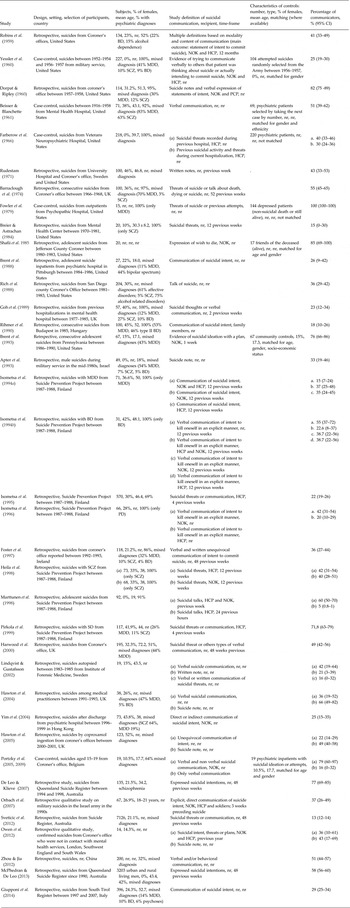
All studies had retrospective designs, and they comprised a total of 14 601 completed suicides, with a sample size ranging from 14 (Owen et al. Reference Owen, Belam, Lambert, Donovan, Rapport and Owens2012) to 7126 (Sveticic et al. Reference Sveticic, Milner and De Leo2012) subjects. Details on these studies are reported in Table 1.
Description of the studies included in the meta-analysis

CI, Confidence interval; MDD, major depression; SCZ, schizophrenia; BD, bipolar disorder; SD, substance dependence; PD, personality disorder; NOK, next of kin; HCP, healthcare professional; PCP, primary-care physician; nr, not reported.
Twenty studies relied on multiple sources of information, six from chart reviews only, eight from the next of kin only and, in two cases, the source of information was not specified.
While several studies reported qualitative descriptions, most reports did not use detailed, systematic definitions of SC. No study used a priori criteria to define the content of the communication (e.g. if the subjects expressed only suicidal intention v. an active plan). Regarding the modality of SC, ten studies did not specify this information, 21 studies reported on verbal communications, eight reported data on written notes, three included both verbal and written communications, and four studies included suicide behaviours. Only 18 studies reported information on who was the recipient of SCs (in most cases both next of kin and health professionals), while 20 studies reported on the duration of the observation period for the SCs (on average 24 weeks; range 1–52 weeks). The study population mean age was 40 years (range 17–72 years), and the percentage of females was 25% (range 0–52%).
Twenty-eight studies provided at least some data on the psychiatric diagnoses of the suicides, such as the percentage of suicides diagnosed with any psychiatric disorder (average proportion: 80%, range 18–100%). The vast majority of studies comprised samples with mixed diagnoses; 16 studies provided the proportion of patients suffering from major depression (mean 32%, range 0–100%), which was >70% in four cases, whereas three studies were entirely focused on patients with schizophrenia (Breier & Astrachan, Reference Breier and Astrachan1984; Heila et al. Reference Heila, Isometsa, Henriksson, Heikkinen, Marttunen and Lonnqvist1998; De Leo & Klieve, Reference De Leo and Klieve2007). One study examined patients with bipolar disorder (Isometsa et al. Reference Isometsa, Henriksson, Aro and Lonnqvist1994c ), one personality disorders (Isometsa et al. Reference Isometsa, Henriksson, Heikkinen, Aro, Marttunen, Kuoppasalmi and Lonnqvist1996) and one subjects with previous substance dependence (Pirkola et al. Reference Pirkola, Isometsa, Henriksson, Heikkinen, Marttunen and Lonnqvist1999).
Prevalence of SC among suicides
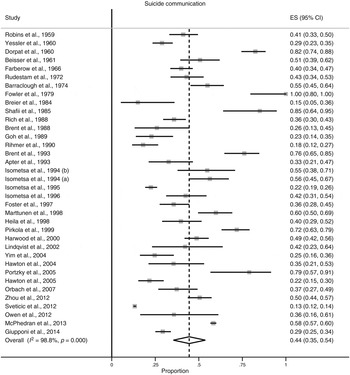
Overall, 4347 cases out of 14 601 suicides had communicated their suicidal intention before the act. The proportion of communicators ranged from 13.2% (942/7126; Sveticic et al. Reference Sveticic, Milner and De Leo2012) to 100% (15/15; Fowler et al. Reference Fowler, Tsuang and Kronfol1979).
In the meta-analysis (see Fig. 1), the overall proportion of suicidal communicators was 44.5% (95% CI 35.4–53.8). An extreme degree of between-study heterogeneity was observed (Q test χ2 = 2914, df = 35, p < 0.001, I 2 = 98.8%). One study yielded an outlier value, and was therefore removed from further analyses (Fowler et al. Reference Fowler, Tsuang and Kronfol1979). However, the prevalence of communicators did not change substantially: 42.7% (95% CI 33.6–52.0, Q test χ2 = 2866, df = 34, p < 0.001, I 2 = 98.8%).
Meta-analysis of the proportion of suicide communicators among suicides. ES, Effect size; CI, confidence interval.

Sources of heterogeneity
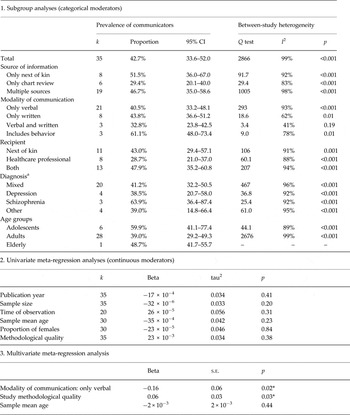
Using subgroup analyses and meta-regression, we examined whether factors related to the study methodology and to the composition of the sample were associated with the observed proportion of communicators (see Table 2).
Factors influencing the proportion of communicators in the meta-analysis

The effect of moderating factors on the proportion of communicators was examined using: (1) subgroup analyses; (2) univariate meta-regression analyses and (3) a multivariate meta-regression. In the first panel, a meta-analysis is repeated for each category of the moderating factor. We report the proportion of communicators (with 95% Confidence Intervals) for the total number of studies (total, after exclusion of the outlier), then within each subgroup and the results of Q test. I 2 indicates the test proportion of between-study heterogeneity and p the statistical significance of the Q test within each subgroup. Comparing different subgroups, if the proportions of communicators have similar values and large overlaps of confidence intervals, this indicates that the moderator is unlikely to play a role in determining heterogeneity. The second panel reports the results of separate meta-regression analyses: the predictor is used as the independent variable and the proportion of communicators as the dependent variable. For each moderator, we report the values of the coefficient (beta), standard error (s.e.), estimate of between-study variance (tau2) and the statistical significance of each moderator (p). The third panel reports the results of an exploratory meta-regression, obtained combining multiple moderators. Categorical moderators were dummy-coded. Proportion of between-study variance explained by the model (adjusted R 2): 14%. Model: F 3,36 = 3.00, k = 40, p = 0.04; tau2 = 0.032.
* p < 0.05
a More than 70% of the sample.
In the meta-regression analyses, study publication year (p = 0.41) sample size (p = 0.20) and methodological quality (p = 0.38) were not significantly associated with the proportion of communicators.
Studies relying on information from chart reviews yielded a lower proportion of communicators than those using interviews of next of kin or using multiple sources of information (29.4 v. 51.5 and 46.7%, respectively), but this difference did not reach statistical significance. Concerning the modality of communication, when studies examined both verbal and written communication, the proportion of communicators was lower (32.8%) compared with studies including only verbal (40.5%) or only written communications (43.8%). When suicide behaviours were also included in the definition of communications, the proportion of communicators was greater (61.1%). However, these differences were not statistically significant. Similarly, there was no significant difference in the proportion of communicators on the basis of who was the recipient. However, when only communication to healthcare professionals was considered, the prevalence was lower (28.7%). Last, the length of the time of observation was not significantly associated with the proportion of communicators (p = 0.31).
Participant characteristics, such as the proportion of females (p = 0.84) and mean age (p = 0.23) were not associated with the proportion of communicators, whereas studies examining adolescents yielded slightly higher values than those examining adults (59.9% v. 39.0%). Again, this difference did not reach statistical significance. When we subdivided the studies by diagnosis, those examining patients with schizophrenia yielded a slightly higher proportion of communicators than did those examining depressed patients (63.9% v. 38.5%), but this difference was not statistically significant. The high prevalence of communicators among schizophrenic patients was driven in particular by one large study, reporting a prevalence of 77% (De Leo & Klieve, Reference De Leo and Klieve2007). All subgroup meta-analyses and meta-regression were characterized by high degrees of residual heterogeneity.
When the most significant moderators were entered in the exploratory multiple meta-regression, the proportion of communicators was negatively associated with recording only verbal communications (B = −0.16, p = 0.02) and, positively, with study methodological quality (B = 0.05, p = 0.03). The model explained 14% of the between-study variance in the outcome (F = 3.00, p = 0.04; tau2 = 0.032).
Publication bias
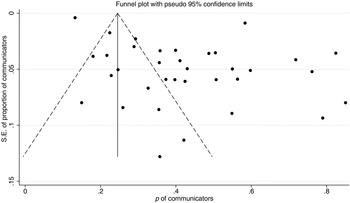
By inspection of the funnel plot asymmetry and conducting Egger's test (t = 3.17, p = 0.003) it was evident that the available studies suffered a significant degree of publication bias (see Fig. 2).
Funnel plot for the meta-analysis. These figures show the correlation between the proportion of communicators and their standard error (s.e.) with pseudo 95% confidence limits.

Case-control studies
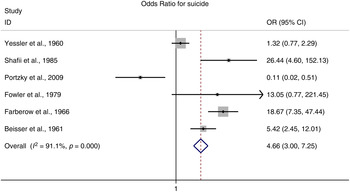
We pooled the six studies comparing the proportion of communicators in suicides and psychiatric controls (Yessler et al. Reference Yessler, Gibbs and Becker1960; Beisser & Blanchette, Reference Beisser and Blanchette1961; Farberow et al. Reference Farberow, Shneidman and Neuringer1966; Shafii et al. Reference Shafii, Carrigan, Whittinghill and Derrick1985; Fowler et al. Reference Fowler, Rich and Young1986; Portzky et al. Reference Portzky, Audenaert and van Heeringen2009). The pooled OR was 4.66 (95% CI 3.00–7.25), characterized by a high degree of heterogeneity (Q test χ2 = 55.9, df = 5, p < 0.001, I 2 = 91.1%) (see Fig. 3). Thus, those who had made a communication of their suicidal intention had a 4-fold higher odds of being suicides than those not making SCs. Of note, four of these studies examined adult samples and yielded a slightly higher effect size (OR 4.99, 95% CI 3.13–7.96, Q test χ2 = 30.8, df = 3, p < 0.001, I 2 = 90.3%), while the studies examining adolescent samples yielded a non-significant effect (OR 1.83, 95% CI 0.57–5.89, Q test χ2 = 21.7, df = 1, p < 0.001, I 2 = 95.4%).
Meta-analysis of case-control studies: odds ratio (OR) of suicide according to suicide communication. CI, Confidence interval.

The same pool of studies was examined with a meta-analysis of diagnostic accuracy: SC was not associated with a significant diagnostic accuracy for suicide (specificity: 76%, 95% CI 47–92; sensitivity: 57%, 95% CI 23–85; PLR: 2.34, 95% CI 0.92–6.00; NLR: 0.57, 95% CI 0.26–1.26; DOR: 4.13, 95% CI 0.86–20.0). However, after the removal of studies conducted on adolescents, the diagnostic accuracy increased, displaying higher levels of specificity than sensitivity (specificity: 80%; 95% CI 45–95%; sensitivity: 58%, 95% CI 19–89%; PLR: 2.98; 95% CI 1.21–7.31; NLR: 0.52; 95% CI 0.23–1.19; DOR: 5.74, 95% CI 1.67–19.8).
Discussion
The present meta-analysis, the first on SCs, found that about half of suicides communicate their intentions prior to death. The estimates of the prevalence of SC were highly heterogeneous across different studies, and this seemed to depend, at least in part, on methodological factors. In particular, studies recording only verbal communications tended to detect lower rates of communication, while studies with higher methodological quality detected higher number of communicators. Based on few available case-control studies, it would appear that subjects who make SCs are associated with a 4-fold greater likelihood of being suicides, compared with non-communicators. As a marker of suicide, SC might have fair specificity but displays a low sensitivity.
Among the general population and some health professionals, an incorrect assumption is that those who talk about killing themselves rarely die by suicide. On the contrary, studies shows that a large proportion (about half) of people who die by suicide have given at least some kind of verbal clue or non-verbal warning of their intentions. In some cases, as many as two-thirds of completed suicides share their intentions before dying by suicide (Dorpat & Ripley, Reference Dorpat and Ripley1960; Barraclough et al. Reference Barraclough, Bunch, Nelson and Sainsbury1974). Scholarly papers routinely cite three major psychological autopsy studies to support the notion that the communication of suicidal intention is present in the vast majority of completed suicides (Robins et al. Reference Robins, Gassner, Kayes, Wilkinson and Murphy1959; Dorpat & Ripley, Reference Dorpat and Ripley1960; Barraclough et al. Reference Barraclough, Bunch, Nelson and Sainsbury1974). Our study found a somewhat lower figure for the communication of suicidal intentions. Comparisons of psychiatric patients and people with no mental disorders find substantial differences, with the former communicating more often than the latter.
Shneidman (Reference Shneidman1996) stated that the common interpersonal act in suicide is the communication of intention, and many individuals choosing to die by suicide consciously or unconsciously provide clues to their intention, signals of distress, mention of helplessness, or pleas for intervention. However, a recent study showed that such communication can often be indirect, ambiguous, humorous and euphemistic; listeners frequently found it difficult to judge the meaning and intention of utterances referring to suicide (Owen et al. Reference Owen, Belam, Lambert, Donovan, Rapport and Owens2012). Moreover, subtle or ambiguous forms of communication would fall below the threshold that studies usually set to define a clear ‘communication’ and, therefore, would go unrecorded. Hence, it is possible that any study adopting a systematic methodology and a rigorous definition of SC might underestimate the proportion of communicators.
Another important issue related to SC is the response that follows such an event. Our data shows that SC seems to have a good positive predictive value, at least among adults. Therefore it is critical that any explicit SC be followed by a referral to a mental health professional and the arrangement of an adequate prevention plan. Rudestam (Reference Rudestam1971) investigated the response to SCs among 100 informants and found that 38% of them met it with scepticism and denial, 47% with concern and 25% with fright. There has been scarce research to date on the behavioural response of those who received the communication. How did they respond, and how often did they contact a mental health professional? For mental health professionals (whether in the mental health sector or in other settings), many factors can impair a proper consideration and response to communication of suicidal intentions, including incorrect and incomplete knowledge about suicide (including acceptance of some of the ‘myths’), poorly conducted psychiatric evaluations (many people who kill themselves are not clinically depressed), excessive reliance on clinical intuition (subjective feelings) rather than evidence, failure to rely on family and community support for the suicidal individual, conflict between staff members, poor staff morale, a belief that suicide may be prevented just by impersonal means, and negative psychological reactions (countertransference) (Maltsberger & Buie, Reference Maltsberger, Buie, Jacobs and Brown1989). Once more, it needs to be stressed how education about suicide should be a key element of continuing education for all health professionals.
At present, there is little evidence that that patient diagnosis has an impact on SC; however this analysis was based on relatively few studies, hence deserve to be interpreted cautiously. Moreover we did not find an association between patients’ age and the prevalence of communicators; despite this, studies conducted on adolescents yielded slightly higher rates of communication than studies on adults. Notably, among adolescents, communication was not associated with an increased risk of suicide. This should prompt further research on communication in specific age groups and prevent generalizing findings from adult populations.
The results from this study need to be weighed against its limitations. Overall, these results should be taken with caution, as they are based on studies with several methodological limitations. Studies had generally low methodological quality. In particular, there was little consensus among investigators regarding the definition of communication of suicidal intention, and the studies differed, not only with respect to the criteria they used, but also in terms of how clearly the criteria were specified in the published reports. Some studies relied primarily on case histories, public records, and written reports, while other investigators interviewed relatives and acquaintances of the suicides. Each source of data alone is likely to underestimate the incidence of SC. Some of the studies used a psychological autopsy design. Pouliot & De Leo (Reference Pouliot and De Leo2006) have noted that data derived from these studies should not be generalized without proper understanding of the shortcomings of this methodology. In fact, reports and records may often be incomplete and inaccurate. The main weakness of interviews is that the acquaintances of the decedent may not be aware of SCs made to others or may have forgotten or suppressed evidence. Other major issues include to whom the communication is addressed (physicians/other personnel/next of kin) and within what time-frame. For example, in the seminal study by Robins et al. 93/134 suicides made prior communications of their intention (Robins et al. Reference Robins, Gassner, Kayes, Wilkinson and Murphy1959). Communications were most often made to spouses (60%), relatives (51%) and friends (35%). All of these factors might limit the degree of accuracy of the estimates of SC presented in the literature. Furthermore, the present authors chose to report those studies available in the literature that could support a broad analysis of the topic so as to offer a sound analysis of SCs prior of suicide. Despite careful and systematic search, we extrapolated those studies that presented original data; however, a number of additional papers could exist as source of information.
There are also limitations in the meta-analysis. Since a shared definition of SC has not yet been formulated, the inclusion of studies was based on the study definition as they were conceived by the individual authors as reported in each study. When attempting to study such a complex phenomenon, the operational definitions are likely to be heterogeneous and might be vulnerable to bias related to researchers’ culture and experience. Also, a degree of subjective interpretation in the process of deciding to include a study is unavoidable. However, we applied clear criteria for the selection of studies and adopted a blind consensus method for inclusion in order to minimize this risk. Second, few studies have been published on this topic and were available for inclusion, especially those with a case-control design. The included studies were conducted over a period of many years and were characterized by great methodological diversity. As expected, this was reflected in high levels of between-study heterogeneity and wide confidence intervals for the estimates of prevalence. However, publication year did not seem to have an influence on the rates of communication suggesting the absence of secular trends. As is warranted in such cases, we applied a random effect model for the meta-analysis, but the presence of significant publication bias warrants caution in the interpretation of results nonetheless (Bulpitt, Reference Bulpitt1988; Evidence-Based Medicine Working, 1992).
Conclusion
Approximately half of all suicides communicate their suicidal intentions prior to their suicide, and it is important that mental health professionals are aware of this. Future studies on this issue should rely on multiple sources of information, define SCs more precisely, explore the content of communications in more depth, distinguish between non-verbal communication, verbal communication and suicidal behaviour, take into account the length of the observation period, and examine the role of age, psychiatric diagnoses and other clinical factors.
Supplementary material
The supplementary material for this article can be found at http://dx.doi.org/10.1017/S0033291716000696.
Acknowledgements
Dr Pompili designed the study and first reviewed the literature; Dr Innamorati reviewed the literature and performed preliminary statistical analysis. Dr Belvederi Murri performed main statistical analysis and performed critical appraisal of studies included in this paper. All authors contributed in study selection and in drafting the paper.
Declaration of Interest
None.