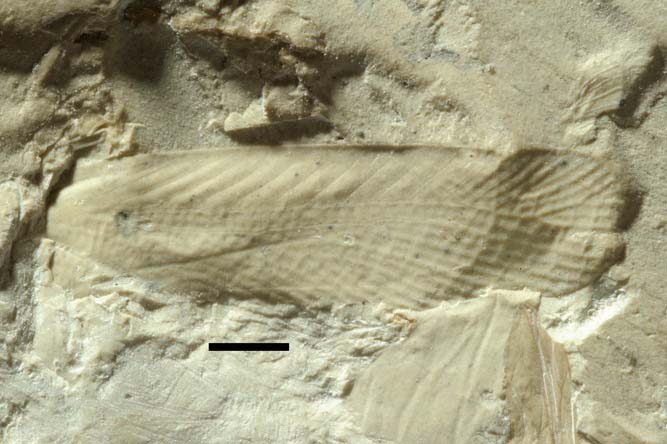
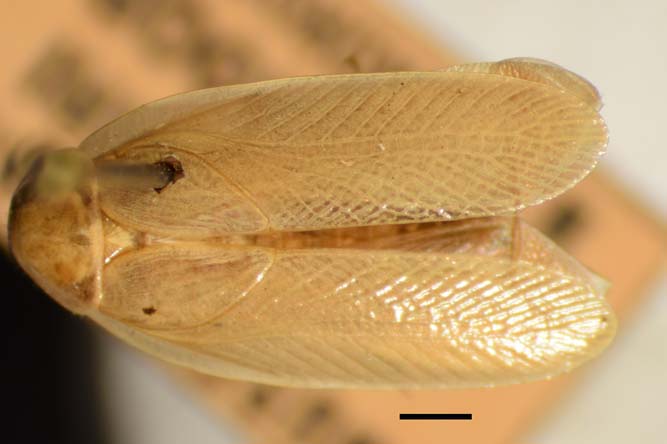
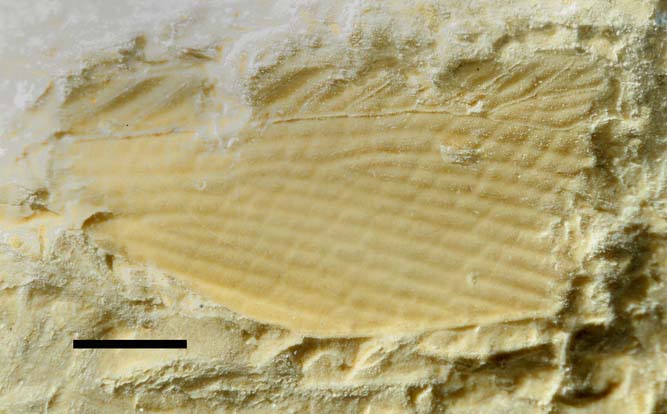
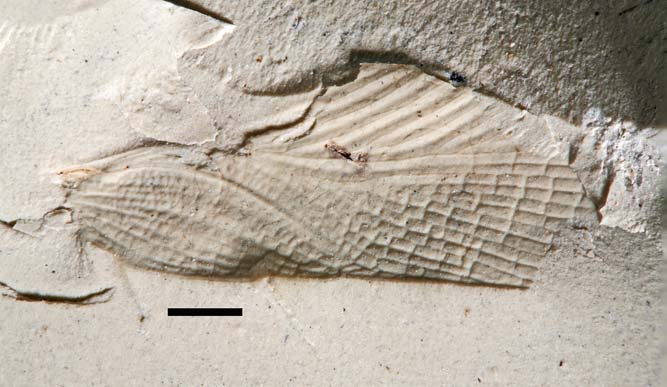
Cockroaches (Blattodea), praying mantises (Mantodea) and earwigs (Dermaptera) are a rare component of Cenozoic fossil insect faunas, and the Insect Limestone of the Isle of Wight, southern England, is no exception.
The insects are preserved in concretions or tabular bands of very fine-grained micrite, known as Insect Limestone. The unit where these concretions/bands occur is known as the Insect Bed, which lies towards the base of the Bembridge Marls Member (Solent Group: Bouldnor Formation). The Bembridge Marls are late Eocene: Priabonian in age (Ross & Self Reference Ross and Self2014). The Insect Bed outcrops on the NW and E side of the island, however all the specimens in this paper would have been collected from the NW side.
Most of the specimens are deposited at the Natural History Museum, London (NHMUK) and are from the A'Court Smith (purchased 1877, 1883), P. B. Brodie (purchased 1898) and R. W. Hooley (purchased 1924) collections. They are labelled ‘Gurnard Bay' or ‘Gurnet Bay' (which is an old name for Gurnard Bay); however, Smith collected specimens all the way from West Cowes to Newtown River on the NW side of the Isle of Wight (Jarzembowski Reference Jarzembowski1980). Most of the specimens from the old collections probably came from Thorness Bay (Jarzembowski Reference Jarzembowski1976). For more information on the history of the collections, see Ross & Self (Reference Ross and Self2014). In addition, a cockroach ootheca was collected by Sam Morris and Paul Whalley in 1972 when they were employed by the NHMUK; the author found a forewing in the 1990s, which is deposited at the Booth Museum of Natural History Museum, Brighton (BMB); a small forewing was found by Mr and Mrs P. New in 2005 and is deposited at the NHMUK, and in the past few years Andy Yule donated four more specimens to the NHMUK that he collected from Saltmead and Sticelett ledges (see map in Ross & Self Reference Ross and Self2014, p. 234, fig. 1).
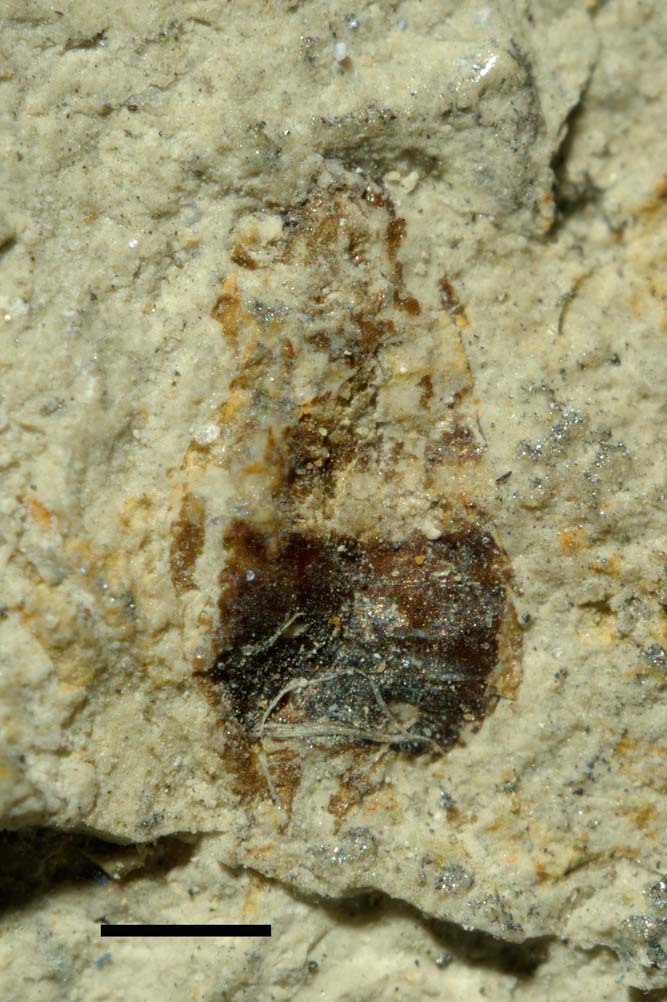
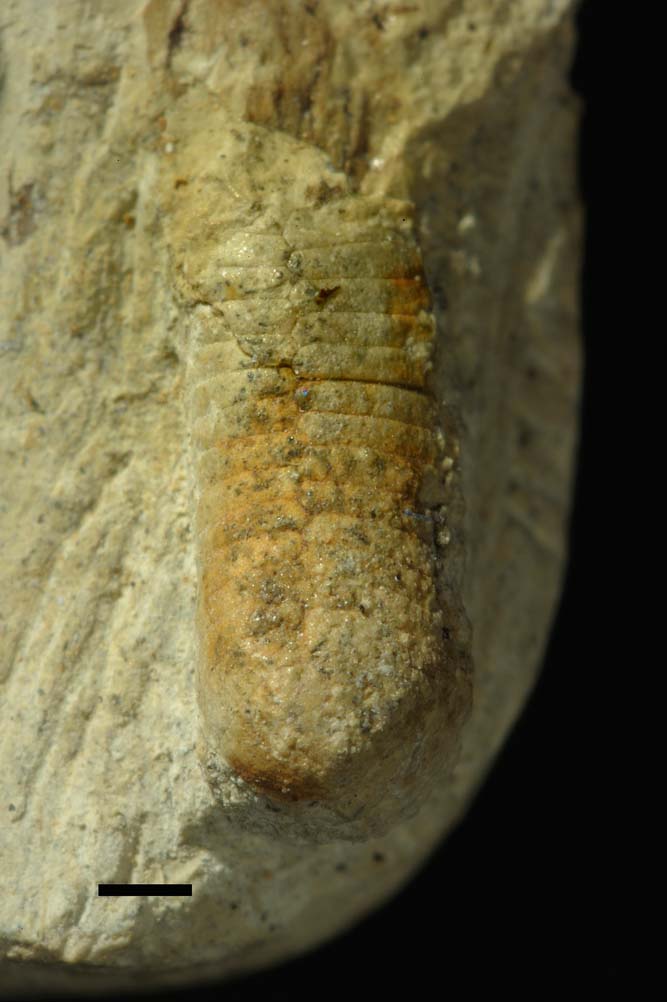
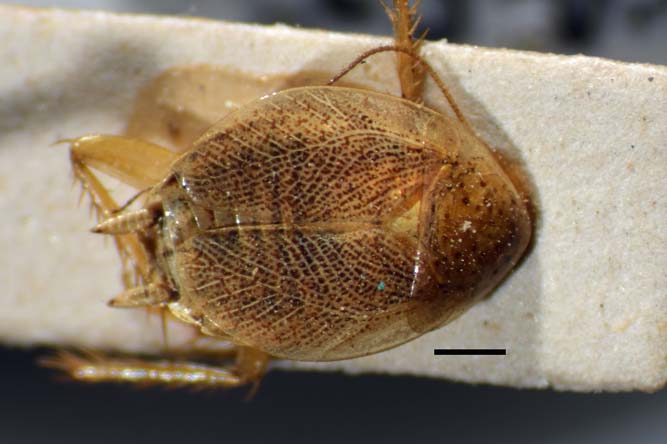
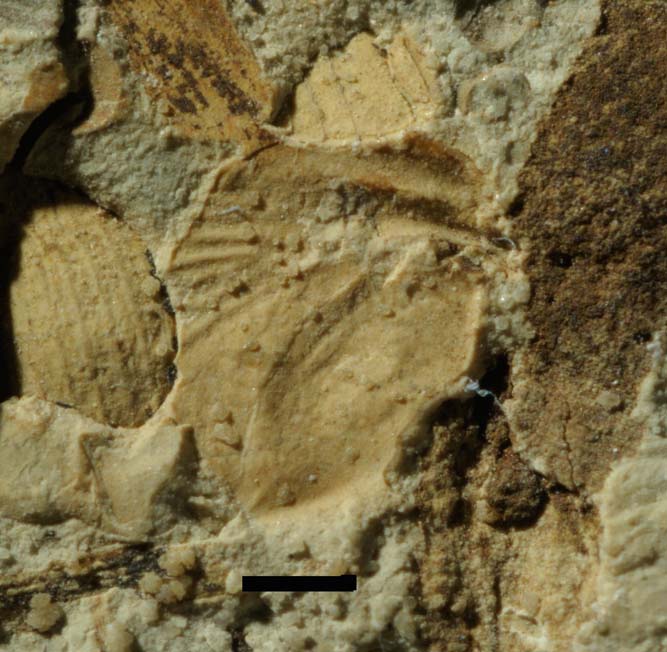
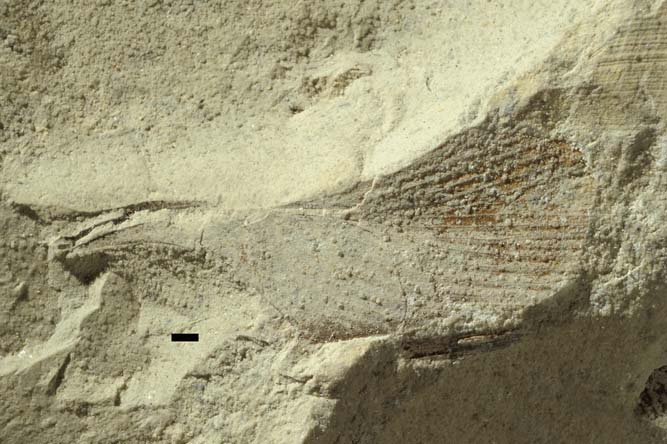
Blattodea (cockroaches) are rare from the Insect Limestone, with 15 specimens, plus five doubtful specimens. The material generally consists of isolated incomplete forewings, although a complete nymph (Fig. 1) and an ootheca (Fig. 2) are known. The presence of Dictyoptera (Blattodea+Mantodea) was recorded by Jarzembowski (Reference Jarzembowski1980); however, the order Blattodea has not specifically been recorded before.
Cockroach nymph, Insect Limestone, NW Isle of Wight; NHMUK I.10206, Brodie Coll. Scale bar=1mm.

Cockroach ootheca, Insect Limestone, NW Isle of Wight; NHMUK In.61279, Coll. S. F. Morris and P. E. S. Whalley. Scale bar=1mm.

Mantodea (praying mantises) are extremely rare from the Insect Bed, with only one specimen known, consisting of a nearly complete forewing with associated partial hindwings. This specimen constitutes the first fossil record of this order from the UK and one of the oldest known crown-Mantodea (see Cui et al. Reference Cui, Evangelista and Béthoux2018).
Dermaptera (earwigs) are extremely rare from the Insect Bed, with only one incomplete specimen known. This record was mentioned by Brodie (Reference Brodie1894).
1. Systematic palaeontology
Order Blattodea von Brunner Wattenwyl, Reference von Brunner Wattenwyl1882
Remarks. Isolated Blattodea forewings, especially incomplete ones, from the Cenozoic are very difficult to identify as the forewings are not used for the taxonomy of Recent taxa. Rehn (Reference Rehn1951) produced a classification based on wings, but this was not widely accepted. Also, the venation of the forewings of extant species is notoriously variable, with even left and right wings of the same individual having slightly different venation and numbers of veins. Add to that the problem of sexual dimorphism, where the forewings of males and females can differ considerably, and it is easy to see why the forewings have not been used for taxonomy. When it comes to fossil Blattodea (except in amber), often it is only the forewings that are preserved; they are toughened for protection to form tegmina, so they have a higher preservation potential. Although the venation is variable, the general form and colour patterning (where preserved) of the forewings can be useful taxonomically (Ross Reference Ross2012).
The nearest comparable fauna to the Isle of Wight fauna is that in Baltic amber of similar age (Priabonian, see Grimaldi & Ross Reference Grimaldi, Ross, Fraser and Sues2017). The main paper is by Shelford (Reference Shelford1910), who described (or redescribed) 24 species in the Richard Klebs collection. He then described the collection at NHMUK (Shelford Reference Shelford1911); however, the four new species he described from ‘Stettin' are actually preserved in East African copal, not Baltic amber (Grimaldi et al. Reference Grimaldi, Shedrinsky, Ross and Baer1995). Only two more species have been described since by Anisyutkin (Reference Anisyutkin2008) and Anisyutkin & Gröhn (Reference Anisyutkin and Gröhn2012). There are two problems here: firstly, Shelford's descriptions and figures are mainly of the genitalia, so are not directly comparable with the Isle of Wight wings; secondly, most of the Klebs collection was lost during World War II, though part of the collection survived and is in the University of Göttingen, Germany. A major project is required to search for types, to designate neotypes and to produce complete redescriptions of these amber taxa.
Shelford placed all of his Baltic amber species in extant genera, which is a reasonable approach for the Isle of Wight fossils, even with regard to modern taxonomy. Thus, the best way to try to identify the Isle of Wight fossil forewings is to systematically look through an extensive pinned collection of Recent taxa for comparison. For this paper the author has thoroughly looked through the pinned collection at the NHMUK. Taxonomic names were checked against the Cockroach Species File Online (Beccaloni Reference Beccaloni2014), as the NHMUK collection is organised according to an older classification. References were checked against scanned volumes in the Biodiversity Heritage Library (http://www.biodiversitylibrary.org) or other online sources.
Three of the fossil forewing specimens appear to be very similar to extant species within the family Ectobiidae, and, thus, are here described as new species placed within the extant genera that the extant species belong to. New species can be justified, as the chance of any of them belonging to extant species is extremely remote given that there is only one undisputed extant insect species recorded from Baltic amber of a similar age to the Insect Limestone – the mayfly Heptagenia (Kageronia) fuscogrisea (Retzius, Reference Retzius1783) identified by Klyuge (Reference Klyuge1986). An additional 12 forewing specimens are generally different from these and each other, and establish that there were probably nine more species present, but they are too incomplete and/or poorly preserved for generic placement and naming. In addition, there are five more specimens that may be Blattodea.
Family Ectobiidae (=Blattellidae) von Brunner Wattenwyl, Reference von Brunner Wattenwyl1865
Remarks. Until recently the family name Blattellidae Karny, Reference Karny1908 was in wide use, with Ectobiinae as a subfamily; however, the family name Ectobiidae should be used instead as it has date priority (as per Beccaloni Reference Beccaloni2014).
Forewings of this family (except the subfamily Nyctiborinae) can be identified from the combination of having a simple subcosta (Sc) in combination with the distinctive shape of the clavus – elongate and subtriangular – with cubitus posterior (CuP) curved at the base, then straight, then curved towards the posterior margin (see Ross Reference Ross2012, fig. 1).
Genus Phyllodromica Fieber, Reference Fieber1853
Type species. Phyllodromica megerlei Fieber, Reference Fieber1853. Recent.
Phyllodromica protosardea sp. nov.
(Figs 3–5)
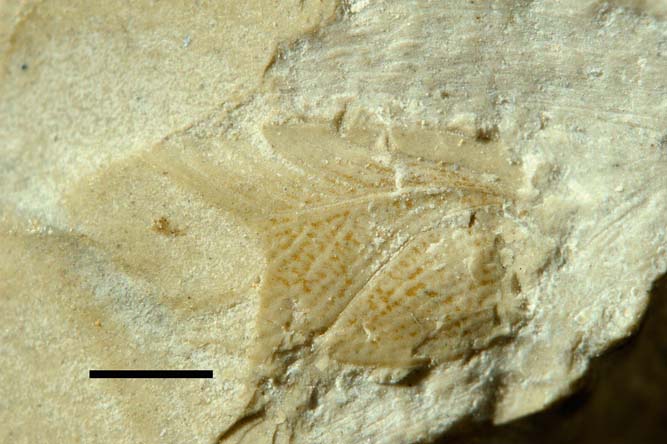
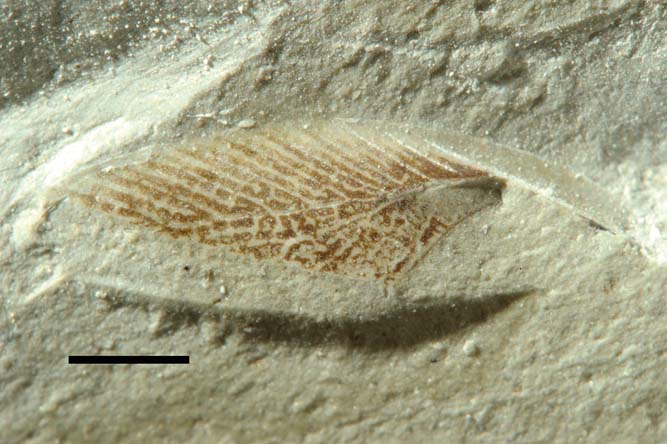
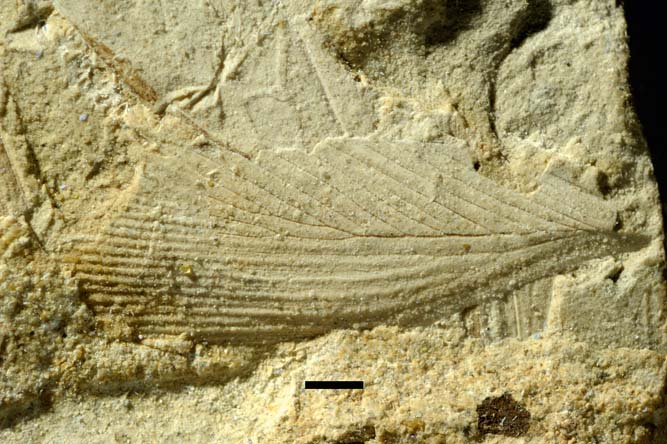
Phyllodromica protosardea sp. nov., Insect Limestone, NW Isle of Wight; Holotype NHMUK In.17142(2) (part), Smith Coll. Scale bar=1mm.

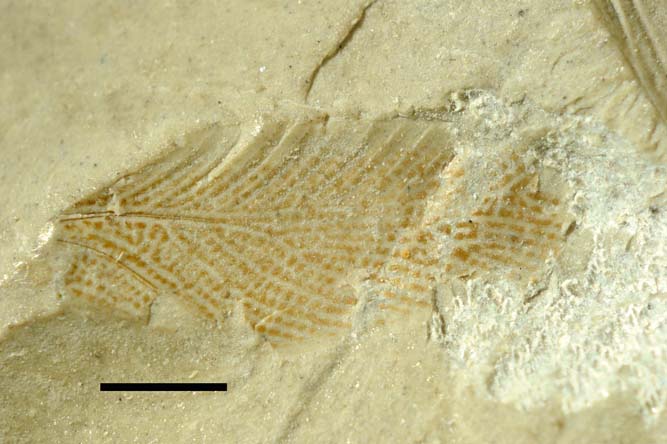
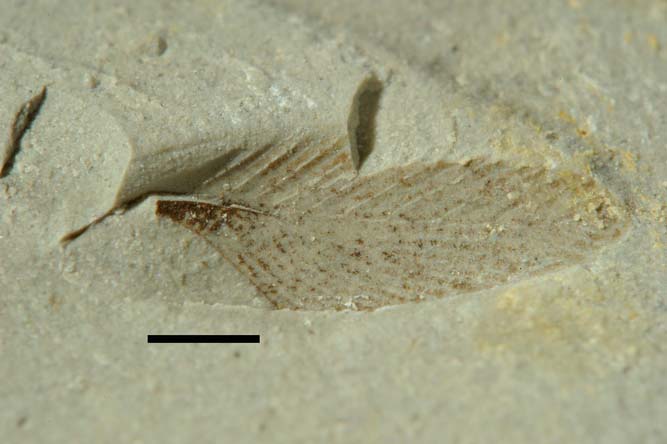
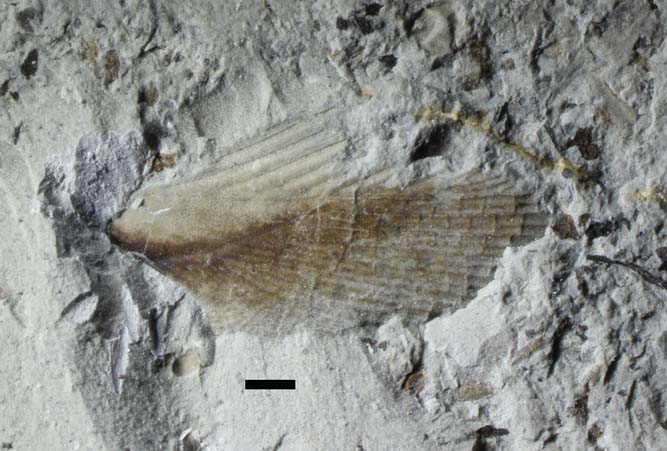
Phyllodromica protosardea sp. nov., Insect Limestone, NW Isle of Wight; Holotype NHMUK I.15039 (counterpart), Smith Coll. Scale bar=1mm.

Composite line drawing of Phyllodromica protosardea sp. nov., showing main veins. Abbreviations: Sc = subcosta; R = radius; M = median; CuA = cubitus anterior; CuP = cubitus posterior; A = anal veins. Scale bar = 1mm.

Holotype. NHMUK I.15039/In.17142(2) (part and counterpart). Smith Coll., NW Isle of Wight. Incomplete left forewing. On same block as a paratype of Mastotermes anglicus von Rosen, Reference von Rosen1913, and a Cicadellidae tegmen (incorrectly referred to as Lepidoptera by Jarzembowski Reference Jarzembowski1980).
Etymology. From ‘proto', meaning first, and the species name sardea, which the fossil appears most similar to.
Diagnosis. Tegmen with curved anterior and posterior margins. Unpigmented main veins and intercalaries, with spotty pigmentation in-between veins. Radius (R) with more than 13 branches, median (M) with more than five branches.
Description. Nearly complete left forewing, preserved composite length 5.0mm, width 2.2mm. Sc simple. R curved at base, with at least 15 pectinate branches. M with seven bifurcating branches. Cubitus anterior (CuA) simple, terminating on posterior margin. Clavus with at least three anal veins.
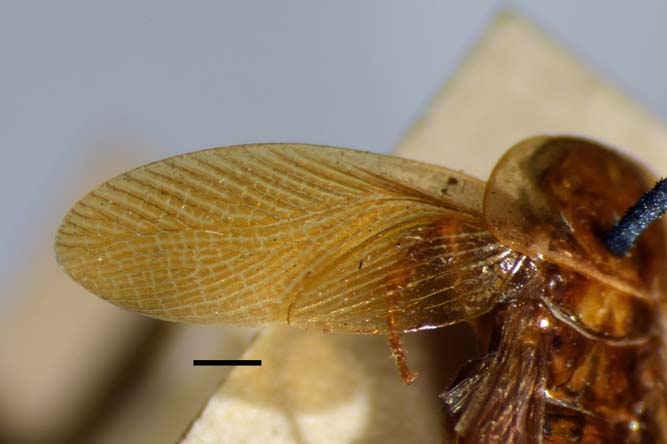
Remarks. This wing is remarkably similar to the forewings of the extant species Phyllodromica sardea (Serville, Reference Serville1839) (Fig. 6), particularly in the colour pattern and branching pattern of M; however, unlike the fossil, this extant species has brachypterous wings and less veins in R and M (9–12 and 2–4, respectively, in specimens at NHMUK). The colour pattern is very distinctive and although there also appears to be unpigmented cross-veins present, many do not cross the intercalaries so it is difficult to determine whether these are true cross-veins or just an effect of the pigmentation pattern. Other species of Phyllodromica seen in the NHMUK collection do not have this colour pattern. This genus, with nearly 100 species, has a widespread distribution in Europe, the Middle East and N Africa (Beccaloni Reference Beccaloni2014). An unidentified cockroach in Baltic amber figured by Weitschat & Wichard (Reference Weitschat and Wichard2002, pl. 34, fig. c) appears to have tegmina with similar colour pattern and venation.
Phyllodromica sardea (Serville, Reference Serville1839), Recent; NHMUK. Scale bar = 1mm.

Genus Balta Tepper, Reference Tepper1893
Type species. Balta epilamproides Tepper, Reference Tepper1893. Recent.
Balta protosimilis sp. nov.
(Figs 7–9)
Balta protosimilis sp. nov., Insect Limestone, Thorness Bay; Holotype NHMUK II.2831a (part), Coll. Mr and Mrs New. Scale bar = 1mm.

Balta protosimilis sp. nov., Insect Limestone, Thorness Bay; Holotype NHMUK II.2831b (counterpart), Coll. Mr and Mrs New. Scale bar = 1mm.

Composite line drawing of Balta protosimilis sp. nov., showing main veins. Abbreviations: Sc = subcosta; R = radius; M = median; CuA = cubitus anterior; CuP = cubitus posterior. Scale bar = 1mm.

Holotype. NHMUK II.2831a, b (part and counterpart), Mr and Mrs New Coll. 2005, Thorness Bay, Isle of Wight.
Etymology. From ‘proto', meaning first, and the species name similis, which the fossil appears most similar to.
Diagnosis. Small tegmen with strongly curved anterior margin and curved posterior margin. Unpigmented main veins, intercalaries and cross-veins, with pigmentation in-between veins. R curved at base then straightens out.
Description. Left forewing lacking clavus, length 5mm, width 1.7mm. Sc simple. R with ten pectinate branches. M faint, probably with five branches. CuA apparently simple.
Remarks. This wing is remarkably similar to the forewing of Balta similis de Saussure, Reference de Saussure1869 (Fig. 10) in the curvature of the anterior margin, colour pattern and venation, except the fossil is significantly smaller and R is much straighter. The posterior part of II.2831a (see Fig. 7) has flaked off and is missing. There are just under 100 species of Balta; however, of those present in the NHMUK collection, most are much larger than the fossil and do not have that particular colour pattern. Balta has a widespread distribution in India, South East Asia, Australia, central Africa and pockets in North and South America (Beccaloni Reference Beccaloni2014), though is absent from Europe today. The fossil record from the Isle of Wight is not a surprise as there are many insect taxa described from Baltic amber that have their nearest relatives in South East Asia and the Southern Hemisphere (see Ross et al. Reference Ross, Jarzembowski, Brooks, Culver and Rawson2000).
Balta similis de Saussure, Reference de Saussure1869, Recent; NHMUK. Scale bar = 1mm.

Genus Malaccina Hebard, Reference Hebard1929
Type species. Malaccina rufella Hebard, Reference Hebard1929. Recent.
Malaccina? wightensis sp. nov.
Malaccina? wightensis sp. nov., Insect Limestone, NW Isle of Wight; Holotype NHMUK I.9266(1), Brodie Coll. Scale bar = 1mm.

Line drawing of Malaccina? wightensis sp. nov., showing main veins. Abbreviations: Sc = subcosta; R = radius; M = median; CuA = cubitus anterior; CuP = cubitus posterior. Scale bar = 1mm.

Holotype. NHMUK I.9266(1), Brodie Coll., NW Isle of Wight. Incomplete right forewing.
Etymology. After the Isle of Wight.
Diagnosis. Tegmen with almost straight anterior margin. Tegmen and veins unpigmented throughout. R straight then bends posteriorly at tip, with terminal branches bending upwards.
Description. Incomplete right forewing. Preserved length 7.4mm (est. length 9mm), width 2.2mm. Not pigmented. Sc simple. R straight, width of radial area 0.7–0.8mm, 12 anterior pectinate branches, plus five bifurcating branches at wing tip, with intercalaries and cross-veins. M and CuA with intercalaries and cross-veins. Diagonal groove across cubital and medial areas (where posterior edge of left forewing would have rested when folded; see Ross Reference Ross2012). M with six branches terminating obliquely on posterior margin. CuA faint, possibly simple, terminating on posterior margin. CuP straight where visible.
Remarks. There are several extant taxa in the NHMUK collection that appear similar to the fossil in having the combination of no pigmentation, M terminating obliquely on the posterior margin and a weak CuA. Out of these, the fossil is most similar to Malaccina pallidula (Bolivar, Reference Bolivar1897) (Fig. 13) in the very gentle curvature of the anterior margin, the form of the cross-venation and R bending posteriorly at the tip of the wing. The fossil species has a straighter R in the basal half of the wing, the terminal branches of R bend upwards and CuP is at a lower angle (probably indicating a longer clavus). This species is included in the NHMUK collection under Lupparia following Princis (Reference Princis1969); however, it is listed under Malaccina in the Cockroach Species File Online (Beccaloni Reference Beccaloni2014). Given that there are several similar extant taxa (e.g., Sorineuchora javanica Caudell, Reference Caudell1927 – though this has a more curved anterior margin and more cross-veins in the radial area), the fossil is tentatively placed in Malaccina. The lack of pigment in the fossil is real and not taphonomic, as there is a tipuloid fly lying nearby that is pigmented. Malaccina is represented by 12 extant species from India and South East Asia, but not from Europe (Beccaloni Reference Beccaloni2014). As for Balta, the fossil record from the Isle of Wight (if it has been correctly identified to genus) is not a surprise.
Malaccina pallidula (Bolivar, Reference Bolivar1897), Recent; NHMUK. Scale bar = 1mm.

Gen. et sp. indet. 1
(Fig. 14)
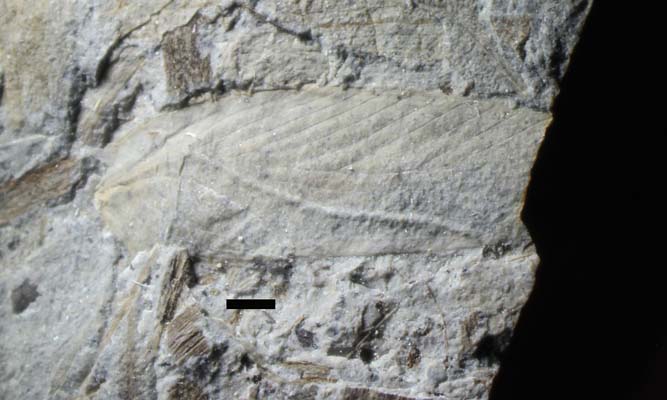
Gen. et sp. indet. 1, Insect Limestone, north-west Isle of Wight; NHMUK In.25559, Hooley Coll. Scale bar = 1mm.

Material. NHMUK In.25559 Hooley Coll., NW Isle of Wight.
Description. Right forewing fragment, preserved length 5.0mm, preserved width 2.5mm. Not pigmented. R straight, curving posteriorly distally, radial area apparently narrow, width 0.5mm. Nine pectinate branches, plus three bifurcating branches distally. Not possible to distinguish M from CuA, both with intercalaries and rudimentary cross-veins, and six branches terminating obliquely on posterior margin.
Remarks. This fragment is unpigmented and the form of M+CuA and posterior bend of R are similar to the specimen of Malaccina? wightensis; however, this fossil appears to have a relatively much narrower radial area and is larger, so is certainly not conspecific and may not be congeneric. Unfortunately, it is too incomplete to formally describe and name.
Gen. et sp. indet. 2
(Fig. 15)
Gen. et sp. indet. 2, Insect Limestone, Thorness Bay; BMB 018877, Ross Coll. Scale bar = 1mm.

Material. BMB 018877/8 (part and counterpart), A. J. Ross Coll. Thorness Bay, Isle of Wight.
Description. Incomplete right forewing with complete clavus. Preserved length 7.5mm, width 3mm. Not pigmented. R with at least eight branches. M and CuA with intercalaries and raised cross-veins; M with five branches, probably terminating at distal posterior margin; CuA simple, curved to run parallel with M and terminates obliquely on the posterior margin. CuP curved, then straightens out, then curves towards posterior margin. Five anal veins with intercalaries and cross-veins.
Remarks. The shape of the clavus is typical of Ectobiidae. Many similar taxa have CuA curving to run parallel to M and terminating obliquely on the posterior margin, and with cross-veins, but it was not possible to place this fossil in any one particular genus. Although it looks like Malaccina? wightensis, this fossil is larger, the veins of M run at a lower angle, CuA is curved and whether the termination of R bends posteriorly is not known. Of the similar extant taxa, it looks like Blattella cavernicola (Shelford, Reference Shelford1907) in being unpigmented; however, in this species (and for other species of Blattella) R is straighter and the radial area occupies less than half the width of the wing (unlike the fossil). The lack of pigment in the fossil is real and not taphonomic as both part and counterpart are unpigmented and preserved in the blue/grey limestone lithology, which provides the best preservation. Malaccina? wightensis and B. cavernicola both possess a groove in the right wing where the posterior margin of the left wing sits when folded; however, this indet. fossil does not possess this. Although B. cavernicola is a cave-dweller, which would explain why it is unpigmented (and may suggest a similar habitat for the fossil), it has a wide distribution and is not, therefore, confined to caves (G. Beccaloni, pers. comm. Reference Beccaloni2015).
Gen. et sp. indet. 3
(Fig. 16)
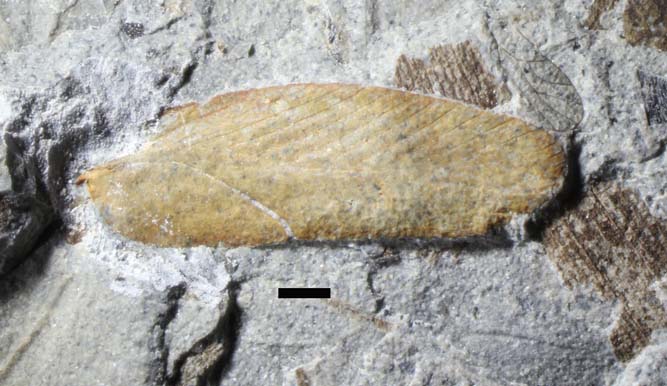
Gen. et sp. indet. 3, Insect Limestone, Saltmead Ledge; NHMUK II.2995a, Yule Coll. Scale bar = 1mm.

Material. NHMUK II.2995 a, b (part and counterpart), Andy Yule Coll., Saltmead Ledge, Isle of Wight.
Description. Nearly complete right forewing without tip. Preserved length 9.0mm, width 3.2mm. Not pigmented. Sc simple. R with at least 11 pectinate branches. M and CuA faint and difficult to determine, though with at least three branches. CuP curved, then nearly straight, then bends towards posterior margin (typical ectobiid); clavus with at least three anal veins terminating at tip of clavus.
Remarks. This specimen is clearly an ectobiid in the form of the clavus and simple Sc, but it is not possible to classify it further. It is difficult to ascertain whether it would have originally had pigment and lost it due to taphomonic processes or if it was originally unpigmented. The veins of associated Oecophylla ant wings are unpigmented, but some other associated wings of other taxa have pigmented veins. There is a strange ridge in the M/CuA area (possibly also extending into Sc), which appears to follow a vein. It is very unlikely to be original, so it probably happened after burial, perhaps when the tegmen was soft and, in the sediment, a nematode worm forced its way along a vein, or perhaps there was a hard linear object below the wing, which imprinted when the sediment was compressed.
Gen. et sp. indet. 4
(Fig. 17)
Gen. et sp. indet. 4, Insect Limestone, Saltmead Ledge; NHMUK II.2996, Yule Coll. Scale bar = 1mm.

Material. NHMUK II.2996, Andy Yule Coll., Saltmead Ledge, Isle of Wight.
Description. Complete right forewing, length 9.5mm, width 3.0mm. Evenly pigmented. Costal (anterior) margin strongly curved, posterior margin straight. Sc simple. R with 13 pectinate anterior branches. M and CuA not discernible. CuP curved, then straight, then bends towards posterior margin (typical ectobiid). Anal veins not discernible.
Remarks. This specimen is clearly an ectobiid, but it is not possible to classify it further due to the venation not being discernible in the posterior half. It is similar to II.2995, except in II.2996 the costal margin is more curved, Sc is at a shallower angle and the clavus is longer, so they are not conspecific.
Gen. et sp. indet. 5
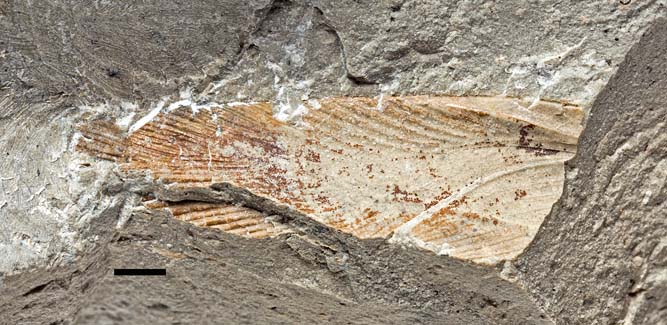
Gen. et sp. indet. 5, Insect Limestone, Saltmead Ledge; NHMUK II.2852, Yule Coll. Scale bar = 1mm.

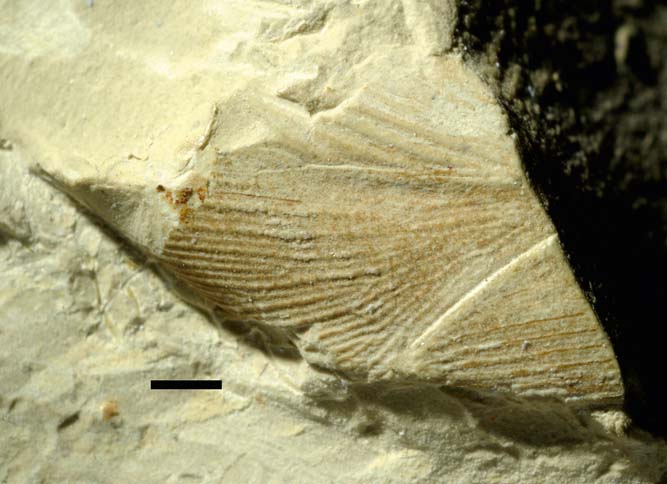
Gen. et sp. indet. 5, Insect Limestone, north-west Isle of Wight; NHMUK In.26065 Hooley Coll. Scale bar = 1mm.

Material. NHMUK II.2852 Andy Yule Coll., Saltmead Ledge, Isle of Wight; In.26065 Hooley Coll., NW Isle of Wight.
Description. II.2852 consists of an incomplete right forewing with part of a clavus. Preserved length 10.0mm, preserved width 3.5mm. Tegmen pigmented, with intercalaries. Sc simple. R with at least 17 branches. M and CuA with intercalaries, difficult to determine, though appear to have at least three branches each. CuP curved then straight. Clavus with at least six simple veins.
In.26065 consists of an incomplete left forewing with distal part of clavus, preserved length 6.6mm, preserved width 4.6mm. Pigmented, R with at least 11 branches. Not possible to distinguish M from CuA though both are probably multi-branched; intercalaries present, 12 visible branches that terminate on posterior margin and probably at wing-tip. Clavus with nine simple anal veins.
Remarks. These two specimens are similar enough to each other to be conspecific but are not complete enough to determine further. The combination of the simple Sc and form of CuP are enough for placement within the family Ectobiidae.
Gen. et sp. indet. 6
(Fig. 20)
Gen. et sp. indet. 6, Insect Limestone, NW Isle of Wight; NHMUK In.17337, Smith Coll. Scale bar = 1mm.

Material. NHMUK In.17337, Smith Coll., NW Isle of Wight.
Description. Incomplete left forewing lacking clavus, preserved length 10.5mm, preserved width 4.0mm. Sc apparently simple, R pigmented along main stem, with at least 12 pectinate branches to anterior margin, plus at least three distal branches towards wing-tip. M multiple forked into four branches parallel to hind margin. CuA with at least two branches running parallel to hind margin. CuP basally slightly curved, then straight.
Remarks. The simple Sc and straight CuP indicate this specimen belongs to the family Ectobiidae. The pigmented R is remarkably like that of the early Cretaceous genus Piniblattella Vršanský, Reference Vršanský1997; however, in the Isle of Wight fossil the CuA branches run nearly parallel to the posterior margin instead of terminating obliquely on it.
Family Corydiidae (=Polyphagidae) de Saussure, Reference de Saussure1864
Remarks. The family Polyphagidae de Saussure, Reference de Saussure1864 was in wide use; however, it is now regarded as a junior subjective synonym (Beccaloni Reference Beccaloni2014).
Gen. et sp. indet. 7
(Fig. 21)
Gen. et sp. indet. 7, Insect Limestone, NW Isle of Wight; NHMUK In.26165, Hooley Coll. Scale bar = 1mm.

Material. NHMUK In.26165 Hooley Coll., NW Isle of Wight.
Description. Right forewing fragment with clavus, preserved length 3.0mm, preserved width 3.1mm. Sc simple, parts of four main veins visible but not possible to determine basal branching; CuP strongly curved delimiting a relatively small clavus; possibly one or two faint anal veins running close to CuP.
Remarks. The strongly curved CuP and small clavus is typical of members of the family Corydiidae, but the specimen is too incomplete for further determination.
Family Uncertain
Gen. et sp. indet. 8
(Fig. 22)
Gen. et sp. indet. 8, Insect Limestone, NW Isle of Wight; NHMUK In.24615a, Hooley Coll. Scale bar = 1mm.

Material. NHMUK In.24615a, b (part and counterpart), Hooley Coll., NW Isle of Wight.
Description. Incomplete right forewing, clavus missing, preserved length 19mm, preserved width 6.5mm. Pigmented, R with at least eight branches, M not distinguishable from CuA, with at least ten branches terminating obliquely on posterior margin and probably at wing-tip.
Remarks. This is by far the largest specimen, so clearly belongs to another taxon, but without the Sc and clavus, is too incomplete to determine further.
Gen. et sp. indet. 9
(Fig. 23)
Gen. et sp. indet. 9, Insect Limestone, Sticelett Ledge; NHMUK II.2994, Yule Coll. Scale bar = 1mm.

Material. NHMUK II.2994 Andy Yule Coll., Sticelett Ledge, Isle of Wight.
Description. Incomplete right forewing, clavus missing. Preserved length 9mm, preserved width 4.2mm. Strongly pigmented posterior and distally of diagonal folding groove. R with at least 11 branches, M and CuA indistinguishable at base anterior of diagonal folding groove, posterior of groove, six branches with intercalaries running parallel to each other probably terminating obliquely on posterior margin and wing-tip.
Remarks. The distinct colouration suggests this is yet another taxon, but is too incomplete to determine further.
Additional indeterminate specimens
NHMUK In.24396 Hooley Coll., NW Isle of Wight. Pigmented forewing fragment, preserved length 7.0mm, preserved width 2.5mm, with a simple Sc, at least nine anterior branches of R visible and part of the main stem of M.
NHMUK II.2894(1) Hooley Coll., NW Isle of Wight. Forewing fragment, preserved length 5mm, preserved width 4.4mm. At least seven branches of R visible, M+CuA inseparable, at least six branches visible running parallel to posterior margin.
For the following specimens, it is not possible to decide if they definitely belong to the order Blattodea: NHMUK I.9171 (fragments), I.9471 (abdomen), I.9997 (abdomen), In.17328 (head) and II.3002 (forewing fragment).
Order Mantodea Burmeister, Reference Burmeister1838
Family Manteidae (=Mantidae) de Saussure, Reference de Saussure1859
Genus Protohierodula gen. nov.
Etymology. After ‘proto', meaning first, and the genus Hierodula.
Diagnosis. The genus is unique in having the combination of a coarse archedictyon, smooth stigma in the cubital area and a gently curved Sc and R that diverge in the basal half of the wing.
Type species. Protohierodula crabbi gen. et sp. nov.
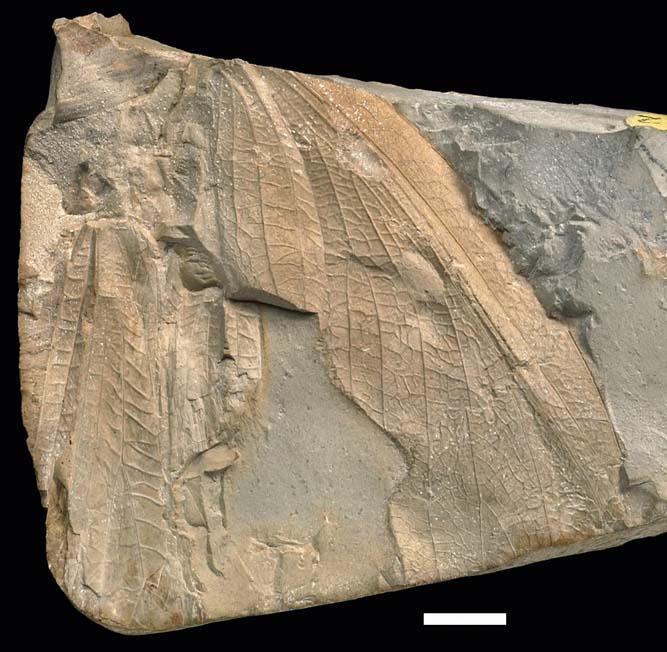
Protohierodula crabbi gen. et sp. nov.
Protohierodula crabbi gen. et sp. nov., Insect Limestone, NW Isle of Wight; NHMUK In.17462, Smith Coll. Scale bar = 5mm.

Line drawing of the right forewing of Protohierodula crabbi gen. et sp. nov., showing main veins. Abbreviations: Sc = subcosta; R = radius; M = median; CuA = cubitus anterior; CuP = cubitus posterior; A = anal veins. Scale bar = 5mm.

Holotype. Female, incomplete right forewing, with possibly two partial hindwings and body fragments. NHMUK In.17462, Smith Coll.
Etymology. The species is named after Phil Crabb, former photographer at the NHMUK, who took excellent photos of this and other specimens for this project.
Diagnosis. As for genus, plus CuA with five branches, and anal vein A2 with three branches.
Description. Incomplete right forewing, maximum preserved length 37mm, maximum preserved width 16mm. Slight tear in tegmen in distal half. Costal margin strongly curved, costal area maximum width 2.8mm. Sc gently curved, terminating on costal margin before wing-tip. R simple where visible, though it may have branched near the wing-tip, gently curved in basal half, straight in distal half and posteriorly curved at tip. M apparently simple, though it may have branched towards the wing-tip. CuA strong, with five visible branches, and a smooth stigma between the two main anterior branches. CuP simple, gently curved, forming the claval furrow. Anal veins (A): A1 simple, running almost parallel to CuP; A2 with three branches. Coarse archedictyon present across whole wing, forming irregular cross-veins at base and on clavus, and faint anterior pectinate branches above Sc.
Hindwings incomplete, maximum preserved length 24mm, maximum preserved width 8mm. Main veins except for cubitus are straight, subparallel and apparently simple in the preserved part of the wing. R and CuA braced by a strong cross-vein. M weak and floating, originating just distal of the bracing cross-vein. CuA with two main branches. Irregular cross-veins present.
Remarks. The classification of Recent Mantodea is based on the form of the forelegs, head and body, which are unfortunately not present in the fossil. Comparison with the Recent collection at the NHMUK shows that the fossil is most similar to members of the family Manteidae. The family name is usually referred to as Mantidae; however, this was corrected to Manteidae (see Carpenter Reference Carpenter1992). The fossil forewing is similar to that of female members of several genera, particularly Hierodula, Prohierodula, Sphodromantis and Stagmatoptera; however, all of these have a broader costal area, with straight Sc and R that are parallel and closely spaced. The smooth stigma is similar to that of Sphodromantis, except in the latter it also impinges on M.
With species belonging to other genera in this family, often only males are present in the collections of the NHMUK, with long slender forewings; however, many taxa have oblique cross-veins rather than an archedictyon. Where females are present the forewings are usually shorter and broader than the males.
The venation and archedictyon of the fossil forewing appear most similar to that of females of Prohierodula viridimarginata La Greca, Reference La Greca1956 (Fig. 26). The latter only differs significantly from the fossil in having a broader costal area, straight Sc and R, and the pale colour spot (stigma) is not smooth. The females of this species have R and M simple or with two branches and CuA with 5–7 branches. The number of branches can vary on the left and right forewings of a single individual.
Right wings of Prohierodula viridimarginata La Greca, Reference La Greca1956, female, Recent, NHMUK. Scale bar = 5mm.

Protohierodula crabbi constitutes the only known species of Mantodea, living or fossil, known from the UK.
Order Dermaptera de Geer, Reference de Geer1773
Superfamily Forficuloidea Latreille, Reference Latreille1810
Family Uncertain
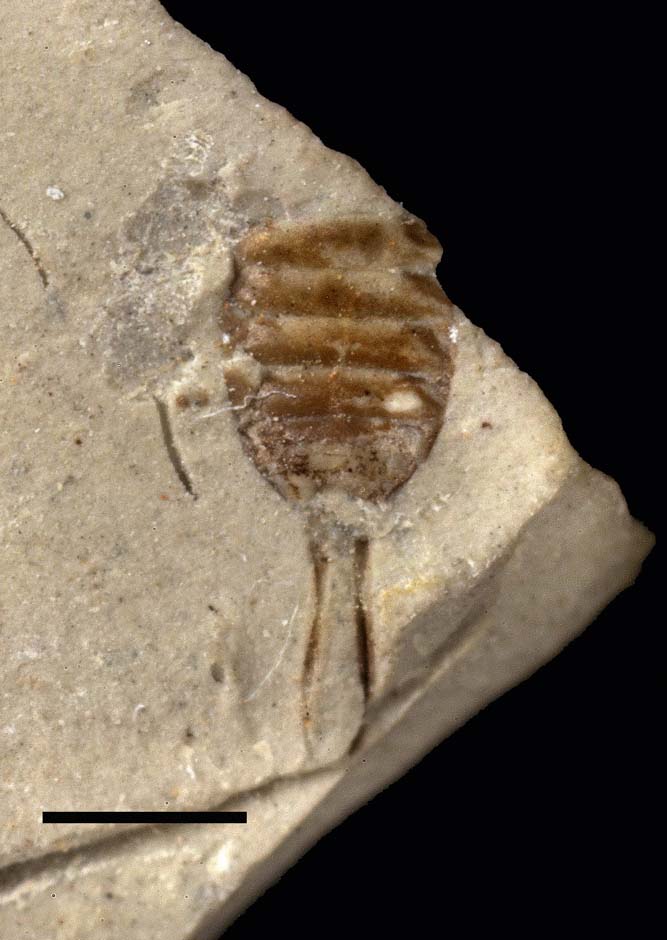
Gen. et sp. indet.
(Fig. 27)
Earwig abdomen, Insect Limestone, NW Isle of Wight; NHMUK I.9837, Brodie Coll. Scale bar = 1mm.

Material. One incomplete specimen consisting of an abdomen with forceps, NHMUK I.9837, Brodie Coll.
Description. Smooth rounded abdomen with six segments preserved, maximum width 1.1mm. Forceps slender, sigmoidal, 1.3mm long. Possibly parts of legs nearby.
Remarks. This specimen was mentioned by Brodie (Reference Brodie1894, p. 70) as ‘Forficula'. It is very small and probably a juvenile. The smooth, rounded end to the abdomen, with long, slender, sigmoidal forceps, is certainly similar to that of nymphs of Forficula. However, there are similar nymphs belonging to other taxa within the superfamily Forficuloidea (Michael Engel, pers. comm. 2015); thus, this specimen is placed within this superfamily, but given the incomplete nature of the specimen it is not possible to identify it further.
2. Palaeoecology and palaeoenvironment
Given that the taxa identified and described in this paper are a rare component of the fauna, they do not add much to the picture of the palaeoecology and palaeoenvironment of the area that now forms the Isle of Wight 34 million years ago. For these groups, the exact lifestyle of many extant species is poorly known, so little can be gleaned from the fossils.
Cockroaches are mainly scavengers of decaying organic waste, so they would have formed a component of the leaf-litter fauna at that time. Given that nearly every fossil cockroach from the Insect Limestone probably belongs to a different taxon, this suggests that there was a relatively high diversity, even though many of the specimens are too incomplete to describe formally. Earwigs are also scavengers, so would also have been a component of the leaf-litter fauna. Praying mantises are relatively large predators of other insects and would have occupied a higher position in the food chain. The relatively high diversity of cockroaches and the presence of a praying mantis (which do not occur in the UK today) indicate that the environment was warmer than today – temperate to subtropical – which fits with the subtropical environment of the forest that produced Baltic amber about 900 miles (1450km) away (see Weitschat & Wichard Reference Weitschat, Wichard and Penney2010).
4. Acknowledgements
Many thanks go to the staff and former staff at NHMUK: to Phil Crabb and Harry Taylor for photography of fossil specimens and to Ben Price for photography of recent specimens; to Claire Mellish for access to the fossil insect collection; to George Beccaloni, Ben Price and Judith Marshall for access to the Recent insect collections at NHMUK; and to Scott Moore-Fay for the preparation of fossil specimens. Many thanks also go to Bill Crighton (National Museums Scotland volunteer) for additional photography of fossil specimens.