Introduction
2016 will mark 50 years since the foundation of modern Emergency Medical Services (EMS) education in the United States (US). United States EMS has influenced the development of similar systems in Australasia, the United Kingdom, South Africa, and the Middle East. Considering its worldwide reach and influence, in the dawn of this half-century milestone, it is of value to examine US EMS education development.
United States EMS education largely is described in the grey literature through “agendas for the future” and related reports published by federal agencies and EMS professional associations. These documents are not readily discoverable, and when viewed from outside of the US, they can be contextually difficult to comprehend. The aim of this report was to provide a unique perspective on EMS education by examining the literature in order to describe the development of US EMS education and to identify predominant themes that will provide context for readers outside the US EMS system.
Methods
The literature search was conducted in two stages. To uncover the grey literature, available EMS reports and others known to exist were hand searched, and Google (Google Inc.; Mountain View, California USA) was searched using combinations of the terms: EMS, Emergency Medical Technician (EMT), paramedic, agenda, future, education, research, leadership, workforce, review, evaluation, and report.
The second search was of the peer reviewed literature. Ovid MEDLINE (National Library of Medicine; Bethesda, Maryland USA) and CINAHL Plus (EBSCO Publishing, Inc.; Ipswich, Massachusetts USA) databases were searched up to September 2014 using combinations of the same terms. The search was then narrowed to EMS education using combinations of the terms: EMS, agenda, education, training, curriculum, standard, history, and development. A final secondary search of bibliographies from retrieved documents and papers was undertaken.
Inclusion criteria for both searches were publications in English and authorship by EMS organizations, committees, or committee members from the US. Where publications by other authors informed or added further detail to EMS publications, these were also included. Exclusion criteria were: opinion pieces, personal perspectives, information updates, articles addressing EMS education design, pedagogy, competency or clinical practice, and articles published in industry magazines.
The first author screened the publications and two other authors undertook a second level review for validation of publications for inclusion. The first author used a thematic analysis approachReference Brooks, Sayre, Spencer and Archer 1 to identify main and subthemes, which were reviewed by two other authors for validation.
Results
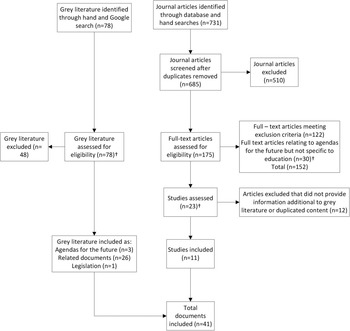
Figure 1 describes the steps followed to identify the 41 publications included in this review. The search results are provided in Tables 1-14 (as supplementary material; available online only) and are a unique resource for scholars and others from outside of the US with an interest in US EMS.
Search Process. †Included in Tables 1-14.

The following major themes and subthemes emerged from the literature:
-
1. Legislative Authority
-
1.1. Federal Authority
-
1.2. Legislation
-
-
2. Physician Direction
-
2.1. EMS System Oversight
-
2.2. Clinical Advances
-
2.3. Curriculum Development
-
-
3. Quality
-
3.1. Education Standards
-
3.2. Accreditation of Courses
-
3.3. Certification of Individuals
-
3.4. Instructional Quality
-
3.5. Medical Direction
-
-
4. Development of the Profession
-
4.1. Licensure/Credentialing of Individuals
-
4.2. Scope of Practice
-
4.3. Evidence-based Practice
-
The results are presented in two separate sections: a chronological description of the development of US EMS education according to historical periods; followed by a discussion of the themes.
The Historical Development of EMS Education in the US
EMS Education Development (1966-1980)
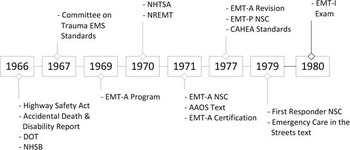
The enactment of enabling legislative frameworks, establishment of federal departments, development of education standards, and publication of National Standard Curricula (NSC) between 1966-1980 highlight the development of EMS education (Figure 2).
Genealogy of Key Events, Reports, and Legislation, 1966-1980. Abbreviations: AAOS, American Academy of Orthopedic Surgeons; CAHEA, Commission on Allied Health Education Accreditation; DOT, DOT: Department of Transportation; EMS, Emergency Medical Services; EMT-A, Emergency Medical Technician-Ambulance; EMT-I, EMT-Intermediate; EMT-P, EMT-Paramedic; NHSB, National Highway Safety Bureau; NHTSA, National Highway Traffic Safety Administration; NREMT, National Registry for EMT’s; NSC, National Standard Curricula.

In 1966, two major events laid the contextual, legislative, and structural foundations for modern EMS education. These were the report of the Committees on Trauma, Shock, and Anesthesia: “Accidental Death and Disability: the Neglected Disease of Modern Society,” which highlighted major deficits in trauma management and recommended improvement across the spectrum of trauma care, including emergency first aid and ambulance service delivery;Reference Braun and Clarke 2 and the Highway Safety Act that established the Department of Transportation (DOT; Washington, DC USA) and mandated improvement in EMS emergency care and development of standards for ambulance attendant training. 3 Over the years, this mandate passed to DOT agencies including the National Highway Safety Bureau (NHSB) and National Highway Traffic Safety Administration (NHTSA).Reference Shah 4
Following the 1967 American College of Surgeons’ (Chicago, Illinois USA) Committee on Trauma publication on emergency ambulance services standards and recommendations for appropriately trained personnel, 5 in 1969, the NHSB released the Emergency Medical Technician-Ambulance (EMT-A) program. 6 Implementation of a first responder training program for fire fighters and police occurred around the same time. 7 To assure national practice standards, the National Registry for EMT’s (NREMT; Columbus, Ohio USA) was established in 1970 to develop independent certification examinations of EMS personnel. 8
1971 heralded three milestones in EMS education: publication of the EMT-A NSC, 7 together with its textbook “Emergency Care and Transportation of the Sick and Injured” by the American Academy of Orthopedic Surgeons (AAOS; Rosemont, Illinois USA), 9 and the first NREMT certification examinations for the EMT-A. 8
In 1977, the NHTSA published a NSC developed by Nancy Caroline and colleagues at the University of Pittsburgh (Pittsburgh, Pennsylvania USA) for an advanced practitioner, the EMT-Paramedic (EMT-P). 9 The textbook “Emergency Care in the Streets” followed in 1979. 10 To support education quality, the Commission on Allied Health Education Accreditation (CAHEA; Clearwater, Florida USA) in 1977 established the first standards and guidelines for voluntary accreditation of EMT-P programs. 7
Due to the cost and length of training, issues with skills maintenance opportunities, and lack of clinical need, the full scope of EMT-P NSC practice was not adopted nationally; instead, the NREMT introduced the EMT-Intermediate (EMT-I) classification and examination.Reference Bledsoe and Sanders 11
At the end of 1980, there were four EMT provider levels: the First Responder, EMT-A, EMT-I, and EMT-P.
EMS Education Consolidation and Review (1981-1989)
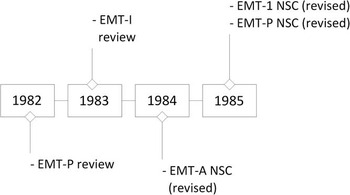
Between 1982 and 1985, the NHTSA oversaw the revision of NSC’s for the EMT-P, EMT-I, and EMT-A (Figure 3). This period of consolidation and review resulted in the improvement and expansion of course content, duration, and clinical experience hours that better reflected the requirements in the field and advances in technical skills and knowledge.Reference Bledsoe and Sanders 11 - 13
Genealogy of Key Events and Reports, 1981-1989. Abbreviations: EMT-A, Emergency Medical Technician-Ambulance; EMT-I, EMT-Intermediate; EMT-P, EMT-Paramedic; NSC, National Standard Curricula.

EMS Education Reflection and Change (1990-1999)
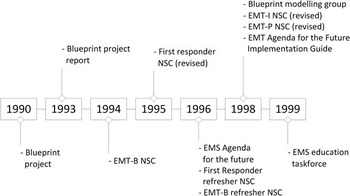
The publication of three key reports and revisions to NSC in the 1990’s demonstrates a time of reflection and change in EMS education (Figure 4).
Genealogy of Key Events and Reports, 1990-1999. Abbreviations: EMS, Emergency Medical Services; EMT-B, Emergency Medical Technician-Basic; EMT-I, EMT-Intermediate; EMT-P, EMT-Paramedic; NSC, National Standard Curricula.

In 1990, the NHTSA commissioned a project team to evaluate current levels of EMT training and certification and to develop a guide for the future. The “National EMS Education and Practice Blueprint” completed in 1993 included the minimum core content, knowledge, and skill expected for each EMT practice level. 14 The “National EMS Education and Practice Blueprint” addressed tailoring of programs for local need, evaluation of qualifications for reciprocity, and the development of bridging programs between curricula and certification levels. It also replaced the EMT-A provider level with EMT-Basic.Reference Dawson, Brown and Chew 15 Reviews of NSC’s for EMT-Basic and First Responder undertaken between 1994 and 1995 acknowledged the use of the Blueprint as a source document.Reference Dawson, Brown and Chew 15 , 16
An influential report of this period, the 1996 NHTSA’s “EMS Agenda for the Future,” critically reviewed 30 years of EMS leadership and provided a vision for the future of EMS and addressed deficits in EMS education. 17 Within the setting of issues with workforce recruitment and retention, poor rates of remuneration, occupational risk exposure, inadequate career advancement pathways, and limited portability of qualifications, this report criticized EMS education for a lack of evaluation data on the suitability of EMS courses to meet the needs of the EMS community. 17 Adequate workforce preparation through adherence to the “National EMS Education and Practice Blueprint” and the need to address clinical currency and refresher training were recommendations in the “EMS Agenda for the Future” to address some of these issues. 17
The “EMS Agenda for the Future” proposed as hallmarks of EMS education into the future a philosophy of life-long learning and clinical practice and education based on sound evidence. 17 The report envisaged replacing prescriptive NSC with national core content within a national course accreditation framework. 17 To further professionalize the workforce, research, quality improvement, and management topics were recommended for inclusion into higher EMS level core content. 17
The “National EMS Education and Practice Blueprint” and “EMS Agenda for the Future” guided revisions of EMT-I and EMT-P NSC, 18 , 19 and all NSC’s published during this period (Figure 4) reflected a new educational philosophy of life-long learning and continuing education and provided some ability to tailor content to local needs.Reference Dawson, Brown and Chew 15 , 16 , 18 , 19
The 1998 “EMS Agenda for the Future Implementation Guide” recommended revising and adopting the “National EMS Education and Practice Blueprint.” 20 The NHTSA in 1998 convened a Blueprint Modeling Group, which recommended building upon the original Blueprint document to develop a more comprehensive education system. 7 , 9 This group re-branded as the EMS Education Taskforce and developed the “EMS Education Agenda for the Future: A Systems Approach.” 7
EMS Education for the Future (2000-2014)
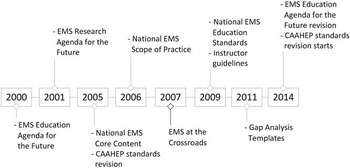
Published in 2000, the “EMS Education Agenda for the Future” described a 10-year implementation plan for a national EMS education system 7 and precipitated the greatest change to EMS education since the 1960’s. The implementation of this new system spans this period (Figure 5).
Genealogy of Key Events and Reports, 2000-2014. Abbreviations: CAAHEP, Commission on Accreditation of Allied Health Education Programs; EMS, Emergency Medical Services.

In 2001, the “National EMS Research Agenda” highlighted the lack of research in EMS and emphasized the interrelatedness of clinical, systems, and education research. 21 This report influenced curriculum content in the national EMS education system across all EMS practice levels.
In 2005, the NHTSA published the first of five integrated components of the national EMS education system, the “National EMS Core Content” which details the conditions, procedures, and skills forming the EMS body of knowledge integral to EMS practice. 22 The second component, the “National EMS Scope of Practice Model,” published in 2006 defines four new provider levels and their scope of practice: the Emergency Medical Responder, EMT, Advanced EMT, and Paramedic. 23
In 2007, the influential Institute of Medicine (IOM; National Academy of Science; Washington, DC USA) report “Emergency Medical Services: at the Crossroads” endorsed the national EMS education system and the need for consistency in EMS education. 24 The IOM considered the national program for accreditation of paramedic programs and national certification as part of the professionalization of the workforce. 24
In 2009, the publication of the third component, the “National EMS Education Standards” (with Instructor Guides), 25 - 28 replaced all existing NSC’s. 9 Replacing the prescriptive content characteristic of NSC’s with broad statements of competency, knowledge requirements, and clinical behavior expectation statements for each practice level in the “National EMS Education Standards” demonstrated a complete overhaul of EMT curriculum. 9
The NREMT policy 29 and the National Association of State EMS Officials (NASEMSO; Falls Church, Virginia USA) resolutions from 2010 30 indicated the implementation of the final two components of the national EMS education system: National EMS Certification and National EMS Program Accreditation.
The “EMS Education Agenda for the Future” itself is under review. 31
Themes in EMS Education
Legislative Authority
The theme of legislative authority includes the subthemes legislation and federal authority. Legislation aided and hindered EMS education. The Highway Safety Act of 1966 provided the means for enacting EMS training and licensing standards, 32 and the EMS Systems Act of 1973 provided discrete funding to support the development of regional EMS systems. 17 The Omnibus Budget Reconciliation Act of 1981, however, shifted EMS funding from federal to state level and fragmented the national approach to EMS education. 24 , 33
It is evident from this review that the federal authority of the DOT and NHTSA drove many programs and initiatives responsible for developing EMS education. In 2007, the IOM recommended that the federal authority for EMS be consolidated into the Department of Health and Human Services (Washington, DC USA). 24 The US Congress, however, has not passed this proposal.
The statutory authority and regulatory responsibility for EMS, however, rests at state, not federal, levels. 23 This accounts for the state-to-state variation in the structure, provision, and funding of EMS, as well as the scope of practice, and hence, educational requirements for each provider level. 34 Emergency Medical Services can be fire department-based, medical center-based, non-profit organizations, private companies, or part of a government agency. 24 Understanding this variation makes evident the need for an approach to EMS education that permits adaptation to local contexts but is limited within a national framework that defines the national provider levels and their respective education standards and scope of practice.
Physician Direction
The pivotal role of the medical profession in the development of curricula and standards for EMS education is clear.Reference Markenson and Foltin 35 The EMS Agenda and position statements for EMS medical directors by the National Association of EMS Physicians (Lenexa, Kansas USA), American College of Emergency Physicians (Irving, Texas USA), and NASEMSO emphasize EMS education as a central function that also encompasses system oversight, authority over patient care, research, and quality improvement. 17 , Reference Rockwood, Mann and Farrington 36 , 37 Imbedding the medical oversight within EMS 17 and involving medical specialists in the review of NSC’s and development of the “National EMS Education Standards” and “National EMS Core Content” provides the mechanism for including advances in medical treatment and prehospital care into EMT curricula.
The position descriptions for EMS medical directors 17 , Reference Rockwood, Mann and Farrington 36 - Reference Cunningham, Wesley and Peterson 38 are subject to local modification, which puts at risk a consistent national approach to medical oversight. Cunningham et al. cite a 2007 NASEMSO survey that revealed eight states and one district had no designated EMS medical director. 37
Quality
The “EMS Education Agenda for the Future” identifies education and accreditation standards, certification, and instructional quality as key components of quality EMS education. 7 Since 1977, the voluntary accreditation process for EMS education courses through the auspices of Commission on Accreditation of Allied Health Education Programs (CAAHEP; previously CAHEA) provides a means for promoting EMS education quality. 7 , 39 The Committee on Accreditation of Educational Programs for the Emergency Medical Services Professions (CoAEMSP; Rowlett, Texas USA) undertakes the EMS accrediting activities for CAAHEP and is lead on a consultative review of EMS education accreditation standards. 39
Certification of graduates to determine their level of competency became a part of EMS education following the establishment of the NREMT in 1970. Limiting the certification process to graduates from nationally accredited programs under the national EMS education system is intended to assure the quality of EMS education and improve EMS education provider standards. 40 Recertification criteria for each provider level require completion of refresher programs and continuing education hours, validated either at state level or by the Continuing Education Coordinating Board for EMS (Dallas, Texas USA).Reference Margolis 41
The “State of EMS Education Research Project” reveals most EMS educators are employed part-time (20 hours or less a week), work with average class sizes of 14.5, and mostly teach EMT-Basic students. 42 The project identifies EMS educator certification and support and access to continuing professional development in instructional theory as important requisites for instructional quality.Reference Ruple, Frazer and Hsieh 43
As education represents the central function of medical oversight in EMS, EMS medical directors also contribute to educational quality. Limited contact by EMT’s with their medical directorsReference Ruple and Frazer 44 and non-uniform national adoption of EMS medical directors 37 puts at risk quality of EMT education.
This review did not identify any studies addressing the effectiveness of accreditation and certification processes on the quality of patient care by EMS providers.
Development of the Profession
The teaching of professionalism is a feature of EMT education documents across all provider levels. This theme, however, encompasses more than educational content. Protection of the public through licensure (registration) and credentialing depict key characteristics of health professions. Despite these requirements existing in US EMS for many years, US EMS education leaders, such as Margolis, see linking EMT licensure to graduation from a nationally accredited program as an important step in aligning EMS with other allied health professions. 40 Such linkages suggest that other health professions and EMTs themselves may not yet consider US EMTs as health professionals.
As EMT scope of practice informs certification, licensure, and education and accreditation standards, the “National EMS Scope of Practice Model” document permits comparison of EMS practitioners with other health professions and helps to define their health care role. 23
Key requirements for advancing the EMS profession include clinical practice based on best available evidence and the need for EMS clinical personnel to have grounding in research skills (addressed in the “National EMS Core Content”). Hence, the implementation of a national EMS education system embraces broader aims than improving education standards and quality of care; it is key to professionalizing EMS. 24 , 40
Discussion
Implementation of the National US EMS Education System
This review highlights a 50-year history of purposeful development of US EMS education, at least at policy level, using the strategy of major government documents that federal agencies led, funded, or supported, which culminated in the implementation of a national US EMS education system. The publication of these documents, however, does not ensure local implementation.
The most recent NASEMSO report describes a rate of adoption range of 76%-100% for the “National EMS Scope of Practice Model” and 48%-88% for national EMS certification.Reference Studnek, Fernandez and Margolis 45 It identifies that 90% of states require national EMS program accreditation for the EMT-P, and that 45 states use the NREMT certification as part of their process for state licensure.Reference Studnek, Fernandez and Margolis 45 For states that do not use the NREMT, there is the risk that their certification process will not be recognized by other states, which ultimately will limit reciprocity and national portability of EMT qualifications due to concerns about educational quality. 46
Results of first-time pass rates of the NREMT certification exam reveal a median of 68% and range of 52%-90% for the EMT and a median of 76% and range 50%-100% for the EMT-P. 47 This indicates a lack of consistency among states and potential variation in quality of candidates from nationally accredited programs.
Less well-described is progress on adoption of the “National EMS Education Standards.” The NASEMSO identifies instructor preparedness to use the “National EMS Education Standards” as the greatest barrier to implementation of the national EMS education system.Reference Studnek, Fernandez and Margolis 45
As it is now 14 years since the publication of the “EMS Education Agenda for the Future,” these results highlight the complexity of the EMS system and difficulty in implementing national change of this magnitude and ensuring consistent quality of EMS education.
Australian Context
The experience of a “guiding light” approach to US EMS education development is different to the Australian context where there are no such federally funded national “agenda type” documents. Where national and state-based documents exist, their development has involved less stakeholder input than the large, broad-based, and multidisciplinary committees or task forces characteristic of the US EMS approach.
In Australia, since the mid-1990s, universities provide undergraduate Bachelor Degree-level education for paramedics. In the US, the CAAHEP website reveals 423 accredited EMT programs which are provided predominantly at the community college level. 48 Other providers include medical centers, hospitals, EMS agencies, fire agencies, and private consortia. 48 Forty-four universities offer only EMT-P programs, and of these, seven universities offer undergraduate Bachelor Degrees; the remainder are certificate type qualifications. 48 While Australian ambulance services determine paramedic scope of practice for their respective jurisdictions, a single degree-level qualification provides employers with graduates that have comparable levels of skill and knowledge and supports portability of qualifications.
Australia, like the US, has a national process for the accreditation of university paramedic programs. This process, which includes associated competency standards, has existed since 2010. Unlike the US, however, despite Paramedics Australasia (Melbourne, Victoria, Australia) advocating for national paramedic registration, no such scheme currently exists.
Limitations
There is potential for selection bias as some reports may have been removed for political sensitivities and available reports may have been selectively preserved. Not all reports detail their purpose or methodology limiting the quality of this review. As this is a review of the literature and not a qualitative analysis, further themes are likely to be evident in the literature.
Conclusion
“Agendas for the future,” and related documents produced through broad interprofessional consultation, with support from federal and US EMS authorities, are the catalysts for EMS education development in the US. This review identified four eras in US EMS education culminating in a model designed to overcome the deficiencies of the past and provide a structure to enhance the quality of US EMS education into the future. Implementation evaluation of the national US EMS system would be a valuable addition to the US EMS literature. The themes that emerged from this literature review assist the understanding of the characteristics of US EMS education.
Supplementary Material
To view supplementary material for this article, please visit http://dx.doi.org/10.1017/S1049023X15005506