Introduction
Poultry meat and egg production accounted for more than 28 percent of the total animal protein produced worldwide in 1997 (Tadelle et al (Reference Tadelle, Millon, Alemu and Peters2003)). It is estimated that by the year 2020, the proportional contribution of poultry to the total animal protein will rise to 40 percent with the major increase being in the developing world (Delgado et al., Reference Delgado, Rosegrant, Steinfeld, Ehui and Courbois1999). About 1.3 billion chickens are found in Africa producing approximately 1.7 and 2.1 million metric tonnes of egg and meat respectively of which 80 percent came from indigenous stock (FAO, 2006). In Sudan, there are no reliable statistics regarding the contribution of the conventional poultry sector. However, it was estimated to constitute about 70 percent of the total production (Suleiman, Reference Suleiman1996). Conventional poultry plays an important role in the socio-economic life of the rural community in Africa as well as in Sudan; generating incomes and contributing to food security (Gueye, Reference Gueye2002). Moreover, poultry raising is preferred by small holders because of the low input costs, high adaptability and resistance to diseases (Wimmers et al., Reference Wimmers, Ponsuksili, Hardge, Valle-Zarate, Mathur and Horst2000). Information about the flock structure of the Sudanese indigenous chicken is lacking. The average flock size of local Malawi chickens was reported to be 12.9 ± 5 birds per household (HH) (Gondwe and Wollny, Reference Gondwe and Wollny2004). In comparison, large flocks per HH (26 and 22 birds/HH) were reported for Pakistan and Senegal native chickens, respectively (Missohou, Dieye and Talaki, Reference Missohou, Dieye and Talaki2002; Javed et al., Reference Javed, Farooq, Mian, Durrani and Mussawar2003).
The Sudanese indigenous chicken breed was classified into three types as described by Desai (Reference Desai1962). The large Beladi (LB) type is the most common, available in Northern, Central, Western and Southern Sudan. The birds are of good size (adult weighing 2½–3.0 Ibs) with a small crushed comb, plenty of plumage of many colour variations. The bare neck (BN) type is smaller than the LB, characterized by its featherless neck and many colours in plumage. The home land of BN type is Southern Sudan and it was reported to be more resistant to endemic diseases compared with other types (Wimmers et al., Reference Wimmers, Ponsuksili, Hardge, Valle-Zarate, Mathur and Horst2000). The Betwil (BT) type is a small dwarf bird, mainly found in the Nuba Mountains region of South Kordofan State, Sudan. It has a small compact body (adult bird weighing 1½–2.0 Ibs) with tiny black legs. Recently in Sudan, the expansion of modern poultry farming in the home lands of indigenous chickens threatened their existence. Therefore characterization of these valuable indigenous animal resources using genetic and phenotypic methods for the purpose of conservation has become very crucial. However, limited research has been conducted to characterize the local fowl of Sudan. In the present study, morphological, productive and reproductive characteristics of Sudanese indigenous chickens were investigated.
Materials and methods
Study sites
This study was conducted in three different localities in the Sudan, namely El Dilling, Abu-Neama and Khartoum North (Bahri). El Dilling locality is situated in South Kordofan State an area which lies 800 km south west of Khartoum (Capital of Sudan) at latitude 12°20′N and longitude 29°28′E with rainfall of 500–800 mm. The area of South Kordofan State is covered by the Nuba Mountains that occur as a series of isolated ranges covering an area of about 48 000 km2.
Abu-Naema locality in Sinnar State (Central Sudan) is an area located 400 km South of Khartoum at latitude 12°44′N, longitude 34°08′E and altitude 445 m above sea level. Bahri locality is in Khartoum State and includes a group of villages situated east of the River Nile. The area is semi desert or poor Savannah. Most of the people in these three localities are either farmers or livestock herders.
Questionnaire administration
A structured questionnaire was administered to 120 HHs from the three localities, 40 for each locality. Data captured in the questionnaires were on chicken management practices such as flock structure, housing, feeding and marketing. Production data included age at start of laying, clutch size, hatchability as well as live weights and egg weight. A total of 900 chickens were characterized through physical examinations that covered plumage colour and pattern, skin colour, shank length, comb colour and shape. The questionnaire and phenotypic characterization were supported by group discussions among villagers.
Data analysis
Descriptive statistics were used to analyse phenotypic characterization data. The frequencies of phenotypic characteristics among the chicken ecotypes were calculated by dividing the number of birds having the trait by the total number of the birds examined. Percentages were used to calculate the prevalence of a trait within each ecotype. The degree of association between prevalence of the trait and chicken ecotypes was tested using Chi-square at the 95 percent confidence level. SPSS Version 10 statistical package (SPSS Inc., Chicago, and III, USA) was used for data analysis.
Results
Flock size and structure
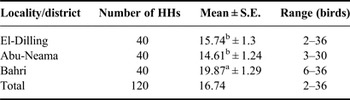
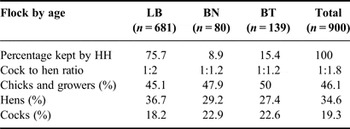
The average flock size per HH was 16.74 ranging from 2 to 36 chickens/HH, the average varied significantly (P < 0.05) according to locality. Bahri locality scored the highest number of chickens per HH with an average of 19.87 ± 1.29, followed by El Dilling (15.74 ± 1.3) then Abu-Neama locality (14.61 ± 1.24) (Table 1). The data collected on the Sudanese indigenous chicken flock structure showed that 46.1 percent were chicks and growers, 34.6 percent hens and 19.3 percent cocks. On the basis of ecotype, the flock was composed of 75.7, 8.8 and 15.5 percent LB, BN and BT, respectively, and the average cock–hen ratio was 1:1.8. Most of the HHs tend to keep more females than males and in all ecotypes surveyed, the chicks and growers formed the majority of the flocks (Table 2).
Flock size in different localities.

Means with the same letter are not significantly different (P < 0.05). HH, hens per household.
Flock size and structure of Sudanese indigenous chicken ecotypes.

LB, large Beladi; BN, bare neck; BT, Betwil; HH, hens per household.
Flock management practice
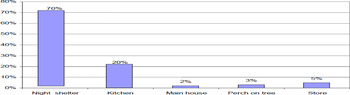
The results revealed that 70 percent of the HHs provide night shelters to the chicken flocks they are keeping and it was observed that housing structures were made from wood or bamboo poles. The non-housed chicken mostly perched around farmer's houses (2 percent) or on the trees near the farmer's homesteads (3 percent) and laid eggs in nests placed around the vicinity or in the kitchen (20 percent) or store (5 percent) (Figure 1). Chicken were found to be scavengers for a variety of feed stuffs that included cereals, weeds, seeds, insects, worms and various herbs. Some farmers usually supplement their chicken with whole cereals once every morning. In all the areas surveyed, HHs do not keep records on feed supplement, survival and mortality of chickens. They also do not vaccinate their chickens nor use veterinary drugs for treatment or prophylaxis. The majority of the interviewed HHs (98.2 percent) declared that women were the owners of chicken with their children assisting them for management (cleaning chicken house, providing supplementary food and water and selling eggs and chickens). However, men were responsible for decision-making (95 percent), giving permission for selling of chicken or eggs as well as home consumption or slaughter for special ceremonies.
Chicken house provision.

Morphological characteristics
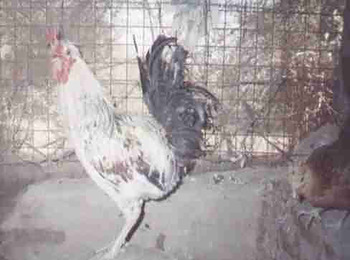
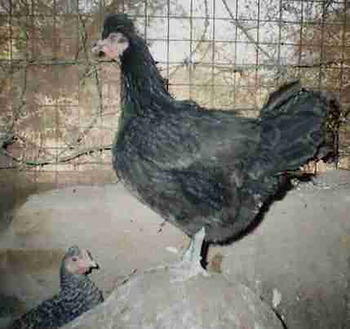
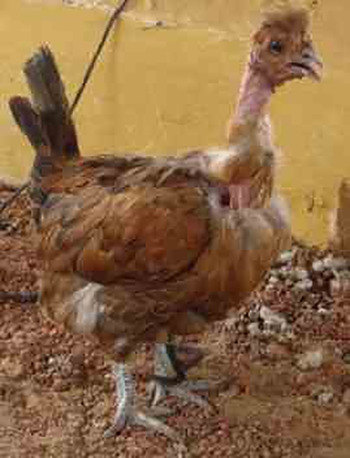
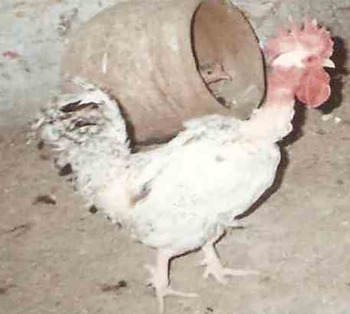
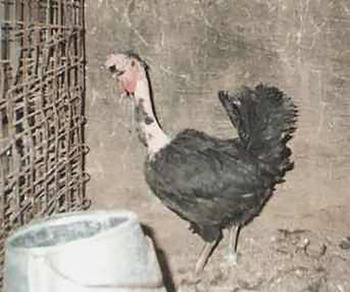
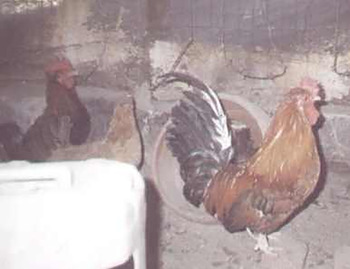
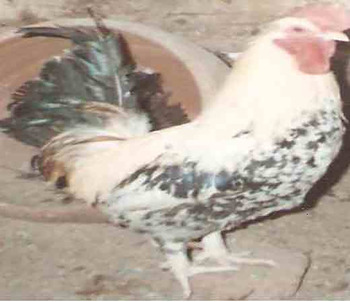
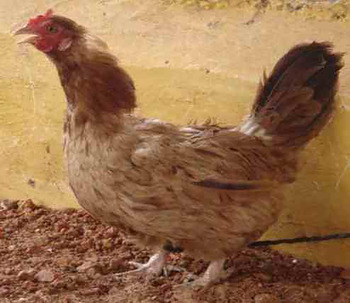
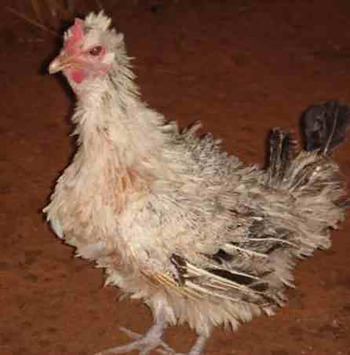
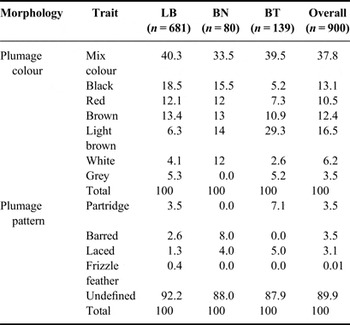
Approximately, 37.8 percent of chickens had mixed colour plumage (Plates 1, 4 and 7), with the highest percentage (40.3 percent) in LB (Plate 1) and the lowest (33.5 percent) in BN (Plate 4), followed by 16.5 percent light brown (Plate 3) and 13.1 percent black (Plate 5) plumage. Feathering did not have a well-defined pattern in the majority of chicken sampled (89.9 percent). Of the patterns that could be described was partridge 3.5 percent, barred 3.5 percent, laced 3.1 percent and frizzle feather (Plate 9) 0.01 percent (Table 3). The majority of chickens (91.1 percent) that include most of the BT (Plates 6, 7 and 8) and LB (Plates 1 and 2) were well covered with feather over all the body, while 8.9 percent were BN chickens without feather in the neck region (Plates 3, 4 and 5).
Mix colour feather LB chicken.

Crown feather Large beladi chicken. (Source: Faculty of Animal Production, U of K, Sudan, 2011)

Brown colour feather Bare Neck chicken. (Source: Faculty of Animal Production, U of K, Sudan, 2011)

Mix colour feather Bare Neck chicken. (Source: Faculty of Animal Production, U of K, Sudan, 2011)

Black colour feather Bare Neck chicken. (Source: Faculty of Animal Production, U of K, Sudan, 2011)

Red colour feather Betwill cock. (Source: Faculty of Animal Production, U of K, Sudan, 2011)

Mix colour feather Betwill cock. (Source: Faculty of Animal Production, U of K, Sudan, 2011)

Light brown feather betwill. (Source: Faculty of Animal Production, U of K, Sudan, 2011)

Frizzle Sudanese chicken. (Source: Faculty of Animal Production, U of K, Sudan, 2011)

Plumage pattern and colour characteristics in percent for different Sudanese indigenous chicken ecotypes.

LB, large Beladi; BN, bare neck; BT, Betwil.
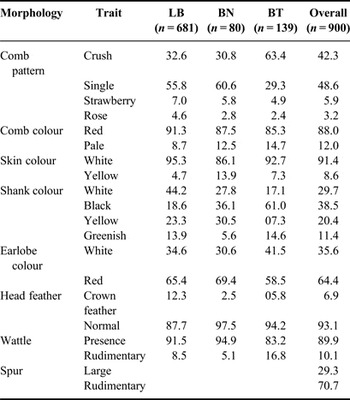
There were four shank colours including black 38.5 percent, white 29.6 percent, yellow 20.4 percent and greenish 11.4 percent. On the other hand, four types of combs were observed and the most frequent was single comb (48.6 percent), crush or rudimentary comb (42.3 percent), strawberry comb (5.9 percent) and rose comb (3.2 percent). The majority of the chickens possessed combs with red colour (88.0 percent) and the rest had pale red combs (12.0 percent). The results revealed that Sudanese chicken had a high frequency of white skin colour (91.4 percent) while yellow skin colour constituted a small percentage (8.6 percent). On the other hand, a well grown wattle was common in the majority of chickens (89.9 percent), whereas few lacked wattles or had rudimentary wattles (10.1 percent). However, it was observed that mainly males had projected wattles. Similarly, 70.7 percent of the sampled chickens had rudimentary spur while 29.3 percent (mainly males) had large spurs. The ear lobes were mostly not prominent and they were mainly red (64.4 percent) and white (35.6 percent) in colour. Crown head feather chicken is known in Sudanese colloquial language as (Abu-Guja). These had a relatively low frequency among the Sudanese indigenous chickens sampled (6.9 percent), while the rest had normal feather on the head (Table 4).The results revealed that the BT chicken ecotype possessed the shortest shank length (4.5 ± 0.47 cm), showing a significant difference (P < 0.05) when compared with LB (7.9 ± 1.0 cm) and BN (7.7 ± 0.93 cm).
Morphological characteristics in percent for different Sudanese indigenous chicken ecotypes.

LB, large Beladi; BN, bare neck; BT, Betwil.
Reproductive performance
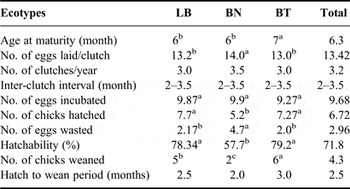
Results revealed that LB and BN pullets reached sexual maturity at 6 months of age, whereas BT pullets reached sexual maturity at 7 months of age (Table 5). Moreover, most of the hens laid on average 13.42 eggs/hen/clutch, with BN being (14.0 eggs/hen/clutch) significantly different (P < 0.01) from LB and BT. The majority of hens produced 3–3.2 clutches of eggs per year with the inter-clutch interval ranging from 2.0 to 3.5 months. On the other hand hatchability was 78.34, 57.7 and 79.2 percent in LB, BN and BT, respectively, with BN being significantly lower (P < 0.01) than the other two types. Hatch to rearing period averaged 2.5 months. These results indicated that there were highly significant differences (P < 0.01) among the chicks reared by the respective ecotype hens up to weaning, with the LB exhibiting excellent maternal care and the BN being the poorest in that respect (Table 5).
Reproductive performances of the Sudanese indigenous chicken ecotypes.

Means with the same letter are not significantly different (P < 0.05). LB, large Beladi; BN, bare neck; BT, Betwil.
Body weight
The average male body weights of LB, BN and BT chicken were 1 720.7 ± 312.0, 1 670.4 ± 175.9 and 1 560.3 ± 155.3 g, respectively, with an overall average of 1 650.3 ± 125 g. While females’ corresponding body weights were 1 350.1 ± 53.5, 1 305.1 ± 98.7 and 906.5 ± 113.6 g with an overall average of 1 187.6 ± 45 g. Sexual dimorphism was evident among Sudanese chicken types with males being significantly (P < 0.05) heavier than the females in the three ecotypes. However, comparisons among ecotypes revealed that the BT ecotype was significantly lighter (P < 0.05) than the other two ecotypes which were almost similar in their body weight (Table 6).
Average body weights (g) for the mature Sudanese indigenous chicken ecotypes.

Means with the same letter are not significantly different (P > 0.05). LB, large Beladi; BN, bare neck; BT, Betwil.
Egg characteristics
Average egg weights of LB, BN and BT chickens were 41.3 ± 3.1, 42.4 ± 1.5 and 38.8 ± 5.1 g, respectively. BT eggs were significantly (P < 0.05) smaller than the eggs of the other two ecotypes, LB and BN. The majority (95 percent) of the Sudanese chicken lay white eggs and the rest 5 percent lay light brown eggs. Yolk was 100 percent yellow in all the ecotypes (Table 7).
Egg characteristics of the Sudanese indigenous chicken ecotypes.

LB, BN, BT, large Beladi, bare neck and Betwil, respectively.
Means with the same letter are not significantly difference (P > 0.05).
Discussion
The flock structure of Sudanese indigenous chicken observed in this study was 46.1 percent chicks and growers, 34.8 percent hens and 19.3 percent cocks. Obviously, the HHs tend to keep females more than males. Males are usually sold and are slaughtered in social and traditional functions. The average flock size of Sudanese indigenous chickens was 16.74 birds/HH which was higher than that of Malawian indigenous chicken flock size of 12.9 birds/HH (Gondwe and Wollny, Reference Gondwe and Wollny2004), but lower than that of Pakistan indigenous chickens which amounted to 26 birds/HH (Javed et al., Reference Javed, Farooq, Mian, Durrani and Mussawar2003) and Senegal indigenous chickens, 22 birds/HHs (Missohou, Dieye and Talaki, Reference Missohou, Dieye and Talaki2002). About 91 percent of village chicken in Sudan are kept by women suggesting gender bias in raising chicken at the village level and that they are a source of women empowerment. This finding is in agreement with that of Kitalyi (Reference Kitalyi1998) and McAinsh et al. (Reference McAinsh, Kusina, Madsen and Nyoni2004). In the surveyed areas, chicken are mainly used for HH consumption, as well as for the purpose of generating income. This observation is in agreement with the conclusion drawn by Gueye (Reference Gueye2002).
The observation that all chickens scavenged for a variety of feeds is similar to the results reported by Maphosa et al. (Reference Maphosa, Kusina, Makuz and Sibanda2004) and Muchadeyi et al. (Reference Muchadeyi, Sibanda, Kusina, Kusina and Makuza2004). However, this method of feeding does not optimize the utilization of the limited feed resources since younger and weaker birds have to compete with mature birds and other scavenging farm animals. This could be one of the reasons for the observed reduced number of weaned chicks coupled with other factors such as predators and the lack of proper housing structures for the birds. Seventy percent of the HHs construct night shelters only and the non-housed birds are either perched on trees or elsewhere around the farmer's homestead. No records were kept for production activities and disease management, which makes the village chicken more vulnerable to diseases and predators.
The inheritance of qualitative traits, such as plumage colour, plumage pattern, skin colour, egg colour, shank length and comb type, is controlled by a single/few pairs of major genes. Such traits usually influence the preferences of consumers. In the present study, we found a high variability in plumage colour within and between the three identified Sudanese indigenous chicken ecotypes; these variable colourations provide aid for camouflage against predators particularly in the rural areas. However, with the modern trends of poultry production the importance of plumage colour goes beyond the need for camouflage. White feathering has become a desirable characteristic in poultry breeding particularly in broilers because it eliminates dark feather pigment deposits in the skin and is consequently preferred for the clean appearance of carcass and cut-up parts. Some important alleles such as frizzle and BN genes which are genetically conserved for their special utility in tropical environments were found to exist among the Sudanese indigenous chickens even though they are at low frequencies. There was a high diversity in colour and type of combs and earlobes observed between and within the Sudanese indigenous ecotypes. The most frequent comb type was single comb, it was more common among LB and BN chickens, followed by crush comb type which was more common among BT chickens. According to Nesheim, Austic and Card (Reference Nesheim, Austic and Card1979), the size and colours of combs and wattles are associated with gonad development and secretion of sex hormones. Large wattle and long legs are important morphological traits that allow better heat dissipation in the hot tropical environment. On the other hand, the short tiny legs and the crush combs of BT chickens may be important for adaptation to the mountainous nature of their home land in the Nuba region of South Kordofan State.
Generally, the Sudanese indigenous chickens are characterized by small body size. However, the sub normal body size of the BT chicken is an indication to the presence of dwarfism, which is due to a sex-linked recessive gene that tends to reduce body and egg size. This trait is promising in the sense that feed requirements for maintenance are lowered and thereby the efficiency of feed utilization is increased (Bordas and Merat, Reference Bordas and Merat1984; Merat, Reference Merat and Crawford1990).
The age at the start of laying for Sudanese indigenous chicken varied from 180 to 210 days, it is higher than that of Egyptian indigenous chicken (Hanafi and Labban, Reference Hanafi and El-Labban1984) and higher than that of the modern strains, such as Rhode Island Red and Rhode Island White (Simeonovova et al., Reference Simeonovova, Ingr, Jerabek, Wnterova and Dvorakova1989). This late age of sexual maturity may be due to variation in management practices, environmental conditions and genetic potential (El-Zubeir, Salih and El-Amin, Reference El-Zubeir, Salih and El-Amin1991; Aganga et al., Reference Aganga, Omphile, Malope, Chabanga and Motsamai2000). The number of eggs per clutch in the present study is very close to that reported for native chickens from other areas such as South Darfur region (Beladi chicken) (9–13 eggs/clutch), Morocco (12 eggs/clutch) and Bangladesh (10–16 eggs/clutch) (Wilson, Reference Wilson1979; Sazzad, Reference Sazzad1986; Benabdeljelil and Arfaoui, Reference Benabdeljelil and Arfaoui2001). However, the low rate of egg production in the indigenous chickens may be associated in part with the behaviour of broodiness. Hatchability in BN chicken was found to be lower than that of the other ecotypes, and this might possibly be due to the presence of the Na allele in the genotype of the embryos. Horst (Reference Horst1980) mentioned that there was a 13 percent reduction of embryonic survival associated with the Na allele. In addition, it might also be due to poor hatchability. BN hens also seem to have low numbers of weaned chicks, although it was proved by Horst (Reference Horst1980) that there was no difference in post embryonic mortality of naked neck chicken compared with normally feathered birds at different ages. All these aspects of poor performance of BN chickens classify them as poor mothers. The hatchability of the indigenous Sudanese chicken under natural incubation was moderately low when compared with that of White and Brown Hisex eggs hatched under artificial incubation in Sudan (El-Agraa, Reference El-Agraa1988).
In general, a rural-oriented breeding strategy to produce a dual purpose chicken seems to be vital in improving the productive and reproductive potential of the indigenous chickens for the benefit of rural communities. This could be achieved through implementing a selective breeding programme for several generations, to be followed by limited cross-breeding involving improved tropical or exotic breeds that proved to be adaptive to tropical environmental conditions. The newly improved genotypes can be tested, propagated and disseminated to rural HHs accompanied with concomitant withdrawal of the existing unimproved flocks. This strategy must be supported by conducting an active extension programme to increase the awareness of HH members of the importance of raising these genetically improved flocks under relatively improved management.
Conclusions
The Sudanese indigenous chicken ecotypes exhibited wide phenotypic variation. Characterization information is important for implementing conservation and improvement programmes for sustainable utilization. Estimates of production performance obtained from the extensive rural systems were significantly lower than those obtained under relatively improved managerial conditions. This necessitates exerting efforts to improve management systems, particularly feeding and health care in rural areas. Several qualitative traits of economic value were reported for the Sudanese indigenous chicken populations which can be helpful for preservation and future commercial exploitation. The field survey in this study revealed that the local chickens of Sudan are available in abundance in their homelands with the exception of the BT ecotype in the Nuba Mountains which seemed to be endangered as a result of conflicts in the region and the ensuing displacement of communities. This ecotype requires special consideration for propagation and conservation.
Acknowledgements
Authors would like to acknowledge the financial support from the University of Bahr Elgazal, South Sudan and the Ministry of Higher Education and Scientific Research, Sudan. Thanks are also extended to the staff, technicians and postgraduate students of the Faculty of Animal Production, University of Khartoum and Faculty of Veterinary Science, University of Bahr Elgazal who offered us technical assistance to conduct this research.