Introduction
One-third to one-half of patients with chronic medical illnesses experience co-occurring disorders of anxiety and/or depression that substantially complicate their adjustment, course, and outcomes. Chronic care models have evolved to improve the quality of care and outcomes for people with chronic diseases. But one limitation of these approaches is that they typically focus on single diseases, medical or psychiatric, while many patients experience co-morbidities.
This systematic review examines interventions for patients with co-occurring chronic medical conditions and anxiety/depression disorders. Because depression and anxiety disorders typically overlap and have similar associations with chronic medical illnesses, we refer to anxiety/depression (unless studies specify one or the other condition) (Kessler et al. Reference Kessler, Berglund, Demler, Jin, Merikangas and Walters2005a; Scott et al. Reference Scott, Bruffaerts, Tsang, Ormel, Alonso, Angermeyer, Benjet, Bromet, de Girolamo, de Graaf, Gasquet, Gureje, Haro, He, Kessler, Levinson, Mneimneh, Oakley Browne, Posada-Villa, Stein, Takeshima and Von Korff2007).
Background
Chronic diseases
Nearly half of the US population experiences one or more chronic illness (Adams et al. Reference Adams, Barnes and Vickerie2009). Chronic illness care in the US accounts for three-fourths of health-care expenditures (Hoffman, Rice & Sung, Reference Hoffman, Rice and Sung1996; Hogan, Dall & Nikolov, Reference Hogan, Dall and Nikolov2003). Several chronic illnesses (including heart disease, stroke, chronic obstructive pulmonary disease, and diabetes mellitus) are still among the leading causes of death in the USA and, along with anxiety/depression, among the leading causes of disability worldwide (Who, 2001; Jemal et al. Reference Jemal, Ward, Hao and Thun2005; Maurer et al. Reference Maurer, Rebbapragada, Borson, Goldstein, Kunik, Yohannes and Hanania2008; Rosamond et al. Reference Rosamond, Flegal, Furie, Go, Greenlund, Haase, Hailpern, Ho, Howard, Kissela, Kittner, Lloyd-Jones, McDermott, Meigs, Moy, Nichol, O'Donnell, Roger, Sorlie, Steinberger, Thom, Wilson and Hong2008).
Based on Wagner's chronic care model (CCM), interventions for specific chronic illnesses (including anxiety/depression) have emphasized proactive and planned care, to replace a primary care system designed to react to acute needs (Wagner, Reference Wagner1998). The CCM emerged from quality improvement work showing that effective systems of care for chronic illness required multiple elements of practice redesign (registry-based clinical information systems, effective team care), clinician decision supports and patient self-management education (Wagner, Austin & Von Korff, Reference Wagner, Austin and Von Korff1996; Bodenheimer, Wagner & Grumbach, Reference Bodenheimer, Wagner and Grumbach2002). As patient-centered care research has developed, CCM interventions have expanded to include the process of shared decision-making to improve the communication between patients and providers (Wagner et al. Reference Wagner, Bennett, Austin, Greene, Schaefer and Vonkorff2005; Montori, Gafni & Charles, Reference Montori, Gafni and Charles2006). And as technology has developed, CCM interventions have added various decision aids and interactive health communications for patients and/or providers (Green et al. Reference Green, Fortin, Maclure, Macgregor and Robinson2006; Kotecha & Birtwhistle, Reference Kotecha and Birtwhistle2009).
CCM interventions have been studied for various single chronic conditions (diabetes, asthma, chronic heart disease, chronic obstructive pulmonary disease, hypertension, and depression). Despite variations in adopted components, in terminology, and in specificity of interventions, reviews have found improved outcomes on process of care measures, intermediate outcomes, and disease control (Chin et al. Reference Chin, Cook, Drum, Jin, Guillen, Humikowski, Koppert, Harrison, Lippold and Schaefer2004; Mattke, Seid & Ma, Reference Mattke, Seid and Ma2007; Vargas et al. Reference Vargas, Mangione, Asch, Keesey, Rosen, Schonlau and Keeler2007; Coleman et al. Reference Coleman, Mattke, Perrault and Wagner2009b). Across studies, outcomes improved when interventions included multiple rather than single components of the CCM, especially attempts to modify patient behavior (self-management) and redesign the system of clinical practice (Dennis et al. Reference Dennis, Zwar, Griffiths, Roland, Hasan, Powell Davies and Harris2008; Coleman et al. Reference Coleman, Austin, Brach and Wagner2009a).
Co-occurring chronic medical illness and anxiety/depression
Anxiety and mood disorders frequently complicate the course and treatment of chronic medical illnesses. The estimated prevalence varies by type and severity of chronic illness, setting and methodology for screening and diagnosis, but rates are consistently higher than in the general population across most chronic illnesses (Clarke & Currie, Reference Clarke and Currie2009). In the National Comorbidity Survey, the 12-month prevalence estimates in the general population were 18% for anxiety disorders and 9.5% for mood disorders (Kessler et al. Reference Kessler, Chiu, Demler, Merikangas and Walters2005b). But for people with diabetes mellitus, studies showed 40–72% incidence of depression and almost 50% incidence of anxiety disorders (Kahn et al. Reference Kahn, Fox, McIntyre, Tumiel-Berhalter, Berdine and Lyle2008; Shah et al. Reference Shah, Gupchup, Borrego, Raisch and Knapp2008). In chronic obstructive pulmonary disease, rates of anxiety/depression were between 40 and 75%, depending on the severity of illness (Kunik et al. Reference Kunik, Roundy, Veazey, Souchek, Richardson, Wray and Stanley2005; Solano, Gomes & Higginson, Reference Solano, Gomes and Higginson2006). In cardiovascular disease, the prevalence of depression was between 16 and 23% (Musselman, Evans & Nemeroff, Reference Musselman, Evans and Nemeroff1998), and in congestive heart failure up to 39% (Lesman-Leegte et al. Reference Lesman-Leegte, Jaarsma, Coyne, Hillege, Van Veldhuisen and Sanderman2009).
Research over the last decade has revealed multiple complex interactions between chronic medical illnesses and anxiety/depression. For example, people with chronic medical illnesses are at increased risk for experiencing anxiety/depression, and the risk increases with the amount of medical burden (Katon et al. Reference Katon, von Korff, Ciechanowski, Russo, Lin, Simon, Ludman, Walker, Bush and Young2004a;Yates et al. Reference Yates, Mitchell, Rush, Trivedi, Wisniewski, Warden, Hauger, Fava, Gaynes, Husain and Bryan2004). In turn, people with anxiety/depression are at risk for developing diabetes mellitus de novo, and for developing heart disease and major cardiac events (Bowen, Senthilselvan & Barale, Reference Bowen, Senthilselvan and Barale2000; Harter, Conway & Merikangas, Reference Harter, Conway and Merikangas2003; Fan et al. Reference Fan, Strine, Jiles and Mokdad2008; Carroll et al. Reference Carroll, Phillips, Thomas, Gale, Deary and Batty2009; Rutledge et al. Reference Rutledge, Linke, Krantz, Johnson, Bittner, Eastwood, Eteiba, Pepine, Vaccarino, Francis, Vido and Merz2009; Sowden & Huffman, Reference Sowden and Huffman2009). Co-occurring chronic medical illness and anxiety/depression have been associated with lower quality of life, poorer response to interventions, worse medical and psychiatric outcomes, early mortality, and higher costs of care (Gaynes et al. Reference Gaynes, Burns, Tweed and Erickson2002; Surtees et al. Reference Surtees, Wainwright, Khaw and Day2003; Lustman et al. Reference Lustman, Clouse, Ciechanowski, Hirsch and Freedland2005; Friedmann et al. Reference Friedmann, Thomas, Liu, Morton, Chapa and Gottlieb2006; Sambamoorthi et al. Reference Sambamoorthi, Olfson, Wei and Crystal2006; Surtees et al. Reference Surtees, Wainwright, Luben, Wareham, Bingham and Khaw2008; Denollet et al. Reference Denollet, Maas, Knottnerus, Keyzer and Pop2009; Phillips et al. Reference Phillips, Batty, Gale, Deary, Osborn, MacIntyre and Carroll2009; Lin et al. Reference Lin, Rutter, Katon, Heckbert, Ciechanowski, Oliver, Ludman, Young, Williams, McCulloch and Von Korff2010). In sum, people with co-occurring chronic medical conditions and anxiety/depression have intertwined, interacting problems, suggesting needs for integrated treatments.
The US Institute of Medicine recommended that co-morbid patients receive integrated treatments, defined as ‘any mechanism by which treatment interventions for co-occurring disorders are combined within the context of a primary treatment relationship or service setting’ (Institute of Medicine (USA). Committee on Crossing the Quality Chasm: Adaptation to Mental Health and Addictive Disorders, 2006). Integration is especially relevant and difficult in the USA because medical and mental health care are profoundly separate in terms of diagnostic systems, delivery and financing systems, workforces, training programs, financing mechanisms, and patients’ attitudes toward care (Pincus, Reference Pincus2006). Further, no consensus exists regarding a specific approach to connecting mental health and medical care, although a variety of models of co-location, co-training, and integration at the level of providers, care teams, and processes of care have been proposed (Goldman, Reference Goldman1999; Bartels, Reference Bartels2004; Bartels et al. Reference Bartels, Coakley, Zubritsky, Ware, Miles, Arean, Chen, Oslin, Llorente, Costantino, Quijano, McIntyre, Linkins, Oxman, Maxwell, Levkoff and Investigators2004; Felker et al. Reference Felker, Barnes, Greenberg, Chaney, Shores, Gillespie-Gateley, Buike and Morton2004; Druss & Newcomer, Reference Druss and Newcomer2007; Huibers et al. Reference Huibers, Beurskens, Bleijenberg and van Schayck2007; Pomerantz et al. Reference Pomerantz, Cole, Watts and Weeks2008; Harkness & Bower, Reference Harkness and Bower2009; Morden et al. Reference Morden, Mistler, Weeks and Bartels2009).
In sum, experts have recommended integrated medical and mental health treatments for people with chronic medical illness and co-occurring anxiety/depression in primary care settings. But what is the evidence for such care?
Methods
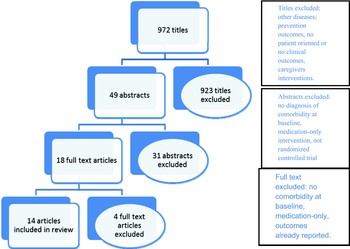
We searched Medline from 1995 to January 2011 for clinical trials published in English. Our search terms included a chronic medical illness modifier, an anxiety/depression modifier, and an intervention-type modifier, linked with AND (see Appendix 1 for complete search terms). Our inclusion criteria were: randomized controlled trials of outpatient interventions, addressed to people with co-morbid specific chronic medical illness (diabetes, cardiovascular, respiratory) and anxiety/depression disorders, which examined patient outcomes (quality of life, satisfaction, morbidity, mortality, and use of services). We excluded pre–post trials, prevention trials, medication-only interventions, no co-morbidity diagnosis at baseline, reports of study protocols, and interventions for caregivers or family members (see Fig. 1). Out of 972 articles, we selected 49 abstracts to review, and ultimately selected 14 randomized controlled trials of interventions for people with anxiety/depression and chronic medical illness to include in the review. Six trials were complex interventions based on the CCM, and eight were randomized controlled trials of psychosocial interventions (Tables 1 and 2).
Search strategy.

Randomized controlled trials of chronic care model interventions for patients with chronic medical illness and anxiety/depression disorders

Randomized controlled trials of psychosocial interventions for people with co-morbid chronic medical illness and anxiety/depression disorders

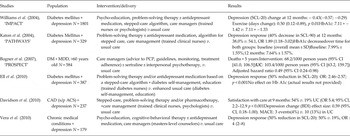
CCM–-based interventions trials are summarized in Table 1.
The IMPACT intervention for elderly people with depression applied evidence-based principles of treatment of chronic illness to depression treatment in primary care. The intervention included psycho-education, an algorithm for stepped collaborative care using problem-solving treatment, antidepressant treatment, and ultimately psychiatric consultation. Clinical nurses or psychologists were trained to be depression clinical specialists embedded in primary care, delivering the intervention and acting as care managers. A planned sub-analysis of people with depression and diabetes showed improved rates of mental health treatment and improvement in depression scores, but significant changes in neither self-care behaviors (except for increase in exercise) nor hemoglobin A1c (Williams et al. Reference Williams, Katon, Lin, Noel, Worchel, Cornell, Harpole, Fultz, Hunkeler, Mika and Unutzer2004).
The PATHWAYS study focused on people with depression and diabetes mellitus and, like the IMPACT study, included a stepped-care intervention for depression, delivered by trained clinical nurses and primary care physicians in primary care. More participants in the experimental intervention, compared to usual care, had depression responses (40% improvement). HbA1c levels decreased over time for both groups, without significant difference between groups. Subsequent analyses showed that the intervention was more effective in treating depression in patients with multiple medical complications, but did not change diabetes clinical measurements or diabetes self-management behaviors (Katon et al. Reference Katon, Von Korff, Lin, Simon, Ludman, Russo, Ciechanowski, Walker and Bush2004b; Kinder et al. Reference Kinder, Katon, Ludman, Russo, Simon, Lin, Ciechanowski, Von Korff and Young2006; Lin et al. Reference Lin, Katon, Rutter, Simon, Ludman, Von Korff, Young, Oliver, Ciechanowski, Kinder and Walker2006). It was associated with a trend toward lower costs over 5 years of follow-up (Katon et al. Reference Katon, Russo, Von Korff, Lin, Ludman and Ciechanowski2008).
The PROSPECT study of care management for older adults with depression in primary care provided trained care managers, support for medication adherence for patients, guidelines for providers, traditional case management, and interpersonal psychotherapy. Depression symptoms and suicidal ideation improved. In a sub-analysis of the participants with diabetes mellitus and depression, those in the intervention arm were less likely to have died during the 5-year follow-up interval than those in usual care, but no other outcomes were reported (Bruce et al. Reference Bruce, Ten Have, Reynolds, Katz, Schulberg, Mulsant, Brown, McAvay, Pearson and Alexopoulos2004; Bogner et al. Reference Bogner, Morales, Post and Bruce2007).
Another intervention based on the IMPACT model addressed people with diabetes mellitus and depression, predominantly Hispanics. The intervention was delivered by diabetes clinical managers who were also delivering, for both the intervention and the control groups, diabetes self-management education. The intervention improved depression response and remission rates, but had no effect on self-care or hemoglobin A1c (Ell et al. Reference Ell, Katon, Xie, Lee, Kapetanovic, Guterman and Chou2010).
A recent trial, the Coronary Psychosocial Evaluation Studies Randomized Controlled Trial (COPES), enrolled patients with persistent depression 3 months after an acute coronary syndrome and used an intervention design similar to the IMPACT study. More participants in the intervention arm were satisfied with their care, and the intervention group had greater improvement in depression symptoms and fewer subsequent major cardiac events (non-fatal myocardial infarction or hospitalization for unstable angina) (Davidson et al. Reference Davidson, Rieckmann, Clemow, Schwartz, Shimbo, Medina, Albanese, Kronish, Hegel and Burg2010).
Another recent trial enrolled primary care patients with major depression and diabetes, chronic respiratory, or cardiovascular disease (as well as hypothyroidism or arthritis). The intervention included collaborative care with cognitive-behavioral therapy, antidepressant medication, and care management delivered by masters-level mental health professionals. The intervention group experienced significantly greater depression responses (Vera et al. Reference Vera, Perez-Pedrogo, Huertas, Reyes-Rabanillo, Juarbe, Huertas, Reyes-Rodriguez and Chaplin2010).
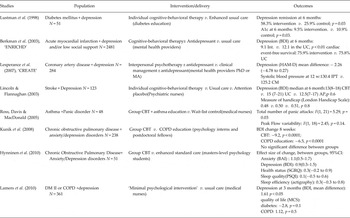
Psychosocial interventions for depression in patients with co-morbid chronic illness and anxiety/depression are summarized in Table 2.
The Lustman study found that people with diabetes mellitus and depression who received 10 weeks of individual cognitive-behavioral therapy for depression were more likely to have remission of depression, and at 6 months post-treatment had a slightly lower hemoglobin A1c compared to people in usual care (Lustman et al. Reference Lustman, Griffith, Freedland, Kissel and Clouse1998).
The ENRICHD trial included people with a recent myocardial infarction and co-morbid depressive disorder or low social support and provided individual and group cognitive-behavioral therapy delivered by trained mental health professionals, with or without antidepressant management as indicated (Berkman et al. Reference Berkman, Blumenthal, Burg, Carney, Catellier, Cowan, Czajkowski, DeBusk, Hosking, Jaffe, Kaufmann, Mitchell, Norman, Powell, Raczynski and Schneiderman2003). The results showed a decrease in depression and increase in social support in both groups after 6 months of intervention, but no significant difference in event-free survival up to 30 months of follow-up (Berkman et al. Reference Berkman, Blumenthal, Burg, Carney, Catellier, Cowan, Czajkowski, DeBusk, Hosking, Jaffe, Kaufmann, Mitchell, Norman, Powell, Raczynski and Schneiderman2003). A subgroup analysis of ENRICHD participants with depression only showed that the death rate was similar in the intervention group and the usual care group (Carney et al. Reference Carney, Blumenthal, Freedland, Youngblood, Veith, Burg, Cornell, Saab, Kaufmann, Czajkowski and Jaffe2004). Cognitive-Behavioral Therapy (CBT) did reduce post-myocardial infarction smoking among the subgroups of depressed patients with adequate perceived social support (odds ratio, 0.68; 95% confidence interval, 0.47–0.98) (Trockel et al. Reference Trockel, Burg, Jaffe, Barbour and Taylor2008).
The CREATE study for people with coronary artery disease and depression compared in a parallel-group, 2 × 2 factorial trial, citalopram with matched placebo and interpersonal psychotherapy with clinical management (systematic evaluation of depression symptoms and medication side effects) (Lesperance et al. Reference Lesperance, Frasure-Smith, Koszycki, Laliberte, van Zyl, Baker, Swenson, Ghatavi, Abramson, Dorian and Guertin2007). The main outcome, the depression score, favored clinical management (control) over interpersonal psychotherapy, especially for people with baseline low social support. There were no differences between the groups on cardiovascular measurements such as blood pressure, heart rate, and QT interval (Lesperance et al. Reference Lesperance, Frasure-Smith, Koszycki, Laliberte, van Zyl, Baker, Swenson, Ghatavi, Abramson, Dorian and Guertin2007).
Lincoln studied individual cognitive-behavioral treatment for depression in people with recent stroke and depression (Lincoln & Flannaghan, Reference Lincoln and Flannaghan2003). Depression score improvements did not differ between experimental and control groups, nor did measures of handicap or activities of daily living.
Ross studied small-group cognitive-behavioral therapy coupled with asthma education for people with co-morbid asthma and panic disorder (Ross, Davis & MacDonald, Reference Ross, Davis and MacDonald2005). The experimental intervention produced a significant improvement in panic frequency and morning peak-expiratory flow post-treatment, with panic outcomes maintained at 6-month follow-up.
Kunik studied group cognitive-behavioral treatment for anxiety/depression v. chronic obstructive pulmonary disease education for people with co-morbid chronic obstructive pulmonary disease and anxiety/depression (Kunik et al. Reference Kunik, Veazey, Cully, Souchek, Graham, Hopko, Carter, Sharafkhaneh, Goepfert, Wray and Stanley2008). Both groups showed significant improvement in measures of quality of life (dyspnea, fatigue, emotion, and mastery) and depression over the 8-week course of treatment, without differences between the groups.
The Hynninen study for outpatients with chronic obstructive pulmonary disease and anxiety or depression disorder compared CBT (psychoeducation on chronic obstructive pulmonary disease and interference with depression/anxiety, sleep hygiene, elements of relaxation, cognitive restructuring, exposure, and behavioral activation) with enhanced standard care (standard care + telephone assessments every 2 weeks). The results showed rapid and persistent improvement in anxiety/depression symptoms in the intervention group, but no significant change in respiratory health status or sleep (Hynninen et al. Reference Hynninen, Bjerke, Pallesen, Bakke and Nordhus2010).
The Lamers study included people with anxiety/depression co-morbid with either diabetes mellitus or chronic obstructive pulmonary disease (Lamers et al. Reference Lamers, Jonkers, Bosma, Kempen, Meijer, Penninx, Knottnerus and van Eijk2010). Medical nurses trained in principles of cognitive-behavioral therapy and self-management provided the experimental intervention (called minimal psychological intervention). The experimental group had better depression response (50% reduction in symptoms) and people with diabetes and depression in the experimental group had better quality of life.
Discussion
The major findings of this review are that current interventions for people with co-morbid medical illness and anxiety/depression produce improvements in the psychiatric co-morbidity, but the gains do not generalize to these patients’ chronic physical conditions. Most of the interventions focused exclusively on the mental health aspect of the co-morbidity, using either complex CCM models or psychosocial interventions. Several applications of the IMPACT trial, a landmark trial in the treatment of depression in primary care, showed that the intervention was effective in the treatment of depression for people with co-morbid depression and chronic medical illness. Similarly, various psychosocial interventions, mostly based on CBT, were generally effective in treating depression or anxiety in people with diabetes, cardiovascular, or chronic respiratory disorders. But treatment of anxiety/depression did not generalize to the medical aspect of co-morbidity.
Following Institute of Medicine guidelines (Institute of Medicine (US). Committee on Crossing the Quality Chasm: Adaptation to Mental Health and Addictive Disorders, 2006), the parsimonious inference is that self-management strategies need to be expanded to encompass the chronic physical illness. How this combining or integration should occur is unclear. Should the same team provide both interventions? Should they be provided concurrently or in sequence? Should the standard CCM interventions be modified in any way for the presence of co-occurring anxiety/depression? These issues need to be resolved by careful research.
Quantitative and qualitative research has identified some of the mediators of the relationships between anxiety/depression and chronic physical illness: decreases in self-care behavior, self-efficacy, medication adherence, self-advocacy within the medical system, and in interpreting symptoms (medical v. psychiatric) (Katon & Ciechanowski, Reference Katon and Ciechanowski2002; Shemesh et al. Reference Shemesh, Yehuda, Milo, Dinur, Rudnick, Vered and Cotter2004; Frasure-Smith & Lesperance, Reference Frasure-Smith and Lesperance2008; Cimpean, Reference Cimpean, Carpenter-Song, Oliver, Brooks, Bartels and Drake2010). One hypothesis is that these specific mediators should be addressed with specific interventions. In other words, the CCM-based model of treating anxiety/depression in primary care could be supplemented with medical self-management, medication adherence strategies, medical care management, or enhanced medical treatment.
People with chronic illnesses generally have multiple health goals that can be addressed sequentially (Montori, Gafni & Charles, Reference Montori, Gafni and Charles2006). Therefore, the process of shared-decision making, an essential component of patient-centered care, could help to individualize interventions in accordance with patients’ resources, preferences, and goals. Decision aids could facilitate shared decision-making. Information technology could enhance these complex interventions, for example, by assisting providers with orders, guidelines, and computerized prompts (Drake et al. Reference Drake, Deegan, Woltmann, Haslett, Drake and Rapp2010).
Conclusions
People with chronic medical illnesses co-morbid with anxiety/depression are at increased risk of complications and death, and the costs associated with the co-morbidity are high. Focusing exclusively on the anxiety/depression does not automatically improve the course of the chronic medical problems. To address the problems of co-morbidity effectively, the CCM model needs to include integrated medical and mental health treatments, enhanced by shared decision-making and information technology. The sequencing and format of integrating these interventions needs to be tested by further research.
Declaration of interest
None.
Appendix 1
Search terms
(a) Chronic disease OR cardiovascular disorders OR respiratory disorders OR chronic obstructive pulmonary disease OR asthma OR diabetes mellitus OR hypertension OR coronary artery disease OR congestive heart failure
AND
(b) Anxiety disorders OR generalized anxiety disorder OR panic disorder OR obsessive compulsive disorder OR post-traumatic stress disorder OR depressive disorders OR major depression
AND
(c) Treatment OR disease management OR collaborative care OR self-management OR psychological OR psychotherapy OR cognitive-behavioral therapy OR problem-solving therapy OR behavioral activation OR case management OR care management