There is now substantial evidence that neighborhood conditions predict youth academic achievement, social competence, and conduct problems (e.g. Sampson et al., Reference Sampson, Raudenbush and Earls1997). Experimental studies (Ludwig et al., Reference Ludwig, Duncan and Hirschfield2001, Damm and Dustmann, Reference Damm and Dustmann2014) leveraging quasi-randomized or randomized neighborhood assignment (i.e. refugee immigrants assigned to neighborhoods, housing vouchers) have indicated that, in the case of youth conduct problems, this association is at least partially causal (although for an excellent debate of these findings, see Ludwig et al., Reference Ludwig, Liebman, Kling, Duncan, Katz, Kessler and Sanbonmatsu2008, Sampson, Reference Sampson2008). A quasi-experimental comparison of cousins residing in neighborhoods with different levels of poverty (Goodnight et al., Reference Goodnight, Lahey, Van Hulle, Rodgers, Rathouz, Waldman and D'onofrio2012) further supported the possibility of causal effects on conduct problems.
Although such work brings needed attention to the role of neighborhood in youth conduct problems, studies of neighborhood poverty, crime, and disadvantage tell us little about how these neighborhood structural characteristics influence child outcomes. Contemporary theoretical models have convincingly argued that neighborhood social processes (i.e. social support, willingness to intervene for the common good) serve as core mechanisms of neighborhood effects on child outcomes, such that neighborhood disadvantage is primarily related to increases in youth conduct problems when accompanied by low levels of informal social control and/or social cohesion (Jencks and Mayer, Reference Jencks, Mayer, Lynn and Mcgeary1990; Coie et al., Reference Coie, Miller-Johnson, Bagwell, Sameroff, Lwis and Miller2000; Leventhal and Brooks-Gunn, Reference Leventhal and Brooks-Gunn2000).
Three neighborhood social processes have emerged as particularly important in this literature (Henry et al., Reference Henry, Gorman-Smith, Schoeny and Tolan2014): informal social control, social cohesion, and norms. Informal social control involves the supervision of children by other adults in the community and the willingness of neighbors to intervene for the common good (Henry et al., Reference Henry, Gorman-Smith, Schoeny and Tolan2014). These interventions can focus on a number of issues, including safeguarding child welfare, preventing or managing youth problem behaviors, and/or intervening when youth are disrupting public spaces. The common theme, however, is that, rather than relying on formal mechanisms of control such as the police, ‘…neighborhood residents take responsibility for and authority to help regulate each other's behavior collectively and informally’ (pg. 190; Henry et al., Reference Henry, Gorman-Smith, Schoeny and Tolan2014).
Social cohesion is defined via social support amongst neighbors, and a sense of belonging to the community (Henry et al., Reference Henry, Gorman-Smith, Schoeny and Tolan2014). It has been argued that social cohesion is particularly important in stressed neighborhoods (Leventhal and Brooks-Gunn, Reference Leventhal and Brooks-Gunn2000), as parents can more easily navigate the environmental, developmental, and structural challenges that characterize those neighborhoods when bolstered by connections with others also facing those challenges (Henry et al., Reference Henry, Gorman-Smith, Schoeny and Tolan2014). These theoretical arguments have been borne out in both correlational and intervention studies demonstrating that high levels of social cohesion protect adolescents in disadvantaged neighborhoods from developing youth conduct problems, among other things (Morenoff et al., Reference Morenoff, Sampson and Raudenbush2001; Sampson, Reference Sampson2003; Tolan et al., Reference Tolan, Gorman-Smith and Henry2004; Wight et al., Reference Wight, Botticello and Aneshensel2006; Simon et al., Reference Simon, Ikeda, Smith, Reese, Rabiner, Miller, Winn, Dodge, Asher and Horne2009).
Neighborhood norms index shared beliefs about acceptable or expected behaviors and are typically assessed in the areas of child welfare and management, youth behavior, crime, and citizen responsibility (Henry et al., Reference Henry, Gorman-Smith, Schoeny and Tolan2014). Recent empirical evidence indicates that when neighbors approve of deviant behavior, youth are more likely to engage in those behaviors (Ahern et al., Reference Ahern, Galea, Hubbard and Syme2009; Reed et al., Reference Reed, Silverman, Raj, Decker and Miller2011; Wright and Fagan, Reference Wright and Fagan2013).
In short, years of sociological studies have suggested that neighborhood social processes partially shape the development of youth conduct problems. Although already important, the broader contribution of this work has been limited by the fact that it has yet to meaningfully consider, either theoretically or empirically, the role of the child's individual attributes in his or her outcome, and specifically the ways in which neighborhood social processes might interact with individual genetic risk for conduct problems. This is no small omission in the neighborhood literature. Several meta-analyses (Burt, Reference Burt2009a, Reference Burt2009b) have robustly indicated that youth conduct problems are moderately-to-strongly heritable, with genetic influences accounting for roughly 48–65% of the variance across the population. How do we integrate this compelling evidence of individual-level genetic risk with the results of neighborhood studies pointing to the importance of emergent neighborhood social processes for resident outcomes? One obvious approach would be via considerations of genotype-environment interplay. GxE is defined as differential responsiveness to environmental risk as a function of genetic variability (Plomin et al., Reference Plomin, Defries and Loehlin1977; Rutter et al., Reference Rutter, Silberg, O'connor and Simonoff1999a, Reference Rutter, Silberg, O'connor and Simonoff1999b), and is thought to constitute a core mechanism though which genes influence mental health (Moffitt et al., Reference Moffitt, Caspi and Rutter2006), including antisocial behavior (Hicks et al., Reference Hicks, South, Dirago, Iacono and Mcgue2009).
What might GxE look like in this case? There are two models of GxE that appear important for youth antisocial behavior, although the model appears to vary with both the specific environmental moderator and the child's level of development (Burt, Reference Burt2011). Under the oft-discussed diathesis-stress model, GxE would manifest as stronger genetic effects in the presence of environmental risk, such that genetic influences on conduct problems were ‘activated’ by exposure to environmental risk (Hicks et al., Reference Hicks, South, Dirago, Iacono and Mcgue2009). Under the lesser known bioecological GxE model, by contrast, deleterious environments would amplify environmental influences, whereas genetic influences would be more important under normal environmental conditions (Bronfenbrenner and Ceci, Reference Bronfenbrenner and Ceci1994; Pennington et al., Reference Pennington, Mcgrath, Rosenberg, Barnard, Smith, Willcutt, Friend, Defries and Olson2009; Burt et al., Reference Burt, Klump, Gorman-Smith and Neiderhiser2016). The logic of the latter model is best illustrated through Lewontin's analogy of genetically variable seeds planted in either nutrient-rich or nutrient-deprived soil (Lewontin, Reference Lewontin1995). Because all plants receive adequate nutrition in nutrient-rich soil, individual differences in plant height would be largely a consequence of genetic differences between plants. The environmental adversity conferred by the deprived soil, by contrast, should eventuate in field populated largely by short plants, regardless of the plants' genetic predispositions for height. Put differently, it may be that some adverse experiences provide such a strong ‘social push’ for a given outcome that the importance of genetic factors in these environments is effectively diminished (Raine, Reference Raine2002).
Current study
The current study sought to evaluate, for the first time, neighborhood social processes as etiologic moderators of youth conduct problems. We made use of two nested studies. We first examined families in the Twin Study of Behavioral and Emotional Development (TBED-C), the only twin study in the world (to our knowledge) to have incorporated neighborhood directly into the inclusion criteria as recommended in the neighborhood literature (see Leventhal and Brooks-Gunn, Reference Leventhal and Brooks-Gunn2000). We augmented the TBED-C's neighborhood sampling approach with state-of-the-art measurement of neighborhood social processes, collecting multiple informant-reports of informal social control, cohesion, and norms from randomly-selected individuals residing in the families' neighborhoods. We then linked these neighbor informant-reports back to both the TBED-C and the Michigan Twins Project, the large-scale, population-based twin registry from which the TBED-C was initially recruited. The current project was thus well-positioned, both in its design and analytic approach, to explore whether and how neighborhood social processes moderated the etiology of youth conduct problems. Given the absence of prior genetically-informed studies examining neighborhood social processes, we did not have any specific hypotheses about the presence or specific pattern of etiologic moderation of youth conduct problems by neighborhood social processes.
Methods
Participants
Twin families
The current study made use of two nested samples within the population-based Michigan State University Twin Registry (MSUTR; Klump and Burt, Reference Klump and Burt2006; Burt and Klump, Reference Burt and Klump2013): the Michigan Twins Project (MTP) and the TBED-C. The primary aim of the on-going MTP is to collect health data on a large sample of child and adolescent twins (current N ~ 12 000 families) that can be used either for data analysis or to select twin families for follow-up research (as was done in the TBED-C, see below). The MTP twins were 50.1% female, and ranged in age from 3 to 17 years (mean age = 8.80 years, s.d. = 4.6 years) at the time of their assessment, although a few pairs (n = 43) had turned 18 by the time their assessment was completed. Twins belonged to racial groups at rates comparable to the lower Michigan Census (e.g. Black: 7.9%, White: 82.0%, Multiracial: 5.3%, respectively) (Burt and Klump, Reference Burt and Klump2012). A parent provided informed consent for themselves and their children.
The TBED-C was recruited out of the MTP, and includes both a population-based arm (n = 528 families) and an independent ‘at-risk’ arm (n = 502 families). To be eligible for participation in either arm of the TBED-C, neither twin could have a cognitive or physical condition (e.g. a significant developmental delay) as assessed via parental screen that would preclude completion of the assessment. Additional inclusion criteria for the ‘at-risk’ arm of the study specified that participating twin families lived in modestly- to severely-impoverished Census tracts. As expected, this additional inclusion criterion eventuated in a less advantaged sample. While twins participating in the population-based arm of the TBED-C belonged to racial groups at rates comparable to local area inhabitants (e.g. Black: 5.4%, White: 86.4%), twins in the at-risk arm were significantly more racially diverse (14.2% Black and 76.3% White). The at-risk arm also reported lower family incomes (Cohen's d effect size = −0.38), higher paternal felony convictions (d = 0.30), and higher rates of youth conduct problems and hyperactivity (d = 0.34 and 0.27, respectively), although they did not differ in youth emotional problems (d = 0.08, ns). The TBED-C twins collectively ranged in age from 6 to 11 years (mean = 7.99, s.d. = 1.49) and were 49% female. Other recruitment and sampling details are detailed extensively in prior publications (e.g. Burt and Klump, Reference Burt and Klump2013; Burt et al., Reference Burt, Klump, Gorman-Smith and Neiderhiser2016). Children provided informed assent, while parents provided informed consent for themselves and their children.
Neighbors
The protocol for the at-risk arm of the TBED-C included the recruitment and assessment of randomly-chosen neighbors. Following the participation of a given family in the ‘at-risk’ study, we sent mailings to 10 randomly-chosen addresses in that family's Census tract, inviting one adult resident per household to complete a survey. When a particular randomly-chosen address was no longer inhabited (i.e. the letter was returned as undeliverable), one attempt was made to find a replacement address. This approach resulted in a sample of 1880 neighbors (63.2% women; 80.6% White, 11.6% Black, 7.8% other ethnic group memberships; average age of 52.6 with a range of 18–95 years). The response rate was 70%, of which 70% agreed to participate (for a final participation rate of 49%). All participants provided informed consent.
To maximize the number of MTP families with available neighborhood informant data, we also included an independent sample of 1430 neighborhood informants (46.7% women; 86.2% non-Hispanic Caucasian, average age of 27.9 with a range of 18–70 years) nested in 997 census tracts across the state of Michigan. Participants in this second sample were recruited via the web-based Amazon marketplace MTurk (Buhrmester et al., Reference Buhrmester, Kwang and Gosling2011). MTurk has a large (N > 100 000) and diverse ‘workforce’ of individuals who complete surveys, writing, and other such tasks on-line. For the current study, we required that all participants resided in Michigan, and paid $1.50 for completion of the assessment. Assessments were identical to those in the above neighborhood informant sample.
Measures
Zygosity
Zygosity was established using physical similarity questionnaires administered to the twins' primary caregiver (Peeters et al., Reference Peeters, Van Gestel, Vlietinck, Derom and Derom1998). On average, the physical similarity questionnaires used by the MSUTR have accuracy rates of at least 95% as compared to DNA. Data structure by zygosity is presented in Table 1.
Sample sizes and operationalization of neighborhood

Note. MZ and DZ indicate monozygotic and dizygotic twin pairs, respectively.
Conduct Problems (CP)
In the MTP, primary caregivers (nearly always the mother) completed the Strengths and Difficulty Questionnaire (SDQ; Goodman and Scott, Reference Goodman and Scott1999), along with a handful of additional items. The SDQ is highly correlated with other measures of psychopathology (e.g. the Child Behavior Checklist) and demonstrates good predictive validity for related diagnoses (Goodman and Scott, Reference Goodman and Scott1999). We specifically focused here on the Conduct Problems scale (i.e. stealing, hot temper, physical fights; 5-items). However, given the relatively low reliability of this 5-item scale (α = 0.64), we added two items assessing other behaviors that are also characteristic of CP (i.e. destroys things that belong to others; thinks things out before acting, reverse-scored). The addition of these two items increased the internal consistency reliability (α = 0.72). Moreover, an exploratory factor analysis yielded evidence of a clean break between the one- and two-factor solutions, with only one eigen value above 1.0 (3.907, next one was 0.855) and a reasonable RMSEA (0.07). The seven items evidenced high loadings on that factor (ranging from 0.63 to 0.76). Only 5.5% of twins had missing CP data. The mean CP score was 2.49 (s.d. = 2.20), with a range of 0 to 14 (skew was 1.38). To adjust for this positive skew, the data were log-transformed prior to analysis to better approximate normality (skew after transformation was −0.02).
In the TBED-C, mothers and fathers completed the Achenbach Child Behavior Checklist (CBCL; Achenbach and Rescorla, Reference Achenbach and Rescorla2001) separately for each twin, while the twins' teacher(s) completed the corresponding Achenbach Teacher Report Form (TRF; Achenbach and Rescorla, Reference Achenbach and Rescorla2001). The teachers of 119 twins were not available for assessment (because the twins were home-schooled, because parental consents to contact the teachers were completed incorrectly, etc.), and our final teacher participation rate across the TBED-C was 83%. The twins themselves completed the Semi-structured Clinical Interview for Children and Adolescents (SCICA; McConaughy and Achenbach, Reference Mcconaughy and Achenbach2001), the corresponding interview for youth ages 6–18, in separate rooms with different interviewers.
For the current study, we made use of the DSM-oriented CP scale (Achenbach and Rescorla, Reference Achenbach and Rescorla2001, McConaughy and Achenbach, Reference Mcconaughy and Achenbach2001), which comprises 17 CBCL items, 13 TRF items, and 19 SCICA items (with nearly identical item content) viewed as ‘very consistent’ with the DSM-IV diagnostic category of Conduct Disorder (e.g. stealing, fighting, setting fires, cruelty to animals, etc.). Further validation work (Achenbach et al., Reference Achenbach, Dumenci and Rescorla2001) indicated that the DSM-oriented CP scale accurately captures conduct disordered behavior and DSM diagnoses. Internal consistency reliabilities for the CBCL and TRF scales were adequate (α = 0.82, 0.87, and 0.77 for mother, teacher, and father informant reports, respectively). Roughly 10% of SCICA interviews were videotaped to obtain inter-rater reliability (the average intraclass correlation across raters was 0.88). The various informant-reports were combined to form multi-informant composites of child CP. Only 4 twins had missing composite scores. Consistent with manual recommendations (Achenbach and Rescorla, Reference Achenbach and Rescorla2001), analyses were conducted on the raw scale scores. The mean CP composite was 1.52 (s.d. = 1.86), with a range of 0 to 15 (skew was 2.50). To adjust for this positive skew, the data were log-transformed prior to analysis to better approximate normality (skew after transformation was 0.64).
Neighborhood social processes
We assessed social processes from neighbors using the Neighborhood Matters questionnaire (Henry et al., Reference Henry, Gorman-Smith, Schoeny and Tolan2014). The Social Cohesion scale consists of 30 items (α > 0.95) assesses perceptions of neighborhood support, help, and trust (e.g. would neighbors intervene if a fight broke out?). The 29-item Informal Social Control scale (α > 0.94) assesses the degree to which residents perceive an expectation among community residents to undertake activities that maintain social order (e.g. what would someone in your neighborhood do if … someone is trying to sell drugs to kids?). The 22-item Norms scale (α > 0.94) assesses perceptions of behavioral norms in the neighborhood, with a focus on norms regarding child welfare and neighborhood safety. Descriptive data for the neighborhood process variables are presented in online Supplementary Table S1.
Operationalization of ‘neighborhood’
We made use of several approaches to operationalizing the twin family's neighborhood, and thus the measurement of social processes in those neighborhoods (see Table 1). For the TBED-C, we geocoded all neighbor and twin family addresses with a 99.9% success rate using an ‘.hmtl’ code that uses Google Maps address data to assign coordinates. We then mapped the geocoded coordinates using ArcGIS v10.3 (ESRI, Redlands, CA). We verified the spatial accuracy of 20 random geocoded locations by comparing the tabular data to ensure that the assigned county and city names correspond with the Census tract found in the original dataset. Using the geocoded coordinates, we computed the distance to the nearest neighbor in the dataset (median distance was 1.25 km, mean = 2.5 km, s.d. = 2.9 km, with a range of 0.25 m to 13.9 km; families in which the nearest neighbor was more than 14 km away were omitted from this particular operationalization). We also calculated average perceptions of neighborhood social processes for each twin family residential location using ArcMap software, averaging the informant-reports of all neighbors residing within 1 km of the twins and all neighbors residing within 5 km of the twins, respectively. Descriptive statistics for these various spatial covariates were then calculated using Stata v13 (College Station, TX).
Because the Department of Vital Records within the Michigan Department of Health and Human Services makes use of confidential driver's license and birth record data to locate each family's address for recruitment into the MTP, they do not release family addresses to researchers at MSU until the families indicate an interest in participating in a specific study (as families did with the TBED-C). However, they will release County and Census tract identifiers for MTP families. This allowed us to link the MTP data to the neighborhood informant data, calculating average perceptions of neighborhood social processes at the level of the Census tract. Slightly fewer than half of the MTP families (N = 5649) resided in a Census tract for which we had at least one neighborhood informant (see Table 1).
Analyses
Classical twin studies leverage the difference in the proportion of genes shared between monozygotic or MZ twins (who share 100% of their genes) and dizygotic or DZ twins (who share an average of 50% of their segregating genes) to estimate the relative contributions of genetic and environmental influences to the variance within observed behaviors or characteristics (phenotypes). More information on twin studies is provided elsewhere (Neale and Cardon, Reference Neale and Cardon1992). In the current study, we fitted the ‘univariate GxE’ model (Purcell, Reference Purcell2002), as shown in online Supplementary Fig. S1, to evaluate whether a given social process variable moderated the etiology of youth CP. Although prone to false positives when twin pairs are imperfectly correlated on the moderator (van der Sluis et al., Reference Van Der Sluis, Posthuma and Dolan2012), it is the most appropriate GxE model when the twins are perfectly concordant on the moderator (van der Sluis et al., Reference Van Der Sluis, Posthuma and Dolan2012), as is this case here.
Mx (Neale et al., Reference Neale, Boker, Xie and Maes2003) was used to fit the GxE models to the data using Full-Information Maximum-Likelihood techniques. When fitting models to raw data, variances, covariances, and means are first freely estimated to get a baseline index of fit (minus twice the log-likelihood; −2lnL). Model fit was evaluated using four information theoretic indices that balance overall fit with model parsimony: the Akaike's Information Criterion (AIC; Akaike, Reference Akaike1987), the Bayesian Information Criteria (BIC; Raftery, Reference Raftery1995), the sample-size adjusted Bayesian Information Criterion (SABIC; Sclove, Reference Sclove1987), and the Deviance Information Criterion (DIC; Spiegelhalter et al., Reference Spiegelhalter, Best, Carlin and Van Der Linde2002). The lowest or most negative AIC, BIC, SABIC, and DIC among a series of nested models is considered best. Because fit indices do not always agree (they place different values on parsimony, among other things), we reasoned that the best fitting model should yield lower or more negative values for at least 3 of the 4 fit indices.
Prior to analyses, each moderator variable was floored at 0 and divided by its maximum, providing a continuous measure of each social process variable that ranged from 0 to 1. Twin sex and age were regressed out of all twin data, in keeping with prior recommendations (McGue and Bouchard, Reference Mcgue and Bouchard1984). Finally, as it is recommended that unstandardized or absolute parameter estimates be presented in etiologic moderation models (Purcell, Reference Purcell2002), we standardized our log-transformed and residualized child CP scores to have a mean of zero and a standard deviation of one to facilitate interpretation of the unstandardized value.
Results
Phenotypic and intraclass correlations
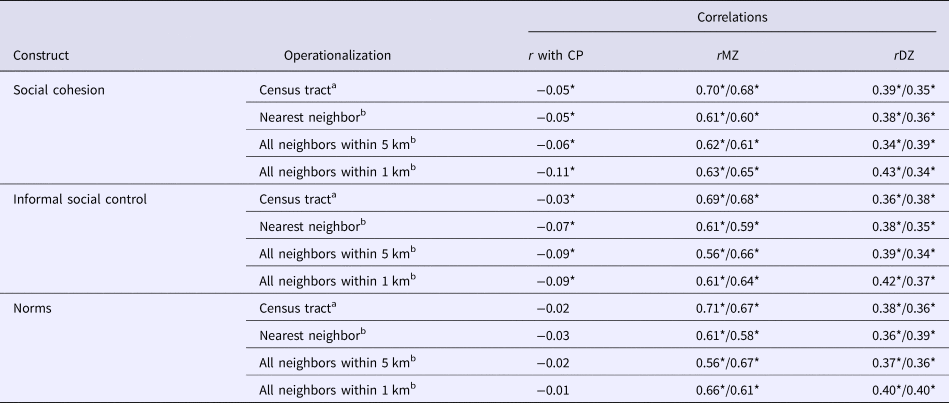
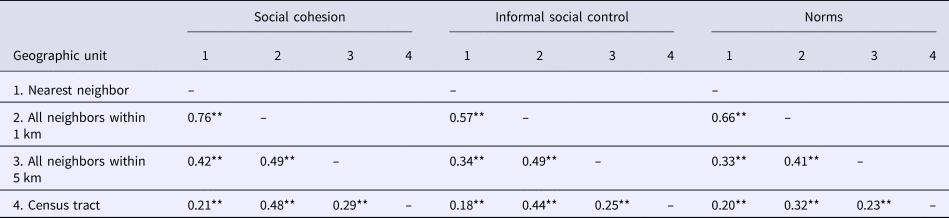
Phenotypic correlations with CP are presented in Table 2. As seen there, the three social process variables demonstrated weak correlations with twin CP regardless of the operationalization of neighborhood (note, however, that the magnitude of the phenotypic correlation between a moderator and an outcome has no bearing on the presence of etiologic moderation; Purcell, Reference Purcell2002). Correlations among the various operationalizations within the TBED-C are presented in Table 3, separately for each social process variable. The strongest associations were observed between the nearest neighbor and the 1 km radius (rs were 0.57 to 0.76), followed by their respective associations with the 5 km radius (rs were 0.33 to 0.49). We were also able to examine associations with the MTP Census tract operationalizations, given that the TBED-C is nested within the MTP. Census tract evidenced its clearest associations with the 1 km radius (rs were 0.32 to 0.48) and somewhat weaker associations with nearest neighbor and 5 km (rs were 0.18 to 0.29).
Phenotypic and Intraclass Correlations

Note: rMZ and rDZ indicate the intraclass twin correlations for MZ and DZ twin pairs, respectively.
a Indicates MTP sample.
b Indicates TBED-C sample.
*Correlation is greater than zero at p < 0.05.
Correlations among measures of neighborhood social processes in the TBED-C

** p < 0.01.
Intraclass correlations are also presented in Table 2, separately by zygosity and level of each social process variable (the latter were divided at the median for these analyses, although they were analyzed continuously in the GxE analyses below). As seen there, the MZ correlations for CP were significantly larger than the DZ correlations in all cases, regardless of sample or neighborhood operationalization. In no case, however, did either the MZ or the DZ correlation significantly change with level of the social process variable (i.e. the MZ correlation was 0.70 at low levels of Census tract social cohesion and 0.68 at high levels). Such findings preliminarily argue against the presence of etiologic moderation of CP by neighborhood social processes.
GxE results
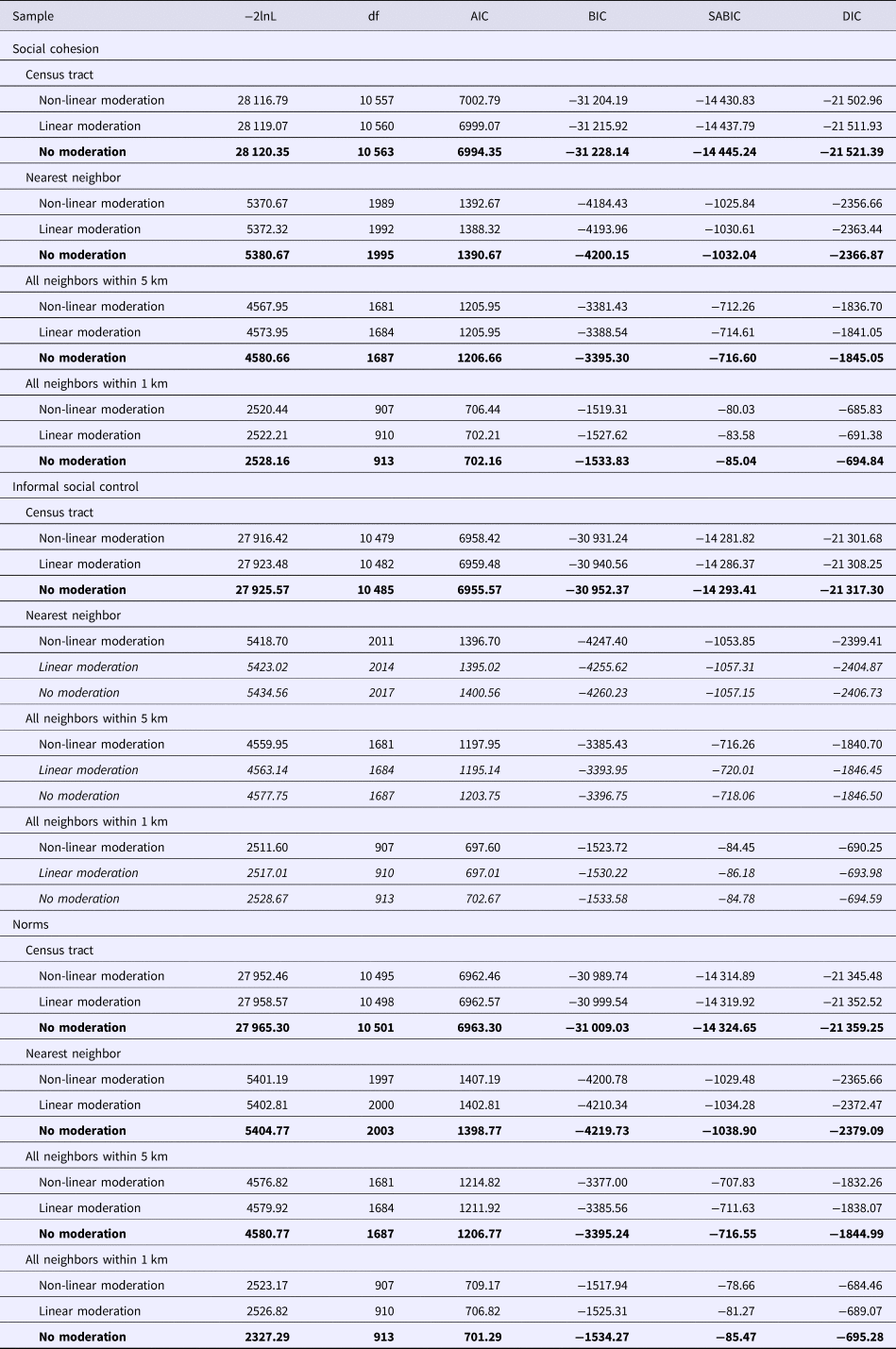
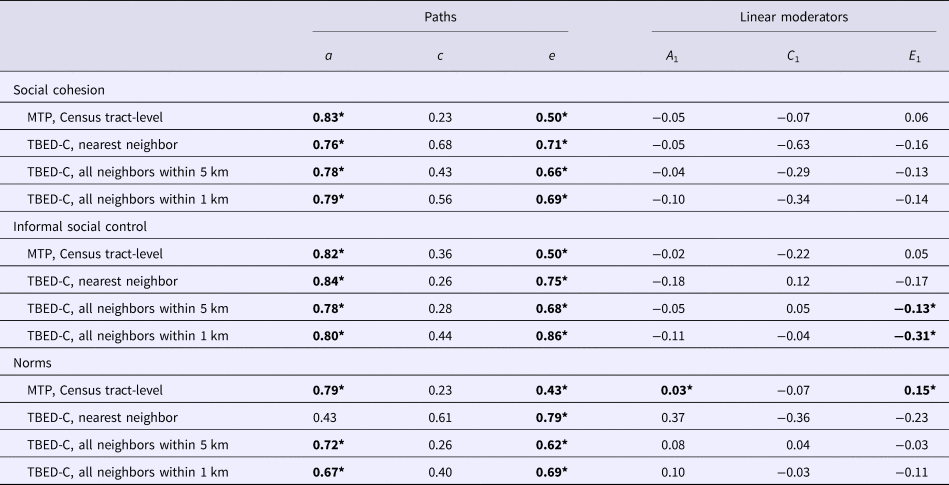
Formal tests of moderation were conducted next. Individual GxE model fitting results are presented in Table 4. As seen there, the no moderation model generally provided the best fit to the data, regardless of sample or neighborhood operationalization. To enhance discussion, however, estimated paths and moderators from the full linear models are presented in Table 5. Results are discussed in turn.
Fit Indices for the GxE analyses

Note. The best fitting model for a given set of analyses is highlighted in bold font, and is indicated by the lowest AIC (Akaike's Information Criterion), BIC (Bayesian Information Criterion), SABIC (sample size adjusted Bayesian Information Criterion), and DIC (Deviance Information Criterion) values for at least 3 of the 4 fit indices. When neither of two models clearly provided a better fit relative to the other, both are italicized.
Unstandardized path and moderator parameter estimates for the full linear moderation models

Note. A, C, and E (upper and lower case) respectively represent genetic, shared, and non-shared environmental parameters on child conduct problems (CP). Because lower levels of each neighborhood social process variable were coded as 0, the genetic and environmental contributions to child CP at this level can be obtained by squaring the path estimates (i.e. a, c, and e). At higher levels, linear moderators (i.e. A 1, C 1, E 1) were added to the paths using the following equation: Unstandardized Variance Total = (a + A 1(informal social control))2 + (c + C 1(informal social control))2 + (e + E 1(informal social control))2. Bold font and an asterisk indicate that the parameter estimate was significant at p < 0.05.
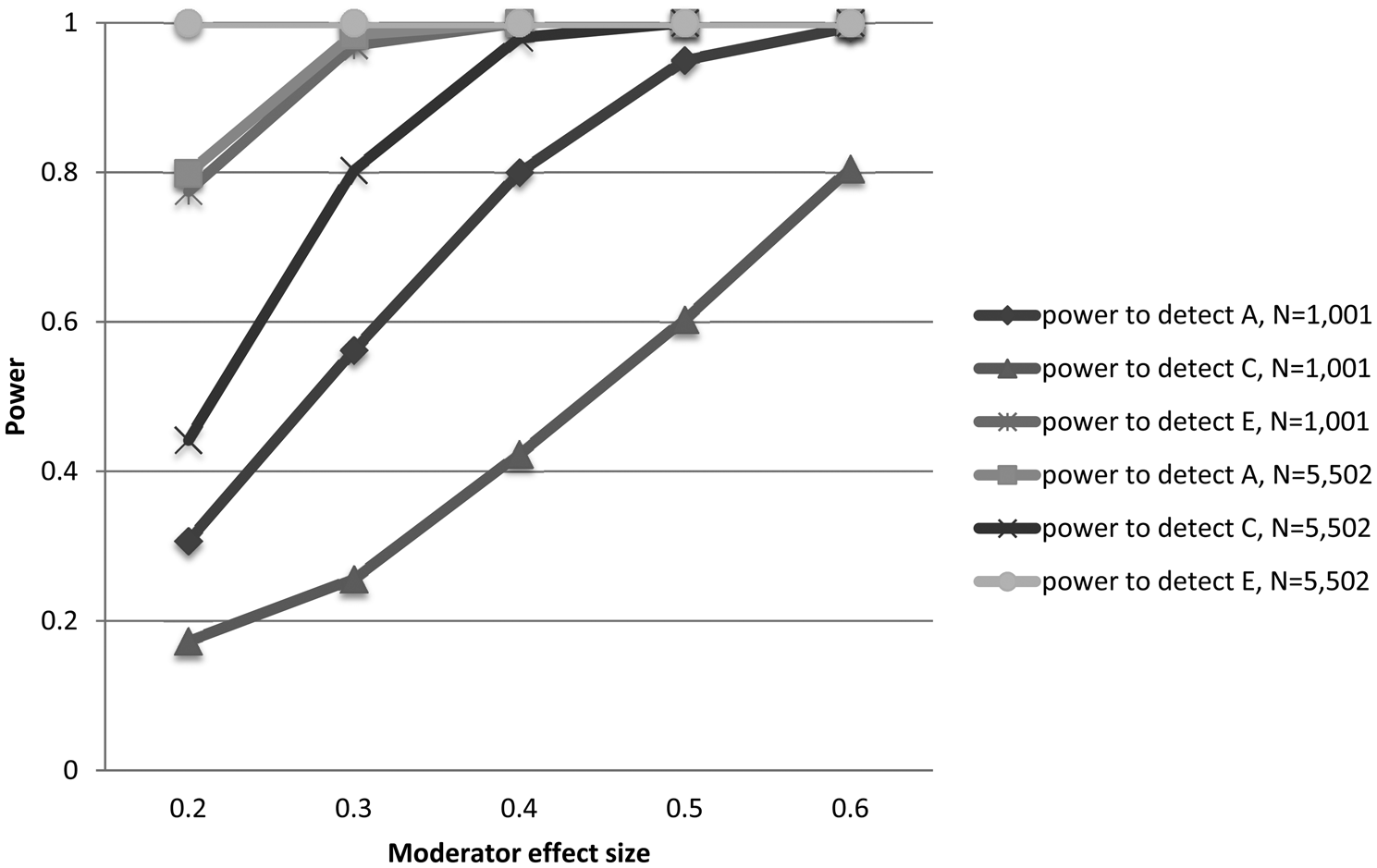
For social cohesion, the no moderation model fitted the data better than the linear or non-linear moderation models regardless of sample or operationalization. The genetic and non-shared environmental moderators were uniformly non-significant and small in magnitude. Although moderators for the shared environment were similarly non-significant, they were more variable in magnitude, ranging from −0.07 (census tracts) to −0.63 (nearest neighbor). The direction of these non-significant effects is particularly interesting, since it tracks prior findings for the structural effects of disadvantage (i.e. shared environmental influences are lower in more advantaged neighborhoods). Such findings raise the possibility that social cohesion may moderate the etiology of CP, but that we are unable to detect this effect in these analyses because we are underpowered. To directly examine this possibility, we evaluated our statistical power to detect etiologic moderation, conducting a series of simulations. Results are plotted in Fig. 1. As seen there, we were sufficiently powered to detect small non-shared environmental moderators (0.2) and moderate genetic moderators (0.4) in samples of 1001 families, but underpowered to detect shared environmental moderators until they were large in magnitude (i.e. we had 80.5% power to detect C moderators of 0.6). In samples of 5502 pairs and larger, however, we were sufficiently powered to detect shared environmental moderators as small as 0.3 and genetic moderators as small as 0.2. Such findings argue against low power as an explanation for our non-significant results in the large MTP sample.
Power analyses

For informal social control, the linear moderation model fitted the data as well as, but not better than, the no moderation model for 3 of the 4 operationalizations. When examining the estimated parameters, the non-shared environmental moderator was statistically significant (albeit small) for the 1 and 5 km radii, potentially highlighting a small reduction in the importance of non-shared environmental influences on CP with increasing informal social control. However, these findings did not persist when examining perceptions of informal social control in the nearest neighbor or by Census tracts (the latter of which was signed in the opposite direction, a notable discrepancy given the sample size for those analyses). Such findings diminish our confidence regarding non-shared environmental moderation of CP by informal social control, but do not rule it out entirely.
For norms, the no moderation model uniformly fitted the data best, regardless of sample or operationalization. Even so, the genetic and non-shared environmental moderators were statistically significant for the Census tract analyses, indicating the possibility of very small increases in genetic influences and small increases in non-shared environmental influences with stronger norms. That said, the direction of the non-shared environmental moderators varied across the various operationalizations of neighborhood, undercutting our confidence in the presence of meaningful non-shared environmental moderation.
Discussion
The primary goal of the current study was to evaluate, for the first time, whether and how neighborhood social processes might moderate the etiology of child CP. Results provided no consistent evidence in support of this hypothesis. The linear moderation model never provided a better fit to the CP data, regardless of operationalization or sample. What's more, when significant moderators did emerge, they were not replicated across the other operationalizations of that neighborhood social process, a key test given both the replicability crisis in psychology and the acknowledged potential for spurious findings in studies focused on statistical interactions (Eaves, Reference Eaves2006; Cohen et al., Reference Cohen, West and Aiken2014). Power analyses indicated that these null findings are not likely to be a function of low statistical power. We thus conclude that, if there is any etiologic moderation of child CP by neighborhood social processes, these effects are small to very small, and inconsistent.
Of note, these findings stand in rather sharp contrast to those of GxE studies examining neighborhood structural characteristics as etiologic moderators of youth CP (Cleveland, Reference Cleveland2003; Tuvblad et al., Reference Tuvblad, Grann and Lichtenstein2006; Burt et al., Reference Burt, Klump, Gorman-Smith and Neiderhiser2016). Tuvblad et al. (Reference Tuvblad, Grann and Lichtenstein2006), for example, examined 1133 population-based twin pairs in Sweden, and found that shared environmental influences on antisocial behavior were more important for adolescents residing in disadvantaged neighborhoods (i.e. those with blight, crime, etc.), while genetic influences were more important for adolescents residing in advantaged neighborhoods. We have since extended these findings in the TBED-C, evaluating Census reports of the % of families residing below the poverty line (Burt et al., Reference Burt, Klump, Gorman-Smith and Neiderhiser2016), maternal reports of neighborhood disadvantage, and neighbor informant-reports (i.e. nearest neighbor, all within 1 km, all within 5 km; Burt et al., Reference Burt, Pearson, Neiderhiser and Klumpsubmitted). As with prior work, results pointed squarely to stronger shared environmental influences on youth antisocial behavior in disadvantaged neighborhoods as compared to advantaged neighborhoods. The consistency of the findings for the structural characteristics of neighborhood disadvantage across independent research teams is rather remarkable, given the use of different samples with unique measurement strategies. Such findings collectively argue that, consistent with the bioecological model of GxE (Scarr, Reference Scarr1992; Bronfenbrenner and Ceci, Reference Bronfenbrenner and Ceci1994), youth CP is more environmental in origin in structurally disadvantaged neighborhood contexts.
Limitations
There are several limitations to the current study. First, although we collected resident perceptions of neighborhood social processes, we did not collect resident perceptions of neighborhood boundaries. It is thus possible that, when they completed their questionnaires, neighbors were referencing a neighborhood different from (but overlapping with or in close proximity to) the one in which the twin family resides. That said, the notable consistency of our results across the various combinations of neighbor informant-reports (and especially the nearest neighborhood informant) suggests that this limitation is unlikely to be the source of our null findings. Regardless, future work should more precisely evaluate neighborhood boundaries when attempting to constructively replicate the current results.
Second, analyses of at-risk samples inevitably raise concerns regarding the generalizability of the results (i.e. do they also extend to population-based samples that include proportionally fewer at-risk youth?). This concern is allayed here by the fact that our findings in the TBED-C extended to a large population-based sample of twins (the MTP), indicating that these effects may generalize beyond at-risk samples. Next, given the power hungry nature of these models, we also regressed sex out of the child CP data prior to analysis. Fortunately, this decision is in keeping with prior meta-analyses arguing against sex differences in heritability estimates for child CP (Burt, Reference Burt2009a), as well as recent work indicating the absence of joint etiologic moderation of CP by sex and neighborhood disadvantage (Burt et al., Reference Burt, Slawinski and Klump2018). Next, our CP data were log-transformed prior to analysis to adjust for positive skew, which can either artefactually inflate or suppress evidence of GxE. Other transformations of the data could theoretically yield somewhat different results.
Finally, although our neighborhood informant sample includes several participants per neighborhood, it is unclear whether participating neighbors were representative of adults in their neighborhoods or how perceptions of social processes might align with more objective measures of these social processes (i.e. direct observations of neighborhood social processes). To preliminarily evaluate the first issue, we examined whether ethnicity data in the Census predicted neighbor self-reports of ethnicity. The two were highly correlated 0.68 (p < 0.001), suggesting that neighbors in our sample may be representative of their overall neighborhoods. However, future work should explore this issue in more depth.
Conclusions
The current results are not consistent with the notion that neighborhood social processes moderate the genetic and environmental origins of child CP. This conclusion has two key implications. First, although the current results might seem to undermine the importance of neighborhood social processes, we would argue against this interpretation, as they instead only suggest that neighborhood social processes do not exert their effects on child CP via etiologic moderation. Our results are silent in regards to other possible etiologic connections. For example, the links between neighborhood social processes and child CP could reflect main effects of neighborhood social processes, in that they protect youth from engaging in high levels of CP regardless of their genetic risk. Alternately, associations could reflect genotype-environment correlations, whereby children at lower genetic risk for CP seek out protective environments (perhaps via strong relationships with particular neighbors) in order to buffer themselves from the conditions in their neighborhoods. Unfortunately, we were unable to examine these alternate possibilities here, since neighbor perceptions of neighborhood-level social processes do not vary across twins, and thus we cannot decompose the covariance between child CP and neighborhood social processes into their genetic and environmental components. Future studies should collect twin perceptions of neighborhood social processes, which are amenable to variance/covariance decomposition, thereby allowing us to better understand the origins of the association between neighborhood social processes and child CP.
Second, when viewed in conjunction with extant studies evaluating neighborhood structural characteristics as etiologic moderators, the current findings suggest that efforts to identify the specific neighborhood-level factors that moderate the etiology of CP in childhood should focus on structural characteristics linked to neighborhood disadvantage. What might these neighborhood-level characteristics be? One possibility relates to exposure to neighborhood crime and/or CP among neighbors, as prior theory and empirical work has indicated youth CP may be influenced in part by the phenomenon of social contagion (Jencks and Mayer, Reference Jencks, Mayer, Lynn and Mcgeary1990; Papachristos et al., Reference Papachristos, Wildeman and Roberto2015; Burt et al., Reference Burt, Pearson, Rzotkiewicz, Klump and Neiderhiser2019), or the spread of particular outcomes across social networks (Christakis and Fowler, Reference Christakis and Fowler2013). Another possibility centers on exposure to environmental contaminants, as such exposures are experienced disproportionately by those living in impoverished environments (Perera et al., Reference Perera, Illman, Kinney, Whyatt, Kelvin, Shephard, Evans, Fullilove, Ford, Miller, Meyer and Rauh2002). This may be particularly the case in Rust Belt states with high levels of lead exposure. For example, of the 32 973 Detroit children younger than 6 years of age who were tested for lead exposure in 2004 (this corresponds to 35.3% of all young children in Detroit at that time), fully one third had blood lead levels greater than the CDC cut-off (i.e. 5 ug/dL) for high lead exposure (https://www.michigan.gov/mdhhs/05885,7-339-73971_4911_4913---,00.html). Such numbers are tragic, given the now uncontested effects of lead exposure on later antisocial behavior (Nevin, Reference Nevin2007). Future work should seek to examine these possibilities.
Supplementary material
The supplementary material for this article can be found at https://doi.org/10.1017/S0033291719001521.
Author ORCIDs
S. Alexandra Burt, 0000-0001-5538-7431.
Acknowledgements
This project was supported by R01-MH081813 from the National Institute of Mental Health (NIMH), R01-HD066040 from the Eunice Kennedy Shriver National Institute for Child Health and Human Development (NICHD), Strategic Partnership Grant #11-SPG-2408 and institutional funds from Michigan State University. The content is solely the responsibility of the authors and does not necessarily represent the official views of the NIMH, NICHD, or the National Institutes of Health. The primary author had full access to all of the data in the study and takes responsibility for the integrity of the data and the accuracy of the data analysis. The authors thank all participating twins and their families for making this work possible. None of the authors report any conflicts of interest.