Introduction
According to the World Health Organization (2016, p. 01), ‘Approximately 50 million people worldwide have epilepsy, making it one of the most common neurological diseases globally’. Epilepsy is a condition characterised by recurrent (two or more) epileptic seizures, which are not explained by any apparent immediate identified cause (Banerjee, Filippi, & Hauser, Reference Banerjee, Filippi and Hauser2009). Adult Onset Epileptic Seizures (AOES) are seizures first experienced by individuals at 18 years of age or older. The onset of epilepsy in adulthood makes for a traumatic experience. As the individual has experienced life without the disease and is facing uncertainties about living with this debilitating illness into the future, they can often be intimidated by the condition. This is in part because there is a stigma associated with epilepsy (Fisher et al., Reference Fisher, Vickrey, Gibson, Hermann, Penovich, Scherer and Walker2000; Jacoby, Reference Jacoby2002), so that even the occasional seizure knowing to have serious personal and social ramifications (Bressi et al., Reference Bressi, Cornaggia, Beghi, Iandoli and Invernizzi2007; Wheless, Reference Wheless2006). Neurosurgery is successful in eliminating seizures in about 45% of the cases, and more successful if with frontal lobe epilepsy, which the second most common form of seizure disorder (Englot, Wang, Rolston, Shih, & Chang, Reference Englot, Wang, Rolston, Shih and Chang2012).
A neurological disease such as epilepsy may, in fact by its very nature what diminish subjective wellbeing (SWB) from its physical pathological presentation with unpredictable and recurrent seizures. The related physical pathological processes associated with the disease in key locations of the brain may impact affect regulation, increasing the risk for depression (Barak & Achiron, Reference Barak and Achiron2009; Hixson & Kirsch, Reference Hixson and Kirsch2009). That being the case, then amelioration of neurological disease symptoms from brain plasticity adaptation or surgical intervention might result in less debilitation and improved SWB (Buckner, Andrews-Hanna, & Schacter, Reference Buckner, Andrews-Hanna and Schacter2008). Lived experience with elective surgery for AOES is under-studied (Bellon, et al., Reference Bellon, Walker, Peterson and Cookson2013; Elliott, Reference Elliott2014) although findings would be important for interventions to support the SWB of those with this health status (Bishop & Allen, Reference Bishop and Allen2003; Elliott & Richardson, Reference Elliott and Richardson2014). This study sought to explore the coping strategies of men with AOES, and how such factors subsequently influenced their SWB following elective neurosurgery.
Subjective Well-being with Chronic Illness and Disease
SWB refers to one's emotional and cognitive self-evaluations, including feelings of happiness, peace, fulfilment, and self-perception (Diener, Oishi, & Lucas, Reference Diener, Oishi and Lucas2003; Diener & Ryan, Reference Diener and Ryan2009). It is often influenced by the way people perceive how they cope with life or the adjustment skills they implement to do so (Krause & Broderick, Reference Krause and Broderick2004; Nelson, Reference Nelson, Nelson, Zejdlik and Love2001). Studies on health-related quality of life have tended to equate high SWB to the absence of the ‘3Ds’: disease, disorder and disability (Keyes, Fredrickson, & Park, Reference Keyes, Fredrickson, Park, Keyes, Fredrickson and Park2012) with the assumption that if these were eliminated, then an individual with chronic illness and disability (CID) would report a higher sense of SWB. This is not necessarily the case, as a number of people with significant health-related challenges may report being both happy and unhappy about some aspects of their lives as would others from the general population (Berridge & Kringelbach, Reference Berridge and Kringelbach2011; Cummings, Reference Cummings, Caltabiano and Ricciardelli2013).
Globally, epilepsy affects more men than women (WHO, 2006, p. 58). In a patriarchal society, the social norms of masculinity or ‘male role’ include personal stability, the maintenance of employment and provision of adequate finances to support the family (Connell, Reference Connell2014). Men who appear to sit outside of these social norms risk social marginalisation. This study adds to the existing literature by exploring the lived experience of AOES and SWB in men who received surgery to control their epileptic seizures.
Coping Strategies with CID
Several coping strategies for living with CID have been identified in the literature: cognitive reconstruction, threat minimisation, emotional acceptance, wish-fulfilling fantasy, information seeking, and self-blame (Braiker, Reference Braiker2006; Livneh, Wilson, Duchesneau, & Antonak, Reference Livneh, Wilson, Duchesneau and Antonak2001; Mahoney & Arnkoff, Reference Mahoney, Arnkoff, Garfield and Bergin1978). Cognitive reconstruction is associated with making sense of the experience of living with CID, with a view to enhancing personal recovery (Livneh et al., Reference Livneh, Wilson, Duchesneau and Antonak2001). Threat minimisation is when an individual engages in thoughts or beliefs and actions aimed to discount the effects of possible barriers to living well with CID (Braiker, Reference Braiker2006). Emotional self-acceptance as a coping strategy refers to personal feelings associated with ownership of the challenges of living with a debilitating health condition (Shariff & Tracy, Reference Shariff and Tracy2011; Zangi, Hauge, Steen, Finset, & Hagen, Reference Zangi, Hauge, Steen, Finset and Hagen2011). Wish-fulfilling fantasy involves holding on to beliefs that known illness symptoms would somehow discontinue or be cured, no longer impacting on daily living (Feinberg, Reference Feinberg2013). It presumably allows people living with CID to alleviate the emotional distress by providing a mental escape through fantasy (Thompson & Upton, Reference Thompson and Upton1992). Self-blame, refers to a person (mis)attributing to the self, the CID-related restrictions to social and health functioning from the objective external environment (Bond, Mpofu, & Millington, Reference Bond, Mpofu and Millington2015). Living with CID is less adaptive if adequate counselling fails to be provided. People with CID may utilise some or all of these coping strategies in tandem or in complementary ways. Their specific use by individuals with AOES following elective surgery is unknown.
The majority of studies on health and wellbeing with epilepsy have utilised quantitative measures (Jacoby, Baker, Crossley, & Schachter, Reference Jacoby, Baker, Crossley and Schachter2013; Jacoby, Snape, & Baker, Reference Jacoby, Snape and Baker2009), and studies are needed that explore lived experience with epilepsy as these provide a complete personal perspective on living with disability (Bishop & Allen, Reference Bishop and Allen2003; Elliott, Reference Elliott2014; Fisher et al., Reference Fisher, Vickrey, Gibson, Hermann, Penovich, Scherer and Walker2000; Jacoby, Ring, Whitehead, Marson, & Baker, Reference Jacoby, Ring, Whitehead, Marson and Baker2014; Wedlund, Nilsoon, Tomson, & Erdner, Reference Wedlund, Nilsoon, Tomson and Erdner2013). No studies to date have explored the lived experience of men with AOES following elective surgery. This study reports on coping strategies of men living with AOES, for which they were treated with following elective neurosurgery. Further, the research project aimed to explore SWB among men with AOES following elective neurosurgery.
Methods
Research Design
This study utilised interpretive phenomenological qualitative enquiry (Smith, Flowers, & Larkin, Reference Smith, Flowers and Larkin2009) to explore experiences of men living with AOES and following neurosurgery for the condition. Interpretive phenomenology is ‘focused on the subjectivity of reality, continually pointing out the need to understand how humans view themselves and the world around them’ (Willis, Reference Willis2007, p. 53). Unlike quantitative methods, which assume that there is an objective reality that can be measured, qualitative methods are ‘directed toward describing, explaining, or interpreting human behaviour from the perspectives of the persons being studied’ (Shepard, Jensen, Scholl, Hack, & Gwyer, Reference Shepard, Jensen, Schmoll, Hack and Gwyer1993, pp. 88–97).
Participant Recruitment and Data Collection Procedure
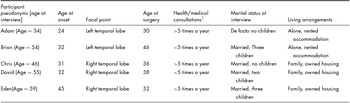
The participants were five males with a clinical diagnosis of AOES, and who had undergone neurosurgery within the past 6–15 years with the intention to reduce seizure activity (see Table 1 for demographics criteria). These participants were recruited for the study with the assistance of Epilepsy Australia as well as personal contacts of the first listed author who himself is an individual living with AOES. The Epilepsy Australia or organisation posted an open invitation for the study in their autumn 2012 newsletter. The invitation included information on study aims, selection criteria, and practical information including potential time and location for interview, and interview options (which included telephone and online interview).
Study participants characteristics

1 Note. The men consulted with a clinical neurologist and a psychologist.
Those who self-identified for the study contacted the first-listed author to set-up for an interview at a location and time of their convenience. The research used a case-study design where the experiences of a small number of participants were explored in depth for richness of description rather than rather than for generalisation of findings.
Data Collection and Procedure
In this study, we used open-ended interviews to gain insight into coping strategies used by men living with AOES following elective neurosurgery. All interviews were conducted in the 6-month period between October 2012 and March 2013. One-on-one or face-to-face interviews were conducted by the first listed author with each of the participants on their experiences living with AOES. Grand-tour (or broadly scoped) type of questions were asked to stimulate open conversation about the effects of epilepsy and neurosurgery on their participation in elected life roles. The grand tour questions were framed thus: ‘Tell me what it felt like to live with adult onset seizures, for which you had surgery. Tell me what comes to mind. There is no importance to what comes first’.
These questions were followed with more focussed questions on the specific aspects of lived experience with AOES, which the participants elected to answer (see appendix for preliminary list of questions). This two-layered interview strategy allowed for further relevant questions to be asked, which were pertinent to each of the participant's experiences. The questions were developed from a review of the literature on SWB with chronic health conditions (e.g., Bond, Mpofu, & Millington, Reference Bond, Mpofu and Millington2015; Diener, Oishi, & Lucas, Reference Diener, Oishi and Lucas2003; Diener & Ryan, Reference Diener and Ryan2009; Dune & Mpofu, Reference Dune and Mpofu2015; Kvale, Reference Kvale1996).
The broad questions focussed on AOES-related coping strategies across life domains: family, work, health care consultation, and community. The data collection instrument was piloted for language and conceptual accessibility on three people with AOES who had undergone neurosurgery treatment, but were not participants in this study. Each interview was audio recorded and transcribed verbatim, with cross-checking of transcriptions by the lead author and second listed author for accuracy.
Data Analysis
Data were thematically analysed to capture personal interpretations of the coping strategies the men with AOES purported to use and how these related to their SWB. After the interviews were transcribed verbatim, the study data were analysed using a line by line analysis (Luborsky, Reference Luborsky, Gubrium and Sankar1994). Line-by-line analysis comprised of a thorough reading of transcripts, followed by a division of the data into significant analytical entities (segmenting the data). Once meaningful segments were identified, these were then coded into themes and sub-themes. Pseudonyms (Adam, Brian, Chris, David, and Eden) were used for the data reporting the five participants’ experiences. Differences in data segment assignment were resolved by consensus between the first and second listed authors while the third and fourth listed authors re-checked alignment of data segments to their assigned themes. The lead author engaged participant members in verification of the interpretations reported in this study.
Ethical Considerations
The Human Research Ethics Committee of the University of Sydney approved the study. Participants individually consented to the study in writing. They were informed that they could withdraw from the study at any time without penalty. They could also contact the second listed author, who was the study's chief investigator, if any concerns or needs for counselling support arose while participating in the study.
Findings
A total of five males completed in-depth interviews – three of whom lived with family. Only one of the men was participating in (part-time) employment. Four of the men relied both on disability support pensions and their partners for financial support. Two of the men (Adam and Chris) were said to be seizure free post-surgery. The other three men self-reported partial seizure control. Adam, Chris, and David reported to be presently consulting with their neurologist on a yearly basis and with their general clinician at least once every 6 months. Brian and Eden saw their neurologist once every four months. Brian also consulted his psychologist on a monthly basis.
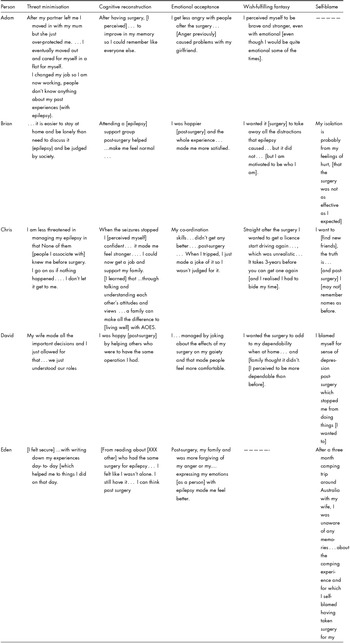
Five themes emerged from the thematic analysis to explore and describe the coping strategies self-reported by the five men with AOES, and how these related to their SWB post-surgery: threat-minimisation, cognitive reconstruction for meanings with AOES survivorship, emotional acceptance and wish fulfilling fantasy, and self-blame (see Table 2). Cognitive reconstruction, emotional acceptance, threat minimisation strategies, and wish fulfilling fantasy tended to have largely positive effects on the men's SWB, whereas self-blame seemed to generate a negative sense of wellbeing.
Cognitive coping strategies of participants

Threat Minimisation, Self-blame, and Social Isolation
The men living with AOES spoke about contending with many threats to personal functioning not only from the unpredictability of seizures, but especially from social role marginalisation. For instance, all five men reported anxieties around their family relationships as follows:
My partner was embarrassed that I was on [disability] pension after surgery. . . [and so] she didn't want her friends to see us together (Adam)
My two brothers said. . .Tell me why you are still sick and have no energy? You need to get more exercise. . .my sibling brothers were thinking [the epilepsy] would go away [with surgery] like going and playing a game of tennis. They were embarrassed because I couldn't do things with them anymore and so they just stopped wanting me around (Adam).
[My parents] never asked how I'm doing. I am never asked, whether I have or haven't had a seizure (post-surgery). It's like been and gone. . .I cannot even ring my parents to talk about this. . .One of my siblings . . .has never wanted to know. He has acted as if I had just a cold. . . (Brian)
I am now afraid of starting a new relationship because of financial stress and pressure that will accompany the inability to maintain full-time employment (Brian)
My wife's parents belittled me and told her she was wasting her time and would eventually be hurt if she stayed with me (Chris).
At first my sister did want to understand it [epilepsy and the need for surgery]. . . (but in the end), it was too much hard work (for her to continue doing so). She was happy with her own (immediate) family, so she didn't need any other family activities in her life (David).
My brother has kept a big distance from me. In fact, all three presently still don't discuss epilepsy or the operation with me. They seem uncomfortable when I'm around their children and they just won't talk about it (Eden)
The men reported perceived threats to their SWB from health care providers, perceiving that providers were more invested in their own technical care procedures than in the person they were treating:
[as for the specialists], their attitude after surgery is they don't have time to address anything. . . .You do not get any direction from the doctors. (Adam).The men reported perceived threats to their SWB from health care providers, perceiving that providers were more invested in their own technical care procedures than in the person they were treating:
[The specialists] . . .cause you to feel isolated because they don't tell you about your own condition. . . . .My clinician gets the information from my neurologist but refuses to share it with me. (Chris).
I even spoke to the epilepsy coordinator at the hospital [requesting information about my condition] and she wouldn't tell me. (David)
Access to rehabilitation after the surgery (for epilepsy) . . .would [help] but they [health care providers] don't have the . . .time or interest following [up with you].
The major exception was the case of Brian who reported positive experiences with health care providers:
My neurologist gives me the time to answer my questions which means I feel comfortable after [consultation]
However, his experience with other health care providers was mixed:
I spoke with a psychologist who helped me get my pension but I wasn't told anything that helped me understand [my condition].
In an attempt to minimise any of the threats to their personal and social functioning, these men sought out as normal a life as possible, regardless of previous damaged family relationships that had arisen from having experienced such a debilitating and stigmatising health condition. For instance, Chris reported minimising threats from day-to-day living with epilepsy as follows: ‘I go on [behaving] as if nothing has happened. . . . I don't let it [consequences of symptoms with surgery] get to me’. Adam minimised the social threat from workplace stigmatisation by ‘hiding from workmates [due to his] past experiences [with epilepsy] . . . .’ and ‘holding to the belief that the symptoms would remain manageable’. Similarly, Chris minimised threats by physically relocating to a new and distant neighbourhood:
I needed to get away from the people I knew before the operation. Now that I live [up here] . . .over 500 miles from where I lived when I had the operation, I have a completely new life. I have a new group of friends [in my new neighbourhood]. . .I no longer need to discuss the condition or operation to these new people.
Self-isolation was another maladaptive threat minimisation strategy. Brian observed that: ‘I am on my own and feel that I need time on my own. . . . .’
He reported social isolation as a coping strategy to minimise the threat of negative social judgement that was shown towards him when experiencing epilepsy. He claimed, ‘it is easier to stay at home and be lonely than need to discuss [epilepsy] and be judged by society’. Chris reported the experiencing of poor short-term memory following surgery as leading to social isolation. He chose to blame himself for losing close social contact by saying, ‘I understand now that it wasn't their fault that I didn't remember their names. . . it's mine’. David reported experiencing post-surgery symptoms of hypervigilance:
I want to be able to make my own decisions and be confident doing so. I blamed myself for [AOES related] depression stopping me for doing things for some time, like making decisions.
The self-blame resulted in unwanted social isolation for David.
Cognitive Reconstruction
A recurrent coping experience for the men following neurosurgery for epilepsy was cognitive reconstruction or trying to makes sense of what level of functional recovery each of them self-perceived to have and which was important for their self-management post-surgery. As an example of cognitive reconstruction, Adam ‘often questioned [his] memory [as to] whether it was ever going to get better. . [self-perceived to] remember like everyone. . . .’ – which positive ability self-perceptions in-turn enhanced his social participation.
Brian eased back into ‘playing gigs and earning an income [and] doing what is important [to him] post-surgery which . . . made [him] more satisfied [than before]’.
David reported seeing his experiences with AOES and surviving neurosurgery as an important factor for supporting others experiencing similar circumstances. He was now able to view his experiences as making him a resourceful person who could offer support to others within the community also living with AOES. He said: ‘I was happy [post-surgery] to help others who were to have the same operation I had’. However, peer support did not seem to work for Adam who reported being rejected by other support group members for ‘being seizure free’. ‘I was going to take part in these [epilepsy support] groups after I was back on my feet, but was disappointed by the reactions of them all. Suddenly I was labelled by it [AOES] even though they [seizures] had stopped. There was now this shame or humiliation. They didn't want me back’.
Eden observed positive role functioning with his children post-surgery: ‘Before the surgery my children needed to care for me as I did for them. After the surgery, with the seizure stopping it was no longer necessary’.
Emotional Acceptance and Wish Fulfilling Fantasy
The men living with AOES identified emotional self-acceptance as enhancing their sense of wellbeing. In this regards, the participants spoke of a variety of survivalist emotional self-acceptance expressions as follows:
[I perceived] greater [family] respect. . .” from “accepting myself as a person . . .successfully living with AOES [Eden].
Chris recognised and accepted the emotions around the dis-coordination that resulted from the neurological surgical procedure. He said,
My co-ordination skills were pretty bad after the surgery, which often saw me losing my balance. Whenever I tripped, I just tried to make a joke out of it so that I wasn't (psychologically) affected by how others judged me for my lack of (physiological) co-ordination that came after surgery.
Similarly, David reportedly utilised humour to manage his emotions around living with the effects of epilepsy thus: ‘When I did something like lost my balance and tripped, I'd make a joke of it. It made people feel more comfortable’.
Brian reported engaging in wish fulfilling fantasies or the belief that as a result of surgery his epilepsy symptoms would eventually diminish, allowing them him to lead as normal a life as the typical other. He said, ‘I wanted it [surgery] to take away all the distractions that epilepsy caused. I wished for people to accept that it [surgery] stopped them [seizures] and I would be able to return to the music industry. It needed to be like I was starting a new career, which I felt I could do’.
However, he acknowledged the fact that others may not have perceived him differently, despite the potential from of surgery to reduce his susceptibility to seizure symptoms. Brian further observed:
But it [surgery] didn't change how people saw me . . .in that they believed him to be with at significant social risk from epileptic seizures. This was despite the fact that overall, Brian perceived himself to be coping more successfully with the psychological aspect of living with seizure post-surgery.
Self-blame
Brian, Chris, David, and Eden practised self-blame from seeing themselves as being at fault for choosing to undergo the elective surgery. Each claimed that it came with significant costs, including poorly influencing short-term memory. For example:
Brian self-blamed for over-loading his wife with the decision making role, being unaware of this until she left him, presumably in frustration:
I was happy that my wife helped me to make decisions but did not realise she hated doing that until she left.
Further, Brian reported experiencing difficulties reaching out to prospective sexual partners, with fear of self-embarrassment occurring due to his difficulties with short-term memory loss, which continued post-surgery. He claimed:
I still want to have sex like everyone else, that hasn't changed. But you can't exactly talk to a woman for 2 hours and then say ‘What is your name again?’ It's a lost opportunity.
Chris practised self-blame for socially distancing himself from family, believing the AOES to be a personal rather than family matter. He reported feeling nervous in the presence of family-of-origin members resulting in unhappiness and poor self-perception. For instance, he said of his self-blaming:
This [self-blaming] now affects my confidence when I go to family events, like a barbeque at my sister's place if they [other siblings] are there. I ‘m not motivated to do so. If I do, I don't offer my help to cook when they are there. This has negatively impacted my happiness and motivation.
Eden self-blamed for co-workers seemingly not accepting him back into his workplace role:
I don't think they [fellow employees] expected me to have the same memory problems after this surgery. I lost the respect of co-workers because [of memory lapses] after surgery. My fellow employees expected me to recover much quicker and so I was labelled as being lazy and no longer reliable.
He also self-blamed for being forgetful of places he had visited on holidays with family, which meant that he had lost cherished memories.
Discussion
This study explored the views and experiences of men living with AOES and specifically their sense of wellbeing following neurosurgery that aimed at reducing, if not eliminating seizure experience. Findings suggest the men with AOES were socially stigmatised even after elective surgery despite the prospects of good seizure control with neurosurgery. The findings of this study are consistent with the view that social context may impact personal functioning with CID more than the objective functional limitations from the illness per se (Bond et al., Reference Bond, Mpofu and Millington2015).
The men with AOES reported utilising threat-minimisation as a means to lower preoccupation with restrictions on participation in major life tasks and the unpredictability of their symptoms. This finding is consistent with that by Biddle (Reference Biddle, French, Vedhara, Kaptein and Weinman2010) who reported higher wellbeing from threat minimisation if it enabled adaptive coping with CID. However, threat minimisation may be harmful when social isolation or the efforts to hide one's CID leads to the failure to express how the condition is presently affecting the individual. Especially to others who might play an instrumental role in the successful management of their condition, such as a medical specialist (Bankhead et al., Reference Bankhead, Brett, Bukach, Webster, Stewart-Brown, Munafo and Austoker2003; Braiker, Reference Braiker2006; Bressi et al., Reference Bressi, Cornaggia, Beghi, Iandoli and Invernizzi2007; Croyle, Sun, & Louie, Reference Croyle, Sun and Louie1993).
Findings from this study suggest the men with AOES are at risk of social stigmatisation, even following the successful remission of seizure symptom as a result of surgery (see also Poochikian-Sarkissian, Sidani, Wennberg, & Devins, Reference Poochikian-Sarkissian, Sidani, Wennberg and Devins2008). Unmitigated self-blame with epileptic seizures has been associated with high psychological distress and risk for poorer coping with the condition (Bressi et al., Reference Bressi, Cornaggia, Beghi, Iandoli and Invernizzi2007). Minimisation of threats for healthy ego functioning may also reduce the tendency to self-blame in the face of significant health challenges potentially resulting in more social engagement and less experience of stigma.
The findings suggest the men with AOES utilise cognitive reconstruction for positive thoughts about living with AOES for a higher sense of SWB. According to Gandy, Sharpe, and Perry (Reference Gandy, Sharpe and Perry2012) and Jacoby, Ring, Whitehead, Marson, and Baker (Reference Jacoby, Ring, Whitehead, Marson and Baker2014), positive reframing of disability experience is important for wellbeing. This typically would be in the form of self-perceptions, with the survivor using coping skills and willingness to try out new ways of relating to the self and the external environment (Asadi-Pooya, Schilling, Glosser, Tracy, & Sperling, Reference Asadi-Pooya, Schilling, Glosser, Tracy and Sperling2007; Livneh et al, Reference Livneh, Wilson, Duchesneau and Antonak2001). The reconstructions experienced by some of the informant participants are consistent with this view.
Emotional self-acceptance was a coping resource for the men with AOES. This is likely explained by the fact that with emotional self-acceptance, survivors of epilepsy may fully experience their bodily sensations without trying to change, control, or avoid the sensations important for orienting themselves to possible seizure experience. For instance, the men with emotional self-acceptance may be less anxious about seizure expression; making it likely that they would emerge from a seizure event with appropriate composure. Emotional self-acceptance is also adaptive in enabling personal growth from one's own internal experiences (Eifert & Heffner, Reference Eifert and Heffner2003).
Implications for Rehabilitation Interventions
Findings of this study suggest that psychosocial factors influence SWB with AOES across seizure types, the period since onset, and clinical consultation arrangements (see also Elliott, Reference Elliott2014). The individual's personal sense of control or agency is of overarching importance to successful living with AOES following neurosurgery. That being the case, rehabilitation support interventions with individuals with AOES should focus on the psychosocial supports for healthy living with epilepsy. Psychosocial factors that carry a higher risk for lower SWB with neurological disease include past psychiatric history, social factors such as social isolation and functional impairment (Ng, Chan, & Straughan, Reference Ng, Chan and Straughan1995; Ouimet, Primeau, & Cole, Reference Ouimet, Primeau and Cole2001; Tenev, Robinson, & Jorge, Reference Tenev, Robinson and Jorge2009). Support interventions for healthy psychosocial functioning with AOES should build on the person and environment assets that the individual with epilepsy can draw on as resources for living well with seizure disorder. Specifically, rehabilitative interventions that aim to enhance a sense of coping, positive emotions and contentment, self-development, purposeful engagement, and a meaningful life hold strong promise with the population of people with seizure disorder (Jacoby et al., Reference Jacoby, Ring, Whitehead, Marson and Baker2014). These psychosocial factors potentially would explain SWB in people with AOES across life domains (Jacoby et al., Reference Jacoby, Snape and Baker2009; Reference Jacoby, Ring, Whitehead, Marson and Baker2014).
Health care providers for people with AOES could be more person-oriented. Bond et al. (Reference Bond, Mpofu and Millington2015) reported on the importance of health care providers to involve people with CID in decisions about their own care. This is likely to result with patient education about their specific health condition as a basis for working with the patient to explore treatment options that would work for the patient (Bordenheimer, Lorig, Holman, & Grumbach, Reference Bordenheimer, Lorig, Holman and Grumbach2002). However, health care providers need to also take into account the level of patient comfort with details regarding the prognosis with AOES in as much as overly positive recovery projections could be as misleading as overly negative ones (Sweeney, Melnyk, Miller, & Shepperd, Reference Sweeny, Melnyk, Miller and Shepperd2010). For people with epilepsy who experience optimal rehabilitation and psycho-education from their health care providers, confidence and independence can be developed (Wedlund, Nilsson, Tomson, & Erdner, Reference Wedlund, Nilsoon, Tomson and Erdner2013).
Strengths and Limitations of the Study and Suggestions for Further Research
Strengths of the study include its use of a multiple case study approach in which a number of case studies were considered together to understand the impact of AOES on SWB but without losing the individuality of the perspectives. With use of a multiple case study approach, each case potentially contributes to clarifying the lived experience with CID increasing the authenticity of the findings at the individual personal level. A related strength of the study was its use of insider perspectives.
As the researcher who interviewed the participants in this study had personally experienced the diagnosis of epilepsy at the age of 20 and was to later experience two left-hemisphere partial temporal lobectomy procedures, this insider perspective strengthened his understanding of what each of the participants told him and continued to experience. As the participants were aware of this before the interview, this facilitated their feeling that the researcher was similar to them and could understand the circumstances they faced. Each participant felt comfortable discussing their story and was happy that the researcher was placing this into a written format.
A limitation of this study is that most people who read this article will not hold the same understanding and perception as a researcher with a lived experience of this subject matter. Some may question whether an individual who had personally experienced this subject matter could provide non-biased results. This was addressed through member checking by other members of the research team and by consciously reporting what the participants said and not a representation of the researcher's own experiences. As this was a case study design focusing on men, generalisation on the results is limited. Further research will focus on adult women and children with epilepsy who experience these circumstances and whether similar or varied effects on SWB are present following neurosurgery.
Conclusion
The men with AOES who received neurosurgery perceived themselves to be successfully coping in major life domains, despite role marginalisation by family, co-workers, and health care providers. Seizure control with surgery did not seem to assuage the men's experience of actual or perceived social stigma and sense of being devalued by others. Coping strategies of cognitive reconstruction including adopting positive thought patterns and beliefs appear to enhance SWB among people with AOES who had neurosurgery. Self-blame for continuing epilepsy related stigma post-surgery was less adaptive and associated with lower SWB. Optimising SWB in people with adult-onset epilepsy would involve attending to their accessible and prospective personal as well as environmental assets for health and wellbeing.
Appendix
-
1. How is your everyday living influenced by living with epilepsy? Describe with examples involving how others reacted to you from having Adult-Onset Epilepsy after neurosurgery?
-
2. What changed for you following the surgery? (If so: What were the differences? How did that make you feel?
-
3. What help did you receive from the specialists and following the surgery? How did that make you feel?
-
4. How do you perceive yourself since surgery for adult-onset seizure? Speak to any aspect important to you over the period since surgery? How is it different now?
-
5. What do you perceive to be the others’ knowledge about epilepsy and adult onset seizures from their interaction with you?
-
6. Do you have any questions at all that you would like to ask me?