Introduction
Galerucella placida Baly (Coleoptera: Chrysomelidae) was first recorded in Punjab (Baly, Reference Baly1878). This insect has been reported in Bangladesh, Nepal, Sri Lanka, Burma, Thailand, Laos, Vietnam, Sumatra and Java (Maulik, Reference Maulik1936; Kimoto, Reference Kimoto1989; Hnatiuk, Reference Hnatiuk1990; Beenen, Reference Beenen1998). Ding et al. (Reference Ding, Fu, Reardon, Wu and Zhang2004) observed the presence of G. placida from Polygonaceae plants (P. perfoliatum L., P. lapathifolium L. and P. hydropiper [L.] Delabre), in China between 1996 and 2001. The insect has also been reported in Australia feeding on Persicaria hydropiper (L.) Opiz. in 2000 (Reid, Reference Reid2001). Furthermore, the insect was noted on Polygonum glabrum Willd (Polygonaceae) in different parts of India (Kashmir, Bihar, West Bengal, Uttar Pradesh and Tamil Nadu) at the beginning of the 19th century (Maulik, Reference Maulik1936). The insect is considered a potential biocontrol agent of the rice-field weed, Polygonum orientale L. (Polygonaceae) in South East Asia (Malik and Barik, Reference Malik and Barik2015; Malik et al., Reference Malik, Karmakar and Barik2016b, Reference Malik, Mitra and Barik2017). Adult G. placida feed on the P. orientale leaves for 7–8 weeks, while larvae gregariously consume leaves for 3–4 weeks and go through four instars to complete larval development (Malik et al., Reference Malik, Das and Barik2016a).
Temperature is an important abiotic factor affecting growth, reproduction, distribution, abundance and phenology, as well as physiological responses in organisms (Zhang et al. Reference Zhang, Fu, Li, Zhang and Liu2015; Ali et al., Reference Ali, Rashid, Huang, Wong and Lei2017; Sarkar and Barik, Reference Sarkar and Barik2017). Temperature above the normal level is recognised as thermal stress for organisms. Cytochrome oxidase plays a vital role in tetravalent reduction of O2 to H2O for more than 95% of all oxygen used in animal cells, whilst at the same time univalent reduction of oxygen occurs both in enzymatic and non-enzymatic reactions, which leads to the production of a variety of reactive oxygen species (ROS) (Storey and Storey, Reference Storey, Storey, Denlinger and Lee2010). At favourable temperatures, a balance exists between the generation of ROS and the antioxidant processes in all living organisms. Adverse temperatures (low or high temperatures) can induce increased levels of oxidative damage in organisms and lead to oxidative stress, which ultimately leads to over-production of ROS (Lopez-Martinez et al., Reference Lopez-Martinez, Elnitsky, Benoit, Lee and Denlinger2008; Storey and Storey, Reference Storey, Storey, Denlinger and Lee2010). Excess ROS can lead to DNA damage (mutations, base deletions and single strand scission) as well as apoptosis (Storey and Storey, Reference Storey, Storey, Denlinger and Lee2010). Furthermore, ROS can cause lipid peroxidation (LPO) as polyunsaturated fatty acids within the lipids are a preferred target of ROS attack, which disrupts membrane fluidity (Apel and Hirt, Reference Apel and Hirt2004; Paital et al., Reference Paital, Panda, Hati, Mohanty, Mohapatra, Kanungo and Chainy2016). All living organisms have developed protective mechanisms for scavenging ROS, which includes small molecular antioxidants and enzymatic components, to prevent damage by ROS (Howe and Schilmiller, Reference Howe and Schilmiller2002). Antioxidative enzymes serve an important role in the scavenging of ROS. Catalase (CAT), superoxide dismutase (SOD), peroxidases (POD) and glutathione-S-transferases (GST) are the important antioxidative enzymes that serve essential roles in catalysis of the decomposition of either hydrogen peroxide (H2O2) or organic hydroperoxides using reduced glutathione (GSH) as a co-substrate (Felton and Summers, Reference Felton and Summers1995; Wang et al., Reference Wang, Oberley and Murhammer2001; Dubovskiy et al., Reference Dubovskiy, Martemyanov, Vorontsova, Rantala, Gryzanova and Glupov2008; Storey and Storey, Reference Storey, Storey, Denlinger and Lee2010). SOD, the most important antioxidant defence, results in the formation of hydrogen peroxide (H2O2) and oxygen (O2). CAT catalyses the disputation of H2O2 into oxygen and water, but CAT is unable to scavenge H2O2 at low concentrations. POD help to protect peroxidative damage in cells by detoxifying H2O2 into water (H2O) and oxygen. Increased amounts of LPO are a marker of oxidative stress, and the process of LPO causes the production of malondialdehyde (MDA). Hence, LPO could be measured indirectly by measuring MDA concentration (Lopez-Martinez et al., Reference Lopez-Martinez, Elnitsky, Benoit, Lee and Denlinger2008; Meng et al., Reference Meng, Zhang, Zhu, Wang and Lei2009).
Polygonum orientale weed grows excessively during October to February in the rice-field when natural populations of G. placida are available in the rice-field. Growers usually apply herbicides to control P. orientale weeds in the rice-field. However, intensive use of insecticides destroys the natural enemy populations of P. orientale weed and may lead to insecticide resistance and environmental contamination. For this reason, the use of the biocontrol agent G. placida against P. orientale weed may have some potential. Populations of adult G. placida begin increasing in the rice-field weed P. orientale during mid-October and become abundant during November to February but disappear from the field during mid-April in West Bengal, indicating that the G. placida can withstand thermal variation of the winter season. Hence, we studied the changes of the antioxidant enzyme activities, H2O2 and MDA under thermal stress between 9 and 24 °C (minimum and maximum temperature of the winter season) in the adult G. placida, to observe the oxidative stress and physiological responses of this insect species under various treatments.
Materials and methods
Insects
Galerucella placida adults (males and females) were collected from the P. orientale plants (4–8 weeks old) present in the Crop Research Farm (CRF) of the University of Burdwan, and maintained in 1 L glass jars, containing P. orientale mature leaves (2–4 weeks old) at 21 ± 0.5 °C temperature, 65 ± 10% relative humidity and 12 L: 12 D photoperiod in a BOD incubator (ADS Instruments and Tech., Calcutta). The natural condition of the leaves was maintained by keeping a moist piece of cotton around cut ends of leaves followed by wrapping with aluminium foil, and replacing the leaves daily with fresh leaves. The beetles were reared for five generations, and the sixth generation females were used in the thermal stress experiments.
Thermal stress
Eight adult G. placida (8–10 day old) females were transferred into a 5 ml cryovial and exposed at 9, 12, 15, 18, 21 and 24 °C for 1 h, after which the adults were allowed to recover at 21°C for 2 h. Adults kept at a temperature of 21 °C served as a control. The adults were frozen immediately in liquid nitrogen and stored at –80 °C until use. Each treatment was replicated five times.
Determination of hydrogen peroxide (H2O2)
Hydrogen peroxide (H2O2) was extracted and estimated by the spectrophotometric method described by MacNevin and Urone (Reference MacNevin and Urone1953). The treated insects were extracted with cold acetone (5 ml) followed by filtering through Whatman No.1 filter paper, and distilled water was added to this filtrate to make the volume 10 ml. 1 ml of 5% titanic sulphate (in 20% H2SO4) was added to this followed by addition of concentrated NH4OH (2 ml). The reaction mixture was centrifuged at 3743 g for 10 min and the pellet obtained was washed three times with acetone (5 ml), which was again centrifuged (cold) at 2599 g for 10 min and the pellet was dissolved in 2(N) H2SO4 (3 ml). The absorbance was measured at 420 nm against a blank in a UV-visible spectrophotometer. The activity of H2O2 was expressed as nmol mg−1 protein.
Extraction and determination of enzymatic antioxidants
CAT was estimated using the procedure described by Snell and Snell (Reference Snell and Snell1971). The treated insects were homogenized in a cold mortar with a pestle in 0.1 M sodium phosphate buffer (pH 7.0) containing 1% polyvinylpolypyrrolidone (PVPP) and the homogenate was centrifuged at 2599 g for 10 min at 4 °C, and the supernatants were selected for enzyme assays. 1 ml of enzyme extract was added to 1 ml of 0.5 mM H2O2 followed by incubation for 15 min at 37 °C. The reaction was stopped by adding 2 ml 1% TiSO4 (in 25% H2SO4). The assay mixture was centrifuged again at 2599 g and the absorbance of the supernatant was measured at 420 nm in a UV-visible spectrophotometer. The enzyme activity was expressed as U mg−1 protein.
To determine the SOD activity, the enzyme was extracted by homogenizing treated insects in pre-chilled 10 ml 100 mM Na-phosphate buffer (pH 6.8) containing 1% w/v PVPP and centrifuged at 3743 g at 4 °C for 10 min. The supernatant was used as enzyme source, and the enzyme activity was determined by measuring the photochemical reduction ability of nitro blue tetrazolium chloride (NBT) according to Giannopolitis and Ries (Reference Giannopolitis and Ries1977). The reaction mixture (3.2 ml) contained 0.05 M Na2CO3, 0.1 mM EDTA, 63 mM NBT and 13 mM riboflavin (riboflavin was added last). The assay mixture was placed under at 40W fluorescent lamp at a distance of 30 cm at 25 °C for 30 min and absorbance was measured at 560 nm against the non-irradiated sample in a UV-visible spectrophotometer. The enzyme activity was expressed as U mg−1 protein.
POD activity was determined according to Kar and Mishra (Reference Kar and Mishra1976). The treated insects were homogenized with a chilled mortar and pestle containing 5 ml of 0.05 M pre-chilled sodium phosphate buffer (pH 6.5). The homogenate was centrifuged at 104 g for 10 min at 4 °C, and the supernatant was used as enzyme source. The reaction mixture was prepared by mixing 2 ml of 0.1mM sodium phosphate buffer (pH 6.8), pyrogallol, hydrogen peroxide and 1 ml enzyme source. The assay mixture was incubated for 30 min at 37 °C, and the reaction was stopped by adding 0.5 ml 5% H2SO4. Absorbance was measured before and after incubation at 420 nm in a UV-visible spectrophotometer. The enzyme activity was expressed as U mg−1 protein.
POD activity towards pyrogallol (PPX) was determined according to Nakano and Asada (Reference Nakano and Asada1981) by measurement of the purpurogallin, which is a product of pyrogallol oxidation. The reaction mixture was 50 mM sodium phosphate buffer (pH 7.0), 40 µl enzyme extract, 180 mM pyrogallol and 2 mM H2O2. The absorbance was read at a wavelength of 430 nm in a UV-visible spectrophotometer, and the enzyme activity was expressed as U mg−1 protein.
POD activity to guaiacol (GPX) was determined according to the method described by Maehly and Chance (Reference Maehly, Chance and Glick1954) via determination of the tetraguaiacol, a coloured product of guaiacol oxidation. The reaction mixture contained 50 mM potassium phosphate buffer (pH 7.0), 100 µl enzyme extract, 20 mM guaiacol and 6 mM H2O2. Absorbance was measured at 470 nm in a UV-visible spectrophotometer, and the enzyme activity was expressed as U mg−1 protein.
Ascorbate peroxidase (APOX) activity was determined according to Nakano and Asada (Reference Nakano and Asada1981). The assay mixture contained 1 ml of enzyme extract, 0.5 mM ascorbic acid and 0.1 mM EDTA. Parallel experiments in the presence of p-chloromercuribenzoate (50 M) were performed to rule out any interference from guaiacol peroxidases. Absorbance was measured at a wavelength of 265 nm in a UV-visible spectrophotometer, and activity of APOX was expressed as U mg−1 protein.
Glutathione-S-tranferases (GST) activity was determined using 1-chloro-2,4-dinitrobenzene (CDNB) as a substrate by the method described by Habig et al. (Reference Habig, Pabst and Jakoby1974). The treated insects were homogenized in a cold mortar with pestle in 0.1 M sodium phosphate buffer solution (pH 6.5) and the homogenate was centrifuged at 2600 g for 10 min at 4 °C, and the supernatants were selected for enzyme assays. The assay mixture contained 0.1M phosphate buffer (pH 6.5), 0.1 ml 1mM GSH, 0.1 ml 1mM CDNB (in ethanol) and 1 ml of enzyme extract. Absorbance was measured at a wavelength of 340 nm in a UV-visible spectrophotometer, and activity of GST was expressed as nmol CDNB/min/mg protein.
Extraction and estimation of malondialdehyde (MDA) content
The amount of MDA was determined by the method of Heath and Packer (Reference Heath and Packer1968). The treated insects were homogenized in 0.1% trichloroacetic acid (TCA) solution followed by centrifugation at 15,000 g for 10 min, and the supernatant (0.5 ml) was added to 1.5 ml 0.5% thiobarbituric acid (TBA) in 20% TCA. This TBA–TCA sample mixture was incubated at 90 °C in a shaking water bath for 20 min, which resulted in appearance of a reddish colour. The reaction was stopped by placing the reaction tubes in an ice water bath. Samples were again centrifuged at 10,000 g for 5 min. Supernatant was collected and absorbance was measured at 532 nm in a UV-visible spectrophotometer. The value for non-specific absorption at 600 nm was subtracted. The amount of MDA-TBA complex (red pigment) was calculated using the extinction coefficient 1.56×10⁵ M−1 cm−1. The result was expressed as nmol mg−1 protein.
Determination of protein
The extraction of protein content from insects was done according to Le Bras and Echaubard (Reference Le Bras and Echaubard1977). Insects were homogenized in aqueous 10% TCA solution and the homogenate was centrifuged at 5000 g for 10 min at 4 °C. The pellet was washed with ether: chloroform mixture (1:1 V/V) and again centrifuged at 5000 g for 10 min at 4 °C. The pellet was then suspended in 1 ml distilled water. The amount of protein in the sample was determined by the method described by Bradford (Reference Bradford1976) using bovine serum albumin as the standard.
Statistical analyses
Data were analysed using one way analysis of variance (ANOVA) with SPSS software (version 11.0). Means associated with the data for each variable were separated using the Tukey–Kramer's HSD test when significant values (P < 0.05) were obtained (Zar, Reference Zar1999).
Results
H2O2 of G. placida
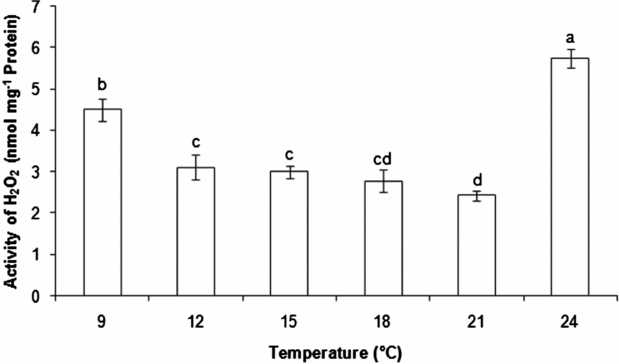
The concentration of H2O2 in G. placida adults was significantly affected by treatment temperatures (F 5, 24 = 30.219, P < 0.0001), which was highest at 24 °C (5.75 ± 0.23 nmol mg−1 protein) followed by 9 °C (4.50 ± 0.27 nmol mg−1 protein), and lowest at 18 °C (2.78 ± 0.27 nmol mg−1 protein) and 21 °C (2.42 ± 0.13 nmol mg−1 protein). However, the concentration of H2O2 did not differ significantly at 12, 15 and 18 °C (Fig. 1).
H2O2 content of Galerucella placida adults after different levels of thermal stress for 1 h. The temperature of 21 °C served as a control. Bars (N = 5, Mean ± SE) with similar alphabets are not statistically different at P < 0.05 (Tukey–Kramer's HSD test).

Antioxidative enzyme activities of G. placida
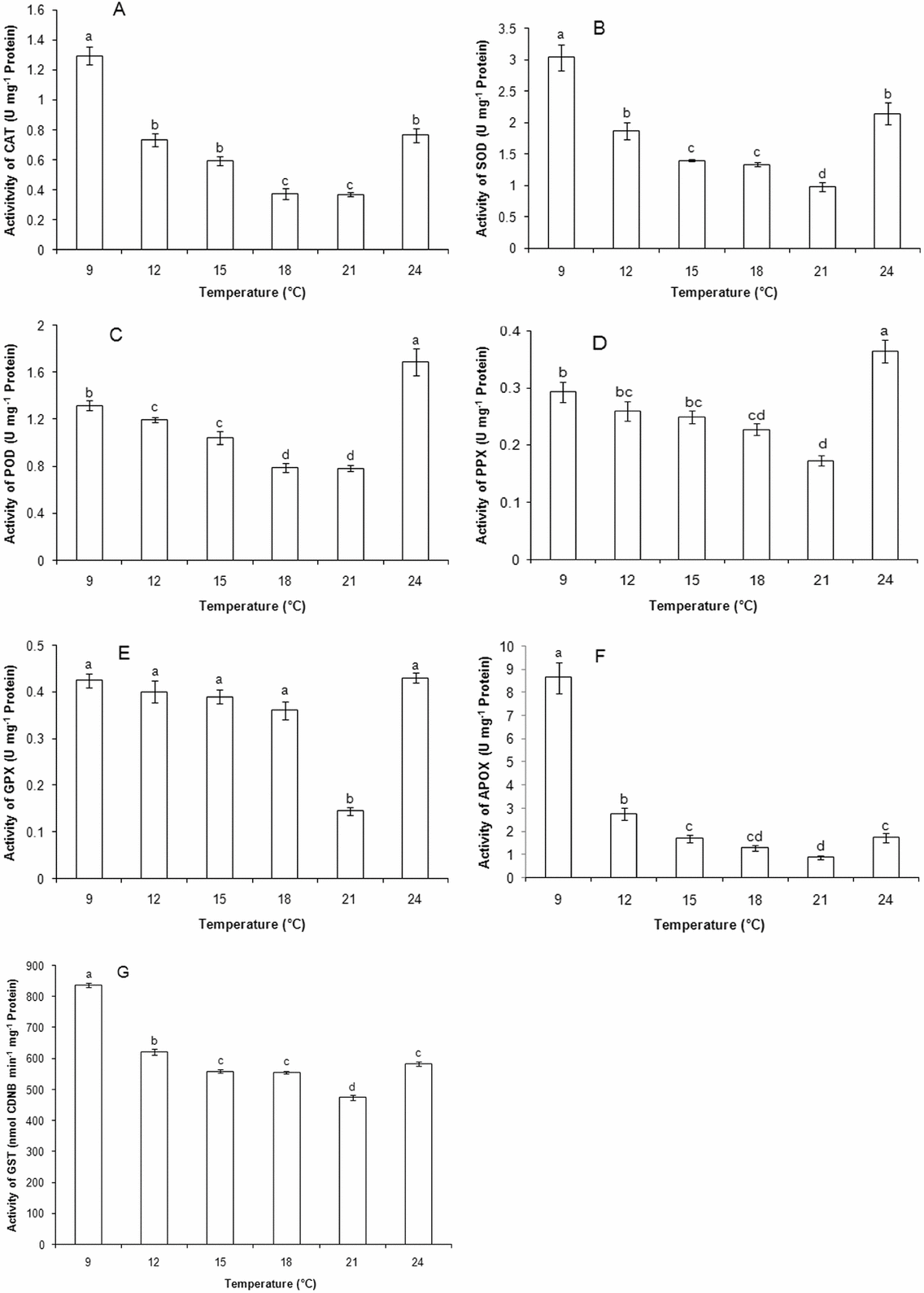
The results for CAT activity were significantly different among treatments (F 5, 24 = 69.381, P <0.0001), i.e. CAT activity tended to decrease with increasing temperatures up to 21°C (0.37 ± 0.01 U mg−1 protein) and then increased at 24 °C (0.76 ± 0.05 U mg−1 protein). CAT activity was highest at 9 °C (1.30 ± 0.06 U mg−1 protein) and lowest at 18 °C and 21 °C (Fig. 2A).
Antioxidative enzyme activities of Galerucella placida adults after different levels of thermal stress for 1 h. The temperature of 21 °C served as a control. Bars (N = 5, Mean ± SE) with similar alphabets are not statistically different at P < 0.05 (Tukey–Kramer's HSD test). (A) Catalase (CAT), (B) Superoxide dismutase (SOD), (C) Peroxidases (POD), (D) Pyrogallol peroxidases (PPX), (E) Guaiacol peroxidases (GPX), (F) Ascorbate peroxidases (APOX), (G) Glutathione-S-transferases (GST) activity.

The activity of SOD in adult G. placida was significantly affected in response to thermal treatments in the laboratory experiment (F 5, 24 = 32.419, P < 0.0001) (Fig. 2B). The SOD activity was highest at 9 °C (3.03 ± 0.21 U mg−1 protein) followed by 24 °C (2.14 ± 0.17 U mg−1 protein) and 12 °C (1.87 ± 0.13 U mg−1 protein), and lowest at 21 °C (0.98 ± 0.06 U mg−1 protein). There was no significant change in SOD activity at 15 °C (1.40 ± 0.02 U mg−1 protein) or 18 °C (1.33 ± 0.03 U mg−1 protein), which was lower than 12 and 24 °C (Fig. 2B).
Thermal stress had a significant activity on POD activity (F 5, 24 = 34.886, P < 0.0001). The activity of POD was highest at 24 °C (1.69 ± 0.12 U mg−1 protein) followed by 9 °C (1.32 ± 0.04 U mg−1 protein) and lowest at 18 °C (0.79 ± 0.04 U mg−1 protein) and 21 °C (0.78 ± 0.02 U mg−1 protein). No significant difference in POD activity was recorded at 12 °C (1.20 ± 0.02 U mg−1 protein) or 15 °C (1.04 ± 0.05 U mg−1 protein) (Fig. 2C).
The activity of PPX was significantly affected by temperature (F 5, 24 = 19.049, P < 0.0001), which was greater at 24 °C (0.36 ± 0.02 U mg−1 protein) and lowest at 21 °C (0.17 ± 0.01 U mg−1 protein). The activity of PPX did not differ between 9 °C (0.29 ± 0.02 U mg−1 protein), 12 °C (0.26 ± 0.02 U mg−1 protein) and 15 °C (0.25 ± 0.01 U mg−1 protein) (Fig. 2D).
The activity of GPX was significantly affected by treatment temperatures (F 5, 24 = 43.276, P < 0.0001). No significant change in GPX activity was seen between 9 °C (0.42 ± 0.02 U mg−1 protein), 12 °C (0.40 ± 0.02 U mg−1 protein), 15 °C (0.39 ± 0.01 U mg−1 protein), 18 °C (0.36 ± 0.02 U mg−1 protein) and 24 °C (0.43 ± 0.01 U mg−1 protein), but the activity of GPX markedly decreased at 21 °C (0.14 ± 0.01 U mg−1 protein) (Fig. 2E).
APOX activities were significantly different among temperature treatments (F 5, 24 = 85.806, P < 0.0001). The activity of APOX exhibited a remarkable increase at 9 °C (8.65 ± 0.67 U mg−1 protein) followed by 12 °C (2.76 ± 0.27 U mg−1 protein) and lowest at 21 °C (0.87 ± 0.09 U mg−1 protein). No significant difference in activity of APOX was found between 15 °C (1.70 ± 0.15 U mg−1 protein) and 18 °C (1.28 ± 0.13 U mg−1 protein) (Fig. 2F).
The activity of GST in adult G. placida was significantly affected by treatment temperatures (F 5, 24 = 277.136, P < 0.0001). Maximum increase of GST activity was found at 9 °C (837.39 ± 6.95 nmol CDNB min−1 mg−1 protein) followed by 12 °C (621.31 ± 10.24 nmol CDNB min−1 mg−1 protein) and minimum activity was found at 21 °C (474.02 ± 8.51 nmol CDNB min−1 mg−1 protein). There was no significant change in activity of GST at 15 °C (559.01 ± 6.24 nmol CDNB min−1 mg−1 protein), 18 °C (555.59 ± 5.0 nmol CDNB min−1 mg−1 protein) and 24 °C (583.69 ± 6.43 nmol CDNB min−1 mg−1 protein) (Fig. 2G).
MDA concentration of G. placida
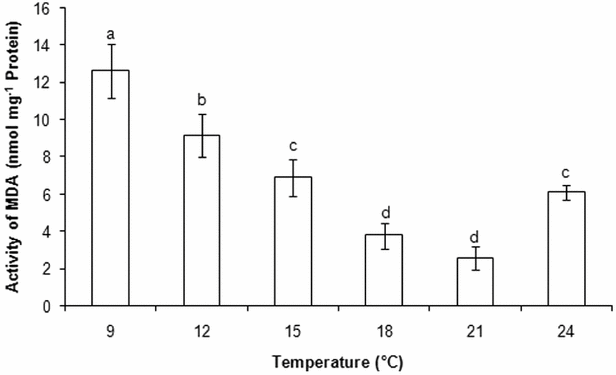
MDA concentration in adult G. placida had a significant effect in response to thermal stress in the laboratory (F 5, 24 = 13.790, P < 0.0001). MDA concentration was highest at 9 °C (12.62 ± 1.44 nmol mg−1 protein) followed by 12 °C (9.16 ± 1.14 nmol mg−1 protein) and lowest at 18 °C (3.79 ± 0.69 nmol mg−1 protein) and 21 °C (2.58 ± 0.62 nmol mg−1 protein), but MDA concentrations were not significantly different at 15 °C (6.91 ± 0.99 nmol mg−1 protein) and 24 °C (6.10 ± 0.38 nmol mg−1 protein) (Fig. 3).
Malondialdehyde (MDA) concentration of Galerucella placida adults after different levels of thermal stress for 1 h. The temperature of 21 °C served as a control. Bars (N = 5, Mean ± SE) with similar alphabets are not statistically different at P < 0.05 (Tukey–Kramer's HSD test).

Discussion
Physiological responses in invertebrates are influenced by temperature, which is one of the most critical abiotic variables (Bale et al., Reference Bale, Masters, Hodkinson, Awmack, Bezemer, Brown, Butterfield, Buse, Coulson, Farrar, Good, Harrington, Hartley, Jones, Lindroth, Press, Symrnioudis, Watt and Whittaker2002; Ali et al., Reference Ali, Rashid, Huang, Wong and Lei2017). Thermal stress induces oxidative stress in insects, and subsequently, elevated levels of ROS are produced to cope with the oxidative stress (Storey and Storey, Reference Storey, Storey, Denlinger and Lee2010). Yet, low levels of ROS are required to regulate normal signal transduction pathways in insects. To determine the oxidative stress and physiological responses of the adult G. placida exposed to relatively low or high environmental temperature, we measured the effect of temperature on the activities of antioxidant enzymes (CAT, SOD, POD, APOX, GPX, PPX and GST) and MDA. Furthermore, we measured the changes of H2O2 at lower and higher temperatures. The present study reveals that these parameters changed significantly under different thermal stresses with the adult G. placida.
MDA, one of the most important oxidation products of peroxidized polyunsaturated fatty acids has been assayed to record the degree of LPO, which serves as a biomarker of oxidative stress (Del Rio et al., Reference Del Rio, Stewart and Pellegrini2005). A significant gradual decrease in MDA concentrations was observed in G. placida adults with an increase of temperature, i.e. highest at 9 °C followed by 12 °C, 15 °C and lowest at 18 °C and 21 °C, and then a significant increase at 24 °C, similar to 15 °C, implicating that variations in production of LPO are due to unfavourable temperature. This observation also revealed that the level of MDA was twofold higher at 9 °C compared to 24 °C, suggesting that MDA serves as an indicator of much stress at lower temperature (9 °C) compared to higher temperature (24 °C) in adult G. placida, which is similar to other animals (An and Choi, Reference An and Choi2010; Yang et al., Reference Yang, Huang and Wang2010; Jena et al., Reference Jena, Kar, Kausar and Babu2013). The level of descending MDA at higher temperature (24 °C) in adult G. placida was probably as a result of the antioxidant system eliminating oxidative stress (Yang et al., Reference Yang, Huang and Wang2010). In the present study, the levels of H2O2 were highest at 24 °C followed by 9 °C, and lowest at 21 °C. These results also indicate that unfavourable temperatures resulted in the production of H2O2 due to stress in adult G. placida. Adverse temperatures are responsible for the over production of H2O2 in insects (Storey and Storey, Reference Storey, Storey, Denlinger and Lee2010).
The antioxidant enzymes (such as CAT, SOD, POD, GPX, PPX, APOX and GST) perform in a synchronized manner to neutralize oxidative stress produced by high concentrations of ROS inside the cell. CAT has been recognized exclusively for scavenging H2O2, because selenium-dependent glutathione peroxidase is absent in insects (Ahmad and Pardini, Reference Ahmad and Pardini1990; Sohal et al., Reference Sohal, Arnold and Orr1990). However, CAT scavenges H2O2 only at high cellular concentrations (Ahmad et al., Reference Ahmad, Duval, Weinhold and Pardini1991). In the present study, CAT activity in adult G. placida was higher at 9 °C, reached at the lowest level at 18 and 21 °C and then again increased at 24 °C. The higher amounts of CAT at 9 °C or 24 °C resulted in the enzyme's enhanced elimination of H2O2; and, hence, its prevention of cell damage by oxidative stress. Jia et al. (Reference Jia, Dou, Hu and Wang2011), Nabizadeh and Kumar (Reference Nabizadeh and Kumar2011) and Ali et al. (Reference Ali, Rashid, Huang, Wong and Lei2017) demonstrated that over-expression of CAT enhances the removal of H2O2 at both low and high temperatures in the oriental fruit fly Bactrocera dorsalis (Hendel), the silkworm (Bombyx mori L.) and the oriental armyworm Mythimna separata (Walker), respectively.
Furthermore, GPX is also associated with scavenging of H2O2 in association with CAT (Lijun et al., Reference Lijun, Xuemei, Yaping and Enbo2005). However, in the current study, the activities of GPX are low at all experimental temperatures compared to CAT, implicating that the activities of CAT are sufficient to cope with the stress induced by temperature (Celino et al., Reference Celino, Yamaguchi, Miura, Ohta, Tozawa, Iwai and Miura2011; Zhang et al., Reference Zhang, Liu, Wang and Wang2014). The activities of SOD were significantly higher at all the experimental temperatures except the control (21 °C), indicating that SOD was influenced by temperature changes thus helping to protect the beetles from thermal stress. Similar results were reported by Jia et al. (Reference Jia, Dou, Hu and Wang2011) and Ali et al. (Reference Ali, Rashid, Huang, Wong and Lei2017) in B. dorsalis and M. separata, indicating that SOD served an important role in reducing high levels of superoxide radicals generated by exposure to low and high temperatures. PPX is known to induce protective immunity in plants (Mai et al., Reference Mai, Tran and Nguyen2016). In the present study, we recorded higher amount of PPX at 24 °C followed by 9 °C, suggesting that the activities of PPX were greater at both higher and lower temperatures as a response to the stress induced by temperature.
In the present study, POD was highest at 24 °C followed by 9 °C in adult G. placida. But, POD did not vary significantly at 12 and 15 °C, which was higher compared to 18 and 21 °C. The results indicate that POD acts as an adaptive response of G. placida under the temperature stress to overcome high and low temperature-induced ROS toxicity. Furthermore, the results indicate that POD may serve a more important role in removing excess ROS when G. placida is exposed to high temperature (24 °C) stress compared to low temperature stress (9 °C). Zhang et al. (Reference Zhang, Liu, Wang and Wang2014) demonstrated that activities of POD increased significantly in the predatory mite, Neoseiulus cucumeris (Oudemans) at higher temperatures.
The activity of APOX increases with the elevated production of H2O2 due to stress (Claravon-Mathews et al., Reference Claravon-Mathews, Summers and Felton1997). APOX compensates for the reduced CAT levels and detoxifies the elevated levels of H2O2 (Barbehenn, Reference Barbehenn2002; Korayem et al., Reference Korayem, Khodairy, Abdel-Aal and El-Sonbaty2012). In the present study, APOX was three-fold higher in adult G. placida at 9 °C compared to 12 °C. No significant difference in activity of APOX was seen at 15, 18 and 24 °C; and furthermore, we failed to observe any significant difference at 18 and 21 °C. These findings reveal that the activities of CAT at 9 °C could not eliminate and detoxify the over-production of H2O2, but at higher temperatures when the activities of CAT increased, the activity of APOX declined. The increase and decrease of APOX during the present study indicates that apart from the reduction of H2O2, APOX might also act on peroxides and hydroperoxides. The activity of APOX has been reported in the whole body of Helicoverpa zea (Boddie) (Lepidoptera: Noctuidae) (Claravon-Mathews et al., Reference Claravon-Mathews, Summers and Felton1997) and Apis mellifera Linnaeus (Hymenoptera: Apidae) (Korayem et al., Reference Korayem, Khodairy, Abdel-Aal and El-Sonbaty2012).
GST, a group of multifunctional dimeric enzymes, might serve as a biomarker for assessing the impact of endogenous and xenobiotic compounds that generate oxidative stress (Monteiro et al., Reference Monteiro, de Almeida, Rantin and Kalinin2006; Board and Menon, Reference Board and Menon2013). The increased activities of GST were recorded at 9 °C followed by 12 °C, and 15, 18 and 24 °C in adult G. placida, implicating GST in the inactivation of toxic LPO products accumulated due to oxidative damage induced by lower and higher temperature stress. Similar findings have been demonstrated in Panonychus citri (McGregor) (Yang et al., Reference Yang, Huang and Wang2010), B. dorsalis (Jia et al., Reference Jia, Dou, Hu and Wang2011) and Antheraea mylitta Drury (Jena et al., Reference Jena, Kar, Kausar and Babu2013). Furthermore, Marutani-Hert et al. (Reference Marutani-Hert, Hunter and Hall2010) reported that GST plays an important role in removing toxic LPO products induced by lower and higher temperature stress in Asian citrus psyllid, Diaphorina citri Kuwayama (Hemiptera: Psyllidae).
Conclusion
This study reveals that thermal stress influences the redox balance, which induces production of oxidative stress products in adult G. placida. As an adaptive response to the fluctuating environmental conditions, adult G. placida subjected to low and high temperatures elevate their antioxidant defences. We demonstrated that low and high temperatures induce oxidative stress by producing higher concentration of H2O2 in adult G. placida compared to controls; and subsequently, induce changes in CAT, SOD, POD, PPX, GPX, APOX and GST activity to cope with oxidative stress at high and low temperatures. The level of SOD was higher than CAT and POD in adult G. placida at all temperatures tested, indicating that SOD plays a more important role in scavenging H2O2 to combat oxidative stress. The level of MDA was twofold higher at 9 °C compared to 24 °C, suggesting that MDA serves as an indicator of significant stress at lower temperature (9 °C). The present study is the first report on the antioxidant defence system in a potential rice-field weed biocontrol agent, G. placida. The findings provide useful information for mass rearing of the G. placida for predicting population dynamics and understanding the potential for G. placida as a potential biocontrol agent against the rice-field weed P. orientale.
Acknowledgements
We thank anonymous reviewers for helpful suggestions of an earlier version of the manuscript. We are thankful to C. L. Staines, National Museum of Natural History, Smithsonian Institution, Washington DC for identifying the insect species. The necessary instrumental facilities obtained from DST-PURSE Phase-II are gratefully acknowledged.