The large-scale proliferation of scientific publications and degrees since the 1960s has resulted in a series of practical as well as theoretical challenges. Pierre Bourdieu attributed the 1968 student protests in France to the “inflation” of diplomas (Bourdieu Reference Bourdieu1984, 217). The number of the citizens in the “republic of science,” to use Michael Polanyi's terminology, has increased dramatically (Polanyi [1969] Reference Polanyi, Mirowski and Sent2002). The quantitative growth is accompanied by an increasing specialization of scientific knowledge. Not only outsiders, but insiders as well, are often lost in a sea of information about past and current research findings.
In this context, the popularity of the notion of limited cognitive capacities should come as no surprise. In the initial formulation, Herbert Simon asserted that “attention rather than information [is] the scarce resource” (Simon Reference Simon1978, 13). Applied to the case of scientists, the idea of limited cognitive capacities transforms into the statement: “attention space is limited.” This deprives most scientists of nearly all chances of being heard and read, not to mention being understood (Collins Reference Collins1998, 38).
In these conditions, some scientists invent new strategies of deviant behavior in keeping with the principle that what is most important is attracting attention regardless of the scientific value of a byproduct, i.e. a proper scientific discovery, a critical comment, the refutation of a theorem, the observation of a new phenomenon, etc. The case of Hwang Woo-Suk, a South Korean biomedical scientist who was considered a world leading expert in stem cell research until November 2005, illustrates the idea of “scientific deviance.” Upon investigation, it turned out that the author of the “path-breaking” research whose results were reported in Science in 2004 and 2005 had “engaged in research misconduct and that the papers contain fabricated data” (Kennedy Reference Kennedy2006, 335). This critical case highlights a particular order of priorities: the need to remain the focus of attention even at the price of fabricating data (if the data that has not been “cooked” serves to attract attention, the conflict between the imperative of remaining in the spotlight and the principles of research integrity appear overshadowed).
Getting connected to three to six well established networks that can simultaneously share attention space in a discipline is another strategy for advancing a scientific career that is studied extensively in Randall Collins’ book. As Nikolay Rozov, the editor and translator of the Russian version of The Sociology of Philosophies notes, a “purely utilitarian reading of some of Collins's ideas. . . would switch the focus of attention from the philosophical problems to social combat” (Rozov Reference Rozov and Collins2002, 16).Footnote 1 Another critical case illustrates tensions accompanying this possible shift. In November 1991, Gang Lu, a graduate student, opened fire at a physics and astronomy department meeting at the University of Iowa killing five people and seriously wounding another before dying of a self-inflicted gunshot. The young astrophysicist's willingness to go beyond the theoretical framework developed by his supervisor led to his expulsion from a circle of the “privileged” and “well connected” and placed his otherwise promising career in jeopardy. In the final account, the conflict between the networking and purely scientific debates took extreme forms and resulted in atrocity (Overbye Reference Overbye2007).
Is there any viable alternative to the transformation of science into the art of attracting attention? A non-deviant response to the communication challenge in science would require attempts to improve communication channels and to reach some agreement as to the basic yet universal rules of scientific communication. This article should be considered a modest attempt to make some first explorative steps in this direction. In Section I, I will discuss the solutions that can be found on the basis of the dominant, neoclassical approach in economic science. The model of rational choice – a core element of neoclassical economics – states that rational actors aim to get more (utility, profit) for less (cost). Applied to science, this reasoning highlights the importance of cost associated with production and dissemination of knowledge. Thus, all other things being equal, there is a need to reduce the cost associated with scientific communication, or communication cost. The model of paradigm-based or “normal” science serves to save on these costs. This is common in the natural sciences and some social sciences, namely economics and psychology.
Section II will be devoted to the developments in the other social sciences with a special emphasis on semiotics. The non-paradigmatic nature of these sciences calls for solutions other than those offered by a new economics of science. The “semiotic” solution of the problem of communication consists in considering knowledge as a set of signs interpreted in a conventional manner. The concept of communication as a transaction will be explored in Section III. Here I will offer some thoughts on an alternative manner for handling the problem of scientific communication that can be called “transactional.” It derives from a combination of semiotics, Marxist philosophy, and institutional theory – the “old” institutionalism and the New Institutional Economics (NIE). In Sections IV and V, the idea of two registers of communication will be introduced along with the idea of freedom as the capacity to switch from one register to another. A case study of the Coase theorem, one of the most actively discussed topics in economic science, will be presented in Section VI for the purpose of demonstration.
I. Building a paradigmatic social science
The new economics of science, the approach pioneered by Partha Dasgupta and Paul David in 1994, views costs associated with scientific communication through the lens of asymmetric information: the economic actors (scientists) exchange a good (scientific knowledge) without having an equal amount of information about it. Scientific communication involves two types of scientists, the auctor, the creator of an original scientific work (see Bourdieu and Passeron Reference Bourdieu and Passeron1970, 73), and the lector, the transmitter and consumer of a pre-existing message.Footnote 2 Both of them have difficulties with assessing the exact value of the information, especially as far as new discoveries are concerned.
Scientific knowledge is an experience good par excellence (Holcombe and Holcombe Reference Holcombe and Holcombe1986, 686): its quality can be assessed only ex post, after it is “purchased,” when a scientist-”consumer” includes the new knowledge in her/his own research agenda.Footnote 3 At the moment of a scientific discovery, nobody but the pioneers can be sure that the results are worth disseminating. Discoveries are given a cold reception as a result of the asymmetry of information the “producers” and the “consumers” have about their value and potential uses. “It is easy to take ownership of a good that nobody understands and that has no utility outside its place of production” (Callon Reference Callon, Mirowski and Sent2002, 290). The asymmetry of information favors deviant strategies such as double-dealing: an insider who took part in a collective discovery can “trade” the information about it for other information provided by an interested outsider without sharing the latter with the other insiders (Dasgupta and David Reference Dasgupta, David, Mirowski and Sent1994, 236).
The reasoning in terms of asymmetric information suggests a way to reduce costs of communication in science. The solution involves the standardization and codification of scientific knowledge. Codified knowledge can be disseminated more easily and without biases. It has the characteristics of a pure public good: non-rival (additional uses do not reduce its value for the other users), non-excludable (the access to it cannot be restricted) and non-exhaustible (Dasgupta and David Reference Dasgupta, David, Mirowski and Sent1994, 227; Callon Reference Callon, Mirowski and Sent2002, 286). However, three new problems immediately arise. First, the problem of exchange transforms into one of production: self-interested economic agents have no interest in producing public goods. They tend to “free-ride,” i.e. wait until others produce them, as economists put it. If everyone adopts this strategy, public goods are simply not produced. Second, the codification and “normalization” of science is likely to produce redundancy: semantic variations on a well known theme are going to be more easily understood and more readily received than information about path-breaking and, hence, difficult to decipher research.Footnote 4 Third, the codification of scientific knowledge requires the existence of a common epistemological framework. In other words, the task of codification can take place only within a scientific paradigm.
Thomas Kuhn defines the scientific paradigm as “the body of belief [the researcher] could take for granted” (Kuhn [1963] Reference Kuhn and Barnes1972, 88). These beliefs that are taken for granted allow for codifying knowledge in a univocal manner. However, paradigm structures communications only within the natural sciences. “There is nothing quite like it in the arts, and the parallels in the social sciences are at best partial” (ibid., 86). The unified coding system available for natural scientists derives from three principal sources: empirism, laboratory technology that makes the technical repeatability of discoveries feasible, and mathematics as a problem-solving technique (Collins Reference Collins1998, 535ff.). A question then arises as to whether or not the arts, humanities, and social sciences can move toward adapting paradigmatic frameworks. An immediate corollary of the theorem of codified knowledge states that they should move in this direction.
Economists have been referring to the model of the natural sciences – physics and chemistry being close to their “ideal type” – since the very beginning of their discipline. “The laws of human action are not indeed as simple, as definite, or as clearly ascertainable as the law of gravitation; but many of them may rank with the laws of those natural sciences which deal with complex subject-matter” (Marshall [1890] Reference Marshall1920, Book I, chap. 4, §1). Economists tend to import concepts directly from the natural sciences, e.g. when conceptualizing economic agents as mechanical forces (Ménard [1988] Reference Ménard1989).Footnote 5 This paves the way for mathematical modeling, econometrical tests as a proof of empirical orientation, and laboratory experiments. Vernon L. Smith and Daniel Kahneman received the 2002 Sveriges Riksbank Prize in Economic Sciences in Memory of Alfred Nobel for their contribution to the development of experimental economics. This seems to confirm that the path economists have taken toward the natural sciences must be chosen by all other social scientists. Economists explicitly shaped the structure of the NIE, which addresses issues in history, sociology, law, and several other social sciences, in keeping with the model of the microeconomic paradigm. “Stable preference, rational choice, and equilibrium structures of interaction constitute the hard core of the microeconomic paradigm” (Eggertsson Reference Eggertsson1990, 5; emphasis added).
A closer look at the NIE convinces us that Kuhn's concerns about the applicability of the paradigm model to the arts, humanities, and social sciences are more than justified: there is no agreement even on the definition of a key concept, “transaction costs.” Broadly defined, transaction costs refer to everything not included in production costs: costs of contract-making, measuring the quality of goods and services, setting and enforcing property rights, etc. On the one hand, the question as to whether transaction costs include the costs of using only the price system as a centerpiece of the market or the costs of using alternative governance structures, namely the firm and the relational contracting, remains open (Ménard Reference Ménard and Oleinik2005, 47–8).
On the other hand, there are competing explanations for the sources of transaction costs: first, the assumptions of bounded rationality and opportunism understood as the search for profit with guile (ibid., 50–3). As long as the seller can cheat on the buyer whereas the latter fails to discover hidden vices of a product/service because of his or her limited capacities, including cognitive, to act rationally, there is a need for additional safeguards involving extra costs. Second, the distribution of transaction surplus gives rise to bargaining problems: each party tries to get the maximum share of it (Cooter Reference Cooter, Eatwell, Milgate and Newman1987). It is enough to recall how difficult and time consuming it may be to make a deal on the street market where price bargaining is permitted. Third, “critical” uncertainty arises as a result of the coexistence of several equally legitimate ways to justify the same action, specifically, there is no room for opportunistic behavior and transaction costs can be ignored if interactions occur within the same sphere of justification (Thévenot Reference Thévenot1989, 174–9).Footnote 6 For instance, high transaction costs on the blood market result from the co-existence of two types of donors: those who sell blood for money (and, hence, have a rational interest in not disclosing hidden vices of their blood) and those who donate blood because of solidarity considerations. Fourth, the lack of social embeddedness, or the under-socialization of economic actors (Granovetter Reference Granovetter1985, 485–7) also should be taken into consideration: the drift into opportunism (e.g., the willingness to return a lost item) is stronger in transactions with personally unknown people. And this list is far from exhaustive.
II. An alternative project of the humanities
The best defense, as the saying goes, is a good offense. The arts, humanities, and social sciences have their own “imperialistic” plans for facilitating communication in science. They develop their own general model of scientific knowledge and communication of an opposite kind from that elaborated on the basis of mathematics and the natural sciences. The project of the arts and social sciences involves developing the principles of semioses – sign producing acts or activities or behaviors – as a key to science and scientific communication as a whole (Schutz Reference Schutz1954; Bibler Reference Bibler1991). This approach is usually associated with the tradition of semiotics and structural linguistics started and developed by Ferdinand de Saussure, Charles S. Pierce, Mikhail Bakhtin, Roman Jacobson, Jacques Derrida, and Yuri Lotman, among others.
Unlike the natural sciences with their focus on the physical body and material objects as products of human activity, the humanities perceive human interactions indirectly, through the prism of the text, whether it is published, hand-written, spoken or simply thought. Human beings express themselves in the text – broadly understood – much better than in the body or material objects. The broad definition of the text as a set of signs puts visual images and material objects to which a particular meaning is attached in this category. Texts are created for the purposes of self-expression and communication. “We need . . . to grasp not merely what people are saying but also what they are doing in saying it” (Skinner Reference Skinner2002, 82; emphasis in the original). The individual “lives in a text outside of her or his (physical) existence; sees and hears her or himself through the other's eyes and ears because the major purpose of writing the text is to be heard” (Bibler Reference Bibler1991, 122).
Placing the text as a set of signs at the center of the analysis gives rise to an interest in codification and codified knowledge (signs and symbols), which makes this topic especially pertinent to the discussion of communication in science. In the case of paradigm-based science, codification is simply a by-product of scientific activities,Footnote 7 the advocates of the humanities argue that codification lies at the heart of any scientific activity and, indeed, any human activity. “Language is the primary modeling system and we apprehend the world by means of the model which language offers” (Eco Reference Eco and Lotman1990, x; emphasis in the original; see also Bakhtin Reference Bakhtin1979, 3, on an “artistic” model of the world). Viewed from this perspective, texts represent models of the world that are composed of meaningful signs and are actively used by scientists in making discoveries as well as lay people in everyday life.
Main-stream economic science disregards the “imperialistic” plans of the arts and social sciences. The supporters of the project of the humanities can be found in the camp of the “old” institutionalists (Pierce contributed to the development of both semiotics and the “old” institutionalism) and among the ranks of the least orthodox thinkers among the advocates of the NIE (Douglass North and his followers). The concept of shared mental models developed by the latter group borrows several features, although in a simplified form, from a semiotic way of reasoning. “Ideologies are the shared framework of mental models that groups of individuals possess that provide both an interpretation of the environment and a prescription as to how that environment should be structured” (Denzau and North Reference Denzau and North1994, 4). A rich heuristic and explanatory potential of the concept, which is underestimated by most economists, has been clearly demonstrated in a series of recent studies (see, for example, Yefimov Reference Yefimov2003; Zweynert Reference Zweynert2006). Of the two functions of shared mental models, interpretative and normative (North Reference North1981, 49; idem 1984, 35), the first is particularly suitable for studies in semiotics and interpretative sociology,Footnote 8 which provides good chances for forming an alternative to paradigm-based science.
However, while scientists agree that signs play an important role, they do not agree on how signs should be interpreted. A sign can be interpreted in a great many ways. This property of signs was noticed by Pierce who stressed their indefinite nature. “All sign relationships are, to some degree, either general or vague. The indefiniteness of a sign occurs because the relationship between the object and the interpretant is unclear, causing the interpreter to misunderstand the effect that the utterer intended the sign to have” (Dyer Reference Dyer1986, 544). No interpretation of a sign can be denied the right to exist. In its extreme form, this tendency leads to the complete relativism of post-modernity: everybody has his or her own truth, everybody is right.
When applied to communication in science, the tendency toward relativism takes the form of research focused on the description of the plural meanings of a sign. In other words, the criticism that “old” institutionalism has an excessively descriptive character still remains valid. For example, Mark Blaug attributes to the advocates of the “old” institutionalism the assumption that “a description is a theory, or, worse, that the more penetrating the description, the better the theory is” (Blaug [1962] Reference Blaug1996, 702; see also Nardinelli and Meiners Reference Nardinelli and Meiners1988, 549).
There are several strategies for organizing apparently divergent interpretations into a coherent system. The first strategy is based on the belief that a hierarchical order of competing interpretations is possible. Attempts to discriminate between the different interpretations, in order to rank them, would require the existence of a figure similar to the mythical commissaire-priseur of Léon WalrasFootnote 9 which embodies the principles and criteria for ranking. This presumably impartial judge would be entitled to determine which interpretation lies closer to the “true” meaning of a sign. An epistemological objection does not provide room for being too optimistic with respect to this manner of reasoning. Any criteria to be used in judgments are dependent on the conceptual framework. “The concepts we employ to report the facts will always serve at the same time to help determine what are to count as facts” (Skinner Reference Skinner2002, 45). Even within the framework of interpretative sociology, interactionist and feminist approaches will not necessarily refer to the same elements of reality for grounding their respective interpretations. “There is no a-theoretical yardstick with which the ‘distance’ of a theoretical model from the real world can be measured. . . . There is no possibility of an extra-theoretical court of appeal to judge theories” (Hodgson Reference Hodgson1988, 35, 44).Footnote 10
If absolute truth, i.e. the correct absolute interpretation of a sign, is unlikely to exist, then further steps along the semiotic path would require attempts to reach an agreement among the competing interpretations without granting a privileged status to any of them. Thus, the second strategy is described in terms of looking for a compromise between equally pertinent interpretations of the same sign. As a textbook on research methods in the social sciences suggests, good concepts are based on a shared reading of reality: “Concepts are constructs derived by mutual agreement from mental images” (Babbie and Benaquisto Reference Babbie and Benaquisto2002, 108; emphasis added). Steven Shapin refers to a “world-known-in-common” by members of a scientific community, or, in broader terms, any community of discourse (Shapin Reference Shapin1994, 37); Mary Douglas refers to a “thought-world” (Douglas Reference Douglas1986, chap. 1).
The decisive role of agreement is better understood in the context of the Thomas theorem and the discussion of self-realized prophecies that generate vivid interest on the part of sociologists and economists. In the initial formulation, as William I. Thomas put it, the theorem specifies the role of individual and subjective beliefs in interpreting reality: “If men define situations as real, they are real in their consequences” (see Merton Reference Merton1995, 380). In an extreme case, this affirmation provides us with some important insights about paranoid behavior (and Thomas had indeed considered such a specimen while formulating the statement that was later transformed by Robert Merton into the “Thomas theorem”). If an actor interprets a sign differently from everybody else, then using the actor's interpretation as a guideline to interpret action would result in paranoia. Under what conditions can the scientist generalize this particular case without the risk of being considered “paranoid” from an epistemological point of view?
The actor's belief in the “reality” of his or her interpretation has to be based on a convention. The notion of conventionFootnote 11 establishes a connection between the Thomas theorem and self-realized or self-fulfilling prophecies: the anticipated state of something “is simultaneously an outcome of the process of anticipation” (Orléan Reference Orléan1988, 237). The accordingly revised Thomas theorem states: if a group of individuals interpreting a sign reaches an agreement, the interpretation they agree on becomes real in its consequences. A “social mechanics” of the rate of interest discovered by John M. Keynes serves here as an illustration. “It might be more accurate, perhaps, to say that the rate of interest is a highly conventional, rather than a highly psychological, phenomenon. For its actual value is largely governed by the prevailing view as to what its value is expected to be. Any level of interest which is accepted with sufficient conviction as likely to be durable will be durable” (Keynes Reference Keynes1936, chap. 15, §2; emphasis in the original). An agreement among stock market traders, the major point of interest for Keynes, is usually reached spontaneously (see also Weil Reference Weil1989 for descriptions of agreement in terms of “animal spirits”). But must we always count on spontaneity and is spontaneous agreement at all possible, for example, in science during an age when papers and academic degrees proliferate?
III. Scientific communication as a particular case of transaction
If we are not to take agreement for granted, we need to go beyond the current subject-matter of semiotics and focus our attention not only on signs, but primarily on the communications established with the purpose of interpreting them. This can be done through critically rethinking communication and its institutional organization. The novelty of the approach developed here consists in putting forward not only negative (no sustainable interpretation of a sign can be achieved without communication) but also positive arguments.
A parallel can be drawn between the proposed shift of attention and that produced in economic theory by the “old” institutionalism. Neoclassical economics studies individual choices under the constraint of scarce resources (the NIE added the formal institutions existing in a society to the list of constraints). Economics “examines that part of individual and social action which is most closely connected with the attainment and with the use of the material requisites of wellbeing” (Marshall [1890] Reference Marshall1920, Book I, chap. 1, §1).
On the other hand, John Commons draws attention to interactions, negotiations between the individuals choosing between commodities. “Institutionalism is a relation of man to man. . . . The smallest unit of the institutional economists is a unit of activity – a transaction, with its participants” (Commons Reference Commons1931, 652–3; emphasis added). In a very similar way, a “transactional” solution of the problem of scientific communication implies shifting emphasis from signs to communication as transactions between human beings in the process of producing and interpreting signs. Communication is then understood as a person-to-person relation in the course of the interpretation of signs with the outcome being an agreement on what constitutes reality.
A similar shift in the focus of attention is underway in the history of science. When summarizing recent developments in this field and outlining a program for further research, James Secord interprets knowledge-making as a form of communication. “This means thinking always about every text, image, action, and object as the trace of an act of communication, with receivers, producers, and modes and conventions of transmission” (Secord Reference Secord2004, 661).
The necessity of communication can be demonstrated with the help of both the negative and positive arguments. The negative arguments – without agreement as to the interpretation of a sign, the transmission of available information is quite simply impossible – have been discussed above. Now we can turn to developing a positive argument: what are the positive incentives for scientists (as any other persons) to communicate? According to a preliminary hypothesis, communication is essential for the “creation of new information, that is, of texts which are not simply deducible according to set algorithms from already existing information, but which are to some degree unpredictable” (Lotman Reference Lotman and Shukman1990, 2). In other words, the production of new information involves at least two people, the actor and his or her interlocutor: “for intelligence to function there must be another intelligence” (ibid.). Extending this affirmation to the case of scientific communication will lead to a conclusion that neither the lector nor the auctor could bypass communication.
Lotman and Bakhtin are interested primarily in the creation of new information through the text, primary a literary text. For instance, Bakhtin conceptualizes a new format for the novel, the “polyphonic” one. According to him, the author to some extent loses control over characters that he or she has created because they act in an autonomous manner and represent points of view different from that of the author. Characters of a polyphonic novel develop and evolve in the process of communication with the other characters and the author. “An idea starts to exist as an independent entity. . . only by entering into dialogue with the other alien ideas” (Bakhtin Reference Bakhtin1979, 100; emphasis in the original). Outcomes of the novel are to some extent unpredictable, including for the author, as they refer to a new “value added” through communication.
The theme of the positive incentives for communication was extensively explored in the early works of Karl Marx (especially in his Economic and Philosophic Manuscripts of 1844) and of some unorthodox Soviet Marxists. Genrikh Batishchev, a Soviet philosopher and interpreter of Marx's writings, who worked from the 1960s through the 1980s, is one of them. His major work, a book on the dialectics of creativity and its embeddedness in communication, was published only posthumously because of the radically unorthodox arguments that it contains, namely that the meaning of one of the key concepts in Marxist thought, the mode of production and exchange (verkehrverhältnisse), was lost in the translation from German. A correct translation would be the mode of production and communication (verkehrweise: intercourse in the broad sense), which applies equally to the concept of production relations (Batishchev [1984] Reference Batishchev1997, 280–281, 296; see also Marx and Engels [1845–1846] Reference Marx, Engels and Ryazanskaya1968, chap. 1, Section “First Premises of Materialist Method,” the English editor's note).
For the purposes of this discussion, a pair of concepts, namely “objectification” (the process through which the product of human activity takes on a material form) – “de-objectification” (the reverse process: eliciting human origins and intentions from their materially embodied forms) might be revisited and rethought. It could be said that human activity is “embodied” in externally existing forms which include texts and material objects. In fact, material objects other than texts are signs too. The message is simply “encoded” in them in a different manner. Indeed, the task of de-objectification lies very close to the semiotic interpretation. De-objectification implies the “translation of the language of materially existing forms into that of communication as an activity. . . . [As a result] communication incorporates the logic of a material object and enriches with it” (Batishchev Reference Batishchev1969, 98). This assumption potentially transforms any product of human activity into a text subject to interpretation.
The semiotic reading of Marxist philosophy not only enlarges the scope of communication, it provides for a clearly positive argument for it. The above-mentioned plurality of the interpretations of a sign is an obstacle to the transmission of a message. Yet it becomes a rich source of the new meanings generated through the superposition of the alternative interpretations as far as the creative side of the text is concerned. “One and the same poem can be translated by different translators in many ways. . . . The text that is produced in these instances we shall term a new one and the act of translation that creates it a creative act” (Lotman Reference Lotman and Shukman1990, 14; emphasis added). Lotman calls any text subject to different interpretations “rhetorical” and opposes it to the “stylistic” text that can be univocally interpreted. The former generates new meanings (ibid., chap. 3) whereas the latter transmits existing ones.
The situation of an open and intense clash of interpretations (“truths”) is painful and extremely stimulating at the same time.Footnote 12 Individuals undergo a trying ordeal of their mental models. After all, these models are enriched by the forced necessity to react to others’ opinions, to take them into consideration without which it would be impossible to put an end to the radical uncertainty about the interpretations of a sign. “A problematic situation reaches a creative dimension if it is located at the intersection of the different traditions by merging them into a unique combination” (Batishchev Reference Batishchev1997, 138 and 32). Probably for this reason, Fyodor Dostoevsky was keen on observing the behavior of his characters at the threshold (porog) where they meet the other personages face-to-face as the bearers of different mental models and the authors of radically different interpretations (Bakhtin Reference Bakhtin1979, 85).
The proposed reasoning helps explain why inquiries crossing the traditional boundaries between scientific disciplines tend to be especially innovative. The clash of paradigms (in the natural sciences) or shared mental models (in the arts, humanities and social sciences) reaches a creative potential, it forces the search for a compromise. If the stylistic text seems appropriate for intra-paradigmatic communications, the findings of interdisciplinary research are usually communicated through rhetorical texts. The particularities of the style of Thorstein Veblen and many other “old” institutionalists, socio-economists, and “evolutionists” can probably be better understood by taking into consideration the peculiarities of the rhetorical style of communication.Footnote 13
IV. Two registers of communication
The problematic nature of communication in science can be interpreted in two ways. On the one hand, communication gaps occur as a result of the coexistence of the two types of texts, rhetorical and stylistic. Simplifying, one could say that they result from the contradictions between statics (the transmission of the interpretations of a sign on the basis of a pre-existing agreement) and dynamics (the creation of the new interpretations and the search for an agreement). A solution for the communication problems would spontaneously accompany the transition from the dynamic to static periods of scientific development. This belief will lead us back to the idea of paradigm-based research,Footnote 14 the non-universality of which was shown earlier, in Part I.
On the other hand, the communication gaps can be highlighted and understood by shifting attention from the issues of statics and dynamics to two levels or registers of interactions in which scientific communication occurs. The proposed conceptualization leaves aside many aspects which make up the richness of communication,Footnote 15 yet it arguably seizes key distinctive features of the two modes. On the first level, communication takes a personalized, localized, and face-to-face form. The interlocutor (at least his or her voice) is usually personally known and physically present. To borrow Hans J. Uldall's expression, the text is then embodied in “the stream of air” (quoted in Derrida Reference Derrida1967, 86). On the second level, an impersonal and delocalized form of communication dominates, the text – “the stream of ink” – is addressed to a personally unknown interlocutor situated out of physical reach. It will be shown that there are specific, communicational puzzles at each of these registers and, consequently, we should apply different strategies for finding their respective solutions.
Linguists, sociologists, and psychologists seem to accept the idea of the two registers of communication more easily than, for example, economists. Mainstream economics has never been characterized by any special interest in the interactions between participants that are socially and spatially close (Oleinik Reference Oleinik2004a, 85). The concept of perfect competition as a theoretical yardstick excludes any limitation of the number of the potential participants in market transactions (in the terms proposed, they are engaged in the interpretation of prices, the most important sign in the market). Even spatial economics studying the localization of economic processes in space, which was quite popular in the nineteenth century, has always remained “in almost total isolation of mainstream economics, whether classical or neoclassical” (Blaug [1962] Reference Blaug1996, 596). The NIE maintains this tradition of ignorance with the notable exception of North who considers the two registers of exchange as a key to understanding economic history. “Personalized exchange involve[s] small-scale production and local trade. Repeated dealing, cultural homogeneity . . ., and a lack of third-party . . . enforcement have been typical conditions. . . . A second general pattern of exchange . . . is impersonal exchange” (North Reference North1990 34–5; emphasis added).
The texts written by the advocates of the economic theory of conventions allow shedding more light on the differences between the two registers. Their authors differentiate between the most public regime of interaction and the “closest,” familiar regime of interaction. The interpretation made at the first level is subject to the judgment by the unknown Other, whereas, in the second case, the interpretation must fulfill the requirements of personal and local convenience. “Coordination of actions is unequally instituted. Even though institutions are based on the most legitimate conventions . . . many actions digress from the institutional format and borrow from other formats more favorable to closeness” (Thévenot et al. Reference Thévenot, Eymard-Duvernay, Favereau, Orléan, Salais and Oleinik2005, 37).
An example of two different manners of accommodating material objects studied by Laurent Thévenot seems pertinent in the context of the present discussion. While traveling, the individual can either stay in a hotel or, if offered, accept accommodation at a friend's home. The living space in a hotel is highly standardized because anyone should be able to learn it quickly and without special help. Conversely, accommodation at a friend's house would involve extensive learning and initiation into the local order of things and the ways of using them (Thévenot Reference Thévenot, Knorr-Cetina, Schatzki and Savigny2001, 57–61). As far as the interpretation of a sign is concerned, if it is done publicly, this process involves references to common knowledge. If done locally, in private, the interpretation is based on information with which only a limited number of individuals is familiar.
Writings in semiotics also make a significant contribution to our understanding of the topic.Footnote 16 Derrida attempts to show the divergent paths of speech and text, sound and logos, language and writing, phonology and grammatology (Derrida Reference Derrida1967). Lotman opposes the texts addressed to the unknown Other to those written to a personally known interlocutor. “A text addressed ‘to everyone’ (i.e. to any address) is, in principle, different from a text which is addressed to one particular person known personally to the speaker” (Lotman Reference Lotman and Shukman1990, 63; emphasis in the original). To be interpreted correctly, speech and hand-written texts require physical co-presence (otherwise, the messages contained in intonation, bodily kinetics, and facial mimics will be lost) or good knowledge of the interlocutor based on the experience of close face-to-face interactions in the past.
One observes the same two patterns in scientific communication. It would be a mistake to analyze only one of them as, for example, Collins who prizes personal, face-to-face communication between fellows, did. “Intellectual creativity is concentrated in chains of personal contacts, passing emotional energy and cultural capital from generation to generation” (Collins Reference Collins1998, 379). Communication through written text loses its specificity in such an analysis; it appears subordinate to “oral ritualism.” A similar criticism appears justified if face-to-face rituals are completely overlooked.Footnote 17 Unfortunately, very few inquiries into the history of thought pay equal attention to both registers of scientific communication, face-to-face and depersonalized. A history of psychoanalysis (Etkind Reference Etkind1993) and some biographical writings (e.g., Cole Reference Cole2003; Gerth Reference Gerth2002)Footnote 18 are among the rare exceptions. As a matter of fact, science has institutionalized the separation of the two registers of communication in the “double-blind” peer-review process.
The idea of the two registers helps differentiate between communication gaps, on the one hand, in face-to-face interactions in science and, on the other hand, the interactions mediated through published texts. Face-to-face communication usually gives rise to problems related to an excessive dependency on emotions, both positive and negative. “When we bond with people deeply, we become to some degree less emotionally free as a result” (Smelser Reference Smelser1998, 8). Ambivalent feelings – the simultaneous existence of attraction and repulsion, of love and hate – structure communication at the first register. Rational considerations, e.g. the arguments directly related to a scientific debate, appear overshadowed by personal sympathies and antipathies. Collins’ optimism about the creative potential of personal contact seems rather excessive: “The reason why books are not as valuable as personal contacts is that a general exposure to the ideas of the time is not sufficient for first-rate intellectual performance; what personal contact with a leading practitioner does is to focus attention on those aspects of the larger mass of ideas which constitute the analytical cutting edge” (Collins Reference Collins1998, 73).
There is another problem with personalized communications. They are embedded in the networks displaying tendencies towards in-group solidarity and out-group hostility. The reverse side of personal loyalty (and the best proof of it) consists in discriminating against “strangers” (Them), the members of other networks.Footnote 19 “Those who contend the organizations are (and should be) governed solely by universalistic rules,” argues Carol Heimer, “are wrong because life in organizations and networks necessarily entails obligations to concrete others that can be met responsibly only by adopting a particularistic orientation” (Heimer Reference Heimer, Nitin and Eccles1992, 144). If the members of a network cannot overcome the opposition between Us and Them, then the network transforms into a “small society,” self-sufficient, ignorant of the competing interpretations of a sign and sometimes – violent (the model of a “small society” is discussed at length in Oleinik Reference Oleinik2003a, chap. 1; some of its applications to the analysis of science – in Oleinik Reference Oleinik2003b). Each “small society” has its own pertinent signs and symbols to interpret and their list does not necessary overlap with those of other networks.
Various solutions have been proposed to deal with the problems of communication at the first register. An “extensive” solution involves the accumulation of “emotional energy,” which would allow for enlarging the scope of a network: the individuals endowed with high emotional energy are able to maintain a large number of emotionally colored contacts. In his book on interaction ritual chains, Collins comes very close to such a belief (Collins Reference Collins2005; see also Baehr Reference Baehr2005).Footnote 20
An alternative strategy relies heavily on developments in the psychology of negotiations. “The psychology of transactions is the psychology of negotiations. Each participant is endeavoring to influence the other towards performance, forbearance or avoidance. Each modifies the behavior of the other in greater or less degree” (Commons Reference Commons1931, 654–5; see also Commons Reference Commons1939, 271, on the “pleasure of being persuaded”). The improvement in communication as the transactions in the course of the interpretation of signs would require the dissemination of rhetorical skills and their adaptation to personal exchanges (one of the tasks of informal logic).
Finally, the opening up of networks might result from the development of universal standards structuring communication between scientific networks. “Particularistic treatment [should] be justified on universalistic grounds through the formulation of a general rule showing which one-member category this actor belongs to and how members of that category should in general be treated” (Heimer Reference Heimer, Nitin and Eccles1992, 158). Claims for the basic rights of the scientist enforced independently of his or her membership in networks (Oleinik Reference Oleinik2003b, 50) illustrate the idea of the general rules.
Communication problems at the second register have a somewhat different nature. The major obstacles to agreement with respect to the interpretation of a sign arise not from personal sympathies/antipathies, but from the lack of the information concerning the context in which a sign originally emerged. In other words, the de-contextualized sign can be interpreted in a variety of – sometimes divergent and mutually exclusive – manners. The strength of depersonalized communication in science – the interest in the signs and symbols specific to other networks and shared mental models – turns into a weakness: it is easier to find the interpretative yardsticks within networks and shared mental models. The program of the de-construction of signs, i.e. the search for their original meaning (Derrida Reference Derrida1967, 74), proves fruitful when implemented within a given shared mental model (culture).Footnote 21 For example, it was shown that a limited number of the signs-symbols serves as a key to interpreting a national literature (see Lotman Reference Lotman and Shukman1990, chap. 6, on the interpretation of the works of Aleksandr Pushkin; and Zherebkina Reference Zherebkina2002, 43ff., on the “de-construction” of the poems of Taras Shevchenko, a nineteenth-century Ukrainian poet, writer, and artist who laid down basic principles of the modern Ukrainian literary language).
Once again, the unorthodox Marxist philosophy gives us some insights and tools for solving communication puzzles. The dialectics of the abstract and the concrete which took final shape in the works of the “late” Marx (in Grundrisse and Das Kapital) and was further developed by Evald Ilyenkov, Nikolay Khessin, and other Soviet unorthodox Marxists in the 1960s and 1970s might serve as a guideline in exploring communication in science. In Marx's own words, the concrete
is a synthesis of many definitions, thus representing the unity of diverse aspects. It appears therefore in reasoning as a summing-up, a result, and not as the starting point, although it is the real point of origin, and thus also the point of origin of perception and imagination. The first procedure [the movement from the concrete to the abstract] attenuates meaningful images to abstract definitions, the second [that from the abstract to the concrete] leads from abstract definitions by way of reasoning to the reproduction of the concrete situation. (Marx [1859] Reference Marx and Ryazanskaya1970, introduction §3)
The concept of the abstract has several features in common with that of the sign, symbol in semiotics. The true abstract corresponds to the essence of matter; it can be compared with “ground zero” in Derrida's arch-writing (archi-écriture), the level at which the process of deconstruction stops. The abstract underlines “those really universal and necessary laws that make up the ‘elementary essence’ of the object under study, the abstract outlines of its inner structure, remain the same throughout its historical development” (Ilyenkov [1960] Reference Ilyenkov and Kuzyakov1982, chap. 4, Section “On the Difference between the Logical and the Historical Methods of Inquiry”).Footnote 22 As in the case of the sign, the abstract can be compared with the plot-gene that bears a genetic code of all subsequent development. The metaphors, cell, embryo, or acorn, that progressively transform into an oak tree, were actively used by Soviet philosophers to explain the transformation of the abstract into empirically observed reality. They pointed out that the commodity, the most abstract category in Marx's Das Kapital, should be understood as a sort of embryo of the capitalistic mode of production (and communication): the commodity transforms into money; money buys the labor force which produces an added-value and becomes the capital; the capital further changes the nature of labor relationships; and so on (Khessin Reference Khessin1964, 12ff.).
Taking into consideration the assumption stated in Part III, that signs can be embodied either in texts or in material objects, the analogy between the dialectics of the abstract and the concrete developed in the framework of materialistic thought and the “idealistic” process of deconstruction does not seem spurious. Nevertheless, the limits of this analogy deserve mention. An idealistic reading of signs refers to a purely mental process focusing on their logical development. On the other hand, a purely materialistic reading postulates an historical evolution of signs, their relative autonomy and independence on the interpretant's attempts to deconstruct them. The clash of the two readings was at the center of a theoretical debate between two camps of Soviet Marxists in the 1960–1970s. Konstantin Tronev, a representative of the first camp, argued that the dialectics of the abstract and the concrete refers to a mental model; it has no counterpart in the real world. “The cognition [based on this dialectics] does not reflect a real, objective movement from the abstract to the concrete” (Tronev Reference Tronev1972). The conclusion that he draws does not, however, go beyond the borders of the materialistic approach: all abstract categories must be interpreted in connection with the “concrete Whole,” i.e. the real world (Tronev Reference Tronev1975). In semiotic terms, a similar assumption would mean that the “sign of sign,” the finishing point of deconstruction, has objective being.
The opposite view was developed on the assumption that there is a close correspondence between, on the one hand, the dialectics of the abstract and the concrete, and on the other hand, the processes in the real world. The historical evolution of signs makes their interpretations possible with the help of the concepts of the abstract and the concrete. “The objective historical process itself carries out the abstraction which retains only the concrete universal moments of development freed from the historical form dependent on the concurrence of more or less accidental circumstances” (Ilyenkov [1960] Reference Ilyenkov and Kuzyakov1982, chap. 4, Section “On the Difference between the Logical and the Historical Methods of Inquiry”; see also Ilyenkov Reference Ilyenkov and Creighton1977, chap. 9; Khessin Reference Khessin1976; and Vazyulin Reference Vazyulin1968, chap. 6). In other words, the process of deconstruction is not subjective; it derives from the objective historical process. The real world provides insights into deconstruction.
The dialectics of the abstract and the concrete offers a new perspective on some issues in the history of science, for instance, the history of medical thought in eighteenth century Germany. It should be noted that when elaborating on the dialectical approach, Marx heavily relied on German idealism, namely the writings by Georg W. H. Hegel and Immanuel Kant. Thomas Broman shows how attempts to organize schools of medicine at German universities according to the Kantian ideal of science produced conflicts and tensions (Broman Reference Broman1989). On the one hand, the education of practitioners, Routiniers, calls for learning practical skills. On the other hand, medical students at the university have to be able to connect the empirically observed symptoms in the patient to a “clear idea either of illness in general or of particular diseases” (Broman Reference Broman1998, 135). In terms of the Marxist dialectics, reformers of medical education did not manage to connect the concrete (practical skills) and the abstract (theories). To put it still differently, German physicians were not prepared to “de-construct” the signs (the symptoms) of illness correctly by linking them to the “plot-genes” (the changes occurring inside the patient's body).
Beyond pointing out the similar problems which both semiotics and the non-orthodox stream of Marxist philosophy deal with, what could be learned from the dialectics of the abstract and the concrete to solve communication problems existing at the second register of scientific interactions? In terms of semiotics, is it simply a metaphor (based on similarity and likeness) or do some principles of metonymy (contiguity, association and causality; see Lotman Reference Lotman and Shukman1990, 39–45) apply? The couple of mutually complementary analytical tools, the movement from the concrete to the abstract (C.  A.), and the ascension from the abstract to the concrete (A. C.), imply that a genuine abstract category starts several possible paths toward empirically observed phenomena, the concrete. This “sign of sign” can be embodied in a large variety of texts. So, the assumption that the abstract, the “sign of sign,” lies behind a great number of apparently diverse texts, makes the process of deconstruction possible. Furthermore, the communication problems at the second register have a solution as long as the texts derive from the same abstract – in Lotman's words, from the same “textual gene” (Lotman Reference Lotman and Shukman1990, 101). An apparent diversity and even divergence of the texts with a common “genome” should not mislead: they all can be subject to a series of transformations producing the same residue. The mathematical concept of congruence illustrates the following idea: numbers, all different, have the similar property of giving the same reminder when divided by the same number called “modulo,” e.g. 25 = 7 = 43 = 61 (mod 6) (for an application of the concept of congruence to system analysis, see Andreff Reference Andreff, Dallago, Brezinski and Andreff1992, 69–72).
The other lesson to be learned from the dialectics of the abstract and the concrete consists in not taking genuine abstract categories, path-starting signs, for granted. They result from the C. A. process at either mental or both mental and historical levels: the deconstruction must be preceded by the construction, the de-symbolizing reading of texts – by, again in Lotman's words, the symbolizing reading (see Lotman Reference Lotman and Shukman1990, 105). The construction of path-starting signs must result from compromise. This significantly reduces the number of communication problems in the later stages. Otherwise the signs tend to be “borrowed,” “appropriated,” and transferred from other contexts,Footnote 23 which only aggravates the communication problems.
Mathematics is usually considered the most successful work on compromise in science that resulted in the construction of a large number of path-starting signs. Mathematics proves to be “the time-honored standard of absolute certainty and consensual agreement. . . Mathematics has a social reality in that it is inescapably a discourse within a social community” (Collins Reference Collins1998, 850, 865; see also the discussion of the social embeddedness of mathematical rules in Kripke Reference Kripke1982, 106–10). The consensual agreement on the interpretation of mathematical signs facilitates communication between scientists in different disciplines and different countries. Vladimir Yefimov correctly points out one of the major reasons for the popularity of mathematical modeling among mainstream economists. Mathematical modeling “creates unlimited possibilities for communicating inside the world community of academic economists on the basis of universal categories without much care about historical and geographical differences” (Yefimov Reference Yefimov2004, 5). However, and this aspect is often missed, mathematics is not the only strategy for the construction of signs and, furthermore, in its case the work on compromise has been done in such a way that not all significant aspects of the diversity of the real world can be taken into account. The spreading “uprising” against the mathematically-shaped mainstream in economics brings these shortcomings to light (see, for example, Fullbrook Reference Fullbrook2004).Footnote 24 In Marxist terms, the ascension from the abstract to the concrete, A. C., stops half-way and cannot be wholly accomplished. Hence, not only is there room for further exploration of the strategies of the construction, this exploration must be done to avoid aggravating the communicational problems in science.
V. Switching from one register to the other
The differentiation of the two registers does not necessarily mean that the scientist is supposed to communicate through either the chains of face-to-face relationships or texts. It can and often does happen, but fully equilibrated communication implies the availability of both registers. The communication gaps and failures at one of the registers could be partially filled up by more intensive communication at the other register (neoclassical economists would say that relations at the two registers are substitutes, yet imperfect). Moreover, some research tasks require intensive face-to-face communication, whereas others require more work on texts. For example, the research and teaching projects that are unfeasible without the simultaneous cooperation of many scientists correspond to the former figure. “The project temporarily brings very disparate individuals together and is presented as a very active segment of the network for a relatively short period of time” (Boltanski and Chiapello Reference Boltanski and Chiapello1999, 157). The role of depersonalized relations becomes especially obvious in the case of intergenerational communication.
The “blind” peer-review process clearly illustrates the tensions between the two registers. In order to evaluate the importance, validity, and reliability of findings reported in a manuscript correctly, the reporter often needs to know not only the “instrument” and the theoretical framework – this information is routinely reported in the text, but also the personality of the author. “The plausibility of a claim and the trustworthiness of a claimant can appear as independent variables, which, when summed, factored, or compared together, yield a reliable judgment of credibility” (Shapin Reference Shapin1994, 21). According to the editor of an academic journal in economics and member of editorial boards of several other journals, even leading journals often relax the requirement of the double-blind review process in their editorial policies. “It has always amazed me that the American Economic Review uses only a half-blind review process – that is the reviewers know who the authors are” (personal communication, 2007).Footnote 25 The fewer available methods for checking the validity and reliability of findings in a discipline, the more acute the need for supplementing depersonalized arguments by the assessment of the claimant's personal trustworthiness. The impact of anthropological writings depends to a significant degree on the personal reputation of their author (Geertz Reference Geertz1996, 14–5).
The availability of both registers is important in every transaction, not only in scientific communication (Oleinik Reference Oleinik2004b, 1043–4). In fact, this constitutes the condition necessary for freedom. Political scientists usually define freedom either as the lack of external constraints and coercion (“negative” freedom) or as the capacity of the individual to carry out his or her own decisions, the possession of strong will (“positive” freedom; see, for instance, Rose Reference Rose1995, 519–23). The latter requires access to sufficient resources, both material and financial, and the capacity to choose between the different plans of action. “The peculiar quality of the human will in all its activities, distinguishing economics from the physical sciences, is that of choosing between alternatives” (Commons Reference Commons1931, 654). The availability of both registers gives the individual a choice between face-to-face and depersonalized interactions.
Freedom in communications relies, to an even greater degree, on switching from one register to the other. The correct interpretation of a text – not only in the arts, but in sciences as well – often requires some knowledge about the author's personality. In a novel “meaning in actual speech can never be analysed in purely linguistic terms, because the relations between addresser, addressee and topic are not contained within the linguistic data” (Lodge Reference Lodge1986, 10). As far as scientific texts are concerned, the choice of research topics can sometimes be better understood on the basis of the knowledge about the scientist's personality. While writing his version of the history of psychoanalysis, Aleksandr Etkind acknowledges that he is mostly interested in studying the “relationships between the subject of the science and the real life of the individuals involved in research and writing” (Etkind Reference Etkind1993, 10).
Some apparent puzzles in the history of sciences (significant at the “second” register) have no solution so long as personal information (from the “first” register) remains inaccessible. A case of the partial citation considered by Merton provides an excellent example. The demonstration that the transformation of the theorem of W. I. Thomas and Dorothy S. Thomas into the (W.) Thomas theorem was due not to “institutionalized sexism” but to the Matthew effectFootnote 26 necessitated the reference to the personal correspondence and the biographical facts. Unfortunately, these sources of information do not fit the conventional format of scientific contributions. “The public record of science therefore fails to provide many of the source materials needed to reconstruct the actual source of scientific developments” (Merton Reference Merton1995, 418).
The Fabrikant case – the murder of three professors committed by their fellow professor, frustrated by the loss of chances to obtain tenure in August 1992 at Concordia University (Montréal) – helps shed some light on the symmetric problems resulting from the unavailability of communication at the second register. In the web of the factors that led to the atrocity, one could easily recognize the prevalence of personalized relationships and their overwhelming influence on the process of decision-making, even in violation of the formal rules, in the department under consideration (Beauregard Reference Beauregard1999, 44ff.).
VI. Discussing the Coase theorem: the “transactional” approach at work
The proposed “transactional” approach allows for a better understanding of developments in one of the branches of the NIE, law and economics, or economic analysis of law. It also offers an explanation of the nature of problems of communication existing in this particular case. The essence of this rapidly evolving approach consists in studying the economic impact of various legal regimes and in bringing the economic way of thinking into the legal profession. At least two laureates of the Sveriges Riksbank Prize in Economic Sciences in Memory of Alfred Nobel have made contributions in this field: Ronald Coase, who received the award in 1991, and Gary Becker in 1992 (the contributions of the 1976 laureate, Milton Friedman, and that of 1982 laureate, George Stigler, were rather indirect). As the title suggests, the program of law and economics concerns both economics and legal studies, as well as a number of neighboring disciplines: political science, management, environmental studies, which makes the issues of communication especially relevant.
A core idea of law and economics derives from the Coase theorem, “probably the most cited economic work of our time” (Cheung Reference Cheung, Eatwell, Milgate and Newman1987, 456). As of the end of March 2008, ISI Web of Knowledge gives 2,546 citations of the article titled “The Problem of Social Cost” initially published in 1960 in which the groundwork for the theorem was laid down (Coase [1960] Reference Coase and Coase1988, chap. 5). The Coase theorem states that the initial allocation of property rights does not have an impact on the structure of production as in the final account the most efficient owner (the actor who can get the maximum from using a particular resource) will get them anyway provided that there is a market for property rights. No matter who initially has property rights over a particular resource, in the final account the most efficient owner will get them through a series of voluntary exchanges on the market. Because the most efficient owner manages to get the maximal profit or utility, he or she offers an unbeatable price for the property rights.
The theorem was first developed as a result of a thought experiment before being applied to the solution of real-life problems. The thought experiment consisted in reconstructing interactions between a rancher and a farmer suffering from damage caused to his crops by the neighboring rancher's cattle. Should the farmer be entitled with the right to restrict the rancher's cattle? Should the rancher pay damages? According to Coase, the “free trade” in the right to cause nuisances helps achieve an optimal structure of production, i.e. the ratio of the crops and the cattle maximizing the total value of production. If the rancher's profit exceeds the farmer's losses, then the former should be able to “buy out” the right to cause nuisances from the latter.
The term “theorem” is used here in the figurative sense, very much as in the case of the above-mentioned Thomas theorem: it has never been formally stated let alone demonstrated in a rigorous manner. Instead, it rather reflects the orientation of social research toward the model of paradigm-based science. Merton, who coined the term “Thomas theorem,” explains that “the word theorem was rhetorically employed in the same broad sense that had the mathematically minded Hobbes referring in The Leviathan to ‘general rules, called theorems or aphorisms’” (Merton Reference Merton1995, 380 fn.).
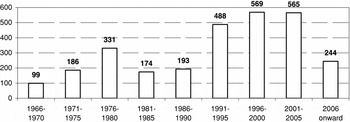
The growing appeal of the Coase theorem – the number of references to it has been especially high since the early 1990s (fig. 1) – can be better seen in the context of, on the one hand, large-scale economic reforms in the post-socialist countries of Eastern Europe and the former Soviet Union and, on the other hand, attempts to solve problems caused by global warming. In both cases, measures deriving from the Coase theorem are at the top of the policy agenda: what was initially a thought experiment becomes a key for solving real problems. The costs of communication related to the Coase theorem and its interpretation appear real too.
Number of citations, “The Problem of Social Costs,” by Ronald Coase (Reference Coase and Coase1960), per 5-year period. Source: Cheung Reference Cheung, Eatwell, Milgate and Newman1987, 456 (the data for 1966–1980); ISI Web of Knowledge v. 4.1 (includes Social Science Citation Index), search carried out on March 29, 2008.

Privatization of state property was given high priority in the early stages of market reforms in post-socialist countries. One of reasons for speeding up privatization consisted in the belief – based on lessons from the Coase theorem – that who gets property rights (and by what means) counts less than their careful specification and free exchange. Advocates of policies of rapid privatization inspired by the Coase theorem believe that eventual inefficiencies and injustices in the initial distribution of property rights tend to be self-corrected as long as the market for property rights properly functions. “The Coase theorem shows how efficiency can be restored, but only if property is protected and contracts are enforced” (Boycko, Shleifer, and Vishny Reference Boyko, Shleifer and Vishny1995, 27). After a series of exchanges, property rights fall into the hands of the actor who offers the highest price, i.e. the most efficient owner: only he/she can make the highest bid without the risk of going bankrupt.
The problem of global warming has a number of potential solutions (Gechev Reference Gechev2005): administrative measures (setting caps on harmful emissions and penalizing deviations), fiscal policies (imposing taxes on heavy polluters), and policies inspired by the Coase theorem, namely the trade in emissions permits. The latter policy becomes increasingly popular both at the global and the national levels (through the exchanges similar to the Chicago Climate Exchange launched in 2003). Each country/firm gets a pollution quota, and, it is worth repeating, their initial distribution could be arbitrary. The Kyoto protocol, for instance, requires a total cut in greenhouse gas emissions of at least 5 per cent against the baseline of 1990. Under this system, the polluter has several options: either to reduce the level of harmful emissions below the specified level and sell a part of its quota in the open market or to save on investments in environment-friendly technologies at the price of buying extra quotas. In the final account, the Coase theorem predicts that the rights to pollute will fall into hands of those who badly need them because investments in reducing harmful emissions in their case exceed the costs of buying emissions permits.
These two cases provide a rough idea of the wide range of contexts in which attempts have been made to apply the Coase theorem. It means, first, that advocates of the Coase theorem see in it something more than a pure abstraction, – a guideline for practical policies. In other words, the theorem calls for solving communication problems accompanying the movement from the abstract to the concrete. It derives from the program of “legal realism,” or the investigation of “the operation of law in relation to social reality” (Kitch Reference Kitch1983, 164). How successful has its implementation been?
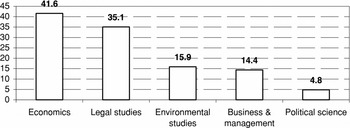
Second, they highlight the fact that law and economics in general and the Coase theorem in particular cross conventional boundaries between disciplines. “Innovation here comes from the fringe, not the mainstream” (ibid., 233). While teaching at a law school, Coase always considered himself an economist. An inherently inter-disciplinary character of the Coase theorem discourse calls for finding a language understandable for all parties involved: economists, legal scholars, environmental scientists, and so forth. Texts citing the Coase theorem tend to be more or less evenly distributed across a number of disciplines (fig. 2). The immediate solution to this communication problem consisted in converting other social scientists into adepts of the economic approach. This is the essence of the program of “economic imperialism,” namely the use of “the economic approach to analyze social issues that range beyond those usually considered by economists” (Becker Reference Becker1993, 385). How successful has this attempt to substitute the language of economic models for concepts and categories specific to the other social sciences been?
Distribution of citations, “The Problem of Social Costs,” by Ronald Coase (Reference Coase and Coase1960), 1966–2008, by subject area, per cent. Source: ISI Web of Knowledge v. 4.1, search carried out on March 29, 2008. The sum of percentages can exceed 100 per cent because a number of publications are counted in more than one subject area.

Speaking about communication problems, it should be noted that the Coase theorem has not escaped tensions between the two registers of communication, face-to-face and depersonalized. Its initial formulation and “demonstration” occurred at a meeting held at the home of one of Coase's colleagues and attended by twenty-one people, including Coase. As one of its participants recalls, “Ronald didn't persuade us. But he refused to yield to all our erroneous arguments” (Kitch Reference Kitch1983, 221). This is hardly surprising, considering Coase's “comparative advantage” in communication through the text. His colleagues claim that “Ronald is not noted for an oral tradition” (ibid., 222). Coase's major contribution to promoting the law and economics approach consists in writing few, yet highly influential, texts and in his editorship of the Journal of Law and Economics that required “extensive correspondence with the authors.”
Coase's relative weakness in oral communication was complemented by his colleagues’ strength in teaching and other forms of face-to-face interactions. Aaron Director, for instance, was famous for his teaching and converting students to the law and economics “faith.” Aaron's “influence has come though oral and teaching interaction with a large number of students passing through Chicago” (ibid., 220). Nevertheless, the reverse side of Director's strength consisted in his relative weakness in communicating at the register of depersonalized interactions and in his failure to publish sufficiently (ibid., 232). Only the membership of both partisans of law and economics in a network called the “Chicago school” made the task of switching from one register to the other possible, not individually, but at the level of the network as a whole.Footnote 27
Law and economics is deeply embedded in the “Chicago school.” Only one key player in this field in the early 1980s admitted that he “is not from or out of Chicago” (ibid., 197). The scope of the network has progressively extended to include three “strongholds,” the University of Chicago, the University of Virginia, and the University of California at Los Angeles: first letters of their names explain the nickname “ChiVirLA” sometimes used to label the “extended school” (Burton Reference Burton and Cheung1978, 76ff.). The three universities are among the top publishers of texts citing the 1960 article by Coase: the University of Chicago comes first with 3.4 per cent of the citations, the UCLA comes eighth with 1.6 per cent, and the University of Virginia comes thirteenth with 1.4 per cent. This means that communication problems existing between the two registers of interaction are bridged here by people, not by particular procedures or communication techniques.
Furthermore, the embeddedness of law and economics in the network partly explains excessive tensions between this approach and the alternative version of “legal realism” represented by the “old” institutionalism, also embedded in a network – with a stronghold in the 1930s-1940s at the University of Wisconsin. The Us versus Them mentality interferes in academic discussions as a result of solving problems of communication through networking.
What about bridging communication gaps at the register of depersonalized interaction? Discussions of the Coase theorem confirm difficulties inherent in moving from the abstract to the concrete. In fact, there exist its several formulations. The “first,” as Claude Ménard labels it, represents the most abstract one (Ménard Reference Ménard and Oleinik2005, 46). According to the definition provided by Harold Demsetz (Coase was skeptical about formulating a theorem): “in a world of zero transaction costs, the output mix that results when the exchange of property rights is allowed is efficient and the mix is independent of who is assigned ownership” (Demsetz Reference Demsetz1967, 349). The assumption of zero transaction costs suggests the highest level of abstraction and remoteness from reality. Accordingly, Demsetz compares it with a “nirvana approach” (Demsetz Reference Demsetz1969, 1).
The “second” theorem, formulated as a result of relaxing the assumption of zero transaction costs, represents the next step in descending from the abstract to the concrete. “Since transactions are not costless, efficiency is promoted by assigning the legal right to the party who would buy it . . . were it assigned initially to the other party” (Posner Reference Posner1977, 36). This principle implies that judges should replicate the market in their decisions and produce the same allocation of property rights that would result from costless exchanges in the perfect market. In other words, the role of judges in the “second” Coase theorem can be compared with that of a central planner in the model of market socialism (see more in Oleinik Reference Oleinik, Beckert and Zafirovski2006, 629): they substitute calculations “by hand” (or computer simulations) for a costly and volatile process of reaching an equilibrium through real exchanges.
Finally, the “extended” Coase theorem opens way further down to the concrete. It refers to the idea of buying and selling various rights not only in connection with economic activities, but in a large number of other contexts, for example, in politics or international relations (Hsiung Reference Hsiung2004; Acemoglu Reference Acemoglu2003). Any conflict involving negative effects (“externalities”) of one party's activities on the second party's situation then calls for trading in the right to cause nuisances. The auctioning helps find out which of the two parties would be the most efficient owner of this right.
The movement from the abstract to the concrete necessitates a careful specification of the assumptions at each stage (e.g., zero transaction costs in the “first” theorem and non-zero transaction costs in the “second”). Now, this task appears problematic and controversial. Transaction costs refer to just one condition under which the theorem holds. The complete list also includes the degree of specification of property rights, the closeness of the market to the situation of perfect competition, the distribution of wealth among the parties involved, their relative bargaining power, the character of their activities (do they have a strong economic dimension?), and so forth (Oleinik Reference Oleinik2008; Cooter Reference Cooter, Eatwell, Milgate and Newman1987). The closer one gets to the concrete, the longer the list of assumptions to be taken into consideration and explicitly discussed. Furthermore, different authors tend to emphasize particular assumptions, which overshadows the issues of their interconnectedness and makes sustainable agreement more difficult to achieve. A meta-analysis of 133 texts discussing the Coase theorem published between 1989 and March 2007 (with the help of ISI Web of Science v. 3.0; selection criterion: TS = “Coase theorem”) shows that in 15 per cent of cases, authors discuss assumptions related to the bargaining process (cooperative versus opportunistic behavior); in 12 per cent, authors discuss the impact of transaction costs; in 10.5 authors discuss the degree of specification of property rights; in 9.8 per cent, they discuss the distribution of wealth; in 9 per cent, the degree of information asymmetry, etc.
Another result of the “big leap forward” from the abstract to the concrete refers to unexpected outcomes of attempts to solve real-life problems on the basis of the Coase theorem. Policies of mass privatization in the post-socialist countries are a case in point. A high level of transaction costs and the lack of market infrastructure prevented the correction of flaws in the initial distribution of property rights through free exchange. As a result, inefficient forms of corporate governance have persisted far longer than predicted by the Coase theorem (Andreff Reference Andreff and Oleinik2005). The population of post-Soviet countries does not consider the emerged structure of property rights legitimate either. In fact, the dissatisfaction with outcomes of mass privatization became one of the driving forces of the “Orange revolution” in November-December 2004 in Ukraine (Pohorila Reference Pohorila and Oleinik2008).
The other source of communication problems when discussing the Coase theorem derives from the interdisciplinary nature of the debates. Economists, legal scholars, management scientists, specialists in environmental studies, and others do not always agree on its interpretation. The underpinning model of a paradigmatic science tailored to standards of the natural sciences does not receive a warm welcome in the social sciences targeted by “economic imperialism.”
The use of the number of cross-citations as a proxy for the degree of sustainability of the agreement among scholarsFootnote 28 produces surprising results. It appears that publications of legal scholars on the Coase theorem have a broader appeal and a stronger impact than those of economists. The average number of references to texts discussing the Coase theorem (TS = “Coase theorem”) is actually higher in legal studies (3.01, N = 48) – a non-paradigmatic science – than in economics (1.01, N = 60) – a supposedly paradigmatic one. Moreover, this difference is statistically significant,Footnote 29 i.e. can be generalized to the entire populations of texts on the theorem written by, on the one hand, legal scholars and, on the other hand, economists. For instance, some legal scholars appear especially critical in regard to the idea that all rights have a price and, hence, can be bought and sold. When explaining the unwillingness of parties in a number of real-life conflicts to enter into Coasian bargaining, Ward Farsnworth, a legal scholar, assumes that it happens “because they have attitudes toward their rights that make them awkward subjects for cash exchanges” (Farnsworth Reference Farnsworth1999, 405). In other words, not all social scientists endorse the idea of speaking an economic version of “Esperanto,” which highlights the limits of the “paradigmatic” solution of communication problems in the social sciences.
VII. Conclusion
In conclusion, we shall put forward the idea of the institutional economics of science. The existing communication problems require intensive efforts focused on reaching an interpretation of signs that has been agreed on both at the register of face-to-face communications and at that of depersonalized communications. The essence of the transactional approach outlined in this article consists in putting the process of semiotic deconstruction and interpretation into the context of interactions, both face-to-face and depersonalized. In other words, it represents an “embedded” version of, on the one hand, the semiotic approach and, on the other hand, Marxist dialectics.
The proposed application of institutionalist thought, focused on studying ways of negotiating and finding compromises, cannot result from anything other than a compromise. “What is required is less a development of institutionalist theory itself but a synthesis of some elements of institutionalist, Marxian and post-Keynesian analysis” (Hodgson Reference Hodgson1988, 23). Better communication means a more durable agreement achieved at less cost. Probably it is time for unorthodox economists to add communication costs (bargaining costs are their subset, see Cooter Reference Cooter, Eatwell, Milgate and Newman1987) to the list of transaction costs, which would contribute to a rapprochement between the proposed mental framework and transaction costs economics, the centerpiece of the NIE. The language of costs serves to incorporate elements of economic thinking into the transactional approach. To put it differently, the paradigm-based model of communication should not be disregarded in the social sciences either.
It is worth noting that the task of improving communication has more far reaching applications than only inside the academia. The communication gaps in everyday life explain a number of problems that are not just purely epistemological in nature. For example, the focus on communication provides deep insights into the sources of terrorism. Michel Wieviorka argues that terrorism “is the expression of a communication failure between those who resort to it and those who are its victims” (Wieviorka [1988] Reference Wieviorka and White2004, xxix; see also Zulaika and Douglass Reference Zulaika and Douglass1996, chap. 7). In other words, studies in communication go in line with the program formulated for the social sciences by Alfred Schutz. According to him, the mental models developed by scientists should be compatible with these used in everyday life (Schutz Reference Schutz1954). This is what we expect with respect to communication models and techniques for reaching agreement.
Acknowledgments
I would like to thank Volker Meja (Memorial University of Newfoundland, Canada), Michel Callon (Ecole Nationale Supérieure des Mines, Paris), Alexandre Métraux, and three anonymous reviewers of Science in Context for their helpful comments and suggestions. I would also like to thank Sheryl Curtis who did a great job of editing. However, all remaining inaccuracies are my own.