Introduction
The use of image-guided navigation systems (IGNS) in sinus and skull base surgery has gained widespread acceptance since its inception in the 1980s.Reference Prulière-Escabasse and Coste1 The American Academy of Otolaryngology published a position statement in 2021 outlining the indications for the use of IGNS in endoscopic sinus surgery (ESS) and endorsing the use of this technology to clarify complex anatomy in appropriately selected cases.2 The use of IGNS in ESS is associated with a reduction in total and major complications,Reference Dalgorf, Sacks, Wormald, Naidoo, Panizza and Uren3 reduced rates of recurrent disease,Reference Galletti, Gazia, Freni, Sireci and Galletti4 improved quality of life,Reference Javer and Genoway5 and more comprehensive surgery with fewer missed paranasal sinus compartments.Reference Giotakis, Kral, Freysinger, Markart and Riechelmann6 In anterior skull base surgery, IGNS use can lead to reduced cerebrospinal fluid (CSF) leak rates, shorter hospital stays and reduced overall costs.Reference Chung, Riley and Woodworth7 The potential disadvantages of using IGNS include the financial cost associated with procurement and maintenance, prolonged operative duration and the theoretical risk of overreliance on the technology. This study aimed to understand current practices and gauge the accessibility and use of IGNS in otolaryngology departments across the UK.
Methods
This anonymised cross-sectional study was conducted between May and December 2023. A 13-point survey was created by the authors and distributed electronically to UK otolaryngology consultants. Survey content focused on the availability of IGNS, barriers to access and indications for its use in ESS and skull base surgery (Appendix 1). Respondents were asked about the impact of IGNS use on training, comprehensiveness of surgery, operative duration and associated stress. Responses were aggregated and analysed using Microsoft Excel (Microsoft Corporation, Redmond, Washington, USA).
Results
Demographics
A total of 154 otolaryngologists completed the survey, with responses from all regions of the UK. The majority had between 0 and 10 years of experience as a consultant, worked within a tertiary care setting and considered rhinology to be their primary subspecialty (Table 1).
Baseline characteristics

Access to image-guided navigation systems
There were 108 (70.1 per cent) respondents who had previously used IGNS for ESS. A total of 97 (63 per cent) reported having access to an IGNS within their department. Of these, 82 (53.2 per cent) had access to one, and 15 (9.8 per cent) had access to multiple systems (Table 2). Fifty-one (33.1 per cent) respondents reported that their department did not have access to an IGNS, and 6 (3.9 per cent) were unaware of its availability. Most of the respondents in London (74.2 per cent), East of England (87.5 per cent), West Midlands (67.6 per cent), East Midlands (77 per cent), Wales (100 per cent), Scotland (77 per cent) and Northern Ireland (100 per cent) reported access to at least one IGNS. Accessibility to IGNS was lower in North-East England and Yorkshire (40 per cent), North-West England (50 per cent), South-East England (33.3 per cent) and South-West England (28.6 per cent). For those who did not have access to IGNS, 19 (37.3 per cent) were based in a tertiary care setting, 31 (60.8 per cent) secondary care and 1 (2.0 per cent) in private practice. When considering barriers to access, 52 (33.8 per cent) respondents cited financial cost, 16 (10.4 per cent) cited a lack of experience using IGNS and 25 (16.2 per cent) reported that it is not required for their case-mix.
Types of image-guided navigation systems used and barriers to access

Indications for the use of image-guided navigation systems
Most respondents (65 per cent) believed it should not be mandatory for departments undertaking ESS to have IGNS available (Table 2). A minority (5.2 per cent) felt that it should be mandatory if a department is performing frontal sinus, revision or complex surgery. Respondents’ opinions on the indications for using IGNS are summarised in Figure 1. Most respondents stated they would not use an IGNS for pathology involving the maxillary (97.8 per cent), anterior ethmoid (92.9 per cent) or posterior ethmoid sinuses (81.6 per cent). However, over half stated they would use it for pathology involving the sphenoid (54.2 per cent) and frontal sinuses (74.6 per cent) or a “full-house” functional ESS (FHF) (57.7 per cent). Over 80 per cent of respondents reported they would use IGNS in cases of distorted anatomy, dehiscent anatomy or where there is a skull base defect. For respondents performing surgery for skull base lesions and sinonasal neoplasms, 100 per cent would use IGNS for advanced skull base lesions, 80.6 per cent would for malignant neoplasms and 49.6 per cent would for benign neoplasms. The majority advocated use with a navigation microdebrider blade (51.9 per cent), but not when utilising a navigation balloon (37.3 per cent). For those who felt it applicable to their practice, 46.8 per cent reported use of IGNS for medico-legal reasons. Other free-text responses are summarised in Table 2.
Indications for use of an image-guided navigation system for endoscopic sinus surgery.

Effect of using image-guided navigation systems
Most respondents felt that using IGNS for ESS had a positive effect on the ability to perform more comprehensive surgery (63 per cent) and on training in theatre (74.7 per cent). Whilst 44.2 per cent felt that it had a positive impact on the stress of surgery, 36.4 per cent thought it had a negative impact on operative duration (Table 3).
Effect of using image-guided navigation systems for endoscopic sinus surgery

Subgroup analysis (rhinology subspecialists vs non-rhinology subspecialists)
Seventy-four respondents cited rhinology as their primary subspecialty. Of these, 87.8 per cent reported that they had previously used IGNS for ESS, compared to 53.8 per cent in the non-rhinology group. Only 29.7 per cent of the rhinology group and 26.3 per cent of the non-rhinology group felt it should be mandatory for a department undertaking ESS to have access to an IGNS. Over 80 per cent of respondents in both groups reported that they would not use IGNS for pathology involving the maxillary, anterior or posterior ethmoid sinuses (Table 4).
Rhinologist vs non-rhinologist opinion on indications for use of image-guided navigation

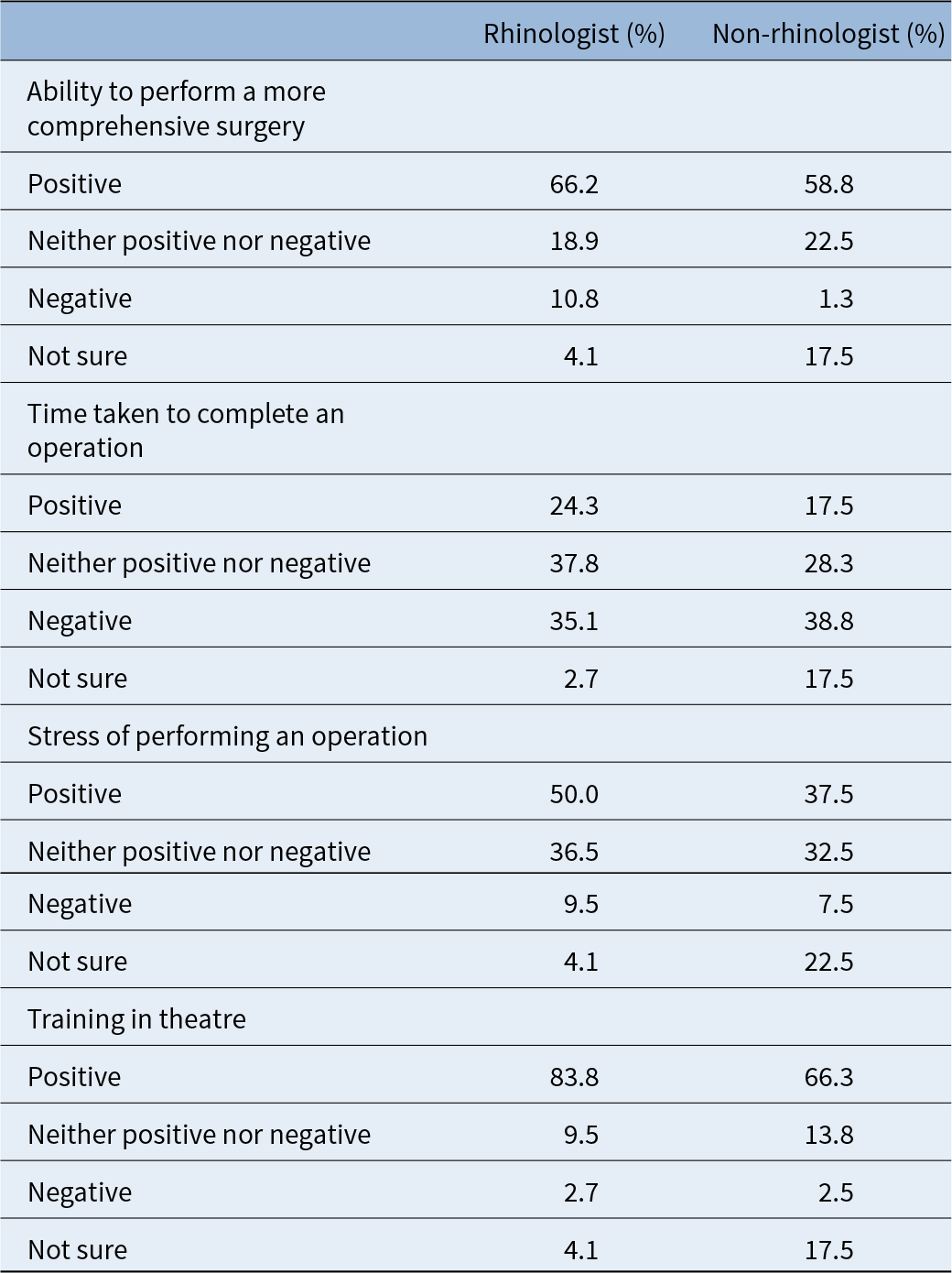
A higher percentage of the non-rhinology group reported they would use IGNS for frontal sinus pathology (79.6 per cent vs 70 per cent) and for FHF (65.4 per cent vs 50.7 per cent). A marginally higher percentage in the non-rhinology subgroup considered a dehiscent skull base (91.5 per cent vs 85.5 per cent), dehiscent optic nerve (91.5 per cent vs 81.8 per cent), dehiscent carotid artery (88.9 per cent vs 84.6 per cent) or a skull base defect (92.9 per cent vs 86.4 per cent) as indications for IGNS use. A slightly higher percentage of the rhinology group felt IGNS had a positive effect on the ability to perform more comprehensive surgery (66.2 per cent vs 58.8 per cent), on the stress of surgery (50.0 per cent vs 37.5 per cent) and on training in theatre (83.8 per cent vs 66.3 per cent) (Table 5).
Rhinologist vs non-rhinologist opinion on the effect of using image-guided navigation systems for endoscopic sinus surgery

Subgroup analysis (≤10 years’ experience vs >10 years’ experience)
A similar percentage in both groups felt that it should be mandatory for departments undertaking ESS to have access to IGNS (29.3 per cent vs 29.2 per cent) and that it had a positive effect on their ability to perform more comprehensive surgery (64.6 per cent vs 69.4 per cent). A greater percentage of the less than or equal to 10-years’ experience group felt IGNS had a positive effect on operative duration (23.2 per cent vs 18.1 per cent), the stress of surgery (45 per cent vs 43.1 per cent) and on training in theatre (80.5 per cent vs 69.4 per cent).
Discussion
This novel cross-sectional study is the first to assess current practice, accessibility and use of IGNS in ESS within the UK. We collated 154 responses from consultants with varying subspecialist interests. Whilst the majority had access to at least one type of IGNS within their department, almost one-third reported no access. This was more common for those working in a secondary care setting but, interestingly, did also include several tertiary referral centres. Respondents from the East of England, London, West Midlands and East Midlands reported a greater degree of access compared to those in the North or South of England. The results of our study suggest that current access to IGNS in the UK is at a level somewhere between that of Canada and the USA. A recent nationwide survey of Canadian otolaryngologists found that 56.3 per cent of respondents had access to an IGNS,Reference McHugh, Sommer, Thamboo, Tewfik and Smith8 whereas a survey of American Rhinologic Society members in 2011 reported that 94.6 per cent of respondents had access.Reference Orlandi and Petersen9, Reference Justice and Orlandi10 Approximately one-third of consultants who responded to our survey felt it should be mandatory for a department undertaking ESS to have an IGNS available for use. This is a similar finding to that reported in a survey of 672 otolaryngologists in the USA, where 31 per cent believed IGNS should be the standard of care for ESS.Reference Hepworth, Bucknor, Patel and Vaughan11
The main barrier to using IGNS reported in the literature is the associated financial cost,Reference McHugh, Sommer, Thamboo, Tewfik and Smith8 which is in line with the findings of our study. Prices vary depending on the manufacturer, specific system and software. However, the approximate cost of a Medtronic or Stryker ENT navigation system in the UK is upwards of £50,000 - £100,00012, 13, whichrepresents a significant initial outlay for a department.
Most of our respondents considered pathology involving the frontal sinuses, revision surgery, dehiscent or distorted anatomy, malignant neoplasms and expanded surgical approaches as indications for IGNS use. Opinion was divided as to whether IGNS should be used for pathology involving the sphenoid sinuses, an FHF, benign sinonasal neoplasms or when using a navigation balloon or microdebrider blade. This divided opinion remained even when assessing responses only from consultants with a rhinology subspecialist interest, suggesting a lack of consensus even amongst surgeons who frequently perform ESS.
Approximately two-thirds of our respondents felt using an IGNS had a positive effect on their ability to perform a more comprehensive surgery. These findings mirror those reported by similar studies in both the USA and Canada,Reference Justice and Orlandi10, Reference Hepworth, Bucknor, Patel and Vaughan11 where greater than 80 per cent felt the use of IGNS increased the completeness of surgery. This assumption is supported by the literature, with recent studies demonstrating a lower incidence of missed paranasal sinus disease when IGNS are usedReference Nobre, Sarmento, Bedaque, Medeiros, Cobucci and Diniz Júnior14 and a positive effect on addressing complex frontal recess and sinus pathology.Reference Giotakis, Kral, Freysinger, Markart and Riechelmann6 Nearly three-quarters of our respondents believed that IGNS positively impacted training in theatre, and greater than 40 per cent felt it had a positive effect on the stress of undertaking a procedure. This notion is supported by cadaveric studies which demonstrated use by residents leads to greater accuracy in identifying anatomical landmarks.Reference Casiano and Numa15 In addition, a randomised clinical trial demonstrated decreased mental burden on experienced residents when utilising an IGNS for ESS.Reference Theodoraki, Ledderose, Becker, Leunig, Arpe and Luz16 Interestingly, this perception of a positive impact on training and stress was reported by a greater percentage of rhinologists and consultants with less than or equal to 10-years’ experience. This may indicate that those who more frequently use IGNS in their practice and likely encountered its use during their training, fellowship or early consultant years have more positive views on its potential benefits. We found mixed opinion regarding the effect of IGNS on operative duration, with 36.4 per cent reporting a negative impact. It may be assumed that the use of IGNS would lead to increased duration due to the time needed for setup and calibration. However, whilst the initial setup time may be prolonged, the literature suggests that increased confidence in identifying anatomical landmarks can result in a reduction in overall operative duration.Reference Nobre, Sarmento, Bedaque, Medeiros, Cobucci and Diniz Júnior14
Interestingly, just under half of our respondents reported IGNS use for medico-legal reasons. Whilst the American Academy of Otolaryngology position statement cites clear indications for IGNS use,2 no such equivalent UK-based guidelines exist, and IGNS use has not yet been formally designated as standard of care. However, recently published systematic reviews do report a trend towards a lower risk of major and total complications when image-guidance is usedReference Dalgorf, Sacks, Wormald, Naidoo, Panizza and Uren3, Reference Nobre, Sarmento, Bedaque, Medeiros, Cobucci and Diniz Júnior14 and, therefore, raises the possibility of whether malpractice could be argued if a complication were to occur in a centre where the technology was available but not utilised.Reference Justice and Orlandi10
Limitations
Whilst we received responses from all regions and greater than 10 per cent of an estimated 1476 consultant otolaryngologists working in the National Health Service, the sample size may limit our ability to form broad generalisations. The voluntary nature of survey participation can result in bias, with respondents more likely to have strong opinions or experiences regarding IGNS use. This could lead to overrepresentation of individuals with favourable views or significant barriers to access. The generalisability of our findings is constrained by the specific context of the UK healthcare system and the unique characteristics of departments within this setting. Variations in healthcare infrastructure, funding mechanisms and clinical practices across different countries may limit the applicability of our results beyond the UK.
• The American Academy of Otolaryngology endorses using image-guided navigation systems (IGNS) in appropriately selected sinus and skull base cases. The use of image-guided navigation in endoscopic sinus surgery is associated with a reduction in complications, reduced rates of recurrent disease and more comprehensive surgery with fewer missed paranasal sinus compartments
• In this cross-sectional survey-based study, the majority of the 154 respondents had access to at least one type of IGNS in their department, although almost one-third reported no access. The most cited barrier to accessing an IGNS was financial cost
• Most respondents considered pathology involving the frontal sinuses, revision sinus surgery, dehiscent anatomy, malignant neoplasms and expanded surgical approaches as indications for use of an IGNS
• Opinion was divided as to whether it should be used for pathology involving the sphenoid sinuses, a full-house functional endoscopic sinus surgery or benign sinonasal neoplasms
• The majority of respondents felt that using an IGNS had a positive effect on the ability to perform a more comprehensive surgery, the stress of performing an operation and on training in theatre
• Our study provides some consensus that may be beneficial for centres forming proposals to acquire an IGNS, but also demonstrates diverse opinions regarding indications for use of image-guidance for endoscopic sinus surgery that underscores the need for clearer guidelines and standardised practices in the UK
Conclusions
This study provides valuable insights into the current landscape of accessibility, utilisation and perceptions surrounding use of IGNS for ESS amongst otolaryngology consultants within the UK. Our findings reveal significant variations in access to such technology across different regions and practice settings, with financial constraints emerging as an overriding barrier. Whilst our study does provide some consensus that may be beneficial for centres forming proposals to acquire an IGNS, the diverse opinions regarding indications for use underscore the need for clearer guidelines and standardised practices. Future collaboration between national organisations, such as ENT-UK and the British Rhinological Society, should be considered to develop a consensus statement on the use of IGNS in the UK.
Data availability statement
The data that support the findings of this study are available from the corresponding author, EB, upon reasonable request.
Funding statement
The authors received no financial support for this study.
Competing interests
The authors have no conflicts of interest to declare.
Ethical statement
Ethics approval was not required for this study.
Authorship statement
E.B., M.H., K.J., A.D. designed the work; E.B., M.H., A.D. acquired and analysed data; E.B., M.H., K.J., A.D. drafted, revised and approved the manuscript; E.B., M.H., K.J., A.D. agree to be accountable for all aspects of the work.
Appendix 1. Accessibility and use of image-guided navigation systems for endoscopic sinus surgery in the United Kingdom