

Introduction
Injury is intentional or unintentional damage to the body resulting from exposure to thermal, mechanical, electrical or chemical energy; or the absence of essential heat or oxygen.1 The major causes of injury are road traffic incident, firearms, drowning, falls, burns, and poisoning.Reference Thanni and Kehinde2 However, differences exist in injury pattern and injury mortality within and between different countries as well as in time trends. In some urban US cities, the prevalence of homicide and civilian firearm injuries are as high as 45.3% of all injuries,3,4 In South Africa, gunshot injuries have been reported to be as much as 60% of the injuriesReference Soreide5 in some cities, and in India, 41.4%.Reference Saraswat6 Road traffic crashes are the leading cause of injury in many parts of Africa, Asia, Europe, and the US.Reference Thanni and Kehinde2,Reference Hsia, Ozgediz, Mutto, Jayaraman, Kyamanywa and Kobusingye7–Reference Panzino, Pizà Oliveras, Pociello Almiñana, García García, Luaces Cubells and Pou Fernández11 Falls frequently are reported as the cause of injury in children and adolescents ≤18 years of age with incidence rates of >40%.Reference de Sousa Petersburgo, Keyes, Wright, Click, Macleod and Sasser12–Reference Gad, Al-Ansary, Saeed and Kabbash14 Poisoning, often seen in children <5 years of age, is not common in Africa.Reference Hsia, Ozgediz, Mutto, Jayaraman, Kyamanywa and Kobusingye7,Reference Adejuyigbe, Onayade, Senbanjo and Oseni15
Trauma continues to be a contemporary health issue, that contributes significantly to mortality and morbidity in all communities. Worldwide, it is the sixth leading cause of death and the leading cause of death from unintentional injury.16,Reference Chandran, Hyder and Peek-Asa17 According to the World Health Organization, Global Burden of Disease, injury is responsible for 9% of all mortality and 12% of the total burden of disease.16 It also is the fifth leading cause of disability. Between the ages of 15 and 45 years, trauma is the leading cause of death.Reference Soreide5
Countries in Africa and parts of Asia account for a disproportionate number of the global burden of injury. The rate of disability-adjusted years (DALYS) in low and middle income countries, 2,398 per 100,000 people, is more than triple that in high income countries. Accidental injury death rates similarly are nearly double those reported in high-income countries (65 per 100,000 persons versus 35 per 100,000 persons). In 2004, about 3.9 million deaths from unintentional injuries, occurred in low and medium income countries.Reference Chandran, Hyder and Peek-Asa17
In Sub-Saharan Africa, reports on the epidemiology of injuries are few. This may be due to a paucity of research on violence and injury prevention. In order to constructively engage public policymakers and evolve strategies for effective violence and injury prevention, more research must be done in Sub-Saharan Africa in areas of injury data collection, defining the epidemiology of injuries, estimating the cost to governments and communities of the burden of injuries and injury disabilities, and understanding public perception of the causes of injuries.
In Nigeria, there is no national or regional trauma registry and data on injuries generally is from studies of the records of only one hospital. The aim of this study is to summarize published data on etiology, mortality ,and morbidity from trauma in Nigeria.
Methods
Publications from Nigeria on the epidemiology and outcome of trauma were reviewed. Using the search criteria; trauma, road traffic accident, death, mortality, hospital, Nigeria, accident and emergency, injury, causes; in various combinations, African Journals Online (AJOL) and Pubmed / Medline electronic databases were searched up to October 2010. Personal and library collections of journals also were searched for publications on the subject. The references of identified publications also were searched for publication from Nigeria on the subject. To qualify for inclusion, a publication had to be about patients in Nigeria, based on trauma irrespective of whether trauma was studied in general or in a particular specialty. Post-mortem studies were included if they analyzed trauma victims. There were no case reports included in the present study.
Full text articles of the identified publications were sought from personal and library collections of the titles as well as from AJOL and Healthinternetwork for research initiative (HINARI) databases. Despite the heterogeneity in the content and style of writing the publications, data were pooled where homogeneity existed.
Two studies identified were excluded because their full text did not meet the inclusion criteria. Ten other identified studies could not be screened because their full text could not be obtained due to inaccessibility or non-availability and were excluded.
Data were processed using Epi Info 3.5 version (Centres for Disease Control, Atlanta, USA) using frequencies and tables, as well as sums and means for numeric variables.
Results
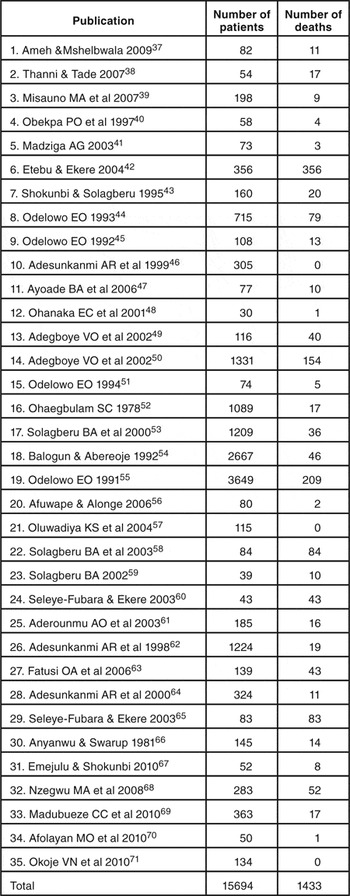
Thirty-five publications met the inclusion criteria and formed the dataset for analysis (Table 1). Twenty publications reported on injuries to all parts of the body whereas five reported on abdominal injuries, four on head injuries, three on chest injuries, two on musculoskeletal injuries, and one on genitourinary injuries. Only six of the studies were solely relative to childhood injuries.
List of publications on the epidemiology of injury from Nigeria

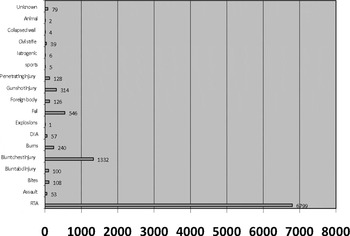
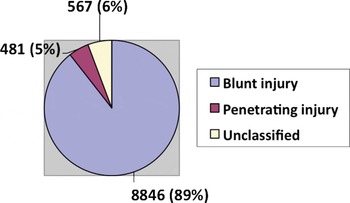
There were a total of 15,694 patients ranging in age from two weeks to 95 years, representing an injury burden of 11.2/100,000 persons (population of 140,000,000). The mean value of their ages was 27 ±13 years. Gender was reported for 1,488 patients of whom males were 998 (67%) giving a M:F of 2:1. In 9,939 patients, the etiology of injury could be identified. Road traffic injuries (6,799; 68.4%) patients, were the most frequent. Other common causes of injury in descending order were blunt chest injury (1,332; 13.4%), fall (546; 5.5%), gunshot injuries (314; 3.2%), and burns (240; 2.4%; Figure 1). Blunt injuries (n = 8,846) accounted for 89% of the injuries while penetrating injuries (n = 481) was 4.8%. The remaining 6.2% injuries could not be classified (Figure 2).
Aetiology of injury in 9939 trauma patients

Prevalence of injuries in Nigeria: blunt versus penetrating

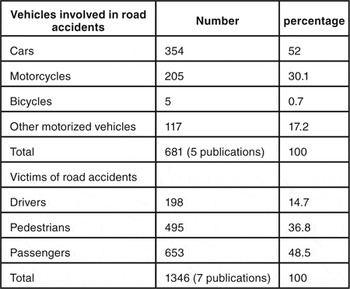
Five studies reported on the types of vehicles involved in road crashes (n = 681). Of these vehicles, 354 were cars, 205 were motorized cycles, five pedal cycles, and 117 other motorized vehicles (buses, trucks and trailers; Table 2). The status of victims of RTCs was recorded in seven studies (n = 1,346) and included 198 drivers, 495 pedestrians, and 653 passengers. The commercial or private nature of the vehicles could not be determined. Six reports were exclusively on children. Out of 2,199 injuries in children, 746 (33.9%) resulted from RTCs, 639 (29.1%) from falls, and 122 (5.5%) foreign-body related, 108(4.9%) bites and 89(4%) from burns.
Distribution of vehicles and victims of road accidents

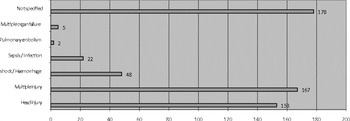
From 32 publications, 1,433 patients reportedly died. The causes of death in 575 patients could be identified and were mostly multiple injuries (167) and head injury (153; Figure 3). Hemorrhage and/or shock were responsible in 48 patients. Mortality in relation to status in RTC was documented in three studies—these included two drivers, 51 pedestrians, and 59 passengers. Time of death post-injury was not provided in any report—thus, the modal pattern of deaths remain unclear.
Causes of trauma deaths in Nigeria

Discussion
There is a male preponderance of involvement in trauma, twice that of females. Coupled with an average age of involvement at 27 ±13 years, this indicates a preponderance of young adult males as being involved in injury events in Nigeria. A similar preponderance of males was noted in the findings of Ohene et al in Ghana,Reference Ohene, Tettey and Kumoji18 Qureshi et al in Pakistan,Reference Qureshi, Khalique, Pasha, Asad, Malik, Shah and Ahmed19 Pereira et al in Brazil,Reference Pereira, Perdoná, Zini, Cury, Ruzzene, Martin and Martinis20 Joshi and Shrestha in Nepal,Reference Joshi and Shrestha9 Hsia et al in Uganda.Reference Hsia, Ozgediz, Mutto, Jayaraman, Kyamanywa and Kobusingye7 The commonly reported gender prevalence of trauma and trauma mortality in children/adolescents is 1.5:1,Reference Hyder, Sugerman, Puvanachandra, Razzak, El-Sayed, Isaza, Rahman and Peden21–Reference Diamond, Parkin, Wales, Bohn, Kreller, Dykes, McLellan and Wesson23 but it was not possible to determine children’s gender in the present study.
The leading cause of injury in this report was RTC (68.4%), followed in a distant second by falls (5.5%). This mirrors a previous report from a Nigerian center.Reference Thanni and Kehinde2 In a trauma registry data report from Uganda, RTC also was the leading cause of injury, but the rate was lower at 49%Reference Hsia, Ozgediz, Mutto, Jayaraman, Kyamanywa and Kobusingye7. The same is true for children as RTCs were the most frequent cause of injuries.Reference Rausch, Sanddal, Sanddal and Esposito25 Fraga et al reported that the most frequent mechanism of injury in children in a US city was RTC (40.2%).Reference Fraga, Fraga, Stanley, Costantini and Coimbra24 The rapidly motorizing nature of modern cities in a developing country like Nigeria may be a reason for the high prevalence of road traffic injuries (RTIs). This is exemplified by the incidence of RTA increasing in a rapidly motorizing country, Dubai, by 38% over a seven-year period accompanied by increase in mortality of 54%.Reference Al Marzooqi, Badi and El Jack26 As in this report, cars and motorized cycles have been reported to be the most frequently involved vehicles in RTCs.Reference Joshi and Shrestha27
In many poor countries, motorized cycles have become an increasingly important means of transportation. In a systematic study of injuries in Nepal, motorcycles were involved in 42.5% of RTCsReference Joshi and Shrestha9 compared to 30% in this report. Young adults are over-represented in road trauma especially when driving is associated with the use of alcohol, which can impair coordination and driving skill. The need for innovative ideas to control road crashes is imperative, especially in developing countries. The use of graduated driver licensing policy,Reference Hinchcliff, Ivers, Poulos and Senserrick28 introduction of a driver penalty-point system,Reference Novoa, Pérez, Santamariña-Rubio, Marí-Dell’Olmo, Ferrando, Peiró, Tobías, Zori and Borrell29 and enforcement of speed limitsReference Al Marzooqi, Badi and El Jack26,Reference Cameron and Elvik30 have been successfully used in some industrialized countries. While the incidence of road crashes in economically advanced countries is stable or declining,Reference Korhonen, Niemi, Parkkari, Palvanen and Kannus31 in poor and developing countries, the incidence is increasing. Visual impairment, inadequate street lighting, excessive speeding, and not wearing seat belt are known risk factors for injuries due to road crashes.Reference Goonewardene, Baloch, Porter, Sargeant and Punchihewa32 Legislation and enforcement of such laws on the control of these known risk factors will, in all likelihood, decrease the prevalence of road crashes and mortality from them.
According to this report, passengers (48.5%) are the leading victims of RTCs followed by pedestrians (36.8%). This is similar to the findings of Mishra et al in NepalReference Mishra, Mishra, Sukhla and Sinha8 (42.5%). Lots of road travel occur in developing countries, and in Nigeria, this is mostly by commercial cars and minibuses. Mass transit by buses and minibuses means that more passengers than drivers and pedestrians per road crash are injured. This may explain the relatively large percentage of passengers involved in road crashes. Pedestrians tend to be the main victims where motorcycles are a predominant vehicle for commercial road transportation.Reference Mishra, Mishra, Sukhla and Sinha8,Reference Joshi and Shrestha27 Children are particularly vulnerable pedestrian victims of RTCReference Hyder, Sugerman, Puvanachandra, Razzak, El-Sayed, Isaza, Rahman and Peden21,Reference Ackaah and Adonteng33 because they are small and may not be seen easily by vehicle drivers. They also frequently walk along and across intra-city roads without adult supervision, while on errands and while going to and from school. Pedestrian-friendly front (bumper) only vehicles will help to reduce morbidity and mortality of pedestrians when crashes occur.
Traditionally, injury mortality is reported to have a trimodal pattern. Immediate deaths (50%), early (30%) and late deaths (20%). Due to improvements in trauma care, particularly prehospital care, resuscitation, and trauma systems, this trimodal pattern has yielded to a bimodal patternReference Gunst, Ghaemmaghami, Gruszecki, Urban, Frankel and Shafi34,Reference Demetriades, Kimbrell, Salim, Velmahos, Rhee, Preston, Gruzinski and Chan35 involving immediate and late deaths. The pattern of mortality could not be determined from the current data set because none of the publications studied the time to death after injury. However, craniocerebral injury is known to be the single leading cause of accidental trauma death, especially early death,Reference Evans, van Wessem, McDougall, Lee, Lyons and Balogh10 followed by exsanguinationReference Sauaia, Moore, Moore, Moser, Brennan, Read and Pons3 and organ failure. Sauia et al Reference Sauaia, Moore, Moore, Moser, Brennan, Read and Pons3 reported 42% and 39% trauma deaths from craniocerebral injury and exsanguinations, from the US while Evans et al Reference Evans, van Wessem, McDougall, Lee, Lyons and Balogh10 reported, also from the US, 33% mortality each from both causes of trauma death. Multiple injuries is the most important cause of death in this report when all causes are pooled (29%), similar to previous report from NigeriaReference Thanni and Kehinde2 and a study of trauma in India by Saraswat (29%).Reference Saraswat6 However, head injury (26.6%) and hemorrhage (8.3%) are the leading individual causes, as in other reports.Reference Sauaia, Moore, Moore, Moser, Brennan, Read and Pons3,Reference Evans, van Wessem, McDougall, Lee, Lyons and Balogh10
These figures actually may be under-representations of the true prevalence of the causes of trauma death from Nigeria because only 40% of the patients that reportedly died had their causes of death documented . Further improvements in the survival of victims of accidental injury in Nigeria probably lie in better prehospital care. Fatality from vehicular trauma has been shown to be worsened by prolonged emergency medical system response time, longer time spent at the scene of accident, and poor prehospital care.Reference Gonzalez, Cummings, Mulekar and Rodning36
Conclusions
This report from Nigeria shows that road traffic crashes are the leading cause of injury among adults and children whereas burns and firearm injuries are relatively uncommon. Falls are six times more prevalent among children. Injury mortality results mainly from head injury and hemorrhage. It is difficult to compare injury data due to the non-availability of a standard mode of reporting.
Introduction of trauma data registries in Nigeria will enhance trauma data collection and consequently, improve the definition of the epidemiology of injuries.
Acknowledgements
The author is grateful for the assistance of the librarians and staff of the Medical Library of Obafemi Awolowo College of Health Sciences, Sagamu, in the Olabisi Onabanjo University, as well as those of E. Latunde Odeku Medical library of the University College Hospital, Ibadan.
Abbreviations:
RTC = road traffic crash
DALYS = disability-adjusted years
AJOL = African Journals Online
HINARI = Healthinternetwork for research initiative