INTRODUCTION
Interactions between marine mammals and fisheries can take several forms, which are divided principally into operational interactions in which the marine mammals have physical contact with fishing gear (Beverton, Reference Beverton, Beddington, Beverton and Lavigne1985), and interactions through trophic pathways (Shima et al., Reference Shima, Hollowed and VanBlaricom2000). Operational interactions can lead to the incidental catch of marine mammals; this is also referred to as incidental take or by-catch, and occurs when any unwanted, live or dead marine mammal is caught during fishing operations (Waring et al., Reference Waring, Gerrior, Payne, Parry and Nicolas1990; Alverson et al., Reference Alverson, Freeburg, Murawski and Pope1994). With an increasing global human population and the corresponding need for fish resources, fishing in both coastal and pelagic waters will likely increase, intensifying the interactions between fisheries and marine mammal populations due not only to competition for resources but also to simple spatial overlap (Read, Reference Read, Reynolds, Perrin, Reeves, Montgomery and Ragen2005; Read et al., Reference Read, Drinker and Northridge2006). In this sense, fisheries by-catch has been identified as a primary driver of population declines in several species of marine megafauna (e.g. elasmobranchs, mammals, seabirds and turtles) (Lewison et al., Reference Lewison, Crowder, Read and Freeman2004). These by-catches not only affect the survival of specific populations but also the trophic structure, species assemblages, and pathways of energy flow in the ecosystems (Pauly et al., Reference Pauly, Christensen, Dalsgaard, Froese and Torres1998; Myers & Worm, Reference Myers and Worm2003).
Despite the recognition of the marine top predator by-catch problem, the knowledge about the impact caused by fisheries to marine mammals is fragmentary, and in most of the world fisheries it is unknown and globally underscored (Read et al., 2006) highlighting the need for by-catch reduction strategies to recover depleted populations (Cox et al., Reference Cox, Lewison, Zydelis, Crowder, Safina and Read2007; Wallace et al., Reference Wallace, Lewison, McDonald, McDonald, Kot, Kelez, Bjorkland, Finkbeiner, Helmbrecht and Crowder2010). Although marine mammals by-catch is a common event in fisheries worldwide this is not necessarily unsustainable, especially in those large population species that exhibit high rates of potential population growth, as is the case of some pinnipeds (Read, Reference Read2008). Although there is a large population size exhibited by some pinniped species, little knowledge exists about the impact these species are facing and there is even less knowledge about the sources responsible for this by-catch.
In this context, Chile being one of the major fishing countries worldwide (FAO, 2010) it is necessary to evaluate the different kinds of interactions between fisheries and marine mammals on the Chilean coast, as well as to understand what can be the possible effects of these interactions on the survival of marine mammals in this region. Although a number of studies have reported interactions between marine mammals and humans in Chile (Northridge, Reference Northridge1984, Reference Northridge1991; Hückstädt & Antezana, Reference Hückstädt and Antezana2003; Moreno et al., Reference Moreno, Hucke-Gaete and Arata2003; Hückstädt & Krautz, Reference Hückstädt and Krautz2004; Sepúlveda et al., Reference Sepúlveda, Pérez, Oliva, Durán, Sielfeld, Araos and Buscaglia2007a; Goetz et al., Reference Goetz, Wolff, Stotz and Villegas2008), none of them report any interaction between trawling fisheries operations and marine mammals.
The South American sea lion (Otaria flavescens) is one of the most frequently encountered and abundant marine mammals on the Chilean coast, reaching approximately 140,000 individuals (Aguayo-Lobo et al., Reference Aguayo-Lobo, Díaz, Yánez, Palma and Sepúlveda1998; Venegas et al., Reference Venegas, Gibbons, Aguayo, Sielfeld, Acevedo, Amado, Capella, Guzmán and Valenzuela2002; Sepúlveda et al., Reference Sepúlveda, Oliva, Pérez, Moraga, Urra, Schrader, Pavés and Buscaglia2007b, Reference Sepúlveda, Oliva, Urra, Pérez-Álvarez, Moraga, Schrader, Inostroza, Melo, Díaz and Sielfeld2011; Bartheld et al., Reference Bartheld, Pavés, Vera, Manque and Miranda2008; Oliva et al., Reference Oliva, Sielfeld, Buscaglia, Matamala, Pavés, José Pérez, Schrader, Sepúlveda, Urra, Farias, Inostroza and Melo2008). Due to its large population size and the proximity of fishing grounds to the coast, interactions with artisanal and industrial fisheries have been documented in Chile (e.g. Torres, Reference Torres1979; Sielfeld, Reference Sielfeld1999; Hückstädt & Antezana, Reference Hückstädt and Antezana2003; Sepúlveda et al., 2007a; Goetz et al., 2008). Research conducted in central Chile on purse seining ships fishing for jack mackerel (Trachurus symmetricus) has shown that an important relationship exists between the ships and O. flavescens, sometimes resulting in fatalities (Hückstädt & Antezana, Reference Hückstädt and Antezana2003). Other studies carried out in southern Chile, indicate that the fisheries targeting Chilean anchovy (Engraulis ringens) and Chilean herring (Strangomera bentincki) can cause sea lion mortality, since O. flavescens individuals trapped within the nets are crushed by the hydraulic winches lifting the nets from the ocean and onto the ship (Arata & Hucke-Gaete, Reference Arata and Hucke-Gaete2005). Finally, studies performed on long-line fleets targeting the Patagonian toothfish (Dissostichus eleginoides) have provided evidence that this activity does not cause sea lion mortality, except in cases when high-calibre firearms are used to frighten or kill approaching sea lions while hauling the catch (Moreno et al., Reference Lillo, Rojas, Tascheri, Ojeda, Olivares, Balbontín, Bravo, Nuñez, Braun, Ortiz, Torres, Véjar, Cubillos and Saavedra2003; Arata & Hucke-Gaete, Reference Arata and Hucke-Gaete2005). This practice, however, is isolated due to the lower presence of O. flavescens on these fishing grounds, which are generally far from the coast.
Globally, little published information exists about the number of marine mammals caught in trawl nets (Fertl & Leatherwood, Reference Fertl and Leatherwood1997). Incidental take of marine mammals (pinnipeds) during trawl operations has received attention in several countries, including Australia (Shaughnessy & Davenport, Reference Shaughnessy and Davenport1996), South Africa (Shaughnessy & Payne, Reference Shaughnnesy and Payne1979), USA (Alaska) (Perez & Loughlin, Reference Perez and Loughlin1991), Canada (Pemberton et al., Reference Pemberton, Merdsoy, Gales and Renouf1994) and Argentina (Romero et al., Reference Romero, Dans, González, Svendsen, García and Crespo2011). However, no previous information exists about the interaction between trawling fisheries and O. flavescens along the South Pacific. In Chile the trawl fishery fleet is the second largest, after the pelagic purse-seine fishery, with a total of 213 to 226 ships (SERNAPESCA, 2010). The levels of interaction between industrial trawling fisheries and marine mammals that approach the vessels in search of discarded fish have not yet been assessed in Chile. In this sense, and considering the high importance of this fishery along south-central Chile, this short note aims to make a preliminary description and set the first record of O. flavescens mortality caused by interactions with the trawling fleet in this area and explore its possible relationship with different fisheries variables (e.g. time of setting and hauling of the trawl, depth of the trawls, target species biomass and geographical position).
MATERIALS AND METHODS
Study area and sampling procedure
Between 19 and 28 September 2004 (austral spring), direct observations on incidental catch of South American sea lion (Otaria flavescens) were made by a scientific observer on-board of an industrial trawler. Fishing effort was concentrated along the continental shelf in south-central Chile (37–40°S) in the South Pacific common hake (Merluccius gayi) main fishery ground. The trawling vessel was 48 m long and the net used measured 30 m wide and 8 m high across the mouth with an 11-mm mesh. A total of 69 trawls were performed on or immediately above the sea floor at a speed of 3.7 knots/h−1. All trawls except one occurred between five and twenty-five nautical miles from the coast. 70% of the trawls were completed during daylight hours and the remaining 30% at night. The observation effort was made from the fishing bridge and accounted for ~95% of time during each trawl. Each trawl observation was made to calculate the number of sea lion captures as well as the state of the animals (dead or alive). Additional observations were performed via visual inspection of the net after each trawl and within the ship's hold.
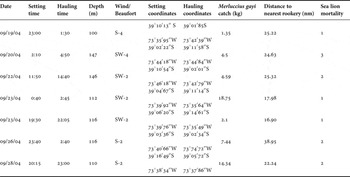
Variables such as time of setting and hauling of the trawl, depth of the trawls, target species biomass, geographical position and distance to the nearest rookery were obtained with the aim to evaluate their relationship with the caught sea lions (Table 1).
Summary of Otaria flavescens mortality during bottom-trawling operations in southern Chile, as observed during September 2004.

Data analyses
Sea lions’ mortality difference between day and night trawls was evaluated taking into account the time of setting and hauling of the net. The difference of mortality between both periods was evaluated using a contingency table in which it was assumed that the number of dead animals between day and night trawls would be equal. This last was evaluated with a correction by the number of trawls during each period.
With the aim to evaluate the potential predictors of caught sea lions and in particular dead sea lions, we used the variables described before (target species biomass (kg), duration time of the trawl (minutes), depth of the trawl and Beaufort state measured during the hauling of the net, and distance to the closest rookery). Dead sea lions' response to the predictors was assessed through multiple regression analyses, using a mixed multiple regression model of continuous and discrete variables. None of the predictors were strongly correlated (R2 < 25%). Analyses were run on Statistica 7.0 (StatSoft, 2004).
Total discarded fish by-catch biomass was estimated through direct evaluation of total catch volume aided by markings on the net, minus the actual retained catch that was of legal length (≥30 cm).
RESULTS
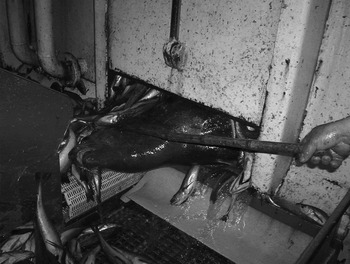
A total of 82 sea lions were observed entangled in the nets and subsequently hauled onto the ship's deck during this study. Twelve of these individuals were found dead (Table 1). Out of the 82 total caught sea lions, 33% were caught in a single trawl that caught 27 individuals (26 September 2004), two of which were found dead (Figure 1).
South American sea lions caught in a single trawl along the continental shelf in south-central Chile during September 2004.

During the 10 days of the study, incidental sea lion capture in the trawling nets was 6.3 sea lions/working day−1 (1.2 sea lions/trawl−1) ranging from zero to 27 caught per trawl. The sea lions that were alive when released onto the ship's deck were returned to the ocean. The total mortality resulted in an average of 0.92 sea lion fatalities each working day, ranging from 0 mortalities to 3 dead animals per day.
Eighty-three per cent of observed sea lion mortalities occurred during nocturnal trawls. Total sea lion mortality rate per ton of catch during the observation period (including diurnal and nocturnal trawls) was 0.012 mortalities/ton−1. The diurnal mortality rate was 0.002 mortalities/ton−1, and the nocturnal mortality rate rose to 0.033 mortalities/ton−1. Upon completion of the study, the total average sea lion mortality rate out of all 69 trawls was 0.17 mortalities/trawl−1 ranging from 0 to 3 mortalities per trawl. The daytime mortality rate was 0.041 mortalities/trawl−1 and the night-time mortality increased to 0.476 mortalities/trawl−1. These data indicate that a difference exists between the mortality rate during nocturnal tows and diurnal tows (χ 2 0.05.1 = 0.6274 (P = 0.5717)) possibly due to the sea lions’ poor night-time vision that facilitates their entanglement in the nets.
This occurred mainly because of the rapid discard of by-catch and target species under legal extraction size (which accounted for 57.8% of the total catch during the sampling period; 575,082 kg of discarded hake). A large number of sea lions followed the ships during operations with the aim to take advantage of this situation.
A multiple regression model did not suggest any positive association between dead sea lions and the predictor variables, nor interaction between all of them and the response variable (P = 0.07).
DISCUSSION
Considering that thirty-nine industrial trawlers are currently operating in southern central Chile, it is thought that each ship would be capturing the same amount of sea lions that were found in this study. However, the extrapolation of the sea lion mortality results presented here is not straightforward since some of these ships operate far from the coast, and therefore far from South American sea lion rookeries, such as those fishing for orange roughy (Hoplostethus atlanticus) more than 600 nautical miles into the open ocean (Lillo et al., 2003; Niklitschek et al., Reference Niklitschek, Boyer, Merino, Hampton, Soule, Nelson, Cornejo, Lafon, Oyarzún, Roa and Melo2005). Although sea lions are capable of travelling hundreds of kilometres, it is uncommon to observe them beyond the continental shelf (Campagna et al., Reference Campagna, Werner, Karesh, Marin, Koontz, Cook and Koontz2001) where orange roughy and other trawling fisheries operate. Although there was no relationship between the dead animals and the proximity to a rookery, it should be highlighted that there are 33 rookeries in the fishing area of the south Pacific common hake. It must also be considered that the study occurred during September, at the end of winter and beginning of spring in the Southern Hemisphere, when the number of sea lion individuals at sea would be higher than in summer because they have not yet formed reproductive colonies (Aguayo & Maturana, Reference Aguayo and Maturana1973). Despite these records it is incorrect to extrapolate them to other situations because of the variability of the fishery and also of the sea lion foraging activity.
Based on field observations, two plausible explanations for elucidating how sea lions are trapped in trawl nets are stated below, both of which are related to the sea lions’ positioning at the ship's stern as they follow the vessel during the fishing operations. The first explanation involves the setting of the trawl net. Sea lions often follow the ship alongside the stern, the location from which the net is launched. When the net is deployed, it can fall over a sea lion, entangling the animal and causing it to sink to the sea floor (90 and 250 m deep) where the net will operate. The remaining sea lions approach the net as it is drawn across the sea surface away from the ship prior to being submerged to the sea floor. They attempt to consume fish remains that have accumulated within the net from previous operations, since it is not cleaned between trawls. When the net is far enough away from the ship and ready to be submerged, the sea lions that have become entangled during their feeding attempts sink below the surface along with the net. All sea lions caught in the nets during the setting process are either killed by asphyxiation from remaining underwater for 45 minutes to three hours (an average of 1.3 h−1) or by the physical stress of being crushed by the tons of catch entering the net during the trawl (between 1.3 and 18.7 tons during the study).
The second explanation (of what could cause the death of sea lions) is related to the hauling process and is directly affected by the ship's speed during the procedure. The ship reaches a maximum cruising speed of ten knots, but only in the trajectory between the home port (in this case, San Vicente: 37°S) and the trawling grounds (39°S). Once the boat has arrived at the trawling grounds, it decreases its operation speed to 5 knots/h−1. This speed allows sea lions to swim alongside the ship without falling behind. Upon setting the net and beginning the trawl, the ship further decreases its speed to 3.7 knots/h−1, enabling the sea lions to continue following the ship. The net, after completing the trawl and capturing the catch, is brought to the surface. Upon reaching the surface, the net is generally 200 or 300 m away from the trawler and is drawn toward the ship with the help of powerful auxiliary motors. This moment is crucial for the sea lions as they approach the net to feed on the fish dropping from it. Some sea lions even take advantage of an easy feeding opportunity and increase their catch by extracting fish from the net's partially open mouth; these are the individuals that enter the net and get trapped.
An important piece of information not available from the fisheries agencies is the amount of discarded fish, which could serve as a principal attractor for sea lions to ships. According to personal communications with workers at the Fisheries Department of the Chilean Subsecretary of Fisheries, the amount of discarded fish during the year of the study was unusually high, which could have caused an increase in the number of sea lions around ships, thereby increasing fatalities. This situation, similar to those previously described, is based on too many assumptions to address with certainty sea lion mortality caused by interactions with trawling ships. Although there was no interaction between the predictor variables and the dead sea lions, it must be recognized that a potentially severe problem does exist, along with a scarcity of studies focused on this topic.
At present by-catch mitigation has to been tackled mainly on a species-by-species or at best a gear specific basis. This is, in part, a reflection of the need for different approaches to manage the individual environmental issues found in each fishery and with each species.
In light of the records presented, we recommend that competent agencies support long-term and geographically broad studies specifically addressing the problem described in order to define it fully and explore possible solutions. Similar studies have already been completed assessing impacts on marine mammals in south-central Chile caused by long-line fishing (Moreno et al., 2003; Hucke-Gaete et al., Reference Hucke-Gaete, Moreno and Arata2004), purse seining and the development of salmon aquaculture (Oliva et al., Reference Oliva, Sielfeld, Durán, Sepúlveda, Pérez, Rodríguez, Stotz and Araos2003).
Thus, having in mind human dependence on goods and services from the oceans, as well as the increasing human population, further studies have to be carried out in order to establish a framework of trade-offs between different human uses and the least possible ecological impact to the ecosystem (Halpern et al., Reference Halpern, Walbridge, Selkoe, Kappel, Micheli, D'Agrosa, Bruno, Casey, Ebert, Fox, Fujita, Heinemann, Lenihan, Madin, Perry, Selig, Spalding, Steneck and Watson2008).
ACKNOWLEDGEMENTS
We acknowledge the outstanding cooperation provided by the captain of the vessel, Captain Enrique Quiero and his crew. We are also indebted to the Fishery Research Institute (INPESCA) for providing logistic assistance.