Introduction
The aetiopathogenesis of chronic otitis media is multifactorial.Reference Doyle1 Recurrent otitis media, upper respiratory tract infections, nasopharynx and Eustachian tube infections, allergy, and ciliary dysfunction are possible risk factors.Reference Cingi, Altin, Cakli, Entok, Gurbuz and Cingi2
Eustachian tube dysfunction is a major risk factor for infective pathologies of the middle ear,Reference Cingi, Altin, Cakli, Entok, Gurbuz and Cingi2, Reference Bakhshaee, Rajati, Fereidouni, Khadivi and Varasteh3 and it frequently occurs as a result of nasal, paranasal and nasopharyngeal pathologies.Reference Parietti-Winkler, Baumann, Gallet, Gauchard and Jankowski4–Reference Hone, Moodley, Donnelly, Fenton, Gormley and Walsh6 Depending on the degree of nasal obstruction, Eustachian tube functions can be affected, which can lead to hypoventilation of the middle ear.Reference Salvinelli, Cásale, Greco, D'Ascanio, Petitti and Di Peco5, Reference Buchman, Doyle, Swarts and Bluestone7 Nasal packing was reported to increase the incidence of Eustachian tube dysfunction as a consequence of inflammatory mediator release and the absence of nasal airflow.Reference Yilmaz, Guven, Buyukarslan, Kaymaz and Erkorkmaz8
This study investigated the possible relationship between unilateral chronic otitis media and nasal obstruction on the same side. Our primary aim was to evaluate the nasal functions of patients with unilateral chronic otitis media using rhinomanometry, and to compare the chronic otitis media sides with the healthy sides, and patients with healthy individuals. Our secondary aim was to investigate the association between nasal functions and the presence of cholesteatoma formation by dividing patients into two groups: a chronic otitis media with cholesteatoma group and a non-suppurative chronic otitis media (without cholesteatoma) group.
Materials and methods
Study protocol
The study was initiated in a tertiary hospital upon receipt of approval from the local ethics committee dated 6 March 2015 (approval number: 1491-235-15/1648.4-499).
Patients aged over 18 years who were admitted from March 2015 to October 2016 to the ENT polyclinic for symptoms of unilateral otorrhoea, with or without hearing loss, and who were then diagnosed with chronic otitis media after otoscopic examination, were included in the study. Patients whose otoscopic examination findings indicated tympanic membrane perforation and/or retraction pockets were diagnosed with chronic otitis media.
Subjects and groups
Those chronic otitis media patients with a central perforation with dry tympanic mucosa constituted the non-suppurative chronic otitis media group. Patients with biopsies (taken from the tympanum or mastoid cavity during surgery) that were reported as cholesteatoma constituted the second chronic otitis media with cholesteatoma group. Patients were excluded if they were aged under 18 years, or had bilateral nasal obstruction, bilateral ear pathology, nasal polyps, upper airway infection, previous nasal or otological surgical procedures, or a history of trauma, or were smokers. The control group consisted of individuals with no ear or nasal function complaints, who were aged over 18 years, with normal otorhinolaryngological examination results.
Rhinomanometry
All patients underwent active anterior rhinomanometry to measure nasal airway resistance. This was performed under normal room conditions using a MasterScope Rhino device (Cardinal Health, Norderstedt, Germany) and the appropriate software (JLab version 5.21(.0.60)). An anaesthesia face mask was used for the test. The probe (silicone tube) used to measure nasopharyngeal pressure and the medical foam tape for isolation were attached to the rim of the ipsilateral nose. Technical regulations and evaluations of the measurements were made in line with the recommendations of the International Standardization Committee.Reference Clement and Gordts9 The test was performed while the patients were seated and conducting physiological (effortless) breathing, and measurements were conducted at a pressure of 150 Pa.
Saccharin test
We evaluated nasal mucociliary transport time by performing a saccharin test measurement on the chronic otitis media sides and unaffected sides of the nose, without use of a topical anaesthetic agent. The saccharin granules were 2–3 mm in diameter. While the patient was in a sitting position, a saccharin granule was placed on the frontal edge of the inferior turbinate. The saccharin test measurement was the time taken from saccharin application to the first perception of a sweet taste and was recorded as the mean ± standard deviation (SD).
Statistical analyses
Statistical analyses were performed using SPSS software for Windows, version 15.0 (Chicago, Illinois, USA). The values were expressed as means ± SDs. Comparisons between the parameters of the independent groups were analysed using the Mann–Whitney U test. Statistical significance was set at p < 0.05.
Results
In total, 102 patients (84 males and 18 females), with a mean age of 22.04 ± 3.67 years, were included in the study. There were 54 patients with non-suppurative chronic otitis media and 48 patients with chronic otitis media with cholesteatoma. The right ear was affected in 57 patients and the left ear in 45 patients.
No significant differences were detected in the nasal airway resistance and mucociliary transport time values, as measured by active anterior rhinomanometry and the saccharin test, between the affected and unaffected sides (p = 0.72 and p = 0.28, respectively) (Table 1).
Comparison of nasal parameters between COM and healthy sides of study group*

Data represent means ± standard deviations. *Total n = 102. COM = chronic otitis media; Pa*s/ml = Pascal second per millilitre
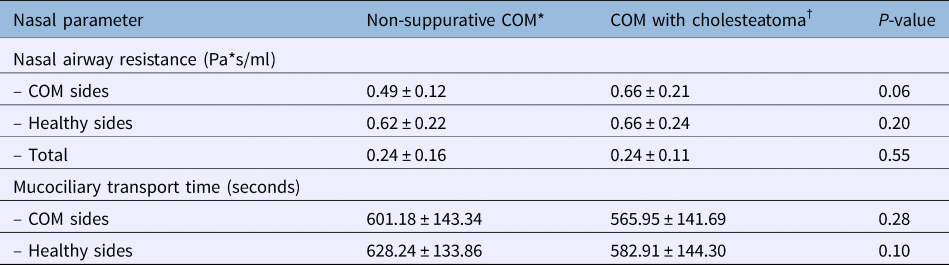
No significant differences were found between the non-suppurative chronic otitis media and chronic otitis media with cholesteatoma groups in terms of nasal airway resistance and mucociliary transport time values (Table 2).
Comparison of nasal parameters between non-suppurative COM and COM with cholesteatoma groups

Data represent means ± standard deviations. *n = 54; †n = 48. COM = chronic otitis media; Pa*s/ml = Pascal second per millilitre
The study group and the control group also showed no significant differences in terms of nasal airway resistance and mucociliary transport time values (p = 0.052 and p = 0.06, respectively) (Table 3).
Comparison of nasal parameters between study and control groups

Data represent means ± standard deviations. *n = 102; †n = 40. Pa*s/ml = Pascal second per millilitre
Discussion
Normal functioning of the Eustachian tube is extremely important for the physiological balance of the middle ear; hence, Eustachian tube dysfunction is the most important factor in the pathogenesis of middle-ear diseases.Reference Doyle1, Reference Cingi, Altin, Cakli, Entok, Gurbuz and Cingi2 Eustachian tube dysfunction may occur in cases of nasal obstruction, such as nasal septum deviation, concha hypertrophy and nasal polyposis, and in other conditions that cause nasal resistance.Reference Maier and Krebs10 For example, Low and Willatt measured nasal functions by nasal peak airflow velocity and reported a significant improvement in middle-ear pressure after septoplasty.Reference Low and Willatt11 Based on these findings, they also proposed a possible relationship between nasal septum deviation and middle-ear problems. Similarly, Filipović et al. reported a higher nasal resistance in patients with Eustachian tube dysfunction.Reference Filipović, Janosević, Andrić and Ugrinović12 Yilmaz et al. blocked the unilateral nasal passage with Merocel® packing and found that Eustachian tube dysfunction developed on the blocked side of the nose.Reference Yilmaz, Guven, Buyukarslan, Kaymaz and Erkorkmaz8 Maier and Krebs stated that patients who required tympanoplasty and who had severe nasal septum deviation should primarily undergo septoplasty, basing this suggestion on the opinion that Eustachian tube dysfunction is often caused by severe septal deviation and concha hypertrophy.Reference Maier and Krebs10 Watson found higher nasal resistance on the affected side in unilateral chronic otitis media patients and suggested that this may develop from mucosal causes, such as concha hypertrophy, rather than mechanical causes, such as nasal septum deviation.Reference Watson13 Kurtgöz et al. assessed the nasal resistance of patients with unilateral chronic otitis media by acoustic rhinometry and reported a significant increase in nasal airway resistance on the pathological side compared with the non-pathological side or in patients with normal ears.Reference Kurtgöz, Kökten and Tekin14 However, acoustic rhinometry measurements mainly determine the cross-sectional area rather than the nasal airway resistance, so their results regarding nasal airway resistance are somewhat controversial, despite the good design of the study.
Although many studies in the literature have suggested an association between nasal obstruction and chronic otitis media and other middle-ear pathologies, some recent investigations suggest no relationship between nasal obstruction and chronic otitis media. For example, Güçlü et al. investigated the relationship between nasal functions and middle-ear pathologies using rhinomanometry and acoustic rhinometry and reported no statistical difference between the measurements of each side in unilateral chronic otitis media cases.Reference Güçlü, Sahin, Tekin and Derekoy15 They also found no differences in nasal resistance measured by rhinomanometry or in the area under the curve measured by acoustic rhinometry when comparing non-suppurative chronic otitis media and suppurative chronic otitis media cases. Similarly, Toros et al. found no differences in the acoustic rhinometry measurements of nasal functions of the affected and unaffected sides in 55 patients with unilateral chronic otitis media.Reference Toros, Karaca, Onder, Caypınar, Sahin-Yilmaz and Oysu16
In our study, we objectively measured the nasal functions of the affected and unaffected sides in unilateral chronic otitis media patients. We endeavoured to demonstrate a relationship between nasal functions and chronic otitis media by comparing the results between patients and healthy individuals. We also grouped patients according to the presence of cholesteatoma to evaluate any potential effect of nasal dysfunction on cholesteatoma formation. We evaluated nasal functions with both active anterior rhinomanometry and the saccharin test, unlike many other studies. Rhinomanometry is a non-invasive test that has been used since 1983 to measure nasal functions, and it correlates best with physical examination findings.Reference Tompos, Garai, Zemplen and Gerlinger17, Reference Hirschberg18 When evaluated together with physical examination findings, rhinomanometry is now accepted as the ‘gold standard’ for the assessment of nasal obstruction.Reference Cole and Fenton19, Reference Arslan, Yildizoglu, Durmaz and Cetinkaya20 We conducted an objective evaluation of the relationship between nasal functions and middle-ear pathology by measuring nasal functions with active anterior rhinomanometry, which is considered the ideal method for nasal function evaluation. Our results were similar to those of Toros et al.Reference Toros, Karaca, Onder, Caypınar, Sahin-Yilmaz and Oysu16 and Güçlü et al.,Reference Güçlü, Sahin, Tekin and Derekoy15 and our objective measurements of nasal functions revealed no differences between the affected and unaffected sides in unilateral chronic otitis media patients. We also found no differences in the nasal airway resistance measurements between the study group with ear pathology and the control group without ear pathology.
In this study, we also investigated mucociliary activity. A previous study by Cingi et al., who investigated the relationship between mucociliary activity and chronic otitis media, found that mucociliary transport times measured by technetium-99 m were decreased on the affected side, suggesting a possible relationship between the impairment of ciliary functions and chronic otitis media.Reference Cingi, Altin, Cakli, Entok, Gurbuz and Cingi2 Similarly, Kurtgöz et al. measured mucociliary transport times using a saccharin test, and found no difference between the affected and unaffected sides.Reference Kurtgöz, Kökten and Tekin14 Güçlü et al. stated that acoustic rhinometry findings did not correlate with saccharin transport times in the affected sides.Reference Güçlü, Sahin, Tekin and Derekoy15
We evaluated the mucociliary activity of affected and unaffected nasal passages by measuring mucociliary transport times using a saccharin test, and found no differences between the affected and unaffected sides. We also found no differences in mucociliary transport times between the patient and control groups. Considering the implications and sample sizes of the previous studies, we conclude that no relationship exists between nasal functions and chronic otitis media.
The small sample sizes of previous studies seem to be insufficient to provide reliable evidence to confirm a relationship between nasal functions and chronic otitis media. By contrast, the present study had a larger sample size and, therefore, stronger analytical power. The calculated statistical power was 80 per cent for the comparison of nasal parameters between the chronic otitis media sides and healthy sides of the study group (n = 102), which seems an acceptable rate (an alpha of 5 per cent corresponds to a 95 per cent confidence interval). In addition, the statistical power was 100 per cent for the comparison of nasal parameters between the non-suppurative chronic otitis media group (n = 54) and chronic otitis media with cholesteatoma group (n = 48), which represents an excellent sample size. The calculation performed for the comparison of nasal parameters between the study (n = 102) and the control groups (n = 40) gave a statistical power of 93 per cent. All these statistical analyses support the reliability of the results of this study in its present design.
• Eustachian tube dysfunction is a major risk factor for infective pathologies of the middle ear
• Eustachian tube dysfunction frequently occurs because of nasal, paranasal and nasopharyngeal pathologies
• Many studies suggest an association between nasal obstruction and chronic otitis media and other middle-ear pathologies
• However, some recent studies suggest no such relationship between nasal obstruction and chronic otitis media
• Our study results do not support the hypothesis that unilateral nasal obstruction may lead to chronic otitis media on the same side
• Our results also suggest that nasal functions do not contribute to cholesteatoma development
Unlike the previously published studies, we also evaluated whether nasal functions contributed to the development of cholesteatoma. We found no differences between the nasal functions of the non-suppurative chronic otitis media and the chronic otitis media with cholesteatoma groups. It should be noted, however, that we used both a saccharin test and active anterior rhinomanometry in our evaluation, which is the first reported combined use in the English literature.
Although the literature presents contradictory results regarding the effect of nasal obstruction on the development of chronic otitis media, many surgeons believe this relationship to be true and prefer to treat nasal obstruction as part of the successful treatment of chronic otitis media. Our study can shed light on this issue through its design, sample size and reliable results.
Conclusion
This study, based on objective methods and a large sample size, indicated no significant difference in the nasal functions between the chronic otitis media and healthy ear sides of patients with unilateral chronic otitis media, or between patients with ear pathology and healthy individuals. In addition, nasal functions had no effect on the development of cholesteatoma.
We believe that this topic should be the subject of further research with larger randomised controlled study populations to confirm the exact relationship between nasal functions and chronic otitis media. Our work offers the most reliable results currently available.
Competing interests
None declared