Although the study of peer relationships and their effects on psychopathology became popularized in the 1980s, early attention was directed toward the construct of peer rejection (Asher & Coie, Reference Asher and Coie1990). As the adverse consequences of peer rejection became clear, a burgeoning interest emerged in identifying specific behaviors through which negative attitudes such as rejection are conveyed to peers. With these efforts arose a heightened concern about bullying and victimization. Given the predominant focus of the time on physical aggression among peers, victimization typically was conceptualized in terms of acts of overt aggression as reflected in hitting, threats of violence, and the like. However, pioneering work by Nicki Crick and colleagues (Crick & Bigbee, Reference Crick and Bigbee1998; Crick & Grotpeter, Reference Crick and Grotpeter1995, Reference Crick and Grotpeter1996; Crick & Nelson, Reference Crick and Nelson2002) spearheaded an innovative line of research aimed at uncovering the nature and consequences of relational aggression/victimization, as reflected in acts aimed at threatening dyadic relationships (e.g., social manipulation) or damaging one's social standing (e.g., exclusion or rumor spreading).
Two decades later, solid evidence documents the adverse effects of victimization, implicating it as a potentially traumatic stressor that warrants significant research and practical attention (Graham, Reference Graham2006). Moreover, research documents multifinality of outcomes (Cicchetti & Rogosch, Reference Cicchetti and Rogosch1996), reflected in between-individual heterogeneity in the consequences of victimization. Yet many of these efforts involve either concurrent or short-term longitudinal studies, leaving open the question of whether victimization constitutes a long-term risk. Moreover, most research fails to distinguish the static effects of victimization from its dynamic effects over time and across developmental transitions. This study examined whether early (second grade) and dynamic (trajectories across second–sixth grades) indicators of victimization uniquely predict risky outcomes in adolescence (sixth grade). In particular, consistent with prior evidence of multifinality in the outcomes of victimization, we sought to understand the emergence of three social orientations that represent risk or protective factors for psychopathology (Caspi, Elder, & Bem, Reference Caspi, Elder and Bem1987, Reference Caspi, Elder and Bem1988): moving against the world (conflictual engagement), moving away from the world (disengagement), and moving toward the world (positive engagement). We also examined whether exposure to victimization contributes to these outcomes beyond early individual differences in children's social motivation.
Victimization and Moving Against the World
Moving against the world was conceptualized as aggressive (e.g., fighting or cruelty) and antisocial (e.g., disobedience or lying) acts that threaten others and defy accepted social norms. Some peer-victimized children may attribute maltreatment to undesirable characteristics of their peers (Perren, Ettekal, & Ladd, Reference Perren, Ettekal and Ladd2013; Schwartz et al., Reference Schwartz, Dodge, Coie, Hubbard, Cillessen and Lemerise1998; Yeung & Leadbeater, Reference Yeung and Leadbeater2007), thereby developing negative peer perceptions (e.g., a sense of mistrust, hostility, or injustice) and feelings of anger (Kochenderfer-Ladd, Reference Kochenderfer-Ladd2004; Salmivalli, Karhunen, & Lagerspetz, Reference Salmivalli, Karhunen and Lagerspetz1996; Troop-Gordon & Ladd, Reference Troop-Gordon and Ladd2005). Being victimized also may instill a defensive stance in children, prompting aggressive efforts to retaliate or reattain their social status. Over time, negative peer perceptions, anger, and aggressive tendencies may become consolidated into a hostile attitude toward the world and generalized antisocial behavior.
Supporting the idea that victimization fosters a social orientation characterized by movement against the world, victimization predicts subsequent aggression (Lamarche et al., Reference Lamarche, Brendgen, Boivin, Vitaro, Dionne and Perusse2007; Ostrov, Reference Ostrov2010; Rudolph, Troop-Gordon, Hessel, & Schmidt, Reference Rudolph, Troop-Gordon, Hessel and Schmidt2011), delinquency (Khatri, Kupersmidt, & Patterson, Reference Khatri, Kupersmidt and Patterson2000; Rusby, Forrester, Biglan, & Metzler, Reference Rusby, Forrester, Biglan and Metzler2005), conduct problems (Loukas & Pasch, Reference Loukas and Pasch2013), and general externalizing behavior (Ladd & Troop-Gordon, Reference Ladd and Troop-Gordon2003; van Lier et al., Reference van Lier, Vitaro, Barker, Brendgen, Tremblay and Boivin2012). Only a few studies provide clues about the impact of victimization on antisocial behavior over longer time spans or across developmental stages. In one study, victimization during first–third grades predicted behavior problems in fourth grade after accounting for proximal (fourth grade) victimization (Ladd & Troop-Gordon, Reference Ladd and Troop-Gordon2003). In a follow-up, changes in victimization from fourth to sixth grades predicted sixth-grade behavior problems (Troop-Gordon & Ladd, Reference Troop-Gordon and Ladd2005). Using a cross-lagged panel design across first–third grades, Leadbeater and Hoglund (Reference Leadbeater and Hoglund2009) found that victimization predicted subsequent physical aggression in boys but not in girls. Using trajectory analyses, Goldbaum, Craig, Pepler, and Connolly (Reference Goldbaum, Craig, Pepler and Connolly2007) found that early adolescents with increasing (“late onset”) victimization showed increasing aggression over time. Finally, Hanish and Guerra (Reference Hanish and Guerra2002) found that victimization predicted aggression 2 years later after adjusting for its stability. Drawing from theory and prior research, we anticipated that early (second grade) and increasing (second–sixth grade) victimization would predict heightened conflictual engagement (i.e., antisocial behavior, reflected in aggressive and delinquent acts) in sixth grade.
Victimization and Moving Away From the World
Moving away from the world was conceptualized as helpless behaviors that reflect a lack of initiative and persistence in the peer group. Some peer-victimized children may attribute maltreatment to undesirable characteristics of themselves (Graham, Bellmore, & Mize, Reference Graham, Bellmore and Mize2006; Graham & Juvonen, Reference Graham and Juvonen1998; cf. Perren et al., Reference Perren, Ettekal and Ladd2013), thereby developing negative self-perceptions (e.g., a sense of low self-worth, self-competence, or self-efficacy; Cole, Maxwell, Dukewich, & Yosick, Reference Cole, Maxwell, Dukewich and Yosick2010; Singh & Bussey, Reference Singh and Bussey2011; Troop-Gordon & Ladd, Reference Troop-Gordon and Ladd2005) and feelings of embarrassment (Kochenderfer-Ladd, Reference Kochenderfer-Ladd2004) and hopelessness (Bonanno & Hymel, Reference Bonanno and Hymel2010). A constant barrage of maltreatment eventually may lead victimized children to withdraw from peers in an effort to avoid future disappointment and harassment. Over time, victimization may undermine children's social initiative and persistence, causing them to give up easily in the face of social challenges (e.g., making friends or resolving conflicts).
Supporting the idea that victimization fosters a social orientation characterized by movement away from the world, victimization is associated concurrently (Crick & Grotpeter, Reference Crick and Grotpeter1996; Pouwels & Cillessen, Reference Pouwels and Cillessen2013; Siegel, La Greca, & Harrison, Reference Siegel, La Greca and Harrison2009) and prospectively (Loukas & Pasch, Reference Loukas and Pasch2013; Rudolph et al., Reference Rudolph, Lansford, Agoston, Sugimura, Schwartz and Dodge2014; Siegel et al., Reference Siegel, La Greca and Harrison2009) with loneliness, social anxiety, withdrawal/isolation, and helplessness. Very few studies use longer term designs to examine patterns of disengagement across several years. Using a cross-lagged panel design, Boivin, Petitclerc, Feng, and Barker (Reference Boivin, Petitclerc, Feng and Barker2010) found that victimization predicted social withdrawal across 1-year periods from third to fifth grades. Moreover, children who started out extremely high in victimization became more withdrawn over time, with a slight decrease in sixth grade. Assessing trajectories of social withdrawal across the middle school transition, Oh et al. (Reference Oh, Rubin, Bowker, Booth-LaForce, Rose-Krasnor and Laursen2008) found that higher levels of victimization in fifth grade (prior to the transition) and in sixth grade (following the transition) predicted a higher likelihood of showing an increasing trajectory relative to a stable low trajectory from fifth to eighth grades. Drawing from theory and prior research, we anticipated that early (second grade) and increasing (second–sixth grade) victimization would predict heightened disengagement (i.e., social helplessness, reflected in low persistence and initiative) in sixth grade.
Victimization and Moving Toward the World
Moving toward the world was conceptualized as friendly, empathic, and inclusive behaviors that reflect a desire to help peers. Regardless of whether they move against or away from the peer group, peer-victimized children are less likely to move toward the peer group over time. Victimization conveys a message that children are not welcome members of the peer group, thereby undermining their confidence and the likelihood they will actively seek affiliations within the mainstream peer group. Victimized children are less likely to be friendly and inclusive, perhaps because of resentment about their own maltreatment or because they assume peers would not be interested in affiliating with them. Moreover, victimized children may not have the social capital to initiate empathic and inclusive interactions with peers.
Minimal research examines how victimization influences children's prosocial orientations. One study revealed that bully-victims were rated by teachers as less prosocial than those not involved in bullying or victimization (Perren & Alsaker, Reference Perren and Alsaker2006). In another study, children who were highly victimized in first grade were decreasingly nominated by peers as prosocial through the third grade (Pouwels & Cillessen, Reference Pouwels and Cillessen2013). Drawing from theory and prior research, we anticipated that early (second grade) and increasing (second–sixth grade) victimization would predict less positive engagement (i.e., prosocial behavior, reflected in relational inclusion) in sixth grade.
Developmental Transitions
The adverse effects of victimization may be amplified during the transitions to middle school and adolescence, which require youth to negotiate complex psychological and social challenges (Oh et al., Reference Oh, Rubin, Bowker, Booth-LaForce, Rose-Krasnor and Laursen2008; Roeser & Eccles, Reference Roeser, Eccles, Lewis and Rudolph2014; Rudolph, Reference Rudolph, Lewis and Rudolph2014). Youth with a history of victimization enter these transitions with prior risks that may impair their ability to effectively navigate their new social landscape. Specifically, victimized youth often lack peer support systems (Hanish, Ryan, Martin, & Fabes, Reference Hanish, Ryan, Martin and Fabes2005) and an adequate repertoire of skills (Champion, Vernberg, & Shipman, Reference Champion, Vernberg and Shipman2003) for coping with transition-related changes. Moreover, the negative peer or self-perceptions associated with victimization may be intensified by normative adolescent increases in social alienation and self-consciousness (Harter, Reference Harter, Montemayor, Adams and Gullotta1990). As peer groups reorganize into adolescent cliques and crowds (Brown, Reference Brown, Feldman and Elliott1990), victimized youth may find it particularly difficult to find a social niche, potentially causing them to become angry or frustrated and to move against the peer group or to become resigned and hopeless and to move away from the peer group. Thus, to fully understand the consequences of victimization, long-term research needs to follow youth over extended time periods and across key transitions. Accordingly, this study examined how early and recent experiences of victimization uniquely contribute to social health following the middle school transition.
Sex Differences and the Consequences of Overt Versus Relational Victimization
This study also examined sex differences in the effects of victimization. Given girls’ tendency to feel afraid and embarrassed in response to peer victimization (Kochenderfer-Ladd, Reference Kochenderfer-Ladd2004), they may take more personal responsibility, leading them to develop socially helpless behavior. Given boys’ tendency to engage in overt forms of aggression (Card, Stucky, Sawalani, & Little, Reference Card, Stucky, Sawalani and Little2008) and antisocial acts (Lahey et al., Reference Lahey, Van Hulle, Waldman, Rodgers, D'Onofrio and Pedlow2006), they may be more likely to use these behaviors to defend themselves or reassert their status following victimization. Some studies indicate significant sex differences in the prospective effects of victimization (e.g., Rusby et al., Reference Rusby, Forrester, Biglan and Metzler2005; Snyder et al., Reference Snyder, Brooker, Patrick, Snyder, Schrepferman and Stoolmiller2003), but others indicate similar effects on conflictual engagement (e.g., Ladd & Troop-Gordon, Reference Ladd and Troop-Gordon2003; Rudolph, Troop-Gordon, et al., Reference Rudolph, Troop-Gordon, Hessel and Schmidt2011) and disengagement (e.g., Ladd & Troop-Gordon, Reference Ladd and Troop-Gordon2003). Although a few studies suggest more consistent or enduring effects in boys (Leadbeater & Hoglund, Reference Leadbeater and Hoglund2009), particularly for externalizing problems (Hanish & Guerra, Reference Hanish and Guerra2002; Sullivan, Farrell, & Kliewer, Reference Sullivan, Farrell and Kliewer2006), others show stronger or more enduring effects for girls (for withdrawal, Boivin et al., Reference Boivin, Petitclerc, Feng and Barker2010; for externalizing problems, Khatri et al., Reference Khatri, Kupersmidt and Patterson2000; Loukas & Pasch, Reference Loukas and Pasch2013; Pouwels & Cillessen, Reference Pouwels and Cillessen2013; Snyder et al., Reference Snyder, Brooker, Patrick, Snyder, Schrepferman and Stoolmiller2003).
Many of these studies examine only overt victimization or collapse across different forms; however, more consistent sex differences may emerge when distinguishing overt and relational victimization. To address the complexity of victimization and maximize the likelihood of identifying sex differences, this study separately examined the consequences of overt and relational victimization. Although a few studies suggest possible sex differences in the effects of these two forms (Siegel et al., Reference Siegel, La Greca and Harrison2009; Sullivan et al., Reference Sullivan, Farrell and Kliewer2006), they are highly correlated (Card & Hodges, Reference Card and Hodges2008) and often have similar consequences (Crick & Grotpeter, Reference Crick and Grotpeter1996; Nishina & Juvonen, Reference Nishina and Juvonen2005). In light of past inconsistent findings, we did not formulate specific predictions about possible sex-differentiated consequences of these two forms of victimization.
Disentangling the Effects of Victimization and Social Motivation
Research examining the contribution of victimization to adjustment implicitly assumes a causal model, wherein peer experiences actively foster adaptive or maladaptive outcomes (Rudolph & Asher, Reference Rudolph, Asher, Sameroff, Lewis and Miller2000). From this perspective, victimization serves as a catalyst for social disruption. However, peer disturbances could merely be an incidental marker of individual risk, such that both exposure to victimization and later maladaptation reflect common underlying pathogenic processes (Rudolph & Asher, Reference Rudolph, Asher, Sameroff, Lewis and Miller2000). Thus, it is critical to determine whether peer maltreatment predicts adverse outcomes beyond individual differences in children. With regard to this study, some children may be temperamentally inclined to move against or away from the world (Caspi et al., Reference Caspi, Elder and Bem1987, Reference Caspi, Elder and Bem1988), leading them both to experience more victimization and to show heightened conflictual engagement or disengagement and less positive engagement.
Specifically, children's social motivation may foster individual differences in their tendency to move toward, against, or away from the world (Erdley, Loomis, Cain, & Dumas-Hines, Reference Erdley, Loomis, Cain and Dumas-Hines1997; Rudolph, Abaied, Flynn, Sugimura, & Agoston, Reference Rudolph, Abaied, Flynn, Sugimura and Agoston2011; Ryan & Shim, Reference Ryan and Shim2008). Social mastery goals involve developing social competence and learning about relationships (e.g., learning how to be a good friend). Social performance-approach goals involve demonstrating social competence by gaining positive social judgments and prestige (e.g., being viewed as important or having “cool” friends). Social performance-avoidance goals involve demonstrating social competence by avoiding negative social judgments (e.g., avoiding being viewed as foolish or a “loser”).
Social mastery oriented children aim to develop positive peer relationships. Their goals involve cooperating and minimizing conflict (Rudolph, Abaied, et al., Reference Rudolph, Abaied, Flynn, Sugimura and Agoston2011), making it likely that they approach peers in a prosocial manner, are inclusive in their relationships, and avoid behaviors that would undermine relationships. Social performance-approach oriented children aim to establish their peer status and prestige. Their goals involve controlling peers and pursuing their own self-interests (Rudolph, Abaied, et al., Reference Rudolph, Abaied, Flynn, Sugimura and Agoston2011), making it likely that they engage in aggressive and antisocial acts that fail to consider the consequences for their peers. Social performance-avoidance oriented children aim to avoid negative peer judgments. Their goals involve minimizing conflict (Rudolph, Abaied, et al., Reference Rudolph, Abaied, Flynn, Sugimura and Agoston2011), making it likely that they will disengage from socially challenging situations and avoid behaviors that make them stand out among peers.
Supporting these predictions, mastery goals are positively associated with prosocial behavior and negatively associated with aggression, whereas performance-approach goals are positively associated with aggression and negatively associated with prosocial behavior (Rodkin, Ryan, Jamison, & Wilson, Reference Rodkin, Ryan, Jamison and Wilson2013; Rudolph, Abaied, et al., Reference Rudolph, Abaied, Flynn, Sugimura and Agoston2011). Performance-avoidance goals are positively associated with ignoring peer conflict and negatively associated with aggression and retaliating in the face of peer conflict (Rodkin et al., Reference Rodkin, Ryan, Jamison and Wilson2013; Rudolph, Abaied, et al., Reference Rudolph, Abaied, Flynn, Sugimura and Agoston2011). More generally, approach motivation predicts moving against the world (Gray, Reference Gray, Ekman and Davidson1994; Rothbart, Ellis, & Posner, Reference Rothbart, Ellis, Posner, Baumeister and Vohs2004), whereas avoidance motivation predicts moving away from the world (Coplan et al., Reference Coplan, Rose-Krasor, Weeks, Kingsbury, Kingsbury and Bullock2013; Rubin, Coplan, & Bowker, Reference Rubin, Coplan and Bowker2009). Motivational tendencies to move against or away from the world also are associated with peer relationship disturbances, including victimization (Bowker & Raja, Reference Bowker and Raja2011; Caspi et al., Reference Caspi, Elder and Bem1988; Coplan et al., Reference Coplan, Rose-Krasor, Weeks, Kingsbury, Kingsbury and Bullock2013; Gazelle & Ladd, Reference Gazelle and Ladd2003; Troop-Gordon & Asher, Reference Troop-Gordon and Asher2005; for a review, see Eisenberg, Vaughan, & Hofer, Reference Eisenberg, Vaughan, Hofer, Rubin, Bukowski and Laursen2009), making it important to consider their role in the observed associations between victimization and social behavior.
Study Overview
Most research documenting adverse consequences of victimization relies on concurrent or short-term designs that focus on static, single informant measures of victimization, fail to distinguish early versus recent experiences, and rarely account for developmental transitions. Prior investigations also have not considered whether individual differences in children account for both their exposure to victimization and their maladaptive outcomes. This study relied on a rigorous analytic approach that (a) used a long-term design and latent growth curve analyses to track the unique consequences of early (second grade) and changing (second–sixth grade) victimization on adolescent outcomes following the middle school transition, (b) separately examined the effects of overt and relational victimization, (c) considered sex differences in the effects of victimization, (d) incorporated multiple developmental outcomes within single models, and (e) disentangled the effects of victimization exposure from those of individual differences in social motivation. We anticipated that early and increasing victimization during childhood would make unique contributions to heightened conflictual engagement (antisocial behavior) and disengagement (social helplessness) and dampened positive engagement (prosocial behavior) in adolescence, even after adjusting for second-grade behavior and social motivation.
Method
Participants
Participants were 636 youth (M age in second grade = 7.96 years, SD = 0.35; 338 girls, 298 boys; 67% White, 33% minority; 35% received a subsidized school lunch) participating in the Social Health and Relationship Experiences Project, a longitudinal study of peer victimization (e.g., Rudolph, Abaied, et al., Reference Rudolph, Abaied, Flynn, Sugimura and Agoston2011; Rudolph, Troop-Gordon, et al., Reference Rudolph, Troop-Gordon, Hessel and Schmidt2011). In second grade (Wave 1 [W1]), parents completed informed consent forms and youth provided oral assent. Of the 724 eligible children, 576 (80%) received consent to participate. Participants and nonparticipants did not significantly differ in sex, χ2 (1) = 0.15, ns; age, t (723) = 0.63, ns; ethnicity (White vs. minority), χ2 (1) = 0.59, ns; or school lunch status (full pay vs. subsidized), χ2 (1) = 0.35, ns. In third grade, an additional 60 classmates of the participating youth were recruited, resulting in a total of 636 participants. Follow-up assessments were conducted at annual intervals through the sixth grade (Wave 5 [W5]). Of the original 636 participants, 548 (86%) had relevant teacher data in the sixth grade. Youth with and without sixth-grade teacher data did not differ in sex, χ2 (1) = 0.03, ns; age, t (634) = 1.42, ns; ethnicity, χ2 (1) = 1.91, ns; or school lunch status, χ2 (1) = 0.36, ns. For youth recruited in second grade, those with and without sixth-grade teacher data did not differ in W1 overt victimization, t (574) = –0.75, ns; relational victimization, t (574) = –0.16, ns; overt aggression, t (574) = 0.89, ns; social helplessness, t (574) = –1.23, ns; prosocial behavior, t (574) = –0.33, ns; performance-approach goals, t (573) = 0.82, ns; performance-avoidance goals, t (573) = –0.98, ns; or mastery goals, t (573) = –0.15, ns. For youth recruited in third grade, those with and without sixth-grade teacher data did not significantly differ in W2 overt victimization, t (58) = 1.03, ns; relational victimization, t (58) = 1.06, ns; overt aggression, t (58) = 1.07, ns; social helplessness, t (58) = 1.09, ns; prosocial behavior t (58) = –1.45, ns; performance-approach goals, t (573) = 1.11, ns; performance-avoidance goals, t (573) = 0.97, ns; or mastery goals, t (573) = 0.24, ns. All 636 youth were included in the central analyses (see the Results Section).
Procedures
The procedures for this study were approved by the university's institutional review board. In the winter of each year, questionnaires were administered during two classroom sessions to small groups (3–4 students) in elementary school and larger groups (15–20 students) in middle school. Teachers returned their surveys at school or by mail. Youth received a small gift; teachers received a monetary reimbursement. Each participating elementary school classroom received a monetary honorarium, and middle schools received a schoolwide honorarium.
Measures
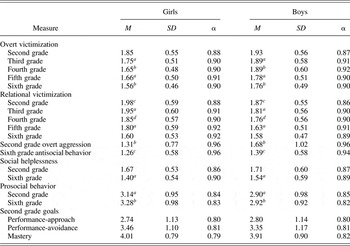
Table 1 presents descriptive data and reliability of the measures for girls and boys. All of the measures showed strong internal consistency across waves.
Descriptive statistics

a Means differ at p < .01.
b Means differ at p < .001.
c Means differ at p < .05.
d Means differ at p = .05.
Peer victimization
Each year from second to sixth grade, youth and teachers completed a revised version (Rudolph, Troop-Gordon, et al., Reference Rudolph, Troop-Gordon, Hessel and Schmidt2011) of the Social Experiences Questionnaire (Crick & Grotpeter, Reference Crick and Grotpeter1996) to assess exposure to peer victimization. This measure assesses overt victimization (being the target of behaviors intended to harm others through physical damage or the threat of such damage; e.g., “How often do you get hit by another kid?”) and relational victimization (being the target of behaviors intended to harm others through manipulation of relationships; e.g., “How often does another kid say they won't like you unless you do what they want you to do?”). Eleven items were added to the original measure to provide a more comprehensive assessment of victimization, resulting in a 21-item measure. Of the new items, 6 assessed overt victimization (e.g., “How often do you get teased by another kid?”) and 5 assessed relational victimization (e.g., “How often does a friend spread rumors about you because they are mad at you?”). Youth checked a box and teachers provided a rating indicating how often they experienced each type of victimization on a 5-point scale. Scores were computed as the mean of the items within each subscale.
Research suggests that self-reports of victimization provide valid information that corresponds to reports by peers (e.g., Graham & Juvonen, Reference Graham and Juvonen1998) and parents (Bollmer, Harris, & Milich, Reference Bollmer, Harris and Milich2006). Teacher reports of victimization also have established reliability and validity, and self- and teacher reports of victimization are significantly correlated (Ladd & Kochenderfer-Ladd, Reference Ladd and Kochenderfer-Ladd2002). In the present sample, youth and teacher reports were moderately but significantly correlated at all waves (average rs = .24 and .22, ps < .001, for overt and relational victimization, respectively). Thus, composite scores were created by averaging the youth and teacher reports of overt and relational victimization. These composite scores provided a more comprehensive picture of victimization by incorporating both child and teacher perspectives, which may provide both overlapping and distinct information about victimization experiences. Research shows that self and teacher reports of victimization are uniquely associated with children's adjustment and that a multiple-informant composite of victimization is a better predictor of adjustment than mono-informant assessments (Ladd & Kochenderfer-Ladd, Reference Ladd and Kochenderfer-Ladd2002).
Overt aggression
When youth were in second grade, teachers completed the overt aggression subscale of the Children's Social Behavior Scale (Crick, Reference Crick1996). Teachers rated each of four items (e.g., “This child pushes or shoves peers.”) on a 5-point scale. Scores were computed as the mean of the items. Previous research supports the reliability and validity of this measure and reveals high correspondence with peer reports of aggression (Crick, Reference Crick1996). Because the measure of antisocial behavior was not administered until sixth grade, this measure was used to adjust for second-grade comparable types of behavior. Supporting this approach, teacher ratings of overt aggression and antisocial behavior in sixth grade were highly correlated, r (548) = .82, p < .001.
Antisocial behavior
When youth were in sixth grade, teachers completed a measure of antisocial behavior (Nolen-Hoeksema, Stice, Wade, & Bohon, Reference Nolen-Hoeksema, Stice, Wade and Bohon2007). This 13-item measure, derived from items on the Child Behavior Checklist (Achenbach & Rescorla, Reference Achenbach and Rescorla2001), assesses aggressive (e.g., “This child was mean or cruel to others”) and delinquent (e.g., “This child lied or cheated”) behaviors over the past year. Prompts were reworded slightly to use for teacher reports. Teachers rated each item on a 5-point scale. Scores were computed as the mean of the items. Prior research has established the reliability of this measure and indicates that scores on a self-report version are associated with scores from the full externalizing scale of the Youth Self-Report form of the Child Behavior Checklist (Nolen-Hoeksema et al., Reference Nolen-Hoeksema, Stice, Wade and Bohon2007).
Social helplessness
When youth were in second and sixth grades, teachers completed the Social Helplessness Questionnaire (Nolen-Hoeksema, Girgus, & Seligman, Reference Nolen-Hoeksema, Girgus and Seligman1992). This 12-item measure assesses the tendency to show low initiative and persistence in peer relationships (e.g., “This child takes little independent initiative in making friends” or “This child is easily discouraged in his/her attempts to get along with other children”). Teachers rated each item on a 5-point scale. Scores were computed as the mean of the items. Prior research has established the reliability and validity of this measure (Caldwell, Rudolph, Troop-Gordon, & Kim, Reference Caldwell, Rudolph, Troop-Gordon and Kim2004; Nolen-Hoeksema et al., Reference Nolen-Hoeksema, Girgus and Seligman1992).
Prosocial behavior
When youth were in second and sixth grades, teachers completed the prosocial behavior subscale of the Children's Social Behavior Scale (Crick, Reference Crick1996). Teachers rated each of three items (e.g., “When this child notices that another kid has been left out of an activity or game, s/he invites the kid to join the group”) on a 5-point scale. Scores were computed as the mean of the three items. Research supports the validity of teacher reports of prosocial behavior (Ladd, Herald-Brown, & Andrews, Reference Ladd, Herald-Brown and Andrews2009; Ladd & Profilet, Reference Ladd and Profilet1996); moreover, scores on this measure correspond with peer reports of prosocial behavior (Crick, Reference Crick1996).
Social goals
When youth were in second grade, they completed a measure of social goals (Rudolph, Abaied, et al., Reference Rudolph, Abaied, Flynn, Sugimura and Agoston2011). Items tap mastery goals, which involve developing social competence and learning about relationships (eight items; e.g., “I like to learn new skills for getting along with other kids”); performance-approach goals, which involve demonstrating social competence by gaining positive social judgments (six items; e.g., “My goal is to show other kids how much everyone likes me”); and performance-avoidance goals, which involve demonstrating social competence by avoiding negative social judgments (seven items; e.g., “I try to avoid doing things that make me look bad to other kids”). Children received the prompt: “When I am around other kids …” and checked a box indicating how true each item was on a 5-point scale (1 = not at all, 5 = very much). Scores were computed as the mean of the items within each subscale. Factor analysis supports distinct mastery, performance-approach, and performance-avoidance factors; construct validity has been established through associations with other types of social goals and multiple indexes of social adjustment (Rudolph, Abaied, et al., Reference Rudolph, Abaied, Flynn, Sugimura and Agoston2011).
Results
Sex differences
A series of t tests was conducted to examine sex differences in the variables. These analyses revealed that boys experienced more overt victimization in third grade, t (600) = 3.14, p < .01, fourth grade, t (584) = 5.43, p < .001, fifth grade, t (571) = 2.84, p < .01, and sixth grade, t (552) = 4.98, p < .001, whereas girls experienced more relational victimization in second grade, t (574) = –2.39, p < .05, third grade, t (600) = –3.03, p < .01, fourth grade, t (584) = –1.94, p = .05, and fifth grade, t (571) = –3.49, p < .01. Boys also displayed more second-grade overt aggression, t (574) = 5.03, p < .001, sixth-grade antisocial behavior, t (546) = 2.57, p < .05, and sixth-grade social helplessness, t (546) = 2.99, p < .01, whereas girls displayed more second-grade, t (574) = –3.00, p < .01, and sixth-grade, t (546) = –4.39, p < .001, prosocial behavior. Girls and boys did not significantly differ on the other variables included in the analyses.
Correlational data
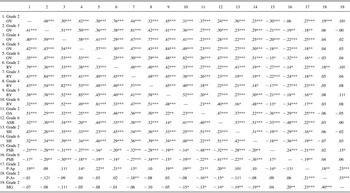
Table 2 presents intercorrelations among the variables. In both girls and boys, victimization generally was significantly negatively correlated with prosocial behavior and significantly positively correlated with antisocial behavior and social helplessness across waves. Correlations among the three types of behavior were low to moderate, suggesting they are related but independent social orientations. In both girls and boys, second-grade performance-approach goals generally were positively correlated with victimization, although a few associations did not reach significance across waves. In girls, second-grade performance-avoidance goals were positively correlated with second-grade overt and relational victimization. In boys, second-grade performance-avoidance goals were negatively correlated with second-grade relational victimization. Mastery goals generally were not significantly associated with victimization, with the exception that second-grade mastery goals were negatively correlated with sixth-grade relational victimization in boys.
Intercorrelations of study variables
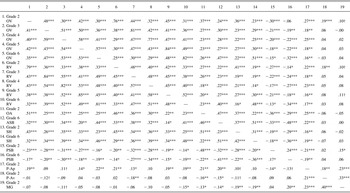
Note: Correlations for females appear above the diagonal; correlations for males appear below the diagonal. OV, Overt victimization; RV, relational victimization; OA, overt aggression; ASB, antisocial behavior; SH, social helplessness; PSB, prosocial behavior; P-Ap, performance-approach goal; P-Av, performance-avoidance goal; MG, mastery goal.
†p < .10. *p < .05. ** p < .01. ***p < .001.
Latent growth curve analyses
A latent growth curve analysis was conducted using Mplus statistical software (Muthén & Muthén, Reference Muthén and Muthén1998–2007) to examine the unique contributions of early (second grade) victimization and linear change (second–sixth grade) in victimization to sixth-grade antisocial behavior, social helplessness, and prosocial behavior, adjusting for second-grade behavior. This analysis was conducted using full information maximum likelihood estimation (Enders & Bandalos, Reference Enders and Bandalos2001); thus, parameters were estimated using available data from all of the 636 participating youth.
Modeling overview
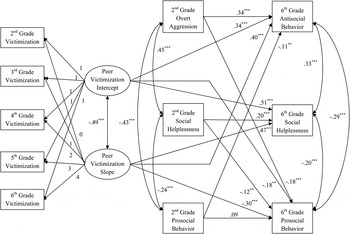
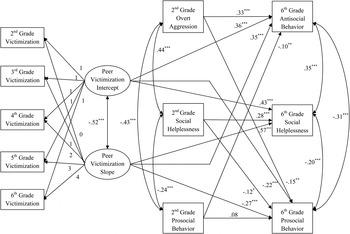
Unconditional growth models were tested separately for overt and relational victimization. For each model, two latent variables were created. A latent intercept variable representing initial victimization was estimated by setting indicator paths from the observed second–sixth grade victimization variables to be equal to 1. A latent slope variable representing linear change in victimization was estimated by setting indicator paths from the observed second–sixth grade victimization variables to 0, 1, 2, 3, and 4, respectively. By setting the path from second-grade victimization to the latent slope variable at 0, the intercept could be interpreted as exposure to victimization at the onset of the study (Duncan, Duncan, Strycker, Li, & Alpert, Reference Duncan, Duncan, Strycker, Li and Alpert1999). The unconditional model provided estimates of the means and variances of the latent intercept and slope that were not conditional on other study variables. Next, observed variables representing sixth-grade antisocial behavior, social helplessness, and prosocial behavior were added to the model. Each of these variables was predicted from the latent intercept and slope factors, adjusting for stability paths from second to sixth grade as well as for second-grade assessments of the other two behaviors (Figures 1 and 2). To account for associations between second-grade victimization and second-grade behavior, covariances between the latent intercept variable and each type of behavior were estimated. Finally, models were reestimated adjusting for the effects of second-grade goals. Paths were estimated from each of the second-grade goals (performance-approach, performance-avoidance, and mastery) to the latent intercept and slope of victimization. Paths were also estimated from each of the second-grade goals to each of the sixth-grade behaviors (antisocial behavior, social helplessness, and prosocial behavior).
Latent growth curve analysis of the contribution of initial overt victimization (second grade) and trajectories of overt victimization (second to sixth grades) to sixth-grade antisocial behavior, prosocial behavior, and social helplessness. Not shown are covariances between second-grade behavior and the intercept and slope of the overt victimization trajectories (see text). Not shown also are significant error covariances between second- and third-grade, second- and fourth-grade, and third- and fourth-grade victimization. **p < .01. ***p < .001.

Latent growth curve analysis of the contribution of initial relational victimization (second grade) and trajectories of relational victimization (second to sixth grades) to sixth-grade antisocial behavior, prosocial behavior, and social helplessness. Not shown are covariances between second-grade behavior and the intercept and slope of the relational victimization trajectories (see text). Not shown also are significant error covariances between second- and third-grade, second- and fourth-grade, and third- and fourth-grade victimization. *p < .05. **p < .01. ***p < .001.

To examine potential sex differences in the parameters, multigroup structural equation modeling was employed. All paths and variances were estimated separately for girls and boys. Significant sex differences were identified by sequentially constraining each parameter to be equal across sex. Chi-square difference tests were used to determine whether there was a significant decrease in model fit when the parameter in question was constrained to be equal for girls and boys. Tests for sex differences were conducted for the means and variances of the latent intercept and slope factors, paths between the observed variables, paths between the latent factors and observed variables, and all covariances between variables. Few sex differences emerged. Boys experienced more frequent overt victimization in the second grade (M = 1.94) than did girls (M = 1.82), Δχ2 (1) = 7.71, p = .006, and girls showed a greater average decline in overt victimization (M = –0.07, p < .001) than did boys (M = –0.04, p < .001), Δχ2 (1) = 43.86, p = .05. Girls experienced more frequent relational victimization in the second grade (M = 2.03) than did boys (M = 1.89), Δχ2 (1) = 10.46, p = .001. For girls only, second-grade performance-avoidance goals predicted more frequent overt and relational victimization in the second grade and greater declines in overt and relational victimization over time. All other sex differences reflected differences in the magnitude of associations not the significance or direction of effects. Of greatest importance, no significant sex differences emerged in the key paths of interest from the latent growth parameters (intercept or slope) to sixth-grade behaviors or in the paths from second-grade goals to sixth-grade behaviors. Thus, final analyses were conducted collapsing across sex.
Overt victimization
Unconditional model
The unconditional model for overt victimization fit the data well, χ2 (7, N = 636) = 4.26, ns, comparative fit index (CFI) = 1.00, root mean square error of approximation (RMSEA) = 0.000, standardized root mean square residual (SRMR) = 0.025. The mean growth trajectory for overt victimization was negative (M = –0.06, p < .001), indicating a decrease in victimization from second to sixth grade. There was significant variance in the latent intercept (p < .001) and in the latent slope (p < .001), indicating that there was variability across children in early overt victimization exposure and in trajectories of overt victimization over time.
Conditional model
The conditional model for overt victimization also fit the data well, χ2 (28, 636) = 75.61, p < .001, CFI = 0.97, RMSEA = 0.052, SRMR = 0.031. Figure 1 presents standardized path coefficients. To ease readability of the figure, covariances between second-grade behavior and the latent intercept (described below) are not displayed. Significant stability was found in antisocial behavior and social helplessness from second to sixth grades. Direct links from second-grade overt aggression and prosocial behavior to sixth-grade social helplessness and from second-grade social helplessness to sixth-grade antisocial behavior were not significant and were removed from the final model. The second-grade assessments of overt aggression, social helplessness, and prosocial behavior were significantly associated in the expected directions with the latent overt victimization intercept (0.54, 0.49, and –0.38, for second-grade overt aggression, social helplessness, and prosocial behavior, respectively, ps < .001). Even after accounting for cross-wave stability in behavior, early and increasing overt victimization significantly predicted more sixth-grade antisocial behavior and social helplessness and less sixth-grade prosocial behavior.
Conditional model adjusting for social goals
The model also fit well after including second-grade performance-approach, performance-avoidance, and mastery goals, χ2 (40, 636) = 10.77, p < .001, CFI = 0.96, RMSEA = 0.053, SRMR = 0.041. Performance-approach goals were associated with higher initial levels of victimization (0.31, p < .001), and mastery goals were associated with lower initial levels of victimization (–0.12, p = .03). Goals did not predict growth in victimization or sixth-grade antisocial behavior or social helplessness. Performance-approach goals predicted lower levels of sixth-grade prosocial behavior (–0.12, p = .01), and mastery goals predicted higher levels of sixth-grade prosocial behavior (0.13, p = .005). Moreover, even after adjusting for second-grade goals, the latent intercept (0.28, 0.45, ps < .001, and –0.13, p = .04) and slope (0.37, 0.44, and –0.28, ps < .001) of overt victimization uniquely predicted sixth-grade antisocial behavior, social helplessness, and prosocial behavior, respectively.
Relational victimization
Unconditional model
The unconditional model for relational victimization fit the data well, χ2 (7, N = 636) = 16.54, p = .02, CFI = 0.99, RMSEA = 0.046, SRMR = 0.022. The mean growth trajectory for relational victimization was negative (M = –0.09, p < .001), indicating a decrease in victimization from second to sixth grade. There was significant variance in the latent intercept (p < .001) and in the latent slope (p < .001), indicating that there was variability across children in early relational victimization exposure and in trajectories of relational victimization over time.
Conditional model
The conditional model for relational victimization also fit the data well, χ2 (28, 636) = 85.98, p < .001, CFI = 0.96, RMSEA = 0.057, SRMR = 0.036. Figure 2 presents standardized path coefficients. Again, to ease readability of the figure, covariances between second-grade behavior and the latent intercept (described below) are not displayed. Significant stability was found in antisocial behavior and social helplessness from second to sixth grades. Direct links from second-grade overt aggression and prosocial behavior to sixth-grade social helplessness and from second-grade social helplessness to sixth-grade antisocial behavior were not significant and were removed from the final model. The second-grade assessments of overt aggression, social helplessness, and prosocial behavior were significantly associated in the expected directions with the latent relational victimization intercept (0.41, 0.51, and –0.30, for second-grade overt aggression, social helplessness, and prosocial behavior, respectively, ps < .001). Even after accounting for cross-wave stability in behavior, early and increasing relational victimization significantly predicted more sixth-grade antisocial behavior and social helplessness and less sixth-grade prosocial behavior.
Conditional model adjusting for social goals
The model also fit well after including second-grade performance-approach, performance-avoidance, and mastery goals, χ2 (40, 636) = 122.17, p < .001, CFI = 0.95, RMSEA = 0.057, SRMR = 0.041. Performance-approach goals were associated with higher initial levels of victimization (0.27, p < .001). Goals did not predict growth in victimization or sixth-grade antisocial behavior or social helplessness. Performance-approach goals predicted lower levels of sixth-grade prosocial behavior (–0.10, p = .03), and mastery goals predicted higher levels of sixth-grade prosocial behavior (0.13, p = .005). Moreover, even after adjusting for second-grade goals, the latent intercept (0.30, 0.37, and –0.19, ps < .002) and slope (0.34, 0.53, and –0.24, ps < .001) of relational victimization uniquely predicted sixth-grade antisocial behavior, social helplessness, and prosocial behavior, respectively.
Discussion
Peer victimization is a common stressor that has the potential to set youth upon unhealthy developmental pathways. Past research documenting the adverse consequences of victimization has been limited in temporal scope and reveals little about how victimization shapes adjustment across key developmental transitions. Moreover, it has failed to consider whether maladaptive outcomes following victimization are incidental to underlying individual risks. Therefore, it remains unclear whether early victimization has lasting consequences beyond the influence of more proximal experiences or children's early individual differences. The present study provided robust evidence for the enduring effects of victimization on multiple adolescent risky outcomes even after accounting for the contribution of their early social motivation.
Victimization and adolescent social health
Both early and increasing victimization predicted heightened antisocial behavior and social helplessness as well as dampened prosocial behavior in sixth grade, following the transition to middle school. It is notable that these effects emerged in the context of a rigorous longitudinal design that considered the unique influence of initial levels and growth in victimization over time and adjusted for earlier and alternate forms of adjustment. The long-term effect of peer victimization across developmental periods has received scant attention. These findings provide evidence that the risk posed by victimization experienced as early as second grade can last through early adolescence, despite evidence of a normative decline in peer victimization during the middle childhood years. Moreover, this enduring risk was unique from that explained by subsequent variability in within-individual increases in peer victimization over time. Thus, early victimization that intensifies across the middle childhood years may have a cumulative effect, resulting in substantial impairment in adolescents’ ability to appropriately engage with their social environment.
Peer-victimized youth who take personal responsibility for their maltreatment (Graham & Juvonen, Reference Graham and Juvonen1998) may lose their sense of control over peer relationships (Singh & Bussey, Reference Singh and Bussey2011), develop feelings of helplessness about changing their social situation, and thus surrender in their efforts to assimilate into the mainstream peer group. In contrast, peer-victimized youth who blame peers for their maltreatment (Perren et al., Reference Perren, Ettekal and Ladd2013) may become mistrusting and angry (Kochenderfer-Ladd, Reference Kochenderfer-Ladd2004; Troop-Gordon & Ladd, Reference Troop-Gordon and Ladd2005), engaging in aggressive acts in an effort to retaliate or to reestablish their status in the peer group. This defensive and resentful interpersonal stance may generalize over time, resulting in antisocial acts that defy social norms. It is, of course, possible that some youth adopt negative views of both themselves and their peers following victimization. Given evidence suggesting that different combinations of self and peer views promote distinct social orientations (Salmivalli, Ojanen, Haanpää, & Peets, Reference Salmivalli, Ojanen, Haanpää and Peets2005), future work should include person-centered analyses that consider possible co-occurrence of multiple risky outcomes among victimized youth.
Reinforcing Nicki Crick's (Crick & Bigbee, Reference Crick and Bigbee1998; Crick & Grotpeter, Reference Crick and Grotpeter1995, Reference Crick and Grotpeter1996; Crick & Nelson, Reference Crick and Nelson2002) emphasis on understanding the damage inflicted by multiple forms of aggression, both overt and relational victimization forecast risky outcomes in early adolescence. Of note, boys and girls were equally susceptible to these risks. Although we thought it possible that males and females, respectively, would show distinct patterns of moving against versus away from the world following victimization, the emergence of relevant sex-differentiated pathways of development typically occurs during midadolescence (Hankin & Abramson, Reference Hankin and Abramson2001; Lahey et al., Reference Lahey, Van Hulle, Waldman, Rodgers, D'Onofrio and Pedlow2006), a little beyond the sixth-grade assessment. It may be that sex differences in the consequences of victimization strengthen at later stages of development. In addition, these sex differences may be reflected in alternate developmental outcomes, such as engagement in relational forms of aggression (Rudolph, Troop-Gordon, et al., Reference Rudolph, Troop-Gordon, Hessel and Schmidt2011).
Disentangling the effects of victimization and social motivation
Guided by an effort to distinguish causal versus incidental models of peer relationship disturbances (Rudolph & Asher, Reference Rudolph, Asher, Sameroff, Lewis and Miller2000), this study addressed a critical confound in prior research on the consequences of victimization. Specifically, we investigated whether risky outcomes following victimization could be explained by early individual differences in social motivation. A growing body of research (Rodkin et al., Reference Rodkin, Ryan, Jamison and Wilson2013; Rudolph, Abaied, et al., Reference Rudolph, Abaied, Flynn, Sugimura and Agoston2011; Ryan & Shim, Reference Ryan and Shim2008) establishes that children differ in the goals they set within their peer relationships. Given evidence that children's motivation to move toward, against, or away from the world contributes to their peer relationships (Bowker & Raja, Reference Bowker and Raja2011; Caspi et al., Reference Caspi, Elder and Bem1988; Coplan et al., Reference Coplan, Rose-Krasor, Weeks, Kingsbury, Kingsbury and Bullock2013; Troop-Gordon & Asher, Reference Troop-Gordon and Asher2005; for a review, see Eisenberg et al., Reference Eisenberg, Vaughan, Hofer, Rubin, Bukowski and Laursen2009) as well as their social and mental health (Booth-LaForce & Oxford, Reference Booth-LaForce and Oxford2008; Caspi et al., Reference Caspi, Elder and Bem1987, Reference Caspi, Elder and Bem1988; Gazelle & Rudolph, Reference Gazelle and Rudolph2004), a pivotal question concerns whether these motivations drive the observed associations between victimization and subsequent maladaptation. A supplemental set of analyses revealed that the effects of victimization were robust even after adjusting for early social goals (mastery, performance-approach, and performance-avoidance). Of course, the nonexperimental nature of our study design precludes strong conclusions of causality, but these findings do establish that the contributions of victimization to risky social outcomes in adolescence are not accounted for by preexisting individual differences in social motivation.
Implications of social health for psychopathology
Risky social outcomes following victimization, in turn, likely launch adolescents onto a pathway toward more severe forms of psychopathology. The adolescent transition represents a stage during which trajectories of risk or resilience may crystallize into persistent and engrained patterns of adaptation. Thus, emerging profiles of social health during this time may develop into intransigent forms of psychopathology. Moreover, moving against or away from, rather than toward, conventional peer groups during adolescence could force victimized youth to seek deviant peer affiliations (Dishion, Veronneau, & Myers, Reference Dishion, Veronneau and Myers2010; Rudolph et al., Reference Rudolph, Lansford, Agoston, Sugimura, Schwartz and Dodge2014), with their own adverse long-term consequences, including depression (Fergusson, Wanner, Vitaro, Horwood, & Swain-Campbell, Reference Fergusson, Wanner, Vitaro, Horwood and Swain-Campbell2003), violence, and substance use (Dishion & Skaggs, Reference Dishion and Skaggs2000).
Peer-victimized youth who move against the world may develop a consistent pattern of conflictual engagement that evolves into diagnosable forms of externalizing psychopathology over time. When victimized, youth may engage in both proactive aggression, aimed at reestablishing their status or dominance in the peer group, and reactive aggression, driven by a desire to retaliate against maltreating peers. Both forms of aggression can progress into delinquency, violence, and substance use (Brendgen, Vitaro, Tremblay, & Lavoie, Reference Brendgen, Vitaro, Tremblay and Lavoie2001; Vitaro, Gendreau, Tremblay, & Oligny, Reference Vitaro, Gendreau, Tremblay and Oligny1998) through a variety of pathways (e.g., peer rejection or deviant peer affiliations; Fite, Colder, Lochman, & Wells, Reference Fite, Colder, Lochman and Wells2007). Thus, victimization may foster aggression and less severe antisocial acts during early adolescence, which consolidate into more serious externalizing psychopathology during later adolescence and adulthood.
Peer-victimized youth who move away from the world (and fail to move toward the world) may develop a consistent pattern of high disengagement and low positive engagement that evolves into depressive disorders over time. Both social disengagement (e.g., social withdrawal/avoidance or helplessness; Rubin et al., Reference Rubin, Coplan and Bowker2009; Rudolph, Reference Rudolph, Nolen-Hoeksema and Hilt2009) and low social engagement (Forbes & Dahl, Reference Forbes and Dahl2012) predict heightened subsequent depression. Moreover, one study showed that social hopelessness (a cognitive counterpart to helpless behavior, indexed by beliefs about one's inability to alter social outcomes) mediates the concurrent association between victimization and suicidal ideation (Bonnano & Hymel, Reference Bonanno and Hymel2010). Thus, victimization may foster high levels of social helplessness and low levels of prosocial behavior during early adolescence, which consolidate into more serious depressive psychopathology during later adolescence and adulthood.
Future directions
This research clearly establishes multifinality (Cicchetti & Rogosch, Reference Cicchetti and Rogosch1996) in the pathways following victimization, such that youth move both against and away from the world, but it does not address the question of which youth develop which social profile. Although we examined whether victimization contributes to risky outcomes beyond the effects of social motivation, it also is possible that victimization interacts with social motivation to determine the precise expression of maladaptation. Following victimization, youth with a strong performance-approach motivation may disregard social norms and the potential consequences of their actions to pursue their own self-interest. These youth may become frustrated and angry because victimization challenges their social prestige or reputation, resulting in aggressive and antisocial behavior. In contrast, following victimization, youth with a strong performance-avoidance motivation may inhibit social advances and disengage from peers to avoid aversive social encounters. These youth may become embarrassed and anxious because victimization provides them with the explicit negative feedback they aim to avoid, resulting in social helplessness. Consistent with these ideas, preliminary research suggests that victimization predicts disengagement (depressive symptoms) in youth (specifically girls) with a strong social avoidance motivation but predicts conflictual engagement (overt aggression) in youth (specifically boys) with a strong social approach motivation (Llewellyn & Rudolph, Reference Llewellyn and Rudolph2014). Of note, youth with strong mastery goals may be protected from the adverse effects of victimization because they are less concerned with peer status or approval. Clarifying the determinants of specific pathways of risk following victimization is critical for the accurate identification of at-risk youth and the development of interventions tailored to specific vulnerabilities of victimized youth.
Future research also needs to elucidate the processes underlying the long-term consequences of peer victimization. As a form of social adversity, victimization may tax biological stress-response systems so as to create more dysregulated responses to stress later in life. Chronic victimization may create a high allostatic load, threatening youths’ ability to effectively regulate their responses to social challenges (Calhoun et al., Reference Calhoun, Helms, Heilbron, Rudolph, Hastings and Prinstein2014). Exposure to victimization also may sensitize neural systems involved in responses to social exclusion (so-called social pain networks), which in turn are linked to psychopathology (Masten et al., Reference Masten, Eisenberger, Borofsky, McNealy, Pfeifer and Dapretto2011). Because adolescence is a time of heightened emotional and biological stress reactivity (Gunnar, Wewerka, Frenn, Long, & Griggs, Reference Gunnar, Wewerka, Frenn, Long and Griggs2009; Ladouceur, Reference Ladouceur2012) and exquisite sensitivity to social rewards (e.g., status or dominance) and punishments (e.g., negative evaluation or rejection; Somerville, Reference Somerville2013; Stroud et al., Reference Stroud, Foster, Papandonatos, Handwerger, Granger and Kivlighan2009), tracking the effects of peer victimization through mid- and later adolescence will be key to understanding its insidious legacy.
Conclusions
Nicki Crick titled one of her earliest articles encouraging the field to take seriously both overt and relational forms of aggression “How do I hurt thee? Let me count the ways” (Crick, Bigbee, & Howes, Reference Crick, Bigbee and Howes1996). This early admonition about the potential damage inflicted by relational as well as overt aggression has been well justified by almost two decades of research. Building on this robust knowledge base, the present study demonstrates that early and increasing exposure to both forms of victimization can be hurtful, creating a long-term legacy of social health difficulties through adolescence with ensuing implications for the development of psychopathology. We can only hope that Nicki Crick's legacy will be to have set the field firmly on a path toward understanding and preventing exposure to these types of victimization as well as their pernicious effects on youth development.