Introduction
The association between growth and health has been discussed for generations. One of the first modern papers, published in 1951 by Leitch (Reference Leitch2001), dealt mainly with childhood malnutrition and its effect on development and adulthood health. It has since been shown that low birthweight is associated with a wide spectrum of adulthood disorders, especially type 2 diabetes, coronary heart disease, and hypertension (Barker et al. Reference Barker, Bull, Osmond and Simmonds1990, Reference Barker, Godfrey, Osmond and Bull1992). Especially harmful seems to be catch-up growth, the combination of being thin at birth but having higher than average weight during childhood (Eriksson et al. Reference Eriksson, Forsen, Tuomilehto, Winter, Osmond and Barker1999). Barker (Reference Barker1994) hypothesized that the foetus responds to under-nutrition with permanent changes in its physiology and metabolism, including reduced cell numbers, altered organ structure, and resetting of hormonal axes. An alternative explanation for the association between low birthweight and risk of type 2 diabetes and cardiovascular diseases suggests that foetal genetically determined insulin resistance results in impaired insulin-mediated growth in the foetus and in type 2 diabetes and vascular disease in adulthood (Hattersley & Tooke, Reference Hattersley and Tooke1999).
Foetal nutrition and growth also seem to affect the risk of developing schizophrenia. Exposure to famine during foetal development increases the risk of schizophrenia (Susser et al. Reference Susser, Neugebauer, Hoek, Brown, Lin, Labovitz and Gorman1996; St Clair et al. Reference St Clair, Xu, Wang, Yu, Fang, Zhang, Zheng, Gu, Feng, Sham and He2005). Low birthweight also increases the risk of schizophrenia: a meta-analysis of population-based cohort studies found that a birthweight under 2500 g [odds ratio (OR) 1.7], and particularly under 2000 g (OR 3.9), was associated with increased odds of developing schizophrenia (Cannon et al. Reference Cannon, Jones and Murray2002).
Only a few studies have investigated the association of schizophrenia with adult height and weight, or with patterns of growth throughout childhood. In a Swedish population study of 719 476 subjects born from 1973 to 1980, shortness at birth, and among males also low body mass index (BMI) and short height at age 18, was associated with increased risk of schizophrenia (Gunnell et al. Reference Gunnell, Harrison, Whitley, Lewis, Tynelius and Rasmussen2005). The increased risk associated with low BMI was restricted to long babies who became light adults (Gunnell et al. Reference Gunnell, Harrison, Whitley, Lewis, Tynelius and Rasmussen2005). In a Finnish birth cohort from Helsinki, born 1924–1933, low birthweight, shortness at birth, and low BMI during childhood were associated with increased risk of developing schizophrenia (Wahlbeck et al. Reference Wahlbeck, Forsén, Osmond, Barker and Eriksson2001). However, a British 1946 birth cohort showed no association between thinness during childhood and future schizophrenia (Jones et al. Reference Jones, Rodgers, Murray and Marmot1994).
In a follow-up using conscript data from the 1959–1961 Copenhagen perinatal cohort including 3210 males, 45 of whom later developed schizophrenia, a clear inverse relationship between BMI and risk of schizophrenia was detected, but not with respect to adult height (Sørensen et al. Reference Sørensen, Mortensen, Reinisch and Mednick2006). In our study of offspring of mothers with psychotic disorders born in Helsinki between 1960 and 1964, the risk of schizophrenia was increased in high-risk subjects who belonged to the lowest tertile of ponderal index at birth and to the highest tertile of BMI at 7 years, suggesting that catch-up growth might also be a risk factor for schizophrenia (Niemi et al. Reference Niemi, Suvisaari, Haukka and Lönnqvist2005). We also found that high-risk boys as a group tended to be shorter than boys from the control group. Only in the Helsinki 1924–1933 birth cohort was the growth curve analysed throughout childhood (Wahlbeck et al. Reference Wahlbeck, Forsén, Osmond, Barker and Eriksson2001). The study analysed the curve of BMI and found that children who later developed schizophrenia were leaner than average.
Overall, the results from these studies have been inconsistent. One possible explanation for this lies in the different time periods in which study subjects in these studies were born. Another explanation may be that not all confounding factors were taken into account in the analyses. Nevertheless, the Swedish study in particular suggests that adult height may be associated with schizophrenia.
In the present study we used a seven-parameter model to detect the characteristics of growth curves of height (Jolicoeur et al. Reference Jolicoeur, Pontier, Pernin and Sempe1988; Ledford & Cole, Reference Ledford and Cole1998). This method enabled us to estimate parameters of adult height at population level and also, with lower precision, predict individual's adult height. We investigated, in a sample of families with at least one member with schizophrenia, whether the growth curve parameter in subjects who later developed schizophrenia differed from unaffected subjects from the same families. We also studied whether weight, height and BMI at different ages predicted later development of schizophrenia, and whether there was any evidence of catch-up growth. In another data set consisting of offspring of mothers with psychotic disorders (high-risk offspring) and controls, we investigated whether the growth curve parameters differed in children with genetic risk for schizophrenia and control offspring.
Method
Study population and data collection
Our study consisted of two distinct populations: an isolated Finnish population from northeastern Finland with a high lifetime morbid risk of schizophrenia (Fin-Iso) (Arajarvi et al. Reference Arajärvi, Haukka, Varilo, Suokas, Juvonen, Suvisaari, Muhonen, Suominen, Tuulio-Henriksson, Schreck, Hovatta, Partonen and Lönnqvist2004), and the Helsinki High-Risk Study sample (HHR), consisting of offspring of mothers with psychotic disorders born in Helsinki from 1960 to 1964 (Niemi et al. Reference Niemi, Suvisaari, Haukka, Wrede and Lönnqvist2004, Reference Niemi, Suvisaari, Haukka and Lönnqvist2005).
Guidance relating to child health in Finland is provided by public health nurses and physicians in cooperation with other specialists in primary care. Health guidance provided for newborn babies and their families is a continuation of prenatal and maternity guidance, and extends to all children under school age (7 years). Thereafter, the children visit school health nurses and physicians in their school area. Nurses and physicians complete a standard form with measurements of weight and height and other standard observations at every visit (at 8–14 days, at 1 month, and 1.5, 2, 3, 4, 5, 6, 8, 10, 12 and 15 months, at 1.5, 2, 3, 4, 5 and 6 years of age, and once a year during school age from 7 years onwards).
The Fin-Iso study sample was collected for a genetic study (Hovatta et al. Reference Hovatta, Varilo, Suvisaari, Terwilliger, Ollikainen, Arajärvi, Juvonen, Kokko-Sahin, Väisänen, Mannila, Lönnqvist and Peltonen1999). All subjects with schizophrenia born from 1940 to 1976 with at least one parent born in the isolate were identified together with their siblings and parents, and were asked to participate in the study (Arajarvi et al. Reference Arajärvi, Haukka, Varilo, Suokas, Juvonen, Suvisaari, Muhonen, Suominen, Tuulio-Henriksson, Schreck, Hovatta, Partonen and Lönnqvist2004). The current study focuses on individuals born between 1950 and 1969 in the isolate itself, for whom we sought childhood developmental information. From the families with at least one sibling having schizophrenia, we found 622 individuals from 147 families born from 1950 to 1969 in the isolate itself, including 57 with schizophrenia. Childhood health-care records for 615 individuals (from 145 families) were found from the archives of the Kuusamo Health Centre, and these included at least five height measurements from 457 individuals (118 families), 42 of whom had schizophrenia. Complete information from ages 0, 7, 10 and 14 was found for 221 individuals (85 families), 22 of whom had schizophrenia. The nearest measurement for each age was used. If no measurement within 1 year of the target age was found, the measurement was considered missing.
The Fin-Iso study sample is described in detail by Arajarvi et al. (Reference Arajärvi, Haukka, Varilo, Suokas, Juvonen, Suvisaari, Muhonen, Suominen, Tuulio-Henriksson, Schreck, Hovatta, Partonen and Lönnqvist2004). Participants were diagnosed using the Structured Clinical Interview for DSM-IV (SCID-I for axis I disorders, SCID-II for axis II disorders) plus information from case-notes of psychiatric treatments, according to the DSM-IV criteria.
The HHR study is a follow-up study of all offspring born between 1960 and 1964 to females who had been treated for schizophrenia spectrum psychoses in mental hospitals in Helsinki before 1975. The control selected for each offspring was the previous same-sex birth from the same maternity hospital. Cohort characteristics and study flow are described in detail in recent papers (Niemi et al. Reference Niemi, Suvisaari, Haukka, Wrede and Lönnqvist2004, Reference Niemi, Suvisaari, Haukka and Lönnqvist2005). Diagnostic assessment according to the DSM-IV-TR criteria was based on case-notes from all lifetime in- and out-patient treatments for mental health problems. The health record cards for each child were sought from their school-age home municipality. The card data covered childhood health checks for each visit from infancy to the end of school age, and were obtained for 159 high-risk and 99 control offspring. We have previously investigated childhood growth and its relationship with schizophrenia in the HHR study (Niemi et al. Reference Niemi, Suvisaari, Haukka and Lönnqvist2005), but detailed analysis of growth curves has not yet been conducted. Compared with the earlier study, we were now able to include more cases, because we concentrated on estimating growth curves of height, whereas our previous study used information on measurements at standard ages. Thus, we used data on 232 individuals who did not develop schizophrenia during follow-up: 142 high-risk offspring (73 males), plus 90 controls (58 males). We excluded schizophrenia patients because their number (n=7) was too low to allow reliable growth curve parameter estimation.
Data analysis
We estimated a parametric growth curve (the Jolicoeur–Pontier–Pernin–Sempe or JPPS growth model) for height with seven parameters (Jolicoeur et al. Reference Jolicoeur, Pontier, Pernin and Sempe1988; Ledford & Cole, Reference Ledford and Cole1998).

where t is the total age measured from the day of fertilization (fertilization was assumed to have taken place 9 months before birth); X is the height reached at age t; A is adult height; D 1, D 2 and D 3 are positive time-scale factors; and C 1, C 2 and C 3 are positive dimensionless exponents. C and D parameters control the shape of the growth curve at different ages but they have no direct biological interpretation.
Parameters of the JPPS model were estimated with a non-linear mixed-effects model, using individual as the grouping level and height in different ages as repeated measurements. All parameters were included as fixed effects into the model, for parameters A and D 3 we also included an individual-level random effect to allow individual variation between growth curves. Separate models were calculated according to schizophrenia status, sex and study population. The Fin-Iso and HHR study samples were analysed separately using the same method. Only individuals with at least 10 observations and at least one observation after age 14 were included in the growth curve analysis. Based on random and fixed model parameters we calculated the predicted adult height for individuals. The primary aim of the JPPS growth curve analysis was to estimate the adult height parameter for the subpopulations, secondary to estimating adult height for individuals.
In the Fin-Iso population we also studied the association between schizophrenia and height, weight or BMI using conditional logistic regression. In these models family was used as the conditioning stratum, which is the standard method for case–sibling design (Gauderman & Kraft, Reference Gauderman, Kraft, Elston, Olson and Palmer2002). Explanatory variables at ages 0, 7, 10 and 14 years were categorized in tertiles, and sex was used as the background variable in all the models. The nearest measurement within the maximum distance of 1 year from target age was used.
We also checked whether catch-up growth, referring to individuals belonging to the lowest tertile at birth but who had moved into the highest tertile in older age, had any association with schizophrenia. In these analysis only families with at least one schizophrenia patient with measurements were informative. Altogether 41 families with 42 persons with schizophrenia and 149 unaffected siblings were included in the analysis. Missing values were dealt with by the multiple imputation method (10 imputations using the data augmentation method) (Schafer, Reference Shafer1997).
All calculations were carried out using the R program (R Development Core Team, 2004) with nlme and norm packages.
Results
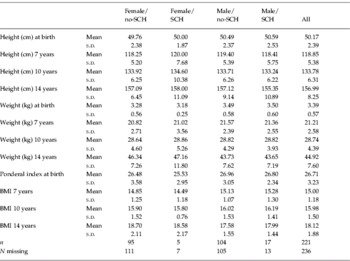
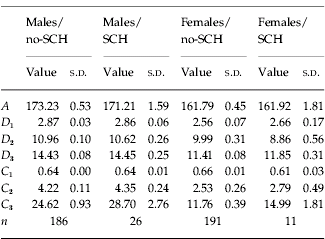
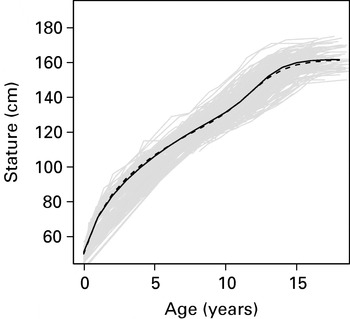
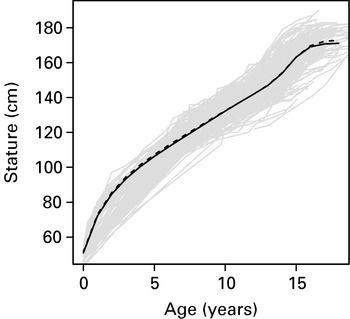
Table 1 shows data from individuals of Fin-Iso with complete measurements for ages 0, 7, 10 and 14 years. The parameter estimates of fixed coefficients of the growth curve are presented in Table 2, showing similar growth patterns for subjects who developed schizophrenia and unaffected subjects. The predicted growth curves based on the parametric model were nearly identical for schizophrenia patients and their siblings in the Fin-Iso population (Figs 1 and 2). We tested the difference in predicted adult height in persons with or without schizophrenia separately for males and females in Fin-Iso population, but found no significant difference.
Body measures of individuals from the Fin-Iso population with subjects' measurements of all ages available

SCH, Schizophrenia; s.d., standard deviation; BMI, body mass index.
Fixed parameter estimates of the JPPS growth curve model from the Fin-Iso population
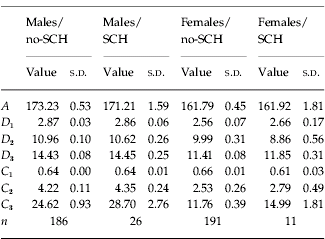
JPPS, Jolicoeur–Pontier–Pernin–Sempe; SCH, schizophrenia; s.d., standard deviation. A is adult height; D 1, D 2 and D 3 are positive time-scale factors; and C 1, C 2 and C 3 are positive dimensionless exponents.
Individual height growth curves for females (grey lines) from the Fin-Iso population. Growth curves predicted by the JPPS model for schizophrenia patients (- - -) and their siblings (–––).

Individual height growth curves for males (grey lines) from the Fin-Iso population. Growth curves predicted by the JPPS model for schizophrenia patients (- - -) and their siblings (–––).

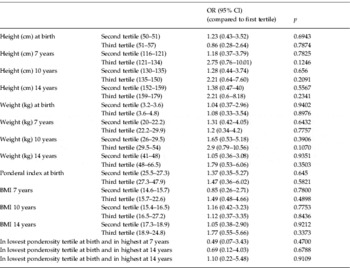
The case–sibling analysis of the Fin-Iso population did not show any association between height, weight or BMI and schizophrenia status in any age groups (Table 3). Furthermore, we could not detect any association between catch-up growth and schizophrenia.
Results of conditional logistic regression with multiple imputations for missing data in respect of schizophrenia from the Fin-Iso study. Matching unit is family, sex as background variable in all models

OR, Odds ratio; CI, confidence interval; BMI, body mass index.
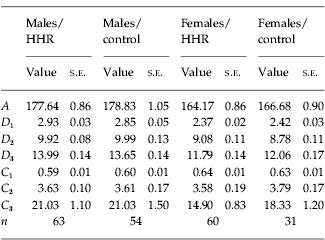
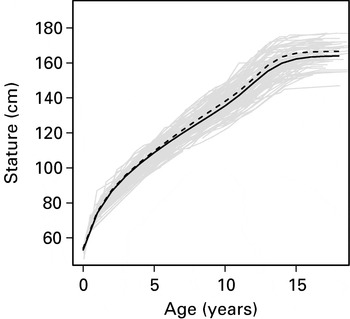
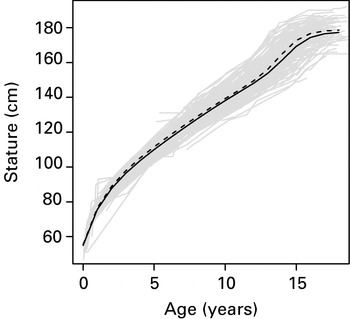
In the HHR study the average number of measurements per individual was 21.2. The parameter estimates from the HHR study show that parameter A (adult height) tended to be larger in the control group (Table 4). There was a borderline significant difference in predicted adult height among females (2.51 cm, p=0.0536) but not among males (1.19 cm, p=0.3283). This slight difference between growth curves of high-risk children and controls can also be detected from Figs 3 and 4.
Fixed parameter estimates from the JPPS growth curve model for Helsinki High-Risk Study (HHR) non-schizophrenic individuals
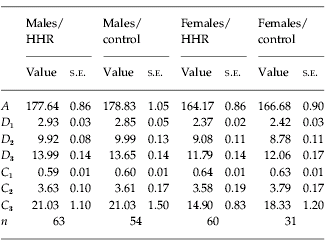
JPPS, Jolicoeur–Pontier–Pernin–Sempe; s.e., standard error. A is adult height; D 1, D 2 and D 3 are positive time-scale factors; and C 1, C 2 and C 3 are positive dimensionless exponents.
Individual height growth curves for females (grey lines) from the Helsinki High-Risk study. Growth curves predicted by the JPPS model for unaffected children of mothers with psychosis (––) and controls (- - -).

Individual height growth curves for males (grey lines) from the Helsinki High-Risk study. Growth curves predicted by the JPPS model for unaffected children of mothers with psychosis (–––) and controls (- - -).

The predicted adult height was significantly (p<0.001) larger in the HHR study compared to Fin-Iso among both males and females.
Discussion and conclusions
We observed no differences in characteristics of growth curves in persons with schizophrenia and their unaffected siblings in the Fin-Iso population, consisting of families with at least one child with schizophrenia. We found no association between height, weight or BMI at various ages and risk of schizophrenia, nor any association between catch-up growth and schizophrenia. Because all families from the isolate had at least one sibling with schizophrenia, it is possible that childhood growth patterns that have been earlier associated with schizophrenia are related to characteristics of families with an elevated risk of schizophrenia, rather than being genuine environmental risk factors for schizophrenia per se. This conclusion is weakly supported by observation from the HHR study that showed borderline significant difference in predicted adult height among females between healthy daughters of mothers with psychotic disorder, and controls. Thus, at least some growth pattern differences previously associated with schizophrenia may be related to characteristics of sibships with familial risk of schizophrenia, rather than being risk factors for schizophrenia. The causes of growth pattern differences within families having family members with schizophrenia could be environmental, linked to, for example, foetal and childhood nutrition, or genetic.
We obtained growth information only from part of the whole study population in both substudies. However, in the Fin-Iso study sample, diagnostic status did not affect the probability of finding growth data (χ21=0.0149, p=0.9028), suggesting that the data are missing at random with respect to diagnosis of schizophrenia. Another limitation was that the relationship between childhood growth patterns and risk of schizophrenia could be investigated only in the Fin-Iso sample, and even in that sample the number of affected siblings was relatively small. However, if we assume a standard deviation of 6.2 cm for parameter A (as observed in current study), power 0.8, significance 0.05, and sample size 100 for the two groups, a difference of 2.5 cm between groups would have been detected. This shows that at least the Fin-Iso population would have been large enough to detect fairly small differences in growth parameters.
The model of Jolicoeur et al. (Reference Jolicoeur, Pontier, Pernin and Sempe1988) for human growth in childhood (JPPS) is widely used (Karkach, Reference Karkach2006). Ledford & Cole (Reference Ledford and Cole1998) tested the performance of several widely used growth models applied to human growth and found the JPPS to be the most satisfactory asymptotic model for growth in human stature. The JPPS growth curve model is well suited for modelling population-level growth parameters because the number of observations for population-level growth curve estimation is large. The predictions for individual-level parameters are more imprecise because the number of observations for individuals is limited. However, this modelling approach also strengthens individual-level parameter estimation, because population-level estimations lend power to individual-level estimations. In the current study we calculated predicted adult height (A) for comparison between populations, but did not take into account that these predictions contain errors inherent from modelling, which is always the case when predicted values are used rather than measured. Therefore, p values concerning differences in predicted adult height are probably too low. Thus, suggestive evidence that daughters of mothers with psychosis have shorter adult stature should be interpreted with caution, and further studies are needed.
Hypotheses of causal mechanisms of foetal origins of adult diseases were recently reviewed by Jaddoe & Witteman (Reference Jaddoe and Witteman2006), and four pathways were listed: (1) foetal under-nutrition, (2) increased cortisol exposure, (3) genetic susceptibility and (4) accelerated post-natal growth. We found no evidence of association between any growth parameter and risk of schizophrenia. However, the HHR sample suggested that subjects with familial risk for schizophrenia may have some differences in their growth compared with subjects without such exposure. The mechanisms for such an association could be genetic (Hattersley & Tooke, Reference Hattersley and Tooke1999) because schizophrenia is associated with diseases that show strong associations with growth, such as type 2 diabetes (Gough & O'Donovan, Reference Gough and O'Donovan2005). However, factors connected to foetal and childhood nutrition could also be important. For example, obstetric complications are more common among mothers with schizophrenia, and their offspring more often have low birthweight (Jablensky et al. Reference Jablensky, Morgan, Zubrick, Bower and Yellachich2005). Moreover, childhood social disadvantage is common among subjects who develop psychotic disorders in adulthood (Bebbington et al. Reference Bebbington, Dinesh, Brugha, Singleton, Farrell, Jenkins, Lewis and Meltzer2004). These environmental risk factors are shared by all children of the same family, and could affect their childhood growth.
On the basis of our results it is impossible to infer whether factors that affect growth in these families are genetic, environmental, or both. In real life, the distinction between genes and environment is not at all clear-cut. Parental care and all other factors affecting childhood that result in better nutrition and care in childhood have resulted in a decreasing trend in the incidence of schizophrenia in industrialized countries, as shown in earlier studies (Balestrieri et al. Reference Balestrieri, Rucci and Nicolaou1997; Brewin et al. Reference Brewin, Cantwell, Dalkin, Fox, Medley, Glazebrook, Kwiecinski and Harrison1997; Suvisaari et al. Reference Suvisaari, Haukka, Tanskanen and Lönnqvist1999). There are several studies showing great heterogeneity of incidence with respect to place and social determinants, which confirms that environmental factors may interact with genetic factors in the aetiology of schizophrenia (Haukka et al. Reference Haukka, Suvisaari, Varilo and Lönnqvist2001; McGrath et al. Reference McGrath, Saha, Welham, El Saadi, MacCauley and Chant2004; Kirkbride et al. Reference Kirkbride, Fearon, Craig, Morgan, Tarrant, Lloyd, Holloway, Hutchinson, Leff, Mallett, Harrison, Murray and Jones2006).
We did not find any association between growth characteristics and schizophrenia in our population-based sample of families with at least one schizophrenia patient. Instead, we found suggestive evidence that daughters of mothers with psychosis have shorter adult stature. It would be worthwhile including family information and re-examining the recent large-scale cohort studies to establish whether childhood growth patterns are associated with schizophrenia, or familial risk of schizophrenia (Wahlbeck et al. Reference Wahlbeck, Forsén, Osmond, Barker and Eriksson2001; Gunnell et al. Reference Gunnell, Harrison, Whitley, Lewis, Tynelius and Rasmussen2005).
Declaration of Interest
None.