INTRODUCTION
The complexity surrounding adjustment to cancer has been highlighted in recent times, with hope (Dufault & Martocchio, Reference Dufault and Martocchio1985), social support (Friedman et al., Reference Friedman, Kalidas and Elledge2006), and finding positive meaning (Schroevers et al., Reference Schroevers, Ranchor and Sanderman2006) all suggested to have a role. Discussions have highlighted the importance of the “will to meaning” (Frankl, Reference Frankl1963, p. 98; Breitbart et al., Reference Breitbart, Gibson and Poppito2004), maintaining a sense of coherence (Antonovsky, Reference Antonovsky1987; Lethborg et al., Reference Lethborg, Aranda and Bloch2006), and meaning-based coping processes (Folkman, Reference Folkman1997) in the face of suffering. The balancing involved in maintaining control, finding support, and meaning while living with the stress of cancer is what Coyle (Reference Coyle2006) refers to as “the hard work of living in the face of death” (p. 266).
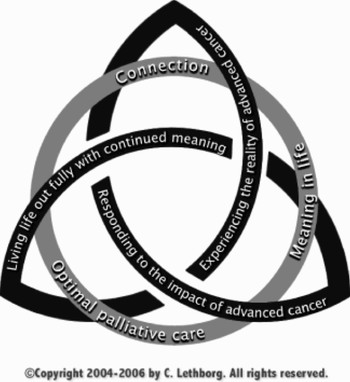
Previous work by the authors (Lethborg et al., Reference Lethborg, Aranda and Bloch2006) offered three interrelated domains to the lived experience of meaning in cancer, including experiencing the reality of advanced cancer (suffering), responding to the impact of advanced cancer (coping), and living life fully with continued meaning (meaning). The unique aspect of these findings was the way in which patients described moving in and out of these domains, forming an adaptive pathway toward coherence and sense of self.
Discerning how such domains relate to each other and mediate adjustment is necessary in order to translate this research into practice. The aim of this article is to examine how meaning in particular mediates adjustment in a cross section of cancer patients. Using validated measures closely matched to the domains of meaning, suffering, and coping with cancer, the relationships between these domains and the relative association of each domain with psychological distress are examined.
Some patterns arising from our initial research are suggestive of existing relationships. Extrapolating from the portrayal of suffering, for example, it could be expected that associations exist between psychological distress and physical and existential distress. Given the way social support, adaptive coping styles, and meaning were shown to be central to the advanced cancer experience, it could also be expected that these factors are associated with psychological adjustment. These patterns further focus our investigation with the following hypotheses:
1. Using psychological distress as the dependent variable, positive correlations will exist with physical and existential distress
2. Satisfaction with social support, adaptive coping styles, and the strength from religious faith will correlate negatively with psychological distress
3. Posttraumatic growth, global meaning, motivation to find meaning, and spiritual meaning will correlate negatively with psychological distress.
METHODS
Participants
Participants were recruited from a day oncology service in an inner-city general hospital. All patients over the age of 18 attending the service and able to use functional English (enough to complete a written questionnaire) were invited to participate. Patients were excluded if they had been diagnosed less than a month earlier or were unable to give informed consent.
We achieved a recruitment rate of 84% of eligible consecutive participants. Of the 119 patients approached to participate, 19 declined. Ten stated they were overcommitted to other studies, five found participation too burdensome, two were too sick medically, and two stated they were too upset on the day.
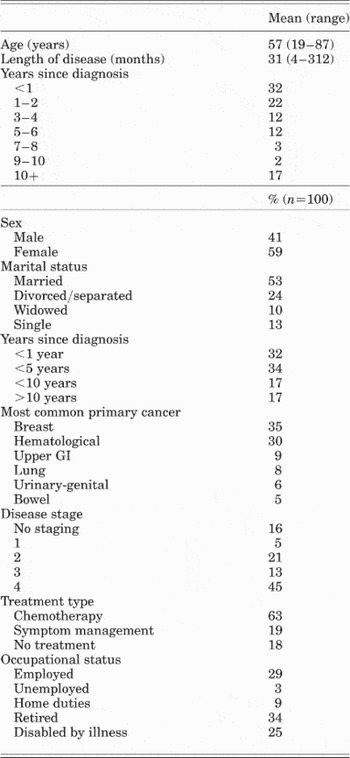
Participant characteristics are summarized in Table 1. There were more women (59%) than men, most were aged 40–69 and most of the participants were married (53%) and living with others (82%). Almost 30% were still working, whereas 25% no longer worked due to the cancer. Breast cancer was the most common malignancy represented (35%), followed by hematological cancer (30%). The seven other cancer sites represented the profile seen in this oncology service. Most participants were receiving a form of medical treatment, chemotherapy in two thirds, and 19% receiving treatment for symptom management. Over half had been diagnosed less than 2 years previously, almost a third (29%) between 2 and 10 years. Most participants had either stage three or four cancer (58%) and becaue hematological cancers are not staged in the same manner as the solid tumor diagnoses, 16% of the sample did not record a stage.
Characteristics of participants (n = 100)

Seventy-one percent of participants were born in Australia, with the remainder coming from 18 different countries. Although most claimed some spiritual/religious belief, only 45% claimed their religious/spiritual status was active.
Procedure
The study protocol was reviewed and approved by the Hospital and University ethics committees. A convenience sample of 100 patients during September to December 2005 who met eligibility criteria participated in this study. A research assistant identified potential participants as they checked into the department for a consultation or treatment appointment and requested their participation. All were given a plain language statement and consent form and a self-report questionnaire and asked to complete it the same day if possible. A box was provided with a reminder for participants to deposit questionnaires before departing. A research assistant was available to answer any queries or concerns.
Those who verbally agreed to participate but did not leave their questionnaires were followed up by phone the next day and by letter if they were not contactable by phone. A stamped addressed envelope was provided for postal return. It was made clear that participation was voluntary and that declining consent or not completing the questionnaire would in no way affect their care.
Measures
To link the model of meaning in cancer from our earlier research to this investigation, the process of selecting measures required a “matching” to the domains of lived experience—suffering, coping, and meaning—previously described. A comprehensive search was undertaken to find measures of each of these domains and to translate them into measurable constructs (variables). These variables were then used in reviewing the literature for measures that, on face validity, most closely matched the essence of the domains described by the participants in our first study. Although a number of instruments (n = 63) were found that were pertinent to these variables, those chosen satisfied the following criteria:
1. Relevance to theme
2. Psychometrically valid
3. Validity in cancer populations
4. Brevity
5. Focus on appraisal by participant
The final measures (n = 8) were selected because they achieved a balance in relation to these criteria.
Measures of Suffering
For the purposes of this study the Brief Symptom Inventory—18 (BSI-18; Derogatis, Reference Derogatis2000) total score (the Global Severity Index [GSI]) was used as a measure of psychological distress.
The BSI-18 is a revised version of the Brief Symptom Inventory (Derogatis & Melisaratos, Reference Derogatis and Melisaratos1983) designed to identify cancer patients at high risk of distress in a clinical setting (Zabora et al., Reference Zabora, BrintzenhofeSzoc and Jacobsen2001). This 18-item measure contains the subscales of Depression, Anxiety, and Somatisation and a GSI score of distress. Each item is rated on a 5-point Likert scale from 0 (not at all) to 4 (always). Participants are asked to respond in terms of “how they have been feeling during the past 7 days.” A score of “0” indicates a given symptom has not been experienced over the past week, whereas a score of “4” indicates a given symptom has been persistent over the past week.
The BSI-18 has been tested as a screening instrument against the Omega instruments (Zabora et al., Reference Zabora, Smith-Wilson and Fetting1990) and noted for its brevity and ease of understanding. It has been utilized in several prevalence studies related to psychological distress in cancer (Zabora et al., Reference Zabora, BrintzenhofeSzoc and Jacobsen2001; Carlson et al., Reference Carlson, Angen and Cullum2004) and found to have impressive validation scores in relation to psychological distress in a group of ambulatory cancer populations (alpha, 0.89, sensitivity, 91.2%, specificity, 92.6%; Zabora et al., Reference Zabora, BrintzenhofeSzoc and Jacobsen2001, p. 245).
For the purposes of this study the physical symptom subscale of the Memorial Symptom Assessment Scale-Short form (MSAS-SF; Chang et al., Reference Chang, Hwang and Feuerman2000) was used to measure physical distress. The MSAS-SF, a revised version of the Memorial Symptom Assessment Scale was designed to identify the severity, frequency, and distress of 32 prevalent symptoms (Portenoy et al., Reference Portenoy, Thaler and Kornblith1994). The MSAS-SF is a well-validated measure of symptom distress in cancer populations and has been reported to have good internal consistency (alpha = 0.82) for inpatient and outpatient haematology/oncology patients (Chang et al., Reference Chang, Hwang and Feuerman2000, p. 1167). For this study, permission was granted to isolate and use only the physical symptom subscale (referred to from this point as the MSAS-SF-psd; R. Portenoy, personal communication, 2005). The physical symptom distress score comprises 12 prevalent physical symptoms: lack of energy, pain, lack of appetite, feeling drowsy, constipation, dry mouth, nausea, vomiting, change in taste, weight loss, feeling bloated, and dizziness.
The MSAS-SF was chosen because it allows participants to describe their perception of the distress caused by the physical symptoms they are experiencing. Here, participants are asked to rate the degree of distress associated with prevalent physical symptoms. Each symptom that has been experienced in the past week is marked by the participant and a score of associated distress is given to the question “How much did it distress or bother you?” ranging from 0 (not at all) to 4 (very much). If the symptom is not present, a value of 0 is assigned. Results then reflect both prevalence and distress of symptoms, with a higher score reflecting greater distress.
The Demoralization Scale (Kissane et al., Reference Kissane, Wein and Love2004) was used to measure existential distress. The Demoralization Scale is a 24-item measure comprised of five dimensions: loss of meaning, dysphoria, disheartenment, helplessness, and sense of failure. Each item is rated on a 5-point Likert scale from 0 (never) to 4 (all the time). Participants are asked to indicate how strongly they feel in relation to each item, “over the last 2 weeks.” Higher scores indicate greater personal relevance. In a study of 100 patients with advanced cancer, these factors were shown to have high internal consistency (alpha = 0.94) and convergent validity with the McGill Quality of Life Scale, Patient Health Questionnaire, Beck Depression Inventory, Beck Hopelessness Scale, Hunter Opinions and Personal Expectations Scale, and the Schedule of Attitudes toward Hastened Death (Kissane et al., Reference Kissane, Wein and Love2004).
Measures of Coping
Coping style was measured by the Brief Cope Inventory (BCI; Carver, Reference Carver1997) an abbreviated version of the COPE Inventory (Carver et al., Reference Carver, Scheier and Weintraub1989). The BCI is a 28-item measure of coping reactions that has 14 scales each with two items. Items are measured on a 4-point Likert scale with responses ranging from 1 (I haven't done this at all) to 4 (I've been doing this a lot). Coping reactions fall under adaptive coping styles (active coping, use of emotional support, use of instrumental support, positive reframing, planning, humor, acceptance, religion) or problematic coping styles (self-distraction, denial, substance use, behavioral disengagement, venting, and self-blame). Reliability coefficients for this measure range from 0.50 to 0.90 (Carver, Reference Carver1997).
Social support was measured by the Duke UNC Functional Social Support Questionnaire (FSSQ; Broadhead et al., Reference Broadhead, Gehlbach and de Gruy1988). The FSSQ is a 10-item measure of the functional elements of perceived social supports of ambulatory patients. The measure uses a Likert scale consisting of two subscales: Confidant support, which reflects aspects of a relationship where important matters in life are discussed and shared (i.e., “I get chances to talk with someone about money matters”) and Affective support, which relates to a more emotional forms of support or caring, feeling valued and loved (i.e., “I get love and affection”). Participants rate each item on a 5-point Likert scale ranging from 5 (I get as much as I would like) to 1 (I get much less than I would like). Higher scores indicate a perception of greater degree of social support. The FSSQ has acceptable reliability with alpha coefficients of 0.62 (confidant) and 0.64 (affective) (Broadhead et al., Reference Broadhead, Gehlbach and de Gruy1988). This measure was chosen for its focus on the satisfaction or perception of the quality of such support by the participant.
Measures of Meaning
The Life Attitude Profile—Revised (LAP-R) scale (Reker & Peacock, Reference Reker and Peacock1981) is a multidimensional measure of discovered meaning and purpose in life. The LAP-R consists of 48 items measuring six dimensions: purpose, coherence, choice/responsibleness, death acceptance, existential vacuum, and goal seeking, and two composite scales: Personal Meaning Index (purpose + coherence) and Existential Transcendence (purpose + coherence + choice/responsibleness + death acceptance − (existential vacuum + goal seeking) (Reker, Reference Reker2001, p. 13). Each item is rated on a 7-point Likert scale of agreement ranging from 7 (strongly agree) to 1 (strongly disagree), with a score of 4 for undecided. A high total score on each dimension reflects a high degree of the attribute in question. In this study the Personal Meaning Index was used to measure global meaning, that is, a person's enduring beliefs and valued goals (White, Reference White2004, p. 477). Existential Transcendence was used to measure motivation to find meaning.
The LAP-R has been reported to have acceptable reliability with alpha coefficients ranging between 0.77 and 0.91 (Reker, Reference Reker2001). The personal meaning scale of the LAP-R demonstrates significant correlations with other measures of global meaning such as the Sense of Coherence Scale (r = 0.50) and the Purpose in Life Test (r = 0.82).
Spirituality was measured by the Functional Assessment of Chronic Illness Therapy—Spiritual Well-Being Scale (FACIT-Sp; Brady et al., Reference Brady, Peterman and Fitchett1999). The FACIT-Sp is part of the larger FACIT measurement system of which the Functional Assessment of Cancer Therapy—General (FACT- G) is the core instrument and is accompanied by a range of other cancer-specific quality of life measures (Cella et al., Reference Cella, Tulsky and Gray1993). The FACIT-SP is a 12- item measure of spiritual well-being comprised of two subscales, the “meaning/peace” subscale (e.g. “I have a reason for living”) and the “faith” subscale (e.g. “I find comfort in my faith or spiritual beliefs”). In addition to the two subscales, the FACIT-SP can be scored to generate an overall score for spirituality. Participants are asked to rate each item on a 5-point Likert scale that reflect experiences in the 7 days prior to interview, ranging from 0 (not at all) to 4 (very much). A high score for each subscale reflects greater spiritual well-being.
The FACIT-Sp has been shown to have good internal consistency and reliability. Alpha coefficients for the overall spirituality, meaning/peace subscale and faith subscale have been reported to vary between 0.81 and 0.88. The FACIT-SP was included in the current study for its broad conception of spirituality over and above a more narrow focus on religion. It is used here to measure spiritual meaning (meaning/peace subscale) and strength from religious faith (faith subscale).
The Posttraumatic Growth Inventory (PTGI; Tedeschi & Calhoun, Reference Tedeschi and Calhoun1996) was used to measure posttraumatic growth or positive outcomes as a response to cancer. The PTGI is a 21-item instrument comprised of five scales: New Possibilities (five items), Relating to Others (seven items), Personal Strength (four items), Spiritual Change (two items), and Appreciation of Life (three items). Items are rated on a 6-point Likert scale, ranging from 0 (I did not experience this change as a result of my cancer diagnosis and/or treatment) to 5 (I experienced this change to a very great degree as a result of my cancer diagnosis and/or treatment). Higher scores reflect greater positive change. Reliability for the total PTGI score is high (alpha = 0.90) with acceptable alphas for subscales ranging from 0.67 to 0.85. Test–retest reliability ranged from r = 0.37 to r = 0.74 for the five subscales (Tedeschi & Calhoun, Reference Tedeschi and Calhoun1996).
A questionnaire was also developed to collect information about gender, age, marital status, occupationial status, ethnicity, religion (including active/inactive practice), language spoken/read. Clinical data (diagnosis, stage of disease, current treatment regimen, and date of diagnosis) were extracted from participant's medical files.
Statistics
Quantitative data were entered into Excel and imported into SPSS by an experienced data manager. The alpha level for statistical significance was set at 0.05. Examination of normal probability plots indicated that distributions met the assumption of normality for all variables except for psychological distress, where a bimodal result was expected.
Correlations for each hypothesis were investigated using Pearson product-moment correlation coefficients. Preliminary analyses were performed to ensure there were no violations of the assumptions of normality, linearity, and homoskedasticity. Following this initial analysis, a post hoc decision was made to further consider apparent trends in correlations between specific factors (though space will not permit all results to be presented here).
Following the correlational analyses, relative associations between the domains of meaning and psychological distress levels were explored using hierarchical multiple regression analyses. Two hierarchical regressions were conducted. Regression I investigated factors predictive of psychological distress. Regression II investigated factors predictive of global meaning.
Prior to entering the independent variables into the regression procedure, two preliminary analyses were conducted. First, correlations between potential predictors (independent variables; demographics, physical distress, coping style, and existential distress) and psychological distress and global meaning (dependent variables) were examined. Second, intercorrelations between independent variables were examined for multicollinearity (correlation ≥ 0.85; Tabachnick & Fidell, 2005) using Multivariate Statistics (Allyn & Bacon, Inc Boston, MA). Subsequently, hierarchical multiple regression was applied to determine how much of the variance in psychological distress or global meaning was explained by the selected independent variables.
RESULTS
Reliability Analyses and Descriptive Statistics
For this cohort, internal consistency for all measures was within the acceptable ranges, except for “self distracting” in the Brief Cope Inventory (Carver, Reference Carver1997), which was below the 0.50 considered to be minimally acceptable (Nunnally, Reference Nunnally1978) for this cohort. A similar finding for this subscale of the BCI is described by Vosvick et al. (Reference Vosvick, Koopman and Gore-Felton2003). Thus this subscale was not used in further analyses.
Relative Associations between the Domains of Suffering, Coping, and Meaning—Analyses Relating to Each Hypothesis
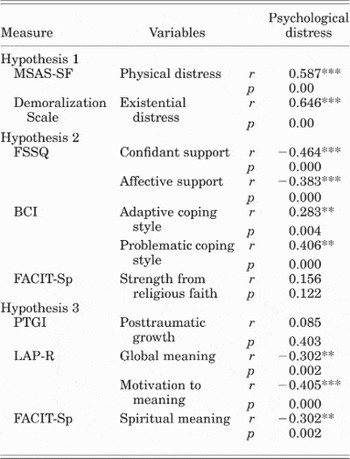
There was a positive correlation found between psychological distress (i.e., BSI-18) and both physical distress (i.e., MSAS; r = 0.587, p < 0.001) and existential distress (i.e., Demoralisation Scale; r = 0.645, p < 0.001). Thus more psychological distress was related to more physical and existential distress and Hypothesis 1 was supported in this sample.
There was a negative correlation between psychological distress (i.e., BSI-18) and social support (i.e., FSSQ; r =−0.465, p < 0.001; this relationship was true for both FSSQ subscales, confidant and affective support; r =−0.464 and r =−0.383, respectively). A positive relationship between psychological distress and both adaptive (r = 0.283, p < 0.01) and problematic coping styles (r = 0.383, p < 0.05) was found. Thus, Hypothesis 2 was supported for social support and adaptive coping style, but not for problematic coping style or spiritual faith.
There was no evidence of a correlation between psychological distress (i.e., BSI-18) and overall posttraumatic growth (i.e., PTGI) (r = 0.085, p = 0.403). There was, however, a negative correlation between psychological distress (i.e., BSI-18) and global meaning (i.e., LAP-R PMI; r =−0.302, p < 0.01), spiritual meaning (i.e., FACIT; r =−0.302, p < 0.01), and motivation to find meaning (LAP-R ET). Thus Hypothesis 3 was supported in relation to the measures of meaning but not in relation to post-traumatic growth.
Table 2 provides a matrix of correlations for each hypothesis.
Correlations between psychological distress and variables related to each hypothesis

** p < 0.01; ***p < 0.001.
Relative Importance of Factors Relating to Psychological Distress—Multiple Regression I
A hierarchical multiple regression analysis was conducted to examine factors predictive of psychological distress. In the first stage, demographic/medical variables were included (gender, age, marital status, living arrangement, and disease stage). Physical distress was entered in the second stage and coping variables in the third (adaptive and problematic coping styles and confidant and affective social support). Finally, meaning (global meaning and motivation to find meaning) and existential distress were entered.
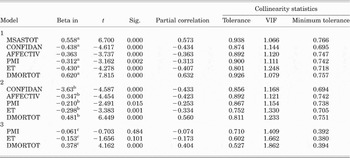
Physical distress was the most significant influence, which alone accounted for 29.2% of the variance in relation to psychological distress. This was followed by coping style and social support, which accounted for 17.4%, and existential distress, global meaning, and motivation to meaning, which accounted for 4.7% of the total variance (see Table 3). As a group, the demographics of disease stage, age range, religious practice, marital status, gender, and living situation were not a significant predictor of psychological distress.
Model of predictors of psychological distress

aSociodemographic variables were living arrangements, religious activity, disease stage, age, gender, and marital status.
bSocial support variables were affective and confidant social support.
cMeaning variables were global meaning and motivation to find meaning.
As a whole, the model explained 62.2% of the variance in relation to psychological distress. Beta weights show lower physical symptom distress, higher affective and confidant social support, higher personal meaning, higher motivation to meaning, and lower existential distress produce lower psychological distress.
Excluded variables show, again, that physical symptom distress and existential distress continue to have a significant impact on psychological distress (p = 0.000 and p = 0.002, respectively) regardless of when they are added to the model (see Table 4).
Excluded variables (dependent variable GDISTRES): Regression I

Live2: Living arrangements—living with others/not living with others; RSTCODE: active religious practice/inactive religious practice; STAGE: disease stage; AGERANGE: age; GENDER: gender; MARITALS: marital status; MSASTOT: total physical distress score; AFFECTIV: affective social support; CONFIDAN: confidant social support; PMI: global meaning; DMORTOT: existential distress; ET: motivation to find meaning.
aPredictors in the model: (constant), LIVE2, RSTCODE, STAGE, AGERANGE, GENDER, MARITALS.
bPredictors in the model: (constant), LIVE2, RSTCODE, STAGE, AGERANGE, GENDER, MARITALS, MSASTOT.
cPredictors in the model: (constant), LIVE2, RSTCODE, STAGE, AGERANGE, GENDER, MARITALS, MSASTOT, AFFECTIV, CONFIDAN.
Relative Importance of Factors Relating to Global Meaning—Multiple Regression II
A similar regression analysis was conducted to examine factors predictive of global meaning. Demographic variables were included (gender, age, marital status, living situation, and disease stage) in the first stage, physical distress in the second stage, and variables relating to confidant and affective social support in the third. Finally, existential distress was entered.
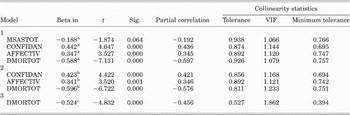
Social support was the most significant predictor of global meaning, explaining 18.2% of the total variance, followed by existential distress (17.3%; see Table 5). As a group, the demographics of disease stage, religious practice, marital status, gender, and living situation were not a significant influence, nor was physical symptom distress, accounting for 3.3% of the variance in relation to global meaning. As a whole, the model explained 41.8% of the variance in relation to global meaning. Beta weights show that higher affective and confidant social support and lower existential distress produce higher global meaning.
Model of predictors of global meaning

aSociodemographic variables were living arrangements, religious activity, disease stage, age, gender, and marital status.
bSocial support variables were affective and confidant social support.
cMeaning variables were global meaning and motivation to find meaning.
Excluded variables show that affective and confidant social support and existential distress continue to have a significant impact on global meaning (p < .001, p < .01, p < .001, respectively) regardless of when they are added to the model (Table 6).
Excluded variables (dependent variable PMI): Regression II

Live2: Living arrangements—living with others/not living with others; RSTCODE: active religious practice/inactive religious practice; STAGE: disease stage; AGERANGE: age; GENDER: gender; MARITALS: marital status; MSASTOT: total physical distress score; AFFECTIV: affective social support; CONFIDAN: confidant social support; PMI: global meaning; DMORTOT: existential distress; ET: motivation to find meaning.
aPredictors in the model: (constant), LIVE2, RSTCODE, STAGE, AGERANGE, GENDER, MARITALS.
bPredictors in the model: (constant), LIVE2, RSTCODE, STAGE, AGERANGE, GENDER, MARITALS, MSASTOT.
cPredictors in the model: (constant), LIVE2, RSTCODE, STAGE, AGERANGE, GENDER, MARITALS, MSASTOT, AFFECTIV, CONFIDAN.
DISCUSSION
The findings from this study confirm the importance of suffering, coping, and meaning in a cross-sectional population of people living with cancer.
Suffering
This group exhibited a significant degree of suffering in relation to each of the components measured (physical, psychological, and existential distress), reflecting the broad manner in which cancer impacts on a person's life. Eighty-eight percent of participants noted the presence of at least one physical symptom over the prior week. The most distressing of these included lack of energy, pain, drowsiness, change in food taste, and lack of appetite. The physical aspect of cancer clearly impacted on their lives, with a quarter stating that they were not working due to their illness.
In relation to the psychological distress of this group, 36.9% were found to be in the clinical range, in keeping with the results of other prevalence studies (35.1%, Zabora et al., Reference Zabora, BrintzenhofeSzoc and Jacobsen2001; 35%, Carlson et al., Reference Carlson, Angen and Cullum2004). This substantial prevalence of psychological distress reflect the burden of cancer on these patients' lives that in turn must interfere with their ability to cope effectively with the disease.
Mean levels of existential distress were lower than another published Australian sample (Kissane et al., Reference Kissane, Wein and Love2004). This may be explained by the mixed nature of cancer stages in this study that included a larger number of early stage cancer patients. The Kissane et al. (Reference Kissane, Wein and Love2004) cohort was derived from patients referred to either palliative care or psychooncology outpatient clinics, and thus, were likely to have higher levels of existential distress.
Coping
Based on our lived experience research, coping was measured in relation to coping style, satisfaction with social support, and the use of religious faith in gaining strength. Many of the methods exhibited reflected components of Folkman's (Reference Folkman1997) meaning-based coping model involving such strategies as revision of goals, positive reappraisal, revising beliefs, and perceiving benefits in stressful situations, all with meaning at the core. Participants in this study displayed a predominance toward adaptive over problematic coping styles, most commonly using active coping, emotional support, instrumental support, positive reframing, planning, and social support.
High scores for coherence illustrated a degree of stability, sense of order, and reason for existence in spite of the uncertainty of cancer. This group displayed an enhanced appreciation of relationships with others and for life itself. Having others to talk to about important life matters and to receive emotional and affection from also enhanced their coping.
Meaning
Three aspects of meaning were measured, including global meaning (participant's beliefs and goals), motivation to find meaning, and spiritual meaning. Though cancer presents physical, psychological, and existential challenges to the patient, it was hypothesized that the ability to maintain meaning in life would remain. Supporting this theory, participants displayed a higher global meaning and motivation toward meaning than for healthy norms (Reker, Reference Reker2001) and similar levels of spiritual well-being to other cancer populations.
These results echo the findings of our previous qualitative research, with the simultaneous existence of suffering, coping, and meaning present in this group. Participants reported substantial suffering alongside significant meaning in their lives and the use of coping strategies that was largely meaning based. Though these findings are also reflective of the measures used (i.e., the study could only measure what it was designed to measure), the existence of meaning in life in spite of the ongoing stresses of cancer remains an important reality.
Influences on Psychological Distress and Global Meaning
Regression analysis further focused these findings in relation to how meaning mediates adjustment in this population. Here, higher physical symptom distress was the strongest influence (accounting for 29.2% of the variance) on psychological distress followed by lower social support (12.8%), and finally, lower meaning (including more existential distress, lower global meaning, and lower motivation toward meaning) accounted for 8.4%. Thus a focus on the physical effects of cancer was shown to be central in the quest for well-being in this population. This finding speaks to the need to always explore the impact of physical suffering on a patient's life, including how bodily symptoms are appraised and experienced. In addition, consultation or referral to specialist palliative care services should be considered when physical symptoms and reduced function interfere with the person's capacity to engage meaningfully in life. Adequate treatment of such symptoms is an important component of the patient regaining control and restoring hope and thus crucial to adjustment (Younger, Reference Younger1995; Clarke, Reference Clarke2003).
When these factors were considered in relation to global meaning, social support arose as the strongest influence (explaining 15.7% of the variance), whereas high levels of existential distress are related to lower levels of global meaning, explaining 14.7%. These findings point to the centrality of human connectedness in dealing with suffering. Feeling able to share concerns and feel supported enhances meaning and adjustment. Social support provides the person with the knowledge that they are cared for, loved, and esteemed (Cobb, Reference Cobb1976) and the environment in which they can share their pain. The connection to others creates a sense of belonging and thus meaning (Suchman & Matthews, Reference Suchman and Matthews1988), and a counter to the isolation that often accompanies adversity (Marris, Reference Marris1974). Feeling connected with others has been found to enhance hope (Ballard et al., Reference Ballard, Green and McCaa1997), meaning (Thomas & Retsas, Reference Thomas and Retsas1999), awareness of life appreciation (Mahon & Casperson, Reference Mahon and Casperson1997), and desire to live (Roud, Reference Roud1986) and is clearly central to overall improved adjustment.
Existential distress was shown to influence well-being, increase psychological distress, and lower global meaning. Loss of meaning reduces a person's ability to maintain a positive outlook and a purpose in life. Clearly, then, it is important to attend to the existential aspect of a person's life when assessing their strengths and resources as well as in the setting of distress.
In addition to attending to physical symptoms then, interventions that focus on upholding and developing social supports and enhancing meaning in life are likely to positively influence well-being and adjustment in the setting of cancer.
A Model of Meaning in Adjustment to Cancer
Findings from this study illustrate the way in which optimal physical care, connection with others, and meaning in life sustain a person as they experience the challenge of cancer (see Figure 1).
Model of adjustment to cancer.

The percentages of variance in relation to positive adjustment make clinical sense. Although all the factors of cancer impacting on a person's life are clearly important, the weightings reflected here suggest the order of attention for an appropriate clinical response. If physical symptoms are well controlled and family/friends are supportive and gathered about the patient, then attention to the existential is the next key clinical agenda to move to. This study has thus tapped into the most fundamental needs of human beings that must be met in order for positive adjustment to occur (Maslow, Reference Maslow1954). The revised model is proof of the central nature of the biopsychosocial approach required for optimal care in the setting of illness hypothesized by Engel (Reference Engel1977)0. What is unique is the weighting of the importance of management approaches that arise from these results.
Limitations
This study is limited by its cross-sectional design. Although participants were representative of the population attending the clinic from which they were recruited, it was biased toward those with breast cancer and hematological malignancy. In addition, the single time point offers only limited insights into the relationships between variables. It is recommended that further research exploring the relationships between suffering, coping, and meaning be undertaken longitudinally to examine the relationships over time.
The measures chosen had all been used previously in the cancer setting and performed well with acceptable Chronbach's alphas. The exception to this was in regard to the Brief Cope Inventory (Carver, Reference Carver1997), which resulted in an alpha under 0.50 in one factor.
Conclusion
These findings further focus the quest to understand the role of meaning in adjustment to cancer. The specific techniques most effective in enhancing meaning and connection are yet to be defined, and such clarification would require intervention-focused research that, in order to appropriately demonstrate change, would need to be longitudinal.
The study supports the concept that cancer is experienced simultaneously as suffering and as a trigger for meaning. Results speak to the clinical complexity of the dynamic experience of suffering and meaning in cancer. We need to better understand the impact of physical suffering and meaning in the lives of this population and to actively work toward the enhancement of social support and connection with others for this group. Optimal palliative and family-centered care blended with therapies that promote a sense of meaning of life lived appear crucial to ameliorate suffering.
ACKNOWLEDGMENTS
The authors wish to thank the 100 people living with cancer who completed questionnaires for this study and for Rosie Brown, R.N., who recruited most of them. We are indebted to the staff in the Oncology Department at St Vincent's Hospital, Melbourne, for their support and encouragement of this research. This study formed part of the first author's Ph.D. being undertaken at the University of Melbourne and we are grateful for funding from the National Health and Medical Research Council of Australia and the Inaugural Sister Claire Nolan Scholarship.