Here we focus on historically oriented research on Mesoamerican languages and its application to the study of pre-Columbian culture history. This application depends upon integrating linguistic data with data from other fields, chiefly including archaeology, epigraphy, ethnohistory, and ethnology. When integrating evidence from disparate fields, it is incumbent on researchers in each contributing field to pursue research into joint issues in as much detail as possible using the methods internal to that field, so that the richest set of constraints on interpretation can be brought to the task of integrating the data.
The topics to which linguistic research has contributed most directly for our understanding of Mesoamerican culture history are those that involve either the spread of languages, whether by the movement of their speakers or the adoption of a language by others, or by intercultural interactions that leave their traces in the adoption of elements of one language by speakers of another language. The linguistic effects of language maintenance and language shift are well understood, and with sufficient historical data the social causes of these linguistic influences can be reliably worked out. Many features of past material culture and practices can also be addressed, especially through their vocabulary. Fundamental to understanding these past linguistic practices is the reconstruction of language history.
Language history can be reconstructed by a variety of methods. One, of course, is to take account of early documentary sources in the languages of the study area. For studies oriented to pre-Columbian Mesoamerica, the most widely applicable method is the comparative method; when there are many languages in a family of languages, earlier phases of the history of these languages can be reconstructed. As an external comparison, large chunks of the Latin language, as spoken by the general population of the Roman empire, can be reconstructed by making systematic comparisons of related vocabulary and of the sound systems and grammatical structures of Portuguese, Spanish, Catalan, French, Italian, Roumanian, and Sardinian.
Although much can be recovered by the comparative method, its results are necessarily incomplete. Reconstruction is substantially aided by documentary sources from earlier eras when they exist. Our written documentation of Latin in the Imperial period shows us that Latin nouns and adjectives had a case system of which only bits survive, and only in Roumanian. In Mesoamerica, texts in Mayan and Mije-Sokean hieroglyphic writing contribute to our understanding of Mesoamerican linguistic history; the comparative method provides evidence concerning earlier and later stages of the languages written in the hieroglyphic texts.
TOPICS, SOURCES, AND METHODS
The knowledge base for research on Mesoamerican linguistic history is in part philological, coming from hieroglyphic, ethnohistoric, and early modern sources. But the main source of data comes from modern linguistic field work documenting the indigenous languages of Mesoamerica. Detailed documentation of most surviving indigenous languages is now a research emergency for Mesoamerican studies.
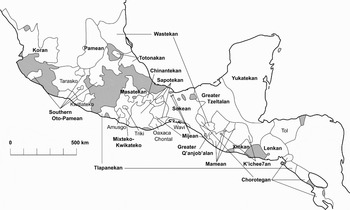
As of 20 years ago, all distinct language families of Mesoamerica had been identified (see Figure 1), and substantial and quite detailed reconstruction work was completed for Mayan, Mije-Sokean, Sapotekan, and Nawa. It is in these families that the most reliable work on Mesoamerican linguistic prehistory has been accomplished during the past 20 years and before—in the Mayan case with important contributions from hieroglyphic texts.
More can be done on all these families, but most future historical and comparative work should be devoted to other families. Because Tarasko (or Purepecha), Kwitlateko, and Wavi have no close relatives and seemingly little internal diversity, deep historical research on them depends on evidence for borrowing between them and early stages of other language families. Consequently, the major comparative work to be done should address Oaxaca Chontal, Totonakan, and Oto-Mangean language families other than Sapotekan.
Three major lines of evidence are typically available for applying the results of historical linguistic research to culture-historical problems.
(1) Language families: In the normal course of transmission of a language across the generations, the vocabulary and grammatical structures of the language change relatively gradually. Different forms of speech gradually emerge through such transmission, typically as speakers spread across broader geographical regions. As a result, the pattern of relationship among languages is generally mirrored by their geographical relationships, and the pattern of linguistic diversification can be correlated with the pattern of spread or influence of the speakers.
(2) Language contact and intergroup interaction: When different cultural groups interact intensively, this interaction often results in the adoption by some groups of linguistic features of the languages of other groups, and the nature of the interaction affects the nature of the linguistic influence. Detailed investigation of the results of language contact can therefore shed light on the history of intergroup interactions.
In Mesoamerica, lexical borrowing among languages occurs at fairly low levels, so its occurrence reflects a serious amount of interaction. Crosslinguistically, the borrowing of structural features requires more intensive or longer-term interaction, typically taking place under conditions of long-term bilingualism by the borrowers. There are many impressive examples of grammatical borrowing in Mesoamerican linguistic history.
For example, there has been serious structural borrowing along the border between Mayans and Sokeans in Chiapas and Tabasco, with likely borrowings in both directions. This zone must have been the setting for a long-term mutual engagement. Some clear examples of Mije-Sokean influence on individual Mayan languages include: (a) The Mije-Sokean third person Ergative marker *7i+ has replaced the native Mayan *u+ in Ch'ol, Ixil, pre-Awakateko, and pre-Q'eqchi7 (Kaufman 2000–2009). (b) The Chiapas Soke Ergative case marker +7is has been borrowed into Tzeltalan and Q'anjob'alan as the preconsonantal Ergative marker, variously s+, 7is+, and x+ (Kaufman 2000–2009). (c) Ch'ol, like Mije-Sokean, has prenominal relative clauses; the relativizer in Ch'ol, +b'  , is borrowed from Sokean +p
 7 (Zavala, personal communication 2009). (d) Ch'ol and Yokot'an have borrowed, as ROOT.ROOT.na, the Mije-Sokean pattern ROOT.ROOT.na:y7, which forms iterative-frequentative intransitive verbs on the basis of affective roots and verb roots (Kaufman 2000–2009).
A wider-ranging case of the result of Mayan-Mije-Sokean contact (Kaufman 1997) is the fact that all Mije-Sokean languages, most Eastern Mayan, and all Western Mayan languages (this excludes Wasteko, Yukatekan, and Q'eqchi7) have a morphosyntactic pattern within the verb phrase whereby intransitive verbs of motion are brought into play as directional complements to a main verb, like English (sit) up, (fall) down, (go) in, (come) out, (run) away/off/hence, (come) hither. In Mayan these verbs are used in an invariant form in each language, according to differing morphological strategies; in Mije-Sokean they are incorporated by the main verb. This is probably the result of influence on Mayans by Mije-Sokeans.
(3) Words and things: A group's material culture, their activities, and the concepts by which they understand the world are conveyed, discussed, and partly transmitted in speech. Reconstructed vocabulary therefore provides access to facets of past cultural traditions.
Reconstructing facets of past cultures from their lexicon depends on the premise that the use of vocabulary referring to particular cultural materials and practices presupposes a knowledge of them. When it is possible to reconstruct for earlier stages of a language family a vocabulary that is specific to an interrelated set of practices, such as maize agriculture, then this complex can be reliably attributed to the people who spoke that language. Postulating the existence of a particular cultural construct based on a single reconstructed word may not be reliable because several languages in a family may shift the original meaning of a term in the same way for a later, introduced item. For example, K'ichee7an languages have something like /saq 7iis/ (literally “white sweet potato”) for ‘potato’, a crop introduced by the Spanish from Peru in the late sixteenth century—which sometimes encouraged the development of the neologism /kaq 7iis/ “red potato” for the native sweet potato (proto-Mayan *7iis). Typically, in cases where we have historical knowledge that the reconstructed meaning refers to an introduced item, other linguistic data suffice to avoid such errors; for example, descendants of *7iis (with no qualifier) mean ‘sweet potato’ throughout the Mayan family.
Languages of Mesoamerica, in their approximate locations as of 1500 ce; from Kaufman and Justeson (2007). Except for isolates, individual Mesoamerican languages are not represented; rather, the map groups these languages into the families or major subgroups of which they were members, which were individual languages between about 1200 and 600 bce (the locations of many were substantially different in that era from what is depicted here). Areas of Nawa speech are shaded in grey. Individual languages (isolates) are specified in plain type, language families and subgroups in bold.

The ideal study in Mesoamerican linguistic prehistory would include a comprehensive analysis of the linguistic history of a language group and a set of inferences about cultural developments that can be drawn from that history and correlated with archaeological, epigraphic, and ethnohistorical sources from the eras about which cultural information is to be inferred. This requires informed collaboration between linguists and archaeologists, as in current research on the Indo-Europeans (e.g., Mallory and Adams 2006). For work by Mesoamericanist linguists, Campbell's (1977) study of K'ichee7an linguistic prehistory is our best model for this kind of research.
Mostly what has been contributed over the past 20 years are targeted studies of particular issues, often of major culture-historical significance, in which the linguistic underpinnings play a role without necessarily being demonstrated within the study itself. While most have moved the study of ancient Mesoamerica forward, many are marred or even vitiated by a failure to take account of a sufficiently comprehensive body of linguistic data, by a disregard of methodological standards of historical comparison including grammatical analysis of forms being compared and detailed observance of sound correspondences, or by a failure to take advantage of the full range of available methods. Maintaining these standards is the single most important responsibility of historical linguists who will be putting forward hypotheses from this field in the coming years.
GENERAL CULTURE-HISTORICAL ISSUES
Most detailed work on Mesoamerican linguistic prehistory has concerned interactions among particular groups. Two large-scale issues are in need of attention. This section addresses migration in prehistory and the spread of agriculture and its relation to the spread of languages.
Migration in prehistory
Migration studies have a contentious history in recent archaeological work, but the linguistic data make it certain that some Mesoamerican populations have moved to other areas. The evidence comes from violations of the correspondence of geographic proximity with the closeness of relationships within language families and, in the case of Oto-Mangean, of families within that language stock.
Within Mayan, the major dislocation is of Wastekan. Wastekan arrived around its current location long ago, when its sound system was essentially like that of proto-Mayan (Kaufman and Justeson 2008:70–73). They departed from the Mayan homeland after maize was already part of the Mayan diet, given that Wasteko has words descending from proto-Mayan *7ix.i ‘to shell corn’, *7ajn ‘roasting ear’, and *q'oor ‘corndough’.
The Oto-Mangean languages occupy a nearly continuous distribution, apart from areas in which it is broken up by Nawa intrusions. However, three Oto-Mangean languages are found far to the southeast: Chiapaneko in Chiapa de Corzo and Chorotega in Nicaragua form the Chorotegan family within Oto-Mangean; Sutiaba, also in Nicaragua, is one of two languages in the Tlapanekan family, which is the closest relative of Chorotegan.
Chinantekan and Oto-Pamean are each other's closest relatives within Oto-Mangean, and Masatekan (Popolocan) and Sapotekan are each other's closest relatives. But north to south the geographic sequence of these families is Oto-Pamean, Masatekan, Chinantekan, and Sapotekan; either Chinantekan or Masatekan must have moved to the far end of the other's territory after or upon the break-up of these groups. Mije-Sokean loans into central Mexico are a mix of words found in both Mijean and Sokean with others that currently survive, and at roughly equal rates, in Mijean only or in Sokean only. This reflects their borrowing from a Mije-Sokean speaking population that was in the area since roughly the proto-Mije-Sokean era. In contrast, all of the 12 recognized Mije-Sokean loans into Chinantekan could have come from Sokean; this would indicate a later era of borrowing, suggesting that it took place after the movement of Chinantekan from the edge of Oto-Pamean territory to near its present location, just to the south of the Gulf Sokean languages.
Agriculture and language spread
On archaeological grounds, the intercultural interaction from which a partly shared Mesoamerican cultural tradition emerged dates no earlier than about 2000 bce, by which time agriculture had become established throughout the region that would become Mesoamerica. The transformation of subsistence economies with the rise of agriculture is a major focus of anthropological theory and of archaeological investigation. These issues have been fruitfully addressed in some parts of the world through studies in linguistic prehistory, and there is some prospect of contribution in this area by detailed investigation of Oto-Mangean linguistic developments.
The best-known attempts to relate the spread of agriculture with linguistic history in the Western Hemisphere are the broad proposals of Peter Bellwood and the specifically Yuta-Nawan proposals of Jane Hill.
Bellwood (2001; also Bellwood and Diamond 2003) has proposed that in areas of the world where agriculture developed in the distant past, language families spread and diversified along with the spread of agriculture: that in each area the language of the first agriculturalists largely replaced those of their non-agricultural neighbors, partly as the burgeoning population of the agriculturalists swamped those of their neighbors, and partly by the shift of some of these neighbors to agricultural practices, including language. Bellwood's proposals build on an earlier theoretically-motivated proposal by Renfrew (1987, 1989) that links the spread and diversification of the Indo-European stock to the initial spread of agriculture into previously non-agricultural areas. It would take us too far afield to address Renfrew's hypothesis here, but suffice it to note that all competent Indo-Europeanists find it impossible to square with a previously constructed massive edifice based on detailed linguistic evidence.
Bellwood and Diamond (2003) have extended Renfrew's hypothesis to propose a farming-cum-language-dispersal model for major chunks of the planet. They use no linguistic data in their arguments, only distillations of the opinions of linguists whose statements seem to be compatible with their model; or in the absence of a definable opinion by linguists, they assume that their temporal and geographical model for the spread of agriculture and languages in a particular area will be borne out by subsequent linguistic investigation.
Mesoamericanists are in a position to address the spread of agriculture as it relates to Mesoamerican linguistic prehistory. The relevant data can only come from language families; language groups with little or no internal diversification, such as Wavi or Tarasko, do not permit us to know if they were even in Mesoamerica when agriculture was being adopted. However, there is substantial linguistic diversity in Mayan, Mije-Sokean, and Totonakan, as well as in four of the eight distinct language families that comprise the Oto-Mangean stock (Oto-Pamean, Mistekan, Masatekan, and Sapotekan). All of these seven families have agricultural complexes reconstructible by the words-and-things approach. The other Oto-Mangean language families—Tlapanekan, Chorotegan, Chinantekan, Amusgo (a single language)—have much less diversity, and this is also true of Xinkan. Data from these families is therefore less useful for addressing the spread of agriculture. Data from the seven most diverse families, and from higher level Oto-Mangean groups (Oto-Pamean-Chinantekan, Tlapanekan-Chorotegan, Amusgo-Mistekan, and Masatekan-Sapotekan), lead to the following conclusions:
(1) In Mesoamerica there was no spread of the language of an original set of agriculturalists over a broad region, but rather a patchwork of at least 11 language families; in the case of Oto-Mangean, in the era of the rise of agriculture there is no indication of major geographic dislocations. This is not consistent with Bellwood's model.
(2) There is no evidence for identifying a group that was more advanced in its agricultural practices, with other groups adopting agriculture and the vocabulary for it. The emergence of all Mesoamerican language families postdates a complete engagement of Mesoamericans with agricultural practices.
(3) All existing Mesoamerican language families appear to have broken up after the rise of agriculture. All of the seven families identified above broke up before the emergence of complex societies. This can be determined both from reconstructed vocabulary complexes and from chronological evidence (including but not limited to glottochronological estimates) concerning the dates of diversification of these families. More generally, with the definite exception of Xinkan, we detect no substantial borrowing of agricultural terms into the common ancestors of Mesoamerican language families.
Many of the agricultural (also commercial) terms of proto-Xinkan come ultimately from Mayan or Mije-Sokean. These loans make up so large a proportion of the agricultural vocabulary that the Xinkans must either have been a largely non-agricultural group that migrated into the region before the end of the Olmec tradition or have been culturally dominated by their neighbors. In either case, they help us to locate some early Mije-Sokean speakers along or near the Pacific coast of Guatemala.
(4) The evidence for the spread of language families over broader territories is that it occurs later—mostly much later—in connection with hierarchical political-administrative organizations; these are probably political and military expansions. Examples are Nawas, late during the Classic and into the Postclassic and early Colonial eras; and Totonakos, around 1000 ce at the expense of neighboring Wastekos. There are also detectable southward migrations of Chorotegans (= Cholultekans), Tlapanekans, Chinantekans, and Kabils (= Wastekans), most probably resulting from intrusions of more northerly neighbors into their territories. None is associated with the spread of agriculture.
What we know of Mesoamerican linguistic prehistory therefore contradicts Bellwood and Diamond's model. More importantly, it provides some relatively direct evidence concerning the processes by which agriculture did spread in Mesoamerica: it spread from group to group without an accompanying spread of the agriculturalists' languages, and without substantial borrowing of agricultural vocabulary.
This work raises a methodological caution: models for the spread of languages or interaction among their speakers are at best speculative if they are advanced without engaging historical linguistic data in detail. Whatever its theoretical merits and weaknesses, Bellwood and Diamond's proposal fails mainly because they advance a temporal and geographical model for the spread of languages via the spread of agriculture while using no linguistic data in their arguments. For further criticism, addressing some of the above along with several other issues, see Campbell (2003) and Campbell and Poser (2008).
There are two major avenues for future research on this topic.
(1) Although in every language family but Xinkan most agricultural vocabulary is indigenous to that family and unrelated to corresponding terms in other families, there is a systematic pattern of borrowing of individual terms for plants or agricultural practices from Mije-Sokean languages. Ten words for cultivated plants were borrowed from Mije-Sokean into three or more Mesoamerican language families, some from the north and some from the south: *kakaw(a) ‘cacao’ (borrowed into 7 families), *tzi7wa ‘yellow squash’ (5), *m n(i) ‘sweet potato’ (5), *po:m
 ‘copal incense’ (5), *7awa7 ‘gourd bowl’ (4), *tzima7 ‘gourd’ (3), *pok(ok) ‘bottle gourd’ (3), *pijo ‘yellow zapote’ (3), *tzipin ‘tomato’ (3), *7a:ti ~ yati7 ‘custard apple’ (3). Many more were borrowed into just one or two languages or families. This diffusion must be related to the general cultural prominence of the speakers of these languages, inasmuch as they are among a much larger set of Mije-Sokean terms that were adopted into a broad range of Mesoamerican languages, many of them at ancient stages of these languages. But the widespread borrowing of terms for individual existing cultigens by speakers of languages all over Mesoamerica must reflect a more or less systematic process of engagement of Mesoamericans with Mije-Sokeans in connection with a broad range of cultigens, a process long postdating the beginning of their cultivation in the borrowing areas.
(2) The Oto-Mangean stock consists of eight language families. According to glottochronology, it has not been unified since about 4000 bce. Even without its extreme diversity, what we know of the correlation between archaeological and lexical diffusion in Sapotekan, independent of glottochronology, makes it certain that Oto-Mangean goes back to early formative times or before. Based on its linguistic diversity, it must be considerably earlier; it is hardly possible that it would date to as recently as 2000 bce. This makes the Oto-Mangean stock our best prospect for tracing any lexical diffusion that may have been associated with the spread of agriculture in highland Mesoamerica. See below (Archaic and early Formative interactions) for further discussion.
CULTURE-SPECIFIC APPLICATIONS
Nawa and its place in the prehistory of central Mexico
A persistent controversy concerning the prehistory of central Mexico is the role of Nawas at various times and places. We have argued for what we believe to be the consensus view—that speakers of Nawa had no major impact in Mesoamerica until the Terminal Classic period (Kaufman 1994–2004, Kaufman and Justeson 2007:195–199, 204–206, cf. 214–215; 2008:73–75). Here we address the more ancient origins of the Nawan group, its history within the broader Yuta-Nawan family, and in particular the recent proposal of Jane Hill. Hill (most prominently, 2001) contends that the Yuta-Nawan family had its origin not, as traditionally thought, among hunter-gatherers around southern Arizona or northwestern Mexico, but among Mesoamerican agriculturalists in central Mexico; and that the family diversified as speakers of proto-Yuta-Nawan expanded northward with agriculture.
We focus on this issue for several reasons. Most importantly, it is one of the most dramatic culture-historical proposals in Mesoamerican historical linguistics of the past 20 years and one that is almost completely at variance with an integrated model of Yuta-Nawan diversification that specialists in historical linguistics have been developing for over 50 years. Hill has marshalled a serious amount of linguistic evidence in an effort to establish this hypothesis. It has generated theoretical interest because she relates it to Bellwood's model, and Bellwood cites her conclusions in support of his work. Discussing this issue is important methodologically because this reinforces the critical role of a proper application of the comparative method to establish historical linguistic hypotheses; we argue that the proposal is vitiated by misunderstandings of the Yuta-Nawan historical developments and of the methodology of comparative reconstruction and subgrouping. (We do not address a number of methodological errors and substantive issues concerning Yuta-Nawan historical linguistics that Hill mishandles, nor the archaeological and paleobotanical issues of the spread of agriculture to the American Southwest; for many of these, see Campbell [2003] and Campbell and Poser [2008]).
We first sketch our own understanding of the structure of the Yuta-Nawan family and of the entry of Nawa into Mesoamerica from the north.
The Yuta-Nawan (YN) family has two branches. Southern Yuta-Nawan (SYN) is the more obvious subgroup, defined by certain innovations in the grammar and phonology that are common to all of these languages. Northern Yuta-Nawan (NYN) is defined by fewer shared innovations, but it is clearly a valid subgroup. Nawan is part of SYN, but it has been seriously changed by contact with Mesoamerican languages and has lost a relatively large number of YN words. As a result, it will be very difficult and maybe impossible to work out whether SYN split into Nawan and Sonoran or whether Nawan is more closely related to some SYN languages than to others.
In spite of this, detailed tracking of the innovations shared between Nawa and other Yuta-Nawan languages shows that contacts between them took place exclusively before the proto-Nawan stage, and the closest contacts are with Kora and Wichol, which are geographically nearest to Mesoamerica. There are traces of contact between Mesoamerican languages and pre-Nawa before some of the interaction among pre-Nawa, Kora, and Wichol (in particular, before *  emerged from original pSYN *u in these three languages). Pre-Nawa borrowed many other terms from Mesoamerican languages on the northern boundary of the region—Wastekan, Totonakan, and northern Mije-Sokean—and did so in the northern highlands of Mesoamerica; and pre-Nawa borrowed numerous grammatical features from Totonakan and Mije-Sokean, reflecting centuries of intensive and asymmetrical interaction. Had Kora, Wichol, and other SYN languages spread outward from Mesoamerica with Nawa their southernmost neighbor, they too should have shown early Mesoamerican influence, but they do not.
Before addressing Hill's proposals, we discuss a key methodological principle whose neglect vitiates some of her attempted reconstructions.
Most crucial for deciding on what sound to reconstruct is establishing cognate sets that show recurring sound correspondences among different languages. For example, many vocabulary items show ts in both Northern and Southern YN languages; clearly, we will reconstruct *ts in the ancestor of these words. In other cognate sets, SYN shows ts but NYN shows y. The fact that the pattern recurs shows that these sounds emerged from some single original sound that was affected (or not) in different ways in the different groups. In fact, this correspondence is in complementary distribution with the first: it occurs after original *  , while the correspondence of SYN ts to NYN ts occurs everywhere else. Accordingly, we can reconstruct *ts for both sounds, with NYN y arising from original *ts after original *
 . According to Hill, *ts is to be reconstructed in this situation rather than y because it is a less “marked” sound; but the real reasons are that we reconstruct *ts for the ts : ts correspondence and that this correspondence is in complementary distribution with the ts : y correspondence.
The opposite situation is contrastive distribution: when two correspondence patterns occur in the same environments, we cannot predict from a single reconstructed sound which of the two patterns would emerge, and we must therefore reconstruct different sounds. Hill treats the correspondence of Hopi and Takic ng (ŋ) to other NYN n and to SYN n as indeterminate, arguing that with *ng and *n being equally “marked,” reconstructing either would suffice. However, this correspondence pattern contrasts with the correspondence of NYN n to SYN n. For example, Hopi and Takic languages have word initial n in some words, as in Hopi na ‘father’, and word-initial ng in others, as in Hopi ngá7at ‘root’; other NYN and all SYN languages have n in related words. There is no other feature that correlates with the occurrence of one versus the other correspondence pattern. We must reconstruct *n for the n : n correspondence, and so we must reconstruct *ng for the ng : n correspondence, and posit a change of initial *ng to n in SYN and in some NYN languages.
Word medially the situation is more complex, with *ng shifting to n in SYN only after *n had previously shifted to l. We apply this result below to the first and most arresting agricultural term that Hill attempts to reconstruct for proto-Yuta-Nawan: ‘maize.’
Altogether Hill attempts to reconstruct nine terms to the proto-Yuta-Nawan stage as members of a maize complex. Of these nine, only four in fact relate to maize, and these four are reconstructible only to Southern Yuta-Nawan. We number them according to the listing in her table (Hill 2001:Table 1).
(1) There are cognate forms in several SYN languages that permit the reconstruction of SYN *sungu ‘corn’ (Kaufman 1981; Hill gives *sunu). Hill treats Hopi sono-w  ‘sand grass’ as part of this cognate set, but this is not valid; were it cognate, it would have medial -ng- rather than -n-. It could, however, be a borrowing from SYN.
(2) The ancestor of the SYN cognates listed under her proposed *sono ‘maize byproduct’ must be reconstructed as *songo. There are no valid NYN cognates. A Hopi cognate would have to be sööngö*, but Hill's cited form söönö could be a loanword.
Hill's proposed cognate sets (5) and (6), from which she proposes to reconstruct *w  ra ‘to shell corn, corn, cob’ and (6) *o7ra ~ *o7ri ‘to shell corn, corn, cob’, do not seem to be coherent sets; they do not follow any regular correspondence patterns that are intelligible or generally accepted. Out of data from these two sets something like #7orV ‘to shell corn’ might be reconstructed, but only for SYN.
Most of the remaining terms in Hill's table do not relate specifically to maize but are of quite general application:
(3) Hill cites a set of SYN cognates, plus one non-cognate form from Hopi, from which she proposes reconstructing a pYN form *pa7ci to which she attributes the meanings ‘corn ear, corn kernel, seed’. The SYN forms are valid cognates; from them plus a (NYN) Tubatulabal cognate /pahcist/ ‘purple seed’, Kaufman (1981) reconstructs pYN *pahtsi meaning ‘seed’ in general + some maize applications.
Hill proposes Hopi paatsama in the meaning ‘hominy’ as a member of this cognate set. However, rather than being descended from a unit morpheme, the term appears instead to be composed of two distinct parts. Toward this analysis, we cite from the Hopi Dictionary (Hill et al. 1998:367, 375, 620):
paatsama ‘hominy or other grain (rice, wheat, etc.) used in mixture with meat stew’
paatsamta [vn. p.] ‘prepare hominy’
paatsaHmta [vn. p.] ‘put hominy in’
paa- [prepound, i.e., a root morpheme that appears preposed to another root morpheme or lexeme in a compound] ‘water’
tsamta [vt. i.] ‘to be taking particulate matter or small objects out of several containers’, e.g. ashes from the stove/firepit, charcoal remnants from pit ovens
Since hominy is prepared by soaking or boiling maize kernels with quicklime or lye from ashes, we suggest that Hopi paatsama ‘hominy’ is a compound of paa- ‘water’ and tsama ‘removed ashes’. If this is so, it cannot possibly have descended from pYN *pahtsi ‘seed’.
(4) Cognates cited by Hill in support of her proposed *saki are consistent with a meaning ‘to roast, parch’—not necessarily applying to maize (Kaufman [1981] gives pYN *saaki ‘to parch’).
(9) Cognates cited by Hill in support of her proposed *ku:mi ~ *ku:mu are consistent with a meaning ‘to nibble, crunch small grains’ (Kaufman [1981] gives pYN *kunmi ‘to eat corn’).
(7) Hill treats pYN *t ma as ‘tortilla, tamale’, but this is a verb whose reflexes (for example Nawa /tema-/) means ‘to bake by steaming (in an oven or sweat-house)’; cf. Nawa tema:s=kal-li. Literally and etymologically, the Nawa word tama-l-li means “steamed thing”: it refers to “tamale” only inasmuch as maize is the main food crop, so that “steamed thing” becomes “steamed food” becomes “steamed maize” becomes “tamale”. All nominalizations of this root in other Yuta-Nawan languages also refer to steamed things but not necessarily to tamales. We know that Nawa tama-l-li, which is a nominalized form, must be based on the verb tema- because, apart from late borrowings, all instances of ta in Nawa dialects with tl are from changes of original te to ta after *ta had shifted to tla.
Tortillas are made not by steaming but by toasting on a griddle, so the meaning ‘tortilla’ could only come about by a later shift of meaning; this is consistent with the fact that griddles are not ancient in Mesoamerica.
(8) Hill proposes reconstructing a pYN *komal ‘griddle’. All the SYN words listed by Hill are borrowed from Nawa koma:l-li, which refers to a ceramic griddle used for heating, toasting, or roasting food—tortillas always being among these food types. Archaeologists use the presence of comals as definitive evidence for tortillas. Comals were not invented before the first millennium bce (Hill 2000:922). On structural grounds Nawa koma:l-li might be a verb root koma- plus a nominalizing suffix -l, but there is no verb koma-* in Nawa. The only NYN language cited is Hopi. Hopi qöma- ‘to make an oblong cake of baked sweet corn’ is on the surface a plausible comparison. But /qömi/ is made by taking sweet corn dough and molding it by hand into an oblong that is eaten cold. While pre-Nawa *koma-, if there ever was such a verb, must have meant something like ‘to heat or roast/toast on a flat object’, it is not clear that Hopi qöma- entails anything but that the corn used to make qömi has been cooked, and that was probably by boiling. We may wonder whether this is a coincidental similarity, and if it is not, whether there is any inherent or original association specifically with maize.
Accordingly, while not totally unambiguous, the available evidence supports reconstructing a maize agriculture complex for Southern Yuta-Nawan. However, not one of Hill's proposed cognate sets provides valid evidence for reconstructing it to the proto-Yuta-Nawan stage nor to Northern Yuta-Nawan.
In the traditional view, which we support, there are no terms reconstructible for proto-Yuta-Nawan that are the names of cultivated plants, nor their parts, nor their use as food, nor for agricultural techniques. On the other hand, in SYN only, some terms relating to agriculture can be reconstructed. This suggests that speakers of SYN, at a stage prior to pSYN, became familiar with agriculture either as they expanded southward or as agriculture expanded northward. The NYN groups who acquired agriculture when agriculture was adopted in the Southwest after 1500 bce (Hopis and Utes) do not share the agricultural terminology of the SYN languages.
Our inability to reconstruct a body of agricultural vocabulary for proto-Yuta-Nawan makes sense in terms of the chronology of cultural developments. Agriculture arose in Mesoamerica around 2000 bce. However, the plants that became food crops had been domesticated hundreds of years earlier than 2000 bce. For Mayan, which began diversifying about 4,000 years ago, a longish list of names of cultivated plants, agricultural techniques, and food preparation can be reconstructed. Yuta-Nawan is more diverse than Mayan, the yield from comparison in Yuta-Nawan is much smaller, and agriculture was not practiced by anybody in Mesoamerica 5,000 years ago.
Archaic and early Formative interactions involving Oto-Mangeans
Oto-Mangean is the most diverse genetic grouping of languages in Mesoamerica, and the most far flung; it occupies a more-or-less continuous territory from the southern coasts of Oaxaca (Sapotekan) and Guerrero (Tlapanekan) to and beyond the northern limit of Mesoamerica (Oto-Pamean). Its geographic range makes it crucial for understanding Mesoamerican culture history.
The diversity of the eight families composing Oto-Mangean can be compared to those of Indo-European language families such as Germanic, Anatolian, and Indo-Iranian, with the diversity of the stock as a whole more comparable to Indo-European itself. Its time depth makes it our only prospect for a linguistic window into the transition between the archaic hunter-gatherer cultures of the region that would become Mesoamerica and the formation of distinctively Mesoamerican cultural traditions around 2000 bce.
It may be partly for this reason that the reconstructed Oto-Mangean lexicon is so rudimentary compared to other language groups, with so far only about 350 items reconstructed to the proto-Oto-Mangean level. But the Oto-Mangean stock is also the most underexplored frontier in Mesoamerican historical linguistics.
A good deal is already known. Analysis of morphological innovations provides a clear picture of the historical relationships among Oto-Mangean families (Kaufman 1988), and the basic sound correspondences among the families has been worked out (Kaufman 1983). Roots are known to have been mostly disyllabic, of the shape consonant-vowel-consonant-vowel, where the consonants might combine with such features as palatalization, prenasalization, aspiration, and glottalization, while the vowels might be associated with different phonation types and lexical pitch, or tone.
The most important basic research in Mesoamerican historical linguistics for the coming years, which will also require a major documentation effort on Oto-Mangean languages, is large-scale lexical reconstruction within individual Oto-Mangean families and, building on it, across the Oto-Mangean stock. This will permit the establishment of a large number of minor or conditioned sound changes and of lexical borrowing among, into, and out of these families. Little has been done toward Oto-Mangean reconstruction since the 1980s. Reconstructions at that time were based largely upon comparison among published reconstructed vocabularies for individual Oto-Mangean families and their subgroups, and these vocabularies, except for Chinantekan (Rensch 1989), are small by comparison to those for other Mesoamerican language families. Enough work has been done on individual Oto-Mangean families to suggest that lexical reconstruction within each family should be relatively straightforward, and work on comparative Sapotekan, in particular, has advanced considerably in the past 30 years (Fernández de Miranda 1995; Benton 1986, 1988; Kaufman 2000–2007). Work on comparative Chorotegan is subject to improvement, but more primary data are not likely to be forthcoming since both Chorotegan languages are extinct.
A great deal of descriptive and comparative work remains to be done on Mistekan, Masatekan (a.k.a. Popolocan), and to a lesser extent on Oto-Pamean in order to bring family-level and Oto-Mangean-level reconstructed vocabularies to an acceptable size. Tlapaneko has a fair degree of local diversification that could be the basis of reconstructing proto-Tlapaneko, if properly documented.
Drawing culturally significant inferences about the large number of Mesoamerican cultural traditions that flourished in what, by Mesoamerican standards, is a massive territory requires linguistic spade work, both descriptive and comparative. Until this is done, we will be able to draw few reliable conclusions about language-related issues concerning cultural developments in something like 30–40% of formative Mesoamerica, however much we may want to do so. Once the necessary spade work is done, however, thanks to major phonological changes that affected all of the families descended from proto-Oto-Mangean, it should be possible to determine in detail what each family borrowed from the others and when. Renewed attention to Oto-Mangean comparative linguistics will almost certainly yield new data on early interactions in the heart of Mesoamerica.
In contrast to the open-ended system of the lexicon, a substantial number of morphosyntactic units can be reliably reconstructed; they recur because they are few in number and apply broadly across the lexicon. Borrowing and interference affects morphosyntax and the lexicon in different ways, but both reflect intercultural interaction in prehistory. Kaufman (1988) provides a detailed reconstruction of Oto-Mangean tense/aspect/mood markers and other elements of Oto-Mangean morphology.
Based on this data, it can be shown that Masatekan (an Eastern Oto-Mangean family) and Tlapanekan-Chorotegan (a Western branch) uniquely share four markers in their respective verb systems. Two markers are uniquely shared between Chorotegan and Masatekan. These sharings seem more likely to be the result of diffusion than of retention from the proto-Oto-Mangean stage by two distantly related neighbors; diffusion might account for several cognate sets that on present evidence appear to be shared uniquely by Masatekan and either Chorotegan or Tlapaneko-Chorotegan. However, the issue is not resolved.
If these shared features are due to diffusion, they reflect interaction among Masatekans and Chorotegans for some time after and possibly for a while before Chorotegan separated from Tlapanekan, and after Masatekan separated from Sapotekan. Painstaking, detailed lexical research will be required to sort out the relationship between the grammatical and lexical influences, whether the lexical borrowing was asymmetrical, whether it began before or after Masatekan broke up, and whether there are specific borrowings that justify specific archaeological correlations. Determining the cultural contexts of this diffusion—for example, whether it occurred before Chorotegan left its ancestral homeland or while it was en route to Chiapas—will depend upon working out a detailed picture of the internal developments within each family, and this in turn requires that we establish what is inherited and what is borrowed, and, in the case of borrowings, at what linguistic era the borrowings occurred.
Historical linguistics and epigraphy
Over the past two decades, there has been an explosion in our understanding of the written languages of ancient Mesoamerica. According to current knowledge, there are three notational systems that represent utterances or discourses in an ancient spoken language: Mayan, Sokean, and Sapoteko.
For the study of ancient Mesoamerica generally, the most consequential has been the study of Mayan hieroglyphic texts because hundreds of texts have well-preserved sections that are long enough to provide interpretable information, and they come from throughout the area of Lowland Mayan civilization. The expansion of our understanding of Mayan texts has come, not exclusively but in large part, from an increasing engagement of epigraphers with hieroglyphic texts as representations of languages, whether on their own or in collaboration with linguists. This has partly resulted from the decipherment of a substantial number of signs that represent syllables, even signs that occur relatively rarely, because they provide serious constraints on the identification of vocabulary and on the representation of grammatical elements. Especially noteworthy has been the attention to the grammatical structure of texts—normally an early phase in the decipherment of a writing system, in the Mayan case it has been the last aspect to be seriously engaged.
At this stage, further progress is likely to be incremental. To the extent that such progress is linked to applications of historical linguistics, it is worth noting that: (1) many advances have come when epigraphers have given up the conceit that Mayan scribes did not accurately represent the language they were writing within the limits imposed by the structure of the writing system. (2) Few epigraphers meet linguistic standards for representing the morphology and syntax of texts. (3) Often epigraphers provide not actual translations of what a text says, but an interpretation that amounts to an exegesis—an attempt to make the point of a passage clearer to a modern readership. What the writers of ancient texts literally said drew upon their expectations of the cultural knowledge that their intended audience would draw upon to get the point, which will frequently or even typically be unstated. Attempts to get at this information are helpful if their interpretive status is made explicit; but epigraphers should minimally provide the literal meanings of the ancient writers' words.
This is all the more important now because of an increasing trend among epigraphers and iconographers to draw insights from the traditions of Classical scholarship. Greeks, for example, made votive sculptures and inscriptions—objects that were made, offered, given, or dedicated in connection with a vow, or that expressed a vow, especially to a god or gods. There are Greek dedicatory texts, whether or not associated with vows, that refer to the object on which they occur as having been dedicated to particular gods or sometimes persons. Both of these categories are regularly applied to Mayan objects, especially to inscriptions that refer to the object on which they occur. But these are not Mesoamerican cultural categories; to our knowledge, there is no verb in any indigenous Mesoamerican language that literally means either ‘to dedicate something’ or ‘to make a vow’. Applying these foreign constructs is not even exegetical; it attributes to ancient Mesoamericans behaviors and intentions for which we have no evidence.
The most direct application of historical linguistics to the analysis of epigraphic Mayan is the determination of what Mayan language is represented in the texts. Since the 1970s, epigraphers, beginning with Fox and Justeson, have put forward arguments showing that hieroglyphic texts from the Classic period Southern Lowlands were written in Ch'olan, and this is the current consensus. The debate is currently between the view that the language was the (Eastern Ch'olan a.k.a. Ch'olti'an) ancestor of colonial Ch'olti7 and modern Ch'orti7, advanced most prominently by Houston, Robertson and Stuart (e.g., 2000), and the view that it was the common ancestor of all Ch'olan languages, argued most thoroughly by Mora-Marín (e.g., 2009). In our view, Mora-Marín has demonstrated that the features cited by Houston et al. as diagnostic of Eastern Ch'olan, except for those first appearing in late texts, are or may well be retentions from proto-Ch'olan and thus provide no evidence for the Eastern Ch'olan hypothesis.
Accounting for the extent and pattern of departures from proto-Ch'olan forms in Classic period inscriptions may be the most significant area for future research into language identification. For example, the most plausible documented diagnostic of Eastern Ch'olan in hieroglyphic texts seems to be the innovative Eastern Ch'olan use of a vowel-harmonic -Vy suffix that forms intransitive stems from intransitive roots, no doubt an extension of the mediopassive suffix of the same shape that forms intransitive stems from transitive roots. This pattern is found much more broadly in Eastern Ch'olan than in the language(s) of the Classic period inscriptions (cf. epigraphic Mayan retention of cham-i ‘he died’ versus the innovated Eastern Ch'olan cham-ay-i). But this is only one of a variety of instances of differing linguistic sources for epigraphically documented forms. Lacadena and Wichmann (2002) have presented evidence for an areal basis for some of these variations, suggesting the emergence of dialect differences within Ch'olan or simply a tendency for scribes to sometimes let vernacular rather than prestige forms into their writings. Other examples involve specific vocabulary, as in the evidently regular use of Yukatekan *k'uuh-uul ‘holy’ rather than the expected *ch'uuh-uul in Ch'olan royal inscriptions, probably reflecting borrowings that might, for example, have been concentrated within religious, political, administrative, or other specialty domains. Some few may be retained archaic spellings, at least in cases like y-uk'-iib' ‘his/her drinking vessel’ in which phonetic spellings are relatively common, but this seems implausible in some cases in which it has been offered, such as k'uuh-uul ‘holy’, in which phonetic spellings of the initial consonant are exceedingly rare.
Considerable progress has also been made on the other two textual systems. In spite of well-publicized criticism by Houston (e.g., Houston and Coe 2004), the essentials of our proposed decipherment of epi-Olmec hieroglyphic writing (Justeson and Kaufman 1993) have been accepted by all professional epigraphers who have met with us and worked through the evidence in detail (including but not limited to Bricker, Grube, Kelley, Lounsbury, Mathews, Mora-Marín, Schele, and Urcid). For Sapoteko writing, work by Marcus, Whittaker, and—above all—Urcid (2001) has provided a historical and calendrical framework on the basis of which we have been able to establish a basic grammatical analysis of the most linguistically explicit texts and phonetic readings for some signs—most completely for those that correspond to aspect/mood markers or to pronouns (Kaufman and Justeson 1993–2008).
Mesoamerican historical linguists' detailed knowledge of Mayan, Mije-Sokean, and Sapotekan language history puts Mesoamericanists in a unique position to contribute to the understanding of general processes by which writing systems emerge and those that affect the maintenance or change of the representational principles of early writing systems. Justeson (e.g., 1989) has long argued for a systematic relationship between the phonological and morphological structure of words and the evolution of principles of phonological representation in writing systems. This is clearly the case at later stages of script evolution, for example in Elamite cuneiform (Justeson and Stephens 1994). In most of the world, it is difficult or impossible to investigate such issues for early stages of script development because, as in the case of Sumerian, the main evidence for the nature of the languages is the script itself. In Mesoamerica, in contrast, we know a great deal about the nature of the relevant languages before, during, and after the periods in which hieroglyphic writing emerged and underwent significant changes.
Nonetheless, with few exceptions Mesoamericanists have been slow to contribute to the understanding of script evolution in terms general enough to be relevant to the general study of writing systems. This is an area in which linguistically-oriented studies in Mayan epigraphy are poised to make significant contributions to the theory of writing systems—for example, to the origin and spread of phonetic complements. Phonetic complements are signs or sequences of signs that are set before a logogram (a sign for a word or stem) to make explicit how the beginning of that sign is pronounced, or after the logogram to indicate how its ending is pronounced. Although some words were spelled exclusively by logograms and others fully phonetically, when a word is spelled in all three ways, the spellings with logograms alone are usually earlier than those with phonetic complements, and spellings with just one complement usually precede spellings with more than one. The use of phonetic complements spread, in part, on a word-by-word basis.
In a study of the spread of phonetic complementation into spellings of month names, Justeson and Mathews (1989) showed that for each name phonetic complements came into use mostly after other motivated uses of the same signs for the same phonological sequences in the same positions of different words. In the two cases whose models were especially similar, the use of the complements cannot be distinguished temporally from that of their models: <wa-ni> (also <ni>) was introduced in spelling #muwan just as the positional suffix -wan began to be represented as <wa-ni> and in the same general region; the complement <ni> came into use in spelling the month name yaax=k'iin shortly after it began being used to spell the general word k'iin ‘day’, with a strong correlation between the presence or absence of <ni> on both terms in texts in which both appeared (Justeson and Mathews 1990:118–19).
It is hypothesized that phonetic complements are promoted largely by phonetic spellings that are required for spelling high frequency grammatical affixes. Phonetic complements are consonant-vowel (CV) syllabograms because phonetic signs themselves are almost always CV (otherwise CVC) in structure. A preposed complement is a syllabogram for the CV sequence that begins a stem represented by the following logogram. Verbs as words always end in a grammatical suffix, usually vowel-initial; because grammatical morphemes are spelled phonetically, and verb stems end in consonants, the complement conveys part of the pronunciation of a verb word that is not explicitly represented by a logogram. All adjectives and noun stems end in a consonant. When a vowel-initial suffix follows such a stem, given that the suffix can only be spelled phonetically and all syllables in Mayan languages start with a consonant, the only way to spell that suffix is with the CV sign for the stem-final consonant + the suffix-initial vowel.
Spelling a word-final consonant involves spelling not only that consonant but also a vowel that is not a part of the word's pronunciation. Justeson proposed in the late 1990s that a repeated association of a word with signs for a particular CV syllable in spelling a vowel-initial suffix in one form of that word would have promoted the choice of the same signs over other syllabograms for the same consonant when that consonant was being spelled word-finally in another form of the same word. Because any consonant can end a noun root, there is a repeating basis for forming such associations across a variety of syllable shapes, and thus for extending the pattern as a whole to less frequent words. Mora-Marín (e.g., 2001:75–86) elaborated this proposal with several examples, including the vowels of -VVj suffixes to unpossessed nouns and -aal and -iil suffixes on nouns; independently, Kaufman proposed a more restricted hypothesis that spellings of final consonants of nouns, adjectives, and numerals are based on the vowel of the -VVl suffix that each word characteristically takes (Kaufman with Justeson 2003:29–34).
The key feature of the grammatical models for word-final phonetic complements is that a CV sign is required to convey just one phoneme of a grammatical morpheme (a vowel-initial suffix), with the other phoneme that the sign conveys being the final consonant of the stem. In the 1990s, Justeson proposed a word-initial analogue with this property: that single-consonant prevocalic grammatical elements, such as the third person ergative/possessive marker y- and, arguably, the locative preposition t-, may have led to the development of preposed complements of the shapes y + vowel and t + vowel to words beginning with y or t in which these grammatical elements did not appear (see Mora-Marín 2001:290–291, 297–299). Noun and adjective roots can end in any consonant, but the only consonants that can serve as preposed morphemes are y, w, and arguably t. These observations together arguably account for both the greater diversity and the higher frequency of postposed complements over preposed complements in Mayan writing.
The results of Grube's (2010) empirical analysis of phonological patterns of preposed complements conform in detail to the model, developed by Justeson and Stephens (1994) based on Elamite data, for the spread of phonological conventions and its relationship to morphology. The process begins with high-frequency grammatical morphemes that are associated with a well-defined spelling pattern. Worldwide, grammatical morphemes are characteristically spelled phonetically; Mayan signs for yV and less commonly wV syllables were therefore required word-initially to spell the possessed forms of words whose stem begins with 7. For example, in y-aajaaw ‘his lord’ a yV sign (here, for ya) was needed to spell the prefixed y, and it thereby also spells the a of the root 7aajaaw. These motivated patterns of use of phonetic signs is extended to cases that closely resemble them (cf. Justeson and Mathews 1990:118). The same signs are applied to spell the same phonological sequence in the same position in other words; this establishes a purely phonetic use of the yV and, to a lesser extent, the wV signs in initial position. Conversely, the pattern of phonetically spelling the beginnings of certain words when possessed extends to spelling the beginnings of the unpossessed forms of these same words, thus word-initial 7V. Finally, the presence of all of these spellings provides a general but less exact and therefore weaker basis for the introduction of CV spellings for the beginnings of Mayan words generally. While not framing their development in these terms, Grube documents all the relevant patterns, including the relative rarity and generally later appearance of initial complements other than yV, wV, and 7V signs; he also effectively disproves the proposal that complements developed mainly as a disambiguating device.
Long-distance diffusion of Mesoamerican cultural traits
There has been considerable discussion among archaeologists of the diffusion of cultural practices and material culture from Mesoamerica to the American Southwest and the American Southeast. There has been almost no linguistic effort to detect diffusion between Mesoamerican and more northerly languages. Documentation of and comparative work on indigenous North American languages is advanced enough that careful attention to resources already available may yield new insights into Mesoamerica's wider relationships. Work by Kaufman since 2004 has yielded a number of likely Mije-Sokean (and other) borrowings into Maskogian (and other Southeastern United States) languages.
Absolute and relative chronologies
Reconstructing facets of past cultures from their lexicon depends on the premise that the use of vocabulary referring to particular cultural practices presupposes a knowledge of these practices; this is especially reliable when several semantically related items can be reconstructed for a related set of practices. In principle, more cultural complexes can be reconstructed to later than to earlier levels in the history of a language family. This permits the development of a relative chronology of cultural developments.
For example, words for several plants serving as containers can be reconstructed back to proto-Mayan (*tzuhh ‘bottle gourd’, *johm ‘container (bowl, dipper, tortilla warmer) made from a gourd’. One pottery container type, a bowl, can also be reconstructed (pM *laq), as can such tools as querns (*kaa7), mullers (*u-q'ab' kaa7, lit. “hand of quern”), whetstones (*hu7x) and other elements of material culture such as net bags (*chiim), mats (*pohp), sandals (*xanh.ab'), and houses (*nhaah). In contrast, terms for a clay griddle can be reconstructed at most to individual subgroups: K'ichee'an *xoht, Mamean *x=k'o7n, Greater Q'anjob'alan *sa7 m, and Greater Lowland Mayan #sam.eht (the last two based on Mije-Sokean *sam ‘to heat something next to a fire’). This agrees with the archaeological chronology, with the items of material culture reconstructed for proto-Mayan appearing during the Formative period, but clay griddles no earlier than the Terminal Classic period. A conspicuous exception is a term for ‘hammock’ (pM *7aab'), widely thought to have been introduced no earlier than the Postclassic period.
This sort of evidence provides a basis for a broad correlation between archaeological and linguistic cultural sequences. More detailed relative chronologies can be worked out using evidence of borrowing between languages or language families whose histories have been worked out in considerable detail; absolute dates can sometimes be assigned when there is archaeological evidence for the timing of the diversification of related cultural groups or for interaction among them. Detailed examples are discussed in our recent publications (Kaufman and Justeson 2007:199–201, 2008:65–69).
One generally applicable method for correlating linguistic and cultural sequences is glottochronology. The method was developed by Swadesh (beginning with Swadesh 1950; for estimation of retention rates, see Swadesh 1955) using a mathematical model inspired by C-14 dating, based on the mathematical assumption that the loss of basic vocabulary, operationally defined by a particular meaning list, is lost at a constant rate, mostly by replacement or by change of meaning. These and other mathematical assumptions of the method are demonstrably not met in reality. However, this does not invalidate the method; the same is true of the widely applied chi-square statistical test. The question is how sensitive the method is to these violations. Our long-term experience in applying glottochronology, in cases where the results can be tested by independent evidence, is that it is quite robust—that it is relatively insensitive to these violations. The overall evidence, in spite of strongly stated objections in the literature, is that glottochronology provides a useful guide to the minimum spans of language diversification over the time spans for which Swadesh was able to calibrate it.
In the next two decades, the practice of glottochronology could be improved by taking account of the standard deviations associated with estimated dates of diversification—relatively small for Classic period developments, but more sizeable for the Formative period. The method itself should be improved. Swadesh designed the method to be based on a set of “basic” meanings that almost every language could be expected to have terms for and that are plausibly more resistant to loss than other vocabulary; somewhat over 100 meanings carefully studied by Swadesh fit this constraint. The method could very likely be improved by testing a larger set of meanings, each calibrated to an individual empirical retention rate, rather than imposing a common rate on all terms. Kaufman (1970) has produced a word list for this purpose, useable world-wide, based on a collation of all then-obtainable “diagnostic lists” (about 25) and the glosses in all comparative linguistic studies involving at least three languages and having between 200 and 750 reconstructed forms (about 35). The list has been pared down to about 700 items from an initial set of 2,500 glosses and 200–300 morphosyntactic points. The calibration of such a list would almost certainly reduce the standard deviations associated with glottochronological estimates.
CONVENTIONS
In general we use practical orthographies that are intelligible to indigenous Mesoamericans rather than formal linguistic orthographies. Words in indigenous Mesoamerican languages are cited according to the orthographic practices of the Project for the Documentation of the Languages of Meso-America, which in turn derive from those of the Proyecto Lingüistico “Francisco Marroquín”; a version of these principles is officialized as the orthography of indigenous languages of Guatemala. This spelling system only uses ASCII symbols, spells phonemically [one phoneme per grapheme (which may consist of a group of ASCII symbols)], and follows Spanish and traditional Mesoamerican orthographic practice when it is not inconsistent. This means that /q/ is spelled <q>, /k/ is <k>, /w/ is <w>, /š/ is <x>, /c/ is <tz> (in Mesoamerican languages; <ts> in Yuta-Nawan languages north of Mesoamerica), /č/ is <ch>, glottal stop is <7>, /ŋ/ is <nh>, the high (in Soke, mid), central to back unrounded vowel of Mije-Sokean languages is < > in Mije-Sokean, /
 / is <
 >, vowel length is <VV> in languages that do not allow vowel sequences and otherwise <V:>. In languages with a contrast between /h/ and /x/, <h> is used for [h] and <j> for [x], but if there is no contrast, <j> is used for either.
Language names are spelled according to a single set of orthographic principles, the same used to spell ordinary vocabulary items—thus, Wavi rather than Huave. They agree with the officialized Guatemalan spellings except in respecting local differences among languages in the spelling of long/tense vowels and in distinguishing glottal stop from glottalization.
RESUMEN
Este artículo presenta nuestras perspectivas sobre la investigación con enfoque histórico de las lenguas mesoamericanas y su aplicación al estudio de la historia cultural precolombina. En la investigación de la historia lingüística mesoamericana la principal fuente de datos proviene del trabajo de campo dedicado a la documentación de las lenguas indígenas de esta área. La documentación detallada de la mayor parte de las lenguas indígenas existentes debe ser, en estos momentos, una prioridad de la investigación en el campo de estudios mesoamericanos. El método que cuenta con un mayor rango de aplicación para la obtención de datos lingüísticos diacrónicos, en estudios en la Mesoamérica precolombina, es el método comparativo; cuando hay varios idiomas dentro de una familia lingüística pueden reconstruirse estadios anteriores de la historia de tales lenguas.
Si bien existen textos en escrituras jeroglíficas—el maya epigráfico y el zoqueano epiolmeca—que contribuyen a nuestro conocimiento de la historia lingüística mesoamericana, el método comparativo proporciona, en cambio, evidencias en cuanto a estadios anteriores y posteriores a los textos jeroglíficos.
Un estudio ideal acerca de la prehistoria lingüística de Mesoamérica combinaría un análisis comprensivo de un grupo de lenguas con un juego de inferencias acerca de los desarrollos culturales que pueden ser abstraídos de tal historia y correlacionados con fuentes arqueologicas, epigráficas y etnohistóricas que provienen de las épocas de las que se propone inferir información cultural. Aunque tal estudio todavía no ha sido logrado, los datos necesarios están disponibles para ciertas familias de lenguas: la mayance, la mije-sokeana, la nawa, y la sapotekana.
Los principales requerimientos para las próximas dos décadas son avanzar en la documentación y en el estudio comparativo de las subfamilias del tronco oto-mangeano (aparte del sapotekano) y del totonakano. Durante los últimos 20 años, la mayor parte del trabajo que se ha dedicado a la prehistoria lingüística mesoamericana se ha enfocado en interacciones entre grupos específicos. Las investigaciones futuras deben dirigirse a tres asuntos más amplios.
(1) La agricultura y la extensión lingüística: La transformación de las economías de subsistencia que resulta del origen de la agricultura es un aspecto principal de la teoría antropológica y de la investigación arqueológica. Lo que sabemos de la prehistoria lingüística de Mesoamérica contradice el modelo de Bellwood y Diamond. Existe un abundante corpus de datos lingüísticos aptos para ser utilizados en la reconstrucción de prácticas agrícolas y de cultígenos, y su difusión entre los mesoamericanos antiguos, y existen aún más datos relevantes que todavía faltan por recopilar. Basándonos en los conocimientos actuales, concluimos que los datos disponibles de Mesoamérica se encuentran en desacuerdo fundamental con los modelos arqueológicos esquemáticos que no toman en cuenta con suficiente detalle los datos lingüísticos. Aún más importante, en partes de Mesoamérica donde se puede comprobar, los datos lingüísticos proporcionan evidencias relativamente directas respecto a los procesos por los cuales se extendió la agricultura en Mesoamérica: Se extendió de grupo en grupo sin que se extendieran las lenguas de los agricultores, con unos niveles de difusión de terminología referente a la agricultura muy ligeros y sin un desplazamiento de lenguas de mayor grado asociado con el origen y la difusión de la agricultura.
(2) Las migraciones en la prehistoria: Aunque los estudios de migración han estado rodeados de polémica en las investigaciones arqueológicas más recientes, existen datos lingüísticos que nos aseguran que varios grupos etno- lingüísticos mesoamericanos se desplazaron a regiones lejanas.
(3) La difusión cultural de Mesoamérica hacia el norte: Ha habido un nivel substancial de discusión entre arqueólogos sobre la difusión, posible y real, de prácticas culturales y elementos de cultura material desde Mesoamérica al suroeste y al sureste de los Estados Unidos. La historia lingüística de estas áreas ya se conoce con suficiente detalle como para mostrar cierto nivel de difusión lingüística de Mesoamérica; por ejemplo, en lenguas maskogianas y otras lenguas del sureste, Kaufman ha identificado varios préstamos del mije-sokeano y otras lenguas mesoamericanas.
Han sucedido varios desarrollos culturales en la prehistoria mesoamericana que faltan por clarificar pero se resolverán en gran parte por medio de los datos lingüísticos. Muy prominente entre estos es una controversia persistente sobre la entrada del nawa en Mesoamérica, el papel de los nawas en varios tiempos y varios lugares y el proceso de la mesoamericanización del nawa. Nosotros hemos demostrado que hablantes del nawa no tuvieron mayor influencia en Mesoamérica antes del clásico terminal (800 a.C. y posteriormente). Rechazamos la hipótesis reciente de Hill (2000)—que los proto-yuta-nawas vivieron en Mesoamérica y llevaron la agricultura consigo en el proceso de extenderse hacia el norte; un repaso de los datos ilustra los tipos de análisis que se tienen que aplicar y los tipos de resultados que se pueden lograr con un trabajo lingüístico detallado sobre tales temas. Nosotros concluimos que las evidencias disponibles apoyan la reconstrucción de un complejo de agricultura a base del maíz sólo para yuta-nawa sureño, y no en Mesoamérica sino en el noroeste de México, donde se habia extendido la agricultura bastante tiempo después de su origen en Mesoamérica. Mucho menos atención se ha prestado a las interacciones culturales en los períodos arcaico y formativo en Mesoamérica. La información lingüística sobre esta época puede venir principalmente de investigaciones sobre la historia temprana de tronco oto-mange. El tronco oto-mange es el agrupamento genético de lenguas más diversificado y más extendido en área. Su extensión geográfica hace que los detalles que pueda proporcionar sean imprescindibles para el entendimiento general de la historia cultural de Mesoamérica. Sin embargo, aparte del sapotekano y el matlatzinka-okwilteko, es poco el trabajo comparativo que se ha llevado a cabo sobre ramas individuales del oto-mange desde 1980; tampoco ha habido mucha documentación comprensiva de lenguas específicas; estas dos clases de estudio deberían ser importantes objetivos de investigación en las dos próximas décadas. Un nivel respetable de trabajo se ha dedicado al proto-oto-mange, pero por la profundidad temporal del tronco y la falta de documentación comprensiva de lenguas particulares, el léxico reconstruido del proto-oto-mange es todavía bastante restringido en su extensión. El trabajo de Kaufman sobre la fonología comparativa del proto-oto-mange y su trabajo sobre la estructura del verbo ha producido evidencias que sugieren casos de interacción entre distintos subgrupos oto-manges pero la base histórica de tales conexiones lingüísticas no se pueden determinar sin documentación adicional para la mayoría de las lenguas del tronco—y esta documentación se tiene que hacer cuanto antes, o no va a ser posible hacerlo.
La epigrafía mesoamericana es el campo en que la lingüística histórica hace su contribución más directa y profunda. Las estructuras fonológicas y gramaticales del idioma representado en los textos proporcionan un marco esencial para el desciframiento de una escritura. Esto se ilustra bien por los avances substanciales que se han logrado en el trabajo sobre la escritura maya jeroglífica, que en gran parte se han basado en la aplicación de la lingüística en estudios epigráficos—muchas veces a base de colaboraciones de largo plazo entre lingüistas y epigrafistas. En la epigrafía maya el enfoque lingüístico ya es una especialidad madura; tomando cuidadosamente en cuenta los resultados de la lingüística histórica, los epigrafistas mayas deben seguir mejorando nuestro entendimiento de esta escritura. De forma paralela, el desciframiento por los autores de la escritura epi-olmeca se fundamenta en un marco lingüístico histórico muy detallado con referencia a la familia mije-sokeana; las críticas a nuestro trabajo no dan en el blanco principalmente porque no manejan los detalles de la estructura mijesokeana. Un acercamiento paralelo, creando un modelo a base del sapoteko y el sapotekano, nos ha capacitado para lograr un desciframiento parcial de la escritura oaxaqueña como representación del sapoteko. Ciertas investigaciones sobre sistemas de escritura del hemisferio oriental sugieren que el modo en el que un sistema de escritura se desarrolla y cambia está fuertemente influído por una interacción entre las estructuras fonológicas y gramaticales de la lengua por un lado, y las convenciones ortográficas en vigor en dado momento por el otro lado. Trabajos recientes sobre la escritura maya proporcionan evidencias de tales procesos. En las próximas dos décadas, las investigaciones detalladas de esta índole posibilitarían una contribución más substancial por parte de los mayistas al estudio comparativo de la estructura y evolución de sistemas de escritura en general.