1. INTRODUCTION
This study considers five hypotheses about contact-induced change made within the framework of Carol Myers-Scotton's Abstract Level model of linguistic structure and her 4-M model of morpheme classification (see, for example, Myers-Scotton, Reference Myers-Scotton2002; Myers-Scotton and Jake, Reference Myers-Scotton and Jake2017). It examines a linguistic variety which is undergoing heavy structural and lexical contact, namely Jersey Norman French (Jèrriais to its speakers), the indigenous Norman variety spoken in Jersey, one of the British Channel Islands, which lie off France's Cherbourg Peninsula.Footnote 1 As a consequence of Jersey's steady anglicisation, in particular since the late nineteenth century, the number of speakers of Jèrriais has declined to the point where intergenerational transmission has ceased (Jones, Reference Jones2001, Reference Jones2015). Today, Jèrriais is spoken by, at a conservative estimate, some 1,000 speakers (i.e. fewer than 1% of the current population), most of whom are elderly (States of Jersey, 2012: 8). However, despite the fact that, today, English dominates every linguistic domain of island life, many of the remaining speakers of Jèrriais still use the language on a daily basis even though, for most, it may no longer represent their main everyday language (see §2 below and cf. Jones, Reference Jones2015).Footnote 2
The theoretical framework to be tested relates to the phenomenon of linguistic convergence, as drawn from these two models, which are outlined in §§1.1 and 1.2 below. Although both models were originally developed within the specific context of codeswitching, the insights they can offer, respectively, about a) how language production proceeds at the abstract level and b) the nature of morpheme types, make them a helpful paradigm in which to consider other types of language contact. As Myers-Scotton and Jake highlight (2017: 347), the 4-M model has already been usefully considered in the context of aphasia, creoles, language attrition and second language learning (cf. among others, Myers-Scotton and Jake, Reference Myers-Scotton and Jake2000b; Wei, Reference Wei2000; Jake, Reference Jake1998). The present study extends the application of this model by examining whether Myers-Scotton's theoretical assumptions about the structural path of language attrition (broadly defined as language loss at the level of the individual) also have relevance for the process of language obsolescence (broadly defined as language loss at the level of the community). It also includes a complementary analysis of the Abstract Level model in this context. Although these models are not universally accepted – not least owing to their reliance on the theoretical construct of a Matrix Language (see, for example, Myers-Scotton, Reference Myers-Scotton1993, Reference Myers-Scotton, Grenoble and Whaley1998, Reference Myers-Scotton2002; Myers-Scotton and Jake, Reference Myers-Scotton and Jake2000b, Reference Myers-Scotton and Jake2017 and cf. Bhat, Choudhury and Bali, Reference Bhat, Choudhury and Bali2016; Gardner-Chloros, Reference Gardner-Chloros2009; MacSwan, Reference MacSwan2005; Bentahila and Davies, Reference Bentahila, Davies and Jacobson1998:3) – their clearly-defined structural parameters and widespread use within the field bring the advantage of enabling the data discussed herein to be used for systematic comparison with other case studies (see, for example, Schmitt, Reference Schmitt2000; Gross, Reference Gross2000; Clyne, Reference Clyne2003; Deuchar, Reference Deuchar2006; Nchore, Reference Nchare2010; Rahimi and Dabaghi, Reference Rahimi and Dabaghi2013; Priya, Reference Priya2015).
1.1 The Abstract Level model
As Myers-Scotton and Jake state, ‘Because the M[atrix] L[anguage] is an abstract construct, it is possible for it to be composed of abstract structure from more than one source variety’ (2000b:2). The Abstract Level model thus examines how language production proceeds at the abstract level. It is based on the premise that all lemmas in the mental lexicon include three levels of abstract lexical structure (Myers-Scotton, Reference Myers-Scotton2002:194; Myers-Scotton and Jake, Reference Myers-Scotton and Jake2017:348–349):
(i) Lexical-conceptual structure (semantic and pragmatic information)
(ii) Morphological realisation patterns (surface realisations of grammatical structure)
(iii) Predicate-argument structure (the mapping of thematic structure onto syntactic relations).
1.2 The 4-M model
The 4-M model is based on the theory that four distinct types of morpheme are related to the language production process in different ways and are differentially elected within the abstract levels of this process (Myers-Scotton and Jake, Reference Myers-Scotton and Jake2000b:3). The theory considers, specifically, whether any form of ‘hierarchy’ may be established in terms of the susceptibility of these different types of morpheme to language contact (Myers-Scotton and Jake, Reference Myers-Scotton and Jake2000a). It should be stressed that the model does not claim that such contact-influenced changes are inevitable but simply that, if any contact influence is indeed present, some morphemes may appear to be more susceptible to change than others. The different morphemes, ordered from what Myers-Scotton claims to be the most to the least susceptible to contact-induced influence, are set out in the 4-M model as follows (cf. Myers-Scotton, Reference Myers-Scotton2002: 74–75):
(i) Content morphemes. These morphemes express a concrete meaning and often form the root of a word
(ii) Early system morphemes. These morphemes appear in the same surface-level maximal projections as their heads and depend on them for information about their forms
(iii) ‘Bridge’ late system morphemes. These morphemes connect content morphemes to each other without reference to the properties of a head, thereby adding information by integrating elements or structures
(iv) ‘Outsider’ late system morphemes. These morphemes depend for their form on information outside their immediate maximal projection. They do not occur in the same constituent as the elements that call them.
It is important to further note that the 4-M model introduces an opposition between [+/- conceptually activated] morphemes (Myers-Scotton, Reference Myers-Scotton2002:76). Content morphemes and early system morphemes are both [+ conceptually activated] since they are activated by the speaker in order to convey a specific and intentional meaning. They also both appear in the same surface-level maximal projections as their heads. Early system morphemes are closely tied to their content-morpheme heads and depend on them for information about their forms. In other words, they add semantic/pragmatic information to their heads (Myers-Scotton, Reference Myers-Scotton2002:75).Footnote 3 Late system morphemes co-index relationships across maximal projections (Myers-Scotton, Reference Myers-Scotton2002:78). They are [– conceptually activated] and play a role in building larger syntactic units, since they ‘indicate relationships in the mapping of conceptual structure onto phrase structures’ (Myers-Scotton, Reference Myers-Scotton2002:77). The two categories of late system morphemes are distinguished by Myers-Scotton on the basis of the opposition [+/- outside information]. ‘Bridge’ system morphemes integrate morphemes into larger constituents and indicate the hierarchical relationships that exist between the morphemes that they unite (2002:78), often performing an associative function in a clause or between two clauses (Myers-Scotton and Jake, Reference Myers-Scotton and Jake2017:344). ‘Outsider’ system morphemes differ from ‘bridges’ since the information they convey is usually not available until the highest-level projection, the Complementiser Phrase (hereafter, CP), is assembled at the level of the Formulator. The Formulator is defined by Myers-Scotton as the level that ‘puts together the syntactic strings that follow language-specific well-formedness requirements’ (2008:28).
1.3 Application of the models to language loss
From these models, Myers-Scotton develops the following arguments about language attrition:
a) Abstract Level model
‘Convergence and attrition result when the three levels of abstract grammatical structure in any lemma in the mental lexicon from language X are split up and combined with levels in a lemma from language Y’ (2002: 168)
b) 4-M model
‘The extent to which attrition first affects an L1 varies with the type of morpheme’ (2002: 168).
Each model accounts for particular aspects of structural change in bilingual speech. As seen above, the Abstract Level model provides a mechanism for such change via the splitting of one level of the abstract grammatical structure of one language and its recombination with parts of the same level from another language (Myers-Scotton, Reference Myers-Scotton2002: 195). However, while this may account for the distribution of various morpheme-types, it does not explain them. This, then, is the role of the 4-M model.
An interaction is posited within these two models, whereby ‘splitting and recombining (the main theoretical notion underling the Abstract Level model) is an earlier attrition feature for conceptually activated morphemes (content morphemes and early system morphemes) than for structurally assigned late system morphemes’ (Myers-Scotton, Reference Myers-Scotton2002:169). The underlying prediction here is that late system morphemes are more resistant to influence from language contact than other types of morpheme.
The specific focus of the present study is to explore whether the five hypotheses developed by Myers-Scotton on the basis of these two models in relation to the process of language attrition (2002: Chapter 5) also have relevance for language obsolescence. As can be seen, Hypotheses 1. and 2. depend on the Abstract Level model and Hypotheses 3.-5. relate to the 4-M model.
1. Of the three levels of abstract lexical structure, the level of lexical-conceptual structure in content morphemes is most susceptible to change through attrition/convergence.
2. The level of morphological realisation patterns is more likely to show modification in attrition than the level of predicate-argument structure.
3. Content morphemes are not only ‘first in’ in language acquisition and in contact situations promoting borrowing, but they are also ‘first out’ in language attrition.
4. Early system morphemes are less susceptible to replacement or loss in attrition than content morphemes, but more so than late system morphemes. Substitution is more likely than loss.
5. Of all morpheme types, late system morphemes are least susceptible to absolute omission.
To achieve this aim, the analysis will explore a) whether Jèrriais is undergoing contact-influenced language change owing to its abstract grammatical structure being split and recombined with English; and b) whether different morpheme types of Jèrriais are related to the production process in different ways and are, accordingly, more or less susceptible to change during the process of language obsolescence. The analysis also makes available original and hitherto unpublished data on this variety of Insular Norman.
1.4. Convergence
As mentioned above, the phenomenon of linguistic convergence (affecting the L1) forms a central part of Myers-Scotton's discussion of language attrition. In this study, therefore, the term ‘convergence’ is used according to her definition, namely ‘a linguistic configuration with all surface morphemes from one language but part of its abstract lexical structure from another language’ (2002:101). It is further emphasised that, under this definition, ‘convergence alone does not involve adding morphemes, but rather only abstract structure’ (2002:165). Crucially, and unlike the definition of convergence given by linguists such as Silva-Corvalán (Reference Silva-Corvalán1994) or Hock and Joseph (1996:173), for Myers-Scotton, convergence involves asymmetry in the participation of the languages represented. In other words, it is largely a one-way phenomenon (2002:172). Under this definition, the Matrix Language may become a composite one, being based on an increasing grammatical input from the dominant language. This means that, at a surface level, a CP may be ‘bilingual’ (i.e. containing material from one or more language). Significantly, however, for Myers-Scotton, the morphosyntactic frame of one language is always maintained so that, although a speaker may potentially change their Matrix Language from one CP to the next and, thus, switch between monolingual and bilingual clauses, at any given moment, so the hypothesis goes, ‘they are speaking only one, even when they resort to the other for assistance’ (Haugen, Reference Haugen1950:211) (cf. Myers-Scotton and Jake, Reference Myers-Scotton and Jake2017:342).
It should be emphasised that the present study does not suggest that any convergence found to occur in Jèrriais is a predictable nor indeed an inevitable outcome of intensive language contact. Rather, it seeks to explore, via the theoretical models discussed above, whether, in the context of Jèrriais, ‘even significant loss has a principled grammar of its own’ (Polinsky, Reference Polinsky1997:401).
2. METHODOLOGY
The corpus analysed in this study was compiled from data obtained via free conversation with 66 native (L1) speakers of Jèrriais from different parts of Jersey. The cessation of the intergenerational transmission of Jèrriais (see Jones, Reference Jones2015) means that all speakers were aged over 60 and, for this reason, the present study does not consider age-related variation. All speakers had been completely bilingual in Jèrriais and English since their childhood and, as has been usual practice in Jersey for many decades, had received solely English-medium instruction at school.Footnote 4 They were of a broadly similar socio-economic grouping, usually with close connections to agriculture and farming, and were sufficiently proficient in both Jèrriais and English to be able to engage in monolingual discourse in either. As Weinreich (1964:3) and others have noted, language attitudes and proficiency (in each language) can have a bearing on an individual's speech (cf. Jones, Reference Jones2005a). Although this study has attempted to minimise such influence by keeping the sample as homogeneous as possible, it is clearly impossible for such factors to be precluded completely. Owing to Jersey's small physical size (some 5 miles by 9 miles) and to the tight-knit nature of the dwindling Jèrriais speech-community, the speakers interviewed have occasion to interact with each other regularly, both during the course of and outside social events organised by local language planning initiatives (cf. Jones, Reference Jones2000, Reference Jones2001, Reference Jones2015: 74–76).Footnote 5 Indeed, despite the clear overall decline in speaker numbers (cf. Jones, Reference Jones2015), Jèrriais still represents an everyday language for all speakers interviewed although, as stated in §1 above, it may no longer represent their main everyday language.Footnote 6
All conversations were conducted by myself and in Jèrriais and, in an attempt to lessen the Observer's Paradox (Labov, Reference Labov1972: 32), I was accompanied by a native speaker who was well known to the interviewees and who often took the lead in the conversation. Working with a local research assistant in this way has proved an effective means of facilitating the elicitation of casual speech, especially in cases where the researcher is not a native speaker of the variety being investigated (Milroy and Gordon, Reference Milroy and Gordon2003:75; Bowern, Reference Bowern and Hickey2010: 351). Involving a research assistant also makes it easier to tap into several different local social networks and to locate speakers via the ‘friend-of-a-friend’ sampling method (Milroy, Reference Milroy1987), both of which help ensure that the data are broadly representative of the way in which Jèrriais is used within the community of fluent speakers. The effectiveness of these strategies has been demonstrated in previous studies of Jèrriais (see, for example, Jones, Reference Jones2001: 45–47). As the conversations inevitably varied in length, in an attempt to maintain consistency, 20 minutes of each conversation were analysed for each speaker, making a total corpus length of 22 hours.Footnote 7
The study of language change implies a comparison of current and former usage. However, in the case of Jèrriais, no monolingual speakers remain to provide access to monolingual norms, and no comparable corpus of older recordings is available, against which current usage can be measured.Footnote 8 In order to provide the present study with a diachronic dimension, therefore, where possible, the features discussed are examined in a) the Atlas Linguistique de la France (hereafter, ALF) (Gilliéron and Edmont, Reference Gilliéron and Edmont1902–10), the data for which were collected in Jersey in 1898, making the work an important source of late nineteenth-century usage; and b) the Atlas Linguistique et Ethnographique Normand (hereafter, ALEN) (Brasseur, 1980, 1984, 1997, 2010), whose data were collected in the 1970s.Footnote 9 Information about traditional usage has also been obtained from metalinguistic publications on Jèrriais such as a) Société Jersiaise (2008a and b), which draw on written sources published over the last 200 years and whose content has been checked by trusted native speakers; b) Le Maistre (Reference Le Maistre1966), whose author is acknowledged as having ‘une connaissance exceptionnelle et profonde de toutes les choses jersiaises’ (Lebarbenchon, Reference Lebarbenchon1988:191); c) Birt (Reference Birt1985), which was compiled with extensive input from similarly authoritative native speakers, one of whom is described as having ‘considerable erudition about all aspects of Jèrriais’ (p.4); and d) Spence (Reference Spence1960) and Liddicoat (Reference Liddicoat1994), which draw on data collected via extensive original fieldwork. Where possible, usage has also been examined in the only substantial volumes of prose written by a native speaker of Jèrriais that have been published to date, namely Le Feuvre (1976) and (1983).Footnote 10
3. RESULTS
3.1 The Abstract Level model
3.1.1 Lexical-conceptual structure
Change in the lexical-conceptual structure of an L1 involves an L1 lexical element being used in what Myers-Scotton terms ‘a non-target-like way’ (2002:196). In other words, as discussed in §1.3 above, under the influence of the L2, levels of the abstract structure of the L1 can be split and recombined with levels of the abstract structure of the L2. Thus, for instance, although the surface form of an L1 lexical element may remain unchanged, a new distinction may nonetheless be introduced into that L1 via the element in question being mapped onto the semantics of the L2. Three variables are analysed in relation to the lexical-conceptual structure of Jèrriais, namely the prepositions ‘with’ and ‘after’ and the strategies used to express affirmation.
(i) Prepositions: ‘with’
In Jèrriais, the different meanings of the preposition ‘with’ (unmarked, instrumental, comitative) are conveyed by three distinct lexical items. Auve [ov], often replaced in contemporary Jèrriais by the French loanword avec (Birt, Reference Birt1985: 165; Jones, Reference Jones2015: 139), is the unmarked form, which also tends to be used when the referent is animate:
P'têt qué d'main, j’éthons eune chance de pâler auve not’ vaîsîn
‘Perhaps tomorrow we will have an opportunity to speak to our neighbour’
(Birt, Reference Birt1985:166).
When the instrumental function is being conveyed and/or the object is inanimate, atout [atu] is used:
The third preposition, acanté [akɑ̃te], conveys a comitative meaning:
Lé Juge s'en r'venait acanté nous en Jèrri
‘The Judge was coming back with us to Jersey’
(Birt, Reference Birt1985: 166).
Notwithstanding the description of these prepositions in metalinguistic works (von Wartburg, 1946 vol. 2, 11:1417; Le Maistre, Reference Le Maistre1966: 3; Birt, Reference Birt1985: 166; Liddicoat, Reference Liddicoat1994: 282; Société Jersiaise, 2008a:25), and their usage in Jèrriais texts (Le Feuvre, 1976: 41, 1983: 102) the lexical-conceptual structure of contemporary Jèrriais seems to be converging with that of English in this context. Although ‘instrumental with’ and ‘comitative with’ contexts were produced by, respectively, 15 and 53 informants, no evidence at all appears in their speech of the traditional 3-fold formal distinction, with all 542 tokens found of the aforementioned ‘with’ contexts in the corpus being realised by the unmarked form auve/avec (see examples (1) – (3).Footnote 11 In other words, although the surface form of this preposition that speakers are using is not English in origin, when speaking Jèrriais they do seem to be adopting the ‘English’ strategy whereby all three distinct semantic functions of ‘with’ are now being realised by the same lexical element (see Table 1) (cf. Dorian, Reference Dorian1981:136 on pluralisation strategies in East Sutherland Gaelic).
Tokens in the corpus of auve/avec

Unmarked usage
(1) [ɑvɛkmɑmɛðʃe:tɛtutɑ̃ʒɛ:rjɛj] ‘With my mother it was all in Jèrriais’
Instrumental usage
(2) [ilɑ̃kuv̥rɛlɑmɛ̃tʃi:avɛkdyv̥rɛ] ‘He used to cover half of it with seaweed’
Comitative usage
(3) [mevlɑhoravɛkdɛdovreilavɛpɛrsɔnavɛkliitɛɑsɑ̃tusœ] ‘There I was out with Dad going to collect seaweed, there was no-one with him, he was on his own’.
(ii) Prepositions: ‘after’
In traditional Jèrriais, two prepositions correspond to standard French après ‘after’, each with a distinct function. Auprès ([ouprei] / [oprɛ]) is the unmarked form:
Auprès aver prîns toute chutte peine-là
‘After having taken all that trouble’ (Le Maistre, Reference Le Maistre1966: 31).
A different preposition, souotre, is used for the ‘in pursuit of’ function (cf. Spence, Reference Spence1960: 222; Le Maistre, Reference Le Maistre1966: 486; Birt, Reference Birt1985:233; Liddicoat, Reference Liddicoat1994:271):Footnote 12
Les deux tchians couothaient souotre not’ pétit cat chaque fais qu'i’l'viyaient dans l'gardîn
‘The two dogs used to run after our little cat every time they saw him in the garden’
(Birt, Reference Birt1985: 233).
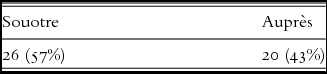
The results in Table 2 demonstrate that, in this context also, English appears to be encroaching on the lexical-conceptual structure of contemporary Jèrriais. The data suggest that the formal opposition that traditionally exists in Jèrriais between the unmarked and ‘in pursuit of’ meanings is becoming neutralised, with the form auprès being found with the ‘in pursuit of’ meaning in the speech of 17 of the 32 informants who produced this context. In other words, as seen in examples (4) and (5), the Jèrriais surface form seems to be combining with the semantics of English.
(4) [mɑ̃vekwɔ:rswɔ:trəji] ‘I am going to run after her’
(5) [sɑ̃tʃɑ̃kwoðioupreilejvɑk] ‘His dog ran after the cows.’
(iii) Affirmation strategies
Tokens in the corpus of prepositions used to express ‘after’ (‘in pursuit of’)Footnote 13

Traditionally, Jèrriais uses three different strategies to express affirmation (Le Maistre, Reference Le Maistre1966: 379, 479, 541; Birt, Reference Birt1985: 51–52; Société Jersiaise, 2008b:353. Véthe confirms a true statement made by an interlocutor, much in the same way as English ‘indeed’:
I’ fait hardi caûd ch't arlévée – Véthe (‘It is very hot this afternoon’ – ‘Yes’ [it is hot])
(Birt, Reference Birt1985: 51).
The other forms, oui and si, are used in the same way as in standard French – the former being unmarked and the latter used to give an affirmative answer to a negative question:
Sont-i’ d'not’ avis? – Oui ‘Do they agree with us?’ – ‘Yes’.
Tu n'sors pon ch't arlévée? – Si (fait) ‘You're not going out this afternoon [are you?]’ – ‘Yes [I am]’
(Birt, Reference Birt1985: 51–52).
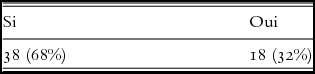
As may be seen from Table 3, in this context also, the English abstract lexical structure appears to be, in part, becoming mapped onto that of contemporary Jèrriais. Although the formal distinction between ‘unmarked yes’ (oui) and ‘contradictory yes’ (si) is observed to some extent (see examples (6) and (7)), this distinction is no longer categorical in contemporary Jèrriais and 15 different speakers out of the 49 who produced a ‘contradictory yes’ context, instead generalised the unmarked form to contexts such as (8).Footnote 14
Tokens in the corpus of si and oui in ‘contradictory yes’ contexts

(6) [ʃunɑnətɛ̃teresɛpõ] [sikɑ̃ʒtɛmus] ‘That didn't interest you’ – ‘Yes it did, when I was a child’
(7) [ɑvɛk[X]nɑnẽmejɑvɛk[Y]sifɛ] ‘With [X] no, but with [Y], yes indeed’
(8) [unepõbẽʒɑnɑʃtœ] [wiulej] ‘She's not very young any more’ – ‘Yes she is.’
(iv) Loan translations
Loan translations, or calques, reflect clearly the way in which the abstract lexical-conceptual structure of Jèrriais may be split and recombined with that of English. The speech of all informants interviewed contained calques. These included word-for-word translations of prepositional verbs (9), (10), (11), (12), of simple prepositions (13), and of idiomatic expressions (14), (15), (16); and also the use of Jèrriais verbs with ‘loan shifted’ meanings (17), (18) (see Appel and Muysken, Reference Appel and Muysken1993: 165; Thomason and Kaufman, Reference Thomason and Kaufman1988: 76, 90; cf. Jones, Reference Jones2001: 123, 127). In the examples that follow, the loan translations are given in italics.
(9) [ʒətʃibɑ:] ‘I fell down’
(10) [ʃunɑmgɑrdɑ̃nɑlɑ̃] ‘That keeps me going’
(11) [ʒetwɔ:le:nõ:bɑ:sjɛ:nu:] ‘I've got all the names down at home’
(12) [njɑpõɑsɛ:dsu:purɑleɑ̃tu] ‘There's not enough money to go around’
(13) [iljɑø̃tɑdmoɑʃtœkinjɑpõdʒɛ:rjeipur] ‘There are a lot of words now that there's not any Jèrriais for’
(14) [inpɑ:lpõlʒɛ:rjeisuvɑ̃asɛ:] ‘He doesn't speak Jèrriais often enough’
(15) [lzoutrlihɑli:sylɑgɑ̃:b] ‘The others pulled his leg’
(16) [tɑ̃pɛðtɛø̃sœlfi:] ‘Your father was an only son’
(17) [tsebẽtʃikʒɑ̃tɑ̃] ‘You know well what I mean’
(18) [dymõ:dkesɔmvnyɑkuneitr] ‘People who we have come to know.’
In all the above examples, each individual surface form is unambiguously Jèrriais. However, the precise configuration of these surface forms has created structures which diverge from traditional usage and where underlying English syntactic influence is easily identifiable.
3.1.2 Morphological realisation patterns
Morphological realisation patterns represent the way in which grammatical realisations are encoded in the surface structure. In this part of the analysis, three variables are examined quantitatively: the agreement of predicative adjectives, word order and the strategy used to express a repeated verbal action.
(i) Agreement of predicative adjectives
Unlike in English, all Jèrriais nouns have grammatical gender (Birt, Reference Birt1985: 14; Liddicoat, Reference Liddicoat1994: 231). Adjectives that agree with masculine nouns are unmarked (Birt, Reference Birt1985: 30–31, 42–43; Liddicoat, Reference Liddicoat1994: 213–216; cf. ALF Maps 135, 138, 182, 916):
Un garçon heûtheux [œ̃gɑrsõœ:ðœ:] ‘a happy boy’
and those that agree with feminine nouns are marked:
Eune fil'ye heûtheuse [ønfilœ:ðœ:z] ‘a happy girl’.
The present study examines gender agreement in predicative adjectives. Since these adjectives are separated from their head-noun by another element, it was felt that they provided a good test of the ‘strength’ of the grammatical relations between them. For an examination of gender-agreement in Jèrriais attributive adjectives, see Jones (Reference Jones2015:125).
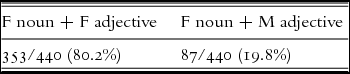
As demonstrated in Table 4, in most cases speakers select the appropriately marked form of the adjective in the predicative context (see examples (19) to (21)).Footnote 15 Nonetheless, the unmarked form of the adjective was recorded with a feminine noun at least once in the speech of 53 informants (see examples (22) to (24)). Since the speech of these informants also contains examples of feminine adjectives being used to qualify feminine nouns and since, in any case, gender is encoded elsewhere in the Jèrriais surface structure (e.g. in the singular determiner) these data do not in and of themselves point to the fact that gender agreement is disappearing from the language. Rather, they appear to be indicative of a convergence of Jèrriais and English morphological realisation patterns in this context.
Traditional usage
(19) [ulejhɔrtulalejsitu] ‘She's [f.] left [f.] Jersey (lit. ‘She's [f.] out [f.]’). She's left everything’Footnote 16
(20) [ulejsikõtɑ̃tlabwɔnfam] ‘She's [f.] so happy [f.], that woman’
(21) [ussɛbɛkõtɑ̃tasaveklapuleavekləko] ‘She [f.] would be very happy [f.] to know that the hen is with the cockerel.’ Non-traditional usage
(22) [ʃejpytodɑ̃lɑʒenerɑsjõkevjɛr] ‘It's rather in the generation [f.] that is old [m.]’Footnote 17
(23) [ɑ̃ʒɛ:riɛtujɑde:prɔnõsjɑsjõ:kisõdiferɑ̃:] ‘In Jersey too there are pronunciations [f.] that are different [m.]’
(24) [ulɛbɛkõtɑ̃kivnɛ] ‘She [f.] is very happy [m.] that he was coming.’
(ii) Order of adjective and its head-noun
Tokens in the corpus of predicative adjective agreement with feminine nouns

For Myers-Scotton, ‘Abstract specifications for word order at all levels of syntax also represent the level of morphological realisation patterns’ (2002:202). Accordingly, the data were examined for the ordering of unmarked adjectives and their corresponding head-nouns. In English, adjectives are pre-posed whereas in traditional Jèrriais they are generally post-posed (cf. ALF Maps 37, 125, 1055A, 1106) – with the exception of a) certain monosyllabic adjectives (cf. ALF Maps 412A, 1176); b) adjectives of colour (cf. ALF Map 568; ALEN Map 380; Birt, Reference Birt1985: 43; Liddicoat, Reference Liddicoat1994: 217); and c) a group of common adjectives such as bé ‘beautiful’, vyi ‘old’, grand ‘big’ and p'tit ‘small’ (cf. ALF Maps 117, 623, 923 among others; Birt, Reference Birt1985: 44–45; Liddicoat, Reference Liddicoat1994: 217–218; Jones, Reference Jones2001: 111–112), all of which are traditionally pre-posed. These exceptions, and also all the adjectives listed in Birt (Reference Birt1985:43–45) as traditionally pre-posed, were discounted from the analysis.
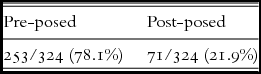
The results in Table 5 confirm the trend in contemporary Jèrriais towards pre-posed adjectives, which were present in the speech of all informants except two (neither of whom produced any adjectives) (cf. Jones, Reference Jones2015 and see examples (25) to (28)). Indeed, the adjectives aîsi ‘easy’, favori ‘favourite’ and spécial ‘special’, none of which are listed as pre-posed in Birt (Reference Birt1985), now appear to be exclusively pre-posed in Jèrriais, while natuthel ‘natural’, triste ‘sad’ and court ‘short’, may be both pre-posed and post-posed. Only adjectives of nationality derived from place names and past participles used adjectivally now appear to be post-posed categorically (cf. Birt, Reference Birt1985:44; Liddicoat, Reference Liddicoat1994:219, and see Jones, Reference Jones2015:132 for further discussion).
Tokens in the corpus of pre-posed and post-posed adjectives

(25) [nɔtfavɔritpjɛʃ] ‘Our favourite place’
(26) [ø̃mɑɲifikvejzẽ] ‘A splendid neighbour’
(27) [ønẽfɛrnɛlmɑʃin] ‘An infernal machine’
(28) [mɑmɑtɛrnɛlgrɑ̃mɛð] ‘My maternal grandmother.’
In fact, in contemporary Jèrriais, the tendency towards pre-position of adjectives appears to be so strong that it extends to qualified and superlative adjectives (see examples (29) to (32)).
(29) [ø̃bẽrɑ:rradjo] ‘A very rare wireless’
(30) [øndivɛrsəmɑ̃bwɔnmejtrɛs] ‘An exceptionally good school mistress’
(31) [ʃede:hardiʃɑrmɑ̃:vejzẽ:] ‘They are very lovely neighbours’
(32) [ʃepõlɑpy:ptitpɑ:rejs] ‘It's not the smallest parish’
(iii) Strategies used to express a repeated verbal action
Jèrriais traditionally expresses the repetition of a verbal action by means of two different morphosyntactic strategies. The more common is by means of the prefix re- which is often metathesised to -èr: r'sétchi ‘to dry again’; èrcaûffer ‘to heat again’ (Spence, Reference Spence1960: 20; Le Maistre, Reference Le Maistre1966: 277, 445 etc; Birt, Reference Birt1985: 92–94; Liddicoat, Reference Liddicoat1994: 59 cf. Le Feuvre, 1976: 116, etc.). This prefix is found with the same function in standard French (resécher, rechauffer) but the scope of the Jèrriais form is wider since, unlike in standard French, it may also be used with the verbs être ‘to be’ and aver ‘to have’: Il r'est malade, l'pouôrre baloque ‘he is ill again, the poor old soul’; j'allons r'aver d'la plyie ‘we're going to have rain again’ (Birt, Reference Birt1985: 94). The second, more transparent, strategy is isomorphic with that of English, namely the insertion of the adverb acouo ‘again’ after the verb: sétchi acouo ‘to dry again’, caûffer acouo ‘to heat again’.
Since both strategies are possible in traditional Jèrriais, the frequent presence in the contemporary language of the more transparent construction cannot be linked definitively to the influence of English, nor can it be considered as a categorical change in the way in which grammatical relations are encoded in the surface structure (cf. Jones, Reference Jones2005b: 168–170). The present analysis therefore went a step further, and considered instances where clear evidence was present of a change in the traditional surface structure of Jèrriais. This involved examining a third strategy, not hitherto mentioned in any metalinguistic work on Jèrriais, namely where the repetition of an action is encoded by means of a bi-partite structure, with one ‘repetition’ morpheme (re-) occurring before the verb and another (acouo) following. The use of this strategy suggests evidence of convergence with English since it appears to indicate that the ‘re- + verb’ construction is no longer felt to be transparent enough to convey the notion of repetition without the reinforcement of acouo. Six speakers made frequent use (50% +) of this non-traditional strategy (see examples (33) to (35)) and another seven produced an overtly hybrid structure in this context by, from time to time, taking the acouo element directly from English (see examples (36) to (38)):
(33) [ilərfi:takwo] ‘They did it again’
(34) [epimakɑ:zakifalelarmɛtrakwo] ‘And then, my coat, I had to put it on again’
(35) [uvulɛlɛrvejakwo] ‘She wanted to see him again’
(36) [ilfõəgɛn] ‘They do it again’
(37) [isõɑejpru:veɑlɑmneəgɛn] ‘They are trying to bring him again’
(38) [ilastɛrteəgɛn] ‘He has started again.’
(iv) Verb satellites
English and Jèrriais may differ as to whether or not particular verbs require satellites. Two cases in point are the verbs ‘to ask for’ (d'mander) and ‘to look for’ (chèrchi) which, in English, require the satellite ‘for’ but which, in Jèrriais, do not require a satellite (cf. Le Maistre, Reference Le Maistre1966: 171 (d'mander) and Le Maistre, Reference Le Maistre1966: 100; Société Jersiaise, 2008a: 63; ALF Map 22 (chèrchi)). The fact that the satellite pouor is used by six speakers out of the 13 who used d'mander (see examples (39) to (42)), and by all three speakers who used chèrchi (see examples (43) and (44)) suggests the presence of English-influenced change in the morphological realisation patterns of Jèrriais.
(39) [idmɑ̃dpurləhɛrnej] ‘He asks for the cart’
(40) [dejlɛtrdmɑ̃dɑ̃purde:rʃɛrʃ] ‘Letters asking for research’
(41) [dmɑ̃dpuroutʃønʃouzɑ̃nɑ̃gjej] ‘Ask for something in English’
(42) [tʃikø̃dmɑ̃dipurme] ‘Someone asked for me’
(43) [le:bɔʃtɛɑʃɛrʃipurø̃kwɔʃõ]‘The Boches were looking for a pig’
(44) [ʒfyʃɛrʃipurmabwɔnfam] ‘I went to look for my wife.’
(v) ‘Bare infinitive’ forms
As will be discussed in §3.2.1, contemporary Jèrriais contains many English-origin verb-forms (Spence, Reference Spence1993: 24; Jones, Reference Jones2015: 146). Since these are usually adapted by means of Jèrriais verbal suffixes: [tɛste] ‘to test’, [titʃe] ‘to teach’, [tipe] ‘to tip’, [spriŋkli:ne] ‘to spring-clean’, no resulting change occurs in the patterns of Jèrriais verb morphology. However, the corpus contains 8 examples (each from a different speaker) of English-origin verbs occurring as ‘bare infinitive’ forms in Jèrriais non-finite verb slots without any such morphological adaptation (see examples (45) to (52)). Unlike in Myers-Scotton and Jake's (Reference Myers-Scotton and Jake2017) discussion of the use of non-finite verbs in a finite verb slot, all examples found in the Jèrriais corpus were in contexts which traditionally trigger an infinitive, suggesting that these Jèrriais ‘bare’ forms may simply represent unadapted infinitives.
(45) [tyvœrkɒlɛktde:foto:] ‘You want to collect photos’
(46) [ʃunapødistrɔitɑvi:] ‘That can destroy your life’
(47) [lmõ:dtʃivøinvɛstlysu:] ‘The people who want to invest their money’
(48) [inpœvpõərɛstle:ʒɑ̃:] ‘They can't arrest people’
(49) [ulejastʌdi]‘She is studying’
(50) [ilaejpruvɛɑiŋkʌridʒle:ʒɑ̃:]‘He tried to encourage people’
(51) [ʒpœ:rikɔ:dʃuna] ‘I can record that’
(52) [sulɛleraidotfɛj] ‘I used to ride them.’
(vi) Articles that combine with prepositions
Both the Jèrriais masculine singular definite article and the plural definite article combine with the prepositions à ‘to’ and dé ‘of’:
À + lé > au ‘to the’ (singular)
À + les > ès ‘to the’ (plural) (cf. French aux)
(Spence, Reference Spence1960: 85, 175; Birt, Reference Birt1985: 17; Liddicoat, Reference Liddicoat1994:235; Jones, Reference Jones2015:150 cf. ALF Maps 76, 171, 1245)
Dé + lé > du ‘of the’ (singular)
Dé + les > des ‘of the’ (plural)
(Birt, Reference Birt1985: 20; Liddicoat, Reference Liddicoat1994: 235; Société Jersiaise, 2008a : 97, 110).
These traditional morphological realisations occur in their hundreds in the corpus and are maintained in all but 18 cases: see for example (53) to (55), which were uttered by individuals who otherwise produced traditional forms consistently.
(53) À + lé (9 tokens) [ʒedmɑ̃deɑlpy:ʒœnfrɛð] ‘I asked the youngest brother’
(54) À + les (7 tokens) [jade:moukisõdifɛrɑ̃ɑlenowtr] ‘There are some words that are different to ours’
(55) Dé + les (2 tokens) [lɔtʃypɑ:sjõdəlezi:lʃtɛhɑrdidyð] ‘The Occupation of the Islands was very difficult’.
Although these non-traditional forms are produced without any accompanying hesitation or pause, the fact that they occur so rarely and, each time, in the mouth of a different speaker, suggests that they may represent momentary speech errors rather than evidence of change in progress.
3.1.3 Predicate-argument structure
(i) Reflexive verbs
In Jèrriais, certain verbs can be reflexive or non-reflexive in both form and meaning (Birt, Reference Birt1985: 79–82; Liddicoat, Reference Liddicoat1994: 248). An example is laver, which means ‘to wash [something]’ in its transitive form but ‘to wash oneself’ in its reflexive form (s'laver) (ALF Map 754 cf. ALF Maps 10, 62, 191, 329, 917). When not being used reflexively, laver can only be transitive: in other words, *il lave (with the meaning ‘he washes himself’) is an impossible structure in traditional Jèrriais.
As may be seen from Table 6, although most usage in the corpus is consistent with that described in metalinguistic texts, some verbs are, at times, losing their traditional reflexive pronoun.
Tokens in the corpus of verbs used with a reflexive meaning

The fact that 16 speakers use non-reflexive forms of four different verbs with a clear reflexive meaning (see (56) – (59)), suggests that, for these particular verbs, non-traditional usage may be starting to emerge. Since, in their non-reflexive form, these verbs can traditionally only be transitive, and therefore require an expressed object, this non-traditional usage reflects a change in the predicate-argument structure of Jèrriais, which is likely to be due to convergence with English, a language which does not mark reflexivity as formally as some other Germanic languages (cf. McWhorter, Reference McWhorter2002).Footnote 18
(56) App'ler Footnote 19 [dykoutɛderouzeilɑpɛlpõdejvejprilɑpɛldezɛðɑɲi:] ‘In the area around Rozel, they are not called vêpres they are called ithangnies’
(57) L'ver Footnote 20 [le:filõlve:ɑø̃kɑrdedʒi:] ‘The girls got up at a quarter to ten’
(58) Mathier Footnote 21 [ʃezefɑ̃:õmɑðje:eilõde:pti:] ‘These children have got married and they have children’
(59) Rapp'ler Footnote 22 [ʒərɑpɛlʒɑmejlejnõ:] ‘I never remember the names’
(ii) Mapping of thematic relations
In traditional Jèrriais, the recipients of the verbs faller ‘to be necessary’ and mantchi ‘to lack, to miss’ are encoded in the utterance as indirect objects (cf. ALF Maps 534, 535). This differs from English, where the recipient is expressed as a nominative:
I vous faut mouothi un jour ‘You must die one day’ (lit. ‘it is necessary to you to die one day’ (Le Maistre, Reference Le Maistre1966: 235)
Les sou lî manquent ‘He is short of money’ (lit. ‘the money lacks to him’)
(Le Maistre, Reference Le Maistre1966: 337)
Another difference in the mapping of thematic relations between Jèrriais and English occurs with the verbs donner ‘to give’ and rêpondre ‘to answer’. In Jèrriais, the experiencer of both these verbs is an indirect object (cf. ALF Map 786), whereas in English it is a direct object:
Jean li a donné les cliés ‘Jean gave him the keys’ (lit. ‘John gave to him the keys’)
(Birt, Reference Birt1985:75)
Rêpondre à tchitch'un ‘To answer someone’ (lit. ‘to answer to someone’)
(Le Maistre, Reference Le Maistre1966: 450).
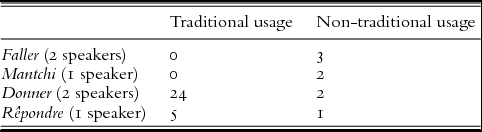
Although traditional usage is usually adhered to in the corpus, the speech of six informants contains instances where the mapping of thematic relations has changed – in the case of faller and mantchi, the recipient has changed from indirect object to subject (see examples (60) and (61)) and, with donner and rêpondre, it has changed from indirect to direct object (see examples (62) and (63)). (cf. Table 7, where the number of speakers producing non-traditional usage is given in brackets). Although the number of tokens of non-traditional usage is not high, it is, however, striking that the mapping of thematic relations should change at all (cf. Fuller, Reference Fuller2000: 54).
Tokens in the corpus of the mapping of thematic relations with the verbs faller, mantchi, donner and rêpondre

(60) [ʒfaledmœðejuktɛlafɛrm] ‘I had to live where the farm was’
(61) [imɑ̃kle:sʌndeiroʊst] ‘He misses Sunday roasts’
(62) [ø̃livrkeʒledune] ‘A book that I have given him’
(63) [ʒəlejrepõnyɑ̃ʒɛ:rjɛj] ‘I answered him in Jèrriais’
3.2 The 4-M model
3.2.1 Content morphemes
For the analysis of content morphemes it was necessary to address the likelihood that the data would contain examples of both single-word intrasentential codeswitches and borrowings (cf. Jones, Reference Jones2001: 118–128, Reference Jones2015: 143–154). Myers-Scotton argues that these lone other-language items occur as part of the same developmental continuum (1993:63) so that, from a synchronic point of view, there is no need, strictly speaking, to distinguish between them (2002:153). Moreover, given that a) the theoretical objective of this part of the study (§3.2) is to examine the degree of susceptibility to contact shown by different types of morphemes – rather than to undertake a focussed analysis of different types of lone other-language items, and b) all of the forms considered in this section (§3.2.1) are content morphemes, the precise distinction between codeswitching and borrowing is not central here either. However, rather than risk muddying waters, it has been decided to try – as far as possible – to remove lexical borrowings from the current analysis. In the absence of any objective, clear-cut criteria as to how this may be achieved (cf. Poplack and Sankoff, Reference Poplack and Sankoff1984, Reference Poplack, Sankoff, Ammon, Dittmar and Mattheier1988; Poplack, Sankoff and Miller, Reference Poplack, Sankoff and Miller1988; Poplack and Meechan, Reference Poplack and Meechan1998; Myers-Scotton, Reference Myers-Scotton1993, Reference Myers-Scotton2002; Jones, Reference Jones2005a), this study follows Myers-Scotton (Reference Myers-Scotton2002:41), Deuchar (Reference Deuchar2006) and Deuchar, Muysken and Wang (Reference Deuchar, Muysken and Wang2007) in identifying borrowings on the basis of their predictability and listedness.Footnote 23 Deuchar claims that: ‘[L]oans are assumed to be listed in the vocabulary of monolingual speakers of the recipient language, whereas switches are not’ (2006:1988). Given the absence of any monolingual speakers of Jèrriais (see §2), listedness is defined in this study, following Deuchar (Reference Deuchar2006), who was also working in a context where no monolingual speakers remain, as words found in either of the most recent dictionaries of Jèrriais, namely Le Maistre (Reference Le Maistre1966) and Société Jersiaise (2008a, b). Words listed in these metalinguistic works were therefore excluded from the analysis.
Contemporary Jèrriais contains many English-origin content morphemes, often as the stems of nouns and verbs. Alongside more well-established forms such as dgaîngue (Le Maistre, Reference Le Maistre1966: 162, Société Jersiaise, 2008a: 99) and stèrter (Le Maistre, Reference Le Maistre1966: 490; Société Jersiaise, 2008a: 314) whose listedness, as explained above, has led to them being discounted from the analysis, the speech of all informants contained forms such as (64) to (76)). Although, as discussed in §3.1.2(v), a small minority of English-origin verbs occur in the data as ‘bare infinitive’ forms (see examples (45) to (52)), most are adapted by means of Jèrriais morphology (see examples (72) to (76)).
a) English-origin nouns
(64) [falɛmɛtlejreilzsyləlɒri] ‘The rails had to be put on the lorry’
(65) [ulejtʃildɹənzrɛppurtɒmsən] ‘She is a children's rep for Thomson [travel company]’
(66) [idesidi:tduvriø̃fiʃændtʃipʃɒp] ‘They decided to open a fish and chip shop’
(67) [mɑfilɑø̃tɑimʃeəopɔrtygal] ‘My daughter has a time-share [apartment] in Portugal’
(68) [ʃtedɑ̃:lsivilsœvis] ‘I was in the civil service’
(69) [njɑvɛpõdəflæts] ‘There weren't any flats’
(70) [isõɑ̃hɒlideiaʃtœ] ‘They are on holiday now’
(71) [mejkummɑfrɛndsulejdið] ‘But as my friend used to say . . .’
b) English-origin verbs
(72) [twɔ:lejʒanʒɑ̃tejɑkiwejpurlejfiʃændtʃips] ‘All the young people were queueing for fish and chips)
(73) [ivnejtɛstejlywaiəzsjɛ:nu:] ‘They came and tested the wires at our house’
(74) [ifofəʊnejɑmɛssivrɛ] ‘I must telephone Mr Syvret’
(75) [juktejɑti:tʃej] ‘Where do you teach?’
(76) [ʒədɹaivimɑ̃kɑ:] ‘I drove my car’
The fact that, in contemporary Jèrriais, most English-origin verbs occur in an adapted form rather than in a ‘bare’ form suggests that, in this context, even when the content morphemes to which they are bound are contact-forms, Jèrriais system morphemes tend to remain present, and hence appear to be less susceptible than content morphemes to contact-influenced change during language obsolescence (cf. Myers-Scotton and Jake, Reference Myers-Scotton and Jake2017: 353). This point will be returned to in §3.2.2 (i) below.
The corpus also contains a few examples (such as (77)) of English-origin phrasal verbs, where the verb has been adapted but not the adverbial component:
(77) [nulejʃipejbæk] ‘They were shipped back’
The Jèrriais data therefore confirm Myers-Scotton's Hypothesis 3., namely that content morphemes are highly susceptible to contact-induced change.Footnote 24
3.2.2 Early system morphemes
Two early system morphemes were analysed, namely plural suffixes and definite articles.
(i) Plural suffixes
The –s plural suffix of English (realised as [s] or [z] according to phonetic context) is considered by Myers-Scotton and Jake as an early system morpheme because it adds conceptual information to its head noun (i.e. it makes it plural) (2017:344). In spoken Jèrriais, plurality is not generally marked on the noun, which usually remains invariable, number being instead conveyed elsewhere in the utterance (such as by an accompanying determiner (Birt, Reference Birt1985: 29; Liddicoat, Reference Liddicoat1994: 232; cf. ALF Maps 141, 796, 1349)).Footnote 25
The analysis sought to determine whether Jèrriais plural suffixes are susceptible to convergence by examining, first, whether Jèrriais nouns are ever pluralised by English suffixes and, second, whether English nouns tend to be pluralised according to the morphological patterns of English or of Jèrriais: in other words, whether the English early system morphemes appear to be elected along with their respective content morphemes.
Not one of the 3,398 Jèrriais-origin plural nouns in the corpus is formed using the English-origin plural morpheme (see Table 8). Moreover, along similar lines, when an English-origin content morpheme is present, English plural morphology is also present in almost two-thirds of cases (see Table 9, where tokens of the English system morpheme were obtained from 60 different speakers). This suggests that the English plural marker tends to be accessed along with its head-noun (cf. Fuller, Reference Fuller2000: 54), confirming Myers-Scotton's claim about the strong link that exists between a content morpheme and the early system morpheme that it elects (2002:301). Although the borrowing of plural morphology is well documented in other situations of language contact (for example, Gardani, Reference Gardani2008; Sommerfelt, Reference Sommerfelt1925: 7–10; Thomas, Reference Thomas and Crystal1982: 210, 214; Comrie, Reference Comrie1981: 157; Boretzky and Igla, Reference Boretzky, Igla, Hinrichs and Büttner1999: 725; Fischer, Reference Fischer1961: 243), the Jèrriais results are more akin to those of Fuller (Reference Fuller2000:54) for Pennsylvanian German, where German-origin nouns only elected an English-origin plural morpheme in 1.3% of cases (cf. Schmitt, Reference Schmitt2000:18 for Russian immigrant children in the USA and Roseano (Reference Roseano2014) for Friulian).
Tokens in the corpus of the pluralisation of Jèrriais-origin content morphemes

Tokens in the corpus of the pluralisation of English-origin content morphemes

A good illustration of the resistance to replacement from English on the part of the Jèrriais plural early system morpheme is represented by the form [le:pəli:smən] (les policemans). In English, the plural morphology of the word policeman (i.e policemen) involves a vowel change (umlaut) ([pəli:smən] – [pəli:smɛn]). The fact that the plural form [le:pəli:smən] (with a plural definite article but no umlaut) was produced by a speaker who is also fluent in English and who is therefore used to the vowel change in the English plural, suggests that the Jèrriais morphological pattern of zero plural marking on the noun is being applied in this instance.
Speakers also frequently mix ‘English’ and ‘Jèrriais’ plural noun morphology on English-origin nouns. That no pattern is discernible here in terms of either the particular lexeme used or the phonetic context is demonstrated by examples (78) and (79), where same speaker produces the same lexeme with different plural morphology during the same utterance:
(78) [ivnɛtɛstɛly:waiəzsjɛ:nu:epiø̃ʒuritɛɑozeɑmɛtly:fiʃy:waiə:ahouɑtɛstɛ] ‘They came to test their wires at our house and then one day they dared to put their blasted wires upstairs to test them’
(79) [ilɑ̃vijɛde:dæfədililɑ̃vijɛse:dæfədilzɑbristəl] ‘He sent daffodils, he sent his daffodils to Bristol.’
Moreover, it appears that the plural morphology of English-origin nouns is not always ‘fixed’ within the Jèrriais speech community. Examples (80) and (81) illustrate how some speakers attach ‘English’ plural morphology to certain English-origin nouns, whereas other speakers appear to make these nouns plural in accordance with the most widespread pattern for Jèrriais plural morphology, namely a null morpheme:
(80) [isõɑʃɛrʃily:kɑ:zose] ‘They look for their cars in the evening’ cf. [ejavede:kɑ:kivnɛsylarut] ‘And there were cars which came on the road’
(81) [ɑlaistɛdvʌdily:takwodɑ:sɛðe:lane:pase:mejsule:mavedejpleiz] ‘In the Eisteddfod [cultural festival] they still had two evenings last year, but we used to have plays’ cf. [ʒɑvõfɛtu:ʃejplei] ‘We did all those plays.’
(ii) Definite articles
Definite articles are early system morphemes since they depend upon their head for their form and are conceptually activated (adding specificity to their head) rather than being structurally assigned. In Jèrriais, the definite article can be marked for gender and number (see Birt, Reference Birt1985:15 and Liddicoat, Reference Liddicoat1994: 234 for details). None of the 3,822 definite articles of Jèrriais contained in the corpus is replaced by the corresponding English form (cf. Myers-Scotton and Jake, Reference Myers-Scotton and Jake2017:356), but neither is any omitted altogether, (and this both when the corresponding noun is of Jèrriais origin or of English origin). Once again, this reinforces Myers-Scotton's claim, mentioned in §3.2.2(i) above, that the link between these early system morphemes and their heads is a strong one and that it is the Matrix Language (Jèrriais in this case), which has the larger structural role (see examples (82) to (88)).
(82) [ʃtɛsyle:krisməskɑ:dz] ‘It was on the Christmas cards’
(83) [ilavɛmẽdɑ̃lbeismɛnt] ‘He had put it in the basement’
(84) [ʃɛlatið:i:ʃtɛpurlelaifbəʊt] ‘It's the raffle, it was for the lifeboat’
(85) [eləspriŋkli:niŋfalɛhalele:tapi:ejle:mɛtdɑ̃:lkjou] ‘And the spring-cleaning, we had to pull out the carpets and put them in the field’
(86) [ulavɛfɛləraidiŋpɑ:tepifalɛfɛrləθiəri] ‘She had done the riding part [of the exam] and then she had to do the theory [part of the exam]’
(87) [ʒeprẽtuʃnɑsylateip] ‘I took all of that on the tape’ [i.e. ‘I recorded it all’]
(88) [ʒɑvemɑ̃livdɑ̃:lɑhæmbæg] ‘I had my book in the handbag.’
3.2.3 Late system morphemes
3.2.3.1 ‘Bridge’ late system morphemes
‘Bridge’ late system morphemes join together two units – either within a clause or by joining together two clauses (Myers-Scotton and Jake, Reference Myers-Scotton and Jake2017:344). Two types of ‘bridge’ late system morphemes were examined, namely genitive constructions and associative constructions.
(i) Genitive constructions
In genitive constructions, the Jèrriais ‘bridge’ late system morphemes à ‘of’, ‘to’ and dé/d’ ‘of’ connect the possessor with the item possessed: la fil'ye à John ‘John's daughter’ [lit. ‘the daughter of John’], les dés d'ma main ‘my hand's fingers’ [lit. ‘the fingers of my hand’] (Le Maistre, Reference Le Maistre1966: 1; Birt, Reference Birt1985: 17 cf. ALF Maps 246, 356).
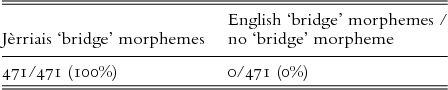
As detailed in Table 10 and illustrated in examples (89) and (90), ‘bridge’ late system morphemes were only found to be replacing their English equivalent (genitive ’s) in an extremely small number of instances (although each of these instances was obtained from a different speaker):
Tokens in the corpus of genitive constructions

(89) [ivulɛvejmɛsperejzʒanfrɛð] ‘He wanted to see Mr Perrée's young brother’
(90) [ʃejdʒɒnzʒva] ‘It's John's horse’.
(ii) Associative constructions
In Jèrriais, where one noun is associated with another, these may be joined morphosyntactically by the ‘bridge’ late system morphemes à ‘of’, ‘to’ and dé/d’ ‘of’: la canne à lait [lit. ‘the jug for milk’] ‘the milk jug’, eune vaque à lait [lit. ‘a cow that produces milk’], l'baté à vaituthes [lit. ‘the boat for cars’] ‘the car ferry’, la boête dé peintuthe ‘the paint box’ (Le Maistre, Reference Le Maistre1966: 1, cf. ALF Map 909).
As Table 11 indicates, in this context no Jèrriais ‘bridge’ late system morphemes were found to be lost or replaced. Indeed, in the corpus, Jèrriais ‘bridge’ morphemes are retained in associative constructions even where the nouns that are being associated are both English in origin (see examples (91) and (92)):
(91) [ilejɑlu:nivɜ:sitidɛli:dz] ‘He is at Leeds University’
(92) [ulapɑ:sewitəʊlɛvəlzɑgreidei] ‘She passed eight ‘O’ levels at grade A’
Tokens in the corpus of associative constructions

The analysis of Jèrriais ‘bridge’ late system morphemes therefore provides strong support for Myers-Scotton's Hypotheses 4 and 5. In the present study, these morphemes are less susceptible to replacement or loss than early system morphemes (Hypothesis 4). Moreover, they do not appear to be susceptible to absolute omission (Hypothesis 5).
3.2.3.2 ‘Outsider’ late system morphemes
Unlike ‘bridge’ late system morphemes, ‘outsider’ late system morphemes are ‘coindexed with forms outside the head of their maximal projection’ (Myers-Scotton, Reference Myers-Scotton2002: 5). They map relationships among arguments and clause structure (Myers-Scotton and Jake, Reference Myers-Scotton and Jake2017:347). As in Deuchar's study of Welsh-English codeswitching (2006: 1998), these morphemes are analysed in Jèrriais via the subject-verb agreement of finite verbs. Although this context provides a large number of ‘outsider’ late system morphemes, not all clauses containing finite verbs were able to be examined since Jèrriais verb agreement is not marked in all cases. Accordingly, only instances of finite verb forms which traditionally bear a (spoken) morphological inflection in Jèrriais have been analysed (cf. Birt, Reference Birt1985: 250–268 for details).
Table 12 demonstrates that, in most cases, usage in the corpus is in line with documented norms (cf. Le Maistre, Reference Le Maistre1966: xxx–xxxiii; Birt, Reference Birt1985: 250–268; Spence, Reference Spence1993: 36–38; Liddicoat, Reference Liddicoat1994: 141–210; ALF Maps 10, 12, 23, 24, 27, 28, 30, 84, 87, 91–103 etc.). This provides further evidence in support of Myers-Scotton's Hypothesis 4. Moreover, unlike with the ‘bridge’ late system morphemes discussed in §3.2.3.1 above, none of the 28 tokens of non-traditional usage, (distributed among the speech of 14 different speakers), reveal any evidence that ‘outsider’ late system morphemes are being replaced by the corresponding English-origin morpheme. Rather, they involve a 3sg form replacing the 3pl form of the verb in question (see examples (93) to (96)).Footnote 26
(93) [jɑtreʒuʒɑ̃timɑ̃dɑ̃gjejdpɑ:lɛtule:sjɛ̃:kivɛnnəpœ:põlpɑ:lɛikõprʌnmejnpœ: põpɑ:le] ‘There is always a lot of English spoken [i.e. at meetings of the Société Jersiaise] not all those who come can speak it [i.e Jèrriais]. They come but they can't speak [it]’ (the traditional 3pl present tense form of the verb pouver ‘to be able to’ is [pœ:v])
(94) [idiɑ̃frɑ̃sejʃɛjkɑtrəvɛ̃dismejɑ̃ʒɛ:rjejʃɛnɛ̃nɑ̃:t] ‘In French they say it's quatre-vingt-dix [‘ninety’] but in Jèrriais it's nénante’ (the traditional 3pl present tense form of the verb dithe ‘to say’ is [di:z])
(95) [itɛsysɑbaiklɛzɑlmɑ̃:lɑre:tielidmɑ̃ditʃikilɑvɛdɑ̃:lpɑ̃ɲi] ‘He was on his bike and the Germans stopped him and they asked him what he had in the basket’ (the traditional 3pl preterite tense forms of the verbs arrêter ‘to stop’ and d'mander ‘to ask’, are, respectively, [ɑre:ti:t] and [dmɑ̃di:t])
(96) [le:ʒɑnpœ:lɑprɑ̃drɑʃtœɑlejkɔl] ‘The young people can learn it now at school’ (the traditional 3pl present tense form of the verb pouver ‘to be able to’ is [pœ:v]).
Tokens in the corpus of subject-verb agreement

Less frequently, the 3pl morpheme is substituted for the 1pl morpheme (see example (97)). This may indicate influence from English, where the morphological forms of the present tense 1pl and the 3pl are often identical.
(97) [le:dœ:dnu:õtɛteelvɛ:iʃẽdɑ̃:lɑkɑ̃pɑn] ‘The two of us have been brought up here in the country’ (the traditional 1pl present tense form of the verb aver ‘to have’ is [avɔ̃]).
This analysis of Jèrriais ‘outsider’ late system morphemes confirms the finding made in relation to ‘bridge’ outsider morphemes in §3.2.3.1, namely that, as suggested by Myers-Scotton's Hypothesis 5, in this context of language obsolescence, both types of late system morpheme appear to be extremely resistant to the influence of language contact.
4. CONCLUSION
This case study has demonstrated that, in contemporary Jèrriais, certain non-traditional structural and lexical features have gained currency in the everyday usage of fluent speakers. It is suggested that, since these features are reasonably common within the contemporary Jèrriais speech community – as opposed to being found merely in the speech of a few (possibly attrited?) isolated speakers, the five hypotheses that Myers-Scotton develops in relation to her Abstract Level and 4-M models of language production about contact-induced change during language attrition may also have some relevance for language obsolescence.
It has been observed that all three levels of the abstract level structure of contemporary Jèrriais have, to some extent, become split and recombined with parts of the corresponding level of English (§3.1). This results in what might be described, in Myers-Scotton's terms, as a ‘converged’ linguistic structure, that may bear a Jèrriais surface form but which may also reveal evidence of a more English-origin structure at an underlying level. The Jèrriais data confirm that, of the three levels examined, lexical-conceptual structure, which showed a clear amount of convergence across all variables (§3.1.1), is most susceptible to change (cf. Hypothesis 1). The predicate-argument structure of Jèrriais also revealed convergence to be present in the mouths of some speakers, but this was found to be less widespread across the speech-community as a whole (§3.1.3). This level seemed therefore the most resistant to change (cf. Hypothesis 2). Myers-Scotton makes no explicit claim about the relative hierarchy between lexical-conceptual structure and morphological realisation patterns, and indeed in the Jèrriais data, these appeared to be quite variable-dependent rather than following any identifiable pattern. For example, in the case of morphological realisation patterns, in broad quantitative terms at least (see note 13), convergence seemed far more present in the context of predicative adjective agreement (§3.1.2(i)) than with articles that combine with prepositions (§3.1.2(vi)).
Evidence of contact was also observed – to different degrees – in relation to all four of the morpheme-types described in Myers-Scotton's 4-M model. The Jèrriais data confirmed that content morphemes were highly susceptible to contact-induced change (cf. Hypothesis 3), with English-origin items frequent in the mouths of all speakers interviewed (§3.2.1). Hypothesis 5, namely that of all morpheme types, late system morphemes are least susceptible to omission, was also confirmed by the Jèrriais data, both with regard to ‘bridge’ late system morphemes (represented in this study by genitive and associative constructions (§3.2.3.1)) and ‘outsider’ late system morphemes (represented by subject-verb agreement (§3.2.3.2)). Furthermore, in conformity with the 4-M model as applied in other contexts of language change, both ‘bridge’ and ‘outsider’ late system morphemes were found to be resistant to change. However, as Fuller also found in her study of Pennsylvanian German (2000), the isolated instances of these changes meant that it was not possible to establish any precise distinguishing ‘ordering’ between them.
Of the three hypotheses relating to the 4-M model, Hypothesis 4 proved the least straightforward to substantiate. First, in terms of the relative ‘hierarchy’ posited between content morphemes: early system morphemes and late system morphemes, although the early system morphemes of Jèrriais were clearly less susceptible to change during language obsolescence than its content morphemes, the Jèrriais early system morphemes analysed did not appear manifestly less prone to change than late system morphemes. In the case of the plural suffixes (§3.2.2(i)), replacement of a Jèrriais-origin early system morpheme by an English-origin early system morpheme never occurs in the data when the content morpheme to which it is bound is of Jèrriais origin, although it does occur reasonably frequently when the content morpheme in question is also of English origin. In contrast, with the definite articles (§3.2.2(ii)), no instance at all was found of replacement in any context. As discussed, a possible explanation for these findings may be the strong link that exists between a content morpheme and the early system morpheme that it elects (cf. Myers-Scotton Reference Myers-Scotton2002:301). Given these findings, the second part of Hypothesis 4 (substitution is more likely than loss) could only be considered in relation to the plural suffixes. However, in this context it was impossible to conclude definitively whether the data were revealing a case of the former or the latter since, in those cases where an English-origin content morpheme does not elect an English early system morpheme (see Table 9), the corresponding Jèrriais-origin system morpheme is in fact realised as a null morpheme.
As Thomason has wisely stated, ‘The fact that certain types of contact-induced change are possible in a given contact situation [. . .] does not mean that we can confidently expect to find them [in all such situations]’ (2008:44). However, it is hoped that, by its examination of Jèrriais through the prism of the Abstract Level and 4-M models, this case study of Jèrriais has provided data that will allow convergence-type changes in language obsolescence to be compared with the same processes in other types of language contact. As a final point, and to answer Polinsky (Reference Polinsky1997), in the case of Jèrriais significant loss does appear, broadly speaking, to have its own principled grammar. However, the precise linguistic detail of this picture has proven to be somewhat less clear-cut than the statement may suggest.