Introduction
Since 1993, the European Union (EU) has recognised nationals of member countries as European citizens. The Treaty on European Union granted ‘Citizens of the Union’ freedom of movement within the EU together with basic voting rights in relation to local and European elections (Anderson Reference Anderson2015). This recognition added to the free labour mobility which had been fundamental for European integration since the establishment of a common market in the 1950s. Despite such commitment to European citizenship, the EU's role regarding social policy has been seen as regulatory and co-ordinating only; a European welfare state comparable to national ones does not exist; substantial social rights to benefits or services have been conferred almost exclusively at national or sub-national level (Anderson Reference Anderson2015; Copeland and Daly Reference Copeland and Daly2014; Saraceno Reference Saraceno, Alber and Gilbert2010; Scharpf Reference Scharpf2002). Consequently, social policies vary considerably between member states (Ackers and Dwyer Reference Ackers and Dwyer2004). Nevertheless, the EU's commitment to free labour mobility has led to one important exception to the nationally bounded nature of social rights within the EU: the council passed legislation to entrench equal treatment by member states of native and migrant workers and to ensure mobility of social security rights between EU countries. In other words, it co-ordinated the national social policies for transnational citizens. This legislation was developed further through rulings by the European Court of Justice (Anderson Reference Anderson2015: 86–92). Thus, an intra-EU migrant worker is protected by the same health and safety regulations at work, and the same pay legislation as native citizens; they receive the same tax exemptions on income, are entitled to the same unemployment benefits and build up the same pension rights.Footnote 1 Indeed, their rights go beyond those granted by their employment status. Migrant workers are also entitled to use health services, receive child benefits and to send their children to school; in addition, they can transfer to their current place of residence any social provision built up in another member state. In short, while they are workers, migrants enjoy full social rights of citizenship in their host countries.
The consensus in the literature is that this legislation is successful; that it provides wide-ranging economic and social protection for intra-EU migrant workers in relation to natives (Ackers and Dwyer Reference Ackers and Dwyer2004; Conant Reference Conant2006; Koopmans Reference Koopmans2010; Kymlicka and Banting Reference Kymlicka and Banting2006; Mau and Burkhardt Reference Mau and Burkhardt2009; Soysal Reference Soysal1994). Scholarly concerns have only been raised with respect to the rights of retired migrants who have never worked in their host country (Ackers Reference Ackers1998; Ackers and Dwyer Reference Ackers and Dwyer2002, Reference Ackers and Dwyer2004; Conant Reference Conant2006; Cook Reference Cook2010; Dwyer Reference Dwyer2001; Kleinman Reference Kleinman2002; Pollard and Ross Reference Pollard and Ross1994; Warnes Reference Warnes, Hudson and Williams1999, Reference Warnes2002; Warnes et al. Reference Warnes, King, Williams and Patterson1999, Reference Warnes, Friedrich, Kellaher and Torres2004; Weiler Reference Weiler and La Torre1998). Yet, this literature relates almost exclusively to the situation before the enlargement of the EU into Eastern Europe beginning in 2003, which has significantly increased the scale of intra-EU migration and established as the most dominant form movement from the much poorer East to the richer West (details below). Since enlargement, new social policy challenges have emerged, causing political and academic debate. Fears that Eastern European migrants will make claims on over-stretched benefit systems and drive up public spending have been exploited, particularly by right-wing European parties which have attracted increased support in the destination countries (e.g. Ministers of the Interior of Austria, Germany, the Netherlands and the UK 2013; Schierup, Hansen and Castles Reference Schierup, Hansen and Castles2006: 4). The most significant result of these fears so far has been the vote for Brexit. However, while the short-term consequences of migration have been high on the agenda, neither the literature nor politicians have paid much attention to the longer-term implications of EU labour migration for the social rights of migrants; in particular, little has been said about how migrant workers will fare who choose to stay in their host country and retire there. This is the subject of the current paper.
Traditionally, the economics literature assumed that labour migration was temporary, that migrants would return to their country of origin upon retirement at the latest. There they would enjoy an above-average standard of living because the pensions accrued in the host country would normally be based on higher wages than in their country of origin (de Coulon and Wolff Reference de Coulon and Wolff2005; Dustmann Reference Dustmann1996; Kilnthäll Reference Kilnthäll2006). These assumptions were supported by data on the first wave of post-war intra-EU migration, from the poorer south of Europe to the North (Dustmann Reference Dustmann1996; Dustmann and Kirchkamp Reference Dustmann and Kirchkamp2000; Poulain and Perrin Reference Poulain, Perrin, Haug, Compton and Courbage2002). However, it has become clear more recently that a significant number of migrants do not return. For example, between 2010 and 2015, the number of EU citizens 65 years and older living in another EU country within the EU-27 grew by 26 per cent, to just over a million citizens altogether, reflecting at least in part permanent settlement after the first wave of intra-EU migration.Footnote 2 The results are not surprising. Living for a long time in their ‘new’ countries, migrants become integrated through employment, social contacts (de Coulon and Woolf Reference de Coulon and Wolff2005; Edin, LaLonde and Åslund Reference Edin, LaLonde and Åslund2000) and attachment to the social rights host countries offer in health care and other services (Kinthäll Reference Kilnthäll2006: 156).
This paper starts from the assumption that a significant proportion of current intra-EU migrants who have settled in their host country after integrating successfully into the labour market during their adult lives may want to retire there. Against this background, its central interest is to determine whether economically successful migrants who decide to stay are able to maintain a full citizenship status in their host country in retirement. Our answer will be based on an assessment of migrants’ projected pension entitlements after full employment careers, spent in home and host countries and measured in relation to common income standards in migrants’ host countries. The paper will show that the citizenship status of many who migrated successfully in the wake of EU enlargement is likely to be curtailed severely upon retirement if they stay in their host country, assuming current conditions do not change. It is true that the pension rights migrants have accrued in their country of origin are fully recognised formally upon retirement in a host country. However, in substance, these rights are rendered worthless in the destination countries, despite co-ordinating EU legislation, because of hugely disparate wage levels between countries of origin and destination. This loss puts migrants at a higher poverty risk than native workers with comparable careers. While similar to natives during working life, the citizenship of migrants who stay put in retirement is diminished.
To develop this argument, the next part of the paper will show where most EU migrants have come from and where they have gone to since 2003 and what is known about their socio-demographic characteristics. We then summarise how EU law co-ordinates the pension rights individuals accrue in different countries in order to calculate a fair pension for migrant workers at the end of their working life. This is followed by an overview of the compulsory pension entitlements workers on different wage levels accumulate in these main home and destination countries, using Organisation for Economic Co-operation and Development (OECD) data. Based on these three steps, we develop four hypothetical young EU migrants whose characteristics are typical for current movements. We assume that these begin their careers in their home country, before moving to another EU country where they want to remain permanently. To measure their citizenship status upon retirement, we calculate their projected pension entitlements for their home and host country and compare this to the relative poverty line in their host country as well as to the pension of a native worker on the same wages at retirement. In using the relative poverty line as a benchmark for full citizenship status we draw on the classic concept of social citizenship. Townsend (Reference Townsend1979: 31) and Marshall (Reference Marshall, Manza and Sauder2009: 149) assumed that for meaningful participation in society individuals needed access to an income that allowed them to maintain customary living standards. Our second benchmark for full citizenship is the mandatory pension of a full-time worker on average life-time wages. This shows the amount considered appropriate for a native worker with the same labour market attributes in terms of education and skill as our migrants (see below). To establish migrants’ social citizenship status, in our empirical analysis we will use both benchmarks. We will explore the extent to which EU migrants who have taken long-term roots in their host country can be free of poverty in retirement compared to the standards of their host societies, and compared to the income of a similar native citizen. After presenting the findings, we discuss what types of reform could address the problem of migrants’ diminished citizenship and the likelihood that such reforms are adopted in the current political climate.
Who migrates?
Between 2005 and 2013,Footnote 3 the number of citizens living in the richer EU-15 states who originated from other EU member states increased by more than 52 per cent (Eurostat 2017, our calculations). Most of this increase was due to a sharp rise, by 364 per cent, in the number of citizens from the new Eastern member states. Most of these migrants came from Romania and Poland, which had more than two million citizens living elsewhere in the EU by 2015. Significant numbers of Bulgarians (>450,000) and Hungarians (>350,000) were also living outside their country of origin by this date. Movement between countries of the EU-15 also continued. This had been greatest between the poorer South and the rich North during the first wave of intra-EU migration in the early post-war period, but South to North migration has continued until today. For example, between 2005 and 2013 the number of Italians living elsewhere in the EU-15 rose by more than 82,000, and the number of Spaniards increased by more than 45,000 (Eurostat 2017, our calculations).
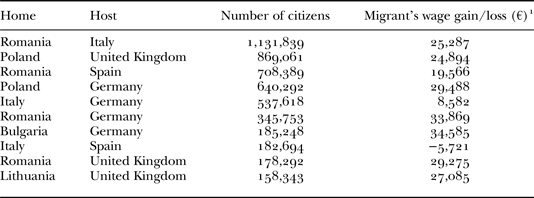
Table 1 shows the consequences of these developments, illustrating the ten largest populations from another EU country in the EU-15 in 2015. Migrants moved predominantly from South-East to South-West, from North-East to North-West and from South-West to North-West (see also Black et al. Reference Black, Engbersen, Okolski and Pantiru2010; Meyer, Bridgen and Andow Reference Meyer, Bridgen and Andow2013). Romanians and Bulgarians migrated mainly to Spain and Italy, and to a lesser extent Germany and the United Kingdom (UK); Polish citizens migrated mainly to the UK and Germany; Italians and Spaniards migrated mainly to Germany and the UK. In summary, by 2015 intra-EU migrants’ main countries of origin were Romania, Poland, Bulgaria and Italy. Their main destination countries were Italy, Spain, Germany and the UK. Most individuals migrate at a relatively young age, in their twenties and thirties, often after spending a few years working in their home country (Eurostat 2011: 20). Moreover, many intra-EU migrants are well educated, and thus capable of earning average wages in their host country (OECD 2008: 14). This notwithstanding, migrant workers in many countries have been disadvantaged by segmentation and/or discrimination (Comet Reference Comet2014; Constant and Massey Reference Constant and Massey2005; Piore Reference Piore1979; Powers and Seltzer Reference Powers and Seltzer1998). Most migrants are able eventually to compete on equal terms with native workers, but this can take many years (Constant and Massey Reference Constant and Massey2005). In the meantime, for some migration means low-wage employment and significant de-skilling in the destination countries (Alexandru Reference Alexandru2012; Eurostat 2011: 21).
Main movements: East–West/North–South (2015) all ages and migrants’ wage gain/loss (2014)

Note: 1. Gap between median gross annual wages of host and home country.
Source: Eurostat, own calculations.
How intra-EU migrants accrue pension rights
We are interested in this paper in how these migrants accrue pension rights. As stated above, most European migrants working in the EU-15 will have been employed in their country of origin for a few years before moving. This means that in the long run their retirement incomes will be affected by the labour market conditions and pension rules of two countries, or more if they migrate to a third country. This process is governed at European and national level. European law stipulates that EU workers residing in another country must be allowed to build pension rights like native citizens and it grants them the right to transfer to their country of residence any pension rights accrued in another member state. The EU Council recognised in 1971 that because the rules of some national systems were based on lifelong membership, mobile workers would be penalised if they entered late or left early and they therefore introduced pension calculation methods to avoid such effects. Since then, migrants’ entitlement on retirement has been calculated first on the basis of the standard rules of the pension system, including late-entry penalties. Secondly, a pro-rata assessment establishes the individual's pension entitlement assuming they spent their whole working career in the member state, and reduces it in relation to the actual time they have accrued rights there. The individual receives whichever is higher of the two amounts (Regulation (EEC) 1408/71; see also Meyer, Bridgen and Andow Reference Meyer, Bridgen and Andow2013). Thus, EU legislation protects well the way migrants accrue pension entitlements. However, their conversion into retirement income depends on the pension rules and wage levels in the migrant's home and host country. Before calculating individual migrants’ pension entitlements, therefore, we first we need to take stock of the conditions in the countries of origin and destination separately.
Pension rules and wage levels
The OECD started comparing the pension rules for all members in 2005 and has since repeated such calculations every few years. Their policy simulation freezes programmes and regulations at a set point in time and models the consequences (see also Bridgen and Meyer Reference Bridgen, Meyer, Meyer, Bridgen and Riedmüller2007: 18). Projections of this sort are unavoidable when the aim is to assess how contemporary rules and regulations will affect citizens’ income in the future. To be sure, other approaches describe the situation of ‘real’ individuals more accurately, such as data on current pension levels of intra- EU migrants, but they will have been built under systems that have changed during a working life, reflecting ‘the influence of policies long since reformed’ (Rake Reference Rake and Clasen1999: 223).
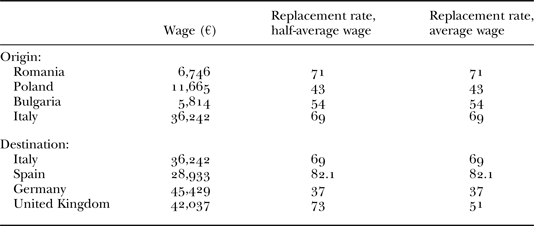
Here we have analysed the OECD's latest projections, reflecting the situation in 2015. To assess the impact of current pension arrangements, the OECD uses hypothetical individuals who are employed throughout their adult lives,Footnote 4 earning average, half-average, and one-and-a-half-average wages. Their pension entitlements upon retirement are then calculated, holding current pension rules constant for a full career and using only mandatory requirements, not voluntary schemes.Footnote 5 These are expressed as a proportion of the individual's last wage (the replacement rate), using assumptions about wages and inflation. In Table 2, we show the outcome of these projections for the main countries of origin and destination; we have selected for our study hypothetical individuals who, for the most part, have earned the average wages of the country in which they are resident. Given that migrants are likely to de-skill, we have not included the OECD's highest replacement rate.Footnote 6 Table 2 also shows the average gross wage levels of these countries.
Gross pension replacement rates, mandatory schemes (2015) and average gross annual wages in main countries of origin and destination (2014)

No systematic differences exist in the statutory pension rules between countries of origin and of destination (Table 2). Replacement rates for workers on the national average and half-average wage vary within each group, and the country with the lowest levels is Germany, which is in the EU-15. Wage-level differences, however, are large between host and home countries. Eastern European wages are lowest by far; for example, the gross average wage in Bulgaria in 2014 was roughly one-eighth of that in Germany; and Poland as the most prosperous Eastern European country had less than one-third of the wage level of Italy, one of the poorer EU-15 countries. Even within the EU-15 disparities are quite large, with Spain's average wage only two-thirds of the German figure. Thus, overall Table 2 shows how much more wage differences matter for migrants’ retirement incomes than types of pension regime. In the next section, we explain how we evaluate what these differences mean for migrants.
Analytical approach
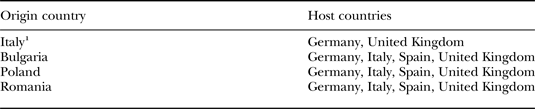
Above we have established that the largest number of migrants have come from Romania, Poland, Bulgaria and Italy in recent years and that the main destination countries were Germany, again Italy, Spain and the UK. We have also determined that typically, these migrants are young, they have worked in their home countries before moving, and we showed what wage and pensions levels they would be projected to have if they stayed in their home countries or had full careers in their host countries. Drawing on these data we have constructed our hypothetical individuals. First, we have organised these home and destination countries into trajectories. The left-hand side of Table 3 lists the home countries of the greatest number of EU émigrés since 2003, on the right we have taken stock of the countries hosting the largest numbers of these migrants.

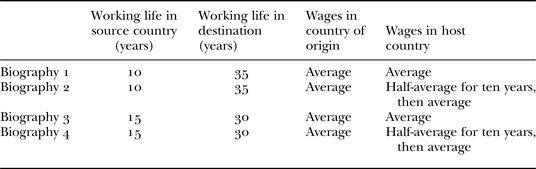
For each trajectory we developed four hypothetical individuals, on the basis of data about the main age and wages of current intra-EU migrants discussed above. Biographies 1 and 2 work in their country of origin for ten years, then spend 35 years in employment in their destination country; biographies 3 and 4 spend 15 years in their country of origin and then work for 30 years in their host country. One migrant from each of these scenarios (biographies 1 and 3) receive the average wages of the country in which they reside throughout their working life; the other two (biographies 2 and 4) have the same labour market attributes in terms of education and skill as the other migrants but are disadvantaged in their host country at first; they receive average wages in their country of origin, but these are halved during the first ten years in their host country before picking up to the average again for the rest of their working life (Table 4). On this basis, we calculated in euros the pensions these individuals would receive annually in each country of our sample, using the OECD replacement rates under the rules of 2015 and Eurostat average wage data (Table 2). We arrived at this figure by first working out a full pension in euros for the host and for the country of origin for each hypothetical migrant based on their wages. We then reduced these pensions according to the shorter amount of time the migrant spent in their home and in their host country, taking EU law into account as outlined above. The migrant's pension from their country of origin was then added to the pension they would receive in their host country. To apply our first benchmark, the migrant's risk of hardship in their host country, we then expressed the total pensionFootnote 7 in relation to the relative poverty line of the host country, using 60 per cent median income.Footnote 8 To apply our second benchmark, we then compared the pension projections for our migrants with those for a native worker with a continuous working life, earning average wages, retiring at the same time as the migrants. All our migrants have the same labour market attributes as this native worker so comparing with this benchmark shows directly the migrants’ loss of relative income and status through moving.
Illustrative migant biographies used in the pension projections

Source: Authors’ construction based on Eurostat (2017).
The four biographies allow us to assess the impact of intra-EU migration on the migrants’ post-retirement income and illustrate what role wage levels and pension systems play. In this regard, we expect biography 1 to do best because they spend the least amount of time in their lower-wage country of origin and do not experience a drop in wages below the average when they migrate. In contrast, we expect biography 4 to do least well because they spend more time in their lower-wage country of origin, and after migration their relative wages fall due to labour market disadvantage. Biographies 3 and 4 we expect to fall between these two extremes. Policy simulation involves assumptions about future developments. By using OECD simulations we accepted their projections about general economic conditions, such as wage and inflation levels, and investment returns in the calculation of defined contribution pensions (OECD 2015: 119–22). These assumptions are based on long-term historical data and have generally been accepted as plausible by most users of the OECD's data. Using these simulations also meant we were largely reliant on their constructed biographies. These have been criticised as too schematic because they fail to incorporate variations in wage levels during employment or gaps due to unemployment or child care (e.g. Bridgen and Meyer Reference Bridgen, Meyer, Meyer, Bridgen and Riedmüller2007). As explained, we addressed this limitation by combining the OECD's half-average wage and average wage scenarios for the projected pensions of our biographies 2 and 4. However, by assuming full working lives without gaps it is possible that our projections represent a generous illustration of intra-EU migrants’ pensions on retirement. It is likely that a greater number of migrants will not achieve the pension levels projected by the OECD in Italy and Spain, i.e. in the host countries where levels of informal work are highest (Schneider Reference Schneider2012).
We also had to make a number of further decisions. When converting the OECD's replacement rates into pensions for our biographies we had to decide how long our biographies would spend in their country of origin and destination, and what level of wages they would earn in each. We were guided by recent migration data, as has been seen, but nevertheless different trajectories producing different results would also have been plausible. For example, a migrant who left their country of origin earlier than ten years into their working life and/or secured higher wages than average while in their host country would secure a better pension on retirement than the best result reported for biography 1 below. By the same token, migration later than 15 years after the start of working life and longer periods of work below average wages in the host country would produce worse results. Secondly, when using current wage levels to convert the OECD's projected replacement rates into a pension,Footnote 9 we assume that wage rates between rich and poor EU countries will not convert during the period of the simulations. This is rather pessimistic. Most evidence (Kočenda, Kutan and Taner Reference Kočenda, Kutan and Taner2006; Matkowski and Proćhniak Reference Matkowski and Proćhniak2007) suggests that the accession states have grown faster recently than the richer EU members, and this is predicted to continue, albeit at a rather slow rate.Footnote 10 If wage rates across EU countries were to become more similar, the value of the pension rights our biographies built up in the country of origin would increase. However, this would not affect migrants who are already in their host country and for future migrants it would not have a substantial impact until convergence has progressed much further. Finally, we assume in our calculations that all pension rights accrued by migrants are transferred successfully and fully between countries. This is in line with EU legislation protecting public pension entitlements built up in other EU countries (see Meyer, Bridgen and Andow Reference Meyer, Bridgen and Andow2013), but there is no research to show their real effectiveness, so it is possible this assumption is optimistic and that entitlements remain unclaimed. Moreover, supranational regulations on the transfer of private pension rights were only agreed in 2014 and are not retrospective (European Commission 2014). Consequently, migrants are likely to experience difficulties. Thus, in assuming full transferability we have adopted the most optimistic scenario for our biographies; if full transferability did not take place their citizenship status on retirement would be diminished more than indicated in our results.
In summary, therefore, while our methods inevitably involve compromises, we are confident they provide the best available indication using current data of the likely impact of intra-EU migration on current migrants’ pension rights. They provide a plausible illustration of the various ways in which migrant trajectory, wage levels, labour market inequalities and pension systems combine to affect the citizenship status of current intra-EU migrants who decide to retire in their host country, particularly as this is affected by the wage differential between the host country and country of origin of the most common intra-EU migratory flows.
Results
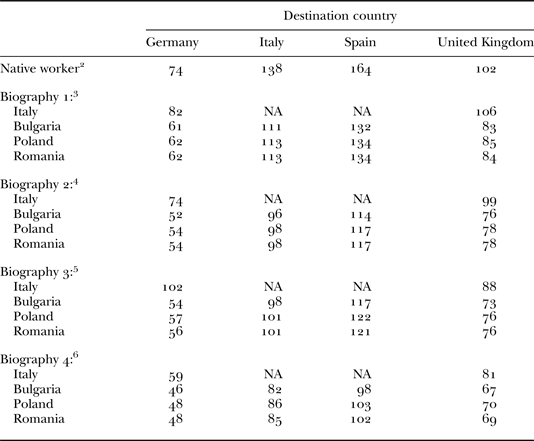
Table 5 compares the projected pensions of all our biographies with the relative poverty line of the host country in which they retire and with the projected pension of a stationary native worker after a full working life on average wages.
Projected pensions of four hypothetical migrants who retire in the host country and of a native worker on average national wages in the host country (percentage of relative poverty line1)

Notes: 1. Sixty per cent of gross median wages. 2. One hundred per cent average wages, 35 years of work. 3. Ten years of work in country of origin, 35 years of work in host country, at average wages of country in which resident. 4. Ten years of work in country of origin at average national wages, ten years of work in host country at 50 per cent average national wages, 25 years of work in host country at average national wages. 5. Fifteen years of work in country of origin, 30 years of work in host country, at average wages of country in which resident. 6. Fifteen years of work in country of origin, ten years of work in host country at 50 per cent average national wages, 20 years of work in host country at average national wages. NA: not applicable.
Biography 1: continued average earnings
We consider first the social citizenship status of the migrant who would be expected to be the best protected of our biographies (biography 1). This individual spends the most time in the labour market of their host country, earning the average wage there. In line with our expectations, they fare reasonably well, notwithstanding that in most cases their pension is significantly below that of the stationary native worker. Thus, all versions of biography 1 who migrate to Italy or Spain are projected to receive a pension at retirement above the relative poverty line there, regardless of their country of origin. Best protected are the migrants to Spain, all of whose projected pensions are more than 20 percentage points above the Spanish relative poverty line. These individuals benefit from the generous public pension system in Spain which protects them from poverty even though they enter late. Significantly less well protected are the biography 1 migrants from the three Eastern European countries who migrate to the UK and, particularly, Germany. All biography 1 migrants from these countries to the UK are projected to be below the UK poverty line on retirement, regardless of their country of origin. At the same time, the UK native worker secures a pension slightly above this threshold. However, it is the biography 1 migrants to Germany who are projected to be in the most difficult financial position on retirement. All of these individuals are 10 points or more below the German poverty line, with those from Eastern Europe again doing least well. However, while the social citizenship status of these migrants would be low, the native German worker would also have a pension below the poverty line. Thus, biography 1's very low pension in Germany is a product of migration and of the low German public pension, which universalises risks. Indeed, because the Italian system is more generous than the German, the Italian migrant to Germany is actually projected to do better on retirement than the German worker, receiving a pension eight percentage points higher in relation to the German poverty line. For the same reason, the Italian biography 1 migrant to the UK has accrued better entitlements overall than the native British worker because the Italian spent ten years in the more generous Italian public system.
Biography 2: earnings dip upon arrival
As stated, biography 1 represents the most optimistic of our scenarios. Only quite small changes to this biography's trajectory generate significantly less-favourable projections. This is illustrated first by biography 2 whose pension rights are affected by a period of low wages after they have migrated, as a consequence of labour market disadvantage. Like biography 1, this individual spends ten years working on an average wage in their country of origin, but unlike biography 1, they spend ten years after migration working on half-average wages in their host country, before earning the average wage there during their final 25 years of their working life. Our projections show that this period of disadvantage in the host country labour market reduces the pensions of biography 2 migrants significantly in relation to biography 1. Thus, whereas only three of our biography 1 individuals were projected to be below the relative poverty line in host countries where the stationary worker was above this line, this rises to six individuals for the biography 2 projections. Thus, all biography 2 migrants to Italy are projected to be just below the host country poverty line whereas all biography 1 individuals were well above this threshold. All biography 2 migrants to Spain continue to be significantly above the host country poverty line but their projected pension is markedly lower than that of biography 1 migrants to this country. The biography 2 migrants to the UK also experience a small fall in their projected pension in comparison with biography 1. Finally, the biography 2 migrants who go to Germany fall further below the relative poverty line of their host country, with even the Italian individual securing a pension equal to that of the native worker, rather than above it as was the case for biography 1.
In summary, a short period of low wages in the host country has a significant effect on the projected pensions of intra-EU migrants on retirement. This is also true if migrants delay migration, even if this delay is quite small. This is shown by the projections for our third biography.
Biography 3: late migration, continued average earnings
Like biography 1, this individual receives the average wage of the country in which they are working throughout their working life. However, rather than staying in their country of origin for ten years, they stay for 15. For most biography 3 migrants this delay reduces their projected pension compared to biography 1. However, this reduction is not generally as great as that generated by the fall in wages in the host country experienced by biography 2. Thus, the situation for most of our biography 3 individuals is projected to be better than that of their biography 2 equivalents. Indeed, in two cases this improvement pushes the biography 3 migrant back above the host country relative poverty line. This is the case for the biography 3 migrants from Poland and Romania to Italy, who are both one percentage point above the Italian poverty line. The projected situation for biography 3 migrants to the UK is the exception to this general picture. They are projected to receive lower pensions than their biography 2 equivalents and, as a consequence, to fall further below the UK poverty line on retirement. This situation will be explained below.
Biography 4: late migration, earnings dip upon arrival
Our fourth biography is the most disadvantaged, as expected because they migrate late and suffer from ten years of labour market disadvantage once they arrive. Most versions of biography 4 secure a pension substantially below the native worker and the relative poverty line of the host country. Only the Polish and Romanian migrants to Spain exceed the poverty level when they retire, and the pension of the Bulgarian migrant to Spain is only just below relative poverty. All other projected pensions are at least 14 percentage points below the host country relative poverty line; the Bulgarian, Polish and Romanian migrants to Germany do not even reach half this level. The Italian migrant to Germany, who does best in relation to the native worker under biographies 1, 2 and 3, fares less well in biography 4: their projected pension falls 14 percentage points behind the native worker's.
The role of pension system generosity
To this point, we have mainly concentrated on the impact of migration timing and periods of low wages in the host country on migrants’ pensions. In our final step, we focus on the relative success of different pension systems in mitigating migrants’ post-retirement citizenship status. The generous public system in Spain is by far the best at mitigating the impact of migration. Under almost all circumstances, our migrant workers achieve a pension above the relative poverty line when their destination country is Spain. Even when the migrant delays migration and suffers a period of low wages, they still only fall below the Spanish relative poverty line on retirement when they migrate from the poorest countries of origin, Bulgaria, and then only by three percentage points. The Italian system is only slightly less generous: five of our 12 migrants receive a pension above the relative poverty line; four others are close to this level. The system in the UK does less well. It protects Italian biographies 1 and 2 against relative poverty on retirement but in all other cases fails to do this. However, interestingly only the UK performs better for biography 2, whose wages fall to half-average for ten years after migration, than biography 3. The UK system is the only one of our sample with a redistributive element: lower-income workers have higher replacement rates than average earners (Table 2). Finally, migrants going to Germany face uniformly grim prospects: a retirement in poverty in their host country regardless of their country of origin, the timing of their migration and their labour market experience. The reason is that the German public pension system is now the least generous in the EU (Meyer Reference Meyer, Kennett and Lendvai-Baintonin press). While most of our migrants fare worse there than our benchmark native worker, German employees too are projected to receive pensions below the German relative poverty line. Summing up, system generosity mitigates the impact of the wage gap between poor and rich countries, and the poorer countries in the rich group, Spain and Italy, do better than Germany and the UK.
The divided citizenship of migrants: summary and options for reform
Above we have explored the extent to which EU migrants who integrated successfully in their host county labour markets and who retire there are able to maintain a status of social citizenship. The most important finding is that the citizenship status of migrants who spend a substantial amount of their working life in their host country building up pension rights will be diminished once they retire, contrary to the assumptions of much of the existing literature, mainly because the pension rights they build up in their country of origin are almost worthless in their host country, due to big differences in national wealth, expressed through wages. The exception to this general picture is first-wave intra-EU migration from the South to the North of Europe, explained by higher wages in the South than the East of Europe.
Thus, the projected pensions of most of our hypothetical biographies are, in many cases, below the amount necessary to participate fully in the society in which they have settled (benchmark 1) and significantly below those of workers with whom they would have spent most of their working life (benchmark 2). In short, having spent much of their working life integrating gradually into the labour market of their host society, acquiring similar economic and social rights to native citizens, migrant workers will lose a significant part of these achievements when they leave the labour force; their citizenship status is diminished in retirement.
Notwithstanding this general picture, however, our findings also suggest that the extent of the projected loss of citizenship status on retirement for intra-EU migrants can vary significantly for individuals with similar working life trajectories. This variation depends on the countries from which migrants come, the risks they encounter, and the countries in which they settle and their pension institutions. Our four biographies show that migrants fare best if they leave their country of origin early and attain a job in their host country at the same level of relative earnings. However, only small delays in migration and/or periods on lower levels of relative income in their host country significantly diminish their projected income, pushing it further behind the native worker and below – or further below – the relative poverty line. The country trajectories followed by our four biographies illustrated the varying impact on retirement income of the different pension institutions experienced by migrants and the wealth of their country of origin. Thus, migrants to Spain from all countries of origin achieved the highest projected pension under each scenario, with all close to, or above, the relative poverty line. Migrants to Italy were the next most advantaged, with five projected to secure a pension above the Italian relative poverty line. The UK performed less well, but the worst performer was Germany's reformed and now quite ungenerous public pension system (Bridgen and Meyer Reference Bridgen and Meyer2014), which generated the lowest projected migrant pensions in all but one scenario.
Our results throw doubt on the assumption that the existing legislative framework is sufficient to protect the citizenship status of intra-EU migrants. Further research to test these findings would involve the construction of more elaborate models than were possible here to test the interaction of migrant country and working-life trajectories with different country pension systems. In this final section, we consider how this projected loss of citizenship status for intra-EU migrants on retirement could be rectified. We accept this task has led us into territory many will consider utopian because it involves redistribution favouring migrants, and governments know they will not score electoral points with such policies. In 2017, citizens in most European countries are unwilling to compensate migrants for their structural disadvantage. In this spirit, we suggest the following for further debate.
We have seen that the stark wealth differences between the political economies of the EU diminish the citizenship of East to West migrants in retirement. EU member states could recognise that migrants who have settled permanently elsewhere cannot overcome this gap through individual planning. To ensure their status as European citizens pledged by the treaties has substance, and to avoid individuals being scarred by poverty in retirement, the Council of Ministers could adopt policies that ameliorate the impact of the wealth gap. These would up-rate the value of the pension rights accrued by migrants in the poorer political economies.
Firstly, a minimum pension in each member state could achieve this, set as close to the relative poverty line as possible and based on EU residence. Such a policy would also create an incentive for personal retirement saving during employment because the minimum pension would be granted without a means test. Very importantly, this policy would have universal appeal: it would offer a minimum in retirement to all citizens. It would address the current shortcoming of Bismarckian social insurance pension systems which have no minimum threshold and thus leave vulnerable those on low pay and with interrupted employment careers (e.g. Bonoli Reference Bonoli2003), but it would also add to higher earners’ pensions. The reform would therefore be more attractive electorally than a policy targeting migrants only (for this argument, see Baldwin Reference Baldwin1990). Its disadvantage is that it would change the paradigm of the Bismarckian countries in our sample; the public pension systems of Germany, Italy and Spain do not have a minimum threshold and reformers might be reluctant to adopt more fundamental change. Nevertheless, of the alternatives discussed here it is the most effective. A second option for pension up-rating would leave intact the Bismarckian principle of income-related benefits which governs the majority of the EU's pension systems (Meyer forthcoming). It would top up the credits for pension rights built up by long-term migrants in their country of origin, using the standards of living of the country in which they retire. However, such a step is unlikely because richer member states will not want to pay for this compensation and they have no incentive to make it easier for migrants from poorer countries to stay after retirement when return migration is less costly. Countries of origin, on the other hand, cannot afford to pay, and the absence of an EU budget for social policy matters makes funding at a supranational level a non-starter.
The politically most feasible option preventing the drop in citizenship status on retirement predicted by this paper is also the most individualised and least effective: increased personal savings would supplement migrants’ public pension rights in their host country. There is some evidence personal saving is higher among migrants than natives (Granier and Marciano Reference Granier and Marciano1975; Kumcu Reference Kumcu1989). However, these higher savings levels are generally confined to migrants whose stay in their host country is temporary (e.g. De Arcangelis and Joxhe Reference De Arcangelis and Joxhe2015; Piore Reference Piore1979). Those who stay longest save less than native citizens, mainly because their socio-economic position is more disadvantaged (De Arcangelis and Joxhe Reference De Arcangelis and Joxhe2015). This suggests that at the very least strong incentives would be necessary to encourage longer-term migrants to save. However, most initiatives to increase voluntary saving rates among lower-income groups in recent years have been disappointing (e.g. Hagen and Kleinlein Reference Hagen and Kleinlein2012; Pemberton, Thane and Whiteside Reference Pemberton, Thane and Whiteside2006); in fact, evidence so far suggests that independent of income people will not save enough voluntarily for their retirement (Meyer Reference Meyer, Kennett and Lendvai-Baintonin press). Thus, policies designed to increase voluntary savings are unlikely to provide a solution to the problems identified in this paper.
This leaves the option of return migration: intra-EU migrants could re-settle in their country of origin at retirement and thus benefit from the wide disparity in wage levels between their host country and country of origin. Their pension there would be significantly higher than average. While some migrants do in fact take this option, for those who want to retire in their host country an involuntary return to their country of origin would diminish their citizenship status, regardless of their financial position. They would have spent a long period of time in their host countries, integrating into society, perhaps raising children and making friendships there. Their desire to stay would likely be based on a sense of belonging to their host nation (Bosniak Reference Bosniak2000; Conover Reference Conover1995), while their identity as citizens of their country of origin might well have been weakened (Glick Schiller and Fouron Reference Glick Schiller, Fouron, Smith and Guamizo1998; Weiner Reference Wiener1998). Thus, while migrants who return would be comparatively well-off financially, they would have to live reluctantly in a society with which they no longer primarily identified.
In short, policy change is unlikely which will significantly protect from relative poverty on retirement those of the current large group of intra-EU migrants who decide to settle permanently in their host country after a long employment career. The citizenship status of these migrants will indeed be diminished in retirement, with many facing a difficult financial position as they grow older.
Acknowledgements
We would like to acknowledge the helpful comments on previous drafts of Karen Anderson, Silke Roth, Brian Nolan, Martin Seeleib-Kaiser and Cecilia Bruzelius. We would also like to thank the two anonymous reviewers for their very useful suggestions. The research for this paper was supported by the Economic and Social Research Council's Centre for Population Change (grant number ES/K007394/1). The financial sponsors played no part in the design, execution, analysis and interpretation of the data, or writing of the study. Both authors contributed equally to the production of this paper.