INTRODUCTION
The challenges for agriculture in the 21st century are to produce 70% more food by 2050 to feed a projected increased population, while implementing more sustainable methods and responding to climate change (Tilman et al. Reference Tilman, Cassman, Matson, Naylor and Polasky2002; FAO 2009). In addition, the mix of foods demanded by the population is expected to change from cereals to meat and dairy (Hubert et al. Reference Hubert, Rosegrant, van Boekel and Ortiz2010). Much concern about feeding the world in 2050 relates to the slower increase in yields of the major cereal crops over the past three decades (Alston et al. Reference Alston, Beddow and Pardey2009). For example, annual increases in wheat yield are shrinking and are now just below 1% (Fischer et al. Reference Fischer, Byerlee and Edmeades2009). Increased yields are considered the major route to meeting future global food demand, through increased potential yield (maximum yield with best varieties and agronomy, and removing constraints) and closing the gap between actual farm yields and potential yields (Fischer et al. Reference Fischer, Byerlee and Edmeades2009).
The ‘drylands’, covering about 0·41 of the Earth's land surface, will need to contribute their share to this yield increase. Drylands are limited by soil moisture, the result of low rainfall and high evaporation, and show a gradient of increasing primary productivity, ranging from hyper-arid, arid and semi-arid to dry sub-humid areas, based on a decreasing level of aridity or moisture deficit (Safriel et al. Reference Safriel, Adeel, Niemeijer, Puigdefabregas, White, Lal, Winslow, Ziedler, Prince, Archer, King, Shapiro, Wessels, Nielsen, Portnov, Reshef, Thonnell, Lachman, McNab, Hassan, Scholes and Ash2005).
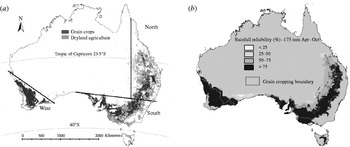
Dryland agriculture is practised in Australia (Fig. 1a) from 21 to 37°S (but may extend to 42°S) in the semi-arid to dry sub-humid regions that receive 300–600 mm of annual rainfall (Squires & Tow Reference Squires and Tow1991). Dryland agriculture has been trialled in the semi-arid tropics of northern and north-western Australia (i.e. latitudes of 15–20°S), but a host of economic, social and technical constraints have limited the establishment of any significant commercial industry (Carberry et al. Reference Carberry, Chapman, Anderson and Muir1996) other than extensive beef production, which dominates agricultural land use in Australia's semi-arid tropics. Dryland agriculture largely fits the warm, seasonally wet/dry agro-climates of these regions (Hutchinson et al. Reference Hutchinson, Nix, McMahon, Pearson and Goodall1992). Other regions of the world with similar agro-climates include southern China, the Mediterranean, southern Africa, mid-South America and southern North America.
(a) Distribution in Australia of dryland agriculture, overlain with dryland grain cropping areas extracted from land-use maps of Australia (BRS 2001, 2006, 2010). The ability of soils to store water enables crops to be grown outside the dryland agricultural boundary in some years. Lines on the map demarcate the three broad dryland agricultural regions in Australia. (b) Rainfall limitations to dryland grain production. Comparison of the grain cropping zone (Hamblin & Kyneur Reference Hamblin and Kyneur1993) with reliability of achieving 175 mm of rainfall during the winter growing season of April to October (rainfall reliability wizard, (Laughlin et al. Reference Laughlin, Zuo, Walcott and Bugg2003).

In dryland regions, plant production is usually low yielding, variable and difficult to predict. Therefore, viable agricultural production relies on managing risks well, and on optimizing the use of local resources to minimize the yield gap between farm and attainable water-limited potential production (maximum production under normal rain-fed conditions with all other constraints removed) (Fischer et al. Reference Fischer, Byerlee and Edmeades2009; Lobell et al. Reference Lobell, Cassman and Field2009).
This paper illustrates the research investments that have enabled dryland or rain-fed agriculture in Australia to increase in productivity. A system's approach that incorporates crops, pastures and grazing animals is perhaps most likely to optimize the use of resources. The extensive livestock grazing in Australia's arid regions is not included in this review, which begins by setting the context for dryland agriculture in Australia before examining the risks and returns from technological innovations over the past 30 years and possible sources of gains in the next 20 years. Social and economic risks to Australian agriculture are not considered.
AUSTRALIAN CONTEXT
Dryland agriculture occupies 97 million ha, or nearly 0·13, of the Australian continent (BRS 2006; Fig. 1a). The distribution of dryland agriculture is largely a function of low rainfall in the interior and the topography towards the coast.
In Australia's dryland agriculture, mixed crop–livestock systems predominate and include diverse enterprises: wool production, dual-purpose flocks, prime lamb and beef production are integrated with cereal, pulse and oilseed crops and forage crops incorporated into the cropping sequence (Kirkegaard et al., Reference Kirkegaard, Peoples, Angus, Unkovich, Tow, Cooper, Partridge and Birchin press). The intensity of cropping on farms ranges from very low to very high (where it generates more than 0·80 of farm income) and usually inversely reflects the contribution by livestock (ABARE 2009b). Dryland agriculture supports 0·80 of Australia's sheep, 0·50 of its meat cattle and 0·93 of its grain production.
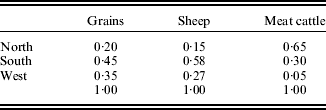
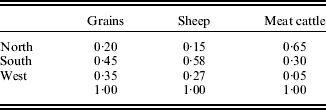
There is considerable diversity in the enterprise mix at the regional and local level (Table 1; Fig. 1a), driven partly by differences in the biophysical resource base and climate (Kirkegaard et al. Reference Kirkegaard, Peoples, Angus, Unkovich, Tow, Cooper, Partridge and Birchin press). Sown pastures or heavily modified pastures are used for livestock grazing, either permanently or as leys in grain cropping rotations (Perry Reference Perry1989; Squires & Tow Reference Squires and Tow1991). In the northern cropping region, ley systems are uncommon and continuous cropping with fallows is more typical. In recent decades, there has been a move towards more intensive cropping in the southern and western regions as a result of the collapse in the wool price (Conner Reference Conner2004; Kirkegaard et al. Reference Kirkegaard, Peoples, Angus, Unkovich, Tow, Cooper, Partridge and Birchin press) and changes in seasonal conditions. However, ley farming systems remain a key component of dryland agriculture in these areas. Comprehensive and more detailed descriptions of dryland agriculture in Australia can be found in Squires & Tow (Reference Squires and Tow1991), NLWRA (2001), Freebairn et al. (Reference Freebairn, Cornish, Anderson, Walker, Robinson, Beswick, Peterson, Unger and Payne2006) and Tow et al. Reference Tow, Cooper, Partridge and Birch(in press).
Breakdown of volume of production, by industry, for the northern, southern and western regions of dryland agriculture in Australia, 2005–06. Source Australian Bureau of Statistics
There has been an almost continuous upward trend in crop yield in Australia during the 20th century, following an era of yield decline, predominantly caused by loss of soil fertility, at the end of the 19th century (Angus & van Herwaarden Reference Angus and van Herwaarden2001). The introduction of pasture legumes, particularly subterranean clover, supplemented with superphosphate, resulted in substantially improved crop productivity, and the ley farming system that developed has remained a key component of Australian dryland agriculture since the 1950s. Later improvements to cropping practices (such as stubble retention, crop rotation and soil fertility management), combined with disease resistance and improved quality of crop and pasture varieties, has led to increased productivity of mixed farming systems. In particular, wheat yields have almost quadrupled over the past 100 years and now average over 2 t/ha (NLWRA 2001). Despite these increases, yield and efficiency gaps (between potential and farm yield) still remain, because of underlying site characteristics, seasonal conditions and their interactions with management. Improved grain yield under limited water supply remains a target.
With considerable fluctuations, due to many innovations and market factors, sheep numbers increased in the period from 1860 to 1970 (NLWRA 2001), but have since declined to c. 70 million. Similarly, national cattle numbers peaked in the mid-1970s at c. 33 million, declined to c. 22 million by 1988 but have since risen to 28 million (ABARE 2009a). Relative price signals, economic booms and recessions, world wars and trade barriers have all influenced livestock and crop production. Improvements in animal genetics and the tolerance of pasture legume and grasses to soil acidity and diseases have contributed significantly to the overall improvement in winter forage production of new varieties, which has been a key profit driver in animal enterprises. The extensive use of performance indicators in the grains industry (e.g. water-limited potential yields or yield frontiers) has no obvious parallel in the livestock sector (Kirkegaard et al., Reference Kirkegaard, Peoples, Angus, Unkovich, Tow, Cooper, Partridge and Birchin press), probably because of the more complex needs of grazing animals. However, individual consultant groups that specialize in livestock-dominated industries use stocking rate benchmarks such as Dry Sheep Equivalents/ha/100 mm and $/Dry Sheep Equivalents, and provide overall summaries of options (e.g. Millar et al. Reference Millar, Jones, Michalk and Brady2009). The concept of livestock water productivity is being developed internationally (Descheemaeker et al. Reference Descheemaeker, Amede and Haileslassie2009).
Considerable research has focused on optimal stocking rates (White Reference White and Snaydon1987) and livestock carrying capacity (McKeon et al. Reference McKeon, Stone, Syktus, Carter, Flood, Ahrens, Bruget, Chilcott, Cobon, Cowley, Crimp, Fraser, Howden, Johnston, Ryan, Stokes and Day2009) – with consequences for production, quality and risks in profitability – as powerful management tools in livestock systems. A research focus has been on addressing ‘feed gaps’ (times of the year when the supply of forage is insufficient to meet livestock demand) that limit livestock productivity and result from seasonal and stochastic changes in forage availability (Bell et al. Reference Bell, Robertson, Revell, Lilley and Moore2008; McKeon et al. Reference McKeon, Stone, Syktus, Carter, Flood, Ahrens, Bruget, Chilcott, Cobon, Cowley, Crimp, Fraser, Howden, Johnston, Ryan, Stokes and Day2009; Moore et al. Reference Moore, Bell and Revell2009).
Water productivity
Some of the key features of Australia's dryland agricultural region are low rainfall, high rainfall variability and long wet and dry periods (Freebairn et al. Reference Freebairn, Cornish, Anderson, Walker, Robinson, Beswick, Peterson, Unger and Payne2006). Farming practices have evolved to cope with the highly variable nature of the rainfall; for example, through the use of fallows in the northern cropping region and in-season adjustment of fertilizer inputs in the southern and western regions.
Reliably achieving winter growing season (April to October) rainfall of more than 175 mm is required for dryland grain production (Fig. 1b); 175 mm equates to a potential wheat yield of 1·5 t/ha using the water-use-efficiency calculation of French & Schultz (Reference French and Schultz1984). The major factor moderating the effects of rainfall reliability is the ability of soils to store water, enabling crops to be grown where rainfall reliability is low but water holding capacity is high; for example, in the northern cropping region (Fig. 1a). Rainfall reliability is the likelihood of a specified amount of rain falling during a particular period, thus introducing threshold values to rainfall analyses. This can be meaningful for producers because the distribution of rainfall, which is often notoriously variable across Australia, can deviate from normal and complicate the use of measures such as deciles particularly where rainfall is low. An analogous situation applies to pastures (French Reference French, Squires and Tow1991; Pearson et al. Reference Pearson, Zuo, Valentine and Unkovich2003). Productivity is closely aligned with water use of up to 600 mm a year (French Reference French, Squires and Tow1991; Bolger & Turner Reference Bolger and Turner1999). However, the relationship between water availability and productivity is not as simple in pastures systems because of the impacts of grazing pressure (Asner et al. Reference Asner, Elmore, Olander, Martin and Harris2004).
Generally, in dryland agriculture, factors that influence the amount of water stored in soils, such as infiltration and storage capacity, and the ability of roots to extract the water from the soil, have major effects on crop and pasture yields. In addition, it appears that other climate factors, such as vapour pressure deficits and fraction of diffuse radiation (Doherty et al. Reference Doherty, Sadras, Rodriguez and Potgieter2010), may limit the apparent water-limited potential yield for crops in some parts of Australia. However, other environmental or management factors (such as losses of water from fallows over the summer months) frequently limit crops from reaching the water-limited potential yield (French & Schultz Reference French and Schultz1984; Angus & van Herwaarden Reference Angus and van Herwaarden2001). Overcoming the relative limitations of these factors in different regions is the core of efforts to improve productivity (Passioura Reference Passioura2006; Fischer et al. Reference Fischer, Byerlee and Edmeades2009), and could result in 2–14 million tonnes of additional grain a year from currently cropped areas in Australia (Walcott et al. Reference Walcott, Beeston, Stephens, Nunweek, Ranatunga, Turner, Acuna and Johnson2006).
REVIEW OF TECHNOLOGIES
Dryland agriculture in Australia has adapted to an extremely variable climate. Keating et al. (Reference Keating, Carberry, Bindraban, Asseng, Meinke and Dixon2010) proposed an approach to explore returns to technology interventions relative to their riskiness, particularly because of the impact of climate variability. Briefly, the conceptualization of this framework is based on the common production functions relating agricultural outputs such as yield to levels of input, such as fertilizer (Dillon Reference Dillon1977). However, such output–input relationships are not consistent due to the variation inherent in biological systems, particularly from climate variability. Variability in response to inputs has been equated to the riskiness of investment and can be represented empirically by the statistical variance in returns (Anderson et al. Reference Anderson, Dillon and Hardaker1977). The framework proposed by Keating et al. (Reference Keating, Carberry, Bindraban, Asseng, Meinke and Dixon2010) represents the ‘efficiency frontier’ from a ‘mean–variance return space’ (Anderson et al. Reference Anderson, Dillon and Hardaker1977) in order to go beyond output–input relationships and explicitly incorporate risk into consideration of agricultural technologies (Fig. 2). The return-risk framework suggests that efficiency frontiers exist at which the return from existing knowledge and technology is maximized for different risk levels. A further suggestion is that risk can then be defined in multiple ways – variability in economic returns (Anderson et al. Reference Anderson, Dillon and Hardaker1977), downside risk of failure (Keating et al. Reference Keating, Godwin, Watiki, Muchow and Bellamy1991), environmental risks from soil degradation (Carberry et al. Reference Carberry, Hammer, Meinke, Bange, Hammer, Nicholls and Mitchell2000) or climate change (Steffen et al. Reference Steffen, Sims and Walcott2006).
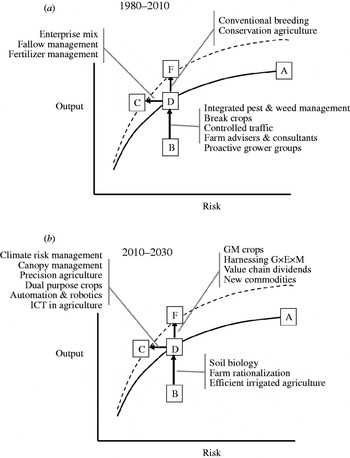
Return-risk framework and technologies which either (a) affected Australian dryland agriculture from 1980 to 2010 or (b) are identified as having potential to affect it between 2010 and 2030. In both figures, A and D are representative points on the efficiency frontier for the best technologies at a point in time (▬) and C and F are specific points on new efficiency frontiers for hypothesized new technologies (- -). Point B represents a position below the current efficiency frontier (Keating et al. Reference Keating, Carberry, Bindraban, Asseng, Meinke and Dixon2010). Note: GM=genetically modified; G×E×M=genotype by environment by management interactions; ICT=information and communications technologies.

The curves in Fig. 2 are styled examples of the efficiency frontier framework: the lower, continuous line represents the frontier for currently adopted technologies and practices; the higher, dashed line represents the frontier for yet-to-be-adopted technologies which create new opportunities and return-risk dimensions. Using this framework, pathways for technology intervention can include:
• Moving from B to D by adopting current best practices to remove system inefficiencies with no increased exposure to risk.
• Moving along the efficiency frontier using existing technologies (D towards A) but with an associated increase in inputs and risk.
• Adopting breakthrough practices or technologies to move to a new efficiency frontier (dashed line) that enables either
○ maintained output through increased efficiency of resource use while reducing exposure to risk (D to C) or
○ increased output for the same level of risk (D to F).
In this framework, it is important to strategically manage risks from biotic and abiotic threats that lower productivity and lead to a regression from these frontiers.
Assessing farm performance against defined benchmarks (e.g. potential yield, water-limited potential yield, or farmer attainable yield) is useful (Fischer & Edmeades Reference Fischer and Edmeades2010) – the return-risk framework adds value by enabling technological interventions to be assessed in terms of risk. For example, few, if any, farmers would seek to produce water-limited potential yields (point A) (Fischer et al. Reference Fischer, Byerlee and Edmeades2009; Lobell et al. Reference Lobell, Cassman and Field2009) due to the greater exposure to financial risk associated with the higher levels of investment. In reality, most farmers choose acceptable risk investments which return closer to 0·60–0·80 of the potential (point D) (Hochman et al. Reference Hochman, Holzworth and Hunt2009a). To increase returns with little added risk, the only real option for these producers is to move from the current efficiency frontier (solid line) by adopting breakthrough technologies (D to F).
Figure 2a employs the return-risk framework of Keating et al. (Reference Keating, Carberry, Bindraban, Asseng, Meinke and Dixon2010) to illustrate how Australian farmers have adopted technology and information systems over the past 30 years to improve their economic performance and deal with the high risk of farming in a variable climate. Figure 2a nominates those technologies which, by 2010, have largely been adopted in Australia's dryland cropping industries – a similar figure could be developed for livestock-dominant industries. Figure 2b suggests technologies which are likely to be developed and adopted over the next 20 years to assist Australian farmers to continue to farm successfully.
Technology adoption 1980–2010
Australian and global agricultural development over the past 30 years has been characterized by productivity growth in food and fibre production. Over this period, agricultural productivity growth in Australia has been high relative to other sectors of the Australian economy and high relative to the agricultural sectors in other Organisation for Economic Cooperation and Development (OECD) countries (Mullen Reference Mullen2007). This is achieved despite farming being largely unsubsidized (OECD 2004) and conducted on fragile soils and in one of the most variable climates in the world.
The impressive performance of Australian dryland agriculture has been achieved through innovation, based on research leading to technology development and adoption. Research has been well supported by strong investments from sectoral funding (Australia's Research and Development Corporations) and public research agencies (Mullen Reference Mullen2007). Historically, such productivity growth has come both from improving farming practices and from adopting better varieties and breeds, although it varies with time and across agricultural industries (Nossal & Sheng Reference Nossal and Sheng2010). Recent reviews of Australian agriculture comprehensively examine how Australian farmers have adopted these technologies and practices (Angus Reference Angus2001; Freebairn et al. Reference Freebairn, Cornish, Anderson, Walker, Robinson, Beswick, Peterson, Unger and Payne2006; Fischer Reference Fischer, Sadras and Calderini2009; Kirkegaard et al. Reference Kirkegaard, Peoples, Angus, Unkovich, Tow, Cooper, Partridge and Birchin press; Tow et al. Reference Tow, Cooper, Partridge and Birchin press). A number of these key technologies have been mapped onto the return-risk framework in Fig. 2a.
One assertion is that more progress has been made over the past 30 years in moving most cropping farmers closer to the existing efficiency frontiers (i.e. B to D) than from the science-initiated generation of new efficiency frontiers, which either increase resource-use efficiency or raise potential economic returns (i.e. C and F). Recent analyses (Carberry et al. Reference Carberry, Hochman, Hunt, Dalgliesh, McCown, Whish, Robertson, Foale, Poulton and van Rees2009; Hochman et al. Reference Hochman, Van Rees, Carberry, Hunt, McCown, Gartman, Holzworth, van Rees, Dalgliesh, Long, Peake, Poulton and McClelland2009b) suggest that the leading Australian farmers are achieving crop yields that are close to their attainable efficiency frontiers; that is, there is a small gap between the harvested yields of their commercial crops and the corresponding attainable yields simulated by models using actual management and environmental drivers. Adoption of technologies such as disease-tolerant varieties, integrated pest and weed management, crop rotations which include legumes and disease break crops, conservation agriculture and controlled traffic have resulted in agronomic practices that enable leading growers to approach their production potential, as limited by their environmental and management boundaries.
Even if the varieties and agronomic practices are available so that crop yields can be largely determined by climate and the supply of soil water and nutrients, threats remain from weeds, diseases, pests and soil degradation – a notable example in Australia is the increasing threat of herbicide-resistant weeds (Owen & Powles Reference Owen and Powles2010). Much past and current research effort has targeted the prevention of any breakdown in the strategies evolved to counter pests and diseases. In addition, practices which threaten the natural resource base for agriculture will result in an unavoidable loss of productivity. Issues such as soil salinity, acidification, erosion and nutrient rundown are current and emerging threats to productivity in Australia (NLWRA 2001; Keating & Carberry Reference Keating and Carberry2010).
Technologies that generate new efficiency frontiers for the different production systems and agroecological zones around Australia result from a combination of improved genetics and management practices. Australian agriculture invests significant resources into breeding programs, and conventional breeding has contributed strongly to increased crop production (Fischer Reference Fischer, Sadras and Calderini2009). However, the total investment into breeding has to be partitioned between efforts to develop and maintain resistance to biotic threats (e.g. Bariana et al. Reference Bariana, Brown, Bansal, Miah, Standen and Lu2007), deal with abiotic hazards, improve quality and create new water-limited production potential (e.g. Richards et al. Reference Richards, Rebetzke, Condon and van Herwaarden2002). While successful examples of the latter are difficult to quantify at present (Richards Reference Richards2006), many are contributing to future improvements (Manschadi et al. Reference Manschadi, Hammer, Christopher and DeVoil2008).
The widespread adoption of conservation agriculture in most regions of Australia (D'Emden et al. Reference D'Emden, Llewellyn and Burton2006) is a significant management practice which has raised cropping productivity over the past 30 years. Conservation tillage practices improve rainfall infiltration and increase soil water storage (Freebairn et al. Reference Freebairn, Cornish, Anderson, Walker, Robinson, Beswick, Peterson, Unger and Payne2006), which commonly results in increased water-use efficiency of crops in Australian dryland farming. Important management aspects of conservation agriculture are crop nutrition, improving soil biota, residue management and crop rotation, all of which contribute to yielding higher-efficiency dividends. Major innovations for mixed crop-grazing systems include better-fitting animal cycles to pasture production, better breeds, supplementary feeds, forage crops, pasture species and pest and disease prevention (McKeon et al. Reference McKeon, Stone, Syktus, Carter, Flood, Ahrens, Bruget, Chilcott, Cobon, Cowley, Crimp, Fraser, Howden, Johnston, Ryan, Stokes and Day2009; Moore et al. Reference Moore, Bell and Revell2009).
Dryland agricultural research in Australia has not only sought to achieve higher yields, but also agronomic and business management practices that reduce production risk. Practices that lower risk, such as farm enterprise diversity (especially mixed crop-livestock systems), pre-crop fallowing to store soil moisture and judicious use of fertilizers, have been widely promoted and adopted by Australian farmers (Freebairn et al. Reference Freebairn, Cornish, Anderson, Walker, Robinson, Beswick, Peterson, Unger and Payne2006; Tow et al. Reference Tow, Cooper, Partridge and Birchin press). The agronomic support to farmers from public extension and private advisors has been a key characteristic in Australian agriculture, enabling the adoption of current best practices (Marsh & Pannell Reference Marsh and Pannell1998). More recently, the emergence of proactive, self-organized farmer groups has given an added dimension to supporting the adoption of good agronomic practices (Carberry Reference Carberry2001).
Future technologies 2010–30
In a recent analysis of opportunities and constraints in Australia's broadacre industries, Keating & Carberry (Reference Keating and Carberry2010) suggested that, while new products or services from agriculture, such as biofuels or bio-sequestration of carbon, may deliver benefits to both farmers and the wider community, these alone will not transform the nature of Australian agriculture. Rather, the greatest emerging opportunity for agricultural land use in Australia must be sought from productivity breakthroughs that address current and emerging constraints. Figure 2b suggests some of the technologies which may deliver productivity increases in Australian dryland agriculture, along three intervention pathways.
First, remove system inefficiencies (point B to point D)
• An improved understanding of the biology of agricultural soils to address edaphic constraints would probably help farmers move towards existing efficiency frontiers. Research in this area will lead to increasing characterization of the function of soil biota (e.g. Torsvik & Øvreås Reference Torsvik and Øvreås2002), quantifying the consequences of its poor management and pursuing opportunities to enhance agricultural performance.
• The rationalization of farms under economic and social pressures, whereby poor-performing farms continue to be bought out by leading farmers (Kingwell & Pannell Reference Kingwell and Pannell2005), will improve the aggregate industry performance in a particular region.
• As water supplies for irrigation become less secure under climate change (CSIRO 2008), formerly irrigated agricultural systems may be replaced by dryland agronomic practices with supplementary irrigation. The efficiency of water use in irrigation practice can probably still improve.
• Government policies that impede efficiency gains should be modified; for example, recent assessments of the Australian National Drought Policy suggested that it must increase its emphasis on creating an environment of self-reliance and preparedness for drought and climate change.
Second, increase the efficiency of resource use (point D to point C)
• Managing climate risk in Australian agriculture remains a challenge (Hochman et al. Reference Hochman, Holzworth and Hunt2009b). Higher returns at reduced risk can be achieved if farmers are able to adjust their agronomic and marketing management flexibly in order to avoid, in any one season, either over-investing in enterprises with poor prospects or under-investing in enterprises with good prospects. While Anderson (Reference Anderson2010) suggests that most benefit will come from improving management response in wetter seasons, the challenge remains to improve the forecast of such seasons. Hammer et al. (Reference Hammer, Nicholls and Mitchell2000) raised the prospects for practical application of season climate forecasting in Australian agriculture and there is still progress to be made to this end.
• While precision agriculture has long been researched, and adopted in part, by Australian farmers (Robertson et al. Reference Robertson, Carberry and Brennan2009), key aspects such as variable rate input applications of fertilizer are yet to have industry-wide effects (Bramley Reference Bramley2009). To achieve increased resource-use efficiency in Australian agriculture, there will need to be continued innovation in precision agriculture to improve the management of spatial and temporal variation; widespread adoption of precision agriculture by farmers; and extension of precision agriculture to pasture and livestock management.
• Dual-purpose crops offer grain production and forage supply to livestock and thus potentially provide a profitable and flexible break-crop option for mixed farms (Kirkegaard et al. Reference Kirkegaard, Sprague, Dove, Kelman, Marcroft, Lieschke, Howe and Graham2008).
• Managing livestock, pastures and forages, including dual-purpose crops, to optimize carrying capacities and minimize climate-induced risks is complex and is likely to require continued investment in models and decision support tools, especially as the climate changes (McKeon et al. Reference McKeon, Stone, Syktus, Carter, Flood, Ahrens, Bruget, Chilcott, Cobon, Cowley, Crimp, Fraser, Howden, Johnston, Ryan, Stokes and Day2009; Moore et al. Reference Moore, Bell and Revell2009).
• Information and communications technologies, including the internet, telecommunications, video and print technologies (McLaren et al. Reference McLaren, Metz, van den Berg, Bruskiewich, Magor and Shires2009), and the associated fields of automation and robotics (Wark et al. Reference Wark, Corke, Sikka, Klingbeil, Guo, Crossman, Valencia, Swain and Bishop-Hurley2007) potentially offer Australian dryland farmers and graziers improved access to agronomic and marketing advice and increased efficiency of labour use.
Third, continue to invest in breakthrough technologies (point D to point F)
• Gene technologies could be considered the source of ‘breakthrough’ innovations in agriculture, by identifying and tracking the inheritance of desired plant characteristics and in moving genes within and between species, particularly given the significant research investment into genetically modified crops (Brookes & Barfoot Reference Brookes and Barfoot2005; Hattersley et al. Reference Hattersley, Johnson, Glover, Foster, Wesley and Mewwett2009). For instance, in Australia a range of physiological traits that will potentially improve water productivity of grain crops are being vigorously explored with marker-assisted selection: examples include osmoregulation (Morgan Reference Morgan2000), carbon isotope discrimination (Rebetzke et al. Reference Rebetzke, Condon, Farquhar, Appels and Richards2008), stay-green (Christopher et al. Reference Christopher, Manschadi, Hammer and Borrell2008), rooting patterns (Manschadi et al. Reference Manschadi, Hammer, Christopher and DeVoil2008) and phenology (Eagles et al. Reference Eagles, Cane, Kuchef, Hollamby, Vallance, Eastwood, Gororo and Martin2010). Furthermore, genetic modification – largely in cotton but now being taken up in canola as moratoria are lifted across Australia – provides opportunities to overcome some biotic and abiotic stresses by introgressing suitable genes into crops but these have significant efficacies and regulatory hurdles to overcome before being available in commercial crops (Hattersley et al. Reference Hattersley, Johnson, Glover, Foster, Wesley and Mewwett2009).
• Harnessing the interactions between the available genetic variability in crops or livestock targeted to specific environments and using adaptive management is seen as a basis for a ‘Genetics× Environment×Management’ revolution that will push water-use efficiency and enterprise performance beyond the current production frontier (Richards et al. Reference Richards, Rebetzke, Condon and van Herwaarden2002). An encouraging activity is the integration of physiological concepts and molecular genetics to aid breeding programmes by using crop models to predict phenotypic outcomes of genetic changes (Hammer et al. Reference Hammer, Cooper, Tardieu, Welch, Walsh, van Eeuwijk, Chapman and Podlich2006; Hammer & Jordan Reference Hammer, Jordan, Spiertz, Struik and van Laar2007).
• Greater participation by farmers in agricultural value chain activities provides the capacity to increase: efficiencies, business integration, responsiveness and market competitiveness (Higgins et al. Reference Higgins, Thorburn, Archer and Jakku2007).
• Long-term and speculative research including converting annual wheat to a perennial crop in order to reduce environmental issues such as a salinity and soil erosion is being investigated seriously (Bell et al. Reference Bell, Wade and Ewing2010), attempts to improve the photosynthetic efficiency of C3 crops (Furbank et al. Reference Furbank, von Caemmerer, Sheehy and Edwards2009; Zhu et al. Reference Zhu, Long and Ort2010), and modifying landscapes to increase water harvesting in marginal rainfall areas.
• Other emerging opportunities in Australian agriculture will probably include new products or services such as biofuels, forest-based carbon storage in agricultural landscapes, bio-sequestration of carbon in agricultural soils (Bruce et al. Reference Bruce, Sims, Walcott, White, Baldock, Grace and Wicks2010) and environmental stewardship schemes that would reward farmers for nature conservation and related non-production services from farming land (Keating & Carberry Reference Keating and Carberry2010). However, it is likely that there may be benefits and trade-offs with food production in delivering these products and services.
In practice, productivity increases will be realized through combinations of these strategies as managers respond to market signals, availability of technologies and immediate drivers such as drought.
GOVERNANCE AND POLICY ISSUES
Government policies for agriculture in Australia often aim to reduce the regulatory constraints on agricultural innovation while acceding to consumer demands for environmental quality, accreditation and quality assurance (Williams & Walcott Reference Williams and Walcott1998). Some of these policies align with the return-risk framework. For instance, to help manage climate variability, the Australian, state and territory governments set up a national drought policy in 1992. The policy has a central philosophy of self-reliance and effective risk management, recognizing that farmers can best make their own decisions based on their own assessment of risk. The intention is that farmers be able to manage their position on the return-risk frontier (e.g. D to A in Fig. 2a). Here, the role of the government is to assist farmers to enhance their skills in key areas of risk management and business planning through education and training, and to provide a safety-net level of support during exceptional circumstances. Similar efforts are being directed to help agricultural industries manage for climate change.
In recent years significant programs to address environmental impacts, biodiversity conservation and sustainable development have been implemented in Australia (Hajkowicz Reference Hajkowicz2009). These programs that aim to move producers up to the existing return-risk frontier (i.e. from B to D in Fig. 2a) may have inadvertently slowed rates of productivity gains by diverting investment away from breakthrough technologies for direct productivity research. For instance, Pardey (Reference Pardey and Brown2010) notes that a diversion in research investment from farm productivity towards environmental effects, food quality and alternative uses during the 1990s is, because of considerable lags in adoption, now likely to contribute to the slowing in productivity gains.
An investment approach to create new return-risk frontiers is to obtain productivity gains (Mallawaarachchi et al. Reference Mallawaarachchi, Walcott, Hughes, Gooday, Georgeson and Foster2009) through innovation (research, development and adoption of new technologies), by matching farmer contributions in the form of levies on production to fund research activities. These funds, which originally supplemented state government, university and private research resources, will increasingly play a more central role as they are now providing the major growth in investments while those from governments are declining.
A risk management approach has been adopted to protect Australia from incursions by exotic pests and diseases that would reduce in-country productivity and prevent regression to lower return-risk frontiers. Australia's very low-risk approach – enabled by its relative physical isolation from sources of many incursive agents – has so far mostly shielded its agriculture from the effects of significant disease outbreaks or pest incursions. A complementary strategy is to prepare for responses to possible contamination or malicious disruption of Australia's food supplies.
However, some policies do not readily fit within a return-risk framework. An international approach is to pursue efforts to increase access to overseas markets and to overcome emerging technical trade barriers and liberalize international trade. Domestic governance policies focus on improving competition, market information and fair trading in food supply chains. While state governments have primary responsibility for agriculture and land use in Australia's federal system, globalizing trends and cross-cutting issues such as irrigation water and reducing greenhouse gas emissions are increasingly involving the federal Australian Government.
Future challenges
Keating & Carberry (Reference Keating and Carberry2010) identify the future threats to Australian broadacre agriculture as:
• climate change and greenhouse gas emissions
• water availability for irrigated agriculture
• energy and input costs
• degradation of soil and natural resources
• access to human capital.
Much effort is currently being expended in Australia to prepare industries for future climate projections and for emission reduction strategies that are likely to be imposed. Most assessments suggest that both irrigated and dryland agriculture in Australia will be significantly affected by climate change (Stokes & Howden Reference Stokes and Howden2010) – options for adaptation will likely be enhanced through current productivity research.
The dryland salinity that results from a mismatch between the timing of rainfall and the water requirements of annual crops and pastures (Passioura & Ridley Reference Passioura, Ridley, Michalk and Pratley1998) remains a significant unresolved legacy of past practices which, because of its multi-faceted nature over different scales and long response times, will challenge Australia's future agricultural endeavour (for instance see Passioura Reference Passioura2005 and Roberts et al. Reference Roberts, Helmers and Fillery2009). The recent decade of extended below average rainfall and reduced irrigation allocations has alleviated many of the symptoms of salinity, but it is likely that efforts to address the underlying causes remain incomplete. Whether agricultural research or public policy can address such environmental degradation, and the associated biodiversity loss, is a source of current intense debate (Hamblin Reference Hamblin2009).
Australia's access to the skills and human capital needed to maintain viable agricultural enterprises and their associated rural communities is being seriously questioned (Pratley & Leigh Reference Pratley, Leigh and Unkovich2008). A limited skills base is likely to increase time to adoption of technological innovations because innovations require extensive trialling to manage the relative riskiness between innovations (Abadi Ghadim et al. Reference Abadi Ghadim, Pannell and Burton2005).
LESSONS LEARNT FROM THE AUSTRALIAN CONTEXT
Despite its variable climate and fragile environment, Australian dryland farming systems have outperformed the agricultural sectors in most other countries over the past 30 years (Mullen Reference Mullen2007). Australian research, development and extension (RD&E) has contributed significantly to the realized agricultural productivity growth. Continued investment in RD&E will be needed in the face of current and emerging challenges. The close relationship between productivity growth in agriculture and RD&E investment has been well documented, both for Australia (Mullen Reference Mullen2007) and globally (Alston et al. Reference Alston, Beddow and Pardey2009). Slowing productivity growth and reduced RD&E funding for agriculture are recent trends and are clearly of concern (Alston et al. Reference Alston, Beddow and Pardey2009).
Australian farmers have adopted technologies which have improved their productivity and profitability. Two key drivers of such technology adoption have been the dominant need for continued on-farm productivity gains in order to maintain economic viability within the prevailing cost-price squeeze, and the essential consideration of risk in managing farms in a highly variable climate. Australian dryland agriculture has been a price-taker on the world export markets (i.e. with little opportunity to influence the price paid to producers) and, as such, its gross value of production has been maintained over the past 30 years mainly through productivity growth rates of at least 2% per year (Mullen Reference Mullen2007). Such rates of productivity growth need to be maintained, not only for Australian farmers to survive but also to help meet the global challenge of achieving food security (Keating et al. Reference Keating, Carberry, Bindraban, Asseng, Meinke and Dixon2010).
Being largely unsubsidized and farming in one of the most variable climates in the world necessitates that Australian farmers, and their technology providers, fully consider risk when making decisions either tactically (e.g. fertilizer inputs) or strategically (e.g. converting the farm and its equipment to conservation agriculture or introducing new crops better suited to a changed climate). Much promotion of new technologies and criticism of the gaps between farmer performance and potential yields largely ignore the influence of risk in decision-making. The framework proposed by Keating et al. (Reference Keating, Carberry, Bindraban, Asseng, Meinke and Dixon2010) and utilized in Fig. 2 explicitly incorporates both production (output in yields or dollars or productivity measures such as water-use efficiency) and risk dimensions.
A systems approach to agriculture has been a defining aspect of both the evolution of farmer practice (Kirkegaard et al. Reference Kirkegaard, Peoples, Angus, Unkovich, Tow, Cooper, Partridge and Birchin press) and the RD&E effort in Australia (Carberry et al. Reference Carberry, Hochman, McCown, Dalgliesh, Foale, Poulton, Hargreaves, Hargreaves, Cawthrey, Hillcoat and Robertson2002). In fact, the active participation of farmers in the RD&E effort is a defining characteristic of Australian agriculture (Carberry Reference Carberry2001).
As evidenced by Australia's success in productivity growth despite farming in the one of the most variable climates in the world, the global challenge to produce 70% more food by 2050 will depend partly on investments in RD&E, risk management systems, farmer skill and human capital, and policies that encourage efficiency gains.