Introduction
Despite government and donor efforts to minimize new infections, sexually transmitted infections (STIs) including HIV/AIDS remain sexual and reproductive and public health concerns. The epidemiological data in most countries reveal that STIs, particularly HIV/AIDS, disproportionately affect women and girls compared with their male counterparts (Adebayo et al., Reference Adebayo, Olukolade, Idogho, Anyanti and Ankomah2013). The risk of contracting HIV infection through sex has been noted to be related to sexual attitudes, beliefs and power dynamics between sex partners (Pulerwitz et al., Reference Pulerwitz, Gortmaker and DeJong2000; Oyediran et al., Reference Oyediran, Isiugo-Abanihe, Feyisetan and Ishola2010, Reference Oyediran, Odutolu, Atobatele and Letamo2011). Therefore, the level of negotiation with respect to the time and conditions of sex by women and their partners will be a precursor to women’s ability to control a variety of sexual and reproductive health outcomes and manage the consequences. Unfortunately, evidence from populations with high levels of HIV infection suggests that refusing sexual intercourse in matrimony is almost impossible and coercive sex among married couples is common (Santhya et al., Reference Santhya, Haberland, Ram, Sinha and Mohanty2007; Tenkorang, Reference Tenkorang2012). This situation portends high vulnerability to HIV infection and other sexually transmitted infections when women lack the power to negotiate safe sex, particularly through refusing sex or insisting on protective measures such as condom use. Recent studies have found a steady increase in HIV infections among married or co-habiting couples (Gupta, Reference Gupta2002; Quinn & Overbaugh, Reference Quinn and Overbaugh2005; Guthrie et al., Reference Guthrie, de Bruyn and Farquhar2007). The new infections most often occur due to unprotected heterosexual practices where women lack the power to negotiate their own sexual health safety (Gupta, Reference Gupta2002; Do & Fu, Reference Do and Fu2011). Married or cohabiting women are more exposed to the risk of acquiring STIs and HIV due to normative values and political factors interacting with their biological vulnerability (Oyediran & Isiugo-Abanihe, Reference Oyediran and Isiugo-Abanihe2005; Ostrach & Singer, Reference Ostrach and Singer2012; Jesmin & Cready, Reference Jesmin and Cready2016).
Being a married woman in a male-dominated culture like Nigeria and Cote d’Ivoire exacerbates women’s risk of STI contraction since society traditionally expects women to be subservient to their husbands, thus exposing them to unprotected sex from husbands who do not believe in protected sex. It is expected that this study will contribute to the extant literature on factors that could enhance the ability of women to negotiate protective sex, when necessary to do so to avoid contracting STIs and HIV.
In recent times and in several countries, efforts have been made to protect women from sexual coercion. In Cote d’Ivoire and Nigeria there are initiatives to implement international resolution through policies, laws and legislation to make sexual coercion against women socially and culturally unacceptable. The influence of socio-demographic factors, gender norms and women’s position within household, as well as community factors on women’s ability to negotiate sex in many parts of the world, has been examined previously (Tenkorang, Reference Tenkorang2012; Bui et al., Reference Bui, Markham, Tran, Beasley and Ross2013; Ung et al., Reference Ung, Boateng, Armah, Amoyaw, Luginaah and Kuuire2014; Jesmin & Cready, Reference Jesmin and Cready2016; Yujiro et al., Reference Yujiro, Alice, Sedziafa, Roger and Isaac2017). In Nigeria a recent study found that 64% and 41% of married women are able refuse sex and ask for condom use, respectively (Yujiro et al., Reference Yujiro, Alice, Sedziafa, Roger and Isaac2017) and in Cambodia a study among married women found that 90% of them reported the ability to refuse sex and 87% reported the ability to ask their husbands or partners to use a condom during sexual intercourse (Ung et al., Reference Ung, Boateng, Armah, Amoyaw, Luginaah and Kuuire2014).
The 2012 Cote d’Ivoire DHS (CDHS) and the 2013 Nigeria DHS (NDHS) present an opportunity to examine 1) whether married or cohabiting women can refuse sex, and 2) can ask for condom use during sexual intercourse when it is necessary to do so. This study examined the effects of gender- and power-mediating variables, personal attributes and behavioural factors of women in Cote d’Ivoire and Nigeria on their ability to negotiate protective sex.
Although countries in West Africa generally have moderate levels of HIV and AIDS compared with other regions in sub-Saharan Africa (Kharsany & Karim, Reference Kharsany and Karim2016), Cote d’Ivoire and Nigeria were selected for analysis because of their relatively high numbers of people living with HIV and AIDS. In the West Africa sub-region, Cote d’Ivoire has the second largest number of people living with HIV after Nigeria (Nweze et al., Reference Nweze, Eke and Nweze2017), with a generalized epidemic. There is evidence of a decline in HIV prevalence in both countries but prevalence is still high and incidence sustained among vulnerable and high-risk social groups.
Theoretical framework and study hypotheses
The significance of investigating a woman’s ability to negotiate protective sex in patriarchal societies is in realizing that sex, though encouraged in these societies, is highly controlled with sex-related education being provided separately for boys and girls by elders. Usually, girls are expected to maintain their virginity until marriage while boys are expected to prove their sexual potency. The gender-based societal expectations that women should be subservient and obsequious while men are forthright and assertive (Krige, Reference Krige1936; Van der Vliet, Reference Van der Vliet and Hammond-Tooke1974; Kies, Reference Kies1987) influence men’s and women’s sexual behaviour and consequently lead to women submitting to their husbands’ sexual needs (Hindin, Reference Hindin2003; Rani et al., Reference Rani, Bonu and Diop-Sidibe2004; Oyediran & Isiugo-Abanihe, Reference Oyediran and Isiugo-Abanihe2005). The increased efforts to examine the subtleties of sexual decision-making with a view to understanding the broader context of women’s sexual behaviour and reproductive health over time have led to the realization that for many people unprotected sex is a rational choice which is perceived to result in, and safeguard, benefits such as emotional intimacy, trust, legitimacy and even economic stability (Sibthorpe, Reference Sibthorpe1992; Pivnick, Reference Pivnick1993; Sobo, Reference Sobo1993, Reference Sobo1994; LeFranc et al., Reference LeFranc, Wyatt, Chambers, Eldemire, Bain and Ricketts1996). Studies have also explored the varied perception of risk as a determinant of individual decisions regarding the circumstances under which sexual intercourse occurs (Ulin, Reference Ulin1992; Gielen et al., Reference Gielen, Faden, Campo, Kass and Anderson1994; Lear, Reference Lear1995; Lear, Reference Lear1996). This study builds on this previous work (Connell, Reference Connell1987; Riley, Reference Riley1997) in assuming, that in patriarchal cultures, ‘gender power dynamics’ explains women’s sexual practice and negotiation because it provides justification for their subservient status in household decisions, including sexual and reproductive health matters.
The theory of gender and power (Connell, Reference Connell1987) and the sexual scripts framework (Gagnon & Simon, Reference Gagnon and Simon2005), provide the theoretical background to assess sexual negotiation within marriage or stable partner relationship. One of the main themes at the core of the theory of gender and power is the idea that sexual practices, including protective sex negotiation, are a consequence of unequal power relations that are structurally embedded in a patriarchal system. Such societies maintain rigid gender norms that result in social practices that include uneven distribution of power in marital relations, polygamy, acceptance of male promiscuity, power of the extended family over married couples, restriction of women’s mobility and women’s submissiveness to their husband’s sexual needs, all of which tend to explain the persistence of women’s vulnerability to risky sexual behaviours. In such societies the ability of a woman to negotiate protective sex through the refusal of sex or condom use depends on the extent to which she can exercise some independence or influence decision-making in the household. Education and ownership of resources, for example, land or home ownership, as well as autonomy to make or be involved in household decision-making would moderate or influence cultural support for subjugation of women’s sexual desires. Education and assets ownership could create an environment that enhances women’s ability to challenge or question social norms about gender roles. By increasing access to resources through employment, education could increase the likelihood of women being able to communicate or discuss their desires with their partners. Land or home ownership could exert a similar influence on women’s ability to discuss their desires with their spouses/partners.
The sexual scripts framework posits that society provides cultural scenarios that prescribe appropriate sexual behaviour. The cultural scenarios are integrated into individualized interpersonal scripts. Intrapsychic scripts are then internally ‘rehearsed’ and externally experienced. The sexual negotiation between husbands and wives would be determined by the congruence between one’s cultural scenarios, interpersonal scripts and intrapsychic scripts (Masters et al., Reference Masters, Casey, Wells and Morrison2012). For example, women who reject cultural scenarios may be more likely to negotiate protective sex than those who conform to cultural scenarios (Bowleg et al., Reference Bowleg, Lucas and Tschann2004). It is important to note that other factors may moderate adherence to cultural norms and sexual practices in marital and stable relationships in the study countries of Cote d’Ivoire and Nigeria. For instance, enabling factor such as increased access to education, employment in the formal sector, participation in public roles and improved contribution to the household economic and financial responsibilities may enhance women’s ability to challenge or question social norms about gender roles. Both education and urbanization may increase women’s knowledge of risks involved in unprotected sex and enhance their ability to negotiate protective sex, including condom use during sex. Several factors could reinforce women’s sexual script in the study setting. For instance, low education, adherence to religious beliefs and supportive attitude to norms that subjugate women’s self-esteem like wife beating might force women to act according to the cultural sexual scripts within marriage.
The two frameworks highlighted above – gender and power, and sexual scripts – inform the current analysis of the factors that influence the ability of married or cohabiting women to negotiate protective sex in the patriarchal societies of Cote d’Ivoire and Nigeria. The two frameworks direct attention to the types of factors that may influence the ability of women to negotiate protective sex in these social settings. These factors are reflected in the study hypotheses as follows:
-
1) Women who possess gender- and power-mediating attributes (for instance, work), participate in the household decision-making process and own land and/or a house, are more likely to be able to negotiate protective sex than their counterparts who do not possess these attributes.
-
2) Women who belong to religious groups with more conservative beliefs, who have misconceptions about HIV transmission, or who reside in the rural areas where there is greater conformity to traditional norms, are less likely to be able to negotiate protective sex than their respective counterparts.
In terms of the programmatic relevance of this analysis, it is expected that the results will guide policymakers, programme managers and community leaders in developing appropriate interventions to address normative values regarding power dynamics/relations within marriage, particularly those that can negatively affect partners’ health.
Methods
The study data came from the Demographic and Health Surveys (DHSs) conducted in Cote d’Ivoire and Nigeria in 2012 and 2013, respectively. A DHS is a nationally representative cross-sectional survey that uses a stratified cluster probability sampling design, with clusters providing the primary sampling unit. Within each selected cluster the DHS randomly samples households. This analysis was based on data from a subsample of currently married or cohabiting women interviewed in the two countries. The dataset was normalized through weighting since the DHS uses different weights for different samples to attain accurate population estimates; the women sample weight in the DHS was used. Only married or cohabiting women aged 15–49 were included in this analysis.
Variable measurements
The dependent variable was ‘ability to negotiate protective sex’. This had two measures: the ability of women to refuse sex with their partners when necessary/desired (0 = no; 1 = yes), and the ability to demand that their partners use a condom during sex (0 = no; 1 = yes). The questions related to these measures asked in the DHS were: ‘Could you say no to your [husband/partner] if you do not want to have sexual intercourse?’; ‘Could you ask your [husband/partner] to use a condom if you wanted him to?’ The explanatory variables were selected based on what studies have shown to influence sexual behaviours and women’s autonomy or involvement in decision-making at the household level. In this context, three categories of predictor variables were selected: gender- and power-mediating measures, personal profile and HIV/AIDS awareness and myths.
Four gender- and power-mediating measures were used as independent variables: i) the working status of the woman (0 = not working; 1 = yes, working); ii) the woman’s participation in the household decision-making process, determined from four items (person who usually decides on the respondent’s health care; person who usually decides on large household purchases; person who usually decides on visits to family or relatives; and person who usually decides what to do with money husband earns). For each item, each woman reported whether the decision was made by the respondent alone, respondent with husband/partner, husband/partner alone, someone else or other. A dichotomous variable was constructed from each item by re-coding the responses as 1 for those who reported ‘respondent alone’ or ‘respondent and husband/partner’ and 0 for those who reported ‘husband/partner alone’ or ‘someone else’. An index with a value of 0–4 was created from these dichotomous variables with 0 indicating non-participation in household decision-making and 1–4 indicating participation in the household decision-making process.
A third gender- and power-meditating measure was ‘women’s acceptance of wife beating’, created from five attitudinal questions related to whether a husband was justified in hitting or beating his wife in the following situations: (1) she goes out without telling him; (2) she neglects the children; (3) she argues with him; (4) she refuses to have sex with him; and (5) she burns food during cooking. From the dichotomous responses (yes = 1; no = 0), an index representing respondent’s attitudes towards wife beating was created, with a score range of 0–5 (0 if the respondent did not agree that a husband is justified in beating his wife in any of the situations and ‘1 or more’ if the respondent agreed in at least one situation). A fourth measure of gender- and power-mediating factor included was women’s access to resources, measured from responses to questions on ownership of land or a house. This ‘access to resources’ measure had a score of 0–2, with 0 indicating that the woman does not own a house or land alone or jointly with her husband/partner, and a value of 1–2 indicating that the woman owns a house and/or land alone or jointly with her husband.
Based on the literature, other variables associated with sexual negotiation such as age, place of residence, region of residence, religion, education, type of marital status, household wealth, number of living children, ever tested for HIV, knowledge of HIV transmission and misconception of HIV transmission were included in the model. The majority of these covariates were measured via single items. However, the two variables on knowledge and myths surrounding HIV/AIDS transmission were constructed from a set of questions. The first variable, ‘knowledge of HIV/AIDS transmission’, was measured from responses to questions on (1) knowing that the chance of infection with HIV is reduced by using a condom at every sexual encounter; (2) knowing that having just one uninfected sex partner reduces the chance of infection; and (3) knowing that a healthy-looking person can be HIV positive. From the responses, a dichotomous variable with values ranging from 0 to 3 was created: ‘0’ if the woman’s responses indicated no knowledge of HIV/AIDS transmission, and ‘1–3’ if the woman’s responses indicated some knowledge of HIV/AIDS transmission. The second variable (misconception of HIV/AIDS transmission) was determined from three items: (1) can get HIV from mosquitoes; (2) can get HIV from sharing of food; and (3) can get HIV by witchcraft. Each item was coded 0 for ‘no’ and 1 for ‘yes’. An index representing women’s misconception of HIV/AIDS transmission was then calculated, with scores ranging from 0 to 3, 0 indicating no misconception and 1–3 indicating some misconception of HIV/AIDS transmission.
Analysis
Descriptive, bivariate and multivariate analyses were undertaken. The descriptive analysis shows the distribution of respondents by the two measures: ‘can refuse sex with their partners’ and ‘can ask their partners to use condoms’. The marginal associations between the two measures of women’s ability to negotiate protective sex and the covariates were examined also using the Chi-squared test.
Because each of the two measures of the dependent variable is dichotomous, the multivariate logistic regression model was used to examine the effects of the selected predictor variables. The multivariate analyses consisted of series of models for each measure of the dependent variable. Using a stepwise approach, three models were fitted for each measure. The first model included only gender- and power-mediating measures (employment status, attitude towards wife beating, autonomy to participate in household decision-making and ownership of house and landed property). In Model 2 background characteristics (age, education, religion, place of residence, type of union and wealth index) and parity were added, and in Model 3, HIV-related measures (ever tested for HIV and awareness and misconception about HIV transmission) were added. The stepwise approach enabled changes in the significance of variables to be measured as additional variables were added in subsequent models. It also enabled how each set of factors was associated with married or cohabiting women’s ability to engage in sexual negotiations to be seen. Each subsequent model provided a higher predictive power as measured by the changes in log-likelihood values. The results were reported as odds ratios, with odds ratios greater than one indicating a higher odds of reporting the ability to refuse sex or ask for condom use, while odds ratios smaller than one indicated lower odds of refusing sex or asking for condom use.
The complex sample design of the 2012 Cote d’Ivoire Demographic and Health Survey and the 2013 Nigeria Demographic and Health Survey were accounted for in the computation of the standard errors of the estimates using the svy procedures in STATA 16. The adjusted Wald test was used to examine whether the additional parameters in Models 2 and 3 contributed significantly to the fit of the first model.
Results
Univariate analysis
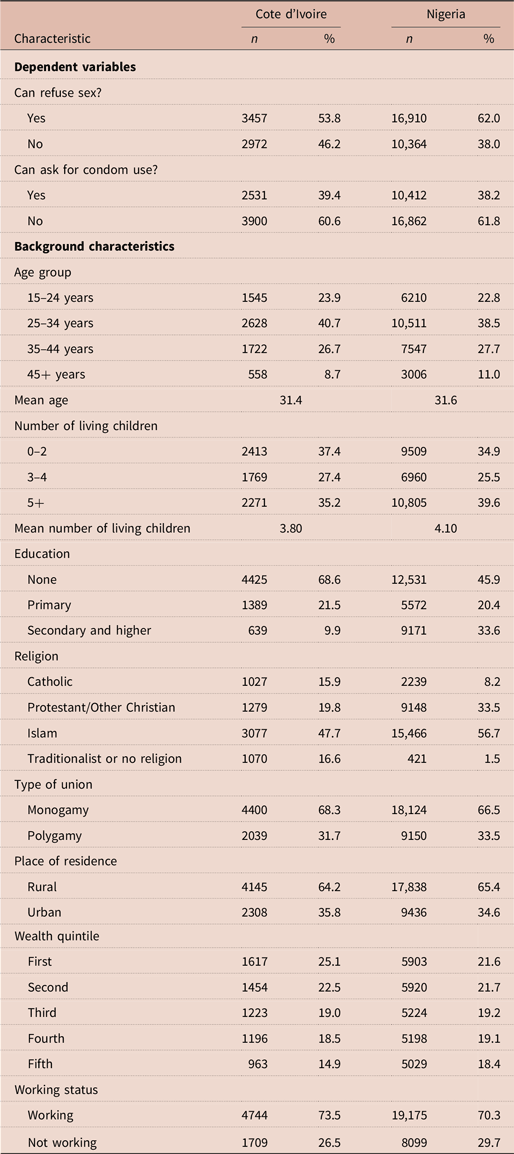
Table 1 shows the percentages of married or cohabiting women in each country that reported the ability to refuse sex or negotiate for condom use are shown. In the two countries, women were more likely to refuse sex than to ask for condom use during sex. In Cote d’Ivoire, 54% of the women reported the ability to refuse sex and 39% reported the ability to ask for condom use during sex. In Nigeria, 62% reported the ability to refuse sex and 38% reported the ability to ask for condom use during sex.
Distribution of married or cohabiting women’s ability to negotiate protective sex (refuse sex or ask for condom use) and selected background characteristics, Cote d’Ivoire and Nigeria

The distribution of the married or cohabiting women by selected background characteristics is also shown in Table 1. The mean ages of respondents in the two countries were similar (31.4 years in Cote d’Ivoire and 31.6 years in Nigeria). Slightly more than 60% of women were under 35 years of age in both countries. There were differences in the educational attainments of women from the two countries: about 69% of women in Cote d’Ivoire as against 46% in Nigeria reported having no formal education, and about 34% of respondents from Nigeria, as against 10% in Cote d’Ivoire, reported having secondary or higher education.
Christians and Muslims are the two predominant religious groups in both countries: about 48% of the women in Cote d’Ivoire and 57% of those in Nigeria were Muslims, and about 36% of women in Cote d’Ivoire and about 42% of those in Nigeria were Christians. A higher percentage of respondents reported having traditional religion in Cote d’Ivoire (17%) than in Nigeria (1%). The majority of the women were in monogamous unions (68% in Cote d’Ivoire and 65% in Nigeria), lived in rural areas (64% in Cote d’Ivoire and 65% in Nigeria) and were employed (about 74% in Cote d’Ivoire and 70% in Nigeria) at the time of the surveys. Thirty-three per cent of women in Cote d’Ivoire and about 38% of women in Nigeria were classified in the fourth and fifth (richest) wealth quintiles. It is important to note that the percentages of women in the three middle wealth quintiles (quintiles 2–3) were similar in both countries.
Bivariate analysis
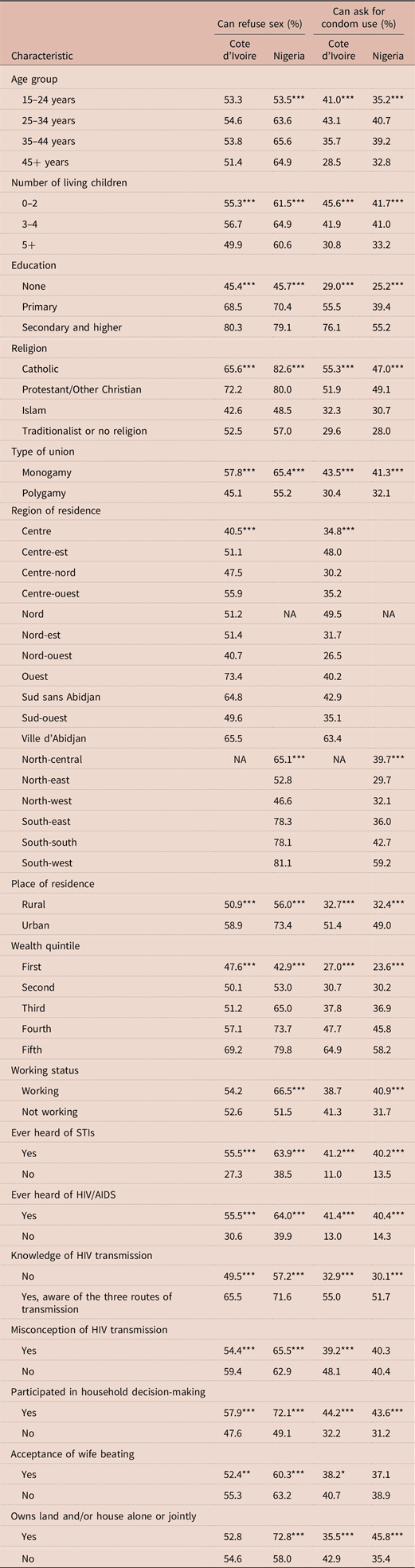
The bivariate analysis showed that in the two countries the percentages of married or cohabiting women that reported having the ability to refuse sex or ask for condom use varied significantly across the population sub-groups, as defined by their background characteristics (see Table 2). In Cote d’Ivoire, women’s ability to refuse sex did not appear to differ by age; however, the ability to ask for condom use during sex was negatively associated with age. In Nigeria, women aged 15–24 years were significantly less likely to be able to refuse sex than those aged 25 years and above, while the ability to ask for condom use during sex had an inverted U-shaped association with age (Table 2). In both countries the ability to refuse sex or ask for condom use during sex was significantly positively associated with women’s education and was highest among Christian women, particularly non-Catholic Christians.
Married or cohabiting women’s ability to negotiate protective sex (refuse sex or ask for condom use) by background characteristics

*p < 0.05; **p < 0.01; ***p < 0.001, based on Chi-squared test.
Urban women, women from monogamous households, women with good knowledge of HIV transmission routes, women who participated in household decision-making, women who rejected domestic violence, women from the highest wealth quintile and women who owned land or a house/property either alone or jointly with their spouse were more likely than at least one of their respective comparison population sub-groups to report the ability to refuse sex and ask for condom use. While the 3–4 parity women were more likely than others to refuse sex, women with 0–2 living children were more likely (especially in Cote d’Ivoire) than others to ask for condom use during sex. The results also showed some significant variations by region of residence, and that women who had ever heard of STIs and HIV/AIDS were more likely than their counterparts who had never heard of these to report the ability to refuse sex and ask for condom use. The ‘net’ effects of these variables on the ability to refuse sex or ask for condom use were estimated with the multivariate regression analysis.
Multivariate analysis
The results of the multivariate analyses are shown in Tables 3–6. In all tables, Model 1 included gender- and power-mediating measures (employment status, attitudes towards wife beating, participation in household decision-making and ownership of house or land). In Model 2 the control variables (age of respondents, education, religion, type of union, place and region of residence, wealth index and parity) were added and in Model 3 HIV-related measures (HIV transmission awareness, HIV transmission myths and ever tested for HIV) were added.
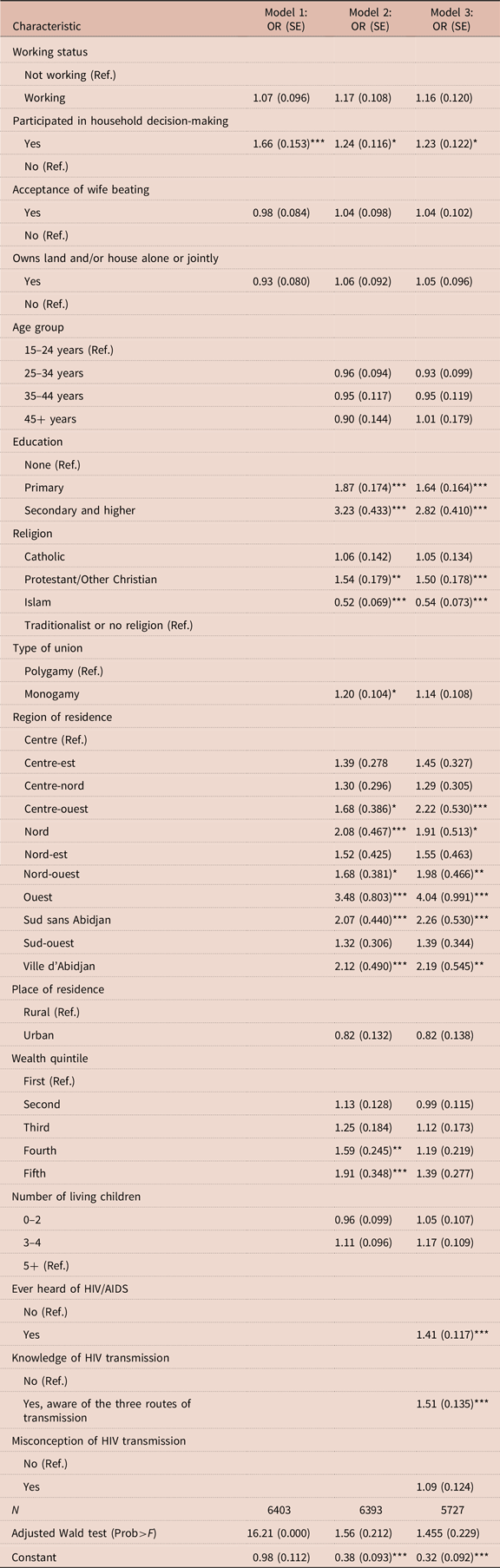
Logit models of married or cohabiting women’s ability to refuse sex, Cote d’Ivoire

*p < 0.05; **p < 0.01; ***p < 0.001.
Women’s ability to refuse sex
Tables 3 and 4 show the results of the logistic regression analysis of the ability of women to refuse sex in Cote d’Ivoire and Nigeria, respectively. The first model in Table 3 shows that only one of the four gender- and power-mediating measures (participation in household decision-making process) significantly influenced married or cohabiting women’s ability to refuse sex in Cote d’Ivoire. The odds of women reporting the ability to refuse sex were significantly higher among women who reported participating in household decision-making (1.66) after controlling other gender- and power-mediating factors. Other measures of gender- and power-mediating factors (employment status, attitude towards wife beating and ownership of property) were not statistically significant predictors of the ability to refuse sex in Cote d’Ivoire. On controlling individual and household factors (age, education, religion, type of marital union, urban vs rural, region of residence, household wealth quintile) in Model 2, women’s participation in household decision-making remained a significant predictor of the ability of women to refuse sex. Of the individual and family factors added in Model 2, women’s education, religious affiliation, type of marital union, household wealth index and region of residence were significant predictors of married or cohabiting women’s ability to refuse sex in Cote d’Ivoire.
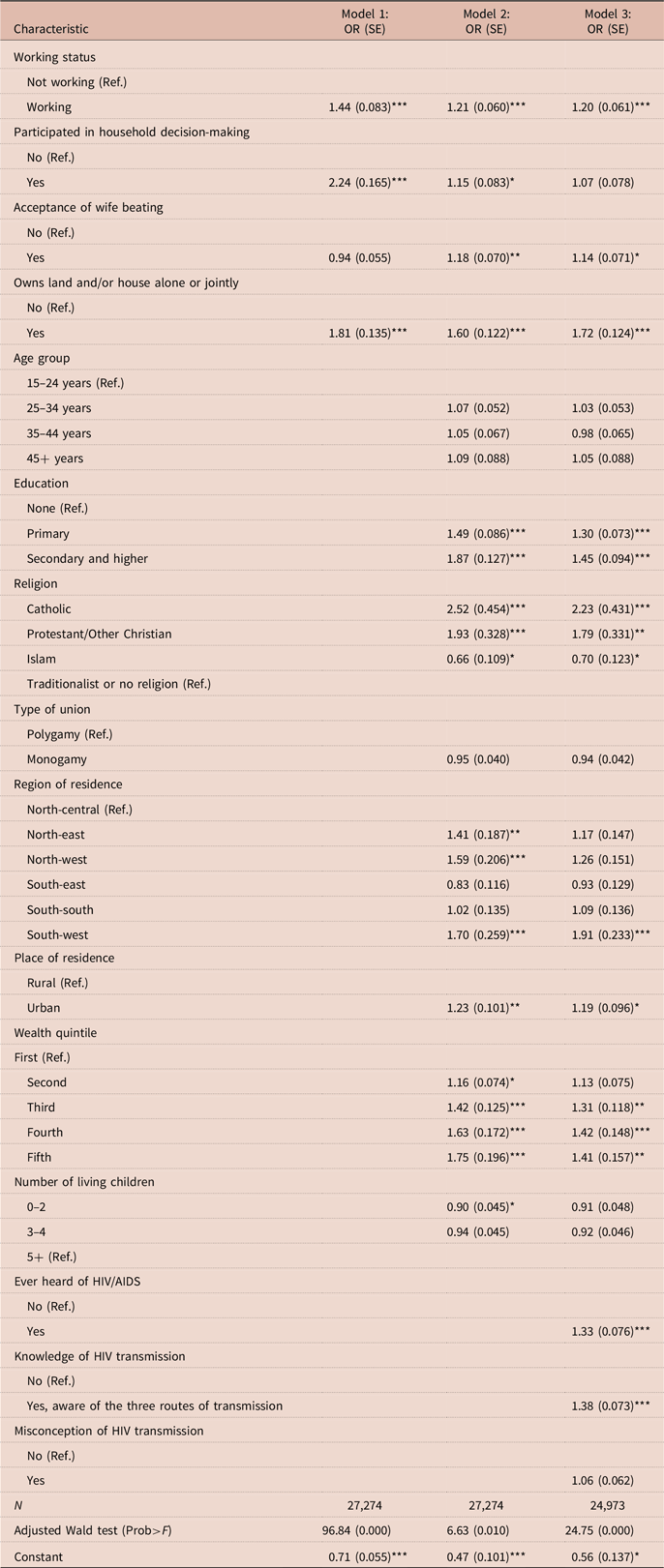
Logit models of married or cohabiting women’s ability to refuse sex, Nigeria

*p < 0.05; **p < 0.01; ***p < 0.001.
In Cote d’Ivoire, education was positively associated with the ability of married or cohabiting women to refuse sex. For instance, married or cohabiting women with primary education and those with secondary or higher education were more likely to be able to refuse sex than those with no education (odd ratios of 1.87 and 3.23, respectively). Religious affiliation of the women was also shown to be an important predictor, with Muslim women being significantly less likely than their Christian counterparts to report the ability to refuse sex; non-Catholic Christians were significantly more likely to report the ability to refuse sex than Catholics. With respect to wealth index, women in the fourth and fifth (richest) quintile households were statistically significantly more likely than those in first (poorest) quintile to report the ability to refuse sex. Region of residence was also shown to be an important predictor, with those women living in Nord, Ouest, Sud sans Abidjan and Ville d’Abidjan being significantly more likely to report the ability to refuse sex than those living in the Centre region. Age, parity and place of residence (urban vs rural) were not significant predictors of the ability to refuse sex.
In the final model with all variables (gender- and power-mediating measures, individual and family characteristics and HIV knowledge and test variables) included in the equation, women’s participation in household decision-making, education, religion and region of residence remained statistically significant predictors of the ability to refuse sex. Women who reported participating in household decision-making had higher odds of reporting the ability to refuse sex compared with their counterparts who did not participate in the household decision-making process. The ability to refuse sex increased significantly with education and Christians were more likely than Muslims to report the ability to refuse sex with their partners. Women from the wealthiest households were more likely than their counterparts from the poorest households to report the ability to refuse sex, and region of residence retained its significance after controlling other variables. However, the effects of wealth status and type of marital union on women’s ability to refuse sex became insignificant on controlling HIV knowledge and test status variables. The odds of the ability to refuse sex were also shown to be higher among women who had ever tested for HIV and those who were aware of three or two routes of HIV transmission.
Unlike the results for Cote d’Ivoire, Table 4 shows that the four measures of gender- and power-mediating factors and place of residence (urban vs rural) had significant effects on the odds of women in Nigeria reporting ability to refuse sex from their partners. The results suggest that women who worked, participated in household decision-making process, supported wife beating and owned land and\or house (gender- and power-mediating factors) and lived in the urban areas were more likely than their respective counterparts to report ability to refuse sex. The gender- and power-mediating measures, as well as place of residence, continued to have significant effects on the ability to refuse sex, even after controlling individual, family and HIV knowledge and test status variables. It is not clear why women who accepted wife beating had increased odds of ability to refuse sex after controlling other variables. Also, as observed for Cote d’Ivoire, the odds of women in Nigeria reporting the ability to refuse sex from their partners varied significantly by education, religion, region of residence and wealth, HIV test experience and HIV transmission awareness, even after controlling other variables. The results show that the odds of women reporting the ability to refuse sex increased significantly with education and wealth quintiles and were significantly higher among women who lived in the South-west region, who were Christians, who had tested for HIV and who had knowledge of HIV transmission. Also, in Nigeria, the ability to refuse sex was significantly positively related to the number of living children prior to controlling HIV-related variables; age and misconception of HIV transmission were, however, not significant predictors of married women’s ability to refuse sex.
Women’s ability to ask for condom use
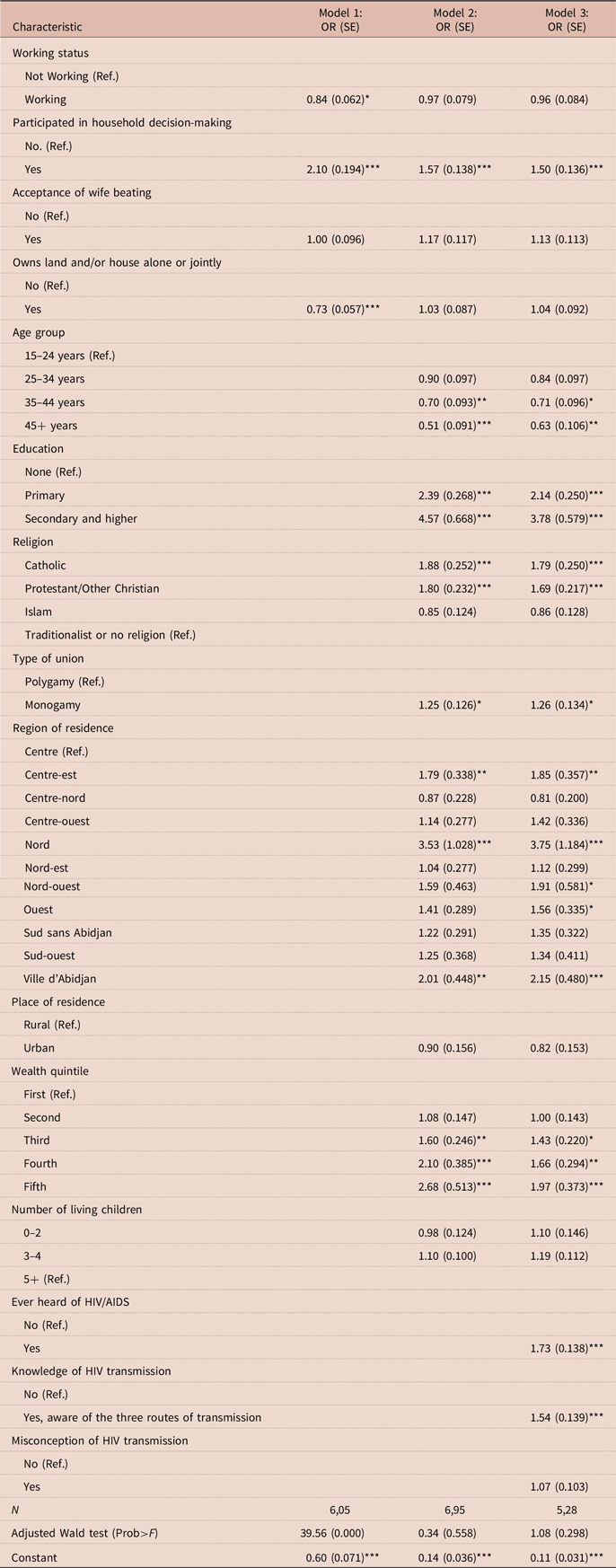
Tables 5 and 6 show the results of the logistic regression analysis of the ability of married or cohabiting women to ask for condom use during sex in Cote d’Ivoire and Nigeria, respectively. In Cote d’Ivoire, women’s participation in the household decision-making process, one of the four gender- and power-mediating factors, had significant effects on the ability to ask for condom use, even when individual and HIV knowledge and test status variables were controlled. Two other gender- and power-mediating factors, employment status and asset ownership (land and house), were shown to have statistically significant effects on the ability to ask for condom use prior to controlling individual and HIV-related factors (Model 1 in Table 5 compared with Models 2 and 3). The last gender- and power-mediating factor – attitudes towards wife beating – did not have a statistically significant effect on women’s ability to ask their husbands or partners to use a condom during sex.
Logit models of married or cohabiting women’s ability to ask husband to use condoms, Cote d’Ivoire

*p < 0.05; **p < 0.01; ***p < 0.001.
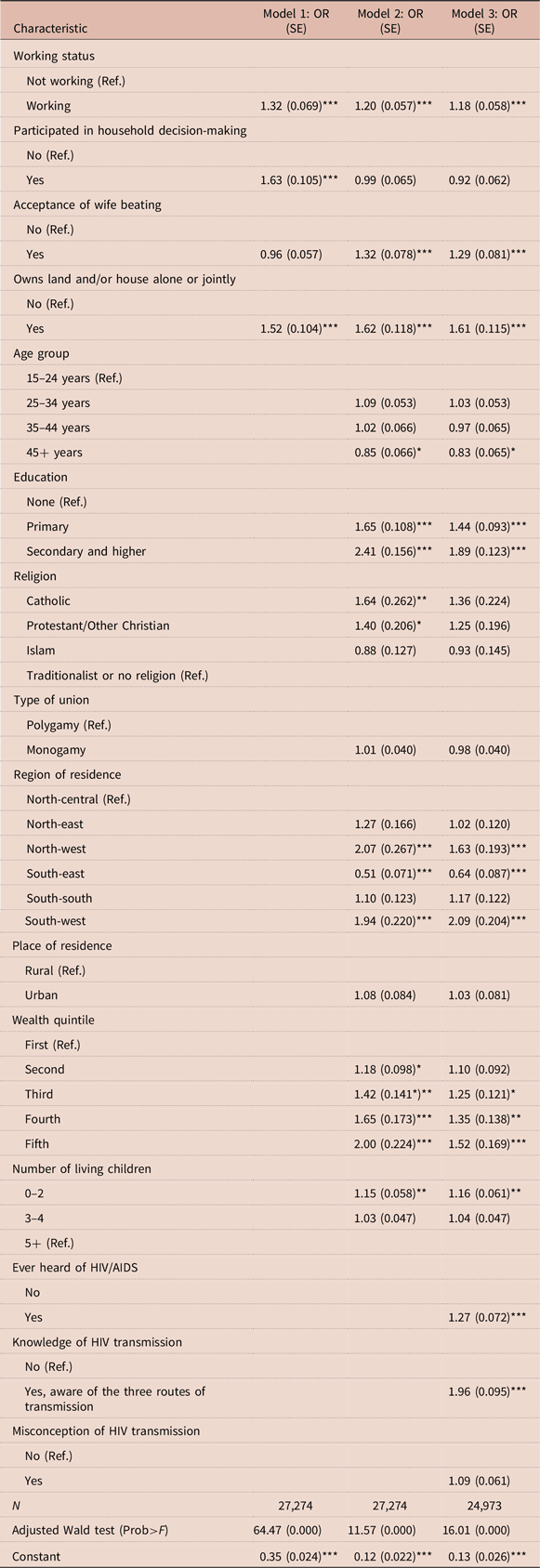
Logit models of married or cohabiting woman’s ability to ask husband to use condoms, Nigeria

*p < 0.05; **p < 0.01; ***p < 0.001.
Model 2 in Table 5 indicates that six of the individual and family factors – namely age, education, religion, type of union, region of residence and household wealth quintile – had significant effects on women’s ability to ask their partners to use a condom during sex. The results show that women’s ability to ask their partners to use a condom during sex decreased with age and significantly increased with education and household wealth index. Also, Catholic women and women in monogamous unions were more likely than their respective counterparts to report the ability to ask their partners to use a condom during sex. Regarding region of residence, women living in the Centre-est, Nord, Nord-ouest, Ouest and Ville d’Abidjan were more likely than those residing in the Centre region to report the ability to ask their partners to use a condom during sex. In Cote d’Ivoire, neither the number of living children nor place of residence was a significant predictor of women’s ability to ask their husbands or partners to use a condom. It is important to note that all the significant variables in Model 2 remained significant in Model 3 after controlling HIV-related variables. In addition, women who had ever tested for HIV or who knew the routes of HIV transmission were more likely than their counterparts to report the ability to ask for condom use during sex; misconception about HIV transmission was not a significant predictor of the ability to ask for condom use during sex.
The gender- and power-mediating factors had a greater effect on women’s ability to ask for condom use during sex in Nigeria than in Cote d’Ivoire. For instance, while in Cote d’Ivoire only one power-mediating factor – participation in household decision-making process – had significant effects on women’s ability to ask for condom use during sex, prior to and after controlling individual and HIV-related factors, in Nigeria, two power-mediating factors – employment status and ownership of land or house – had significant effects on women’s ability to ask for condom use during sex, prior to and after controlling individual and HIV knowledge and test status. The other two gender- and power-mediating variables were significant under different circumstances; while participation in the household decision-making process was significant before controlling individual and HIV knowledge and test status variables, attitude towards wife beating became significant only after controlling individual and HIV-related variables. As stated earlier, it is not clear why women who accepted wife beating were more likely than those who rejected wife beating to refuse sex or ask for condom use during sex. The Model 2 estimates show that the odds of women reporting the ability to ask for condom use during sex increased significantly with education and wealth quintile, decreased with number of living children, were higher among Christian women than among non-Christian women, were significantly higher in the South-west and North-west and significantly lower in the South-east than in the North-central regions. With the exception of religion, all the significant variables in Model 2 remained significant in Model 3 where additional variables – HIV knowledge and test status – were controlled. As observed for Cote d’Ivoire, women in Nigeria who had ever tested for HIV or who knew the routes of HIV transmission had higher odds of being able to ask for condom use during sex than their respective counterparts who had not tested for HIV or who did not know the routes of HIV transmission; misconception about HIV transmission was not a significant predictor of the ability to ask for condom use during sex.
Discussion
Analysing the DHS data using the stepwise multivariate logistic regression procedure, this study examined the factors that influence the ability of married or cohabiting women in Cote d’Ivoire and Nigeria to negotiate protective sex. With studies placing women’s position and cultural norms at the root of the STI, particularly HIV and AIDS epidemic in sub-Saharan Africa, this paper examined the influence of gender- and power-mediating measures on women’s ability to negotiate protective sex beyond the effects of individual and family factors. The inclusion of gender- and power measurements in this analysis was informed by the fact that these countries are primarily patriarchal, where due to power imbalances in favour of the men, women’s sexuality, particularly of those in union or stable relationships, is controlled by their spouses. The multivariate results provide some support for the gender-and-power and sexual scripts argument that the sexual behaviour of married or cohabiting women is influenced by societal conditions, in addition to individual and family characteristics. The ability of married or cohabiting women to negotiate protective sex was significantly more likely among women who lived in settings where cultural norms on their sexuality and submissiveness were more liberal and/or who, because of personal achievements, had some leverage to negotiate with their spouses.
A high percentage of married or cohabiting women in Cote d’Ivoire and Nigeria reported the ability to negotiate protective sex. During the 2012 DHS in Cote d’Ivoire 54% and 40% of the women reported that they could refuse sex or ask their partners to use a condom during sex, respectively. And, during the 2013 DHS in Nigeria 62% of the women reported that they could refuse sex and 38% reported that they could ask for condom use during sex. The findings answered the study questions, and confirmed the findings of other studies, which found that women who possess certain qualities that moderate the environment and social expectation of sexual relations within marriage would have the ability to negotiate protective sex (Onipede & Isiugo-Abanihe, Reference Onipede and Isiugo-Abanihe2008; Tenkorang, Reference Tenkorang2012; Yujiro et al., Reference Yujiro, Alice, Sedziafa, Roger and Isaac2017). The moderately high percentages of women who reported the ability to negotiate protective sex by refusing sex or asking for condom use during sex represented a significant departure from the traditional practice where it was taboo for women to refuse sex or set conditions for having sex.
That a higher percentage of married or cohabiting women reported the ability to refuse sex as against the ability to ask their husbands or partners for condom use suggests that women in marital relationships are more comfortable with refusing sex than with asking for condom use. It is possible that asking for condom use might be construed as lack of trust and consequently result in negative reactions from the husband or partner. Women are more likely to succeed in refusing or delaying sex through bargaining, disengagement or begging (Popoola, Reference Popoola2009). Women may adduce several reasons such as being sick, not in the mood, tiredness and menstrual pain to not wanting to have sex. However, asking for condom use having consented to have sex might be construed as suspicion of infidelity and lack of trust and could lead to sexual violence within marriage, particularly in male-dominated cultures (Oyediran and & Feyisetan, Reference Oyediran and Feyisetan2017). In addition, women – particularly newly married or those with small numbers of children – may find it extremely difficult to ask for condom use from their husbands who expect them to have (more) children. Hence, any programme targeted at preventing adverse outcomes of unsafe sex practices should explore and address reproductive issues faced by the women.
While some factors had significant influence on women’s ability to refuse sex or ask for condom use in both countries, some factors had significant influence on these measures only in one of the two countries, suggesting the need to always explore context-specific issues that should be considered when designing programmes to promote more-egalitarian sexual relations within marriage. The common significant predictors of the ability to refuse sex in both countries were education, household wealth status, religion, participation in household decision-making, ever tested for HIV and knowledge of HIV transmission. Only in Cote d’Ivoire was type of union a significant predictor (Models 2 and 3) and only in Nigeria were age (in Model 2 only), place of residence, parity (Models 2 and 3), working status, ownership of landed property and attitude to wife beating significant predictors of the ability to refuse sex. The common significant predictors of the ability to ask for condom use during sex in both countries were age, education, religion household wealth status, attitude to wife beating, ever had an HIV test and knowledge of HIV transmission. Only in Cote d’Ivoire were type of union and participation in the household decision-making process significant predictors of the ability to ask for condom use, and only in Nigeria were working status, land/house ownership and misconceptions about HIV transmission significant predictors of the ability to ask for condom use during sex.
The results show the significance of a combination of facilitating factors – education, participation in household decision-making process, ownership of landed property, employment status (Nigeria), knowledge of HIV transmission routes, HIV test status and household wealth status – in women’s ability to negotiate protective sex through refusing sex or asking for condom use during sex. As with other studies, the results of this study shed light on factors that can facilitate a more-egalitarian sexual relationship between partners in male-dominated settings. Policies aimed at promoting protective sex among couples should be informed by an understanding of how these attributes enhance women’s ability to negotiate protective sex. For instance, could it be that women with these attributes are more able to initiate effective communications on sex with their partners than their respective counterparts? There is also a need to know more about what constitutes negotiating protective sex from the couple’s perspective. Since negotiation involves at least two people, efforts to have a better understanding of how negotiating protective sex for STIs/HIV and pregnancy prevention takes place would require collecting qualitative data from both men and women with a view to gauging their perspectives and determining the types of spousal communication that promote desired sexual and reproductive health outcomes and how they do so. There have been studies in patriarchal cultures that have demonstrated the significance of couple communication in contraceptive use and fertility decisions (Feyisetan, Reference Feyisetan2000; Oyediran & Isiugo-Abanihe, Reference Oyediran and Isiugo-Abanihe2002; Desgrées du Loû, Reference Desgrées du Loû2005). Programmes aimed at preventing adverse outcomes of risky sex practices in patriarchal societies should explore and address reproductive issues faced by married or in-union women in these societies.
The results show that some predictors were significant in only one of the two countries. This is a major finding that highlights the need to contextualize programmes to enhance women’s ability to negotiate protective sex with a view to preventing poor reproductive health outcomes. While the gender- and power-dynamics theory and the sexual scripts framework provide the framework for examining the ability to negotiate protective sexual behaviour, the factors that mediate the power dynamics and cultural sexual scripts might vary from one society to another. It is, therefore, important to always contextualize studies and programmes to promote more-egalitarian relationships within marriage. Besides, the paths through which these factors mediate traditional power structures might vary across settings.
Of significance also in this study was the observation that women’s ability to identify STI/HIV transmission risks enhances their ability to negotiate protective sex. The study findings offer potentially new directions for policy and programme interventions aimed at ensuring a decreasing rate of HIV transmission among married women in Cote d’Ivoire and Nigeria. Since there is no information from the DHS data on women’s perceptions of their vulnerability to HIV infection, it was difficult to assess the role of these perceptions in the current analysis. However, it might not be out of place to assume that women’s ability to refuse sex or ask for condom use might be indicative of their understanding of the consequences of unprotected sex. The data did not permit a full exploration of context-specific normative values that may affect, or be affected by, women’s status, including power dynamics and perceptions of risk associated with unprotected sex. It was also not possible to examine the effects of community/local programmes on reducing HIV and STI infections among married men and women.
It is becoming increasingly evident that married women, or women in stable relationships, are becoming more likely to be infected with STI/HIV due to unequal gender and power relations in marital unions – an emerging situation that tends to disavow the initial assertion that marriage acts as a shield to HIV infection. This study shows that women in patriarchal cultures and in societies characterized by patrilineal societies have the ability to negotiate protective sex once they possess certain qualities. Consequently, this study adds to the existing knowledge about the factors that influence the ability of women to negotiate protective sex within marriage in cultural settings that compromise women’s autonomy by normative values and power relations. The factors include a mixture of gender- and power-mediating factors, individual and family characteristics and HIV prevention measures. By showing that the significant predictors of women’s ability to negotiate protective sex, especially those related to gender- and power-mediating factors, vary between Cote d’Ivoire and Nigeria, this study highlights the need to factor in societal or culture-specific norms and values when developing policies to address risky sexual practices. Even within the same countries, different strategies may have to be developed to address the issue in different geographic or cultural settings. This suggestion is affirmed/reinforced by the present findings, which show significant differences in the odds of the ability to negotiate protective sex by region of residence.
Acknowledgment
The authors would like to thank ICF International implementer of the MEASURE DHS Program for granting access to the 2012 Cote d’Ivoire DHS and the 2013 Nigeria DHS datasets. Authors further acknowledge the comments and suggestions of colleagues on an earlier version of the paper presented at the 2018 Population Association of America (PAA) annual meeting in Denver, Colorado, USA. More importantly, the authors acknowledge the paper reviewers, who provided new insights to improve this work for publication. The views and opinions expressed in this paper are the authors’ alone and do not necessary reflect those of the United States Agency for International Development or John Snow Inc.
Funding
This research received no specific grant from any funding agency, commercial entity or not-for-profit organization.
Conflicts of Interest
The authors have no conflicts of interest to declare.
Ethics Approval
Informed consent was obtained from participants in the 2012 CDHS and 2013 NDHS. The authors sought permission to use the data and authorization was granted by MEASURE DHS to download and analyse the women recode datasets for the two countries. All procedures performed in the study involving human participants were in accordance with the ethical standards of the institutional and/or national research committee and with the 1964 Helsinki declaration and its later amendments or comparable ethical standards.